ISSN: 2147-611X
www.ijemst.com
Teacher Talk in Professional Learning
Communities
Karin Brodie, Tinoda Chimhande
University of the Witwatersrand, Johannesburg
To cite this article:
Brodie, K. & Chimhande, T. (2020). Teacher talk in professional learing communtities.
International Journal of Education in Mathematics, Science and Technology (IJEMST), 8
(2),
118-130.
This article may be used for research, teaching, and private study purposes.
Any substantial or systematic reproduction, redistribution, reselling, loan, sub-licensing,
systematic supply, or distribution in any form to anyone is expressly forbidden.
Authors alone are responsible for the contents of their articles. The journal owns the
copyright of the articles.
Volume 8, Number 2, 2020
Teacher Talk in Professional Learning Communities
Karin Brodie, Tinoda Chimhande
Article Info
Abstract
Article History
Received: 18 July 2019
Professional learning communities can be important sites for teacher learning depending on the quality of the conversations in these communities. This paper investigates how different activities in teacher communities support different content and depth in teacher conversations, through examining the conversations of four professional learning communities of mathematics teachers over two years. Our analysis suggests three key findings. First, there were strong relationships between different activities and the content of the conversations in the communities. Second, the depth of the conversation in the communities was constant across activities and over time. Third, conversations about learner thinking, a key goal of the project, did not increase over time, but there were increases in talk about mathematics and practice. We explore the implications of these findings for teacher learning. Accepted:
26 March 2020
Keywords
Professional learning community
Teacher conversations Content of teacher talk Depth of teacher talk
Introduction
The professional learning of in-service mathematics teachers is an area of central concern for schools, governments and mathematics teacher educators. Current approaches to mathematics teacher education emphasise learning in, from and for practice (Ball & Cohen, 1999; Borko, Jacobs, Koellner, & Swackhamer, 2015) and professional learning communities (PLCs) are seen as a way to bring professional development closer to teachers’ practices and their contexts (Katz, Earl, & Ben Jaafar, 2009). PLCs are groups of teachers who engage together in regular, systematic and sustained cycles of inquiry-based learning, with the intention to develop their individual and collective capacity for teaching (Hairon, Goh, Chua, & Wang, 2017; Katz et al., 2009; Stoll, Bolam, McMahon, Wallace, & Thomas, 2006). Key to PLC work, is professional learning, which means learning in relation to the knowledge-base of teaching (Darling-Hammond & Sykes, 1999).
PLCs are designed as forums for teachers to engage in regular, ongoing, systematic enquiry into practice and “allow them to explore their strengths and weaknesses with colleagues; develop collaborative solutions to problems of practice; and implement new ideas collectively for the benefit of learners” (Brodie, 2014, p.222). PLCs are a departure from short-term and fragmented approaches to mathematics teacher professional development (Borko, 2004), since PLCs provide teachers with extended and sustained opportunities to talk and work together on developing their own mathematical knowledge, their learners’ thinking and their practice. Teachers’ talk in a PLC is “a discussion between peers that allows teachers to explicitly articulate, appreciate and extend their understanding of practice” (Nsibande, 2007, p.4). PLC conversations can unlock the tacit knowledge of teachers, make that knowledge public and shared, and therefore subject to deliberate and thoughtful changes (Katz et al., 2009).
1. How do different activities that teachers engage in during PLC meetings shape the content and depth of their conversations?
2. Do the content and depth of teacher talk change over time?
3. What opportunities for learning are created in teacher conversations?
Project Background
The DIPIP project set up PLCs for high school mathematics teachers in the Johannesburg area over four years (2011-2014). Teachers were engaged in a developmental sequence of activities, that supported them to identify and engage with the reasoning underlying learner errors and provided opportunities for discussions of learner thinking, teachers’ own mathematical knowledge and practice. Teachers were encouraged to identify both valid and invalid reasoning that underlies learners’ errors, so that they could build on learners’ reasoning to develop the appropriate mathematical concepts (Brodie, 2014). The activities were designed to be somewhat adaptive (Koellner & Jacobs, 2015), with possibilities for choice and flexibility for PLCs built in. The PLCs chose the mathematical content areas that they focused on and sometimes modified or left out activities as appropriate in their contexts.
The activities were developed by a project team, most of whom also facilitated the communities. The project team met regularly, developed protocols for the activities, and reflected together on the progress of the communities, i.e. we formed our own PLC (Brodie, Molefe, & Lourens, 2014). The team consisted of four post-graduate students in mathematics education, and the project leader, who is the first author of this paper. The second author joined the team in 2015 to assist with data analysis and was not involved in working with the PLCs. Neither of the authors were facilitators.
Over the four years, twelve schools from two districts participated, some joining in 2011 and others in 2012. Six schools participated consistently for three or four years. The districts were selected purposively: they were close to each other and there were schools in each district that were interested in participating. Schools within the districts were selected if three or more mathematics teachers were interested in participating in the communities and if they served mainly learners of low or low to mid socio-economic status. Schools and teachers joined the project voluntarily. In most cases, each school constituted one community, however in one case, three schools came together to form one community because in two of the schools there were fewer than three teachers who wanted to participate.
Over the four years, 50 teachers participated, 22 for three years or more. Meetings were held weekly, for about one hour after school during school terms. Each PLC had a post-graduate student as a facilitator (university-based facilitator) in 2011 and 2012. In 2013, teachers (school-(university-based facilitators) took over the leadership of the PLCs. They were teachers who had participated in 2012, were chosen by the PLC in consultation with the project team to become facilitators, and attended an additional meeting once a month with the project team, to support their facilitation. University-based facilitators observed the school-based facilitators every two weeks and discussed their facilitation with them afterwards.
Theoretical Framework: Learning as Social Practice
For Lave and Wenger, practice is always social practice, and communities and learning are always socio-historically situated in webs of social relations. A teacher learns in the context of the relationships in her classroom, with her colleagues and in the education system and the society of which she is a part, as well as in relation to her own history, which is also socially situated. How these relationships are configured will constrain and afford learning for particular teachers and particular communities of teachers. An important part of a social practice theory of learning is that both individuals and communities learn and grow. As people enter a practice, they take on the goals and methods of the practice but over time they must contribute to changing these, otherwise the practice will not grow and will not be sustained over time.
For Lave and Wenger, learning is defined as increased participation in a practice. For teachers, that practice is both their teaching practice and its influences on learners’ learning, and their professional talk about and reflection on their teaching. For the purposes of this paper, we focus only on the latter. However, we note that we do not conflate teacher talk with learning. While we can see some evidence of teacher learning in their talk, teacher learning obviously will go beyond what they say, and must include what they do in the classroom. Our focus in this paper is to examine and describe teacher conversations in PLCs so that we might be able to link them to teachers’ practices.
Analytic Framework: Activity, Content and Depth
Given our theoretical framework of social practice as fundamental to professional learning, our specific analytic framework to examine teachers’ conversations needed to focus on what they were talking about and how they were talking about it, in relation to the activities they were engaged in. Thus we characterized teachers’ conversations by what they were working on: the task or activity; the content of their talk about the activity or other matters; and the depth of their talk. We analysed the conversations in relation to what we hoped teachers would talk about, and what the facilitators guided them to talk about, which was an understanding of the reasoning behind learner errors. So we took increased talk about this reasoning in more depth to be evidence of learning in the teachers’ conversations.
Activity
Professional development programmes make use of a number of actitivies to guide and focus teachers’ enquiry and learning. Important principles for the development of such activities are that they foreground the design of and reflection on educational objects and practices and they allow for a focus on, as well as a distancing from, practice. Activities can be more or less formally structured in PLCs (Koellner & Jacobs, 2015; Vangrieken et al., 2017) and can vary from seeking help with teaching challenges, through collaborative discussions, to data analysis and research projects. Activities that have been found to be succesful for teacher learning include: analyzing videotapes of teaching (Alles et al., 2018; Borko, Jacobs, Eiteljorg, & Pittman, 2008; Van Es & Sherin, 2008); participating in lesson study activities where teachers jointly plan, observe, analyse and refine lessons (Coe, Carl, & Frick, 2010; Posthuma, 2012); and engaging in analysis of student data, through tests, work produced and other artifacts of learning (Boudett, City, & Murnane, 2008; Katz et al., 2009).
The DIPIP project team designed a cycle of six activities which aimed to support the teachers to understand and engage with the mathematical reasoning underlying learners’ errors: test analysis; curriculum mapping; learner interviews; readings and discussion; lesson planning and lesson reflection. In this paper we do not discuss curriculum mapping and learner interviews as they provided sporadic data over the four years of the project. The DIPIP protocol for the test analysis encouraged teachers to first talk about each question in the test in terms of what it was assessing - by asking the question: what concepts are required to get this item correct? After discussing each question, teachers identified the errors that the learners made and then discussed the possible reasons behind the more frequent errors by putting themselves in the position of the learners and trying to understand how the learners were thinking when they made the errors (Brodie, 2014). Teachers then discussed possible ways in which their teaching or the curriculum could be linked to the errors and whether certain teaching strategies could perpetuate particular learner errors.
that there are explanations related to learning and teaching mathematics for why these errors occur so pervasively. After discussing the concepts and misconceptions in the papers, teachers talked about different strategies that they could use to teach the critical concept.
The teachers then worked together to plan a series of 2-4 lessons in which they tried to develop the learners’ understandings of the critical concept. The protocols for lesson planning guided teachers to develop tasks and questions for their lessons, to discuss how to engage learners with the tasks and concepts, and to anticipate learner errors and how they might deal with them. Explicit mathematical language and concepts, and various pedagogies were focused on as the teachers discussed the planned concepts and tasks. The idea was for teachers to develop an orientation to learner errors in their planning.
Each teacher then taught the lessons and their lessons were videotaped. For the lesson reflection sessions, each teacher was given their lesson videotapes and asked to identify the errors that learners made in class and to see how they (teachers) dealt with those errors in class. Each teacher chose two episodes to discuss in the PLC: one in which they thought they had engaged well with a learner error and one where they thought they had not engaged well. The aim of reflecting on the lessons was to provide teachers with opportunities to better understand learner errors in practice and to use the feedback from the PLC to inform how they would work with learner errors in the future.
Content
The content of teachers’ talk in PLCs is the substance of what they talk about and is key to their learning and their ongoing professional development. Although teachers might talk about many things when they get together, the important aspects of professional inquiry must relate to their teaching and their learners’ learning, in relation to the goals of the professional development. The content shows the extent to which they are enquiring into important aspects of their practice, and the extent to which they discuss their own goals and the goals of the project. Shifts in content over time can also indicate what teachers are learning. In the case of this project, we were interested in the extent to which teachers spoke about learner errors and learner thinking in the project activities and whether the content of their talk shifted over time.
Studies of mathematics teachers’ talk in structured professional communities have found that teachers talked about a range of issues. Hindin et al. (2007) studied a group of mathematics teachers who were designing instruction to improve learners’ understanding, and found that teachers shared their specialized content knowledge and pedagogical content knowledge for facilitating learning of the concepts. Rowland (2012) explored mathematics teachers’ conversations about integrating technology in their mathematics classrooms and found that teachers reflected on: planning their lessons to allow the use of available technology; difficulties in integrating technology into lessons; and challenges with technology in their individual classrooms.
Rowland (2012) also found that during the PLC conversations, teachers talked about common mathematical problems which they discussed and solved together using their content knowledge. Conversations were used as a forum to pool teachers’ collective content knowledge, to rearticulate their problems and to explore possible solutions (Miller, 2008). Sun, Wilhelm, Larson, and Frank (2014) found that conversations among mathematics teachers in a PLC often happened through seeking advice from each other. Such conversations were triggered by one colleague asking for strategies to teach problematic mathematical concepts.
Chauraya (2016) showed that over time in a community, teachers shifted from seeking help from each other towards seeing the PLC as a space to both formulate and solve problems collaboratively through joint enquiry and conversations. Marchant and Brodie (2016) investigated teacher knowledge conversations in one PLC which was part of the DIPIP project and found that the community spent about one third of their time on content knowledge conversations and two thirds on pedagogical content knowledge conversations. In many cases, the teachers began conversations wth pedagogical issues, which required pedagogocial content knowledge, and these pedagogical content knowledge conversations triggered content knowledge conversations.
talk related to instruction and resources in class that is not about learner thinking; and “DIPIP Priorities” includes talk on eliciting and understanding learner thinking and the reasoning behind errors. An important difference should be noted between learner understanding under “Learner” and learner thinking under “DIPIP priorities” - learner understanding refers to a description of the learner’s knowledge or strategies, while learner thinking refers to talk about the reasoning behind the learner’s error. (The other DIPIP priorities are not explained here because they are not discussed in this paper).
Depth
The depth of teachers’ talk is a measure of the quality of teachers’ engagement with mathematical ideas, issues of practice and learners’ thinking. Following Van Es (2011) our description of depth indicates the extent to which teachers are analytic in their conversations, rather than descriptive and evaluative, and how they use specific examples and general principles in relation to each other.
Coburn and Russell (2008) used categories of low, medium, and high depth to compare types of activities and depth of teachers’ talk between two groups of mathematics teachers engaged in different activities. Activities observed in the first group were: task analysis, working on mathematics problems for the purposes of learning how to teach the lessons; analysis of strategies learners were using for solving mathematical problems; and structured reflection on practice. Activities observed in the second group were: explaining the curriculum, doing mathematics problems to learn how to do them, and mapping activities. Coburn and Russell (2008) found that the activities in the first group resulted in discussions that were mainly of medium depth while most of the activities in the second group resulted in discussions that were of low depth. The disparity of the depth of conversations between the two groups suggests that activities focusing specifically on teacing and learning strategies promoted deeper discussions. The activities in the first group are a closer fit with those in the DIPIP project (see description above).
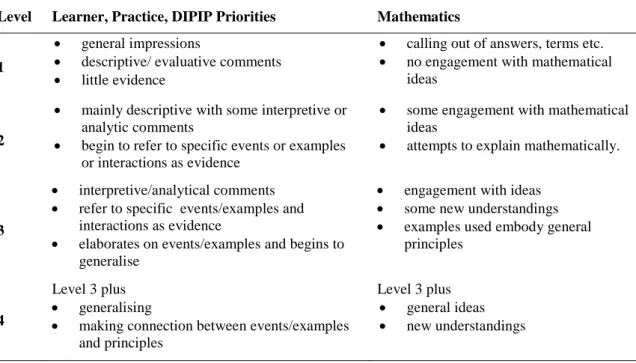
Eskelson (2012) investigated mathematics teachers’ conversations in a teacher-initiated PLC by examining the depth of teachers’ talk associated with the various types of activities and whether the depth changed over time. He identified five activities: work with mathematical tasks, unstructured reflection on practice, structured reflection on practice, discussion of instructional moves, and modeling instruction. Using a slightly adjusted version of Coburn and Russell’s (2008) categories of depth, Ekelson’s analysis showed that each of these activities typically produced discussions that were at a medium depth and the depth of the conversations did not change over time. Our study adapts a framework for depth from the work of Van Es (2011), which helped us to distinguish between evaluation, description, interpretation and analysis in the teachers’ conversations. Table 1 shows the indicators for four levels of depth for our different content categories.
Table 1. Indicators of depth in teachers’ talk Level Learner, Practice, DIPIP Priorities Mathematics
1
general impressions
descriptive/ evaluative comments
little evidence
calling out of answers, terms etc.
no engagement with mathematical ideas
2
mainly descriptive with some interpretive or analytic comments
begin to refer to specific events or examples or interactions as evidence
some engagement with mathematical ideas
attempts to explain mathematically.
3
interpretive/analytical comments
refer to specific events/examples and interactions as evidence
elaborates on events/examples and begins to generalise
engagement with ideas
some new understandings
examples used embody general principles
4
Level 3 plus
generalising
making connection between events/examples and principles
Level 3 plus
general ideas
Method
Sample
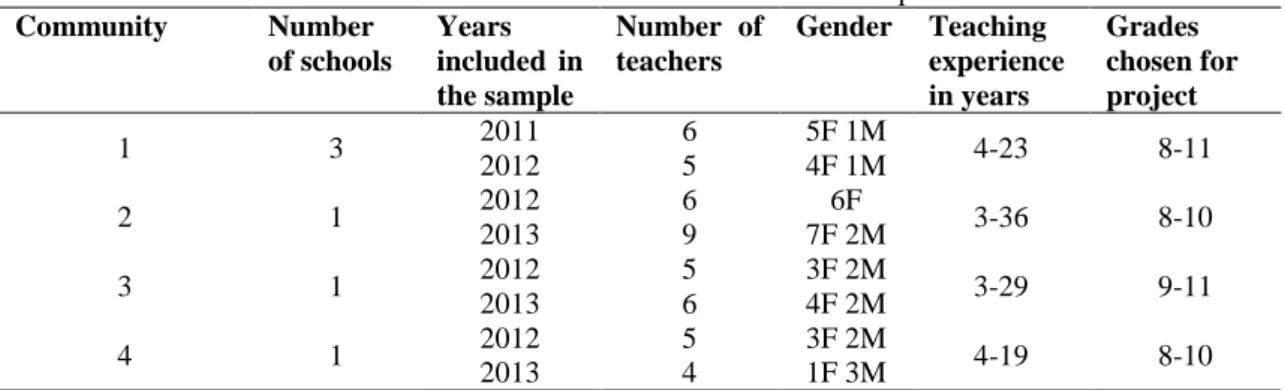
We analysed teachers’ conversations in four PLCs in the DIPIP project over two years, the first and second year in the project: For community 1, these were 2011 and 2012 and for communities 2, 3 and 4, 2012 and 2013. The four PLCs came from six secondary schools that had participated consistently in the project and included 22 teachers in the first year and 24 teachers in the second, with 18 teachers in the PLCs over both years. Each teacher chose one class for focused analysis in the project, but many taught across two to three grades. We aimed for a diversity of grades because we wanted teachers to see progress across grades in their analyses. Table 2 gives information about the sample.
Table 2. Communities and teachers in the sample
Community Number
of schools
Years included in the sample
Number of teachers
Gender Teaching experience in years
Grades chosen for project
1 3 2011 6 5F 1M 4-23 8-11
2012 5 4F 1M
2 1 2012 6 6F 3-36 8-10
2013 9 7F 2M
3 1 2012 5 3F 2M 3-29 9-11
2013 6 4F 2M
4 1 2012 5 3F 2M 4-19 8-10
2013 4 1F 3M
Data
All of the PLC sessions in 2011 and 2012, and some in 2013 were videotaped. The remainder in 2013 were audiotaped. It was difficult to store the video equipment safely at schools and we could not get the equipment to the schools on the days that the university-based facilitators did not go in 2013.
The video- and audiotapes form the data for this paper. Table 3 shows the number of sessions that were coded in each community per activity per year. We coded 60% of sessions after removing sessions where teachers were not directly engaged with the activities. The sessions for coding were chosen to reflect the range and number of activities that each community worked on in each year, and so that we could compare similar activities across the two years.
Table 3. Number of coded sessions Test
Analysis
Readings & Discussion
Lesson Planning
Lesson Reflection
Total
Community 1, 2011 1 2 3 6
Community 1, 2012 1 3 3 7
Community 2, 2012 2 1 1 3 7
Community 2, 2013 1 2 1 4
Community 3, 2012 1 2 2 5
Community 3, 2013 2 5 7
Community 4, 2012 2 1 2 3 8
Community 4, 2013 1 1 1 3
Total 8 7 13 19 47
watching videotapes are not included in the coded time. Table 4 shows that a high percentage of the total time in the PLCs was spent discussing substantive content.
Table 4. Total time coded (hours: minutes) Year 1
coded (total)
Year 1 % coded/total
Year 2 coded (total)
Year 2 % coded/total
Community 1 4:11 (5:43) 73 7:19 (8:51) 83
Community 2 6:33 (9:04) 72 3:44 (4:51) 77
Community 3 4:58 (5:57) 83 4:55 (6:33) 74
Community 4 8:43 (12:47) 68 2:05 (2:35) 80
Total 24:25 (33:31) 73 18:13 (22:50) 80
Coding
The coding was done using Studiocode™, which allows the video- and audio-recordings to be coded along a timeline. Conversation units were created, which are defined as a sequence of turns on an identifiable topic and are demarcated on the basis of topic shifts in the conversation. Each conversation unit was then allocated an activity, content and depth code.
The coding scheme was drawn directly from the conceptual framework. There are four substantive Activity codes: test analysis; readings and discussion; lesson planning and lesson reflection. The substantive Activity codes are coded further with Content and Depth codes. The Content codes were Learner, Mathematics, Practice and DIPIP priorities, discussed previously. The codes were intially divided further into subcategories but these did not give additional useful information. The Depth codes were levels 1-4 in Table 4.
To ensure coding reliability, the two authors and a doctoral student, who also used these codes, coded three PLC sessions independently. Inter-rater percentages of agreement were found to be 78% or higher. Thereafter, the second author coded all the sessions and the first author reviewed these. Disagreements were resolved by discussion.
A Studiocode™ scripting report template was developed, which gives the time spent by each PLC on each Activity, Content and Depth code. A script report for each PLC was generated for each Activity that teachers in the four PLCs engaged in. The time spent on each Content and Depth code in different sessions of the same Activity was combined for each year and converted to a percentage of the coded time for all the coded conversation units. Percentages of the coded time were used to understand the content and activity-depth relationships.
Results and Discussion
In this section we discuss the findings from our coding and our analyses of the findings in relation to activity, content and depth.
Activity-Content Relationships
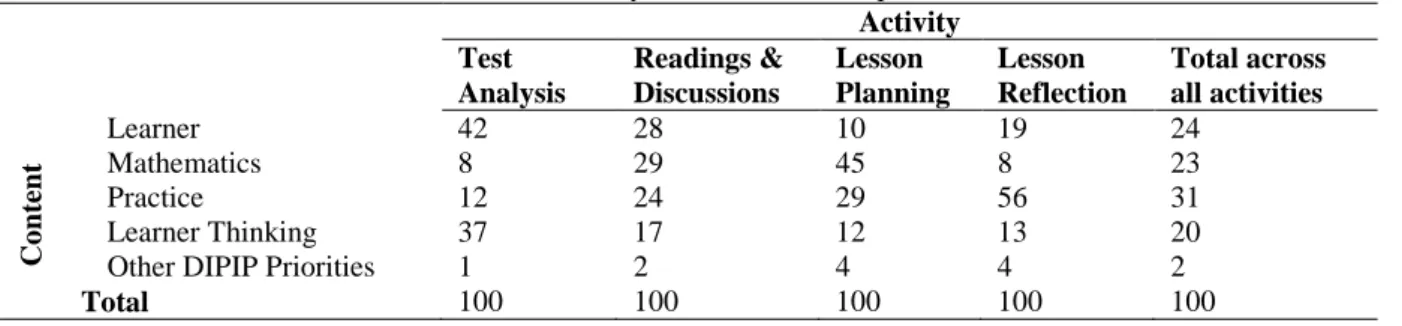
Table 5 provides the percentages for each content code in each activity for the combined PLCs over the period of two years.
Table 5. Activity-content relationships Activity Test
Analysis
Readings & Discussions
Lesson Planning
Lesson Reflection
Total across all activities
Co
nte
nt
Learner 42 28 10 19 24
Mathematics 8 29 45 8 23
Practice 12 24 29 56 31
Learner Thinking 37 17 12 13 20
Other DIPIP Priorities 1 2 4 4 2
Table 5 shows interesting variation across the activities. A focus on learners, both understanding (42%) and thinking (37%), was most evident in the test analysis. This occurred because the test analysis distanced the focus from the teachers themselves and their lessons so that more focus was on the learners. Teachers spent substantial time trying to understand how the learners were thinking when they made the errors. This finding did not surprise us because it was an explicit design of the project and we were pleased to see the focus on both learners and learner thinking.
A focus on mathematics was most evident in Lesson Planning (45%), because in these sessions, teachers often worked on the tasks and discussed them without reference to learners. When planning their lessons, teachers spent 29% of their time on practice and much less time was spent on learner understanding (10%) and learner thinking (12%). This surprised and concerned us because we build specific guidance into the Lesson Planning protocols, which aimed to focus teachers on predicting and anticipating learner errors and learner thinking. This was also found in another analysis from the same project (Brodie, Marchant, Molefe, & Chimhande, 2018).
A focus on practice was most evident in Lesson Reflection (56%). The lower percentages for learner thinking (13%) and learner understanding (19%) shows that it was difficult to remove the focus from teachers themselves onto the learners when analyzing lessons. Teachers’ conversations were mainly about how they dealt with learner responses in class and PLC members suggested ideas about how teachers could have dealt with learner responses differently, rather than focusing on the reasoning underlying the errors (see also Brodie, 2014).
Activity-Depth Relationships
Table 6 provides the percentages for each level of depth for each activity and shows that level 2 and level 3 conversations were predominant across all activities in both years, supporting Eskelson’s (2012) findings that different activities do not influence the depth of the conversation and that most conversations are of medium depth. There were some small differences in level 1 and level 4 conversations, with level 1 being higher in Test Analysis and Lesson Reflections and level 4 being higher in Readings and Discussion and Lesson Planning. This is because it was possible to reach a higher level in the discussions of mathematics, which occurred more in these two activities.
Table 6. Activity-depth relationships Activity
Test Analysis
Readings and Discussion
Lesson Planning
Lesson
Reflection Total
Dept
h Level 1 26 6 6 17 14
Level 2 39 41 36 41 39
Level 3 29 36 38 32 34
Level 4 6 17 20 10 13
Total 100 100 100 100 100
Content and Depth Over Time
Figure 1 shows the shifts for each content code for each activity for each year and Figure 2 shows the shifts in depth for each activity for each year. A key focus of the project was to see whether teachers spoke more about learner thinking over time. Figure 1 shows that in total, across all activities, they did not, with the percentage of time devoted to talk about learner thinking dropping from 24% to 13%. There was an increase in talk about mathematics from 15% to 33% over the two years.
Figure 1. Activity-content relationships over time
Figure 2 shows an increase in level 2 talk over the two years, from 35% to 45%, accompanied by a decrease in level 4, from 17% to 8%. Level 3 remained constant at 33/34%. Looking across the activities, we don’t see any obvious patterns in relation to depth, but we did see some interesting patterns across communities, to which we now turn.
Figure 2. Activity-depth relationships over time
Figure 3 shows that the decline in talk about learner thinking and the increase in talk about mathematics occurred across all communities to different extents. The decline in talk about learner thinking was substantial in community 3, less so in communities 1 and 4, with hardly any decline in community 2. The increase in talk about mathematics was substantial in communities 1, 3 and 4 and less so in community 2. Increases and decreases in talk about learners and practice varied across the communities, with no interesting trends. Figure 4 shows that in relation to depth, an increase in level 2 talk accompanied by a decrease in level 3 talk happened in all the communities except for community 1. Community 1 decreased level 1 and 2 talk, and increased level 3 and 4 talk. This is significant because communities 2, 3 and 4 all shifted to a school-based facilitator in year 2 (2013), whereas community 1 retained the university-based community in year 2 (2012). So the depth of the conversation may be as much a feature of the facilitator as of the community over time. It is however interesting that even with the university-based facilitator, conversations about learner thinking did not increase in this community. 0 10 20 30 40 50 60 70
Year 1 Year 2 Year 1 Year 2 Year 1 Year 2 Year 1 Year 2 Year 1 Year 2
Figure 3. Content-community relationships over time
Figure 4. Depth-community relationships over time
Conclusions
Much of the support for PLC work is based on the premise that strongly collaborative work among teachers builds opportunities for professional learning. There is a growing empirical research base showing the success of some PLCs, as well as challenges and difficulties in PLC work (Vangrieken et al., 2017). There is little work on linking conversations in PLCs to teacher learning or learning opportunities. Horn et al (2017) have shown that very few teacher conversations show the level of critical collaboration required for learning opportunities to be present. Chauraya and Brodie (2017, 2018) have linked changes in teacher practices, which are a key element of teacher learning, to activities in a PLC. In order for stronger links to be made between what happens in communities, teacher learning and teacher practice, detailed accounts of what happens in communities need to be developed. This paper has developed both a method for looking at teacher conversations and some conclusions about opportunities for teacher learning, some more tentative than others.
First, we have seen that different activities support conversations about different content that is important for mathematics teachers’ learning: conversations about the learner, about learner thinking, about teachers own mathematical knowledge and about practice. Together, across a set of developmental activities, conversations
0 5 10 15 20 25 30 35 40 45 50
Year 1
Year 2
Year 1
Year 2
Year 1
Year 2
Year 1
Year 2
Year 1
Year 2
C1 C2 C3 C4 Totals
Learner
Maths
Practice
Learner thinking
0 10 20 30 40 50 60 70 80
Year 1 Year 2 Year 1 Year 2 Year 1 Year 2 Year 1 Year 2 Year 1 Year 2
C1 C2 C3 C4 Totals
Level 1
Level 2
Level 3
about all of these content areas were supported. So we can argue that a range of activities is necessary for opportunities for teacher learning to be available in different areas of important content for teachers. Second, we saw that the depth of the teachers’ conversations did not shift substantially over time, except in one community. This finding supports other research (Eskelson, 2012; Horn et al., 2017) and suggests that this is an important area for development in PLC work.
Third, in relation to the learning goal of the project which was to support teachers to engage more with the underlying thinking behind their learners’ errors, we have some interesting findings. We did not see an increase in teachers’ talk about learner thinking over time, which we had hoped for, suggesting that this may be a difficult focus for teachers, or that other foci were deemed to be more important. We did see an increase in a focus on mathematics, which suggests that these communities found discussions about mathematics to be important for their learning. A study of the teachers’ changes in practices shows that about half of the teachers did increase the richness of the mathematics in their classrooms. We also saw an increase in talk about learner thinking over time in the lesson reflection sessions. This suggests, tentatively, that teachers did learn to see and talk about learner thinking in their and others’ classrooms.
This study has also raised questions that are important for the design of future teacher development and research projects involving PLCs. A first question is what might be an appropriate balance of the different content areas of teacher talk – in relation to teachers’ goals and project goals? While we would not expect equal focus on all areas, can we give communities and their facilitators some indication of how to distribute time in the communities? And how might activities be developed more deliberately so that teachers are more likely to talk about the different content areas. This would require attention to both what teachers might learn from activities and how they might engage with them – outcome and process. A second, seemingly more difficult question, is: what would it mean to have deeper conversations in PLCs? How might activities promote deeper conversations and what kind of training would facilitators need to push for deeper conversations at key points in the community conversations. While it is important to continue to research the affordances and constraints of PLCs, it is also important that this research continues to inform subsequent development of professional development through PLCs, so that the potential benefits of PLCs can be more effectively realised. Understanding the activity-content-depth relationships in PLCs can help to further this process.
References
Alles, M., Seidel, T., & Groschner, A. (2018). Establishing a positive learning atmosphere and conversation culture in the context of a video-based teacher learning community. Professional development in education, Published online January 2018.
Ball, D. L., & Cohen, D. K. (1999). Developing practice, developing practitioners: Towards a practice-based theory of professional education. In L. Darling-Hammand & G. Sykes (Eds.), Teaching as the learning profession. (pp. 3-32). San Francisco: Jossey-Bass.
Borko, H. (2004). Professional development and teacher learning: mapping the terrain. Educational Researcher, 33(8), 3-15.
Borko, H., Jacobs, J., Eiteljorg, E., & Pittman, M. (2008). Video as a tool for fostering productive discussions in mathematics professional development. Teaching and Teacher Education, 24, 417-436.
Borko, H., Jacobs, J., Koellner, K., & Swackhamer, L. (2015). Mathematics professional development: Improving teaching using the problem solving cycle and leadership preparation models. New York: Teachers College Press.
Boudett, K. P., City, E. A., & Murnane, R. J. (2008). Data-Wise: A step-by-step Guide to Using Assessment Results to Improve Teaching and Learning. Cambridge, MA: Harvard Education Press.
Brodie, K. (2014). Learning about learner errors in professional learning communities. Educational Studies in Mathematics, 85, 221-239.
Brodie, K. (2016). Facilitating professional learning communities in mathematics. In K. Brodie & H. Borko (Eds.), Professional learning communities in South African schools and teacher education programmes. Pretoria: HSRC Press.
Brodie, K. (2018). Professional learning communities and curriculum reforms. In Y. Shimizu & R. Vithal (Eds.), ICMI Study 24. School mathematics curriculum reforms: challenges, changes and opportunities (pp. 333-340). Tsukuba, Japan.
Brodie, K., & Borko, H. (2016). Introduction. In K. Brodie & H. Borko (Eds.), Professional learning communities in South African schools and teacher education programmes. Pretoria: HSRC Press. Brodie, K., Marchant, J., Molefe, N., & Chimhande, T. (2018). Developing diagnostic competence through
competence of mathematics teachers: Unpacking a complex construct in teacher education and teacher practice (pp. 151-171): Springer.
Brodie, K., Molefe, N., & Lourens, R. (2014). Learning to lead professional learning communities in mathematics. Journal of Mathematics Education Leadership, Winter/Spring 2014.
Chauraya, M. (2016). The importance of identity in a teacher professional learning community. In K. Brodie & H. Borko (Eds.), Professional learning communities in South African schools and teacher education programmes. Pretoria: HSRC Press.
Chauraya, M., & Brodie, K. (2017). Learning in Professional Learning Communities: Shifts in Mathematics Teachers' Practices. African Journal for Research in Mathematics, Science and Technology Education, 21(3), 223-233.
Chauraya, M., & Brodie, K. (2018). Conversations in a professional learning community: An analysis of teacher learning opportunities in mathematics. Pythagoras, 39(1), 1-9.
Coburn, C. E., & Russell, J. L. (2008). District policy and teachers' social networks. Education evaluation and policy analysis, 30(3), 203-235.
Coe, K., Carl, A., & Frick, L. (2010). Lesson study in continuing professional teacher development. Acta Academica, 42(4), 206-230.
Darling-Hammond, L., & Sykes, G. (Eds.). (1999). Teaching as the learning profession. San Francisco: Josey-Bass.
De Neve, D., & Devos, G. (2017). How do professional learning communities aid and hamper professional learning of beginning teachers related to differentiated instruction? Teachers and teaching: theory and practice, 23(3), 262-283.
Eskelson, S. L. (2012). Teachers' talk assessing the depth of interactions in a teacher-initiated professinol learning community. Paper presented at the National Council or Teachers on Mathematics Research Pre-session., Philidelphia.
Ford, M. J., & Forman, E. A. (2006). Redefining disciplinary learning in classroom contexts. Review of research in education, 30, 1-32.
Fulton, K., Doerr, H., & Britton, T. (2010). STEM Teachers in Professional Learning Communities: a knowledge synthesis. National Commission on Teaching and America’s Future and WestEd.
Hairon, S., Goh, J. W. P., Chua, C. S. K., & Wang, L. (2017). A research agenda for professional learning communities: moving forward. Professional Development in Education, 43(1), 72-86.
Hindin, A., Morocco, C. C., Mott, E. A., & Aguilar, C. M. (2007). More than just a group: teacher collaboration and learning in the workplace. Teachers and teaching: theory and practice, 13(4), 349-376.
Horn, I. S., Garner, B., Kane, B. D., & Brasel, J. (2017). A taxonomy of instructional learning opportunities in teachers’ workgroup conversations. Journal of Teacher Education, 68(1), 41-54.
Katz, S., Earl, L., & Ben Jaafar, S. (2009). Building and connecting learning communities: the power of networks for school improvement. Thousand Oaks, CA: Corwin.
Koellner, K., & Jacobs, J. (2015). Distinguishing models of professional development: the case of an adaptive model's impact on teachers' knowledge, instruction, and student achievement. Journal of Teacher Education, 66(1), 51-67.
Lave, J., & Wenger, E. (1991). Situated learning: Legitimate peripheral participation. Cambridge: Cambridge University Press.
Marchant, J., & Brodie, K. (2016). Content knowledge and pedagogical content knowledge conversations. In W. Mwakapenda, T. Sedumedi, & M. Makgato (Eds.), Proceedings of the 24th Annual Conference of the Southern African Association for Research in Mathematics, Science and Technology Education (SAARMSTE). (pp. 148-159).
Miller, M. (2008). Problem-based conversations. Using pre-service teachers' problems as a mechanism for their professional development. Teacher Education Quarterly, 35(4), 77-98.
Nsibande, R. (2007). Using professional dialogue to facilitate meaningful reflection for Higher Education practitioners. Paper presented at the Enhancing Higher Education, theory and scholarship., Adelaide, Australia.
Posthuma, A. B. (2012). Mathematics teachers' reflective practice within the context of adapted lesson study. Pythagoras, 33(3).
Rowland, A. (2012). Teachers tell all: exploring conversations as a professional lerning strategy. Paper presented at the Annual meeting of the International Society for Technology in Education (ISTE), San Diego, CA.
Scribner, S., & Cole, M. (1981). The psychology of literacy. Cambridge, MA: Harvard University Press.
Stoll, L., Bolam, R., McMahon, A., Wallace, M., & Thomas, S. (2006). Professional learning communities: a review of the literature. Journal of Educational Change, 7, 221-258.
Tam, A. C. F. (2015). The role of a professional learning community in teacher change: a perspective from beliefs and practices. Teachers and teaching: theory and practice, 21(1), 22-43.
Van Es, E. (2011). A framework for learning to notice student thinking. In M. G. Sherin, V. Jacobs, & R. Phillipp (Eds.), Mathematics teacher noticing: Seeing through teachers' eyes. New York: Routledge. Van Es, E., & Sherin, M. G. (2008). Mathematics teachers "learning to notice" inthe context of a video club.
Teaching and Teacher Education, 24, 244-276.
Vangrieken, K., Meredith, C., & Kyndt, E. (2017). Teacher communitiesas a context for professional development: a systematic review. Teaching and Teacher Education, 61, 47-59.
Vescio, V., Ross, D., & Adams, A. (2008). A review of research on the impact of professional learning communities on teaching practic and student learning. Teaching and Teacher Education, 24, 80-91. Wenger, E. (1998). Communities of practice: Learning, meaning and identity. Cambridge: Cambridge
University Press.
Author Information
Karin BrodieUniversity of the Witwatersrand South Africa
Contact e-mail: [email protected]