
VIDEO STREAMING OVER WIRELESS NETWORKS
Xiaoqing Zhu and Bernd Girod
Information Systems Laboratory, Stanford University Stanford, CA 94305, USA
{zhuxq,bgirod}@stanford.edu
ABSTRACT
Video streaming over wireless networks is compelling for many applications, ranging from home entertainment to
surveillance to search-and-rescue operations. Interesting
technical challenges arise when the unpredictable nature of the wireless radio channel meets the requirements of high data rate and low latency for video transport.
This tutorial provides an overview of the technical chal-lenges of video streaming over wireless networks, with a fo-cus on novel cross-layer design solutions for resource al-location. Performance comparison of various centralized and distributed schemes are presented, using video stream-ing over wireless home networks as an application example.
1. INTRODUCTION
Video streaming over wireless networks is compelling for many applications, and an increasing number of systems are being deployed. Video streaming of news and entertainment clips to mobile phones is now widely available. For surveil-lance applications, cameras can be flexibly and cheaply in-stalled, if a wireless network provides connectivity. A wire-less local area network (WLAN) might connect various au-diovisual entertainment devices in a home. Last, but not least, in search-and-rescue operations, real-time audiovisual communication over wireless ad-hoc networks can save lives. While video streaming requires a steady flow of infor-mation and delivery of packets by a deadline, wireless radio networks have difficulties to provide such a service reliably. The problem is challenging due to contention from other net-work nodes, as well as intermittent interference from ex-ternal radio sources such as microwave ovens or cordless phones. For mobile nodes, multi-path fading and shadowing might further increase the variability in link capacities and transmission error rate. For such systems to deliver the best end-to-end performance, video coding, reliable transport and wireless resource allocation must be considered jointly, thus moving from the traditional layered system architecture to a cross-layer design.
This tutorial provides an overview of the design chal-lenges for video streaming over wireless networks, and sur-veys recent research efforts in the field. The paper is orga-nized by wireless streaming problems of increasing complex-ity, ranging from the simple scenario of delivering a single video stream over a single wireless link (Section 2), to shar-ing a wireless multi-access channel among multiple video streams (Section 3) to the general case of multiple streams sharing a mesh network (Section 4). While most of the issues discussed are general, we use high-definition (HD) video streaming over 802.11a home networks as a concrete exam-ple when presenting simulation results.
2. STREAMING OVER A SINGLE WIRELESS LINK
As the wireless link quality varies, video transmission rate needs to be adapted accordingly. In [1], measurements of packet transmission delays at the MAC layer are used to se-lect the optimal bit rate for video, subsequently enforced by a transcoder. The benefit of cross-layer signalling has also been demonstrated in [2], where adaptive rate control at the MAC layer is applied in conjunction with adaptive rate con-trol during live video encoding.
Video rate adaptation can also been achieved by switch-ing between multiple bitstreams encoded at different rates [3, 4], or truncating the bitstream from a scalably encoded rep-resentation [5]. Packets can also be dropped intelligently, based on their relative importance and urgency, utilizing the rate-distortion optimized framework introduced in [6].
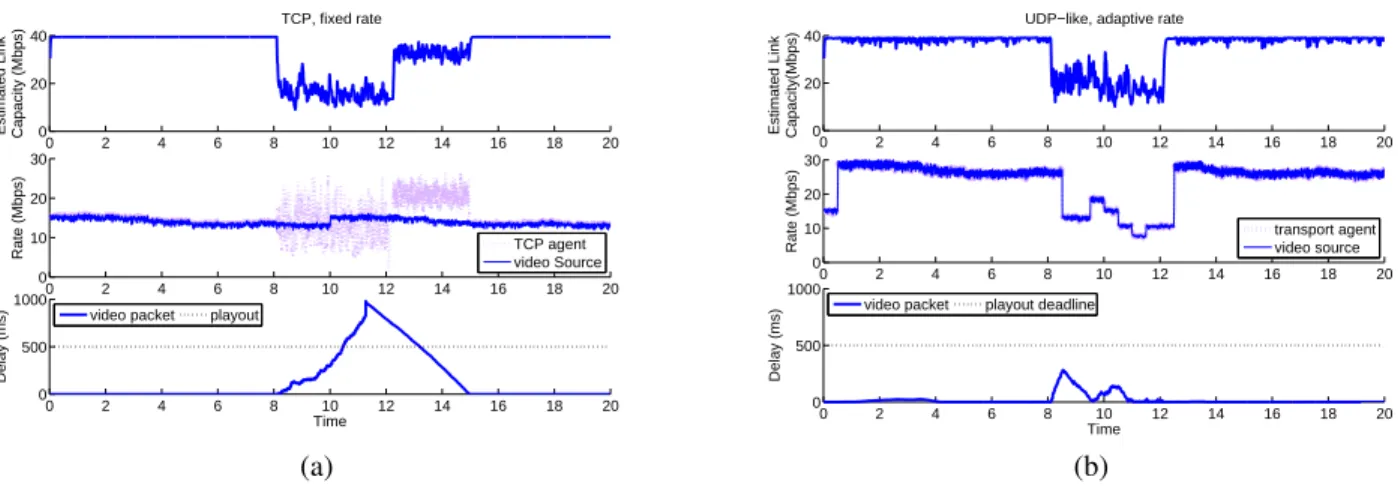
The benefit of cross-layer video rate adaptation is illus-trated in Fig. 1. We simulate the transmission of a single video stream over an otherwise idle 802.11a wireless link. With a nominal link speed of 54 Mbps and a much slower transmission rate of 6 Mbps for MAC-layer headers and control packets, the effective maximal throughput is about 40 Mbps for video packets of 1500 bytes. The HD video sequenceHarbor(1280x720p, 60 fps) is encoded using the
H.264/AVC reference codec, with GOP length of 30 at vari-ous quality levels. Video streaming at one fixed quality level using TCP is compared against streaming on top of UDP with a video-aware application-layer transport protocol. The application-layer rate controller switches between different versions of video bitstreams according to estimated link ca-pacity. While acknowledgment packets are sent for every re-ceived packet in TCP, the ACK frequency is reduced to once every ten received packets in the application-layer transport protocol. As a consequence, a higher video rate and quality can be supported, due to the reduction of acknowledgment overhead1.
Between time 8 and 12 seconds, the simulated wireless link experiences 32% packet loss at the MAC layer, lead-ing to many retransmissions and much lower link capacity. During this period, the transport rate of the TCP agent fluc-tuates over a wide range due to variations in the observed end-to-end packet round-trip-time. TCP congestion control defers transmission of incoming video packets until previ-ous packets are acknowledged. This causes many packets to miss their playout deadline, even after the channel has re-covered. When adaptation is allowed, the video bitstream is
1Since acknowledgment packets are of comparable sizes as the
MAC-layer control overheads, the amount of time occupied by the transmission of acknowledgment bitstreams becomes comparable to the original video stream. Therefore, per-packet acknowledgement streams may constitute a significant amount of overhead, even though their data rates are only a small fraction of the HD video streams.
0 2 4 6 8 10 12 14 16 18 20 0
20 40
Estimated Link Capacity (Mbps)
TCP, fixed rate 0 2 4 6 8 10 12 14 16 18 20 0 10 20 30 Rate (Mbps) 0 2 4 6 8 10 12 14 16 18 20 0 500 1000 Time Delay (ms) TCP agent video Source
video packet playout
(a)
0 2 4 6 8 10 12 14 16 18 20
0 20 40
Estimated Link Capacity(Mbps)
UDP−like, adaptive rate
0 2 4 6 8 10 12 14 16 18 20 0 10 20 30 Rate (Mbps) 0 2 4 6 8 10 12 14 16 18 20 0 500 1000 Time Delay (ms) transport agent video source
video packet playout deadline
(b)
Figure 1: Comparison of video streaming over a single wireless link: a) fixed video source rate over TCP; b) adaptive video rate via bitstream switching over a video-aware application-layer transport protocol, with reduced ACK frequency. Traces are plotted for estimated link capacity in the top graphs; sending rate of the transport agents (dotted lines) and video source rate (solid lines) in the middle graphs; and packet delivery delay (measured as the time difference between the generation of a video packet and its arrival at the receiver, in solid lines) in comparison of the playout deadline (dotted line) in the bottom graphs.
switched to a version with lower rates, thereby avoiding link congestion and sustaining the video stream at a reduced qual-ity level. In this case, the rate of the transport agent always matches that of the video source.
3. STREAMING OVER SINGLE-HOP NETWORKS
We now consider the scenario where multiple video streams time-share the same network over single-hop wireless con-nections of potentially different link speeds. Channel time allocation among the streams needs to maximize overall re-ceived video quality. The optimization can be performed jointly by a central controller when all the video streams orig-inate from the same wireless node, e.g., the media gateway in a wireless home network or the base station of a cellu-lar system. If, however, the video streams originate from different sending nodes, allocation needs to be carried out in a distributed fashion. This problem arises, e.g., in wire-less home networks, where video might be simultaneously streamed from a DVD player, a personal video recorder and a laptop computer to different displays around the house.
3.1 Centralized channel time allocation
Even with centralized control, optimal channel time alloca-tion among multiple streams is a non-trivial task. In general, the wireless links experience different channel conditions
A B C (a) A B C (b)
Figure 2: Network topology for multiple video streams sharing a single-hop wireless network. (a) All streams originate from the same wireless node. (b) The video source nodes are distributed.
and, hence, differ in transmission speed. The video streams containing different contents also derive different utility from a change in allocated rate. As a consequence, the same allo-cated rate over a fast link would require lower fraction of channel time than over a slow link; the same increase in al-located rate may benefit a ”hard” stream containing complex motion more than another ”easy” stream with little or no mo-tion.
In [7], channel time allocation is formulated as a con-vex optimization problem, with three alternative objec-tives: minimizing average mean-square-error (MSE) distor-tion of all streams (min-MSE), maximizing average PSNR of all streams (max-PSNR), and minimizing maximum MSE (minmax-MSE) among all streams. Subjective tests confirm that the min-MSE criterion corresponds best with user pref-erences.
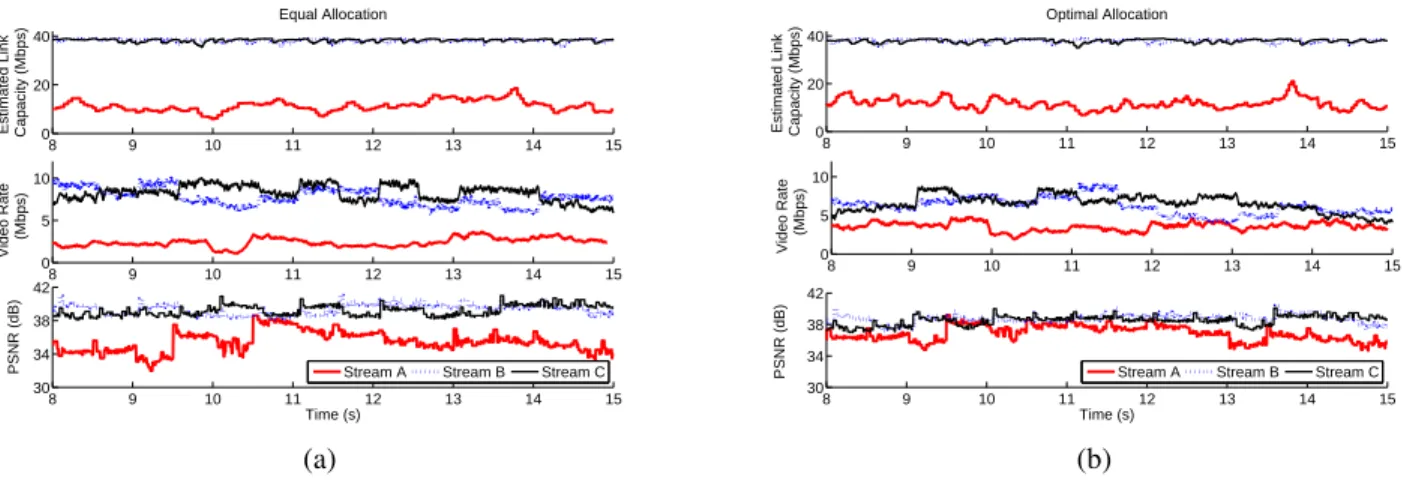
Figure 2 (a) shows the network topology for compar-ing centralized time allocation results from the min-MSE algorithm against a heuristic scheme that divides channel time equally among all active streams. TheCrewHD video
sequence is streamed to three different clients over three 802.11a links at 54 Mbps nominal link speed. Two of the wireless links are error-free, while the third link experiences 32% packet loss at the MAC layer. The estimated link capac-ities correspond to the maximum achievable data rate over each link, if it were allocated 100% of channel time. Traces of the estimated link capacities, resulting video rates and cor-responding video qualities in PSNR are plotted in Fig. 3. Combining knowledge of the rate-distortion function of all streams, the min-MSE algorithm is able to improve the video quality traversing the worst link by 1.4 dB over the scheme with equal allocation, at the cost of 0.6 - 0.7 dB reduction for the other two streams.
3.2 Distributed channel time allocation
The multi-stream resource allocation problem becomes more challenging if it has to be solved in a distributed manner. A game-theoretic approach has been proposed for spectrum al-location among wireless stations [8]. In [9], distributed rate-distortion optimized packet scheduling is used with multiple
8 9 10 11 12 13 14 15 0
20 40
Estimated Link Capacity (Mbps)
Equal Allocation 8 9 10 11 12 13 14 15 0 5 10 Video Rate (Mbps) 8 9 10 11 12 13 14 15 30 34 38 42 Time (s)
PSNR (dB) Stream A Stream B Stream C
(a)
8 9 10 11 12 13 14 15
0 20 40
Estimated Link Capacity (Mbps)
Optimal Allocation 8 9 10 11 12 13 14 15 0 5 10 Video Rate (Mbps) 8 9 10 11 12 13 14 15 30 34 38 42 Time (s)
PSNR (dB) Stream A Stream B Stream C
(b)
Figure 3: Centralized time allocation for three video streams sharing a WLAN (see Fig. 2 (a)): (a) equal allocation among all streams; (b) min-MSE allocation according to [7]. The total channel time constraint is set to 75% in both cases. Traces are plotted for estimated link capacity (top), resulting video rate (middle) and video quality in PSNR (bottom) for each stream. Average video PSNR for the three streams with equal channel allocation are 39.4 dB, 39.2 dB and 35.5 dB respectively. For optimized allocation, they are 38.8 dB, 38.5 dB and 36.9 dB.
streams competing over a shared communication channel. The same optimization problem as in Section 3.1 can be solved by a fully distributed protocol using a pricing mech-anism. Each stream adjusts its channel time allocation ac-cording to local observations of video rate-distortion trade-off and link capacity, as well as a common shadow price maintained at all users. The shadow price decreases when to-tal allocation is below the given constraint to encourage rate increment from all streams, and increases when it is above the limit [10].
The efficacy of the distributed protocol is demonstrated in Fig. 4, comparing allocated rate and video quality re-sulting from the distributed scheme against those from an oracle-aided centralized controller. In this experiment, the
CrewHD sequence is streamed from three different 802.11a
nodes, all within transmission range of each other, as shown in Fig. 2 (b). The nominal link speed of two of the links is fixed at 54 Mbps, while that of the third varies from 6 Mbps to 54 Mbps. It can be observed that allocated rate achieved by the distributed scheme matches closely with the centralized solution, leading to similar video qualities. As the transmis-sion speed of the third link approaches that of the other two, the overall video quality of all three streams improves, while the quality gap between the streams diminishes.
4. STREAMING OVER MESH NETWORKS
Video streaming over wireless mesh networks imposes ad-ditional challenges introduced by multi-hop transmissions. Cross-layer design and optimization for this problem is a very active area of investigation with many remaining open problems. In the following, a survey of research efforts in joint optimization of multiple protocol layers is presented first, followed by discussions on routing for media streaming, and rate allocation among multiple video streams in mesh networks.
4.1 Multi-layer resource allocation
The flexibility offered by cross-layer design has been ex-ploited in a number of research efforts. Joint optimization of power allocation at the physical layer, link scheduling at
the MAC layer, network layer flow assignment and trans-port layer congestion control has been investigated with con-vex optimization formulations (see, e.g., [11, 12, 13]). Our own cross-layer design framework [14] attempts to main-tain a layered architecture while exchanging key parameters between adjacent protocol layers. The framework allows
5 10 15 20 25 30 35 40 45 50 55 2 3 4 5 6 7 8 9
Link Speed of Stream C (Mbps)
Video Rate (Mbps) Crew, 1280x720p, 60 fps Stream A centralized Stream A distributed Stream B centralized Stream B distributed Stream C centralized Stream C distributed (a) 5 10 15 20 25 30 35 40 45 50 55 34 35 36 37 38 39 40
Link Speed of Stream C (Mbps)
PSNR (dB) Crew, 1280x720p, 60 fps Stream A centralized Stream A distributed Stream B centralized Stream B distributed Stream C centralized Stream C distributed (b)
Figure 4: Channel time allocation for three video streams, all
Crew, sharing a single-hop network (see Fig. 2 (b)). Comparison
of allocated rate (a) and resulting video quality (b) as a function of link speed of the third stream, between pricing-based distributed scheme [10] and an oracle-aided centralized controller.
enough flexibility for significant performance gains, while keeping protocol design tractable within the layered struc-ture, as demonstrated by the preliminary results exploring adaptive link-layer techniques, joint capacity and flow as-signment, media-aware packet scheduling and congestion-aware video rate allocation.
4.2 Routing for Media Streaming
Routing over wireless mesh networks is a difficult prob-lem due to dynamic link qualities, even when nodes are static [15]. For video streaming, multipath routing has been proposed in combination with multiple description coding, to achieve robust delivery via path diversity [16, 17, 18].
In spite of the high data rates achieved over single-hop wireless transmissions, throughput over a multi-hop wireless path is typically significantly lower, due to contention among adjacent links along the path [19]. Since video packets need to be delivered by their playout deadline, self-inflicted congestion may drastically degrade received video quality over a throughput-limited path [20]. Route selection should therefore minimize network congestion, measured as aver-age per-link delay of all packets. Congestion-minimized routes can be derived from solutions to a classical flow assignment problem, either via centralized computation [21] or with a distributed algorithm [22].
4.3 Multi-Stream Rate Allocation
When multiple streams share a wireless mesh network, their rates need to be jointly optimized to avoid network conges-tion while maximizing overall received video quality. The joint rate allocation problem can be solved by minimizing the Lagrangian cost of total video distortion and overall net-work congestion [23]. For each stream, the optimal allocated rate strikes a balance between minimizing its own video dis-tortion and minimizing its contribution to overall network congestion. This is achieved by a distributed rate allocation protocol, which allows cross-layer information exchange be-tween the video streaming agents at the application layer on the source nodes and the link state monitors at the MAC layer on the relay nodes.
Instead of repeating details of the distributed protocol from the original paper, we illustrate in Fig. 5 performance comparison of the proposed scheme versus TCP-Friendly Rate Control (TFRC) [24]. Two HD video sequences are streamed over a small wireless mesh network comprising five 802.11a nodes. The first stream (Harbor) travels over a
3-hop path; the other (Crew) over a single-hop path. The Har-borsequence requires much higher encoding rate to achieve
the same quality asCrew, due to its more complex video
con-tents.
Since TFRC is unaware of the video RD trade-off and relies mainly on end-to-end observations of round-trip-time and packet losses, the allocated rate for theHarboris
approx-imately one third of that forCrew. This leads to around 8 dB
of difference in the PSNR of the two received streams: while
Crewis being delivered at a high quality of 39.5 dB in PSNR,
the average quality ofHarboris only 30.9 dB. The proposed
media-aware allocation scheme, in comparison, results in in-creased allocation forHarborand lower rate forCrew.
Con-sequently, the quality gap between the two streams is reduced to 5 dB, withHarborimproved to 31.6 dB andCrew
remain-2 1 3 4 5
R
2R
1 (a) 8 9 10 11 12 13 14 15 0 2 4 6 8 10 12 14 16 Time (s) Video Rate (Mbps)Harbor over 3−hop path vs. Crew over 1−hop path
Harbor, Proposed Harbor, TFRC Crew, Proposed Crew, TFRC (b) 8 9 10 11 12 13 14 15 24 26 28 30 32 34 36 38 40 42
Harbor over 3−hop path vs. Crew over 1−hop path
Time (s) PSNR (dB) Harbor, Proposed Harbor, TFRC Crew, Proposed Crew, TFRC (c)
Figure 5: Two video streams competing over a wireless mesh network: (a) Network topology; (b) comparison of allocated rate resulting from the media-aware scheme in [23] versus TFRC; (c) comparison of video quality in PSNR.
ing at a relatively high quality of 37.0 dB. It can also be noted that rate allocation from TFRC yields greater fluctu-ations due to traffic contention between the two streams. The cross-layer scheme, in contrast, benefits from explicit knowl-edge of available network throughput and maintains steady rate allocations.
5. CONCLUSIONS AND OPEN PROBLEMS
In this tutorial paper we have reviewed key problems and tentative solutions for video streaming over wireless net-works, with an emphasis on network-adaptive rate control and resource allocation among multiple video streams. As shown in the various examples, cross-layer information ex-change is required, so that video source rates can adapt to the time-varying wireless link capacities. Resource allocation
among multiple streams can also benefit from being aware of the video characteristics (e.g., RD trade-off of each video stream) and underlying network conditions, for maximizing overall received video quality. Such considerations should be incorporated into the design of a future cross-layer protocol for video streaming over wireless networks.
Many open problems remain, particularly in the context of wireless mesh networks. For instance, it is still unclear whether the stringent latency constraint (usually less than a second) for video streaming can be met when packets need to be delivered over multiple hops of time-varying wireless links in a mesh network. Conditions where multipath routing is beneficial for streaming need to be identified, as contention of video traffic along parallel paths may cancel out the path diversity advantage of robustness to packet losses. Typically the wireless network is shared by both video streaming and other applications such as file downloading. The problem re-mains to be addressed as how to optimally allocate network resource among heterogeneous traffic types, each bearing a different performance metric (e.g., completion time for file downloading versus video quality for streaming).
REFERENCES
[1] P. van Beek and M. U. Demircin, “Delay-constrained rate adaptation for robust video transmission over home net-works,”IEEE International Conference on Image Processing, (ICIP’05), Genova, Italy, vol. 2, pp. 173–176, Sept. 2005.
[2] L. Haratcherev, J. Taal, K. Langendoen, R. Lagendijk, and H. Sips, “Optimized video streaming over 802.11 by cross-layer signaling,” IEEE Communications Magazine, vol. 44,
no. 1, pp. 115–121, Jan. 2006.
[3] T. Ozcelebi, M.R. Civanlar, and A.M. Tekalp, “Minimum delay content adaptive video streaming over variable bitrate channels with a novel stream switching solution,”Proc. IEEE International Conference on Image Processing, (ICIP’05),
vol. 1, pp. 209–212, 2005.
[4] T. Stockhammer, M. Walter, and G. Liebl, “Optimized h. 264-based bitstream switching for wireless video stream-ing,”Proc. IEEE International Conference on Multimedia and Expo, (ICME’05), Amsterdam, The Netherlands, pp. 1396–
1399, July 2005.
[5] F. Yang, Q. Zhang, W. Zhu, and Y.-Q. Zhang, “Bit alloca-tion for scalable video streaming over mobile wireless inter-net,”Proc. Twenty-third AnnualJoint Conference of the IEEE Computer and Communications Societies (INFOCOM’04), HongKong, China, vol. 3, pp. 2142 – 2151, Mar. 2003.
[6] P. A. Chou and Z. Miao, “Rate-distortion optimized streaming of packetized media,”IEEE Transactions on Multimedia, vol.
8, no. 2, pp. 390–404, Apr. 2006.
[7] M. Kalman and B. Girod, “Optimal channel-time allocation for the transmission of multiple video streams over a shared channel,” Proc. IEEE International Workshop on Multime-dia Signal Processing (MMSP’05), Shanghai, China, pp. 1–4,
Oct. 2005.
[8] A. Larcher, H. Sun, M. van der Schaar, and Z. Ding, “De-centralized transmission strategies for delay-sensitive applica-tions over spectrum agile network,”Proc. Packet Video Work-shop, Dec. 2004.
[9] J. Chakareski and P. Frossard, “Rate-distortion optimized distributed packet scheduling of multiple video streams over shared communication resources,” IEEE Transactions on Multimedia, vol. 8, no. 2, pp. 207–218, Apr. 2006.
[10] X. Zhu, P. van Beek, and B. Girod, “Distributed channel time allocation and rate adaptation for multi-user video streaming over wireless home networks,” IEEE International Confer-ence on Image Processing (ICIP’07), Accepted, 2007.
[11] R. L. Cruz and A. Santhanam, “Optimal routing, link schedul-ing and power control in multi-hop wireless networks,”Proc. INFOCOM, San Francisco, California, USA, pp. 702–711,
Mar. 2003.
[12] Y. Wu, P. A. Chou, Q. Zhang, K. Jain, W. Zhu, and S-Y. Kung, “Network planning in wireless ad-hoc networks : A cross-layer approach,” IEEE Journal on Selected Areas in Commu-nications, vol. 23, no. 1, pp. 136–150, Jan. 2005.
[13] Y. Xi and E. M. Yeh, “Optimal capacity allocation, rout-ing, and congestion control in wireless network,” Proc. IEEE International Symposium on Information Theory (ISIT’06), Seattle, WA, USA, pp. 2511–2515, July 2006.
[14] E. Setton, T. Yoo, X. Zhu, A. Goldsmith, and B. Girod, “Cross-layer design of ad hoc networks for real-time video streaming,” IEEE Wireless Communications Magazine, vol.
12, no. 4, pp. 59–65, Aug. 2005.
[15] D. De Couto, D. Aguayo, B. Chambers, and R. Morris, “Per-formance of multihop wireless networks: Shortest path is not enough,” Proc. ACM First Workshop on Hot Topics in Net-works (HotNets-I), Princeton, New Jersey, USA, pp. 83–88,
Oct. 2002.
[16] J. G. Apostolopoulos and S. J. Wee, “Unbalanced Mul-tiple Description Video Communication Using Path Diver-sity,” IEEE International Conference on Image Processing (ICIP’01), Thessaloniki, Greece, vol. 1, pp. 966–969, Oct.
2001.
[17] S. Mao, S. Lin, S. Panwar, Y. Wang, and E. Celebi, “Video transport over ad hoc networks: Multistream coding with mul-tipath transport,”IEEE Journal on Selected Areas in Commu-nications, vol. 21, no. 10, pp. 1721–1737, Dec. 2003.
[18] W. Wei and A. Zakhor, “Multiple tree video multicast over wireless ad hoc networks,” IEEE Trans. on Circuits, Systems and Video Technology, vol. 17, no. 1, pp. 2–15, Jan. 2007.
[19] J. Li, C. Blake, D. S. J. De Couto, H. I. Lee, and R. Morris, “Capacity of ad hoc wireless networks,” inProceedings of the 7th ACM International Conference on Mobile Computing and Networking, Rome, Italy, July 2001, pp. 61 – 69.
[20] X. Zhu, E. Setton, and B. Girod, “Congestion-distortion op-timized video transmission over ad hoc networks,” EURASIP Journal of Signal Processing: Image Communications, vol.
20, no. 8, pp. 773–783, Sept. 2005.
[21] E. Setton, X. Zhu, and B. Girod, “Congestion-optimized mul-tipath streaming of video over ad hoc wireless networks,”
Proc. IEEE International Conference on Multimedia and Expo (ICME’04), Taipei, Taiwan, vol. 3, pp. 1619–1622, July
2004.
[22] X. Zhu and B. Girod, “A distributed algorithm for congestion-minimized multi-path routing over ad hoc networks,” Proc. IEEE International Conference on Multimedia and Expo (ICME’05), Amsterdam, The Netherlands, pp. 1484–1487,
July 2005.
[23] X. Zhu and B. Girod, “Distribued rate allocation for video streaming over wireless networks with heterogeneous link speeds,” International Symposium on Multimedia over Wire-less (ISMW’07), Invited Paper, Aug. 2007.
[24] S. Floyd and K. Fall, “Promoting the use of end-to-end con-gestion control in the internet,” IEEE/ACM Trans. on Net-working, vol. 7, pp. 458–472, Aug. 1999.
![Figure 5: Two video streams competing over a wireless mesh network: (a) Network topology; (b) comparison of allocated rate resulting from the media-aware scheme in [23] versus TFRC; (c) comparison of video quality in PSNR.](https://thumb-us.123doks.com/thumbv2/123dok_us/9227875.2407707/4.918.488.789.121.761/competing-wireless-network-topology-comparison-allocated-resulting-comparison.webp)
