International Research Journal of Pharmaceutical and Biosciences (IRJPBS) 4 (3) 1
REVIEW ARTICLE
International Research Journal of Pharmaceutical and Biosciences
Pri
-
ISSN: 2394 - 5826http://www.irjpbs.com e-ISSN: 2394 - 5834
Review on controlled porosity osmotic pump tablets
and its basic components
Ganesh N.S. 1*, Liji Jacob2, Vineeth Chandy3
1Professor and HOD, Department of Pharmaceutics, T. John College of Pharmacy, Gottigere,
Bangalore – 560083
2Post Graduate Student, Department of Pharmaceutics, T. John College of Pharmacy,
Gottigere, Bangalore – 560083
3 Prinicipal, T. John College of Pharmacy, Gottigere, Bangalore – 560083.
Article info Abstract
Article history: Received 02 APR 2017 Accepted 04 APR 2017
*Corresponding author: [email protected]
Copyright 2017 irjpbs
A system that can deliver drug at a controlled rate is very important for the treatment of various chronic diseases such as Diabetes, Asthma and Heart disease. Conventional drug delivery systems are known to provide an immediate release of drug in which one cannot control the release of the drug and cannot maintain effective concentration at target site for longer time. Drugs having short biological half-life and poor water solubility offers challenges in the controlled release formulation because of low dissolution rate and poor bioavailability. Hence to avoid these, various controlled drug delivery systems are developed. Among these Osmotic drug delivery system, utilizes the principle of osmotic pressure releases drug in optimised manner. Controlled porosity osmotic pump (CPOP) based drug delivery system contains active ingredient, osmogens, semi permeable membrane, channelling agent and water soluble additives. In this system, when water comes in contact with water soluble additives it results in an in situ formation of a Microporous membrane. The main driving force for the release of drug is osmotic pressure. Osmogens maintain concentration gradient across the membrane. The present study deals with Controlled porosity osmotic pump tablets and its basic components.
International Research Journal of Pharmaceutical and Biosciences (IRJPBS) 4 (3) 2
INTRODUCTION
Oral delivery is currently the gold standard in the pharmaceutical industry where it is regarded as the safest, most convenient and most economical method of drug delivery having the highest patient compliance. Yet, there are problem encountered in solid dosage forms like multiple dosing of the product due to short biological half-life of drug and low bioavailability. To overcome such problems, certain innovative drug delivery systems, like CPOP (Controlled porosity osmotic pump) tablets have been developed [1]. The most important advantages of CPOP tablets when compared to conventional oral dosage forms is its extended and controlled release of drug which avoids administration of product several times a day and increases patient compliance. Further CPOP tablet increases solubility of poorly soluble drugs with suitable solubility modifires [2].
A CPOP (controlled porosity osmotic pump) tablet is an osmotic tablet wherein the delivery orifices are formed in situ through leaching of water soluble pore-forming agent incorporated in semipermeable membrane. Drug release of CPOP depends on various factors like coating thickness, solubility of drug in tablet core, level of pore-forming agents and osmotic pressure difference across the membrane [3].It can be prepared by different techniques like, direct compression method, wet granulation of the core and coating with suitable coating solvents [4].
The release of drug from CPOP tablets is independent of presence and absence of food, pH of gastro intestinal (GI) tract, GI motility and hydrodynamic conditions of body due to rate controlling semi permeable membrane. In ODDS the drug dose and dosing interval are optimized to maintain drug concentration within the therapeutic window [5].
When an osmotic system comes in contact with water, water diffuses into core through the microporous membrane setting up an osmotic gradient and thereby controlling the release of the drug. Osmotic pressure is the pressure applied to the higher concentrated solution side to prevent transport of water across the semi permeable membrane. The rate of drug delivery from osmotic system is directly proportional to the osmotic pressure developed due to imbibitions of fluids by osmogens. The following review concentrates on controlled porosity osmotic pump tablets and its basic components [6].
OSMOTIC DRUG DELIVERY SYSTEM
International Research Journal of Pharmaceutical and Biosciences (IRJPBS) 4 (3) 3
TYPES OF OSMOTIC IMPLANTABLE PUMPS
An osmotic pump includes bi compartment system, separated by a piston. One of the Compartments contains osmotic engines specifically prepared with an excess of solid Sodium Chloride, such that it remains throughout the delivery time and results in a constant osmotic gradient. It also consists of Semi permeable membrane on one end through which water is drawn into the osmotic engine and establishes a constant osmotic gradient between tissue, water and osmotic engine. Other compartment consists of drug solution with an orifice from which the drug is released due to osmotic gradient. Various types of Osmotic Implantable Pumps are Rose and Nelson Pump, Higuchi leeper, Higuchi Theewus, Implantable mini osmotic pumps like Alzet and Duros
Pump [7].
Oral osmotic pump
Oral osmotic pumps consist of an osmotic device for delivering active ingredient into the oral cavity. The osmotic device comprises a semi permeable membrane surrounding the compartment which contains active ingredient that is insoluble in an aqueous fluid. The passage through the semi permeable membrane connects the exterior of the device with compartment containing active ingredient for delivering from the device to oral cavity. Based on chamber in oral osmotic pump, it is classified into single chamber osmotic pump such as elementary osmotic pump and Multi chamber osmotic pump
such as Push-Pull osmotic pump with expanding second chamber [8].
Specific types
Recent advances include various specific systems in osmotic pumps such as Controlled porosity osmotic Pump (CPOP),Osmotic Bursting osmotic pump, Liquid OROS, Delayed delivery osmotic device, telescopic capsule, OROS CT (Colon targeting), sandwiched oral therapeutic system, osmotic pump for insoluble drugs and monolithic osmotic system
and OSMAT [9].
CONTROLLED POROSITY OSMOTIC PUMP (CPOP)
International Research Journal of Pharmaceutical and Biosciences (IRJPBS) 4 (3) 4
difference across the membrane [10]. The rate of flow of water into the device can be
expressed as given below
Equation 1,
dv/dt=Ak/h(dπ-dp)
where
dv/dt is rate of flow of water to device
k and A are membrane permeability and surface area of membrane, respectively
dπ and dp are osmotic pressure difference and hydrostatic difference between inside
and outside of the membrane, respectively.
Fig. 1 Schematic representation of controlled drug delivery system.
ADVANTAGES OF CONTROLLED POROSITY OSMOTIC PUMP TABLETS
1. The delivery of drug may be delayed or pulsatile.
2. The drug release is independent of physiological conditions of the body,
gastric pH and drug of hydrodynamic condition.
3. The release of drugs from CPOP follows zero order kinetics after an initial
lag.
4. The drug delivery provides high degree of in vitro in vivo correlation.
5. The release of drug is less affected by the presence of food in GIT.
6. The drug release is higher than conventional drug delivery system.
7. There is no need of laser drilling because the holes are formed in situ.
8. The delivery rate of drug from CPOP is predictable and programmable.
9. The stomach irritation problems are reduced because the drug is
delivered from the entire surface rather than single delivery orifice.
10.The production in scale up is very easy.
DISADVANTAGES OF CONTROLLED POROSITY OSMOTIC PUMP TABLETS
1. Retrieval therapy is not controllable in case of unexpected adverse
effects
2. There is a chance for the development of drug tolerance
3. The method of preparation is very costly
Aqueous environment
Coating containing Pore Forming agent
International Research Journal of Pharmaceutical and Biosciences (IRJPBS) 4 (3) 5
4. There is a chance of dose dumping if the coating process is not well
controlled.
BASIC COMPONENTS OF CONTROLLED POROSITY OSMOTIC PUMP TABLETS
Drugs
All drugs are not suitable for CPOP as prolonged action medication.Drugs having following characteristics are suitable for formulation
1. It should have short half – life
2. Prolonged release of drug should be desired
3. It should be potent in nature
4. Solubility of drug should not be very high or very low
Osmotic agents
These are also known as osmogens or osmogents and are used to create osmotic pressure inside the system. When the solubility of drug is low then the drug will show zero order release but at a slow rate. To enhance the release rate osmotic agent is added in the formulation. Osmotic agents maintain a concentration gradient across the membrane. They also generate a driving force for the uptake of water and assist in maintaining drug uniformity in the hydrated formulation. Osmotic components are usually ionic compound consisting of either inorganic salts or hydrophilic polymer. Osmotic agents can be any salt such as sodium chloride, potassium chloride or sulphates of sodium or potassium and lithium. Additionally sugars such as glucose,
sorbitol or sucrose or inorganic salts of carbohydrates can be osmotic agents[11].
Classification of osmotic agents Table 1
S. No Osmogens Example
1 Water- soluble salts of
inorganic acids Sodium carboxy methyl cellulose, Magnesium chloride
2 Organic polymeric osmogent Polyacrylamides, Sodium
sulphate
3 Carbohydrates Xylose, Arabinose
4 Water soluble salts or
organic acids Glycine, Alanine
5 Water- soluble salts of
International Research Journal of Pharmaceutical and Biosciences (IRJPBS) 4 (3) 6
Semi permeable membrane (SPM)
An important part of the CPOP is Semipermeable membrane housing. Therefore, the polymeric membrane selection is major key to the osmotic delivery formulation. The membrane should posses certain characteristics such as impermeability to the passages of drug and other ingredients present in the compartments. The membrane should be inert and maintain its dimensional integrity to provide a constant osmotic driving force during dug delivery. Any polymer that is permeable to water but impermeable to solute can be used as a coating material in osmotic devices. The semipermeable membrane must meet some performances.
Ideal properties of semi permeable membrane
1. The membrane should be biocompatible.
2. The material should have sufficient wet strength and wet modulus.
3. The reflection coefficient and leakiness of the osmotic agent should
approach the limiting value of unity.
4. The membrane should have sufficient water permeability to retain water
flux rate in the desired range[12].
Wicking agents
A wicking agent also called as pore forming agent is defined as a material with the ability to draw water into the porous network of a delivery device. A wicking agent is of either swellable or non- swellable nature. They are characterised by having the ability to undergo physisorption with water. Physisorption is a form of absorption in which the solvent molecules can loosely adhere to surfaces of the wicking agent by Vander Waal’s interactions between the surface of the wicking agent and the adsorbed molecule. The function of the wicking agent is to carry water to surfaces inside the core of the tablet, thereby creating channels or a network of increased surface area .Materials, which
suitably for act as wicking agents include colloidal silicone dioxide, kaolin[13].
Pore forming agents
These agents are particularly used in the pumps developed for poorly water soluble drug and in the development of controlled porosity or Multiparticulate osmotic pumps. The pore forming agents cause formation of microporous membrane. The microporous wall may be formed in situ by a pore former by its leaching during the operation of the system. The pore forming agents are those agents which help to increase the contact surface area of the drug with the incoming aqueous fluid. The use of the wicking agent help to enhance the rate of drug released from the orifice of the drug. The examples are colloidal silicon dioxide. PVP, carbohydrates like sucrose, sorbitol and sodium lauryl
sulphate[13].
Plasticizers
International Research Journal of Pharmaceutical and Biosciences (IRJPBS) 4 (3) 7 and brittle polymer into a softener, more paliable material, and possibly make it more resistant to the mechanical stress. Plasticizers increases the workability, flexibility and permeability of coating solvents. PEG 600, PEG 200, ethylene glycol diacetate are used as plasticizers. Different types and amount of plasticizers used in coating membrane also have a significant importance in the formulations of osmotic systems [14].
Coating solvents
The primary function of solvents system is to dissolve or disperse the polymer and other additive and convey them to substrate surface. Solvent used to prepare polymeric solution include inert inorganic and organic solvents that do not adversely harm the tablet core, wall and other materials. The most common coating solvents used are methylene chloride, acetone, methanol and ethanol [15].
MECHANISM OF DRUG RELEASE
Tablet has rigid water permeable jacket with many small holes. As the tablet passes through the body, the osmotic pressure of the tablet pushes the active drug through the opening in the tablet [16]. The basic equation for osmotic system is
Equation 2, dM/dt=dV/dt.c
Where
dM/dt is mass release
dV/dt is volumetric pumping rate
c is concentration of drug But,Equation 3
dV/dt=(A/h)Lp (σͭΔπ-Δp) where
A is membrane area
h is thickness of membrane
Lp is mechanical permeability
Σ is reflection coefficient
Δπ is osmotic pressure difference
Δp is hydrostatic pressure difference
As the size of orifice increases, Δpalso increases so Δπ>> Δp and equation becomes
dV/dt=A/h Lp (σͭΔπ). When osmotic pressure of the formulation is large compared to
the osmotic pressure of environment, p can be substituted as Dp Equation 4,
International Research Journal of Pharmaceutical and Biosciences (IRJPBS) 4 (3) 8
COMPATIBILITY STUDIES
Fourier transforms infrared spectroscopy (FTIR)
The use of FTIR technique allows pointing out the implication of the different functional groups of excipients by analysing the significant changes in the shape and position of the absorbance bands. In this method individual samples as well as the mixture of the drug and excipients are grounded and mixed thoroughly with potassium bromide (1:100) for 3-5 mins in a motar and compressed into disc by applying pressure of 5 tons for 2 mins in hydraulic press. The pellet was kept in the sample holder and scanned
from 4000 to 400 cm-1 in FTIR spectrophotometer. Then the characteristics peaks of all
samples as well as mixtures are obtained[17].
Differential scanning Calorimetry
The compatibility of drug with the excipients used for the formulation development was tested using differential scanning calorimetry. Physical mixtures of drug and individual excipients in the ratio 1:1 are taken and examined n DSC. Individual samples as well as physical mixture of drug and excipient are weighed to about 5 mg in DCS pan. The sample pan was crimped for effective heat conduction and scanned in temperature
range 50-3000 C. Heating rat of 200 C min-1 was used and the thermos grams are
compared with pure samples versus optimized formulation.
EVALUATION PARAMETERS Angle of Repose (θ)
The angle of repose test is very sensitive to the method used to create the heap. Angle of repose may be determined by heap shape measurement. By using the classical method angle of repose can be measured. The diameter of powder heap is measured and angle of repose is calculated using he following equation
Equation 5, Tanθ= tan-1(2h/d)
Where θ is the angle of repose, h is the height of heap in cm and d is the diameter of
the circular support in cm. Angle of repose can be observed accurately by placing a dry and clean funnel on burette stand at a particular height ( 2-5cm). place a graph paper on flat surface that is allow accurately weighed granules to flow slowly throughout the funnel, untill the open heap of granules bounces the tip of funnel. Draw the circumference of the heap. Allocate the midpoint and measure the radius. The height of the heap is also measure. Repeat the experiment and calculate the average radius and height.
Bulk density (eb)
International Research Journal of Pharmaceutical and Biosciences (IRJPBS) 4 (3) 9 Equation 6,
Bulk density = Weight of granules Bulk volume of granules
Tapped density (et)
The measuring cylinder containing a known mass of granules blend is tapped 1000 times for a fixed time. The minimum volume occupied in the cylinder (Vt) and mass of the granules (m) are measured. The tapped density is measured by using the following formula.
Equation 7,
Tapped density = Weight of granules Tapped volume
Compressibility index ( Carr’s index)
The compressibility index determines the flow property characteristics of granules developed by Carr. The percentage compressibility of granules is a direct measure of the potential powder arch and stability. The carr’s index can be calculated by the following formula
Equation 8, Compressibility index = tapped density-bulk density ×100 Tapped density
Hausner’s ratio
Hausner’s ratio is used for the determination of flow properties of granules. The ratio can be calculated by taking ratio of tapped density to the ratio of bulk density
Equation 9,
Hausner’s ratio = Tapped density Bulk density
POST COMPRESSION PARAMETERS OF OSMOTIC PUMP TABLETS Thickness
The thickness of individual tablets is measures by using Vernier calliper which gives the accurate measurement of thickness. It provides information of variation of thickness between osmotic pump tablets. Generally the unit for thickness measurement is mm. the limit of the deviation of each tablet is + 5%.
Hardness
The hardness of tablets can be determined by using Monsanto hardness tester and
measured in terms of kg/cm2.
Friability
Friability of tablets is performed in a Roche friabilator. Ten tablets are initially weighed
International Research Journal of Pharmaceutical and Biosciences (IRJPBS) 4 (3) 10 revolutions and the tablets are subjected to the combined effects of abrasion and shock because the plastic chamber carrying the tablets drops them at a distance of six inches
with every revolution. The tablets are then dusted and reweighed (W). The percentage
of friability was calculated using following formula, Equation 10,
Friability= (initial weight-final weight/initial weight) 100
Weight variation
The weight variation test is done by weighing 20 tablets individually calculating the average weight and comparing the individual tablet weights to the average. The percentage weight deviation is calculated and the compared with USP specifications. The tablets meet the USP test if not more than 2 tablets are outside the percentage limit and if no tablet differs by more than 2 times the percentage limit.
Disintegration test
In disintegration test apparatus disintegration time of tablets is measured by placing tablets in each tube and the basket rack assembly is positioned in a 1- litre beaker of
water or simulated gastric fluid or simulated intestinal fluid at 370 C + 20 C such that the
tablet remain 2.5 cm from the bottom of the beaker. A standard motor moves the basket up and down through a distance of 5 to 6 cm at a frequency of 28 to 38 cpm (cycles per min). USP disintegration test will be passed if all the tablets disintegrate and the particles are passed through the #10 mesh screen within specified time.
Uniformity of drug content test
In this USP method 10 dosage units are individually assayed for their content according to the method described in the individual monograph. Unless otherwise stated in the monograph the requirements for content uniformity are met if the amount of active ingredient in each dosage unit lies within the range of 85- 115% of the label claim and standard deviation is less than 6%. If one or more dosage units do not meet these criteria additional tests as prescribed in USP are required.
In vitro dissolution studies
In vitro dissolution study is performed by using USP type 1 Apparatus (Basket type). The tablet is kept 900 ml of dissolution fluid phosphate buffer of pH 7.4 or 0.1 N Hcl or simulated gastric fluid with stirrer rotating at a specified RPM and maintaining the
temperature at 37 ±0.50 c of dissolution media. 5 ml of samples withdrawn at different
time intervals are replaced with fresh medium and analysed in UV – Visible spectrophotometer for estimation of absorbance taking a suitable blank solution. Finally the drug release rate is calculated using a suitable equation [17].
Scanning electron microscopy
In order to observe the mechanism of drug release from the developed formulations surface coated tablets before and after dissolution studies are examined using a
International Research Journal of Pharmaceutical and Biosciences (IRJPBS) 4 (3) 11 between sheets of wax paper in a dessicator until examination. The samples are fixed on a brass stub using a double sided tape and then gold coated in vaccum by a sputter coater. Scans are taken at an excitation voltage of 20 KV in SEM fitted with ion sputtering device. The surface morphology of coated membrane of optimized formulation film coating before and after coating before and after dissolution is examined and by comparing the porous morphology the capability of porogen and drug
release can be evaluated[18].
FACTORS AFFECTING RELEASE OF MEDICAMENT
Factors affecting the release rate of medicament from osmotic drug delivery system are,
1. Solubility
2. Osmotic pressure 3. Delivery orifice 4. Membrane type
SOLUBILITY
Solubility of drug is one of the most important factors since kinetics of osmotic release is directly related to the drug solubility. In osmotic drug delivery system, solubility of drug plays a major role in the drug release. When the solubility of drug is moderate to high the mechanism of drug release can be modified.
OSMOTIC PRESSURE
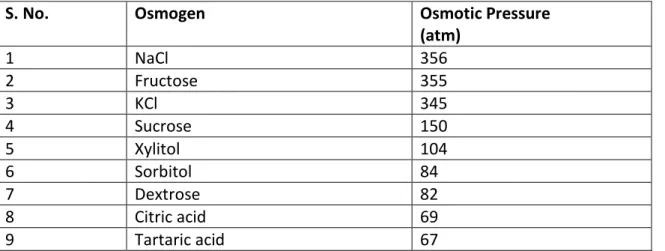
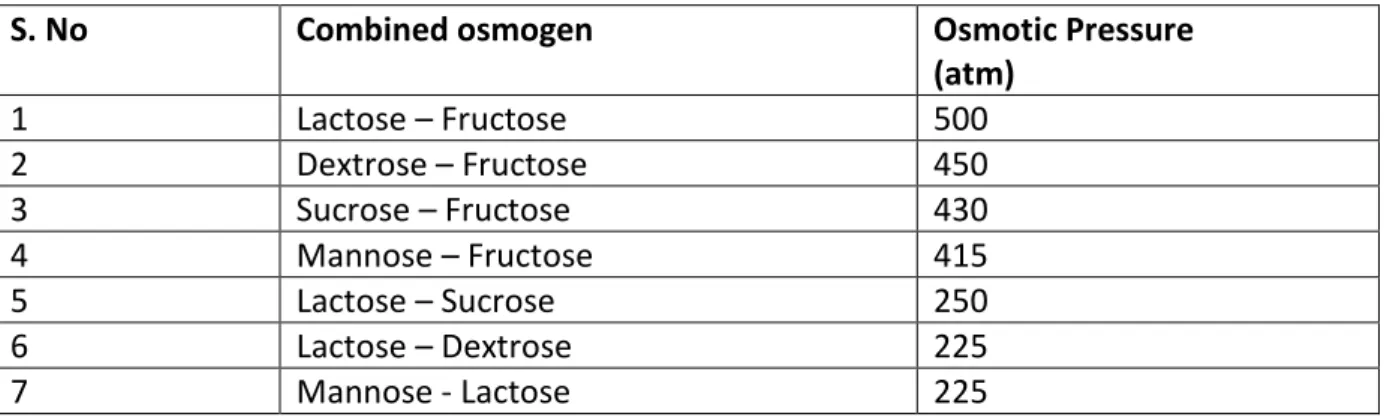
Rate of drug release from an Osmotic system is directly proportional to Osmotic Pressure of the core formulation. In order to achieve optimized and constant Osmotic Pressure in compartment Osmotic agent must be added to table. So varying the osmogens vary osmotic pressure and hence drug release. Osmogens are classified as inorganic and organic osmogens [19].
Table 2: OSMOGENS
S. No. Osmogen Osmotic Pressure
(atm)
1 NaCl 356
2 Fructose 355
3 KCl 345
4 Sucrose 150
5 Xylitol 104
6 Sorbitol 84
7 Dextrose 82
8 Citric acid 69
International Research Journal of Pharmaceutical and Biosciences (IRJPBS) 4 (3) 12
Table 3: COMBINED OSMOGEN
S. No Combined osmogen Osmotic Pressure
(atm)
1 Lactose – Fructose 500
2 Dextrose – Fructose 450
3 Sucrose – Fructose 430
4 Mannose – Fructose 415
5 Lactose – Sucrose 250
6 Lactose – Dextrose 225
7 Mannose - Lactose 225
DELIVERY ORIFICE
Formation of orifice can take place by,
• Laser,
• Micro drill,
• Modified punches,
• Controlled porosity osmotic pumps can be generated by in-situ formation of delivery
orifice which has been described in US Patent.
MEMBRANE TYPE
Drug release from osmotic system is largely independent of pH and agitational intensity of GIT. Examples are Cellulose Ester, Cellulose Triacetate, Cellulose Propionate, Cellulose Acetate Butyrate, Ester, Ethyl Cellulose and Eudragits.
Among above Cellulose Acetate Butyrate is most commonly used because of its, 1. High water permeability,
2. Permeability can be adjusted by varying the degree of acetylation of polymer and also by increasing plasticizer concentration,
3. Flux enhancer and,
4. Superior drying property so advantageous to thermolabile drugs.
However asymmetric membrane capsule are new type of coating which can be fully utilized for osmotic drug delivery system and offers significant advantage over membrane coating used in conventional Osmotic DDS which devoid of coating defects and they are having higher rate of water influx which allow the release of drug with lower or no osmotic pressure or lower solubility [20].
CONCLUSION
International Research Journal of Pharmaceutical and Biosciences (IRJPBS) 4 (3) 13 as osmogens, osmotic pressure of core components and nature of rate controlling membrane the drug delivery can be controlled. The release of drug follows zero order kinetics and is safer than conventional dosage forms.
REFERENCES
1. Rajesh A. Keraliya, Chirag Patel, Pranav Patel. Osmotic drug delivery system as a
part of modified release dosage form. Int J Pharm Sci. 2013;3(1):23-32.
2. Brahma P Gupta, Navneet Thakur, Nishi P Jain. Osmotic Controlled Drug Delivery
system with Associated Drugs. J Pharm P Sci. 2010;13(3):571-88.
3. Kashmir Singh, Manpreet Kaur Walia. Osmotic Pump Drug Delivery System. J Drug
Deliv Ther. 2013;3(5):156-62.
4. Mothilal M, Damodharan N, Lakshmi K S. Formulation and in vitro evaluation of
osmotic drug delivery system of metoprolol succinate. Int J Pharm Sci. 2010;2(2):64-68.
5. http://en.wikipedia.org/wiki/antidiabetic.
6. Prakash B Rao M, Geetha, N. purushothama. Optimization and Development of
swellable controlled porosity osmotic pump tablet for theophylline. Trop J Pharm Res. 2009;8(3):247-55.
7. Usha Sri T, Rajesh Vooturi, Vishnu P, Naveeen Babu K. Formulation and evaluation
of controlled porosity osmotic drug delivery system of metaprolol succinate. Int J Pharm. 2014;4(4):246-55.
8. Fathima Sanjeri Dasankoppa, Mahesh Ningangowdar, Hasanpasha Sholapur.
Formulation and evaluation of controlled porosity osmotic pump for oral delivery of ketorolac. Asia J Pharm Clin Res. 2013;6(3):81-85.
9. Sadhana R.Shahi, Nityanand S.Zadbuke, Bhushan Gulecha. Design and development
of controlled porosity osmotic tablet of diltiazem. Int J Pharm Bio Sci. 2010;1(1):1-7.
10. Rajagopal Kumaravelrajan, Nallaperumal Narayanan. Development and evaluation
of controlled porosity osmotic pump for Nifedipine and metaprolol combination. Lipids in health and disease . 2011;84(5):530-83.
11. Krunal M. Upadhayay. Formulation and evaluation of oral controlled porosity
osmotic pump tablet of methylphenidate HCl. Pharm Sci Monitor. 2013;4(3):20-30.
12. Wen-Jin xu, Ning Li. Preparation of controlled porosity osmotic pump tablets for
salvianolic acid and optimization of formulation using an artificial neural network method. Acata pharm Sinica B. 2011;1(1):64-70.
13. Rajan K.Verma, Sanjay Garg. Development and evaluation of osmotically controlled
oral drug delivery system of glipizide. Eur J Pharm Bio Pharm. 2004;57:513-25.
14. Xiongkai cheng, Min sun. Design and evaluation of osmotic pump –based controlled
release system of Ambroxol hydrochloride. Pharm Develop Tech. 2010;1:1-8.
15. Arti Banerjee, P. R. P. Verma. Controlled porosity solubility Modulated osmotic
pump tablets of Gliclazide. Int J Pharm Sci. 2013;2:231-42.
16. Sudeesh Edavalath, Shivanad K. Formulation Development and Optimization of
Controlled porosity Osmotic pump tablets of diclofenac sodium. Int J Pharm Sci. 2011; 3(1)80-87.
17. Ayesha sultana, VH Sastry. Controlled Porosity Osmotic Pump (Cpop)-An Advanced
International Research Journal of Pharmaceutical and Biosciences (IRJPBS) 4 (3) 14
18. Vavia PR Makhija SN. Controlled porosity osmotic pump-based controlled release
systems of pseudoephedrine I. Cellulose acetate as a Semipermeable membrane. JCR. 2003;89:5–18.
19. Singla D, Kumar SLH, Nirmala. Osmotic Pump Drug Delivery- A novel Approach.
IJRPC. 2012;2(2):661-670.
20. Khan I, Arjariya P, Ratnakar D, Farheen F. A Review: An Article of importance in its