Preparing rural and regional students for the future world of work:
Developing authentic career focussed curriculum through a collaborative
partnership model
Jessica Woodroffe, Office of the PVC Schools Engagement, Academic Division, University of Tasmania.
Sue Kilpatrick, School of Education, University of Tasmania.
Brett Williams, Office of the PVC Schools Engagement, Academic Division, University of Tasmania
Matthew Jago, Tasmanian Department of Education Corresponding author: [email protected]
Abstract
Small places are not devoid of opportunities nor of successful programs to equip them for the future, despite perception to the contrary (West, 2013). This paper considers career education in the context of rural places in the modern globalised world. The paper introduces the Pathways to Success project, involving more than eighty initiatives mapped to the Australian curriculum showcasing further education, training and careers in local industries to more than 8000 learners and their schools and teachers in Tasmania. It outlines how a partnership model among schools, industry, technical and vocational, and higher education sectors can be used to move from a sole dependency model to a partnership model of career education. Drawing on the project’s mixed method evaluation results, the paper considers the key opportunities and challenges for
preparing rural and regional Tasmanian students for the future world of work. It focuses on how collaborative partnerships can better equip educators with information and networks they need to positively impact on how young rural and regional Tasmanian students consider education pathways and career options to get to ‘what’s next’ in their lives. It showcases how rural and regional communities and resources can be used to develop new and innovative place based career and curriculum learning.
Introduction
Effective career education is crucial in preparing young rural and regional people for life and work in the increasingly globalised economy of the future. How education systems engage with and prepare students for further education, training and employment in rural and regional contexts now will have considerable impact on current generations of students as they negotiate ‘what’s next’ in their lives. Evidence shows that schools alone, are not well equipped to create locally relevant programs that facilitate, promote and enable students to actively understand, negotiate and feel supported in their choice of careers. This paper considers the role of cross-sectoral partnerships in informing rural educators as key influencers of rural young people’s career and further education decisions. It introduces the Pathways to Success project and examines how collaboration among school, technical and vocational, and higher education sectors and industry can be used to positively move career education in Tasmania from a sole dependency model to a partnership model.
Background
A person’s career is strongly linked to identity development (Bluestein et al., 2011; LaPointe, 2010), self-fulfilment (Baruch, 2003), socio-economic status, social mobility and quality of life (Trusty et al., 2000). In previous generations, a career was typically characterised by a ‘linear, static and rigid’ (Baruch, 2003) continuum of work, where success was attributed to
organisational and professional constancy. These continua are no longer common in most nations (Baruch, 2003, 2004; Adamson, et al., 1998) because perverse, unrelenting global social, technological and economic changes have affected the nature of available careers, leading some to argue Australia is “undergoing the most significant disruption in the world of work since the industrial revolution” (Foundation for Young Australians [FYA], 2016, p. 3).
Effective career education is crucial in preparing young people for life and work in the increasingly globalised economy of the future. Current students navigate a new world of
boundary-less, multidirectional and dynamic career paths (Baruch, 2003; 2004). This ‘new world’ of work presents opportunities and challenges for students and education systems. McKrindle (2017) contends that more than half of Australia’s ‘Generation Z’ (those currently aged between seven and 21) will have 17 different jobs across an estimated five careers, staying on average 1.8 years per job in their early career and averaging about three years per job over their working life. Research shows that young Australians are not faring well in preparation for jobs of the future and in transitions from school and education to work (FYA, 2016), with many not having access to
“a program of learning explicitly designed to facilitate the development of their careers”
(Organisation for Economic Co-operation and Development [OECD], 2014, p. 3).
Opportunities and challenges in preparing our schools and students for the changing world of work
The changing work order has increased dialogue around the importance of career and life planning in educational policy worldwide (Commission on Adult Vocational Teaching and Learning [CAVTL], 2013; Christie, 2016; DeFillipi & Arthur, 1994; Gatsby, 2014; Hughes & Karp, 2004; OECD, 2002). Key reports, including the Gatsby Charitable Foundation commissioned report on Good Career Guidance (2014), define ‘career guidance’ broadly to include all those activities intended to assist young people make decisions about future education, training and jobs (2014, p. 6). It provides eight key ‘benchmarks’ for the provision of best practice career guidance in English schools. Similar recommendations in Australia include the Review of the Australian Blueprint for Career Development (2012) by the Australian Department of Education and Training, Preparing Secondary Students for Work by the Education Services Australia (2014) and
These reports explicitly highlight how Australia’s education system has failed to systematically create learning opportunities and programs that facilitate, promote and enable students to actively understand, negotiate and feel supported in their choice and development of careers. All advocate for integration of preparation programs within the Australian curricula, including exposure to higher education, the workplace and employers with authentic forms of learning (Bozick & MacAllum, 2002; Hughes & Karp, 2006; Somerville & Yi, 2002). However, educators can struggle to stay up to date with changes in the world of work, including jobs that are available within and outside communities, the skills that are needed and valued, and the educational pathways to career pathways that will allow people to transition successfully between the many jobs that today’s school students will have in their lifetimes (Hooley, Watts & Andrews, 2015). How education systems engage with new worlds of work in a relevant and local context now will have considerable impact on current generations of students as they negotiate ‘what’s next’ in their lives. However, the literature reveals little insight into how rural and regional schools, universities and communities can partner to engage with this new educational career agenda. Rural regions and the new world of work
To succeed in the changing world economy, rural regions must adapt to the rapid changes occurring in regional industries, grow their human capital and become more entrepreneurial (Beddie et al., 2014; Flora et al., 1993, 2004). Participation in higher education is seen as increasingly important in benefitting not only individuals, but also societies and economies (David, 2009; Gale & Tranter, 2011). It is crucial that educational opportunities are provided at all levels to ensure that rural students can develop potential (Brown & Schafft, 2011). The higher education focused widening-participation agenda of the past decade is a response not only to increasing social and economic change, but to the social justice agenda which aims to provide opportunities for people from non-traditional higher education backgrounds including those from rural areas (Gale & Tranter, 2011).
Rural areas in many contexts, including Australia and in Tasmania, have historically had lower rates of higher education participation and attainment than metropolitan areas (Abbott-Chapman, 2011; Belasco & Trivette, 2015; Bohn, 2014; Demi et al., 2010). A number of factors related specifically to rurality influence rural people’s career and higher education aspiration and participation. Like most literature about rural education, these factors reflect a deficit view. Factors of rurality can impact on awareness of possibilities as well as on actual or perceived ability to realise educational aspiration, or the attainability of higher education (James 2001; Robinson 2012). While some young people embrace the opportunity to learn in order to leave their rural place and experience the wider world (Corbett, 2007), the evidence of relatively low higher education participation on the part of rural youth demonstrates they are a minority. Young people can be discouraged from choosing an ‘unimagined’ educational pathway or career that is different from their family’s or that is likely to lead to a job and life away from their home (Byun et al., 2012; Mills & Gale, 2008). Community norms, values and attitudes can sometimes serve to reinforce or deter aspirations for further education, training and career aspiration outside their rural communities (Haas & Nachtigal, 1998).
proportion of beginning teachers and teachers asked/required to teach ‘out of field’ (Handal et al., 2013) and histories of lower levels of participation in further education compared to
metropolitan areas (Abbott-Chapman, 2011; Belasco & Trivette, 2015; Bohn, 2014). However, it is argued that schools alone are “unable to successfully respond to social and economic changes such as the new global economy and work order” (Calabrese, 2006, p. 176).
Effective partnerships between schools, universities, vocational education and training (VET) sectors, industry and community organisations can act as powerful structures to support change (Marlow, 2000; Peel, Peel & Baker, 2002) including new learning environments that prepare students for further education and new worlds of work. Bourke and Jayman have observed in Canada “an intensified interest in the possibilities that school-university partnerships hold for enhancing equity and accessibility in education” (2011, p. 77), particularly relating to an increase in programs which aim to demystify the education process and facilitate transitions of students from compulsory schooling to further education (Bourke & Jayman, 2011; Dei, 2000). In Tasmania, which has the most dispersed population of any Australian state with 58% of its population outside the greater capital city area in rural and regional areas (Australian Bureau of Statistics [ABS], 2012), and where there is only one university, there is significant opportunity for schools to partner with the tertiary sector to promote and expose students to pathways to further
education and careers.
There are notable influences that can impact on how universities can successfully partner with regional and rural schools (Warren & Peel, 2005). While no two rural schools or communities are the same, some research indicates better school-community relationships than urban schools (Kearney, 1994; Tompkins & Deloney, 1994). There are opportunities for rural schools to partner (formally or informally) with universities and local industry and other community stakeholders to provide authentic educational experiences (Kilpatrick, Johns, Mulford, Falk, & Prescott, 2002) that enhance aspirations, strengthen transitions and prepare rural students for further education and careers. However, partners must have an understanding of the goals, culture and language of each other’s sector, and crucially, to be prepared to actively resource collaboration through ‘partnership work’ (Clemans, Billett, & Seddon, 2005; Fitzallen et al., 2015; Kilpatrick et al., 2002). Viewing rural community as a ‘curricula resource’ (Bauch, 2001; Driscoll, 1995; Pinar, 1998;
Slattery, 1995; Theobald, 1997), where schools and their partners use local physical and human resources, is particularly relevant for rural places like Tasmania. Acknowledging that rural communities are “well positioned to serve as learning laboratories” (Bauch, 2001, p. 216) can facilitate the extension of educational opportunities outside the classroom and can value-add to curriculum. Engagement of local industry and further education providers offers rich possibilities to enable students to better understand pathways to and opportunities from education, training and work both within and outside their communities. This supports the view that it takes the
“whole education community” including “teachers, administrators, students, and parents as well as the broader community to support students’ in successful education and career/life planning”
(Ontario Public Service, 2013, p. 3; Alleman & Neal, 2013).
This paper next introduces the Pathways to Success project, which aimed to address the challenges of providing authentic career education to disadvantaged Tasmanians and foster access and participation in further education in Tasmania.
The Pathways to Success Project
The University of Tasmania’s Pathways to Success and A Place in Tasmania’s Future Economy
university-level qualification. In Tasmania, this figure was 14.3% and as low as 8.7% in some rural regions of the state. Participation rates for low socioeconomic status (SES) Tasmanian students, defined as the bottom 25% of SES students on the relevant index by the Australian Bureau of Statistics (2004), were only a quarter of those for undergraduate domestic students as a whole. Only 23.5% of Aboriginal people aged over 15 had completed Year 12 and 1.7% had a bachelor’s degree or higher (ABS, 2011b). Tasmania’s Economic Development Plan (2011, p. 1) stated that
“increasing educational outcomes and year-12 retention rates” are key to ensuring a “skilled workforce and Tasmania’s long-term future.” Priority industry sectors for Tasmania’s future were identified as advanced manufacturing, food and agriculture and tourism. A skills shortage list also identified shortages for health professions (Australian Government, 2012). Such evidence pointed to the need for strategic initiatives that would assist young Tasmanians, particularly those in rural and socially disadvantaged communities, to participate in a future skilled economy and to be aware of the opportunities available to them in the state.
Project aims, design and implementation
The overarching objective of Pathways to Success was to increase participation in further
education and training in Tasmania. The program included initiatives and pathways which aimed to inform and build aspiration; to expose educational pathways; to provide smooth transitions to further education; and to enable current and future students, schools and teachers and their communities to engage with career possibilities aligned with Tasmania’s industries of the future: food, advanced manufacturing, tourism and health (State of Tasmania, 2011).
Project initiatives included explicit links to future job opportunities and training and education pathways. Groups targeted were Tasmanians from a low SES background from all rural and regional areas of the state as well as those who identify as Aboriginal. This included three primary learner groups: students in Years 7-10; senior school students in Years 11 and 12 and young adult TAFE and other VET students.
The project targeted not only students themselves but also their teachers and school leaders as key influencers of student aspiration and expectation regarding future career and education pathways (Hooley, Watts & Andrews, 2015). The project was founded on a strong partnership approach that acknowledged the opportunities and challenges of Tasmania’s social and economic fabric. The university project team developed partnerships with the Tasmanian
Department of Education, vocational education provider TasTAFE, community organisations and local industries. The project design drew on Naylor et al.’s (2013) review of effective higher education outreach for school students. It incorporated curriculum enhancement relevant to the four industries of the future, targeted students before the final years of school and partnered with schools with low transition rates to VET or university. The initiatives were tailored to the student lifecycle from aspiration formation to career guidance, incorporating exposure to pathways to vocational and higher education and links to work and careers. The project used contextual understanding of the priority growth areas of the future Tasmanian economy to develop relevant learning initiatives. Initiatives were mapped to the Australian curriculum, including attention to how learning was linked to general capabilities which involved students applying their knowledge and skills confidently and appropriately in different contexts to better them “to live and work successfully in the twenty- first century” (Australian Curriculum,
Assessment and Reporting Authority [ACARA], 2016).
rural/regional areas of Tasmania n = 47), 134 industry and community partners and 8,366 Tasmanians (7962 school students, 171 TAFE students, 110 adult learners and 123 educators) participated in the project.
The project evaluation
The evaluation drew on the CIPP model first described by Stufflebeam (Frye & Hemmer, 2012) which considers and examines program context, inputs, process and products. The mixed method research used a convergent parallel design (Creswell, 2013) to gather and analyse quantitative and qualitative data using a variety of methods including survey questionnaires, semi-structured interviews, focus groups and informal feedback from schools, parents and industry bodies. The evaluation data provided insight into the enabling and challenging aspects and processes underpinning the project’s development and delivery implementation; and
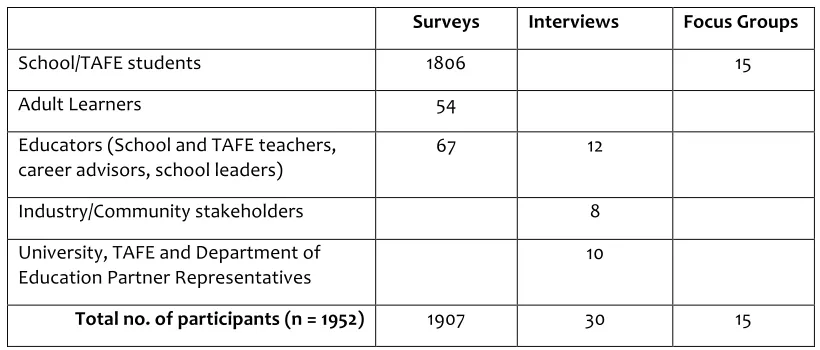
observed impacts, if any, of initiatives on participants. The evaluation received approval from the Human Research Ethics Committee (Tasmania) and the Tasmanian Department of Education. Thirty-six of the 83 Pathways to Success initiatives were targeted for evaluation over an eighteen-month period. In total, 1,952 individuals contributed to the evaluation (see Table 1).
Table 1: Participants in the Pathways to Success Evaluation by Research Method
Surveys Interviews Focus Groups
School/TAFE students 1806 15
Adult Learners 54
Educators (School and TAFE teachers,
career advisors, school leaders) 67 12
Industry/Community stakeholders 8
University, TAFE and Department of Education Partner Representatives
10
Total no. of participants (n = 1952) 1907 30 15
This paper focuses only on evaluation findings from surveys and interviews with teachers, school leaders, industry and education representatives and project team members. It explores successful and challenging aspects of developing and implementing effective career education activities/partnerships in rural and regional Tasmania that aligned with Tasmania’s industries of the future: food, advanced manufacturing, tourism and health. We acknowledge that any longer term impacts of the project on participation in further education and training will take many years to manifest.
Key Findings: Challenges and Opportunities for Rural Career Education Partnerships
Key findings from the evaluation inform how to best prepare rural students for the future world of work, in particular, how collaborative partnerships can work effectively to support educators and schools charged with this responsibility.
Developing an authentic and relevant careers curriculum
students to see links between school, industry and further education pathways. Being able to talk to teachers about industry in the language of curriculum was paramount to engaging school partners, as was being able to explain curriculum links to industry partners (Kilpatrick et al., 2002).
Teachers are time poor, in what is a packed curriculum and calendar of teaching adding more and more programs just becomes harder and harder. By being able to assist in having a program already mapped and ready to go we were actually being able to give teachers some time back. (Project Manager)
Educators acknowledged that explicit links between the curriculum and the program were not only relevant but also advantageous to students’ learning by providing a different perspective on issues offered outside the classroom environment:
It absolutely linked in what we were doing. So, for example, we had just looked at food security and ecological sustainability, and then our students were able to engage with the 24 Carrot programs and it just provided these real life links or tangible examples that were linked to the classroom but not IN the classroom, so the message was from a different more relatable angle. (Teacher #11)
Ongoing consultation with schools and partners in determining how programs could be implemented flexibly in relevant contexts as well as how best to appeal to students was identified as a key aspect of the project’s ‘partnership work’ (Clemans et al., 2005):
We identified relevant gaps or opportunities that the schools needed help with or wanted to explore…that was the success – always look at need, understand the student group and consult first(Project employee #4)
Additionally, initiatives were designed to assist students to develop general capabilities as outlined in the Australian curriculum by providing them with opportunities to apply their knowledge and skills confidently, effectively and appropriately in learning environments which mirrored work, careers and further education in the twenty-first century (ACARA, 2016). For example, students were required to use their experiences and learning from the project in an applied way through class based projects, assessments, hands on activities, portfolios and other mediums gained from their contact with local industries and businesses. Educators reported that students were able to utilise problem based learning and to develop their own skills, knowledge and creativity through exploring ‘real life’ issues affecting the local industries and workplaces they had engaged with:
The students came back and they worked for weeks after proposing things like better use of social media for agri-tourism, product development, effective marketing and branding – and we then sent these ideas back to the industries who we had visited, the students just loved it. (Teacher #32)
Developing a relevant and innovative curriculum-based model to assist in addressing schools’ need for career education was also shown to have sustainability beyond the project’s life. A number of educators spoke of embedding whole or part elements of the project into their ongoing teaching and career activities:
I have used this program, its examples, its stories and its reframing of opportunity in engaging with our kids since I was involved. (Teacher #19)
Utilising rural and regional place to enhance curriculum learning
better using community as ‘curricula resource’ (Bauch, 2001; Driscoll, 1995). Pathways to Success
delivered key elements of ‘quality career guidance’ as outlined by the Gatsby Charitable
Foundation (2014) by collaboratively developing programs which facilitated exposure and local encounters with further education and real students, workplaces, employers and employees across five industries and a diversity of different rural and regional places, spaces and environments.
Educators acknowledged that the program provided a powerful example of facilitating the movement of learning about further education, careers and industry out of the traditional classroom environment and into relevant, but non-conventional, learning spaces that better reflect the ‘real world’ (Bozick & MacAllum, 2002; Braund & Reiss, 2006; Hughes & Karp, 2006; Somerville & Yi 2002). This included using sites such as farms, aquaculture and horticulture processing sites, local businesses, botanic gardens, laboratories, community and kitchen gardens, vineyards, orchards, national parks, museums, hospitals, libraries, ships as well as university campuses and other spaces as well as the use of ‘real life’ employers, employees and other individuals that could provide relevant and relatable stories and insights:
The recent excursion that highlighted Agricultural Science as a current and prominent growth sector was a fantastic experience that generated thought and created a great network opportunity for everyone… I am compelled to pass on just how successful and valuable this experience was to our student cohort. (School Principal #1)
It offered this really real, creative and engaging approach to giving kids a message about what’s out there, that there are lots of ways of getting to an endpoint, of being successful – of breaking down stereotypes…(Teacher #7)
For industry partners, the opportunity to showcase their working environments and to share their own stories and career and training pathways was welcome and something that they had not known how to initiate:
I’ve been wanting to do more in the community to really showcase what our industry has to offer – there are so many jobs and opportunities yet we find it hard to attract young people. Reaching the next generation and talking to kids about what’s on offer was invaluable. Just having that bridge between us and schools was great, and I plan to keep this going.
(Industry Stakeholder #2)
The project was able to utilise curricula of place to deliver initiatives in two ways; one through running programs in local regions familiar to rural students, as well as running them outside their immediate communities. The former was valued by rural educators because it moved away from a deficit approach to rural communities by showcasing local employment opportunities rather than lack of employment, highlighting professional networks and educational opportunities, some of which they were previously unaware of despite them being on their doorstep:
I can honestly say that when you live in a small region, you tend to think you know everything about that area – I couldn't believe how much opportunity there was with agriculture and tourism quite literally on our doorstep/backyard…It was a real eye opener made all the better by hearing it from people who lived locally!(Teacher #8)
Pathways to Success also enabled students to safely leave their rural and regional communities to explore less familiar places like university campuses and larger urban areas as part of their school program. Educators acknowledged that this was important in providing new archives of
Some of our kids, they haven't been into CBD (Central Business District), at all, in their lives. To see light bulb moments from their involvement, to see new possibilities open up to them and build their confidence that accessing education is achievable – that needs to be
acknowledged in this program as making a difference.(School Principal #1)
Providing real life role models to students from relatable people, like meeting a teacher who had a baby when she was 16 and went back to school-they hear the stories and understand that education, training and success generally comes in all shapes, sizes- and pathways.
(Teacher #11)
While expanded learning sites alone will not alone increase higher education participation, our rural educators saw this as an important part of the complex process of widening awareness of opportunities and of students imagining themselves as participants in an urban life style (Mavelli, 2014):
Another senior teacher and I were blown away with what the program offered to our kids and the exposure it gave them that they would NEVER have had otherwise; we were incredibly impressed with it and the potential of it to impact further on how we taught our particular subjects and engaged with our kids around these ideas of ‘what’s possibly next’.
(Teacher #4)
Educators acknowledged challenges in continuing such exposure within their school beyond the life of the Pathways to Success project, including resourcing and budgets which meant it not always possible to transport students to continue such activities outside their school. However, they reported increased awareness of local industries and environments that could be harnessed for learning within their subjects and with their students in the future – both inside and outside their rural communities and observed the benefit of exposure days in assisting students to articulate a vision for their future (Mavelli, 2014).
Equipping rural educators
There is evidence that rural youth are often not given the information and skills they need to
“make an informed choice about where they wish to live and work” (Bauch, 2001, p. 204). While teachers can play a substantial role in supporting young people to make choices about their future; teachers’ own knowledge and understanding of available careers and education pathways may be limited (Hooley, Watts & Andrews, 2005).
Findings from the evaluation showed that Tasmanian educators often lacked confidence and up to date knowledge on what was available to their students locally with respect to further education, training and career opportunities and that professional development in this area was welcomed as it filled a gap.
There is so much work to be done with people whom are working in schools, they really need a broad understanding of what’s out there for students, and this program has done just that, the professional development aspect of this program has been exceptional.
(Educational Stakeholder #2)
The evaluation showed that the Look in at Jobs professional development activities which aimed to expose, promote and showcase a variety of further education and training and career
I think that program (Look in at Jobs) was one of the best PDs I’ve had in a while. Just the connection and the exposure to industry, I know my staff took a lot away from that and back to our students as well.(School Principal #2)
Rural teachers reported benefits related to industry contact and networking, discovery and understanding of careers of the future and employment pathways for their students within a local context. Many specifically commented that they had never been involved in a program of learning which provided an amalgam of perspectives on future careers and pathways:
I’ve never had an opportunity to meet with industry and understand the ‘real’ stuff going on in the local community, I was blown away by what’s happening in local areas and that there is employment there for our students. (Pathway/Career Planner #9)
Authentic contract with industry people and their world of work underpinned the success of the project for professional development. Learning about all the ‘background’ jobs related to industry that I could talk to students about. (Pathway/ Career Planner #7).
The educator survey (n = 67) also reported benefits of involvement amongst teachers, career advisors and school leaders including:
• 91% of educators agreed that the activity had given them a better understanding of the
jobs and careers available for students in Tasmania in targeted industry areas;
• 91% agreed that they had a better understanding of further education options for their
students;
• 88% agreed that they felt more confident to talk to students about education and
employment options in Tasmania and to help them make future career plans;
• 91% agreed that their participation had been beneficial to their professional knowledge
and learning in knowledge of industry, and/or pathways to higher education and/or links between industries, careers and education.
The challenges reported by educators in accessing this form of professional development were mainly pragmatic considerations including travel to and from rural communities, which took teachers’ time and required ongoing support from school leaders. New teachers also spoke of the need for universities to consider career education as part of their training of graduate teachers as many were unable to speak about disciplines in which they were not trained
themselves. The need for career planning to be better situated within the Australian curriculum and included in ongoing professional development was clearly articulated by educators in both interviews and surveys:
…teachers are often thrown in the deep end, especially the first few years out. You are just getting a sense of your own career and then being charged with assisting your students to find theirs – that can be really daunting especially if you aren’t sure and something needs to be done to support teachers to do this. (Teacher #3)
To summarise, the findings show that professional development for educators can be effective with regards to increased knowledge, understanding and confidence; and how partnerships with external collaborators such as universities and industry can be created to support this, and that this should occur as an ongoing opportunity.
Beyond a sole dependency to a partnership model of career education
collaborative approach to addressing how schools, teachers, students and community engage with young Tasmanians around further education and careers was essential:
The research will pretty clearly say that a sole dependency model for students to try and work on their futures is outdated and doesn’t work as well. (Educational Stakeholder #1) Other stakeholders spoke of the strength of Pathways to Success in bringing a range of
stakeholders together for one shared purpose which created networks for future efforts and student centred career learning:
The thing I value most about this program is that it offers a rare glimpse at how a
coordinated effort and approach to aspiration, raising awareness and imparting information realistically and creatively can make an impact – we shouldn’t be in silos, we should be working in partnership and that’s what it [Pathways to Success] has done. (Vocational Education Stakeholder #2)
School leaders understood the role and value of partnerships in the project’s efficacy in
informing students’ aspiration and post-school pathway plans acknowledging that it was almost impossible to ‘do’ effective career education alone:
We are always trying to prepare out students for life beyond [school], it’s a huge part of what we do. Pathways really compliments these messages and is an opportunity to build on the messages around future careers and planning.(School Principal #2).
Industry representatives from rural and regional areas were generally very willing to engage in the partnership. They related to the role asked of them and noted that there was much to be gained from working in the space of student aspiration and creating knowledge of education, training and careers collaboratively. For many, this was the first time they had been able to effectively interact with students and educators about their area and the opportunities it held:
I’ve just loved being able to share our story, to do some myth busting about Agriculture I guess – it’s more than being a farmer, people think there is nothing to this industry – even teachers I’ve met in the program have been surprised by what’s on their doorstep. Students I saw had these ideas about agriculture and then they got to touch see, feel and smell what we do – and it’s bringing these possibilities and seeing them realise that this industry is so much bigger than you think and so open to opportunity and success…(Industry
Stakeholder #2)
Industry saw benefits for themselves from the partnership and spoke about the importance of providing ongoing engaging opportunities to showcase opportunities within their area:
In our industry, we have a lot to offer, and I would absolutely, without thinking, offer my ongoing support to the project and any schools or students that might benefit from visiting us or from us sharing our story. (Industry Representative #3)
Discussion and Conclusion
This paper highlights how a multi-sector partnership helped move Tasmania from a sole school-based dependency model of aspiration raising and career planning to a more authentic, fit-for-the-future collaborative venture.
Pathways to Success has reinforced the potential of partnerships between schools, universities and communities to support the complex process of changing rural students’ perceptions of what is attainable and future careers though improving teacher understanding of the new world of work and educational pathways (Bourke & Jayman, 2011; Marlow 2000). This change has gone some way to addressing concerns that education systems have failed to systematically create authentic learning opportunities which facilitate and enable students to actively understand, choose and negotiate careers in the context of rapid changes in the world of work (Bozick & MacAllum, 2002; Gatsby, 2014; Hughes & Karp, 2006). Educators not only reported increased understanding of careers in industries of the future, but also, crucially, that they were better able to include relevant authentic learning experiences for their students in the curriculum because of participation in Pathways to Success.
Programs were strengthened by ‘authentic classrooms’ and learning activities that used rural communities, places and people as ‘curricula of place’ (Bauch, 2001; Driscoll, 1995; Pinar, 1998; Slattery, 1995; Theobald, 1997). Non-conventional learning settings were valued by students and educators as innovative and effective settings for creating linkages and real life examples of pathways to education and employment. The evidence presented in this paper shows that teachers valued professional development activities around careers and education pathways and reported role models to be a highly effective means to shift awareness of possible careers. There are strong indications that the model will continue. Teachers report an intention to continue using the learning activities in their teaching; industry participants have volunteered to continue and some programs have been embedded within the University, Department of Education and other organisations (University of Tasmania, 2016; Tasmanian Department of Education, 2017; Beacon Foundation, 2017). Challenges to sustainability include ensuring there are resources to provide the collaborative education- industry professional development that
teachers need; and particularly resourcing the cross-sector translation that was provided by the project team. This translation transformed industry enthusiasm to contribute to building the workforce of the future into practical programs that fitted with the curriculum and addressed the learning needs of teachers as well as students.
Acknowledgements
We acknowledge all the Pathways to Success team (2013-2016) and their invaluable contribution to the program. We acknowledge schools and industry and community/project stakeholders and partners. Special acknowledgment goes to Dr. Susan Johns, the original project evaluator.
References
Abbott-Chapman, J. (2011). Making the most of the mosaic: Facilitating post-school transitions to higher education of disadvantaged students. The Australian Educational Researcher,38(1), 57-71.
Adamson, S., Doherty, N., & Viney, C. (1998). The meaning of career revisited: implications for theory and practice. British Journal of Management, 9(4), 251-259.
Alleman, N. & Neal, H. (2013). Multiple points of contact: Promoting rural postsecondary preparation through school-community partnerships. The Rural Educator,34(2), 1-11. Appadurai, A. (2004). The capacity to aspire: Culture and the terms of recognition. In V. Rao &
M.Walton (Eds.), Culture and Public Action (pp. 59-84). California: Stanford University Press. Australian Bureau of Statistics. (2011a). Census dictionary 2011. Retrieved from
http://www.abs.gov.au/AUSSTATS/[email protected]/allprimarymainfeatures/C57A1F893D1FC495CA
2578FE001D867D?opendocument
Australian Bureau of Statistics. (2011b). Census community profiles - Tasmania. Retrieved from http://www.censusdata.abs.gov.au/census_services/getproduct/census/2011/communitypr ofile/
Australian Bureau of Statistics. (2004). Information paper: An introduction to Socio-Economic Indexes for Areas (SEIFA). Canberra, ACT: Author.
Australian Department of Employment. (2012). Skills shortage list-Tasmania. Retrieved from
https://docs.employment.gov.au/documents/skill-shortage-list-tasmania
Ballou, D., & Podgursky, M. (1995). Rural schools-fewer highly trained teachers and special programs, but better learning environment. Rural Development Perspectives, 10, 6-16. Baruch, Y. (2003). Transforming careers: from linear to multidirectional career paths. Career
Development International, 9(1), 58-73.
Baruch, Y. (2004). Managing careers: Theory and practice. Harlow: Pearson.
Bauch, P. (2001). School community partnerships in rural schools: Leadership, renewal, and a Sense of Place. Peabody Journal of Education, 76(2), 204-221.
Beacon Foundation. (2017). Collaborative classrooms. Retrieved from
https://ebeacon.net.au/collaborative-classrooms/
Beddie, F., Creaser, M., Hargreaves, J., & Ong, A. (2014). Readiness to meet demand for skills: a study of five growth industries. Adelaide: NCVER.
Belasco, A. S., & Trivette, M. J. (2015). Aiming low: Estimating the scope and predictors of postsecondary undermatch. The Journal of Higher Education, 86(2), 233-263.
Blustein, D., & Noumair, D. (2011). Self and identity in career development: Implications for theory and practice. Journal of Counseling & Development, 74(5), 433-441.
Bohn, B. (2014). College decision factors for rural students (master's thesis). Ann Arbor, United States: The College of St. Scholastica.
Bourke, A., & Jayman, A. J. (2011). Between vulnerability and risk: Promoting access and equity in a school–university partnership program. Urban Education,46(1), 76-98.
Bozick, R., & MacAllum, K. (2002). Does participation in a School-To-Career program limit educational and career opportunities? Journal of Career and Technical Education, 18(2), 30-46.
Braund, M., & Reiss, M. (2006). Towards a more authentic science curriculum: The contribution of out-of-school learning. International Journal of Science Education, 28(12), 1373-1388.
Brown, D., & Schafft, K. (2011). Rural people and communities in the 21st Century: Resilience and transformation. London: Polity.
Byun, S. Y., Meece, J. L., Irvin, M. J., & Hutchins, B. C. (2012). The role of social capital in educational aspirations of rural youth. Rural sociology, 77(3), 355-379.
Calabrese, R. (2006). Building social capital through the use of an appreciative inquiry theoretical perspective in a school and university partnership. International Journal of Educational Management,20(3), 173-182.
Chalker, D. M. (1999). Politics and decision-making: The rural scene. In D. M. Chalker (Ed.),
Christie, F. (2016). Careers guidance and social mobility in UK higher education: Practitioner perspectives. British Journal of Guidance & Counselling, 44(1), 72-85.
Clemans, A., Billett, S. & Seddon, T. (2005). Initiating, developing and sustaining social partnerships through partnership work. In J. Searle, F. Beven, & D. Roebuck (Eds.),
Vocational Learning: Transitions, Interrelationships. Partnerships and Sustainable Futures. Proceedings of the 13th annual international conference on post-compulsory education and training (pp. 94-101). Brisbane: Australian Academic Press.
Commission on Adult Vocational Teaching and Learning. (2013). It’s about work: Excellent adult vocational teaching and learning. London: LSIS.
Corbett, M. (2007). Learning to Leave. Black Point, Canada: Fernwood.
Creswell, J. W. (2013). Research design: Qualitative, quantitative, and mixed methods approaches. London: Sage Publications.
David, M. (2009). Improving learning by widening participation in higher education. London: Routledge.
DeFillippi, R. J., & Arthur, M. B. (1994). The boundaryless career: A competency based perspective. Journal of Organizational Behaviour, 15(4), 307-324.
Demi, M. A., Coleman-Jensen, A., & Snyder, A. R. (2010). The rural context and secondary school enrollment: An ecological systems approach. Journal of Research in Rural Education, 25(7), 1-26.
Driscoll, M. E. (1995). Thinking like a fish: The implications of the image of a school community for connections between parents and schools. In P. Cookson & B. Schneider (Eds.),
Tranforming schools (pp.209-236). New York: Garland.
Dei, G. J. S. (2000). Local knowledges and educational reform in Ghana. Canadian and International Education,29(1), 35-55.
Education Services Australia. (2014). Preparing secondary students for work: A framework forvocational learning and VET delivered to secondary students. Retrieved from https://cica.org.au/wp-content/uploads/Preparing-Secondary-Students-for-Work.pdf
Flora, C. B., & Flora, J. (1993). Entrepreneurial social infrastructure: a necessary ingredient. Annual of the American Academy of Political and Social Science, 529, 48-58.
Flora, C., Flora, J., & Fey, S. (2003). Rural communities: Legacy and change (2nd ed.). Boulder, CO: Westview Press.
Fitzallen, N., Barnes, R., Beswick, K., Balatti, J., Brown, N., McNaught, K., & Kilpatrick, S. (2015).
Developing pathways from vocational to higher education courses: challenges faced, conference. Australian Association for Research in Education: Freemantle, Western Australia.
Foundations for Young Australians. (2016). The new work order ensuring young Australians have skills and experience for the jobs of the future, not the past. Retrieved from
http://www.fya.org.au/wp-content/uploads/2015/08/The-New-Work-Order-FINAL-low-res-2.pdf
Frye, A., & Hemmer, P. (2012). Program evaluation models and related theories. Medical Teacher, 34, 288-299.
Gale, T., & Parker, S. (2013). Widening participation in Australia in higher education. Leicester, England: Higher Education Funding Council for England.
Gale, T., & Tranter, D. (2011). Social justice in Australian higher education policy: An historical and conceptual account of student participation. Critical Studies in Education, 52(1), 29-46. Gatsby Charitable Foundation. (2014). Good career guidance. Retrieved from
http://www.gatsby.org.uk/uploads/education/reports/pdf/gatsby-sir-john-holman-good-career-guidance-2014.pdf
ED 420 461). Charleston, United States: Clearinghouse on Rural Education and Small Schools.
Handal, B., Watson, K., Petocz, P. & Maher, M. (2013). Retaining mathematics and science teachers in rural and remote schools. Australian and International Journal of Rural Education, 23, 13-27.
Hughes, K. & Karp, M. (2006.) Strengthening Transitions by Encouraging Career Pathways: A look at State Policies and Practices. Community College Research Center, 30, 1-4.
James. R. (2001). Participation disadvantage in Australian higher education: An analysis of some effects of geographical location and socioeconomic status. Higher Education, 42(4) 455-472. James, R., Wyn, J., Baldwin, G., Hepworth, G., McInnis, C., & Stephanou, A. (1999). Rural and
isolated school students and their higher education choices: A re-examination of student location, socioeconomic background, and educational advantage and disadvantage. Melbourne: Centre for the Study of Higher Education and Youth.
Kearney, J. M. (1994). The advantages of small rural schools (Final Report to the Idaho Rural School Association) (ERIC Document Reproduction Service No. ED 373 934). Charleston, United States: Clearinghouse on Rural Education and Small Schools.
Kilpatrick, S., Johns, S., Mulford, B., Falk, I., & Prescott, L. (2002). More than an education: leadership of school-community partnerships. Canberra: Rural Industries Research and Development Corporation.
LaPointe, K. (2010). Narrating career, positioning identity: Career identity as a narrative practice.
Journal of Vocational Behavior, 77(1), 1–9.
Marlow, M. (2000). Collegiality, collaboration, and kuleana: Three crucial components for sustaining effective schools-university partnerhips. Education, 121(1), 188-196. Mavelli, L. (2014). Widening participation, the instrumentalization of knowledge and the
reproduction of inequality. Teaching in Higher Education, 19(8), 860-869.
McKrindle, M. (2017). Education in Australia: McKrindle Research Forum. Retrieved from
http://blog.mccrindle.com.au/the-mccrindle-blog/education_in_australia_mccrindle_research_future_forum_resource
MCEECDYA. (2010). The Australian blueprint for career development, prepared by Miles Morgan Australia. Canberra: Australian Government. Retrieved from www.blueprint.edu.au Mills, C. & Gale, T. (2007). “Remind me; what's the point of schooling?”: Factoring back in the influence of changing economic, political and cultural contexts. Presented at AARE 2007 International Education Research Conference, Fremantle.
Naylor, R., Baik, C., & James, R. (2013). A critical interventions framework for advancing equity in Australian higher education. Melbourne: Centre for the Study of Higher Education. Organisation for Economic Co-operation and Development. (2002). OECD Review of Career
Guidance. Paris: Author. Retrieved from
http://www.oecd.org/edu/innovation-education/1937973.pdf
Ontario Public Service. (2013). Creatingpathwaysto success: Policy and program requirements, Kindergarten to Grade 12: An education and career/life planning program for Ontario schools.
Retrieved from
http://www.edu.gov.on.ca/eng/document/policy/cps/CreatingPathwaysSuccess.
Peel, A., Peel, B., & Baker, M. (2002). School/university partnerships: a viable model, International Journal of Educational Management, 16(7), 319-325.
Pinar, W. (1998). Curriculum: Towards new identities. New York: Garland.
Sharplin, E. (2002). Rural retreat or outback hell: expectations of rural and remote teaching.
Issues in Educational Research, 12(1), 49-63.
Slattery, P. (1995). Curriculum development in the postmodern era. New York: Garland. Somerville, J. & Yi, Y. (2002). Aligning K-12 and postsecondary expectations: State policy in
transition. Washington, DC: National Association of System Heads.
State of Tasmania. (2011). Economic development plan. Hobart: State of Tasmania. Tasmanian Department of Education. (2017). My education. Retrieved from
https://my.education.tas.gov.au/Pages/default.aspx
Theobald, P. & Nachtigal, P. (1995). Culture, community and the promise of rural education. Phi Delta Kappan, 77, 132-135.
Tompkins, R. & Deloney, P. (1994). Rural students at risk in Arkansas, Louisiana, New Mexico, Oklahoma, and Texas. Austin, TX: Southwest Educational Development Laboratory. Trusty, J., Ng, K. & Plata, M. (2000). Interaction Effects of Gender, SES, and Race-Ethnicity on
Postsecondary Educational Choices of U.S. Students. The Career Development Quarterly, 49(1), 45–59.
University of Tasmania. (2016). Creating my career in northern Tasmania. Retrieved from
http://www.utas.edu.au/latest-news/utas-homepage-news/creating-my-career-in-northern-tasmania
Warren, L., & Peel, H. (2005). Collaborative model for school reform through a rural school/university partnership. Education,126(2), 346-352.
Webb, S., Black, R., Morton, R., Plowright, S., & Roy, R. (2015). Geographical and place dimensions of post-school participation in education and work. Adelaide: NCVER.