Volume 2012, Article ID 780637,14pages doi:10.1155/2012/780637
Research Article
Goal-Programming-Driven Genetic
Algorithm Model for Wireless Access Point
Deployment Optimization
Chen-Shu Wang
1and Ching-Ter Chang
21Graduate Institute of Information and Logistics Management, National Taipei University of Technology,
Taipei 10608, Taiwan
2Department of Information Management, Chang Gung University, Tao Yuan 333, Taiwan
Correspondence should be addressed to Chen-Shu Wang,[email protected]
Received 24 February 2012; Accepted 8 May 2012 Academic Editor: Jung-Fa Tsai
Copyrightq2012 C.-S. Wang and C.-T. Chang. This is an open access article distributed under
the Creative Commons Attribution License, which permits unrestricted use, distribution, and reproduction in any medium, provided the original work is properly cited.
Appropriate wireless access point deploymentAPD is essential for ensuring seamless user
communication. Optimal APD enables good telecommunication quality, balanced capacity loading, and optimal deployment costs. APD is a typical NP-complex problem because improving
wireless networking infrastructure has multiple objectivesMOs. This paper proposes a method
that integrates a goal-programming-driven modelPMand a genetic algorithmGAto resolve
the MO-APD problem. The PM identifies the target deployment subject of four constraints: budget, coverage, capacity, and interference. The PM also calculates dynamic capacity requirements to replicate real wireless communication. Three experiments validate the feasibility of the PM. The results demonstrate the utility and stability of the proposed method. Decision makers can easily refer to the PM-identified target deployment before allocating APs.
1. Introduction
Appropriate wireless access point deploymentAPDis essential for ensuring seamless user communication. Optimal APD enables good telecommunication quality, balanced capacity loading, and optimal deployment costs. APD is a typical NP-complex problem1because it involves multiple decision objectives, such as budget2–4, coverage2,5–8, interference
3,4,7, and dynamic capacity1,4,6–9. Furthermore, these objectives usually contradict each other7. For example, the number of APs is usually positively related to the wireless signal coverage rate and telecommunication reliability 1. However, more APs increase deployment costs. These conflicting criteria should be considered simultaneously when solving APD problems9,10.
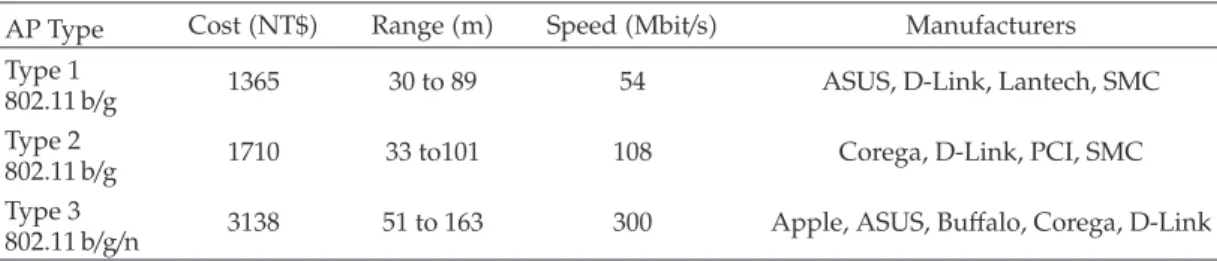
Table 1: A comparison of the three wireless AP types.
AP Type CostNT$ Rangem SpeedMbit/s Manufacturers
Type 1
802.11 b/g 1365 30 to 89 54 ASUS, D-Link, Lantech, SMC
Type 2
802.11 b/g 1710 33 to101 108 Corega, D-Link, PCI, SMC
Type 3
802.11 b/g/n 3138 51 to 163 300 Apple, ASUS, Buffalo, Corega, D-Link
In the last decade, many studies have attempted to solve APD optimally by considering multiple objectives MOs. There are four main objectives: budget, coverage rate, capacity, and interference. Studies have attempted to identify maximal coverage. For example, Huang et al. developed a growth-planning algorithm to establish the maximal coverage range11. Zhao et al. used a point-to-point signal strength strategy to implement indoor AP location optimization for maximal coverage12. For the capacity objective, the capacity requirements of wireless networks compared to wired networks are particularly difficult to evaluate because users are dynamic and can move from place to place. This makes APD a dynamic and complex problem. The dynamic capacity requirement must be addressed to resolve APD 13 because users can access particular APs to balance loads 9, 14. Finally, for the interference objective, too many APs of the same type and placed too close together may cause AP malfunction because of frequency interference. To avoid communication interference, some studies 6, 15 have suggested that APs should be arranged on different communication channels, but this leads to other communication channel assignment problems.
This paper applies a goal-programming-driven modelPMto the MO-APD problem. It uses goal programmingGPto infer and model the PM and a genetic algorithmGAto search for near optimal solutions. These methods are easily applied to MO-APD problems to reflect real situations. The remainder of this paper is organized as follows:Section 2defines the problem; Section 3details the PM;Section 4 presents a discussion on the PM solution process using a GA;Section 5provides the results of numerical experiments which are given in this section; lastly,Section 6offers a conclusion and suggestions for future research.
2. Description of the APD Problem
This research resolves the MO-APD problem according to four decision constraints: budget, coverage, capacity requirements, and interference. The PM identifies a feasible target deploymentT, which consists of three types of wireless APs, as shown inTable 1. This study conducted experiments and surveys that indicate that the coverage range and communication speed of a Type 3 AP are wider and faster, respectively, than AP Types 1 and 2. However, Type 1 AP equipment is cheaper than AP Types 2 and 3. Two APs may interfere with each other if they are the same type and are too near. Therefore, the PM must balance the four decision con-straints and allocate three AP types in the target deployment of the APD problem.Table 2lists the variables used in the proposed models.
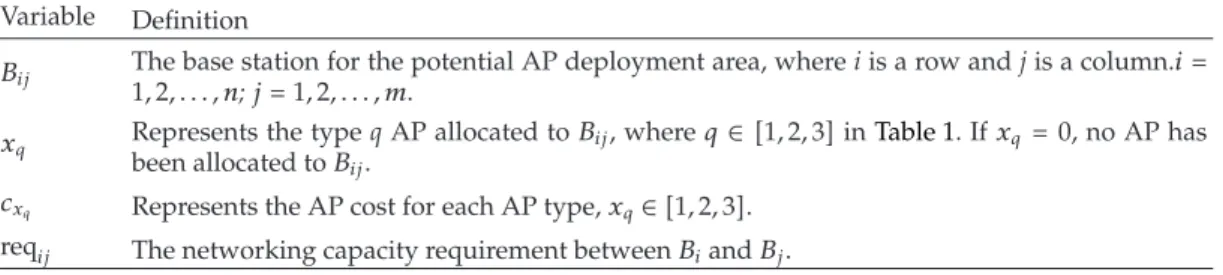
Table 2: Variables used in this paper.
Variable Definition
Bij The base station for the potential AP deployment area, where i is a row and j is a column.i
1,2, . . . , n;j1,2, . . . , m.
xq Represents the type q AP allocated toBij, whereq∈1,2,3inTable 1. Ifxq0, no AP has
been allocated toBij.
cxq Represents the AP cost for each AP type,xq∈1,2,3.
reqij The networking capacity requirement betweenBiandBj.
2.1. The Budget Constraint
θT
Budget is the most important APD-MO constraint that directly affects the feasibility ofT. The cost function in2.1evaluates the total cost ofT. Equation2.2evaluates the budget constraint. In2.2, bgt represents the given budget constraint for the AP allocation forT:
CSTT
i
j
CxqBi,j, ∀Xq/0, i1,2, . . . , n, j 1,2, . . . , m, 2.1
if CSTT<bgt, θT 1, elseθT bgt
CSTT.
2.2
2.2. The Coverage Constraint
ΦT
Figure 1 shows that to enable seamless user communication, two APs are allocated, but two capacity requirementsreq2,1and req2,3have no signal coverage. The coverage function
CVGT evaluates the signal coverage area ofT. Equation 2.3 evaluates the coverage fulfillment rate:
ΦT CVGT
target area. 2.3
2.3. The Capacity Constraint
ΨT
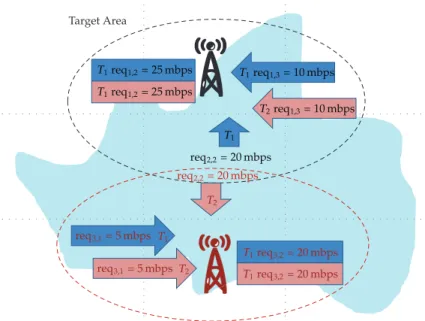
Figure 2shows a dynamic capacity scenario. The target area allocates two Type 1 APsAP1
and AP2, and two APs simultaneously cover the capacity requirementsreq22. For time
slot 1T1, the capacity requirements of req12,req13,and req22 access AP1, and the capacity
requirements of req31 and req32 access AP2. Therefore, for time slotT1, AP1 and AP2 must
provide 55 and 25 mbit/s capacity, respectively. In time slotT2, req22 shifts connection from
AP1 to AP2 for balance loading. Therefore, for time slot T2, AP1 and AP2 must provide 35
req req req
req req req
req
req req
Target Area
1,1 1,2
1, m
2,1 2,2 2, m
n,1
n,2 3,3
Figure 1: The signal coverage illustration.
Target Area
T1
T1 req1,2=25 mbps T1
T1 req1,2=25 mbps
T1req1,3=10 mbps T2
T2
T2
req1,3=10 mbps
req3,1=5 mbps
req3,1=5 mbps
T1req3,2=20 mbps
T1req3,2=20 mbps
req2,2=20 mbps
req2,2=20 mbps
Figure 2: The dynamic capacity requirements of two APs. The blue area represents time slot 1T1and the
pink area represents time slot 2T2.
A Monte Carlo simulation algorithm—that simulates the capacity of T—implements the DCPijTfunction. Equation2.4evaluates the capacity fulfillment rate:
if DCPijT>reqij, ΨT 1, i1,2, . . . , n; j1,2, . . . , m,
elseΨT DCPijT reqij .
Target Area
B2,2
B1,1 B1,2 B1,m
B2,1 B2,m
Bn,1
Bn,2
B3,3 Type 1 AP
Type 1 AP
Type 2 AP
Figure 3: The frequency interference illustration.
2.4. The Interference Constraint
ωT
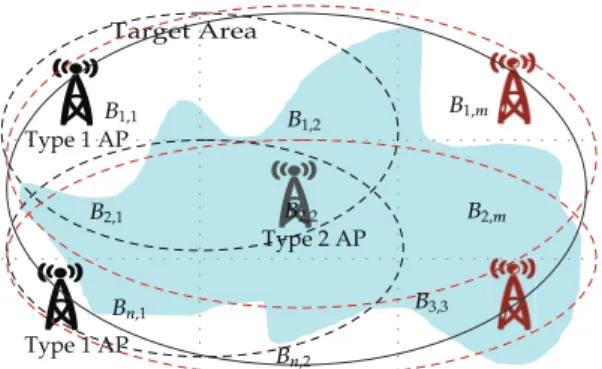
Figure 3 shows that many Type 1 APs are used to maximize coverage and capacity of T because of budget constraints. However, too many APs of the same type and allocated too near to each other may lead to AP malfunction because of AP frequency interference. For example, Figure 3 shows a perfect coverage design. However, it also shows an increased interference rate. The interference function IFTT evaluates the interference area of T.
Equation2.5evaluates the interference fulfillment rate:
ωT 1− IFTT
target area. 2.5
3. Proposed Model to Solve MO-APD
Two main approaches can be used to formulate MO-APD. One approach is the cost-oriented approach, which aims to minimize total cost subject to MO performance constraints. This study formulated MO-APD using the cost-oriented approach as shown in Proposal 1 P1. GAL-CVG, GAL-CP, and GAL-IFT are the given constraints for coverage rate, capacity fulfillment rate, and interference fulfillment rate, respectively.
P1
Min CSTT≤bgt, 3.1
subject to
ΦT≥GAL−CVG, 3.2
ΨT≥GAL−CP, 3.3
Equations3.2–3.4are the coverage, capacity, and interference constraints. Equation
3.1is the objective function, which minimizes the total cost subject to multiple decision constraints3.2–3.4.
The second approach is performance oriented, and it maximizes the performance of target deployment subjects to real constraintse.g., budget. This study reformulated the MO-APD using the performance-oriented method, shown in Proposal 2P2.
P2
MaxΦT ΨT ωT, 3.5
subject to3.1–3.4.
Equation3.5is the objective function in P2, which maximizes the coverage, capacity fulfillment, and interference fulfillment rates of T subject to budgetary 3.1 and other decision constraints 3.2–3.4. GP aids MO decision-making problem modeling. It was first introduced by Charnes and Cooper 16and further developed by Tamiz et al. 17, Romero18, and Chang19. Various types of GP approaches exist, such as lexicographic GP, weighted GP, MINMAXChebyshevGP, and multichoice GP19. To enable decision makers to easily set the constraint weighting according to their preferences, this study used a weighted GP approach to translateP2into the PM.wcvg,wcp, and wIFTare the
important weightsbetween 0 and 1for the GAL-CVG, GAL-CP, and GAL-IFT constraints, respectively.
PM
Min Wbgt
bgtWcvg
cvg−Wcp
cp−WIFT
IFT−, 3.6
subject to
CSTT−bgtbgt−bgt, 3.7
ΦT−cvgcvg−GAL−CVG, 3.8
ΨT−cpcp−GAL−CP, 3.9
ωT−IFTIFT−GAL−IFT, 3.10 bgt,bgt−,cvg,cvg−,cp,cp−,IFT,IFT−≥0. 3.11
4. Process for Solving the PM Using a GA
The GA is a stochastic searching method that uses the mechanics of natural selection to solve optimization problems. The GA was developed from the theory of natural selection
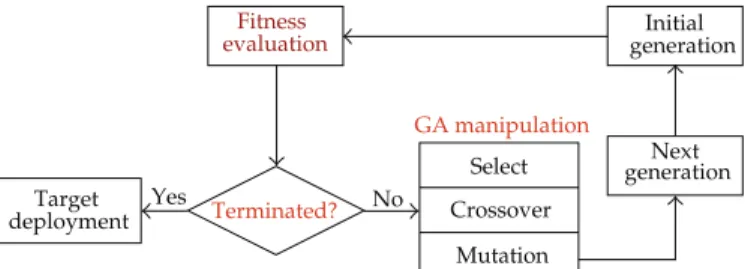
20. Because the GA is a good stochastic technique for solving combinatorial optimization problems, this study uses the GA as the PM search tool, as shown inFigure 4.
An initial solution population is randomly created. The fitness of each individual in the population then determines whether it survives. Termination criteriasuch as the generation size or the fitness value exceeding the thresholddetermine the target deploymentTto be achieved. Finally, genetic operators such as selection, crossover, and mutation identify the
Initial generation
Terminated?
Select Crossover
Mutation
GA manipulation
Target deployment
No Yes
Fitness evaluation
Next generation
Figure 4: GA-based PM solution process.
next generation. After meeting a number of iterations or predefined criteria, a near optimal solution is found.
4.1. Representation Structure: Encode/Decode
A graph represents a target deploymentTthat can also be expressed as a two-dimensional matrix. In the graph, each potential base stationBi,jhas two states: APBi,j 1allocated
and no APBi,j 0allocated. A base station with an allocated AP must have an AP type
xq 1,2,3.n×mbit strings were used as chromosomes to representT :
T
⎡ ⎢ ⎢ ⎢ ⎣
B1,1 B1,2 · · · B1,m
B2,1 B2,2 · · · B2,m
..
. ... ... ...
Bn,1 Bn,2 · · · Bn,m
⎤ ⎥ ⎥ ⎥
⎦. 4.1
4.2. Evaluation Function
The PM objective functionFiwas used as a GA evaluation function in4.2. All variables in4.2are defined as in the PM:
Fi Wbgt
bgtWcvg
cvg−Wcp
cp−WIFT
IFT−. 4.2
4.3. GA Manipulations
1Selection: roulette wheel selection ensures that highly fit chromosomes produce
more offspring. This method selects a candidate network according to its survival probability, which is equal to its fitness relative to the whole population, as shown in4.3:
Fi
F
i
. 4.3
2Crossover: the crossover method randomly selects two chromosomes from the
4 8 3 10 5 7 10 6 8 10
7 9 5 1 3 1 6 2 2 9
0 2 5 6 5 6 4 5 3 8
6 1 8 7 5 4 9 6 2 6
0 4 7 7 8 8 10 8 3 3
10 6 8 1 4 4 6 8 9 5
4 1 9 2 8 0 8 2 7 4
3 9 2 5 8 7 1 4 8 9
8 2 7 4 4 5 8 8 10 7
6 1 9 0 6 1 5 4 6 6
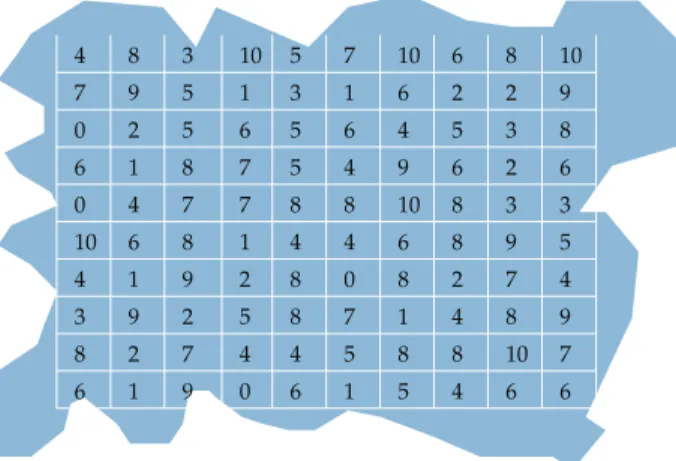
Figure 5: Capacity requirements for Experiment 1.
1, n×m. Two new chromosomes, called offspring, are then obtained by swapping all characters between positionCandn×m.
3Mutation: the combined reproduction and crossover methods occasionally lose
potentially useful chromosome information. Mutation is introduced to overcome this. It is implemented by randomly complementing a bit0 to 1 and vice versa. This ensures that good chromosomes are not permanently lost.
5. Experiment Validation and Analysis
To validate the efficiency and feasibility of the PM at resolving APD problems, three experiments were designed and implemented. Experiment 1 included four subtests to validate parameter combination types consisting of different decision variables. Experiment 2 included two subtests to confirm the ability of the PM to solve dynamic capacity problems. Experiment 3 ensured that the PM is suitable for large-scale problems and tested the GA parameter effects.
5.1. Experiment 1: Decision Variable Combination Validation
Four subtests consisting of different decision variables and important weights validated the ability of the PM to solve APD problems. The target area inFigure 5is a 90 km2 irregularly
shaped area. The capacity requirements inFigure 5were identical for all subtests. All reqij could move around the target area, where signal coverage was present. For comparative purposes, the GA parameters of the four subtests—population size600, terminated gen-eration500, crossover rate0.4, and mutation rate0.1—were fixed.Table 3lists the other decision variables.
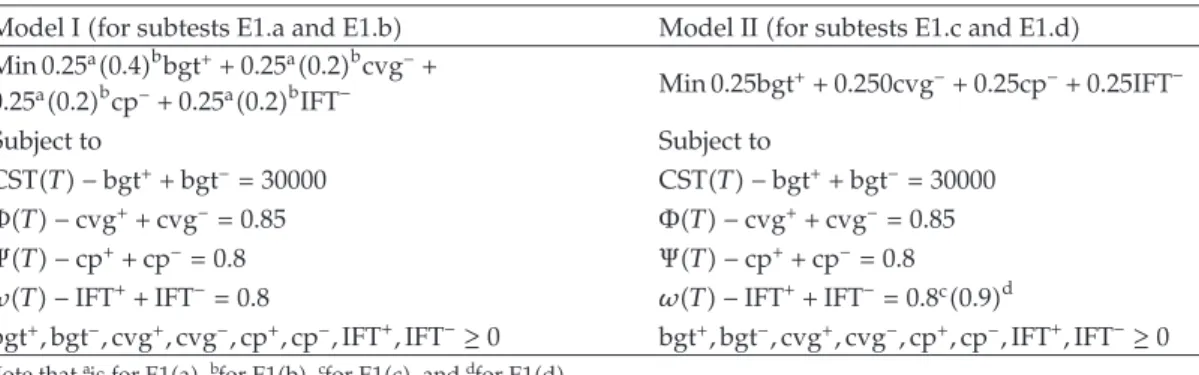
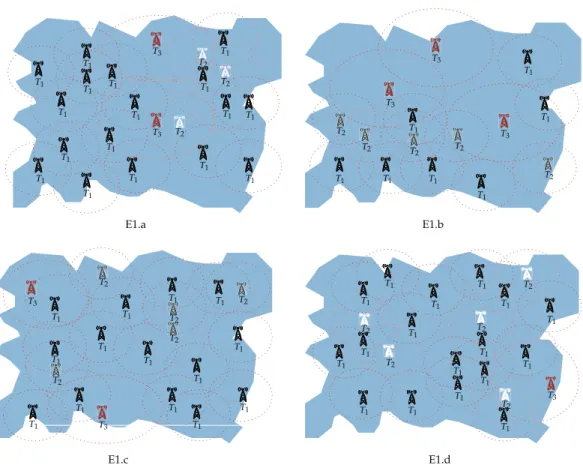
Table 4shows the four subtests formulated as Model I and Model II according to the PM. To avoid the randomizing effect of the GA, all subtests were run three times with the same parameters on the same machine. The result averages are reported.Table 5shows the analysis of the experiment results. The E1.a and E1.b results show that the important budget weight is less in E1.b than in E1.a. Therefore, only 15 APson averageare deployed for E1.b,
Table 3: Decision variables and import weights for four subtests in Experiment 1.
Decision variable E1.a E1.b E1.c E1.d
Budget 30000Wbgt.25 30000Wbgt.40 35000Wbgt.25
Coverage rate 85%Wcvg.25 85%Wcvg.20 85%Wcvg.25
Capacity fulfillment rate 80%Wcp.25 80%Wcp.20 80%Wcp.25
Interference fulfillment rate 80%WIFT25 80%WIFT.20 80%WIFT25 90%WIFT25
Note that important weights are marked in parentheses.
Table 4: Model I and Model II for resolving the four subtests.
Model Ifor subtests E1.a and E1.b Model IIfor subtests E1.c and E1.d
Min 0.25a0.4bbgt0.25a0.2bcvg−
0.25a0.2bcp−0.25a0.2bIFT− Min 0.25bgt0.250cvg−0.25cp−0.25IFT−
Subject to Subject to
CSTT−bgtbgt−30000 CSTT−bgtbgt−30000
ΦT−cvgcvg−0.85 ΦT−cvgcvg−0.85
ΨT−cpcp−0.8 ΨT−cpcp−0.8
ωT−IFTIFT−0.8 ωT−IFTIFT−0.8c0.9d
bgt,bgt−,cvg,cvg−,cp,cp−,IFT,IFT−≥0 bgt,bgt−,cvg,cvg−,cp,cp−,IFT,IFT−≥0
Note thatais for E1a,bfor E1b,cfor E1c, anddfor E1d.
Table 5: Analysis of the results of Experiment 1.
Indicator E1.a E1.b E1.c E1.d
Fitness .9534 .9420 .9568 .9567
Times 160.0993 160.106 159.0593 170.4233
Cost 36954 29360 34647 34694
Coverage rate .85 .6967 .8167 .8233
Capacity fulfillment rate .8490 .6981 .8189 .8269
Interference fulfillment rate .94 .9867 .94 .99
Number of APs 22 15 21 23
as shown inFigure 6. The results also show that the decision maker must either increase the budget or adjust the other decision objectives. For example, E1.b shows that the coverage and capacity fulfillment rates can only reach 0.7 at the current budget. As the budget increases from 30000in E1.bto 35000in E1.c and E1.d, the number of APs deployed increases to 22on average. The coverage and capacity rates increase from 0.7 in E1.b to 0.82 in E1.c and E1.d. E1.d deployed more APs23at a lower cost than E1.a22 APs.Figure 6shows that the APs in E1.c and E1.d are spread evenly in the target area to avoid interference.Figure 7 shows the convergence trends for all subtests.T emerges after 100–150 iterations.
5.2. Experiment 2: Dynamic Capacity Requirement Validation
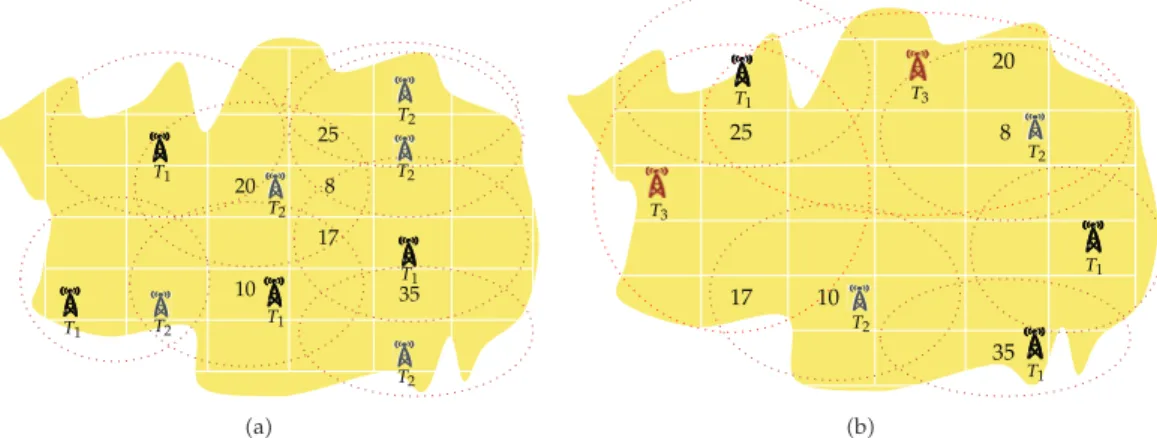
Experiment 2 consisted of two subtests to validate the ability of the PM to resolve dynamic capacity requirements.Figure 6ashows that in subtest E2.a, most capacity requirements are in the central area of the target32 km2.Figure 6bshows that in subtest E2.b, the capacity
T1
T1 T1
T1
T1
T1
T1
T1
T1 T1
T1 T1 T1 T1 T1 T1
T1 T2
T2 T2 T3 T3 T T T T T T T T1 T1 T1 T1 T1 T1 T1 T2 T2 T2 T2
T2 T3
T3 T3 T1 T1 T1 T1 T1 T1 T1 T1 T1 T1 T1 T1 T1 T1 T2 T2 T2 T2 T2 T3 T3 T1 T1 T1 T1 T1 T1 T1 T1 T1 T1 T1
T1 T1
T1 T1 T1 T1 T2 T2 T2 T2 T2 T3 E1.a E1.b E1.c E1.d
Figure 6: AP deployment results for the four subtests in Experiment 1.
Table 6: Decision variable and important weights for Experiment 2.
Decision variable Variable value
Budget 15000Wbgt.3
Coverage rate 85%Wcvg.15
Interference fulfill rate 85%WIFT.15
Capacity fulfill rate 95%Wcp.4
Note that the important weights are marked in parentheses.
requirements are scattered in the corners of the target area.Table 6shows that the capacity requirements and all default decision variables are identical for both tests. The GA param-eters—population size600, terminated generation500, crossover rate0.4, and mutation rate0.1—were fixed to enable result comparison. To avoid random GA effects, all subtests were run three times with the same parameters on the same machine. The result averages are reported.
Table 7shows the experiment results analysis. As expected, APD follows the capacity requirements, as shown in Figures8aand8b. Figures8aand8balso show that APs are more central in E2.a than in E2.b to fulfill the capacity requirements. Although the capacity requirements are the same in both experiments, E2.a requires nine APs, which is more than
0 100 200 300 400 500 0.84
0.86 0.88 0.9 0.92 0.94 0.96
Generations
Fitness value
E1.a E1.b
E1.c E1.d
Figure 7: The convergence trends for the four subtests in Experiment 1.
25
20 8
17
10 35T1
T1
T1
T1
T2
T2
T2
T2
T2 a
20
25 8
17 10
35
T1
T1
T1
T2
T2
T3
T3
b
Figure 8: The capacity requirement and results of Experiment 2 forasubtest E2.a andbsubtest E2.b. The numbers represent the capacity requirements.
E2.bseven APs. Therefore, capacity requirements are dynamic, andTrequires more APs to manage the capacity requirement increase in E2.a.
5.3. Experiment 3: The Effect of Large-Scale Problems and
GA Parameters on Validation
Two subtests of Experiment 3 were designed as large-scale problems.Table 8lists the decision variables and the important weights. Experiment 3 also tested GA parameter combinations, including crossover and mutation rates.
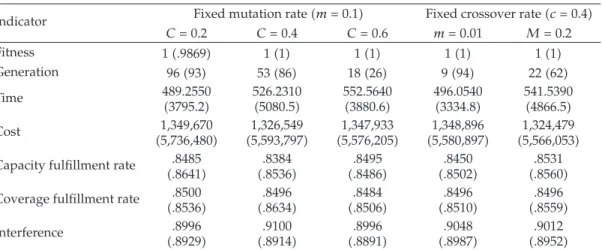
The results analysis in Table 9 shows that the PM is more sensitive to crossover rate. Generation—as an evaluation indicator for subtests E3.a and E3.b—shows that feasible deployment can be reached in the following order of crossover rates: 0.6converged by 22 iterations, 0.4converged by 70 iterations, and 0.2converged by 95 iterations. However, no such pattern exists for mutation rate in either test. Therefore, a crossover rate of 0.4 and
Table 7: Analysis of the results of Experiment 2.
Indicator E2.a E2.b
Fitness 1 1
Times 5.1883 4.7797
Cost 14387 14068
Coverage rate .8518 .8518
Capacity fulfillment rate 1 1
Interference fulfillment rate .9815 .9259
Number of APs 9 APs 7 APs
Table 8: Decision variables and important weights for Experiment 3.
Objective E3.a E3.b
Target area 2250 km2 90000 km2
BudgetWbgt.55 1350 000 5650000
Coverage rateWcvg.15 85% 85%
Capacity and interference fulfillment ratesWcpWIFT0.15 80% 80%
Note that the capacity requirements are shown in the Appendix and the important weights are marked in parentheses.
Table 9: Analysis of the results of Experiment 3.
Indicator Fixed mutation ratem0.1 Fixed crossover ratec0.4
C0.2 C0.4 C0.6 m0.01 M0.2
Fitness 1.9869 11 11 11 11
Generation 9693 5386 1826 994 2262
Time 489.2550 3795.2 526.2310 5080.5 552.5640 3880.6 496.0540 3334.8 541.5390 4866.5 Cost 1,349,670 5,736,480 1,326,549 5,593,797 1,347,933 5,576,205 1,348,896 5,580,897 1,324,479 5,566,053
Capacity fulfillment rate .8485
.8641 .8384 .8536 .8495 .8486 .8450 .8502 .8531 .8560
Coverage fulfillment rate .8500
.8536 .8496 .8634 .8484 .8506 .8496 .8510 .8496 .8559 Interference .8996
.8929 .9100.8914 .8891.8996 .9048.8987 .9012.8952
The experiment results for E3bare in parentheses.
a mutation rate of 0.1 are recommended for experiment implementation to avoid GA parameter effects. The results inTable 9show that large-scale problemsE3.bcan be resolved within an acceptable time4191.52 s, approximately 1 h.
6. Conclusion
Optimal wireless LANWLANdesign is important to ensure seamless user communication. Appropriately locating wireless APs for WLANs is important. Optimal APD enables high telecommunication quality, balanced capacity loading, and optimal deployment costs. This study proposes a GP-driven model integrated with a GA to solve MO-APD subject to four constraints: budget, capacity, interference, and coverage. The experiment results show that
Figure 9: Capacity requirements for Experiment 3.a.
the PM resolves many APD problems and achieves dynamic capacity replication. Results confirm the ability of the PM to solve large-scale APD problems. Future research should focus on other applications and further verification of PM.
Appendix
Figure 9shows the capacity requirement for the E3.a subtest.
References
1 N. Weicker, G. Szabo, K. Weicker, and P. Widmayer, “Evolutionary multiobjective optimization for
base station transmitter placement with frequency assignment,” IEEE Transactions on Evolutionary
Computation, vol. 7, no. 2, pp. 189–203, 2003.
2 A. Mc Gibney, M. Klepal, and D. Pesch, “Agent-based optimization for large scale WLAN design,”
IEEE Transactions on Evolutionary Computation, vol. 15, no. 4, pp. 470–486, 2011.
3 L. Liao, W. Chen, C. Zhang, L. Zhang, D. Xuan, and W. Jia, “Two birds with one stone: wireless access
point deployment for both coverage and localization,” IEEE Transactions on Vehicular Technology, vol. 60, no. 5, pp. 2239–2252, 2011.
4 K. P. Scheibe and C. T. Ragsdale, “A model for the capacitated, hop-constrained, per-packet wireless
mesh network design problem,” European Journal of Operational Research, vol. 197, no. 2, pp. 773–784, 2009.
5 K. Collins, S. Mangold, and G. M. Muntean, “Supporting mobile devices with wireless LAN/MAN
in large controlled environments,” IEEE Communications Magazine, vol. 48, no. 12, pp. 36–43, 2010.
6 A. Hills, “Large-scale wireless LAN design,” IEEE Communications Magazine, vol. 39, no. 11, pp. 98–
7 K. Jaffr`es-Runser, J. M. Gorce, and S. Ub´eda, “Mono- and multiobjective formulations for the indoor wireless LAN planning problem,” Computers and Operations Research, vol. 35, no. 12, pp. 3885–3901, 2008.
8 R. Whitaker and S. Hurely, “Evolution of planning for wireless communication systems,” in
Proceed-ings of the 36th Hawaii International Conference on System Sciences, p. 10, January 2003.
9 J. H. Lee, B. J. Han, H. J. Lim, Y. D. Kim, N. Saxena, and T. M. Chung, “Optimizing access point
allo-cation using genetic algorithmic approach for smart home environments,” Computer Journal, vol. 52, no. 8, pp. 938–949, 2009.
10 I. E. Liao and K. F. Kao, “Enhancing the accuracy of WLAN-based location determination systems
using predicted orientation information,” Information Sciences, vol. 178, no. 4, pp. 1049–1068, 2008.
11 X. Huang, U. Behr, and W. Wiesbecd, “Automatic cell planning for a low-cost and spectrum efficient
wireless network,” in Proceedings of the IEEE Global Telecommunications Conference (GLOBECOM ’00), vol. 1, pp. 282–276, December 2000.
12 Y. Zhao, H. Zhou, and M. Li, “Indoor access points location optimization using Differential
Evolution,” in Proceedings of the International Conference on Computer Science and Software Engineering
(CSSE ’08), pp. 382–385, December 2008.
13 J. H. Lee, B. J. Han, H. K. Bang, and T. M. Chung, “An optimal access points allocation scheme based
on genetic algorithm,” in Proceedings of the International Conference on Future Generation Communication
and Networking (FGCN ’07), pp. 55–59, December 2007.
14 F. Guo and T. C. Chiueh, “Scalable and robust WLAN connectivity using access point array,” in
Proceedings of the International Conference on Dependable Systems and Networks, pp. 288–297, July 2005.
15 X. Ling and K. L. Yeung, “Joint access point placement and channel assignment for 802.11 wireless
LANs,” IEEE Transactions on Wireless Communications, vol. 5, no. 10, pp. 2705–2711, 2006.
16 A. Charnes and W. W. Cooper, Management Model and Industrial Application of Linear Programming, vol.
1, Wiley, New York, NY, USA, 1961.
17 M. Tamiz, D. Jones, and C. Romero, “Goal programming for decision making: an overview of the
current state-of-the-art,” European Journal of Operational Research, vol. 111, no. 3, pp. 569–581, 1998.
18 C. Romero, “Extended lexicographic goal programming: a unifying approach,” Omega, vol. 29, no. 1,
pp. 63–71, 2001.
19 C. T. Chang, “Revised multi-choice goal programming,” Applied Mathematical Modelling, vol. 32, no.
12, pp. 2587–2595, 2008.
Submit your manuscripts at
http://www.hindawi.com
Hindawi Publishing Corporation
http://www.hindawi.com Volume 2014
Mathematics
Journal ofHindawi Publishing Corporation
http://www.hindawi.com Volume 2014 Mathematical Problems in Engineering
Hindawi Publishing Corporation http://www.hindawi.com
Differential Equations International Journal of
Volume 2014
Hindawi Publishing Corporation
http://www.hindawi.com Volume 2014 Hindawi Publishing Corporationhttp://www.hindawi.com Volume 2014
Hindawi Publishing Corporation
http://www.hindawi.com Volume 2014
Mathematical PhysicsAdvances in
Complex Analysis
Journal of Hindawi Publishing Corporationhttp://www.hindawi.com Volume 2014
Optimization
Journal ofHindawi Publishing Corporation
http://www.hindawi.com Volume 2014
Combinatorics
Hindawi Publishing Corporation
http://www.hindawi.com Volume 2014
International Journal of Hindawi Publishing Corporation
http://www.hindawi.com Volume 2014
Journal of
Hindawi Publishing Corporation
http://www.hindawi.com Volume 2014
Function Spaces
Abstract and Applied Analysis Hindawi Publishing Corporation
http://www.hindawi.com Volume 2014
International Journal of Mathematics and Mathematical Sciences
Hindawi Publishing Corporation http://www.hindawi.com Volume 2014
The Scientific
World Journal
Hindawi Publishing Corporation
http://www.hindawi.com Volume 2014
Hindawi Publishing Corporation
http://www.hindawi.com Volume 2014
Discrete Dynamics in Nature and Society
Hindawi Publishing Corporation
http://www.hindawi.com Volume 2014
Hindawi Publishing Corporation
http://www.hindawi.com Volume 2014
Discrete Mathematics
Journal ofHindawi Publishing Corporation
http://www.hindawi.com Volume 2014 Hindawi Publishing Corporationhttp://www.hindawi.com Volume 2014