The Pediatric Infectious Disease Journal Publish Ahead of Print DOI: 10.1097/INF.0000000000001539
Early Antiretroviral Therapy Initiation and Mortality Among Infants Diagnosed with HIV in the First 12 Weeks of Life: Experiences from Kinshasa, DR Congo and Blantyre, Malawi
Anna Sheahan, PhDa, Lydia Feinstein, PhDb, Queen Dube, MDc, Andrew Edmonds, PhDd, Chawanangwa Mahebere Chirambo, BSe, Emily Smith, PhDf, Frieda Behets, PhDg, Robert Heyderman, FRCP, PhDh, and Annelies Van Rie, MD, PhDi
Corresponding author: Anna Dow Sheahan, [email protected], 919 302 7867 ABBREVIATED TITLE: Early Infant HIV Diagnosis in Malawi and DR Congo RUNNING HEAD: HIV Diagnosis and Treatment
a
Department of Epidemiology, Gillings School of Global Public Health, University of North
Carolina at Chapel Hill, Chapel Hill, NC, USA;
b
Department of Epidemiology, Gillings School of Global Public Health, University of North
Carolina at Chapel Hill, Chapel Hill, NC, USA c
Department of Pediatrics & Child Health, Queen Elizabeth Central Hospital, Blantyre, Malawi;
d
Department of Epidemiology, Gillings School of Global Public Health, University of North
Carolina at Chapel Hill, Chapel Hill, NC, USA;
e
Malawi-Liverpool-Wellcome Trust Clinical Research Programme, University of Malawi
College of Medicine, Blantyre, Malawi;
f
Department of Epidemiology, Gillings School of Global Public Health, University of North
Carolina at Chapel Hill, Chapel Hill, NC, USA;
g
Department of Epidemiology, Gillings School of Global Public Health, University of North
Carolina at Chapel Hill, Chapel Hill, NC, USA;
h
Malawi-Liverpool-Wellcome Trust Clinical Research Programme, University of Malawi
College of Medicine, Blantyre, Malawi; Division of Infection and Immunity, University College
London;
i
Department of Epidemiology, Gillings School of Global Public Health, University of North
Carolina at Chapel Hill, Chapel Hill, NC, USA, and Department of Epidemiology and Social
Medicine, Faculty of Medicine and Health Sciences, University of Antwerp, Antwerp, Belgium;
KEYWORDS: Prevention of mother-to-child HIV transmission (PMTCT); Pediatric HIV; Early Infant Diagnosis (EID); Early Infant ART (EIART); Antiretroviral therapy
FUNDING: Research supported by the National Institutes of Health Fogarty International Center and NICHD under Award Number R01HD053216. The Malawi-Liverpool-Wellcome
Trust is supported by a Strategic Award from the Wellcome Trust, UK. L.F. was supported by a
National Institutes of Health training grant (grant numbers 2T32AI070114-06,
5T32AI070114-07). The UNC-DRC program was funded by the Centers for Disease Control and Prevention and
the President's Emergency Plan for AIDS Relief, with additional support from the Elizabeth
Glaser Pediatric AIDS Foundation, the Belgian Development Cooperation, the William J.
Clinton Foundation, the United Nations Children's Fund, and the Global Fund to Fight AIDS,
Tuberculosis, and Malaria. The sites in Kinshasa were established as part of a partnership
between the Kinshasa School of Public Health and the DRC National AIDS Program with
Background: Based on clinical trial results, the WHO recommends infant HIV testing at age
4-6 weeks and immediate antiretroviral therapy (ART) initiation in all HIV-infected infants. Little is
known about the outcomes of HIV infected infants diagnosed with HIV in the first weeks of life in
resource-limited settings. We assessed ART initiation and mortality in the first year of life among
infants diagnosed with HIV by 12 weeks of age.
Methods: Cohort of HIV-infected infants in Kinshasa and Blantyre diagnosed before 12 weeks
to estimate 12-month cumulative incidences of ART initiation and mortality, accounting for
competing risks. Multivariate models were used to estimate associations between infant
characteristics and timing of ART initiation.
Results: 121 infants were diagnosed at a median age of 7 weeks (interquartile range 6-8). The
cumulative incidence of ART initiation was 46% (95% CI: 36%, 55%) at 6 months and 70%
(95% CI: 60%, 78%) at 12 months. Only age at HIV diagnosis was associated with ART
initiation by age 6 months, with a subdistribution hazard ratio of 0.70 (95% CI: 0.52, 0.91) for
each week increase in age at DNA PCR test. The 12-month cumulative incidence of mortality
was 20% (95% CI: 13%, 28%).
Conclusions: Despite early diagnosis of HIV, ART initiation was slow and mortality remained
high, underscoring the complexity in translating clinical trial findings and WHO guidance into
real-life practice. Novel and creative health system interventions will be required to ensure that
all HIV infected infants achieve optimal treatment outcomes under routine care settings.
INTRODUCTION
Morbidity and mortality among untreated HIV-infected children is exceptionally high,1,2 with almost 50% of perinatally-infected children estimated to die within the first year of life and
20% estimated to die within the first three months of life.1 Early initiation of antiretroviral therapy (ART) has been shown to significantly reduce the risk of mortality. In a landmark
clinical trial (CHER study), asymptomatic infants (median age 7.4 weeks) with a CD4% >25
who were randomized to immediate ART experienced a large (75%) reduction in mortality
compared to infants who were randomized to initiate ART based on immunologic or clinical
eligibility criteria.3 The World Health Organization (WHO) amended the guidelines in 2008 to recommend immediate initiation of ART in all children diagnosed with HIV in the first two
years of life, independent of clinical and immunologic markers of immunosuppression.4 Translating evidence from clinical trials into practice and achieving similar results in
routine care settings can be difficult, particularly in resource-limited settings. Although the
roll-out of ART has been dramatic, the treatment of HIV-infected infants in sub-Saharan Africa has
lagged behind that of older children and adults. In 2014, overall, only 32% of HIV-infected
children were accessing antiretroviral treatment compared to 41% of eligible adults.5 Timely initiation of ART for perinatally-infected infants is particularly challenging, in large part due to
the complexity of early infant HIV diagnosis (EID) at four to six weeks of age.4,6 Several barriers to accessing EID have been highlighted in prior studies, including cultural resistance to testing,
lack of laboratory infrastructure, weak sample transport networks, poor communication between
laboratories and primary care clinics, weak linkages between EID and pediatric HIV care and
treatment programs, non-availability of pediatric-appropriate antiretroviral formulations, and loss
to follow-up at all stages of the EID cascade, including between delivery and testing.7-10
Little is known about the outcomes of HIV-infected infants diagnosed through EID in
resource-constrained settings. Using data from two HIV research and treatment programs in the
Democratic Republic of Congo (DRC) and Malawi, we assessed early infant ART (EIART)
initiation and mortality in the first year of life among infants diagnosed with HIV prior to 12
weeks of age.
MATERIALS AND METHODS Study population
The study population included HIV-infected infants diagnosed with HIV following EID
performed prior to 12 weeks of age in Blantyre, Malawi (between July 2008 and August 2011)
and Kinshasa, Democratic Republic of Congo (DRC) (between August 2009 and August 2012).
In Blantyre, EID activities were implemented as part of a research study that assessed the
effect of HIV on the neurodevelopment. HIV-exposed infants identified through prevention of
mother-to-child transmission (PMTCT) activities at two public health facilities were referred to
study staff for EID services. HIV-infected infants were referred back to the primary care facility
for clinical management and ART initiation. The Kinshasa data come from two centralized HIV
prevention, care and treatment sites (one primary health center and one pediatric hospital)
providing family-centered care. The referral network for the two centralized sites includes 90
maternities providing routine PMTCT services. HIV-exposed infants were identified through
routine PMTCT activities. Before 2011, all HIV-exposed infants were referred for EID and
clinical management at one of the two centralized sites. In the decentralized model implemented
in 2011, all ART eligible pregnant women and their exposed infants were referred to a
for their exposed infants at the level of the maternity with referral for care to a centralized site if
their infant was HIV-infected.11-14
Available PMTCT services in Malawi consisted of single dose nevirapine before July
2009. Between July 2009 and January 2010 the regimen changed to include zidovudine from 28
weeks of gestation until a week after delivery, with the addition of nevirapine for the week
following delivery. After delivery, single dose nevirapine was given to the infant within 72 hours
and zidovudine was given for seven days. In the DRC, before 2010 mothers who were not yet
eligible for ART received single dose nevirapine, as did their infants. Once the national
guidelines changed to include Option A in 2010, the regimen changed to zidovudine prophylaxis
from as early as 14-weeks gestation up to seven days postpartum, with infants receiving a daily
prophylactic regimen of nevirapine from birth until six weeks after weaning or for six days after
birth if they were not breastfed. Due to inconsistent availability of zidovudine and presentation to
care later in pregnancy, some women continued to receive single dose nevirapine on its own or
in addition to zidovudine even after 2010.
In both cities, EID was performed using DNA PCR (version 1.5 of the Amplicor HIV-1
DNA test kit, Roche, Basel, Switzerland) on dried blood spots (DBS) collected via heel prick. In
Blantyre, confirmatory testing was done by DNA PCR on a second blood spot of the original
DBS card or by an HIV RNA viral load test (version 1.5 of the Amplicor HIV-1 Monitor, Roche)
on a subsequently collected peripheral blood sample. In Kinshasa, confirmatory testing was done
by DNA PCR on a new DBS sample. An infant was considered HIV-infected if the confirmatory
nevirapine/stavudine/lamivudine in Malawi and zidovudine/lamivudine/lopinavir/ritonavir or
zidovudine/lamivudine/nevirapine in the DRC).
The study was approved by the Institutional Review Board of the University of North
Carolina at Chapel Hill, the Ethics Committee of the Kinshasa School of Public Health, and the
University of Malawi College of Medicine Review Board. Parents or guardians of all children
included in the analysis provided written informed consent.
Measurements
The primary outcomes of interest were ART initiation and mortality in the first 12
months of life. Covariates included age at first infant HIV test, gender, receipt of any PMTCT
prophylactic regimen (based on current recommendations) by infant and/or mother, and
breastfeeding status (exclusive breastfeeding or not), maternal ART status, severity of
immunodeficiency (CD4%<25 or ≥25), anemia, and growth failure measured at time of infant
HIV diagnosis. The hemoglobin cut points for severe, moderate, and mild anemia were defined
according to the WHO recommendations for children under five (<7 g/dl, 7-9.9 g/dL, and
10-10.9 g/dL, respectively).15 Growth failure was defined as having a weight-for-age z-score
(underweight) or height-for-age z-score (stunted) less than two standard deviations for the weight
and height measured between HIV diagnosis and 17 weeks of age. Z-scores were derived from
the WHO Child Growth Standards16. Severity of immunodeficiency and anemia were determined from the first available CD4% and hemoglobin values measured before 15 weeks of age.
Statistical analysis
Descriptive statistics were used to characterize the study population at infant enrollment
and at age 12 months. Competing risk cumulative incidence functions17 were computed to estimate the 12-month cumulative incidence of infant ART initiation, stratified by city. Infants
contributed follow-up time from birth until the event of interest (ART initiation), competing
event (death), or censoring event (loss to follow-up [LTFU], transfer out, 12 months of age, or
end of data collection (August 2013 for Kinshasa, no administrative censoring for Blantyre),
whichever occurred first. Infants were considered LTFU on their last attended clinic visit date
following two (Blantyre) or three (Kinshasa) failed tracking attempts after a missed appointment.
The same approach was used to estimate 12-month cumulative incidences of death, except there
were no competing risks to account for.
To determine predictors of ART initiation by six months of age, we used the SAS macro
%PSHREG18 to implement the proportional subdistribution hazards model of Fine and Gray.17,19 Bivariate and multivariate subdistribution hazard ratios (in text referred to as HR), as well as
corresponding 95% confidence intervals (CI), were generated. In these analyses, infants
contributed follow-up time from birth until the event of interest (ART initiation by age six
months, a competing event (death), or a censoring event (LTFU, transfer of care to another
facility, six months of age, or end of data collection), whichever occurred first.
All analyses were performed using SAS 9.3 (SAS Institute, Inc., Cary, North Carolina).
We conducted a complete case analysis, excluding observations with missing values for
covariates. All tests of statistical significance were two-sided and the threshold for statistical
significance was p < 0.05.
RESULTS
Between 2008 and 2012, 2593 children underwent DNA PCR testing at the EID
programs: 1305 at the two centralized HIV care and treatment sites in Kinshasa and 1288 in the
Blantyre clinics. Of these children, 121 (4.7%) were diagnosed with HIV by age 12 weeks of
121 children was seven weeks (interquartile range: 6-8 weeks) and similar between the two
countries (Table 1).
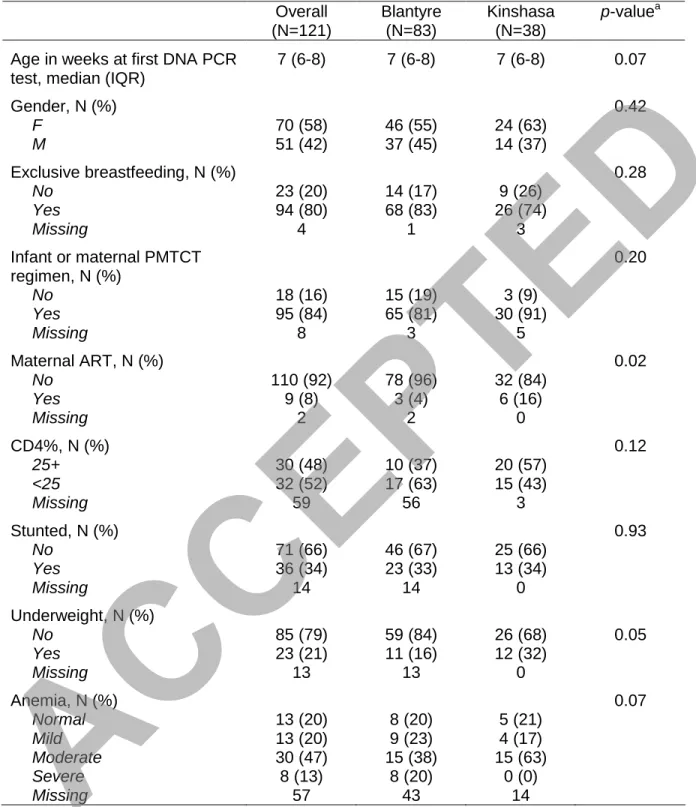
Despite the availability of routine PMTCT services, in 16% (18) of infants (9% (3) in
Kinshasa and 19% (15) in Blantyre) neither the mother nor the infant had received any
antiretroviral drugs for PMTCT (Table 1). Overall, 8% (9) of women were receiving
antiretroviral treatment. At time of HIV diagnosis, 80% (94) of infants were exclusively
breastfed, 21% (23) were underweight, and 34% (36) were stunted. About half of all infants had
a CD4% below 25 (63% (17) in Blantyre and 43% (15) in Kinshasa), but CD4% was not
available for all infants in Blantyre.
During the first 12 months of life, 75 (62%) children initiated ART. ART was initiated at
a median age of 6.2 months (27 weeks, range 9.1 to 51.4 weeks), at a younger age in Kinshasa
(24 weeks) than Blantyre (33 weeks) (Figure 1). The 12-month cumulative incidence of ART
initiation was 70% (95% CI 60%, 78%), and was higher in Kinshasa (82%, 95% CI: 64%, 92%)
than Blantyre (64%, 95% CI: 51%, 74%) (p=0.017). The 6-month cumulative incidence of ART
initiation was 46% (95% CI 36%, 55%), and was also higher in Kinshasa (54%, 95% CI: 37%,
69%) than in Blantyre (42%, 95% CI: 30%, 53%) (p=0.12). Of the 46 infants who did not start
ART in the first 12 months of life, 17 (40.0%) died and 15 (32.6%) were LTFU.
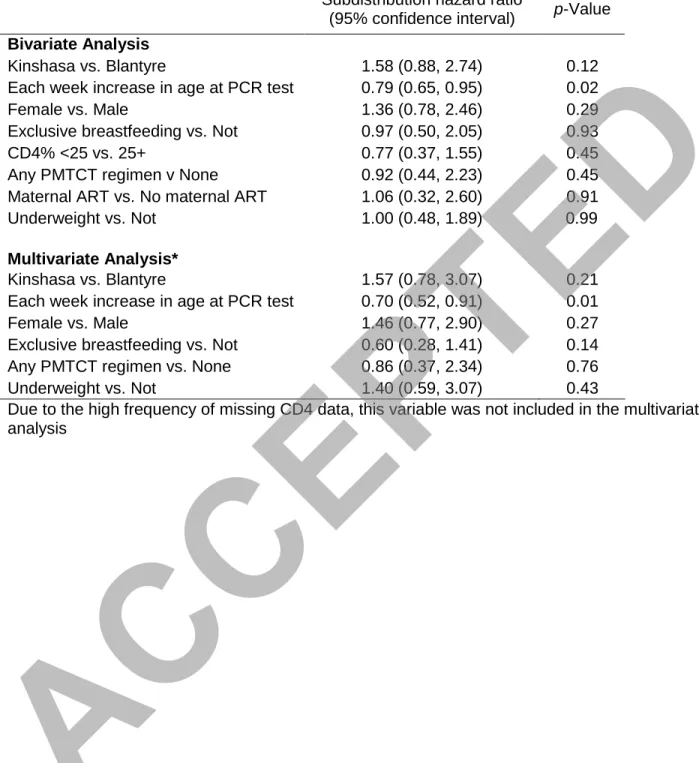
In bivariate analysis (Table 2), age at HIV diagnosis (p=0.02) was predictive of ART
initiation by six months of age, with a hazard ratio of 0.79 (95% CI: 0.65, 0.95) for each week
increase in age at DNA PCR test. Country, gender, exclusive breastfeeding, receipt of infant or
maternal antiretrovirals for PMTCT, and underweight status of the child were not associated with
independently associated (p<0.01) with ART initiation by six months of age (HR, 0.70; 95% CI:
0.52, 0.91).
Overall, 11% (95% CI: 6%, 18%) of infants died by six months of age and 20% (95% CI:
13%, 28%) died by 12 months of age (Figure 2). Mortality in the first year of life was higher in
Blantyre than in Kinshasa with a 12-month cumulative incidence of 27% (95% CI: 17%, 39%) in
Blantyre versus 8% (95% CI: 2%, 20%) in Kinshasa (p=0.04).
DISCUSSION
Among infants diagnosed with HIV in the first 12 weeks of life in Blantyre, Malawi and
Kinshasa, DRC, we found that few children received immediate ART, a high proportion failed to
initiate ART by six months of age, and one in five infants died before reaching one year of age.
The association between earlier DNA PCR testing and earlier ART initiation in our
analysis highlights the importance of removing barriers to EID, including inadequate recording
of HIV exposure and maternal HIV status on patient records, maternal non-disclosure,
insufficient awareness of EID, high cost and logistical complexity of HIV DNA PCR tests, and
LTFU after diagnosis given the need for a return visit. Development of an accurate, cheap
point-of-care assay for EID has the potential to optimize the outcome of perinatally-infected infants.
During the pre-ART era, when an estimated 36% of perinatally-infected children died
within the first year of life,20 findings of retrospective cohort studies observed that starting ART in the first six to 12 months of life decreases mortality and improved clinical outcomes.21-24 Our results extend these finding by assessing the one year outcomes in infants participating in a
PMTCT-linked EID program. While the 20% mortality rate we observed in the first year of life
among infants diagnosed with HIV at a median age of 7 weeks (IQR 6-8) is an improvement
compared to the pre-ART era, it is much higher than the mortality observed in infants
randomized to immediate ART in the CHER study (4% over a median follow-up of the full
cohort of 40 weeks) conducted in South Africa. We believe the discrepancy between the trial and
implementation data is due to several factors. First, the CHER study excluded children with
evidence of immunosuppression (CD4% <25). Similar to observations in other studies23, we found that half (52%) of young infants already have signs of immunosuppression at time of
infant HIV diagnosis. Expanding eligibility for immediate ART to all infants, including those
with immunosuppression in the first weeks of life, will result in higher mortality rates than what
was observed in the restricted trial population. Another important difference is the median age of
ART initiation. Under the CHER trial conditions, all children were tested for HIV prior to age 6
weeks and ART initiation was achieved by age 7.4 weeks (IQR: 6.6, 8.9).3 In our analysis, we included children receiving EID before age 12 weeks to take into account of the delays that often
occur under real world conditions. In this population, ART initiation occurred at a median age of
6.2 months. Delays in ART initiation occur as children need to return for their EID HIV test
result, which is often delayed given the difficulties with transportation and communication
between the centralized laboratory and the primary care clinics. Furthermore, upon diagnosis,
children often need to be referred for ART initiation as this is not yet available at primary care in
many settings, again resulting in further delays.
While the delays in ART initiation were present in both cities, rates of ART initiation
were higher and 12-month mortality was lower in Kinshasa compared to Blantyre, with no
deaths occurring between 3-12 months in the Kinshasa patients, likely due in part to higher ART
initiation rates. While the numbers are relatively small and theses differences need to be
confirmed, the differences may be explained by the fact that the HIV care and treatment program
intensive monitoring and evaluation, whereas HIV-infected infants in Blantyre were referred to
routine public HIV care and treatment program. Furthermore, a strong family-centered program,
which was the focus of the Kinshasa program, has been shown to result in improved infant
outcomes.14 We envision that the shift to Option B+ in Malawi and DRC may result in improved infant HIV care and treatment25 by overcoming some of the barriers to timely ART initiation including stigma,26,27 loss to follow up, 28-30 and fear of finding out an infant’s status.26,27 There is existing evidence that increasing access to combination antiretroviral therapy for mothers
results in improved retention of HIV-exposed infants,14 a finding which may be promising for improved linkage to care and retention of infants born to HIV-infected mothers in the setting of
Option B+.
The use of prospectively collected data on infants diagnosed at two different
resource-poor settings are important strengths of this assessment of infant outcomes which, to our
knowledge, is the first report of infant outcomes under routine PMTCT and EID implementation
at primary care. It is estimated that in 2014 a quarter of women still did not have access to any
PMTCT regimens. 5 Our data provide valuable context for the reality and challenges of implementing HIV prevention and treatment in the real world setting. The challenges
encountered in the settings described here have relevance for the implementation a wide variety
of current and future public health guidelines that go beyond the specific EID guidelines that are
the focus of this work. Several limitations should be noted. First, despite the aggregation of two
databases, the limited sample size prohibited assessment of the causal effect of timing of ART on
mortality. Furthermore, due to delays in availability of test results and the need for referral for
HIV care and ART, some children were lost to follow up and others died before ART could be
REFERENCES
1. Marston M, Becquet R, Zaba B, et al. Net survival of perinatally and postnatally
HIV-infected children: a pooled analysis of individual data from sub-Saharan Africa.
International journal of epidemiology. Apr 2011;40(2):385-396.
2. Taha TE, Kumwenda NI, Broadhead RL, et al. Mortality after the first year of life among
human immunodeficiency virus type 1-infected and uninfected children. Pediatr Infect
Dis J. Aug 1999;18(8):689-694.
3. Violari A, Cotton MF, Gibb DM, et al. Early antiretroviral therapy and mortality among
HIV-infected infants. N Engl J Med. 2008;359(21):2233-2244.
4. World Health Organization (WHO). Report of the WHO Technical Reference Group,
Paediatric HIV/ART Care Guideline Group Meeting: World Health Organization; 2008.
5. UNAIDS. UNAIDS Fact Sheet, available at
http://www.unaids.org/en/resources/campaigns/HowAIDSchangedeverything/factsheet.
Accessed May 10, 2016. 2016.
http://www.unaids.org/en/resources/campaigns/HowAIDSchangedeverything/factsheet.
Accessed May 10, 2016.
6. Ciaranello AL, Park JE, Ramirez-Avila L, Freedberg KA, Walensky RP, Leroy V. Early
infant HIV-1 diagnosis programs in resource-limited settings: opportunities for improved
outcomes and more cost-effective interventions. BMC medicine. 2011;9:59.
7. Cook RE, Ciampa PJ, Sidat M, et al. Predictors of successful early infant diagnosis of
HIV in a rural district hospital in Zambezia, Mozambique. J Acquir Immune Defic Syndr.
8. Braitstein P, Songok J, Vreeman R, et al. 'Wamepotea' (They have become lost):
Outcomes of HIV-positive and HIV-exposed children lost to follow-up from a large HIV
treatment program in western Kenya. J Acquir Immune Defic Syndr. Mar 9.
9. Nuwagaba-Biribonwoha H, Werq-Semo B, Abdallah A, et al. Introducing a multi-site
program for early diagnosis of HIV infection among HIV-exposed infants in Tanzania.
BMC Pediatr.10:44.
10. Dube Q, Dow A, Chirambo C, et al. Implementing early infant diagnosis of HIV
infection at the primary care level: experiences and challenges in Malawi. Bull World
Health Organ. Sep 1 2012;90(9):699-704.
11. Edmonds A, Yotebieng M, Lusiama J, et al. The effect of highly active antiretroviral
therapy on the survival of HIV-infected children in a resource-deprived setting: a cohort
study. PLoS Med. 2011;8(6):e1001044-e1001044.
12. Edmonds A, Yotebieng M, Lusiama J, et al. Quantification of CD4 responses to
combined antiretroviral therapy over 5 years among HIV-infected children in Kinshasa,
Democratic Republic of Congo. J Acquir Immune Defic Syndr. 2012;61(1):90-98.
13. Feinstein L, Edmonds A, Chalachala JL, et al. Temporal changes in the outcomes of
HIV-exposed infants in Kinshasa, Democratic Republic of Congo during a period of
rapidly evolving guidelines for care (2007-2013). AIDS. 2014;28 Suppl 3:S301-311.
14. Feinstein L, Edmonds A, Okitolonda V, et al. Maternal Combination Antiretroviral
Therapy is Associated with Improved Retention of HIV-Exposed Infants in Kinshasa,
Democratic Republic of Congo. J Acquir Immune Defic Syndr. Apr 13 2015.
15. World Health Organization (WHO). Haemoglobin concentrations for the diagnosis of
anaemia and assessment of severity: World Health Organization; 2011.
16. WHO Multicentre Growth Reference Study Group. WHO Child Growth Standards:
Length/height-for-age, weight-for-age, weight-for-length, weight-for-height and body
mass index-for-age: Methods and development: World Health Organization; 2006.
17. Lau B, Cole SR, Gange SJ. Competing risk regression models for epidemiologic data. Am
J Epidemiol. 2009;170(2):244-256.
18. Kohl M, Plischke M, Leffondre K, Heinze G. PSHREG: a SAS macro for proportional
and nonproportional subdistribution hazards regression. Computer methods and
programs in biomedicine. Feb 2015;118(2):218-233.
19. Fine JP, Gray RJ. A proportional hazards model for the subdistribution of a competing
risk. J Am Stat Assoc. 1999;94(445):496-509.
20. Newell ML, Coovadia H, Cortina-Borja M, et al. Mortality of infected and uninfected
infants born to HIV-infected mothers in Africa: a pooled analysis. Lancet. Oct 2-8
2004;364(9441):1236-1243.
21. Purchase SE, Van der Linden DJ, McKerrow NH. Feasibility and effectiveness of early
initiation of combination antiretroviral therapy in HIV-infected infants in a government
clinic of Kwazulu-Natal, South Africa. J Trop Pediatr. Apr 2012;58(2):114-119.
22. Shiau S, Arpadi S, Strehlau R, et al. Initiation of Antiretroviral Therapy Before 6 Months
of Age is Associated with Faster Growth Recovery in South African Children Perinatally
Infected with Human Immunodeficiency Virus. J Pediatr. Jan 10 2013.
23. Kabue MM, Buck WC, Wanless SR, et al. Mortality and clinical outcomes in
HIV-infected children on antiretroviral therapy in Malawi, Lesotho, and Swaziland. Pediatrics.
24. Collins IJ, Jourdain G, Hansudewechakul R, et al. Long-term survival of HIV-infected
children receiving antiretroviral therapy in Thailand: a 5-year observational cohort study.
Clinical infectious diseases : an official publication of the Infectious Diseases Society of
America. Dec 15 2010;51(12):1449-1457.
25. Kieffer MP, Mattingly M, Giphart A, et al. Lessons learned from early implementation of
option B+: the Elizabeth Glaser Pediatric AIDS Foundation experience in 11 African
countries. J Acquir Immune Defic Syndr. Dec 1 2014;67 Suppl 4:S188-194.
26. Adeniyi VO, Thomson E, Ter Goon D, Ajayi IA. Disclosure, stigma of HIV positive
child and access to early infant diagnosis in the rural communities of OR Tambo District,
South Africa: a qualitative exploration of maternal perspective. BMC Pediatr.
2015;15:98.
27. Donahue MC, Dube Q, Dow A, Umar E, Van Rie A. "They have already thrown away
their chicken": barriers affecting participation by HIV-infected women in care and
treatment programs for their infants in Blantyre, Malawi. AIDS Care.
2012;24(10):1233-1239.
28. Centers for Disease C, Prevention. Impact of an innovative approach to prevent
mother-to-child transmission of HIV--Malawi, July 2011-September 2012. MMWR Morb Mortal
Wkly Rep. Mar 1 2013;62(8):148-151.
29. Feucht UD, Meyer A, Thomas WN, Forsyth BW, Kruger M. Early diagnosis is critical to
ensure good outcomes in HIV-infected children: outlining barriers to care. AIDS Care.
30. Cromwell EA, Dow AE, Low D, et al. Barriers to successful early infant diagnosis of
HIV infection at primary care level in Malawi. Pediatr Infect Dis J. Mar
2015;34(3):273-275.
Figure Legend
Figure 1. Twelve-month cumulative incidence of ART initiation in Kinshasa, Democratic Republic of Congo and Blantyre, Malawi
Figure 2. Twelve-month cumulative incidence of death in Kinshasa, Democratic Republic of Congo and Blantyre, Malawi
TABLE 1. Characteristics of 121 HIV-infected infants at enrollment
Overall Blantyre Kinshasa p-valuea
(N=121) (N=83) (N=38)
Age in weeks at first DNA PCR test, median (IQR)
7 (6-8) 7 (6-8) 7 (6-8) 0.07
Gender, N (%) 0.42
F 70 (58) 46 (55) 24 (63)
M 51 (42) 37 (45) 14 (37)
Exclusive breastfeeding, N (%) 0.28
No 23 (20) 14 (17) 9 (26)
Yes 94 (80) 68 (83) 26 (74)
Missing 4 1 3
Infant or maternal PMTCT regimen, N (%)
0.20
No 18 (16) 15 (19) 3 (9)
Yes 95 (84) 65 (81) 30 (91)
Missing 8 3 5
Maternal ART, N (%) 0.02
No 110 (92) 78 (96) 32 (84)
Yes 9 (8) 3 (4) 6 (16)
Missing 2 2 0
CD4%, N (%) 0.12
25+ 30 (48) 10 (37) 20 (57)
<25 32 (52) 17 (63) 15 (43)
Missing 59 56 3
Stunted, N (%) 0.93
No 71 (66) 46 (67) 25 (66)
Yes 36 (34) 23 (33) 13 (34)
Missing 14 14 0
Underweight, N (%)
No 85 (79) 59 (84) 26 (68) 0.05
Yes 23 (21) 11 (16) 12 (32)
Missing 13 13 0
Anemia, N (%) 0.07
Normal 13 (20) 8 (20) 5 (21)
Mild 13 (20) 9 (23) 4 (17)
Moderate 30 (47) 15 (38) 15 (63)
Severe 8 (13) 8 (20) 0 (0)
Missing 57 43 14
a
p-Values are for the comparison of Blantyre versus Kinshasa.
Note: Enrollment characteristics were measured by 15 weeks of age, except for weight and
height, which were measured by 17 weeks of age. Analysis includes first available
TABLE 2. Predictors of ART initiation by six months of age
Subdistribution hazard ratio
(95% confidence interval) p-Value
Bivariate Analysis
Kinshasa vs. Blantyre 1.58 (0.88, 2.74) 0.12
Each week increase in age at PCR test 0.79 (0.65, 0.95) 0.02
Female vs. Male 1.36 (0.78, 2.46) 0.29
Exclusive breastfeeding vs. Not 0.97 (0.50, 2.05) 0.93
CD4% <25 vs. 25+ 0.77 (0.37, 1.55) 0.45
Any PMTCT regimen v None 0.92 (0.44, 2.23) 0.45
Maternal ART vs. No maternal ART 1.06 (0.32, 2.60) 0.91
Underweight vs. Not 1.00 (0.48, 1.89) 0.99
Multivariate Analysis*
Kinshasa vs. Blantyre 1.57 (0.78, 3.07) 0.21
Each week increase in age at PCR test 0.70 (0.52, 0.91) 0.01
Female vs. Male 1.46 (0.77, 2.90) 0.27
Exclusive breastfeeding vs. Not 0.60 (0.28, 1.41) 0.14
Any PMTCT regimen vs. None 0.86 (0.37, 2.34) 0.76
Underweight vs. Not 1.40 (0.59, 3.07) 0.43
Due to the high frequency of missing CD4 data, this variable was not included in the multivariate analysis
Gray’s Test for Equality of Cumulative Incidence Functions p=0.02
Figure 1
Gray’s Test for Equality of Cumulative Incidence Functions p=0.04
Figure 2