Greiss, S., Hermes, J. J., Gänsicke, B. T., Steeghs, D. T. H., Bell, K. J.,
Raddi, R., ... Winget, K. I. (2016). The search for ZZ Ceti stars in the original
Kepler mission. Monthly Notices of the Royal Astronomical Society, 457(3),
2855-2863. https://doi.org/10.1093/mnras/stw053
Publisher's PDF, also known as Version of record
Link to published version (if available):
10.1093/mnras/stw053
Link to publication record in Explore Bristol Research
PDF-document
This is the final published version of the article (version of record). It first appeared online via Oxford University
Press at http://mnras.oxfordjournals.org/content/457/3/2855. Please refer to any applicable terms of use of the
publisher.
University of Bristol - Explore Bristol Research
General rights
This document is made available in accordance with publisher policies. Please cite only the published
version using the reference above. Full terms of use are available:
The search for ZZ Ceti stars in the original
Kepler
mission
S. Greiss,
1J. J. Hermes,
1,2ܠ
B. T. G¨ansicke,
1D. T. H. Steeghs,
1Keaton J. Bell,
3R. Raddi,
1P.-E. Tremblay,
1E. Breedt,
1G. Ramsay,
4D. Koester,
5P. J. Carter,
1,6Z. Vanderbosch,
3D. E. Winget
3and K. I. Winget
31Department of Physics, University of Warwick, Gibbet Hill Road, Coventry CV4 7AL, UK
2Department of Physics and Astronomy, University of North Carolina, Chapel Hill, NC 27599-3255, USA 3Department of Astronomy, University of Texas at Austin, Austin, TX 78712, USA
4Armagh Observatory, College Hill, Armagh BT61 9DG, UK
5Institut f¨ur Theoretische Physik und Astrophysik, University of Kiel, D-24098 Kiel, Germany
6H.H. Wills Physics Laboratory, School of Physics, University of Bristol, Tyndall Avenue, Bristol BS8 1TL, UK
Accepted 2016 January 6. Received 2016 January 5; in original form 2015 December 8
A B S T R A C T
We report the discovery of 42 white dwarfs in the original Keplermission field, including nine new confirmed pulsating hydrogen-atmosphere white dwarfs (ZZ Ceti stars). Guided by
theKepler-Isaac Newton Telescope Survey, we selected white dwarf candidates on the basis
of theirU−g,g −r, andr−Hα photometric colours. We followed up these candidates with high-signal-to-noise optical spectroscopy from the 4.2-m William Herschel Telescope. Using ground-based, time series photometry, we put our sample of new spectroscopically characterized white dwarfs in the context of the empirical ZZ Ceti instability strip. Prior to our search, only two pulsating white dwarfs had been observed byKepler. Ultimately, four of our new ZZ Cetis were observed from space. These rich data sets are helping initiate a rapid advancement in the asteroseismic investigation of pulsating white dwarfs, which continues with the extendedKeplermission,K2.
Key words: asteroseismology – surveys – white dwarfs.
1 I N T R O D U C T I O N
White dwarfs are the end points of all low- to intermediate-mass stars, which are the majority of stars in the Universe. They are dense stellar remnants composed of electron degenerate cores sur-rounded by non-degenerate envelopes. These evolved stars provide key insight into Galactic star formation and evolution.
To use white dwarfs as tracers of Galactic evolution, we must determine their basic physical parameters, such as effective tem-peratures (Teff), surface gravities (logg) and masses. More than
80 per cent of white dwarfs have hydrogen-rich atmospheres, known as DA white dwarfs (Giammichele, Bergeron & Dufour 2012; Kleinman et al.2013). Spectroscopy has been a successful tool in obtaining DA atmospheric parameters, yet it only provides a view of the outermost layers of the white dwarf, and it is subject to systematic problems that require correction if the star is cooler than roughly 13 000 K and the surface is convective (Tremblay et al.
2010,2013).
Asteroseismology, however, can probe deep into the interior of a white dwarf and provide information on its composition, rotation
E-mail:[email protected]
†Hubble Fellow.
period, magnetic field strength, mass, temperature and luminosity, by matching the observed non-radial g-mode pulsations to theoret-ical models (see reviews by Fontaine & Brassard2008; Winget & Kepler2008; Althaus et al.2010).
As white dwarfs cool, they pass through instability strips depend-ing on their outermost envelope composition, which coincides with the onset of a partial ionization zone. This zone efficiently drives pulsations, which cause periodic brightness variations of the white dwarf (Brickhill1991). The variable DA white dwarfs (DAVs), also known as ZZ Ceti stars, are the most commonly found and studied type of pulsating white dwarfs. Their effective temperatures range between12 300–10 900 K for a typical mass ofM0.6 M, with pulsation periods ranging from 100–1400 s (Mukadam et al.
2006; Gianninas, Bergeron & Ruiz2011).
Ground-based studies of ZZ Ceti stars have been carried out for decades, but very few have been observed long enough to resolve more than six pulsation modes. Crucially, there are potentially nine free parameters in the asteroseismic modelling of pulsating white dwarfs (Bradley 2001), which has required holding fixed many parameters in order to constrain the internal properties of ZZ Cetis. It is clear that fully constraining these free parameters and thus the internal white dwarf structure and evolution will require a larger sample of rich asteroseismic observations.
2016 The Authors
at University of Bristol Library on August 10, 2016
http://mnras.oxfordjournals.org/
2856
S. Greiss et al.
Considerable effort has been expended to obtain uninterrupted photometry from coordinated, multisite, ground-based campaigns to study pulsating white dwarfs, especially through the Whole Earth Telescope (Nather et al.1990), which has been operating for more than two decades (e.g. Winget et al.1991; Provencal et al.2012). However, theKeplerplanet-hunting spacecraft offers a unique op-portunity to obtain high-quality, space-based light curves of variable stars, white dwarfs included.
Unfortunately, few white dwarfs were known in the original
Kepler mission field, and only two pulsating white dwarfs were discovered within the first two years of the mission (Hermes et al.
2011; Østensen et al.2011b). In order to increase this sample, we began the search for all white dwarfs in the original field of the
Keplermission, and more specifically any possible ZZ Ceti stars. We created theKepler-INT Survey (KIS; Greiss et al.2012a) in or-der to select white dwarf candidates using colour–colour diagrams, and report on that search here.
In Sections 2 and 3, we describe the selection method of our white dwarfs and present their spectroscopic observations. In Section 4, we focus on the nine new pulsating white dwarfs. We conclude in Section 5.
2 TA R G E T S E L E C T I O N
We selected our white dwarf candidates usingU−g,g−rand
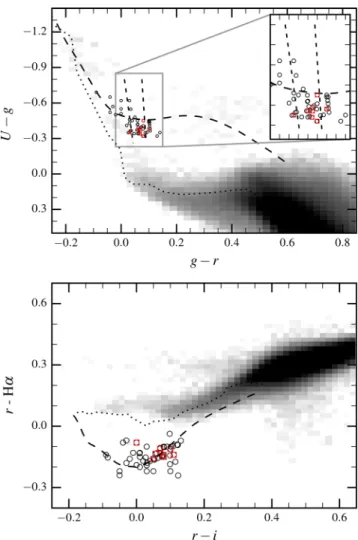
r−Hα,r−icolour–colour diagrams using data from KIS, shown in Fig.1. KIS is a deep optical survey using the Wide Field Camera (WFC) on the 2.5-m Isaac Newton Telescope (INT), taken through four broad-band filters (U,g,r,i) and one narrowband filter (Hα), covering more than 97 per cent of the originalKeplerfield down to∼20th mag (Greiss et al.2012a,b). All magnitudes for the KIS survey are expressed in the Vega system.
White dwarfs have bluer colours than main-sequence stars, and most single DA white dwarfs also have strong H α absorption lines, leading tor − Hα <0 (see bottom panel of Fig.1). We have integrated the atmospheric models of canonical-mass 0.6 M (logg=8.0) white dwarfs of Koester (2010) with the various filter profiles to guide our colour cuts, similar to Groot et al. (2009).
Our photometric selection recovered KIC 4552982, the first ZZ Ceti star in theKeplerfield (Hermes et al.2011; Bell et al.2015). We narrowed our selection to a small region around KIC 4552982 and to candidates close to the empirical (Teff, logg) instability strip
projected intoU−g,g−rspace. This left more than 60 white dwarf candidates, 43 of which we were able to follow up spectroscopically (Table2).
3 S P E C T R O S C O P Y
3.1 WHT observations
We were awarded a total of eight nights on the 4.2-m William Her-schel Telescope (WHT) in 2012, 2013, and 2014, where we obtained intermediate resolution spectra of 43 of our candidates in order to confirm their identities as white dwarf stars and to characterize their atmospheric parameters, especially their effective temperatures and surface gravities. We used the Intermediate-dispersion Spectrograph and Imaging System1(ISIS), with the R600R and R600B gratings
on the red and blue arms, respectively.
1http://www.ing.iac.es/Astronomy/instruments/isis/
Figure 1. U−g,g−r(top) andr−Hα,r−i(bottom) colour–colour
diagrams of point sources from KIS (grey-scale), with logg=8.0 DA white dwarf cooling tracks overplotted as a dashed line (the dotted line marks the region expected of main-sequence dwarfs). Narrowing our colour selection around the first ZZ Ceti in the field identified by Hermes et al. (2011) left
60 white dwarf candidates (open circles). The red open squares correspond to the nine ZZ Ceti stars we confirmed in theKeplerfield; two have identical U−g,g−rcolours.
Table 1. Journal of spectroscopic observations.
Night UTDate Slit Seeing Notes
(arcsec) (arcsec)
a 2012 August 9 1.2 1.6 Clouds
b 2012 August 10 1.2 2.5–4.5 Haze c 2012 August 11 1.2 0.7–1.1 Thin
d 2013 June 6 1.0 0.8–1.0 Clear
e 2013 June 7 1.0 0.8–1.0 Clear
f 2013 June 8 1.0 0.8–1.0 Clear
g 2014 July 25 0.8 0.6–0.8 Clear h 2014 July 26 0.8 0.4–0.6 Clear
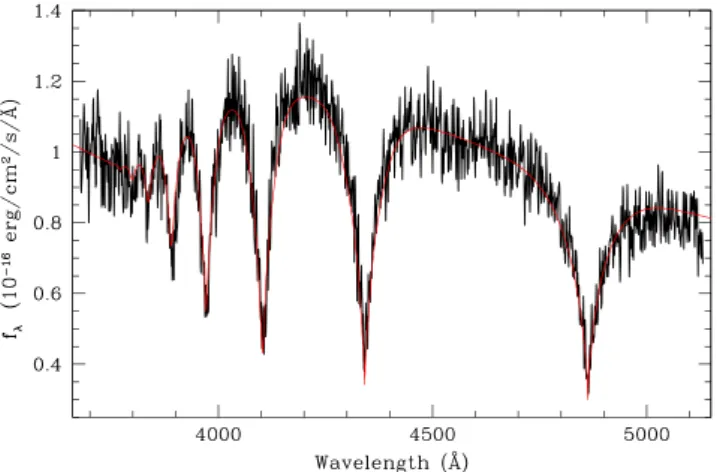
The slit widths were chosen close to the seeing of each night to maximize spectral resolution (1.5–2.0 Å). A full journal of observations is included in Table1. The blue arm was centred at 4351 Å and the red arm at 6562 Å. The spectra covered a wavelength range from roughly 3800–5100 Å in the blue (see Fig. 2), and roughly 5600–7100 Å in the red. However, since the higher order Balmer lines contain the most information about the atmospheric
MNRAS457,2855–2863 (2016)
at University of Bristol Library on August 10, 2016
http://mnras.oxfordjournals.org/
Figure 2. A representative WHT/ISIS spectrum from our sample, KISJ1923+3929 (g= 19.4 mag, S/N12), obtained in a single 1800 s exposure on 2013 June 8 confirming the star to be a DA white dwarf. The best-fitting atmosphere parameters (Teff=11 160±140 K, logg=7.90±
0.04), shown in red and detailed in Table3, place the star within the em-pirical ZZ Ceti instability strip, and pulsations were subsequently detected from the ground (see Fig.4).
parameters (e.g. Bergeron, Saffer & Liebert1992), we only used the blue arm for our Balmer profile fits (Section 3.2).
All our spectra were debiased and flat-fielded within standard
STARLINK2 packages KAPPA, FIGAROand,CONVERT. They were then
optimally extracted usingPAMELA3(Marsh1989). Copper–argon arc
lamp exposures were taken at the start and end of each night for the wavelength calibration of the spectra. We also observed several standard stars at the beginning, middle and, end of each night: Feige 34, Grw+70 5824, LB 1240, G191−B2B and L1512−34. We used
MOLLY4for the wavelength and flux calibration of the extracted 1D
spectra obtained.
All 43 observed targets were confirmed to be DA white dwarfs, verifying our colour-selection methods. We provide the coordinates andU,g,r,i, Hαmagnitudes of our targets in Table2, and detail the spectroscopic observations and the derived atmospheric parameters in Table3. Only one object we observed was a previously known white dwarf: KISJ1909+4717, also known as KIC 10198116, which was previously discovered by Østensen et al. (2011a) and observed for one month withKepler.
3.2 Atmospheric parameters
We were primarily interested in the potential ZZ Ceti stars within our DA white dwarf sample, and spectroscopically determining temperatures is the most efficient way to find new pulsating white dwarfs (e.g. Mukadam et al.2004a). Because pulsations in ZZ Cetis are driven by a hydrogen partial-ionization zone they are confined to a narrow instability strip in (Teff,logg) space (Gianninas et al.
2011), making it possible to select ZZ Ceti candidates from our sample of white dwarfs on the basis of those parameters.
We fitted 1D model atmospheres to our spectra in order to ob-tain their effective temperatures and surface gravities. To derive the
2The
STARLINK Software Group homepage website is
http://starlink.jach.hawaii.edu/starlink 3
PAMELAwas written by T. R. Marsh and can be found in theSTARLINK
distribution Hawaiki and later releases.
4
MOLLY was written by T. R. Marsh and is available from http://www.warwick.ac.uk/go/trmarsh/software.
most robust atmospheric parameters, we have fitted the six Balmer lines Hβ–H9 using synthetic spectra computed by two indepen-dent groups. The first fits use the pure hydrogen atmosphere models and fitting procedure described in Tremblay, Bergeron & Gianninas (2011) and references therein, which employ the ML2/α=0.8 pre-scription of the mixing-length theory (Tremblay et al.2010). The second set of fits use the pure hydrogen atmosphere models detailed in Koester (2010), which also employ ML2/α=0.8, following the procedure described in Napiwotzki et al. (2004). Since the empirical instability strip has most thoroughly been defined by the first set of models, our final determinations use the models described in Trem-blay et al. (2011). If the parameters found from the Koester (2010) models differ by more than 1σ, we have increased the parameter uncertainties to compensate for this disagreement.
When multiple exposures were taken for a given star, we cal-culated the atmospheric parameters for each individual spectrum, and then took the weighted mean as a final value. The results from the fits to the spectra of all our observed white dwarfs are given in Table3. These parameters have been corrected for the 3D depen-dence of convection described by Tremblay et al. (2013). Addition-ally, we include in Table3estimated spectroscopic masses of our 43 white dwarfs, found using the mass–radius relation and the evolu-tionary cooling models from Fontaine, Brassard & Bergeron (2001) with a carbon–oxygen core (Bergeron, Leggett & Ruiz2001).5
In Fig.2, we show the WHT spectrum of one of our nine new con-firmed ZZ Ceti stars, overplotted with the best-fitting atmospheric parameters. Several of the most promising candidates were followed up with ground-based time series photometry, which we describe in the following section. Fig.3shows our atmospheric parameters and subsequent high-speed photometry in the context of the ZZ Ceti instability strip.
4 G R O U N D - B A S E D H I G H - S P E E D P H OT O M E T RY
We obtained ground-based optical time series photometry for 17 of our 43 ZZ Ceti candidates, in order to check for variability. The ground-based observations of eight of our stars were obtained using WFC mounted on the 2.5-m INT on La Palma. These INT observations in 2012 were part of the RApid Temporal Survey (RATS) (Ramsay et al.2014), which is a deep optical high-cadence survey of objects in theKeplerfield using one-hour-long sequences of 20 s g-band exposures.
Additionally, we obtained high-speed photometry using the Ar-gos (Nather & Mukadam 2004) and later the ProEM camera mounted on the 2.1-m Otto Struve Telescope at McDonald Ob-servatory. These McDonald observations were obtained through a 3 mmBG40filter to reduce the effects of transparency variations, and were reduced using the externalIRAFpackageccd hspwritten
by Antonio Kanaan (Kanaan, Kepler & Winget2002). For every light curve, we divided the normalized, sky-subtracted target flux by the measured flux for the brightest comparison star of similar colour in the field.
In order to assess variability in these white dwarf stars, we com-puted a relatively conservative significance threshold following the method outlined in Greiss et al. (2014). In short, we randomly
5The cooling models can be found on http://www.astro.umontreal.ca/˜bergeron/CoolingModels/. Also refer to Holberg & Bergeron (2006), Tremblay et al. (2011), and Bergeron et al. (2011) for colour and model calculations.
at University of Bristol Library on August 10, 2016
http://mnras.oxfordjournals.org/
2858
S. Greiss et al.
Ta b le 2 . Summary of photometry o f our candidates selected for spectroscopic follo w-up. All m agnitudes are in the V eg a system. KIS ID K IC ID RA (J2000) Dec. (J2000) U (mag) g (mag) r (mag) H α (mag) i (mag) Comments J1846 + 4157 – 1 8 4 6 35.96 + 41 57 07.6 17.96(2) 18.31(1) 18.22(1) 18.33(3) 18.14(2) – J1848 + 4225 6923777 18 48 30.83 + 42 25 15.5 18.02(1) 18.36(1) 18.32(1) 18.51(4) 18.29(2) NO V > 3.5 ppt J1851 + 4506 – 1 8 5 1 01.28 + 45 06 49.5 18.51(4) 18.92(3) 18.81(3) 18.96(9) 18.72(4) – J1857 + 4908 11337510 18 57 30.66 + 49 08 36.2 18.34(1) 18.79(1) 18.75(1) 18.90(3) 18.74(2) – J1858 + 4613 9573820 18 58 10.23 + 46 13 07.9 18.31(2) 18.77(1) 18.74(2) 18.98(5) 18.79(4) – J1859 + 4842 11125021 18 59 01.98 + 48 42 38.3 18.57(1) 19.02(1) 18.92(1) 19.09(2) 18.88(1) NO V > 6.3 ppt J1902 + 4223 – 1 9 0 2 07.12 + 42 23 25.5 18.67(1) 18.99(1) 18.86(2) 19.08(5) 18.76(3) – J1904 + 4130 – 1 9 0 4 50.16 + 41 30 16.7 17.03(2) 17.45(1) 17.39(1) 17.54(3) 17.36(1) – J1904 + 4245 7184288 19 04 26.62 + 42 45 48.7 18.21(1) 18.78(1) 18.81(1) 18.97(4) 18.83(3) – J1906 + 4354 8084967 19 06 31.31 + 43 54 48.8 18.67(2) 19.01(1) 18.95(2) 19.17(6) 19.00(4) – J1906 + 5002 11805054 19 06 34.71 + 50 02 17.0 18.73(3) 19.28(2) 19.24(3) 19.39(8) 19.33(5) – J1908 + 4316 7594781 19 08 35.91 + 43 16 42.3 17.84(1) 18.16(1) 18.08(1) 18.23(2) 18.00(1) ZZ Ceti (a) J1908 + 4619 9639485 19 08 25.69 + 46 19 35.4 18.03(2) 18.45(1) 18.39(2) 18.46(4) 18.42(2) NO V > 4.6 ppt J1909 + 4717 10198116 19 09 59.36 + 47 17 09.5 15.82(1) 16.30(1) 16.25(1) 16.43(1) 16.28(1) NO V > 0.13 ppt (a,b) J1911 + 4543 9272512 19 11 33.53 + 45 43 46.1 18.26(2) 18.67(2) 18.65(2) 18.73(5) 18.69(3) – J1913 + 4709 10132702 19 13 40.87 + 47 09 30.6 18.71(3) 19.08(3) 19.01(3) 19.15(8) 18.93(4) ZZ Ceti (a) J1917 + 3927 4357037 19 17 19.17 + 39 27 18.2 17.91(1) 18.28(1) 18.22(1) 18.38(3) 18.17(2) ZZ Ceti (a) J1917 + 4413 8293193 19 17 55.28 + 44 13 26.2 18.10(2) 18.42(1) 18.34(2) 18.47(4) 18.27(3) ZZ Ceti J1918 + 3914 – 1 9 1 8 54.33 + 39 14 32.9 18.36(1) 18.72(1) 18.62(1) 18.69(3) 18.49(2) – J1918 + 4533 9149300 19 18 30.15 + 45 33 13.0 17.80(2) 18.42(2) 18.42(2) 18.61(7) 18.42(4) – J1919 + 4247 – 1 9 1 9 55.09 + 42 47 23.1 17.36(1) 18.05(1) 18.14(1) 18.28(3) 18.23(2) – J1919 + 4712 10203164 19 19 52.92 + 47 12 56.3 17.73(2) 18.16(2) 18.13(2) 18.30(5) 18.11(2) NO V > 2.4 ppt J1919 + 4957 11759570 19 19 12.21 + 49 57 51.3 17.40(1) 17.92(1) 17.96(2) 18.18(6) 17.93(3) – J1920 + 4338 7885860 19 20 18.87 + 43 38 32.4 18.52(3) 18.84(2) 18.71(2) 18.93(5) 18.66(3) – J1920 + 5017 11911480 19 20 24.87 + 50 17 22.1 17.68(2) 18.13(2) 18.05(2) 18.13(6) 18.05(4) ZZ Ceti (a,c) J1922 + 4807 10794439 19 22 48.86 + 48 07 21.4 18.05(2) 18.70(2) 18.74(3) 18.84(7) 18.71(4) – J1923 + 3929 4362927 19 23 48.76 + 39 29 33.1 19.05(2) 19.43(1) 19.33(2) 19.44(6) 19.26(3) ZZ Ceti J1924 + 3655 1293071 19 24 08.27 + 36 55 18.4 17.53(1) 18.15(1) 18.12(1) 18.25(3) 18.13(2) NO V > 2.9 ppt J1926 + 3703 1432852 19 26 03.05 + 37 03 16.4 18.49(1) 19.04(1) 19.04(2) 19.24(5) 19.03(3) NO V > 6.9 ppt J1929 + 3857 3854110 19 29 52.07 + 38 57 50.0 18.20(1) 18.55(1) 18.41(1) 18.51(3) 18.33(2) – J1929 + 4302 – 1 9 2 9 12.27 + 43 02 52.1 18.01(3) 18.45(2) 18.35(2) 18.44(5) 18.23(3) – J1932 + 4210 6695659 19 32 12.04 + 42 10 53.5 18.36(4) 18.87(3) 18.87(3) 18.97(8) 18.78(4) NO V > 7.4 ppt J1933 + 4753 10604007 19 33 55.22 + 47 53 02.4 18.71(3) 19.13(2) 19.03(2) 19.13(7) 18.92(4) – J1935 + 4237 7124835 19 35 34.63 + 42 37 41.7 17.31(1) 17.76(1) 17.70(1) 17.83(3) 17.69(2) – J1935 + 4634 9775198 19 35 06.67 + 46 34 59.1 17.88(1) 18.28(1) 18.20(1) 18.36(3) 18.15(2) NO V > 7.4 ppt J1939 + 4533 9162396 19 39 07.15 + 45 33 33.9 18.15(2) 18.51(1) 18.48(2) 18.65(5) 18.36(2) ZZ Ceti J1943 + 4538 – 1 9 4 3 02.67 + 45 38 42.4 16.93(1) 17.30(1) 17.26(1) 17.44(2) 17.23(1) – J1943 + 5011 – 1 9 4 3 31.92 + 50 11 45.8 16.77(1) 17.12(1) 17.03(1) 17.13(2) 16.93(1) – J1944 + 4327 7766212 19 44 05.85 + 43 27 21.7 16.41(1) 16.76(1) 16.73(1) 16.86(1) 16.67(1) ZZ Ceti J1945 + 4348 8043166 19 45 59.25 + 43 48 45.3 17.26(1) 17.61(1) 17.55(1) 17.58(2) 17.45(1) – J1945 + 4455 – 1 9 4 5 42.30 + 44 55 10.6 16.82(1) 17.16(1) 17.09(1) 17.20(2) 16.99(1) ZZ Ceti J1945 + 5051 12217892 19 45 03.58 + 50 51 39.7 18.73(2) 19.11(2) 19.05(2) 19.29(9) 18.93(4) – J1956 + 4447 – 1 9 5 6 16.98 + 44 47 53.4 18.49(3) 18.88(2) 18.81(2) 19.00(8) 18.71(4) – (a) O bserv ed b y K epler spacecraft; (b) Ø stensen et al. ( 2011a ); (c) G reiss et al. ( 2014 ).MNRAS457,2855–2863 (2016)
at University of Bristol Library on August 10, 2016
http://mnras.oxfordjournals.org/
Ta b le 3 . Summary of spectroscopic observ ations and results from w hite dw arf m odel atmosphere fits to the spectra. KIS ID K IC ID g (mag) Exp. time (s) Night a Tef f (K) log g (cgs) M ass (M ) C omments J1846 + 4157 – 18.3 1 × 1200 e 1 0 770(130) 8.03(0.05) 0.62(03) – J1848 + 4225 6923777 18.4 3 × 1200 e,h 1 2 410(150) 8.03(0.04) 0.63(03) NO V > 3.5 ppt J1851 + 4506 – 18.9 1 × 1500 e 9720(120) 7.78(0.10) 0.48(05) – J1857 + 4908 11337510 18.8 1 × 1500 c 1 1 160(160) 8.27(0.07) 0.77(04) – J1858 + 4613 9573820 18.8 1 × 1200 c 1 4 800(1100) 7.91(0.06) 0.56(04) – J1859 + 4842 11125021 19.0 1 × 1200 c 1 1 250(170) 8.28(0.06) 0.78(04) NO V > 6.3 ppt J1902 + 4223 – 19.0 1 × 1800 f 1 0 640(130) 8.05(0.05) 0.63(03) – J1904 + 4130 – 17.5 1 × 900 e 1 1 960(150) 8.02(0.04) 0.62(03) – J1904 + 4245 7184288 18.8 1 × 1200 c 1 3 430(1440) 8.54(0.06) 0.95(04) – J1906 + 4354 8084967 19.0 1 × 1800 c 1 3 890(520) 7.94(0.05) 0.58(03) – J1906 + 5002 11805054 19.3 1 × 1800 f 1 2 980(240) 8.01(0.06) 0.61(04) – J1908 + 4316 7594781 18.2 6 × 1800 c,d,g 1 1 730(140) 8.11(0.04) 0.67(03) ZZ Ceti (a) J1908 + 4619 9639485 18.5 3 × 1200 c,h 1 4 420(120) 7.97(0.04) 0.59(03) NO V > 4.6 ppt J1909 + 4717 10198116 16.3 6 × 1500 a 1 3 900(420) 8.06(0.04) 0.65(03) NO V > 0.13 ppt (a,b) J1911 + 4543 9272512 18.7 1 × 1200 c 1 3 650(390) 8.15(0.07) 0.70(04) – J1913 + 4709 10132702 19.1 3 × 1500 d 1 1 940(380) 8.12(0.04) 0.68(03) ZZ Ceti (a) J1917 + 3927 4357037 18.3 3 × 1200 d 1 0 950(130) 8.11(0.04) 0.67(03) ZZ Ceti (a) J1917 + 4413 8293193 18.4 1 × 1200 c 1 2 650(530) 8.01(0.04) 0.61(03) ZZ Ceti J1918 + 3914 – 18.7 1 × 1500 e 1 0 960(140) 7.95(0.05) 0.57(03) – J1918 + 4533 9149300 18.4 1 × 1200 c 1 0 570(130) 7.98(0.06) 0.59(03) – J1919 + 4247 – 18.1 1 × 1200 c 1 5 440(490) 8.36(0.06) 0.84(04) – J1919 + 4712 10203164 18.1 1 × 900 c 1 0 400(230) 8.27(0.07) 0.77(04) NO V > 2.4 ppt J1919 + 4957 11759570 18.0 5 × 1275 b 1 4 470(260) 8.22(0.13) 0.75(06) – J1920 + 4338 7885860 18.7 1 × 1800 c 1 0 330(130) 7.95(0.06) 0.57(04) – J1920 + 5017 11911480 18.1 3 × 1200 e 1 1 580(140) 7.96(0.04) 0.58(03) ZZ Ceti (a,c) J1922 + 4807 10794439 18.7 1 × 1200 c 1 0 140(120) 8.12(0.08) 0.67(04) – J1923 + 3929 4362927 19.4 1 × 1800 f 1 1 140(140) 7.84(0.05) 0.51(03) ZZ Ceti J1924 + 3655 1293071 18.1 5 × 1200 b,c,g 1 1 550(140) 7.99(0.04) 0.60(03) NO V > 2.9 ppt J1926 + 3703 1432852 19.0 1 × 1200 c 1 2 240(360) 8.82(0.07) 1.11(04) NO V > 6.9 ppt J1929 + 3857 3854110 18.4 1 × 1200 c 1 0 480(130) 7.85(0.09) 0.52(05) – J1929 + 4302 – 18.4 2 × 1200 c 1 0 500(130) 7.86(0.08) 0.52(04) – J1932 + 4210 6695659 18.9 1 × 1500 f 1 1 560(140) 7.83(0.06) 0.51(04) NO V > 7.4 ppt J1933 + 4753 10604007 19.0 1 × 1500 e 1 0 140(120) 8.31(0.07) 0.80(04) – J1935 + 4237 7124835 17.7 1 × 900 f 1 3 560(420) 7.86(0.04) 0.53(03) – J1935 + 4634 9775198 18.2 1 × 1200 f 1 2 930(200) 8.06(0.05) 0.64(03) NO V > 7.4 ppt J1939 + 4533 9162396 18.5 1 × 1200 e 1 1 070(140) 8.06(0.05) 0.64(03) ZZ Ceti J1943 + 4538 – 17.3 1 × 900 f 1 3 120(380) 7.90(0.04) 0.55(03) – J1943 + 5011 – 17.0 1 × 900 d 1 0 730(130) 8.08(0.04) 0.65(03) – J1944 + 4327 7766212 16.7 3 × 900 d,g 1 1 890(150) 8.01(0.04) 0.61(03) ZZ Ceti J1945 + 4348 8043166 17.6 1 × 900 f 1 0 430(130) 8.05(0.04) 0.63(03) – J1945 + 4455 – 17.1 1 × 900 e 1 1 590(140) 8.04(0.04) 0.63(03) ZZ Ceti J1945 + 5051 12217892 19.1 1 × 1800 e 1 1 910(380) 7.98(0.06) 0.59(04) – J1956 + 4447 – 18.8 1 × 1500 e 1 4 160(820) 7.91(0.05) 0.56(03) – aSee T able 1 ; (a) Observ ed by K epler spacecraft; (b) Ø stensen et al. ( 2011a ); (c) G reiss et al. ( 2014
). at University of Bristol Library on August 10, 2016
http://mnras.oxfordjournals.org/
2860
S. Greiss et al.
Figure 3. (Teff, logg) diagram of the white dwarfs we observed spectroscopically with WHT/ISIS. The red circles correspond to new ZZ Ceti stars; the five
orange circles are ZZ Cetis ultimately observed byKeplerand include one not characterized here, KIC 4552982 (Bell et al.2015). The objects marked as green triangles were observed not to vary to at least less than 0.8 ppt amplitude, with limits detailed in Table4. The objects marked as light blue squares have not been observed with high-speed photometry. The small, dark grey points correspond to known ZZ Ceti stars with atmospheric parameters characterized in an identical way (Gianninas et al.2011; Tremblay et al.2011), and the dark grey dash–dotted lines show cooling tracks of various masses (Fontaine et al.2001). The red and blue dashed lines correspond to the latest boundaries of the empirical ZZ Ceti instability strip (Tremblay et al.2015). All parameters have been corrected for the 3D dependence of convection (Tremblay et al.2013).
permuted the fluxes for each time in the light curve, performed a Fourier transform (FT), recorded the highest peak in the resultant FT, and repeated the process 10 000 times. We derived a 3σ thresh-old as the value for which 9970 of these permuted FTs had a lower maximum amplitude. We considered any peaks in the FT in the original light curve above this value significant. The 3σ threshold also marks a useful limit for the maximum pulsation amplitudes we would be sensitive to for the white dwarfs which we designate not observed to vary (NOV).
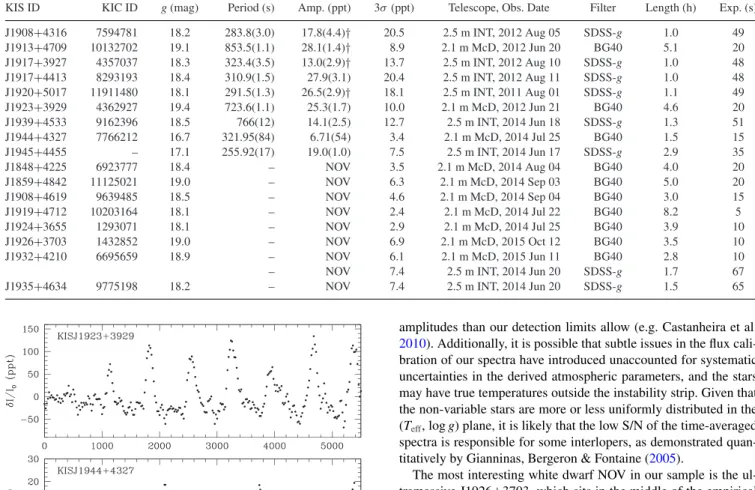
We include a full summary of this high-speed photometry and the appropriate 3σ limits in Table4. Our relative amplitude units are in parts per thousands (ppt), where 1 ppt=0.1 per cent.
4.1 Confirmation of Nine New ZZ Cetis
Nine of the 17 white dwarfs we have followed up with high-speed photometry show significant photometric variations at periods con-sistent with g-mode pulsations in typical white dwarfs (Mukadam et al.2004a). Some pulsational variability was immediately evident in the light curve – Fig. 4shows two of our new ZZ Ceti stars observed from McDonald Observatory.
Fig. 5shows FTs of all nine new ZZ Cetis, and the top half of Table4summarizes the characteristics of the highest amplitude variability in each white dwarf. Two white dwarfs observed as part of the RATS survey did not show significant peaks (KISJ1908+4316 and KISJ1917+3927), but were later confirmed to pulsate using extendedKeplerobservations.
As white dwarfs cool through the ZZ Ceti instability strip, their convection zones deepen, driving longer period pulsations (Winget et al.1982; Tassoul, Fontaine & Winget1990). This trend is borne
out in our time series photometry. Most of the new ZZ Ceti stars found by our work have dominant pulsations between 250–320 s, typical of objects within the ZZ Ceti instability strip. Of note, the three new ZZ Ceti stars with main pulsation periods>720 s all have spectroscopically determined effective temperatures <11 550 K, putting them near the cooler, red edge of the instability strip.
Once we were able to establish pulsations from ground-based follow-up, we submitted the target for space-based, minute-cadence monitoring by theKeplerspacecraft. Since all ZZ Cetis we dis-covered are relatively faint (all haveg>16.7 mag, see Table3), extended time series photometry will significantly improve the sig-nal to noise (S/N) of the observed pulsation spectrum and enable the detection of weak pulsation modes, which is not easily feasible through ground-based studies, given aliasing.
However, only four of our targets were observed from space, and two for just one month, before Kepler lost its ability to maintain fine pointing at its original field near Cygnus due to the failure of the second and critical reac-tion wheel. The four with space-based data obtained thanks to this program are KISJ1920+5017 (KIC 11911480, Greiss et al.2014), KISJ1908+4316 (KIC 07594781), KISJ1917+3927 (KIC 04357037), and KISJ1913+4709 (KIC 10132702). We will present analysis of the latter three ZZ Ceti stars in a forthcoming publication.
4.2 White dwarfs NOV
In addition to the confirmation of nine new ZZ Ceti stars, our ground-based photometry has put relatively strong limits on the lack of photometric variability in eight other white dwarfs with effective
MNRAS457,2855–2863 (2016)
at University of Bristol Library on August 10, 2016
http://mnras.oxfordjournals.org/
Table 4. Summary of ground-based, time series photometry of 17 ZZ Ceti candidates from our survey. We include the dominant periods and their amplitudes of our nine new confirmed ZZ Cetis. Targets marked with a dagger (†) were followed up by theKeplerspace telescope.
KIS ID KIC ID g(mag) Period (s) Amp. (ppt) 3σ(ppt) Telescope, Obs. Date Filter Length (h) Exp. (s) J1908+4316 7594781 18.2 283.8(3.0) 17.8(4.4)† 20.5 2.5 m INT, 2012 Aug 05 SDSS-g 1.0 49 J1913+4709 10132702 19.1 853.5(1.1) 28.1(1.4)† 8.9 2.1 m McD, 2012 Jun 20 BG40 5.1 20 J1917+3927 4357037 18.3 323.4(3.5) 13.0(2.9)† 13.7 2.5 m INT, 2012 Aug 10 SDSS-g 1.0 48 J1917+4413 8293193 18.4 310.9(1.5) 27.9(3.1) 20.4 2.5 m INT, 2012 Aug 11 SDSS-g 1.0 48 J1920+5017 11911480 18.1 291.5(1.3) 26.5(2.9)† 18.1 2.5 m INT, 2011 Aug 01 SDSS-g 1.1 49 J1923+3929 4362927 19.4 723.6(1.1) 25.3(1.7) 10.0 2.1 m McD, 2012 Jun 21 BG40 4.6 20 J1939+4533 9162396 18.5 766(12) 14.1(2.5) 12.7 2.5 m INT, 2014 Jun 18 SDSS-g 1.3 51 J1944+4327 7766212 16.7 321.95(84) 6.71(54) 3.4 2.1 m McD, 2014 Jul 25 BG40 1.5 15 J1945+4455 – 17.1 255.92(17) 19.0(1.0) 7.5 2.5 m INT, 2014 Jun 17 SDSS-g 2.9 35 J1848+4225 6923777 18.4 – NOV 3.5 2.1 m McD, 2014 Aug 04 BG40 4.0 20 J1859+4842 11125021 19.0 – NOV 6.3 2.1 m McD, 2014 Sep 03 BG40 5.0 20 J1908+4619 9639485 18.5 – NOV 4.6 2.1 m McD, 2014 Sep 04 BG40 3.0 15 J1919+4712 10203164 18.1 – NOV 2.4 2.1 m McD, 2014 Jul 22 BG40 8.2 5 J1924+3655 1293071 18.1 – NOV 2.9 2.1 m McD, 2014 Jul 25 BG40 3.9 10 J1926+3703 1432852 19.0 – NOV 6.9 2.1 m McD, 2015 Oct 12 BG40 3.5 10 J1932+4210 6695659 18.9 – NOV 6.1 2.1 m McD, 2015 Jun 11 BG40 2.8 10 – NOV 7.4 2.5 m INT, 2014 Jun 20 SDSS-g 1.7 67 J1935+4634 9775198 18.2 – NOV 7.4 2.5 m INT, 2014 Jun 20 SDSS-g 1.5 65
Figure 4. Light curves of two of our new ZZ Cetis observed from
Mc-Donald Observatory. The top panel shows a relatively cool ZZ Ceti, KISJ1923+3929, with a highly non-sinusoidal pulse shape and dominant oscillation period of roughly 724 s. The bottom panel shows the brightest new ZZ Ceti we confirmed, KISJ1944+4327, with much lower amplitude and shorter pulsation periods of 321.95 and 274.76 s. 1 ppt=0.1 per cent.
temperatures near the ZZ Ceti instability strip. Those limits are quoted as a 3σ threshold in Table4, and represented visually with a FT for each object in Fig.6.
Several of these non-variable white dwarfs have atmospheric parameters that place them within the empirical ZZ Ceti instability strip given their uncertainties, most recently updated by Tremblay et al. (2015). It has been assumed that all white dwarfs in this region can foster a partial ionization zone and thus pulsate – that the instability strip is pure – but this claim is still under review (Bergeron et al.2004; Mukadam et al.2004b; Castanheira et al.
2007), although there is good agreement between the observed and theoretical ZZ Ceti instability strip (e.g. Van Grootel et al.2013).
We will not address that issue here, other than to say there are a number of reasons why these objects may appear not to pulsate. First, it is possible the white dwarfs really do vary, but at lower
amplitudes than our detection limits allow (e.g. Castanheira et al.
2010). Additionally, it is possible that subtle issues in the flux cali-bration of our spectra have introduced unaccounted for systematic uncertainties in the derived atmospheric parameters, and the stars may have true temperatures outside the instability strip. Given that the non-variable stars are more or less uniformly distributed in the (Teff, logg) plane, it is likely that the low S/N of the time-averaged
spectra is responsible for some interlopers, as demonstrated quan-titatively by Gianninas, Bergeron & Fontaine (2005).
The most interesting white dwarf NOV in our sample is the ul-tramassive J1926+3703, which sits in the middle of the empirical instability strip. At 1.14±0.04 M, it would be the second-most-massive white dwarf known to pulsate, behind only GD 518 (Her-mes et al.2013). White dwarfs this massive likely have at least partially crystallized interiors. We did not detect photometric vari-ability in this relatively faint target (g=19.0 mag) to a limit of roughly 6.9 ppt, but it is quite possible that this white dwarf pul-sates at lower amplitude. For example, the two most massive known pulsating white dwarfs have low pulsation amplitudes, which rarely exceed 5 ppt in a given night and are often far lower in amplitude (Kanaan et al.2005; Hermes et al.2013).
The Kepler mission would have given at least an order-of-magnitude improvement on these NOV limits, were these targets observed from space. For example, Østensen et al. (2011a) showed that J1909+4717 did not vary to at least an amplitude of 0.13 ppt using just one month ofKeplerdata in Q4.1. However, only the four known pulsating white dwarfs listed at the end of Section 4.1 were observed before the spacecraft had a failure of its second reaction wheel.
We note that many white dwarfs with atmospheric parameters within the empirical instability strip remain unobserved, and we encourage additional follow-up to constrain pulsational variability in these white dwarfs. We especially encourage further monitoring of the ultramassive J1926+3703.
5 C O N C L U S I O N
Using photometric colour selection from the KIS survey and sub-sequent medium-resolution spectroscopy from ISIS on the WHT, we have discovered and characterized 42 new white dwarfs in the
at University of Bristol Library on August 10, 2016
http://mnras.oxfordjournals.org/
2862
S. Greiss et al.
Figure 5. FTs confirming variability in seven of our nine new ZZ Ceti stars.
The dotted blue line corresponds to the 4Aline marking four times the mean FT amplitude. The dashed green line shows the 3σsignificance line, as described in the text and listed in Table4. The targets KISJ1908+4316 and KISJ1917+3927 showed promising light curves, and were followed up and confirmed as ZZ Ceti stars withKeplerspace-based photometry; their analysis is presented in a forthcoming paper.
Figure 6. FTs of eight pulsating white dwarf candidates observed not to
vary. The blue dotted line and green dashed lines have the same meaning as before.
originalKeplermission field. Follow-up, high-speed photometry from ground-based telescopes confirmed that at least nine of these objects are ZZ Ceti stars. Four were subsequently observed from space using theKeplerspace telescope, and Greiss et al. (2014) report on the first ZZ Ceti found in this project, KIC 11911480. Asteroseismic inferences from the extended data sets on the other three will be presented in a forthcoming publication.
Unfortunately, the failure of the second and critical reaction wheel that keptKeplerprecisely pointed towards its original mission field
MNRAS457,2855–2863 (2016)
at University of Bristol Library on August 10, 2016
http://mnras.oxfordjournals.org/
occurred within months of our discovery of many of these new ZZ Ceti stars, and our sparse ground-based discovery light curves are so far the only time series photometry for most of the targets here. At the end of its roughly four years pointed towards its original field,Keplerobserved a total of six pulsating white dwarfs.
However, the two-reaction-wheel controlled K2 mission will cover a significantly larger footprint as it tours the ecliptic (Howell et al.2014), andK2will likely observe more than a thou-sand white dwarfs, dozens of them pulsating. Already several impor-tant discoveries have come from theseK2observations of pulsating white dwarfs (Hermes et al.2014,2015a,b). The colour selection methods honed in this work have ensured that dozens of pulsating white dwarfs have been or will be observed byK2for up to 80 d at a time, using selection from a variety of multiwavelength photometric surveys.
AC K N OW L E D G E M E N T S
The authors acknowledge fruitful conversations with A. Gianni-nas during the preparation of this manuscript. The research lead-ing to these results has received fundlead-ing from the European Re-search Council under the European Union’s Seventh Framework Programme (FP/2007-2013) / ERC Grant Agreement n. 320964 (WDTracer). Support for this work was provided by NASA through Hubble Fellowship grant #HST-HF2-51357.001-A, awarded by the Space Telescope Science Institute, which is operated by the Associ-ation of Universities for Research in Astronomy, Incorporated, un-der NASA contract NAS5-26555. DS acknowledges support from STFC through an Advanced Fellowship (PP/D005914/1) as well as grant ST/I001719/1. KJB acknowledges funding from the NSF under grants AST-0909107 and AST-1312983, the Norman Hacker-man Advanced Research Program under grant 003658-0252-2009, and theKeplerCycle 4 Guest Observer program 11-KEPLER11-0050. This paper makes use of data collected at the INT and the WHT, both operated on the island of La Palma, by the Isaac Newton Group in the Spanish Observatorio del Roque de los Muchachos, as well as data taken at The McDonald Observatory of The University of Texas at Austin.
R E F E R E N C E S
Althaus L. G., C´orsico A. H., Isern J., Garc´ıa-Berro E., 2010, A&AR, 18, 471
Bell K. J., Hermes J. J., Bischoff-Kim A., Moorhead S., Montgomery M. H., Østensen R., Castanheira B. G., Winget D. E., 2015, ApJ, 809, 14 Bergeron P., Saffer R. A., Liebert J., 1992, ApJ, 394, 228
Bergeron P., Leggett S. K., Ruiz M. T., 2001, ApJS, 133, 413
Bergeron P., Fontaine G., Bill`eres M., Boudreault S., Green E. M., 2004, ApJ, 600, 404
Bergeron P. et al., 2011, ApJ, 737, 28 Bradley P. A., 2001, ApJ, 552, 326 Brickhill A. J., 1991, MNRAS, 251, 673 Castanheira B. G. et al., 2007, A&A, 462, 989
Castanheira B. G., Kepler S. O., Kleinman S. J., Nitta A., Fraga L., 2010, MNRAS, 405, 2561
Fontaine G., Brassard P., 2008, PASP, 120, 1043
Fontaine G., Brassard P., Bergeron P., 2001, PASP, 113, 409 Giammichele N., Bergeron P., Dufour P., 2012, ApJS, 199, 29 Gianninas A., Bergeron P., Fontaine G., 2005, ApJ, 631, 1100 Gianninas A., Bergeron P., Ruiz M. T., 2011, ApJ, 743, 138 Greiss S. et al., 2012a, AJ, 144, 24
Greiss S. et al., 2012b, preprint (arXiv:1212.3613)
Greiss S., G¨ansicke B. T., Hermes J. J., Steeghs D., Koester D., Ramsay G., Barclay T., Townsley D. M., 2014, MNRAS, 438, 3086
Groot P. J. et al., 2009, MNRAS, 399, 323 Hermes J. J. et al., 2011, ApJ, 741, L16
Hermes J. J., Kepler S. O., Castanheira B. G., Gianninas A., Winget D. E., Montgomery M. H., Brown W. R., Harrold S. T., 2013, ApJ, 771, L2 Hermes J. J. et al., 2014, ApJ, 789, 85
Hermes J. J. et al., 2015a, MNRAS, 451, 1701 Hermes J. J. et al., 2015b, ApJ, 810, L5 Holberg J. B., Bergeron P., 2006, AJ, 132, 1221 Howell S. B. et al., 2014, PASP, 126, 398
Kanaan A., Kepler S. O., Winget D. E., 2002, A&A, 389, 896 Kanaan A. et al., 2005, A&A, 432, 219
Kleinman S. J. et al., 2013, ApJS, 204, 5 Koester D., 2010, Mem. Soc. Astron. Ital., 81, 921 Marsh T. R., 1989, PASP, 101, 1032
Mukadam A. S. et al., 2004a, ApJ, 607, 982
Mukadam A. S., Winget D. E., von Hippel T., Montgomery M. H., Kepler S. O., Costa A. F. M., 2004b, ApJ, 612, 1052
Mukadam A. S., Montgomery M. H., Winget D. E., Kepler S. O., Clemens J. C., 2006, ApJ, 640, 956
Napiwotzki R. et al., 2004, in Hilditch R. W., Hensberge H., Pavlovski K., eds, ASP Conf. Ser. Vol. 318, Spectroscopically and Spatially Resolv-ing the Components of the Close Binary Stars. Astron. Soc. Pac., San Francisco, 402
Nather R. E., Mukadam A. S., 2004, ApJ, 605, 846
Nather R. E., Winget D. E., Clemens J. C., Hansen C. J., Hine B. P., 1990, ApJ, 361, 309
Østensen R. H. et al., 2011a, MNRAS, 414, 2860
Østensen R. H., Bloemen S., Vuˇckovi´c M., Aerts C., Oreiro R., Kinemuchi K., Still M., Koester D., 2011b, ApJ, 736, L39
Provencal J. L. et al., 2012, ApJ, 751, 91 Ramsay G. et al., 2014, MNRAS, 437, 132
Tassoul M., Fontaine G., Winget D. E., 1990, ApJS, 72, 335
Tremblay P.-E., Bergeron P., Kalirai J. S., Gianninas A., 2010, ApJ, 712, 1345
Tremblay P.-E., Bergeron P., Gianninas A., 2011, ApJ, 730, 128
Tremblay P.-E., Ludwig H.-G., Steffen M., Freytag B., 2013, A&A, 559, AA104
Tremblay P.-E., Gianninas A., Kilic M., Ludwig H.-G., Steffen M., Freytag B., Hermes J. J., 2015, ApJ, 809, 148
Van Grootel V., Fontaine G., Brassard P., Dupret M.-A., 2013, ApJ, 762, 57 Winget D. E., Kepler S. O., 2008, ARA&A, 46, 157
Winget D. E., van Horn H. M., Tassoul M., Fontaine G., Hansen C. J., Carroll B. W., 1982, ApJ, 252, L65
Winget D. E. et al., 1991, ApJ, 378, 326
This paper has been typeset from a TEX/LATEX file prepared by the author.
at University of Bristol Library on August 10, 2016
http://mnras.oxfordjournals.org/