Claire C. Payne. Retrieval of LGBTQ+ Recreational Reading Material: A Comparative Study. A Master’s Paper for the M.S. in I.S. degree. May, 2018. 103 pages. Advisor: Melanie Feinberg
Over the past few decades, a sizeable body of library and information science literature has pointed to the inadequacies of traditional cataloging and classification systems for describing material related to marginalized communities. At the same time, alternative metadata systems have proliferated in online environments and social tagging has become almost ubiquitous. Focused specifically on the retrieval of LGBTQ+-related recreational reading materials, this study used an online survey to assess the utility of traditional library systems in comparison with the utility of the user-moderated folksonomy employed in the Archive of Our Own (AO3) fanwork repository. Results indicated that respondents, who were generally comfortable in both the library and Archive environments, preferred using AO3 to access LGBTQ+ material and perceived the tagging system to be of greater value in search processes than typical subject access mechanisms. Several possible avenues for improving current systems emerge in the conclusion of the paper.
Headings:
Fan fiction
Libraries & LGBT people Reading as recreation
RETRIEVAL OF LGBTQ+ RECREATIONAL READING MATERIAL: A COMPARATIVE STUDY
by Claire C. Payne
A Master’s paper submitted to the faculty of the School of Information and Library Science of the University of North Carolina at Chapel Hill
in partial fulfillment of the requirements for the degree of Master of Science in
Information Science.
Chapel Hill, North Carolina May 2018
Approved by
Contents
INTRODUCTION ... 3
BACKGROUND:METADATA AND TAGGING AT THE ARCHIVE OF OUR OWN ... 7
LITERATURE REVIEW ... 12
User-centered Cataloging and Alternative Classification Systems ... 12
Cataloging for Marginalized Populations and Subject Access for LGBTQ+ People .... 15
Fan Studies and Library and Information Science... 16
Historiography and Potential for Future Work ... 18
METHODOLOGY ... 21
Participant Recruitment ... 21
Survey Design ... 23
Data Analysis ... 24
FINDINGS ... 26
Demographics ... 26
Fan Communities Represented ... 27
Recreational Reading Behavior ... 27
Systems Familiarity ... 29
Search Behaviors ... 32
Searching in Practice ... 38
A Search Exercise ... 45
DISCUSSION ... 50
LIMITATIONS ... 54
CONCLUSION ... 57
APPENDIX A:SURVEY INSTRUMENT... 62
APPENDIX B:TUMBLR RECRUITMENT POST ... 91
APPENDIX C:TWITTER RECRUITMENT POST ... 92
APPENDIX D:ADVANCED SEARCH VIA WORK TAGS SCREENSHOT ... 93
APPENDIX E:SORT AND FILTER FUNCTIONALITIES SCREENSHOT ... 94
Tables
TABLE 1.READING HABITS. ... 28
TABLE 2.RESPONSES ABOUT FEATURING LGBTQ+ EXPERIENCES... 28
TABLE 3.LGBTQ+ CHARACTER PREVALENCE. ... 29
TABLE 4.SYSTEMS FAMILIARITY. ... 30
TABLE 5.TAGGING SYSTEM KNOWLEDGE. ... 30
TABLE 6.SEARCHER COMFORT LEVELS. ... 31
TABLE 7.SUBJECT HEADING FAMILIARITY... 31
TABLE 8.SEARCH FREQUENCIES. ... 32
TABLE 9.REASONS FOR AO3 PREFERENCE. ... 34
TABLE 10.TAG AND SUBJECT HEADING USE IN SEARCH... 37
TABLE 11.OTHER USES OF TAGS. ... 38
TABLE 12.LIBRARY SEARCH STRATEGIES, ALL CONTENT ... 39
TABLE 13.LIBRARY SEARCH STRATEGIES,LGBTQ+ CONTENT. ... 39
TABLE 14.POSITIVE ASPECTS OF LIBRARY SEARCH. ... 40
TABLE 15.FRUSTRATIONS WITH LIBRARY SEARCH. ... 40
TABLE 16.AO3 SEARCH STRATEGIES, ALL CONTENT. ... 42
TABLE 17.AO3 SEARCH STRATEGIES,LGBTQ+ CONTENT ... 42
TABLE 18.POSITIVE ASPECTS OF AO3 SEARCH. ... 45
TABLE 19.FRUSTRATIONS WITH AO3 SEARCH. ... 45
TABLE 20.SEARCH TASK RESULTS. ... 46
TABLE 21.RESULTS OF CATALOG SEARCH TASK. ... 47
TABLE 22.RESULTS OF AO3 SEARCH TASK. ... 48
TABLE 23.RESULTS FROM LIBRARY SEARCH TASK, REFLECTIONS ON DIFFICULTY. ... 49
Introduction
Though modern English-language library classificatory systems and controlled
vocabularies are continually tweaked, altered, and updated, a substantial body of
scholarship has nevertheless shown that these systems are frequently fraught with bias
and representational inaccuracies (see, for example, Adler, 2017; Olson, 2001). Beyond
the inherently problematic nature of a biased system of assigning metadata, these
inaccuracies in representation will also necessarily lead to difficulties and inaccuracies in
information retrieval. Problems with classification of LGBTQ+ related materials, in
particular, have been studied extensively, with wide implications (Adler, 2017; Olson,
2001; Johnson, 2010). Investigations have generally concluded that current classification
systems—particularly Library of Congress Subject Headings (LCSH)—are not
adequately inclusive of the LGBTQ+ community (defined here as including people who
self-identify as part of the lesbian, gay, bisexual, transgender, or queer communities; or
who otherwise see themselves as a gender or sexual minority). For users searching for
LGBTQ+ content, this inadequacy adds an extra layer of difficulty to the information
retrieval process.
Fortunately for these LGBTQ+ users, online systems have been developed that
provide alternatives to the restrictiveness of traditional controlled vocabularies. Social
tagging is extremely prevalent, both outside traditional library catalogs and within these
systems themselves. Previous research has delved into the relative utility of a variety of
(Adler, 2009; Lu, Park, & Hu, 2010; Rolla, 2009). Some of this previous work (such as
Adler, 2009) has even specifically considered tagging practices of queer (used in this
paper as a synonym for LGBTQ+) content. This study, then, is an expansion on this
previous body of work. This paper is concerned with a set of tagging and classification
practices that are not as frequently subject to academic inquiry: the organizational system
of a web-based fanwork repository, fanwork defined here as a piece of media (a story,
artwork, etc.), usually created by a fan without intention of profit, directly inspired by
another piece of media and often reusing that original media’s characters or setting.
Having surveyed 150+ LGBTQ+ adults, this work examines the utility of a moderated
social tagging system in comparison with traditional subject headings when used for
retrieval of queer recreational reading objects online. This work builds off the inquiry of
scholars such as Ludi Price and Julia Bullard, who have devoted recent articles and
dissertations to the intersections of information science and fan studies—and done some
of the critical work of collocating these two disciplines (Price & Robinson, 2016; Price,
2017; Bullard, 2017).
Though studies of fans within information and library science are relatively
uncommon, there is a long history of fans acting as their own digital catalogers and
archivists online.1 Online fan repositories serve populations of all ages, interests, and backgrounds; they vary widely in size, scope, and quality. Though many fanworks are
uploaded to sites whose permanence is unknown—an enormous body of fanfiction
resided on now-dormant LiveJournal blogs in the first decade of the 21st century—many
other creators take great care to publish their work to reliable and sustainable platforms,
meticulously cataloging their productions with complex metadata and tagging systems.
Perhaps the most well-known contemporary repository is the Archive of Our Own. AO3,
as it is commonly known, is a project of the Organization for Transformative Works—“a
nonprofit organization run by and for fans to provide access to and preserve the history of
fanworks and fan cultures.”2
While they may enjoy serving as their own pseudo-librarians, fans primarily visit
fan sites for social purposes (Price & Robinson, 2016). Internet fandom is often perceived
as a safe recreational space for teens and adults who may not know people in real life
who share a particular obscure cultural interest. Members of marginalized groups can
frequently find themselves represented in fandom to a degree not seen in mainstream
media productions.3 This is especially true of LGBTQ+ people, due in no small part to the popularity of same-sex pairings within many fan communities (Binstock, 2016; Hu,
2016; Niehaus, 2014). Many fan spaces are deliberately inclusive: AO3 has been
analyzed as an example of embedded feminist HCI (Fiesler, Morrison, & Bruckman,
2016), and there are countless examples of individual fans curating their own webpages
to express support for queer people.4 In focusing on LGBTQ+ adults, then, this research
2http://www.transformativeworks.org/about_otw/, accessed October 26, 2017.
3 It should be highlighted that fandom is clearly not a haven for all marginalized groups, but addressing the complexities of all fan experiences is unfortunately outside the scope of this paper.
project is a deliberate study of connections between classificatory systems and, critically,
a population that those systems are theoretically designed to support. I examined use of
the moderated folksonomic tagging system of AO3 to answer the question: When
assessed in comparison with typical (Library of Congress Subject Heading) systems of
classifying content, does the use of AO3’s moderated tagging system lead to LGBTQ+
users reporting greater ease and satisfaction when searching for recreational reading
material online? This project has implications for how fan and non-fan platforms employ
tagging as a tool for user search and object retrieval. Data collected points to strengths or
weaknesses of how different tagging and classification systems serve users searching for
Background: Metadata and Tagging at the Archive of Our Own
To provide context for this work, it is necessary to provide brief background on
the Archive of Our Own. Approximately a decade old at the time of this writing, AO3
was founded in 2008 after a 2007 proposal for “An Archive of One’s Own” that reflected
growing concerns in fan communities about commercial entities profiting off their labor
as well as a desire among fans for their work to be preserved and documented (“An
Archive of One’s Own”, 2007). Over the course of 2007 and 2008, volunteers began
building the infrastructure for the parent Organization for Transformative Works and
AO3; both have grown enormously since that time. Though the Archive is technically
still in an open beta, it currently hosts over three million fanworks and has over one
million registered users.
While AO3 is broadly fascinating as a successful volunteer archival project, this
study is focused more specifically on the tagging and metadata structure of the site. As
Bullard explored in her dissertation work, the Archive is a “successful large-scale
user-driven classification design project” (2017, p. 74). The tag-oriented metadata system for
works uploaded to the site was designed and is continuously maintained by a team of
expert volunteers. As is the case with any folksonomy, users (in this case, authors) are
free to add any tags they wish to their own content. Where AO3 differs from most
systems, however, is in its large-scale behind-the-scenes system of “tag wranglers”: users
who work to synonymize, canonize, and otherwise curate user-generated tags. The AO3
“The idea is to standardize canonical tags and synonym relationships as much as possible, while keeping in mind that different fandoms (and people) organize information about their fandoms differently. The aim, then, is not a perfect tagging scheme, but clarity, differentiation between similar tags with different concepts, prevention of single tags with different meanings, and ease of use for as many people as possible.”
For folks who work as wranglers, the Archive has published a seven-part set of pages that
provide extensive documentation on how to approach the process. Bullard (2017) has
provided a thorough explanation of AO3 tags and wrangling; a brief description will
suffice here.
AO3 has four kinds of tags: Fandom, Character, Relationship, and Additional tag
(Freeform tags). When posting a work, the interface prompts authors to sort their tags by
category. For authors, the work of tagging their piece is then complete. In the
background, however, tag wranglers take over, continuously updating tag structures and
hierarchies in a multistep process that moves tags from free text to systematically
categorized. Tag wranglers:
• Assign canonical tags, a single master tag meant to group a set of tags that refer to
the same concept.
• Synonymize tags, creating the grouped tags under a master tag.
• Disambiguate tags, e.g. adding text to canonical tags to distinguish between the
fandoms for a book versus the movie of the same name.
• Create parent tags and child tags, categorizing and grouping specific tags
• Produce metatags, high-level tags that group together similar (but not
synonymous) tags to allow searchers to use one tag to retrieve a wide variety of
related works.5
These wrangled tags are then used in the AO3 search and browse functionalities. Users
are provided with interfaces to browse fandoms and browse or search works, bookmarks,
and tags themselves. An advanced work search feature allows for complicated queries to
locate fanworks, including searching by all tag types—the interface lists canonical tags
for selection as users begin typing in tag fields (see Appendix D for an image of the tag
search component). The main search bar at the top of any AO3 page is a keyword search,
but prompts the user to include different filters as desired (e.g., words:>10000). When
users click on a tag on any part of the site, they are presented with a list of works tagged
with that tag or one of its synonyms or metatags. Within these specifically tagged results,
they are also provided a complex set of sort and filter options (Appendix E). In essence,
the Archive’s robust filter and search options are all underwritten by the tag system and
the efforts of the tag wranglers.
There are a few other functionalities of AO3 that are more tangential to the work
of this study, but were mentioned frequently in survey responses. Alongside
user-generated and wrangler-mediated tags, there are other pieces of metadata that the Archive
considers “tags”: authors can assign their work a rating (from General Audiences to
Explicit) and can provide select “Archive Warnings” for content like graphic violence.
They can also optionally class their work by primary kind of relationship present, with
choices for several combinations of same-gender or heterosexual pairings (along with a
“Gen[eral]” option). Additionally, though this study is focused on retrieval of works
within the Archive’s main search systems, users can also add tags to their personal
bookmarks, which are searchable by all users.
As this study is about tags relating to LGBTQ+ material, it is worth noting that
AO3 provides explicit instructions about how to handle metadata architecture related to
identity issues. The Wrangling Guidelines state:
“DO NOT make tags synonyms when dealing with people’s identities unless you are absolutely sure that you are doing so appropriately. If you aren’t sure, ask the list or leave it alone. If you come across an identity term that you aren’t familiar with, definitely leave it alone. This includes national, ethnic, racial, sexual, gender, and religious identities, and probably other categories as well.”
Tag wranglers, then, are encouraged to act with an abundance of caution when it
comes to creating metadata for LGBTQ+ material.
Finally, AO3’s primary guiding principle for tag wrangling was critical to the
logic underlying this study: “The purpose of tags is to help users find works”
(“Wrangling Guidelines”). Somewhat similarly, in their documentation for Researchers,
the Library of Congress indicates that:
“The primary purpose of LCSH [Library of Congress Subject Headings] is to provide standardized English-language subject category terms that can be used to bring together in convenient groups the literature of the world--no matter how great its variation in title keywords, and world--no matter what the original language of the works being cataloged--so that materials on the same subject can be noticed and retrieved together” (“Doing Research at the Library of Congress”, 2016).
The spirit of findability made so explicit at AO3 is present in this mission. Price (2017)
also assessed the two entities as parallel creations as she stated: “tagging – on AO3 in
library catalogues, except that [tags] are far more granular and far more numerous” (p.
Literature Review
This study has its roots in a diverse body of information science and related
literature.
User-centered Cataloging and Alternative Classification Systems
Though the history of cataloging and classification is far too lengthy to explore in
its entirety here, the history of potential disruptions to traditional cataloging methods is
comparatively brief. For several decades, authors have framed standard cataloging
practice as a problem for user experience—yet the very discussion of this problem over
multiple decades indicates that it is an issue that has yet to be adequately addressed. As
Hoffman (2009) described it, cataloging has traditionally been unique in the library world
in that established standards are not effectively designed to allow for user needs to be
met: controlled vocabularies and reliance on individual catalogers for any appropriate
customizations of classifications have not made for an effective system. Other authors
point to the particular dubiousness of these traditions in an online environment. Bates
(1986; 1989) was an early voice in discussions about the potential of online searching,
and was in particular an early proponent of uncontrolled vocabularies to serve user needs
(1989). Alemu et al. (2011) took up this call in later decades, framing collaborative
metadata formation and social tagging as a social constructivist approach to cataloging.
Thus, while classifying using Library of Congress Subject Headings remains
hegemonic in the library world, there is a significant quantity of recent library and
collaborative classification systems for both retrieval and description online: most authors
have concluded these studies by recognizing the positive prospective impact of tagging,
while also acknowledging one or more caveats that prevents them from replacing
traditional cataloging systems. Speller (2007) provided an early example of this
assessment of alternative classification systems: in an extensive review of then-existing
literature, she suggested that alternative classification is both useful and problematic from
several perspectives, including quality control and specificity. Though a number of
platforms have been considered since her 2007 report, the largest number of researchers
have specifically assessed tags users have added to records in LibraryThing, a social
platform for cataloging of personal libraries: Rolla (2009) argues that due to differences
in how catalogers and users label material, tags can enhance, but not supplant, traditional
subject headings. Lu et al. (2010) had a similar finding: they recognized that social tags
can improve collection accessibility, but also suggested that unregulated erroneous tags
may be problematic for library catalogs. Kipp and Campbell (2010) and Steele (2009)
were more moderated in their approach, suggesting that users find utility in both tags and
traditional classification systems. Pirmann (2012) considered LibraryThing tags from a
usability perspective, and had a different objection than earlier authors: while tags
enhance subject access, current search system design does not adequately support
retrieval of items based on tags.
These cautious yet curious findings were not exclusive to research on
LibraryThing: Thomas et al. (2009) used a variety of platforms to come to the similar
conclusions, arguing that the use of folksonomies in library catalogs augments patron
seemingly been discussed extensively, there is no body of literature that addresses the
utility of moderated social tagging systems, or specifically the system in use in the
Archive of Our Own. Further, most authors do not entertain the possibility that tags can
be of great utility on their own, without the underlying structure of a standard
classification system within a library catalog. This paper begins to address both of these
gaps.
A few researchers have considered alternative classification systems beyond
simple questions of utility. Yi and Mai Chan’s work (2009) attempted to collocate tags
and Library of Congress headings and therefore assumed that there might be some utility
in bringing order to tags via an established classification scheme; this attempt to network
different classification systems is not seen in other papers, but the authors still relied on
LCSH as the most acceptable standard. Adler (2009) considered LibraryThing tags and
LCSH specifically with regards to transgender-themed materials; she found a relatively
substantial divide between tags users assigned in LibraryThings and subject headings
assigned with LCSH, but echoed other work in suggesting that neither is effective on its
own. Finally, Bates and Rowley (2011) asked deeper questions, echoing the weaknesses
of standard classification systems described in the second section of this literature review.
Writing from the UK, they found that LibraryThing user tags are also subject to bias
(albeit different ones) and do not entirely serve as a solution to problems of social
exclusion found in typical classification systems. Given the relative scarcity of studies of
this type, however, more research about the practical and social implications of tags
within and outside of library systems is needed; this study participates in this area of
Cataloging for Marginalized Populations and Subject Access for LGBTQ+ People
Apart from Adler’s 2009 study, most examinations of alternative classification
systems were not domain-specific. Classification complications, however, are very often
particular to a field or group of fields, and classification of LGBTQ+ materials in
particular is a particularly fraught topic. The rapid changes in terminologies and identity
politics attached to these items present an enormous challenge to traditional classification
methods that are under bureaucratic management. Though Sanford Berman first brought
issues of bias in LCSH to the fore in 1971 (Berman, 2014), the majority of research
pertaining to the complexities of cataloging materials that relate to marginalized groups
has appeared in the last two decades. Several modes of inquiry have emerged, and a few
key authors (such as Adler, Olson, Roberto, and Drabinski) have been responsible for
much of the growth in scholarly research on these topics.
The fundamental outcome of this increase in inquiry is that the scholarship has
unconditionally recognized the shortcomings of LCSH (see Drabinski, 2013, for an
excellent explanation of the cementation of this process). There still, however, exists a
significant body of work that aims to further establish how these subject headings fail at
representation of marginalized bodies and provide potential solutions to the problem.
Authors such as Christensen (2008), de la Tierra (2008), and Greenblatt (2011) have
recently written short essays that introduce the problems of LCSH and reflect on the
progress of the past, and then continue calling for change to come from the Library of
Congress itself. Johnson (2008) took a slightly different approach in that he emphasized
the utility of GLBT (his term) thesauri for retrieving material, offering examples of more
potential of uncontrolled vocabularies or moderated uncontrolled vocabularies (such as
that in use at AO3) for queer subject access.
In the last few years, researchers have also begun exploring cataloging and
subject access concerns from densely theoretical perspectives. Drabinski (2013)
convincingly employed a queer theoretical framework to suggest that one should provide
users with the tools to engage with extant metadata systems as biased texts, as an
all-inclusive unbiased classification system is an impossible goal. Adler (2017) drew on
queer theory to craft her comprehensive monograph about the history of knowledge
organization as it relates to sexuality, persuasively arguing that Library of Congress
subject headings have reinforced mechanisms of social power that other practitioners of
non-normative sexual behavior. It is likely that critical theoretical approaches to
cataloging and classification practice will grow in import in the coming years. As this
paper is focused on how users engage with classification systems, it is engaged with this
theoretical literature while also keeping practical usability at the fore.
Fan Studies and Library and Information Science
It is only recently that fanfiction and fan studies have arisen as appropriate topics
of scholarly interest, but in the past few years several emerging scholars have dedicated
articles, dissertations, and theses to intersections between the disciplines of fan studies
and information and library science.6 This significant intellectual work has legitimized the inclusion of fans in serious study of LIS.
6 The Fan Studies Network—visualized as “an international friendly space in which scholars of fandom could easily forge connections with other academics in the field”—was founded only in 2012.
Some of this research has been relatively wide in scope. Price and Robinson
(2016), drawing on the early stages of Price’s dissertation study, described their
investigative project on fan community information behavior as a whole. Price recently
completed the study that resulted from this extensive investigative project and published
the most comprehensive existing study at the intersection of fan studies and LIS; her
2017 dissertation aimed, quite broadly, “to explore the information behaviour of cult
media fan communities” (Price, 2017, p. 9). In this text, Price constructed a multi-faceted
model of fan information behavior that took into account fannish activities across the
web; her results specifically relevant to tagging are discussed below. Koven-Matasy
(2013) also broadly considered the overlap between fandom and LIS, from a different
angle. Her findings suggested that there were both social and (limited) professional
benefits for librarians who participated in fan culture.
Most researchers, however, have tackled a smaller subset of fan products or a
particular aspect of fandom culture, and a few threads emerge in the literature. Gursoy
(2015), Daw (2015), and Lothian (2013) all considered the archival potentials of
fanworks, though Lothian wrote from a cultural studies perspective rather than an LIS
lens. Both Gursoy and Daw suggested that fan materials have a valuable role to play in
archives, while Lothian troubled ideas of what can and should be archived through a lens
of critical theory. This research, while of little apparent practical relevance for this paper,
serves to endorse fanworks as a useful point of LIS inquiry.
More relevant to this study, some previous authors have specifically considered
questions about tagging, particularly as part of Master’s level research projects. Dalton
Archive of Our Own, tentatively arguing that users perceived it as reasonably valuable.
Donkar (2007) attempted to establish the existence of consistent vocabularies within a fan
community on the now-defunct platform Delicious, and found that patterns and trends did
in fact emerge. Price, as part of her expansive doctoral research (2017), analyzed tagging
practices within a specific fandom on Tumblr, AO3, and Etsy in an attempt to explore fan
tag usage patterns; she supplemented her analysis of a large dataset with interviews with
tag creators. This subsection of her findings indicated that, related to the efforts of tag
wranglers, “tags on AO3 were more effective bearers of information than on the other
sites investigated” (p. 275). Most substantially, Bullard (2016a, 2016b, 2017) also studied
AO3 in her dissertation research, using its tagging methods as a means to consider
classification design. Bullard spent several years embedded a researcher within the
volunteer “tag wrangler” army of The Fanwork Repository (a pseudonym she uses to
refer to AO3). From this position, she analyzed the design decisions of these volunteers
and argued that “designers have an important role in creating the values or bias of a
classification system” (Bullard, 2017, p. v). These previous considerations of tagging are
of incredible utility for the framing of this paper. However, no previous research has
investigated the utility of fannish tagging practices for a particular subset of users; this
paper adds breadth to this growing body of scholarship.
Historiography and Potential for Future Work
Finally, it should be noted that over the past three decades a few critical edited
volumes have been produced that tackle the intersections of subjects highlighted above in
this review. While some individual chapters have already been cited, considering these
for succinct visualization of the scope and trajectory of the most relevant body of LIS
literature for this project.
Gough and Greenblatt’s book (1990) was an early voice in discussions about how
to best provide service for LGBTQ+ library users; it was not until the late-2000s that
other book-length texts were produced addressing similar concerns. Greenblatt herself
published a substantially revised version of this book twenty years later (2011a). Content
changes from the earlier edition are evident in a change in name: what was called Gay
and Lesbian Library Service in 1990 became Serving LGBTIQ Library and Archives
Users in 2011. Both volumes included chapters that addressed bibliographic access
alongside topics such as collection development and professional resources for queer
librarians—but in 2011, for example, transgender issues were covered much more
extensively, while several chapters on AIDS-related materials for potential circulation
were no longer included.
Alongside Greenblatt’s work, Emily Drabinski’s groundbreaking ongoing series
(as editor) on “Gender and Sexuality in Information Studies” has produced several
volumes relevant to this project: Dean and Keilty’s (2013) Feminist and Queer
Information Studies Reader gathered a wide variety of papers that look at LGBTQ+
concerns in LIS as a whole, while Wexelbaum’s (2015) Queers Online: LGBT Digital
Practices in Libraries, Archives, and Museums focuses in on digital space. The market
for materials addressing queer subjects in LIS has clearly broadened since 1990, and
perhaps even since 2011: the specificity and number of volumes in this series allows
Greenblatt was able to. The success of this series is perhaps an indicator that LIS
practitioners and scholars are, as a group, growing more concerned with queer issues.
Finally, unrelated to either of the above collection sets, Roberto (2008) brought
together essays that considered specifically cataloging problems and means of addressing
them. While Radical Cataloging considers questions of race and religion alongside
reflections on gender and sexuality, the volume in its entirety points to a newly increased
scholarly engagement with the shortcomings of LCSH—as this intervention in the
discourse on cataloging appeared almost 40 years after Sanford Berman’s earliest
publications that brought the issue to the fore (Berman, 2014).
Alongside the chapters, books, and articles considered above, these seminal edited
volumes have done important work in establishing the validity of the areas of study
surrounding this project, and interest in LGBTQ+ subject access concerns is increasingly
visible. The investigation of how queer populations (and, of course, other marginalized
groups) engage with information is, however, still an intellectual space ripe for growth—
especially since, as established in the second section of this literature review, the
language around queer issues is in near-constant flux. This paper is meant as a
Methodology
Though (as described above) there exists an existing body of work that tackles
various intersections of tagging, LGBTQ+ materials access, LIS, and fandom, the limits
of previous research on fanfiction repositories in particular mean that this work is
exploratory in nature. This study collected data through a survey administered online via
the Qualtrics platform (Appendix A) to answer the question: do users report higher ease
and satisfaction in searching for recreational reading materials online in typical LCSH
systems or in moderated tagging systems (specifically that in use at the Archive of Our
Own, or AO3)? This survey consisted of both closed-response and open-response
questions, and was designed to be completed in approximately 20-40 minutes.
Participant Recruitment
The survey was distributed through online social networks. Koven-Matasy
(2013), writing about the intersection of fandom participation and careers in librarianship,
created a Tumblr blog for the sole purpose of dissemination of her master’s paper survey.
She explained Tumblr’s particular utility for a survey of this type:
“[Tumblr] combines the community-building aspect of social media (different users “follow” each other’s accounts in order to view their posts on an aggregated “dashboard” and can “like” or “reblog” specific posts in order to show their interest or approval; in the case of reblogging the original post will then be shown on the dashboards of all the followers of the user who reblogs it, with any additional commentary that user sees fit to provide) with topical discovery (posts can be tagged, and those tags can be searched or “tracked” by users who are interested in a particular
Considering the success of Koven-Matasy’s approach (she had more than 150
usable responses), I created a Tumblr account (@findinglgbtqmaterial) from which to
disseminate the tagged survey recruitment post (Appendix B). I included an actual photo
of myself as the blog’s avatar in order to legitimize the young account, and my contact
information was available at the link to the survey. The post was tagged with terms
related to the research as well as names of top fandoms from 2017 as determined by
Tumblr's algorithms and published by Tumblr; theoretically, users from all over Tumblr
were able to serendipitously find the survey.7 To begin circulating the survey, I shared the original Tumblr post through two different longstanding personal Tumblr blogs, one of
which is devoted to LGBTQ+ literature and has a sizeable following of similarly-themed
blogs. Through reblogs by interested parties and serendipitous browsing, the survey then
circulated far outside my own social sphere and fan communities; at the time the survey
closed, the post had over 300 “notes”, meaning 300 blogs had either liked or reblogged it.
Only approximately 5 of these notes originated from bloggers whom I personally know.
I also created a Twitter account (@clairecpayne) to disseminate the survey.
Twitter is useful for essentially the same reasons as Tumblr with regards to this study, but
generally used by a broader population than Tumblr. In fitting with the norms of the
platform, the profile included a photo of me and a very brief academic biography of
myself. Due to character limits, the short call for participants included fewer tags than the
Tumblr post and was only tagged #fanstudies (Appendix C). I first retweeted the Tweet
on my personal account, and from there it gained a modest degree of traction. It was
retweeted 16 times before the survey closed; in marked contrast to the Tumblr spread, I
knew about half of these disseminators personally.
Had the survey not effectively spread organically, I had planned to contact
particular “high profile” members of fandom online to ask them to share the survey to
their own networks as well. The benefits of sharing the survey instrument in these
specialized networks were weighed against the potential problems with this approach:
using fandom-specific recruitment ran the risk of concentrating survey respondents
within a particular fandom or fandoms; the limitations of this are described below.
Ultimately, this technique was unnecessary: the sample was a blend of a convenience and
snowball sample, fitting with the exploratory nature of the research.
Survey Design
Participants who clicked the link to the survey (Appendix A) were first presented
with three screening questions asking them about their age, then reading habits. If
participants reported that they were under 18, or reported that they do not use the library
and/or do not search for recreational reading material using AO3 at least once every six
months, they were directed to the end of the study. If participants were over 18 and did
use the mechanisms of interest in this study, they continued on to the body of the survey.
Recruitment materials made clear that this survey was intended for readers of queer
material, but participants faced no screening questions about sexual identity as I did not
wish to gate keep or make participants uncomfortable about not “qualifying” for the
survey.
Survey questions asked participants about their experiences searching for
of questions covered the habits and preferences of participants with regards to all
fanfiction and traditional fiction as well as LGBTQ+-themed fanfiction and traditional
fiction. The second set of questions concerned participants’ search behaviors. Half of
participants then saw a set of questions that asked them to recount and provide feedback
on certain specific search practices, while the other half was given two brief retrieval
tasks and asked questions about their experience with the tasks. The next set of questions
asked all participants about their past experiences with tags and subject headings
specifically. The final section of the survey collected demographic data pertinent to
assessing survey results. Participants were asked for their age range, gender identity,
sexual orientation, and primary language. Apart from the multiple-choice age ranges, all
of these questions were open-ended. As was the case with the rest of the survey, no
questions required a response. Participants were also asked about their primary fan
community or communities, to ensure that not all responses come from a single fandom
that may have particular tagging practices skewing the entire study. No location or IP
address information was collected from participants, and all responses were completely
anonymous.
Data Analysis
The survey remained open for two weeks, from February 17, 2018, to March 3,
2018. At the time it closed, the Tumblr post was updated to note that it was no longer
accepting new responses, and an additional Tweet was threaded to the original for the
same purpose. 301 people began the survey, and 209 technically completed it. Of these
209, 151 answered affirmatively to all three screening questions and therefore filled out
completing the survey.8
Closed-response questions provided some numerical insights into the perceptions
and behaviors of participants. Responses to all open-ended questions—including
demographic data—were inductively coded preliminarily by hand; codes were then
refined using Nvivo qualitative data analysis software. Due to the highly specialized
vocabulary used in both the survey and in many responses—including many fandom
acronyms, portmanteaus, and platform-specific terms, as well as terms related to gender
and sexuality with which a lay reader might not be familiar—a second coder was not
used.
Findings
Demographics
Though only limited demographic data was collected, it is useful to here make a
few notes about the general spread of study participants. 91% of participants (138) were
between 18 and 34 years of age, and no participants were aged 65 or older. 132
participants (87%) answered that English was the language they used most frequently to
communicate; six participants used English and another language (Spanish [2
participants], Portuguese, Brazilian Portuguese, Japanese, and Russian). Two participants
used Finnish most frequently, and two used Norwegian. Czech, Danish, German, Haitian
Creole, Italian, Polish, and Spanglish were each used by one respondent.
Of 149 people who responded to the open-ended question “How would you
describe your gender identity?”, only 12 described themselves as male or men. 54
participants explicitly identified themselves as cisgender, while 15 identified as
nonbinary. Sizeable numbers of participants identified as trans (14), genderfluid (6), and
genderqueer (5); five noted that they were to some degree questioning their gender
identity. By far the largest number of participants used female, woman, or girl to describe
their identity (97; 65% of the population that responded to this question).
The question “How would you describe your sexual identity?” was similarly
open-ended; all 151 participants responded. Many participants additionally differentiated
between their sexual identity and their romantic identity in their response to this question.
stated that survey participants were overwhelmingly queer. There was, however, wide
variation in the terms used by the remainder of respondents. 60 participants identified as
“bi” or “bisexual”. Large factions also described themselves as lesbian (32), asexual (27),
and queer (23). Two respondents indicated that they use one word (such as “bisexual”) to
keep things simple when describing themselves, but would ideally attach more nuanced
identity terms to themselves; this is an interesting concern to note given its intersection
with this study’s interest in terminology and descriptors as means of access.
Though no question in this survey asked about racial or ethnic identity, several
participants self-identified as people of color in their responses to other questions.
Fan Communities Represented
Participants were asked of which fan community or communities, if any, they had
particular knowledge. Responses indicated that participants were active in a wide number
of fandoms, with no single fan community appearing in more than 25% of responses.9 The vast majority of participants also listed two or more fandoms.
Recreational Reading Behavior
In order to properly contextualize information about searching practices,
participants were asked about their reading habits. Respondents spent a considerable
amount of time reading fiction, with 64 respondents (42%) spending more than ten hours
a week reading fiction of any kind for pleasure (see Table 1). Participants also reported
spending more time reading fanfiction than traditionally published fiction.
Table 1. Reading habits.
In an average week, how much time do you spend reading [material type] for pleasure? (n=151)
0
hours 0 to 2 hours 2 to 4 hours 4 to 6 hours 6 to 8 hours 8 to 10 hours More than 10 hours Fiction of
any kind 0% 4% 17% 9% 18% 11% 42%
Fanfiction 1% 19% 16% 17% 15% 8% 24%
Traditional
fiction 1% 35% 26% 17% 4% 9% 8%
97% of all respondents indicated that it was somewhat or very important to them
that fiction they chose to read featured LGBTQ+ characters, themes, and/or experiences.
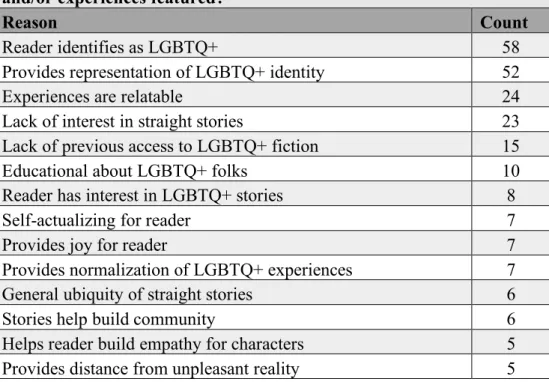
The most common reason given for this importance was that the respondent was
LGBTQ+ themselves (58) (Table 2). This interest was reflected in participants’ chosen
reading materials (Table 3), with fanfiction featuring LGBTQ+ characters more
frequently than traditional fiction.
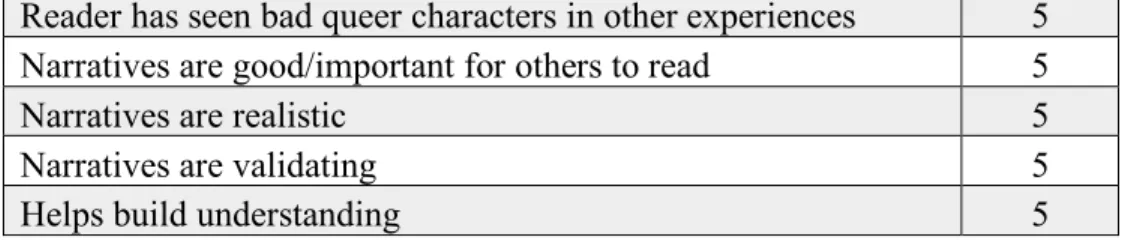
Table 2. Responses about featuring LGBTQ+ experiences.
Why is it very important to you to see LGBTQ+ characters, themes, and/or experiences featured?
Reason Count
Reader identifies as LGBTQ+ 58
Provides representation of LGBTQ+ identity 52
Experiences are relatable 24
Lack of interest in straight stories 23
Lack of previous access to LGBTQ+ fiction 15
Educational about LGBTQ+ folks 10
Reader has interest in LGBTQ+ stories 8
Self-actualizing for reader 7
Provides joy for reader 7
Provides normalization of LGBTQ+ experiences 7
General ubiquity of straight stories 6
Stories help build community 6
Reader has seen bad queer characters in other experiences 5 Narratives are good/important for others to read 5
Narratives are realistic 5
Narratives are validating 5
Helps build understanding 5
Table 3. LGBTQ+ character prevalence.
How often does [material type] you read for pleasure feature LGBTQ+ characters? (n=151)
Never Rarely Sometimes Often Very often
Fiction of any kind 0% 5% 21% 33% 40%
Fanfiction 0% 1% 4% 13% 82%
Traditional fiction 3% 38% 31% 20% 9%
Systems Familiarity
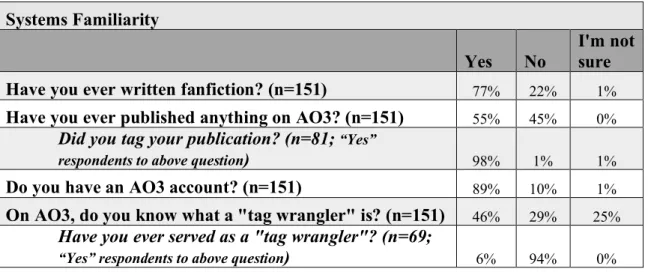
This survey found that respondents are fairly familiar with the systems used to
organize material in AO3 as well as how one approaches searching these systems (Tables
4, 5, and 6). A remarkable 117 respondents (77%) answered affirmatively that they had
written fanfiction in the past, 83 of whom (55% of total respondents) had published work
on AO3. 79 of these AO3 creators mentioned that they had tagged their work on the
platform, indicating that over half the participant sample (79; 52% of total) had
experience in creating the type of AO3 metadata under consideration here. Only 4
participants, however, had ever served as a tag wrangler, and only 24 (16%) agreed that
with the Wrangling Guidelines. 10
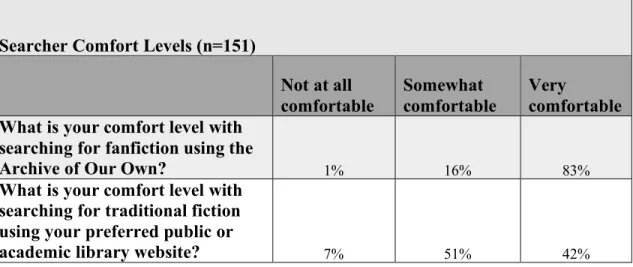
On the whole, a total of 126 respondents (83%) indicated that they felt “very
comfortable” searching AO3, with only one individual replying that they were “not at all
comfortable” with the system.
Table 4. Systems familiarity.
Systems Familiarity
Yes No
I'm not sure
Have you ever written fanfiction? (n=151) 77% 22% 1%
Have you ever published anything on AO3? (n=151) 55% 45% 0%
Did you tag your publication? (n=81; “Yes”
respondents to above question) 98% 1% 1%
Do you have an AO3 account? (n=151) 89% 10% 1%
On AO3, do you know what a "tag wrangler" is? (n=151) 46% 29% 25%
Have you ever served as a "tag wrangler"? (n=69;
“Yes” respondents to above question) 6% 94% 0%
Table 5. Tagging system knowledge.
Tagging System Knowledge (n=151)
Yes, a great
amount Yes, somewhat Yes, I've heard of it No, not at all
Do you feel that you have knowledge of the AO3 tagging system as detailed in
the Wrangling Guidelines? 16% 51% 23% 10%
Table 6. Searcher comfort levels.
Searcher Comfort Levels (n=151)
Not at all comfortable
Somewhat comfortable
Very
comfortable What is your comfort level with
searching for fanfiction using the
Archive of Our Own? 1% 16% 83%
What is your comfort level with searching for traditional fiction using your preferred public or
academic library website? 7% 51% 42%
In contrast, participants were less familiar with their library search systems and
subject headings as used for retrieval (Tables 6 and 7). 82 participants (54%) responded
that they knew what a subject heading is in the library context; only 64 participants
(42%) identified themselves as “very comfortable” searching using their preferred public
or academic library website. 27 (18% of total) agreed that they had “specialized
knowledge” of subject headings: though they were not asked to identify the specifics of
their situation, responses to other questions indicate that the participant pool included a
number of library staffers, booksellers, and researchers.
Table 7. Subject heading familiarity.
Subject Heading Familiarity
Yes No
I'm not sure
Do you know what a subject heading is? (n=151) 54% 21% 25%
Imagine you are looking at the entry for a book in a library catalog. Do you know where to find that book’s subject headings? (n=120; “Yes” and “I’m not sure” respondents to
top question) 68% 13% 19%
Do you have any specialized knowledge of subject headings? (n=81; “Yes” respondents to
Search Behaviors
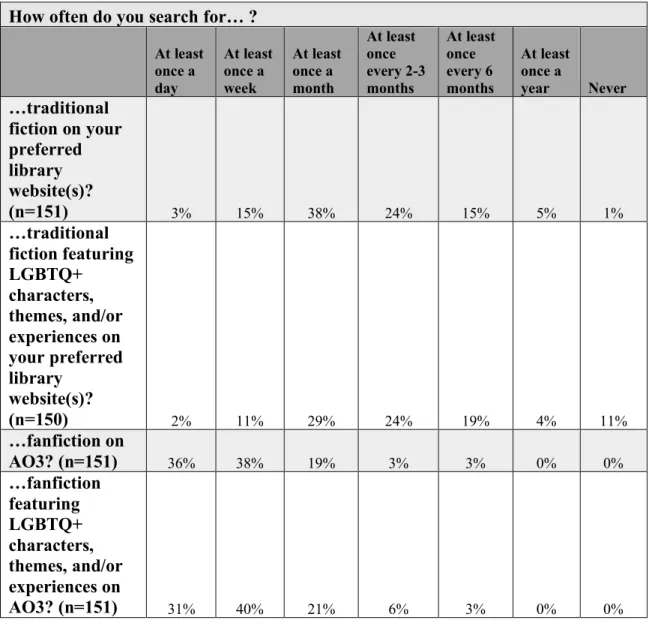
Frequency. Participants search both their preferred library website and AO3
relatively frequently, and search for fiction featuring LGBTQ+ characters quite often. 83
participants (55%) search their library website at least once a month, while even more
participants engage in AO3 searches on a regular basis: 141 people (93%) used the
Archive to search at least once a month (Table 8).
Table 8. Search frequencies.
How often do you search for… ?
At least once a day At least once a week At least once a month At least once every 2-3 months At least once every 6 months At least once a
year Never
…traditional fiction on your preferred library website(s)?
(n=151) 3% 15% 38% 24% 15% 5% 1%
…traditional fiction featuring LGBTQ+ characters, themes, and/or experiences on your preferred library website(s)?
(n=150) 2% 11% 29% 24% 19% 4% 11%
…fanfiction on
AO3? (n=151) 36% 38% 19% 3% 3% 0% 0%
…fanfiction featuring LGBTQ+ characters, themes, and/or experiences on
AO3? (n=151) 31% 40% 21% 6% 3% 0% 0%
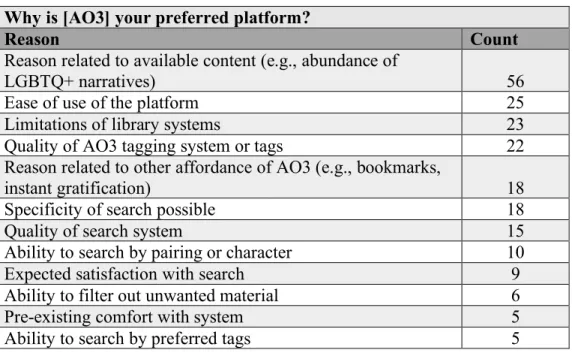
themes, and/or experiences, 115 respondents (76% of total) indicated that AO3 is their
preferred platform over their local library online catalog. The most common reasons
provided for this preference are seen in Table 9. Most often, the rationale did not relate to
search practices, but rather pointed towards the nature of the material available on AO3.
One respondent of these 56 summed up that attitude succinctly: “AO3 has a wider
selection of gay content”. However, a significant number of respondents attributed their
preference in part to the quality of AO3’s tagging system (22) or the quality of the search
structure (15), which is inherently supported by the tagging system. 23 ascribed their
preference to the limitations of traditional library search systems. Comments of this
nature pointed towards several elements of the AO3 system:
“Ao3's breadth of material, wonderfully tagging system, and summaries are far more likely to yield up material I actually want to read. Because fics tend to be thoroughly tagged, I'm able to carefully sort out stories that feature precisely the sort of plot I'm craving…”11
“The Ao3 tagging system, both the default (such as labeling m/m and f/f pairings) and user-generated (such as "POV bi character or "coming out") make finding specifically LGBTQ stories very easy. For traditional fiction I often have to know titles and authors before I can start searching.”12
“AO3 seems more organized for LGBTQ+ purposes. My library's way of searching is very clearly designed by a heterosexual person. It's great that they're proactive in including LGBTQ+ literature in their collection, but the search abilities of AO3 are vastly superior. I can specifcally search for very specifc types of fanfiction, whereas with the library it's more hit or miss.”
11 All quotations are drawn directly from participant responses and therefore may include minor errors in spelling and grammar.
Table 9. Reasons for AO3 preference.
Why is [AO3] your preferred platform?
Reason Count
Reason related to available content (e.g., abundance of
LGBTQ+ narratives) 56
Ease of use of the platform 25
Limitations of library systems 23
Quality of AO3 tagging system or tags 22 Reason related to other affordance of AO3 (e.g., bookmarks,
instant gratification) 18
Specificity of search possible 18
Quality of search system 15
Ability to search by pairing or character 10
Expected satisfaction with search 9
Ability to filter out unwanted material 6
Pre-existing comfort with system 5
Ability to search by preferred tags 5
One respondent noted a difference in the kind of content they sought on AO3 versus in
library catalogs, but still identified an important distinction between the metadata
practices of the two systems:
“I'm not sure these two are easily comparable, since on AO3 I am looking for specific characters and pairings, so my approach is quite different. But traditional library catalogues often have searchable information that is only tangentially relevant for recreational reading (i.e. year published), but have no proper tagging system for content. For instance, searching for the term
"lesbian" on my local library's catalog gets me 3 results, even though I know they have more relevant content.”
There were seven participants who registered a preference for their library’s website or
catalog to find LGBTQ+ fiction. Four of these respondents preferred the type of content
available at the library, for material or quality-related reasons. Two broadly found the
system easier or were more used to it. One respondent provided a stellar review for their
practices: “My library system is very inclusive, so I get good results for traditional
fiction.”
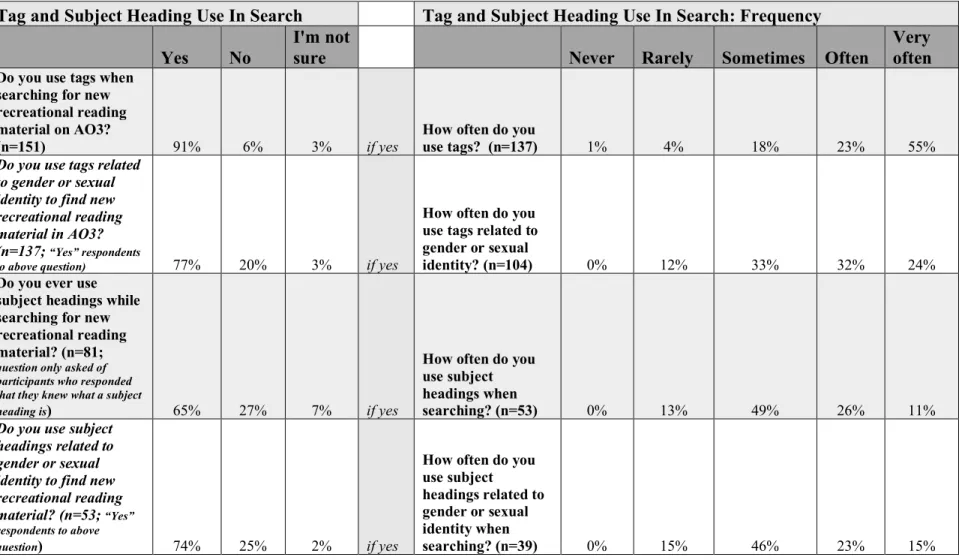
Self-reported participant use of tags and subject headings. When asked about
searching using tags and subject headings directly, it is clear that participants make use of
tags on AO3 much more frequently than they do subject headings in library catalogs
(Table 10). Of 151 survey takers, 105 use tags related to gender and sexual identity when
searching, whereas 39 use subject headings related to gender and sexual identity in the
library setting.
On AO3, 60 respondents (40%) indicated that they use tags for purposes besides
searching for material (Table 11). The most common additional purpose supplied (20
users) was using tags to get information about the work or help them make a choice about
what to read: “When I do not search for specific works, I always read the tags to see what
the work is about, since you sometimes can't tell from the description.” 19 participants
mentioned that tags help them avoid certain themes or filter out material they don’t want
to read: “I also use them to filter out content I don't want to see!” A few participants
indicated an interest in tags that goes beyond the purely functional: one responder uses
tags for “Statistical analysis of fandom works, done for funsies.” Notably, 14 participants
also responded that they use informational tags as they produce content, and eight
participants authored tags designed to be less informational: “I'll often tag my own works
with things like "whatamIdoing" or "Ihopeyouenjoythis", as it's just a little bit more self
expression that the readers get to see from the author. Gives me a little more joy in
publishing works.” For some searchers, this is a source of frustration:
“See, the reason why I dont rely on anything beyond basic character &
want to miss a story by narrowing things down too much, and 2) An expressive medium, like tumblr when people just "talk in the tags".
Artistically it's fun, and it offers information on the story, but tagging that way is useless when conducting searches for new material.”13
37
Table 10. Tag and subject heading use in search.
Tag and Subject Heading Use In Search Tag and Subject Heading Use In Search: Frequency
Yes No
I'm not
sure Never Rarely Sometimes Often
Very often
Do you use tags when searching for new recreational reading material on AO3?
(n=151) 91% 6% 3% if yes How often do you use tags? (n=137) 1% 4% 18% 23% 55%
Do you use tags related to gender or sexual identity to find new recreational reading material in AO3? (n=137; “Yes” respondents
to above question) 77% 20% 3% if yes
How often do you use tags related to gender or sexual
identity? (n=104) 0% 12% 33% 32% 24% Do you ever use
subject headings while searching for new recreational reading material? (n=81;
question only asked of participants who responded that they knew what a subject
heading is) 65% 27% 7% if yes
How often do you use subject headings when
searching? (n=53) 0% 13% 49% 26% 11%
Do you use subject headings related to gender or sexual identity to find new recreational reading material? (n=53; “Yes” respondents to above
question) 74% 25% 2% if yes
How often do you use subject
headings related to gender or sexual identity when
Table 11. Other uses of tags.
Other Uses of Tags
Use Count
Getting information about a work or making reading choices 20
Avoiding or filtering out unwanted content 19
As author, providing information about a work 14
Providing trigger or content warnings 9
Writing Tumblr-style tags (e.g., “sorry I wrote this at 3am”) 8
Cataloging own work 1
Bookmarking works 5
Performing formal or informal research 4
Exploring them for amusement 3
Only 14 participants use subject headings for any purpose besides searching. Six
of those participants use subject headings in some kind of professional capacity—and in
at least one instance, only in a professional capacity: “I upload material in my job, so I
use subject headings to categorize things. When I search, I typically use keywords.” Four
participants use subject headings to get a sense of what a book is about.
Examined granularly or holistically, these participants report that they use subject
headings much less frequently and employ headings for fewer purposes than AO3 tags.
Searching in Practice
The limitations of library systems suggested in participants’ stated preferences
were reiterated in the portions of the survey that requested that participants recount their
personal practices for finding new fiction to read, both general and LGBTQ+ specific.
Half of all survey respondents (randomly assigned) were presented with these questions.
The most common strategies mentioned for browsing for any new material in a library
only three participants; three participants also mentioned using tags at their library. One
respondent describes:
“when searching for traditional fiction at a library I don't browse, I am there looking for something specific, or browsing within an author. So I search by title and author almost exclusively. I find browsing traditional library catalogs less than enjoyable and prefer browsing the shelves when I'm just looking.”
The trends were not significantly different when participants were instructed to describe
their practices of browsing for LGBTQ+ material using the online catalog (Table 13).
Though many respondents did not answer this portion of this question, those that did
most frequently mentioned searching for a known title (19). Keyword searches and
subject searches were mentioned only by three participants each.
Table 12. Library search strategies, all content
Library Search Strategies: Any Content
Strategy Count
Search for a specific book 31 Search for a known author 21 Use outside
recommendations 21
Goodreads 8
Word-of-mouth/general
interpersonal 7
Librarian 6
Keyword search 16
Search by genre 13
No strategy, just frustration 8 Use built-in algorithmic
recommendations 7
Read summaries 7
Browse new books 5
Use search filters 5
Use Google for help 5
Use set categories in a
system like Overdrive 5
Table 13. Library search strategies, LGBTQ+ content.
Library Search Strategies:
LGBTQ+ Content
Strategy Count
Search for a specific book 19 Use outside
recommendations 10
Use set categories in a
system like Overdrive 7
Read summaries 6
Keyword search 3
Search for a known author 3
Subject search 3
Use built-in algorithmic
recommendations 2
Look at course reading lists
in a university library 1
Use filters 1
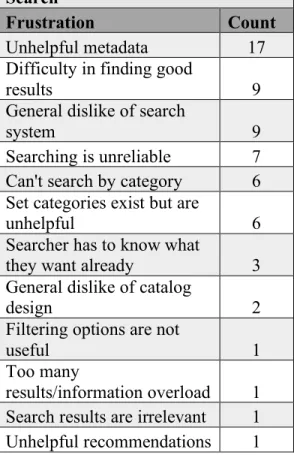
Subjects were asked about what they like about this search process for LGBTQ+
material and what they find frustrating. Though five participants had positive comments
about the general search system at their library, and two appreciated the keyword
functionality, the number of frustrations was much higher (Tables 14 and 15).
Table 14. Positive aspects of library search.
Reported Positives of Library Search
Positive Aspect Count Reason related to available
content (e.g., quality) 6 Functionality of general
system 5
Availability of algorithmic
recommendations 2
Functionality of keyword
search 2
Ability to Search by
genre/section 2
Existence of set categories 1 Functional/useful metadata 1 Availability of reviews and
ratings 1
Availability of subject
headings 1
Table 15. Frustrations with library search.
Reported Frustrations with Library Search
Frustration Count
Unhelpful metadata 17
Difficulty in finding good
results 9
General dislike of search
system 9
Searching is unreliable 7 Can't search by category 6 Set categories exist but are
unhelpful 6
Searcher has to know what
they want already 3
General dislike of catalog
design 2
Filtering options are not
useful 1
Too many
results/information overload 1 Search results are irrelevant 1 Unhelpful recommendations 1
17 participants noted that the kind of metadata available for fiction was unhelpful, with
many of these participants expressing frustration that metadata gave no hints as to what a
work was about or if it even featured queer themes.
instance, under "gay & lesbian" (which is a pretty ghettoized category to begin with) there is exactly 1 (one) title listed in both libraries, since apparently books with LGBT+ content that are also gen lit, or fantasy, or whatever other genre, are listed only under their main category. Basically, if you don't know what you're looking for specifically, you're out of luck.”
“I've seen a few categories of LGBT Fiction before but I think that was only for gay pride month/events. When those categories exist it's GREAT because I don't always find good recommendations. The frustrating part is how much is still not advertised as I wish it would be so that I could know it's queer fiction. I understand that some writers don't want to label their character's identities or they don't want the book to be focused primarily on gender and sexuality when other important things are happening but like- so much of my town's society isn't accepting of queer people. I want to feel comfortable somewhere. If you don't make it known that your book has queer themes or characters, I'm probably not going to read it.”
Nine participants broadly noted that the queer fiction was difficult to find within existing
search systems, and an equal number of participants also registered a general dislike for
the search system. Others had more specific complaints. Six participants indicated that
they’d like to be able to search by some kind of hierarchical category system, and six
mentioned that an LGBTQ+ tag or categorical scheme does exist but is not helpful or
inclusive:
“The LGBTQ+ books are not under an ‘LGBTQ+ section’ but rather, in the ‘diversity’ section, because of this, it can be difficult to find an LGBTQ+ book. It is frustrating that the LGBTQ+ section is the smallest part of the ‘diversity’ section, which is, not coincidentally, the smallest section of the website’s library.”
Participant processes for browsing for new material to read on AO3 were very
diverse, for both all material and LGBTQ+ material. The most common strategies
employed for general searching are visible in Table 16. One participant helpfully