472
AN ACTIVE STORAGE FRAMEWORK BASED ON
STORAGE SECURITY IN CLOUD COMPUTING
Dr.C.Kumar Charliepaul 1 Felcia Jerlin 2 Principal Assistant professor / CSE A.S.L Pauls College of Engg & Tech, Dr.G.U POPE College of Engineering, Coimbatore . Tuticorin
[email protected] [email protected]
Abstract – Personal knowledge hold on within the Cloud could contain account numbers, passwords, to be different necessary info that would be used and misused, a contender, or a court of law. These knowledge area unit cached, and archived by Cloud Service suppliers (CSPs), typically while not authorization and management. Self-destructing knowledge in the main aims at protective the user data’s privacy. Data and data copies become destructed or unclear when a user-specified time, with none user intervention. Additionally, the secret writing key is destructed when the user-specified time. During this paper, we have a tendency to gift SeDas, a system challenge through a unique integration of scientific discipline with active techniques storage techniques supported T10 OSD commonplace. We have a tendency to enforce a proof-of-concept SeDas image. Through practicality and evaluations of the SeDas to meets all the privacy-preserving goals represented. System to be compared while not self-destructing knowledge mechanism, output for downloading with the projected SeDas tolerably decreases by but seventy two, whereas upload/download self-destructing with operations knowledge mechanism will increase by an hour.
keywords- Active storage, Virtual machine, data privacy, self-destructing data.
I. INTRODUCTION
OUR development of Cloud computing and popularization of mobile web, Cloud services have become more and a lot of vital for people’s life. Individual’s square measure a lot of or less requested to submit or post some personal non-public info to the Cloud by the net. When individuals do that, they subjectively hope service suppliers can offer security policy to protect their knowledge from unseaworthy, therefore others individuals won't invade their privacy.
As folks believe additional and additional on the web and Cloud technology, security of their privacy takes additional and additional risks. On the one hand, once knowledge is being processed, reworked and stored by this ADPS or network, systems or network should cache, copy or archive it. These copies square measure essential for systems and also the network. However, folks haven't any
knowledge regarding these copies and can't management them, so these copies might leak their privacy. On the opposite hand, their privacy also can be leaked via Cloud Service suppliers (CSPs’) negligence, hackers’ intrusion or some legal actions. These issues present formidable challenges to shield people’s privacy.
473 1) we have a tendency to specialize in the connected key distribution algorithmic rule, Shamir’s algorithmic rule ,MD5 Algorithm[2], that is employed because the core algorithmic rule to implement shopper (users) distributing keys within the object storage system. We use these strategies to implement a safety destruct with equal divided key (Shamir Secret Shares [2]).
2) Cloud ME supported active storage framework, we have a tendency to use associate degree object-based storage interface to store and manage the equally divided key. We enforced a proof-of-concept SeDas epitome.
3) Through practicality and security properties analysis of the SeDas epitome, the results demonstrate that SeDas was sensible to use and meets all the privacy-preserving goals. The epitome system imposes fairly low run time overhead.
4) SeDas supports security erasing files and random cryptography keys hold on in an exceedingly magnetic disc drive (HDD) or solid state drive (SSD), severally. The rest of this paper is organized as follows. We have a tendency to review the related add Section II. We have a tendency to describe the design, design and implementation of SeDas in Section II. The intensive evaluations are given in Section III, and that we conclude this paper in Section IV.
II. RELATED WORKS
Computing and communicating through the Web makes it virtually impossible to leave the past behind. A lost or stolen laptop can expose personal photos or messages; or a legal investigation can subpoena the entire contents of a home or work computer, uncovering just embarrassing details from the past. The goal of
email provider is to maintain the privacy of all the user data which should not be copied by other user. This can be avoided by the method of cryptographic keys and password, which will block the information of the user as unreadable to other user after a specific time so that third party not able to access or read the information. We are implemented a proof-of-concept Vanish prototype that uses the million-node Vuze Bit Torrent DHT to create self-destructing data. the description of our Vuze-based self-destructing data system, please refer to our paper. we found that the initial Vuze DHT implementation on which Vanish was based was not adequately protected against Sybil attacks that seek to harvest data from the DHT. Due to overly eager replication for availability, part it is due to the fact that existing DHTs were not designed with such attacks in mind. we have been working with Paul Gardner to implement, and evaluate at scale measures for improving Vuze's security against Sybil-driven data-harvesting attacks. Our measures:
(1) limit the excessive amount of replication that currently exists in Vuze, and (2) limit the ability of an attacker to perform large-scale Sybil attacks. Our evaluation shows combined defenses significantly raise the bar against Sybil attacks.. A new directions and architectures for self-destructing data are introduced for the investigation. The future for self-destructing data is to leverage multiple back-end storage systems (both DHTs and other types of distributed structures) in such a way that compromising Vanish would require compromising the entire storage node. As a proof of concept of this idea. we released a new prototype that splits the keys across both Vuze DHT and collaboration with Vinnie Moscaritolo from we are now investigating new storage backends for Vanish that have fundamentally different properties and threat models.
474 describe the latest advances in Vanish research on our publications page as they become available.
III. DESIGN AND IMPLEMENTATION OF SEDAS
Fig.1 shows the design of SeDas. There are 3 measure parties based on the active storage framework.
i) Information server (MDS): MDS is user for chargeable management; server management and session management get into file information management.
ii) Application node: the applying node could be a consumer to use storage service of the SeDas.
iii) Storage node: every storage node is Associate in Nursing OSD. It contains 2 core subsystems: key price store system and active storage object (ASO) runtime system. The key price store system that's supported the object storage element is employed for managing objects hold on in storage node: operation object, read/write object and then on. The object ID is employed as a key. The associated information and attribute square measure stored as values.
The ASO runtime system supported the active storage agent module within the object-based storage system is employed to process active storage request from users and manage technique objects and policy objects.
A. Active Storage Object
Based on active storage framework, we have a tendency to use AN object-based storage interface to store and manage the equally divided key. we have a tendency to enforced a proof-of-concept Sedas image Through practicality and security properties analysis of the Sedas prototype, the results demonstrate that
Sedas is sensible to use and meets all the privacy-preserving goals.
The image system imposes moderately low runtime overhead. The emergence of object-based interface, storage devices will benefit of the communicatory interface to realize some cooperation between application servers and storage devices.
B. Self Destructed Data
No express delete actions by the user, or any third-party storing that information No have to be compelled to modify any of the hold on or archived copies of that data. The time of key attainment is decided by DHT system and not governable for the user. This paper proposes a distributed object-based storage system with self-destructing information perform. in depth experiments show that the planned SeDas doesn't have an effect on the conventional use of storage system and might meet the wants of self-destructing information beneath a survival time by user governable key.
C. Data Process
A service methodology wants an extended time to method an advanced task, thus implementing code of a service methodology in user area will profit of performance of the system. All the info and their copies become destructed or indecipherable once a user-specified time. A destruct methodology object that\'s related to every secret key half and survival time parameter for every secret keys half. The application node may be a shopper to use storage service of the SeDas.
475 will transfer information keep within the information storage system.
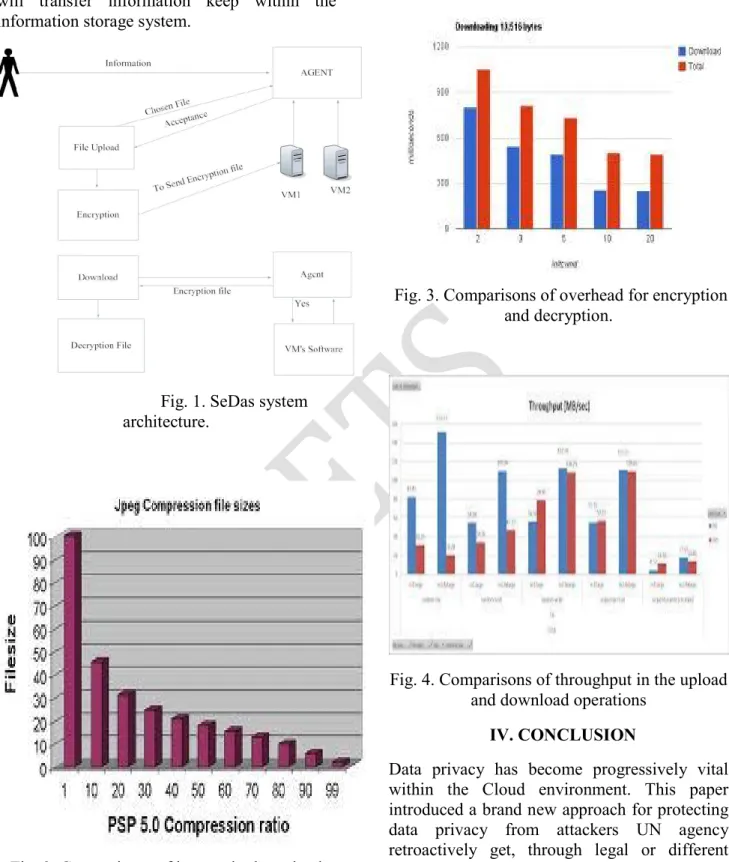
Fig. 1. SeDas system architecture.
Fig. 2. Comparisons of latency in the upload and download operations.
Fig. 3. Comparisons of overhead for encryption and decryption.
Fig. 4. Comparisons of throughput in the upload and download operations
IV. CONCLUSION
476 essential properties of active storage framework based on T10OSD normal. We tend to incontestable the practicableness of our approach by presenting SeDas, a proof-of-concept prototype based on object-based storage techniques. SeDas causes sensitive information, like account numbers, passwords and notes to irreversibly destroy, with none action on the user’s part .Our measurement and experimental security analysis into the practicableness of our approach. Our arrange to release the current SeDas system can facilitate to produce researchers with any valuable expertise to tell future object-based storage system styles for Cloud services.
REFERENCES
[1] R. Geambasu, T. Kohno, A. Levy, and H. M. Levy, “Vanish: Increasingdata privacy with self-destructing data,” in Proc. USENIX SecuritySymp., Montreal, Canada, Aug. 2009, pp. 299–315.
[2] A. Shamir, “How to share a secret,” Commun. ACM, vol. 22, no. 11,pp. 612–613, 1979.
[3] S. Wolchok, O. S. Hofmann, N. Heninger, E. W. Felten, J. A. Halderman,C. J. Rossbach, B. Waters, and E. Witchel, “Defeating vanishwith low-cost sybil attacks against large DHEs,” in Proc. Network andDistributed System Security Symp., 2010.
[4] L. Zeng, Z. Shi, S. Xu, and D. Feng, “Safevanish: An improved dataself-destruction for protecting data privacy,” in Proc. Second Int. Conf.Cloud Computing Technology and Science (CloudCom), Indianapolis,IN, USA, Dec. 2010, pp. 521–528.
[5] L. Qin and D. Feng, “Active storage framework for object-basedstorage device,” in Proc. IEEE 20th Int. Conf. Advanced InformationNetworking and Applications (AINA), 2006.
[6] Y. Zhang and D. Feng, “An active storage system for high performancecomputing,” in Proc. 22nd Int. Conf. Advanced InformationNetworking and Applications (AINA), 2008, pp. 644–651.
[7] T. M. John, A. Riya, and J. A. Chandy, “Active storage usingobject-based devices,” in Proc. IEEE Int. Conf. Cluster Computing,2008, pp. 472–478.
[8] S. Shenker, C. Partridge, and R. Guerin,“Specification of guaranteed quality of service,”RFC 2212, IETF, Sept. 1997
[9] M. Carlson, W. Weiss, S. Blake, Z. Wang, D.Black, and E. Davies. “An Architecture forDifferentiated Services,” RFC 2475, IETF, Dec.1998
[10] R. Guerin and V. Peris, “Quality-of-service inpacket
networks: basic mechanisms anddirections,” Computer
Networks Journal, Vol.31, No. 3, Feb. 1999
[11] Z. Dimitrijevic and R. Rangaswami, “Quality of service support for real-time storage systems,”in Proc. of Intl. IPSI-2003 Conference, (Stefan, Montenegro), October IPSI-2003
[12] K. Kim, J. Hwang, S. Lim, J. Cho, and K. Park, “A real-time disk scheduler for mulreal-timedia integrated server considering the disk internal scheduler,” in Proc. of the International Parallel and Distributed Processing Symposium, Apr. 2003
[13] S. Brandt, S. Banachowski, C. Lin, and T.Bisson. “Dynamic integrated scheduling of hard real-time, soft real-time and non-real-time processes,” in Proc. of the IEEE Real-Time Systems Symposium (RTSS ’03), Dec. 2003.
[14] C. R. Lumb, A. Mrchant, G. A. Alvarez, Façade:virtual storage devices with performanceguarantees, In Conference on File and StorageTechnology (FAST 03), (San Francisco, CA),Mar. 2003
[15] E. Riedel, “Active disks - remote execution for network-attached storage,”Ph.D. dissertation, Electrical and Computer Engineering, CarnegieMellon University, 1999, tech. Report no. CMU-CS-99-177.
[16] Information Technology - SCSI Architecture Model - 3 (SAM-3), ANSI,Sep. 2004.
[17] D. Du, D. He, C. Hong, J. Jeong, V. Kher, and Y. Kim, “Experiences inbuilding an object-based storage system based on the OSD T-10 standard,”Digital Technology Center, University of Minnesota, Minneapolis,MN, Tech. Rep. DTC 2006/13, 2006.
[18] S. Y. W. Yu and G. J. Lipvski, “CASSM: A cellular system for verylarge data bases,” in Proceedings of International Conference on VeryLarge Data Bases (VLDB), 1975.
[19] E. A. Ozharahan, S. A. Schuster, and K. C. Smith, “RAP: Associativeprocessor for database management,” in Proceedings of AFIPS Conference, 1975.
Authors Biography: -
Kumar Charlie Paul, Principal of A.S.L Pauls College of Engineering & Technology. Had did many National and International Conferences and published many papers in journals. He also guided many students for their Ph.D project works. Having more than 23 years of experience in teaching field.