Supercomputer Simulations of Nondestructive Tomographic
Imaging with Rotating Transducers
Sergey Y. Romanov1
c
The Author 2018. This paper is published with open access at SuperFri.org
A method of nondestructive ultrasound tomographic imaging employing a rotating transducer system is proposed. The rotating transducer system increases the number of emitters and detectors in a tomographic scheme by several times and makes it possible to neutralize image artifacts resulting from incomplete-data tomography. The inverse problem of tomographic reconstructing the velocity structure inside the inspected object is considered as a nonlinear coefficient inverse problem for a scalar wave equation. Scalable iterative algorithms for reconstructing the longitudinal wave velocity inside the object are discussed. The methods are based on the explicit representation for the gradient of the residual functional. The algorithms employ parallelizing the computations over emitter positions. Numerical simulations performed on the “Lomonosov-2” supercomputer showed that the tomographic methods developed can not only detect boundaries of defects, but also determine the wave velocity distribution inside the defects with high accuracy provided that both reflected and transmitted waves are registered.
Keywords: supercomputer, ultrasound tomography, nondestructive testing, inverse problems.
Introduction
This paper considers ultrasound tomography methods as applied to nondestructive testing (NDT). Typical NDT tasks include ultrasonic inspection of welds, non-destructive testing of concrete structures, products made of plastics and composite materials [4]. However, commonly used ultrasonic inspection methods are not tomographic, as the object is usually sounded from a single side. There are many NDT methods that can detect the boundaries of defects inside the object by measuring reflected ultrasonic waves. One example is “topological imaging” [1, 5]. Synthetic Aperture Focusing Technique (SAFT) [3, 10] is also widely used.
In the practice of NDT, inspected objects often have areas with different acoustic properties, which can be unknown. An example of such a problem is inspection of a welded joint. The speed of sound in the joint and in the base metal is different. Topological imaging and SAFT methods cannot determine the acoustic parameters, such as the sound speed distribution, but correct application of these methods is possible only if the acoustic properties of the object are known. The tomographic methods used in this study use both reflected and transmitted waves for image reconstruction and make it possible not only to detect the boundaries of various regions inside the object, but also to determine the wave velocity in these regions [7, 9, 11, 12].
In [2], a method of ultrasound tomography for NDT with fixed transducer arrays was inves-tigated. A rotating transducer system for sounding an object from different angles allows us to improve the quality of the reconstructed image in this paper. In addition, the use of a rotating transducer array increases the number of emitter positions by several times, thus compensating for a small number of detectors in typical linear transducers used in NDT. However, increasing the number of emitters also increases the computational complexity linearly. Scalable algorithms for general-purpose multi-CPU supercomputers have been developed to tackle this problem. The numerical simulations were performed on the “Lomonosov-2” supercomputer [14].
1Lomonosov Moscow State University, Moscow, Russian Federation
From the mathematical point of view, inverse problems of ultrasound tomography are com-plex non-linear coefficient inverse problems. Solving them requires huge computational resources, and implementation of solution algorithms is not possible without the use of high-performance computing systems. In recent years, significant progress has been made in developing efficient numerical methods for solving such inverse problems using supercomputers [6, 13].
1. Inverse Problem and the Solution Method
A distinctive feature of solids is that both longitudinal and transverse waves can propagate through them. However, the velocities of these waves differ by a factor of two or more, which allows the separation the longitudinal waves by pulse arrival time. In this study, the inverse problem is considered in terms of scalar wave model for the longitudinal waves u(r, t)
c(r)utt(r, t)−∆u(r, t) =δ(r−r0)·g(t), u(r, t= 0) = 0, ut(r, t= 0) = 0. (1)
Herec(r) = 1/v2(r),v(r) is the velocity of the longitudinal wave in the medium. Computing the
u(r, t) wave field for a givenc(r) coefficient using the equation (1) constitutes a direct problem. The inverse problem of ultrasonic tomography under the scalar wave model consists in reconstructing the unknown wave velocity v(r) inside the region of interest using the measured wave field u(r, t) at the detectors. This inverse problem is nonlinear, and we formulate it as a problem of minimizing the residual functional between the measured and computed wave fields. We use an iterative gradient method to minimize the functional [8, 13].
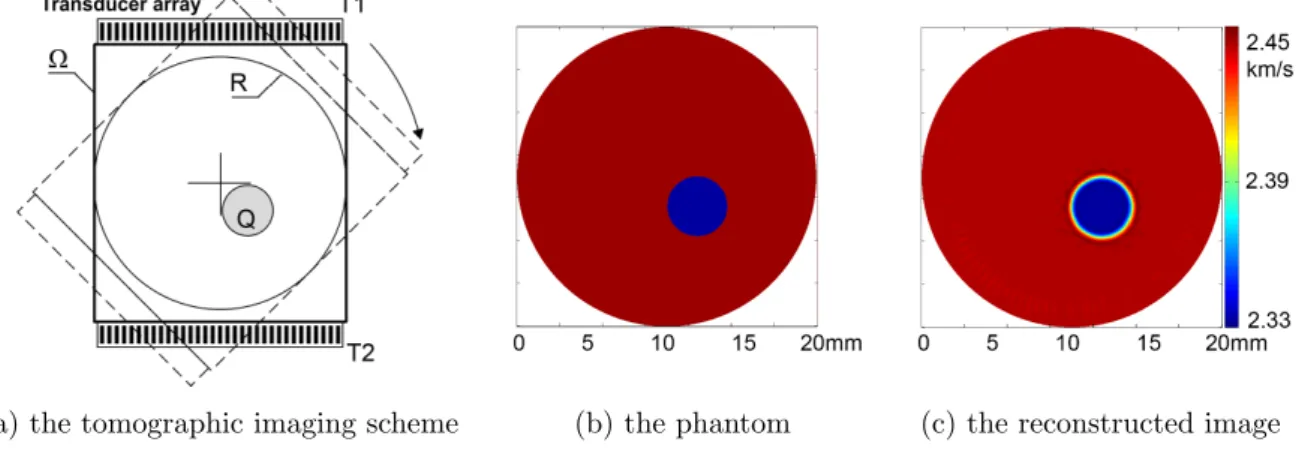
Figure 1(a) shows the scheme of a tomographic examination with rotating transducer arrays. We consider the simplest 2D problem, in which the inspected region is a circle R containing an inhomogeneity Q. Two linear transducer arrays T1, T2 are located on opposite sides of the region R. Each array consists of 24 elements at a pitch of 0.6 mm which can both emit and receive ultrasound waves. The transducers can be rotated around the inspected object. The wave velocityv1 in the Q is unknown and differs from the knownv0 in the surrounding medium.
(a) the tomographic imaging scheme (b) the phantom (c) the reconstructed image
Figure 1.A tomographic examination with rotating transducer arrays
network. The computations were parallelized so that one computing core was allocated for every emitter position. This method is natural for the problem considered, since the computations for each emitter are practically independent. This approach was proven to be effective and the algorithm practically linearly scales up to several hundreds of CPU cores. The data exchange overhead amounted to ≈ 2% of the total computation time. The total of 384 CPU cores were used. Spatial domain decomposition was not used, since parallelization over emitter showed much greater efficiency. Single-precision floating point arithmetic was used in computations.
2. Numerical Simulations
The numerical experiment consisted of solving direct and inverse problems. First, for each emitter position we solve the direct problem of wave propagation in a square computational domain Ω encompassing the region of interest R (Fig. 1(a)). The transducers T1, T2 are then rotated along with the computational grid by angle 22.5◦. The wave field is registered by the detectors for each rotation step and used as simulated experimental data for the inverse problem. The central wavelength of the sounding pulse was 0.466 mm (5 MHz frequency). The beam width of each element was≈50◦. A inter-element pitch larger than the wavelength and a narrow beam resulting from a large element size are a typical case in NDT applications.
Figure 1(b) shows the phantom. The sound speed in the medium was set to v0 = 2450
m·s-1 (ebonite material), and in the inhomogeneity Q — tov
1 = 2330 m·s-1 (rexolite material).
Figure 1(c) shows the reconstructed sound speed The initial sound speed approximation for the iterative method was chosen as v0 = const = 2450 m·s-1. As is evident from Fig. 1(c), a
rotating transducer system allows not only to reconstruct the boundaries of the object, but also determine the sound speed inside the object with high accuracy. No artifacts, which are typical for incomplete-data tomographic reconstruction [2], are present in the image.
The size of the computational domain was 20×20 mm, the finite difference grid contained 700×700 points. The total of 384 emitter positions were used in the simulation. The computing time for 40 gradient descent iterations on 384 CPU cores in parallel amounted to 30 minutes.
Conclusion
In this paper, we propose a method of ultrasonic tomographic imaging involving a rotating transducer, and discuss parallel algorithms for reconstructing the longitudinal wave velocity in-side the inspected object. The use of a rotating transducer system yields reconstructed images without artifacts typically present in incomplete-data reconstructions. The computational com-plexity increases several times, however, parallelizing the computations over emitter positions leads to scalable CPU algorithms on a supercomputer.
Acknowledgments
This paper is distributed under the terms of the Creative Commons Attribution-Non Com-mercial 3.0 License which permits non-comCom-mercial use, reproduction and distribution of the work without further permission provided the original work is properly cited.
References
1. Bachmann, E., Jacob, X., Rodriguez, S., Gibiat, V.: Three-dimensional and real-time two-dimensional topological imaging using parallel computing. J. Acoust. Soc. Am. 138(3), 1796– 1796 (2015), DOI: 10.1121/1.4933696
2. Bazulin, E.G., Goncharsky, A.V., Romanov, S.Y., Seryozhnikov, S.Y.: Parallel CPU- and GPU-algorithms for inverse problems in nondestructive testing. Lobachevskii J. Math. 39(4), 486–493 (2018), DOI: 10.1134/S1995080218040030
3. Bazulin, E.G., Sadykov, M.S.: Determining the speed of longitudinal waves in an isotropic homogeneous welded joint using echo signals measured by two antenna arrays. Russ. J. Nondestruct Test 54(5), 303–315 (2018), DOI: 10.1134/S1061830918050029
4. Blitz, J., Simpson, G.: Ultrasonic Methods of Non-destructive Testing. Springer (1995)
5. Dominguez, N., Gibiat, V.: Non-destructive imaging using the time domain topological energy method. Ultrasonics 50, 367–372 (2010), DOI: 10.1016/j.ultras.2009.08.014
6. Goncharsky, A.V., Seryozhnikov, S.Y.: The architecture of specialized GPU clusters used for solving the inverse problems of 3D low-frequency ultrasonic tomography. Communications in Computer and Information Science 793, 363–395 (2017), DOI: 10.1007/978-3-319-71255-0 29
7. Goncharsky, A.V., Romanov, S.Y.: Supercomputer technologies in inverse problems of ultrasound tomography. Inverse Probl. 29(7), 075004 (2013), DOI: 10.1088/0266-5611/29/7/075004
8. Goncharsky, A.V., Romanov, S.Y.: Iterative methods for solving coefficient inverse prob-lems of wave tomography in models with attenuation. Inverse Probl. 33(2), 025003 (2017), DOI: 10.1088/1361-6420/33/2/025003
9. Goncharsky, A.V., Romanov, S.Y, Seryozhnikov, S.Y.: Inverse problems of 3D ultrasonic tomography with complete and incomplete range data. Wave Motion 51(3), 389–404 (2014), DOI: 10.1016/j.wavemoti.2013.10.001
10. Hall, T.E., Doctor, S.R., Reid, L.D., Littlield, R.J., Gilber, R.W.: Implementation of real-time ultrasonic SAFT system for inspection of nuclear reactor components. Acoustical Imag-ing 15, 253–266 (1987), DOI: 10.1007/978-1-4684-5320-1 23
13. Romanov, S.: Optimization of numerical algorithms for solving inverse problems of ul-trasonic tomography on a supercomputer. Communications in Computer and Information Science 793, 67–79 (2017), DOI: 10.1007/978-3-319-71255-0 6