ENSURING CORRECTNESS AND FRESHNESS OF
OUTSOURCED DATABASES
by Ujwal Karki
A thesis
submitted in partial fulfillment of the requirements for the degree of Master of Science in Computer Science
Boise State University
DEFENSE COMMITTEE AND FINAL READING APPROVALS
of the thesis submitted by
Ujwal Karki
Thesis Title: Integrity Coded Databases: Ensuring Correctness and Freshness of Outsourced Databases
Date of Final Oral Examination: 16 June 2017
The following individuals read and discussed the thesis submitted by student Ujwal Karki, and they evaluated the presentation and response to questions during the final oral examination. They found that the student passed the final oral examination.
Jyh-haw Yeh, Ph.D. Chair, Supervisory Committee
Dianxiang Xu, Ph.D. Member, Supervisory Committee
Gaby Dagher, Ph.D. Member, Supervisory Committee
Certainly, this journey until now was not by me alone. There has been continuous guidance and support from many individuals, who have helped me reach this far. First and foremost, I would like to express my sincere gratitude to my very helpful advisor Dr. Jyh-haw Yeh. He always provided me the motivation, correct guidance, important and timely suggestions which has made this work a successful one. I would also like to thank my committee member Dr. Dianxiang Xu from whom I have learned a lot in the issues related to computer security, which is closely related to my thesis work, and also the various aspects of software engineering from the classes I have taken with him. I am also very thankful to my other committee member Dr. Gaby Dagher, for providing me with invaluable feedback, ideas and suggestions during my regular meetings with him. I am also very grateful to him for allowing me to be the part of his advanced cryptography class, where I got to learn a lot of topics related to my thesis work.
The financial support from the Department of Computer Science by providing me a full scholarship is one of the reasons I was able to pursue my graduate studies at Boise State University. I feel very humbled for having that opportunity. I also feel lucky enough to be surrounded by such wonderful friends and colleagues, which made me feel this new place as friendly and as close as my home.
My special thanks go to my mother who has always been my sole inspiration in life’s many lessons.
In recent years, cloud storage has become an inexpensive and convenient option for individuals and businesses to store and retrieve information. The cloud releases the data owner from the financial burden of hiring professionals to create, update and maintain local databases. The advancements in the field of networking and the growing need for computing resources for various applications have made cloud computing more demanding. Its positive aspects make the cloud an attractive option for data storage, but this service comes with a cost that it requires the data owner to relinquish control of their information to the cloud service provider. So, there remains the possibility for malicious insider attacks on the data that may involve addition, omission, or manipulation of data. This paper presents a novel Integrity Coded Database (ICDB) approach for ensuring data correctness and freshness in the cloud. Various options for verifying the integrity of queried data in different granularities are provided, such as the coarse-grained integrity protection for the entire returned dataset or a more fine-grained integrity protection down to each tuple or even each attribute. ICDB allows data owners to insert integrity codes into a database, outsource the database to the cloud, run queries against the cloud database server, and verify that the queried information from the cloud is both correct and fresh. An ICDB prototype has been developed in order to benchmark several ICDB schemes to evaluate their performance.
ABSTRACT . . . vi
LIST OF TABLES . . . xi
LIST OF FIGURES . . . xvi
LIST OF ABBREVIATIONS . . . xxi
LIST OF SYMBOLS . . . xxii
1 Introduction . . . 1
1.1 Background . . . 1
1.1.1 Thesis Statement . . . 2
1.1.2 Outline . . . 5
2 Previous work . . . 6
2.0.1 Integrity Coded Databases (ICDB)–Protecting Integrity for Out-sourced Databases . . . 6
2.0.2 Securing Storage in Public Cloud Infrastructure . . . 7
2.0.3 Freshness Guarantee for an Outsourced Database . . . 8
2.0.4 Authentication of Outsourced Databases using Signature Ag-gregation and Chaining . . . 9
Techniques . . . 10
3 ICDB Models . . . 12
3.1 Basic ICDB Model . . . 12
3.2 Dual Mode Verification (DMV) Model . . . 15
4 ICDB Construction . . . 20
4.1 Definition of Variables . . . 20
4.2 Integrity Codes . . . 21
4.2.1 Integrity Code Generating Algorithms . . . 23
4.2.2 Serial Number Construction . . . 26
4.3 Granularity Schemes . . . 27
4.3.1 One Code per Field (OCF) . . . 28
4.3.2 One Code per Tuple (OCT) . . . 37
4.4 Aggregate Integrity Code Generation and Verification . . . 44
5 Experimental Results and Analysis . . . 47
5.1 Hardware and Software Used . . . 47
5.2 Integrity Protection . . . 48
5.2.1 Forgery Attack . . . 48
5.2.2 Substitution Attack . . . 49
5.2.3 Old-Data Attack . . . 50
5.2.4 Tuple Insertion Attack . . . 51
5.2.5 Tuple Deletion Attack . . . 51
5.3 Memory Penalty . . . 52
5.4.1 Experimental Results for the Basic ICDB Model . . . 56
5.4.2 Experimental Results for the Dual Mode Verification (DMV) Model . . . 85
6 Conclusion and Future Work . . . 117
REFERENCES . . . 121
A Employees Database Schema . . . 124
B Hardware Specifications . . . 129
C Development Environment: . . . 132
D ICDB Commands . . . 134
D.1 Initial Setup . . . 135
D.2 Running the ICDB tool . . . 135
D.3 Commands Available . . . 136
D.3.1 Convert DB Command . . . 137
D.3.2 Convert Query Command . . . 137
D.3.3 Execute Query Command . . . 137
E Query Conversion: . . . 138
E.1 MySQL Select Queries: . . . 139
E.1.1 ICDB Select Queries(OCF): . . . 139
E.1.2 ICDB Select Queries(OCT): . . . 140
E.2 MySQL DELETE Queries . . . 141
E.2.2 ICDB Delete Verification Queries (OCT): . . . 142
E.3 MySQL Functional Query: . . . 143
E.3.1 ICDB Functional Query(OCF): . . . 143
E.3.2 ICDB Functional Query(OCT): . . . 143
3.1 An example of an ICDB table with tuple-level integrity protection . . . . 14
4.1 An example table for OCF granularity . . . 28 4.2 An example table for OCT granularity . . . 38
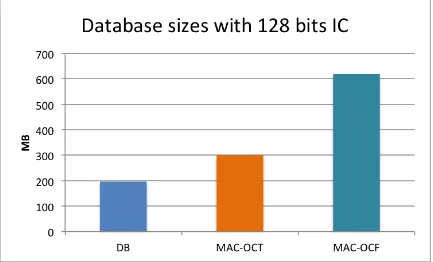
5.1 Database sizes: DB is the original Employees SQL database; MAC-OCT andMAC-OCFare the Employees ICDB databases using 128-bit HMAC or CMAC integrity code implementing the OCT scheme and the OCF scheme, respectively. Sizes are displayed in Megabytes. . . 53 5.2 Database sizes for the original Employees SQL database, and the
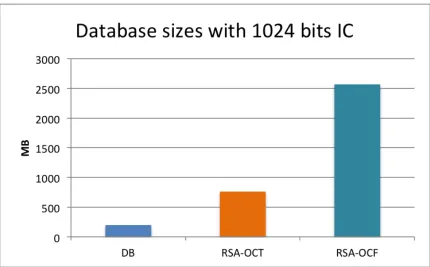
con-verted ICDB RSA-OCT and RSA-OCF databases respectively. Sizes are displayed in Megabytes . . . 55 5.3 Using HMAC-SHA, query process time raw data in milliseconds for
different number of tuples returned (in thousands) by the SELECT * query over theEmployees.salaries table. . . 59 5.4 Using CMAC-AES, query process time raw data in milliseconds for
different number of tuples returned (in thousands) by the SELECT * query over theEmployees.salaries table. . . 60 5.5 Using RSA, query process time raw data in milliseconds for different
number of tuples returned (in thousands) by the SELECT * query over the Employees.salaries table. . . 61
rate, i.e., how much user data (size in MB) can be processed in a SELECT * query using three different algorithms in OCT or in OCF. The data in the DB row is the process rate for a standard SQL database. 63 5.7 Using HMAC-SHA, query process time raw data in milliseconds for
different number of tuples inserted (in thousands) by the INSERT query into theEmployees.salaries table. . . 66 5.8 Using CMAC-AES, query process time raw data in milliseconds for
different number of tuples inserted (in thousands) by the INSERT query into theEmployees.salaries table. . . 67 5.9 Using RSA, query process time raw data in milliseconds for different
number of tuples inserted (in thousands) by the INSERT query into the Employees.salaries table. . . 68 5.10 Using HMAC-SHA, query process time raw data in milliseconds for
different number of tuples deleted (in thousands) by the DELETE query from theEmployees.salaries table. . . 71 5.11 Using CMAC-AES, query process time raw data in milliseconds for
different number of tuples deleted (in thousands) by the DELETE query from theEmployees.salaries table. . . 72 5.12 Using RSA, query process time raw data in milliseconds for different
number of tuples deleted (in thousands) by the DELETE query from the Employees.salaries table. . . 73 5.13 HMAC-SHA raw data for a Query joining the Employees.employees
and the Employees.salaries tables, showing the time required (in milliseconds) for the number of tuples selected (in thousands). . . 77
and the Employees.salaries tables, showing the time required (in milliseconds) for the number of tuples selected (in thousands). . . 78 5.15 RSA raw data for a Query joining the Employees.employees and the
Employees.salaries tables, showing the time required (in milliseconds) for the number of tuples selected (in thousands). . . 79 5.16 HMAC-SHA plotted with time required (in milliseconds) against
num-ber of tuples (in thousands) returned using an ICDB SELECT Query corresponding to the Functional Query . . . 82 5.17 CMAC-AES plotted with time required (in milliseconds) against
num-ber of tuples (in thousands) returned using an ICDB SELECT Query corresponding to the Functional Query . . . 83 5.18 RSA plotted with time required (in milliseconds) against number of
tuples (in thousands) returned using an ICDB SELECT Query corre-sponding to the Functional Query . . . 84 5.19 Using HMAC-SHA, query process time raw data in AV mode in
mil-liseconds for different number of tuples returned (in thousands) by the SELECT * query from the Employees.salaries table. . . 89 5.20 Using CMAC-AES, query process time raw data in AV mode in
mil-liseconds for different number of tuples returned (in thousands) by the SELECT * query from the Employees.salaries table. . . 90 5.21 Using RSA, query process time raw data in AV mode in milliseconds
for different number of tuples returned (in thousands) by the SELECT * query from the Employees.salaries table. . . 91
showing the speed the user data (size in MB) can be processed by three different algorithms in OCT and in OCF. The data in the row labeled
DB is the process rate for a standard SQL database. . . 93 5.23 Using HMAC-SHA, query process time raw data in AV mode in
mil-liseconds for different number of tuples deleted (in thousands) by the DELETE * query from the Employees.salaries table. . . 97 5.24 Using CMAC-AES, query process time raw data in AV mode in
mil-liseconds for different number of tuples deleted (in thousands) by the DELETE * query from the Employees.salaries table. . . 98 5.25 Using RSA, query process time raw data in AV mode in milliseconds
for different number of tuples deleted (in thousands) by the DELETE * query from the Employees.salaries table. . . 99 5.26 HMAC-SHA plotted query processing time for a query joining the
Employees.employees and the Employees.salaries tables, showing the time required (in milliseconds) for the number of tuples selected (in thousands) in aggregate verification mode. . . 103 5.27 CMAC-AES plotted query processing time for a query joining the
Employees.employees and the Employees.salaries tables, showing the time required (in milliseconds) for the number of tuples selected (in thousands) in aggregate verification mode. . . 104 5.28 RSA plotted query processing time for a query joining the
Employ-ees.employees and the Employees.salaries tables, showing the time re-quired (in milliseconds) for the number of tuples selected (in thousands) in aggregate verification mode. . . 105
ples returned using a SELECT Query corresponding to the Functional Query . . . 108 5.30 CMAC-AES plotted query processing time against the number of
tu-ples returned using a SELECT Query corresponding to the Functional Query . . . 109 5.31 RSA plotted query processing time against the number of tuples
re-turned using a SELECT Query corresponding to the Functional Query 110 5.32 Memory penalty rates for all experiments in both the ICDB basic and
the DMV models . . . 111 5.33 Average performance penalty rates for all experiments in both ICDB
basic and DMV models . . . 111 5.34 Ranking Scale . . . 116 5.35 Ranking of different ICDB schemes in either Basic or DMV model . . . . 116
2.1 Merkle Hash Tree . . . 11
3.1 A diagram illustrating the interactions between ICDB client and cloud DB Service Provider . . . 13 3.2 An Architecture for Dual Mode Verification (DMV) model (built on
the top of the basic ICDB model) . . . 19
5.1 Database sizes: DB is the original Employees SQL database; MAC-OCT andMAC-OCFare the Employees ICDB databases using 128-bit HMAC or CMAC integrity code implementing the OCT scheme and the OCF scheme, respectively. Sizes are displayed in megabytes. . . 53 5.2 Database sizes for the original Employees SQL database, and the
con-verted ICDB RSA-OCT and RSA-OCF databases respectively. Sizes are displayed in megabytes . . . 55 5.3 Using HMAC-SHA, plotted query process time in milliseconds for
dif-ferent number of tuples returned (in thousands) by the SELECT * query over theEmployees.salaries table. . . 59 5.4 Using CMAC-AES, plotted query process time in milliseconds for
dif-ferent number of tuples returned (in thousands) by the SELECT * query over theEmployees.salaries table. . . 60
number of tuples returned (in thousands) by the SELECT * query over the Employees.salariestable. . . 61 5.6 A chart plotted for Basic ICDB model showing the process rate, i.e.,
how much user data (size in MB) can be processed in a SELECT * query using three different algorithms in OCT or in OCF. The leftmost bar marked as DB is the process rate for a standard SQL database. . . 63 5.7 Using HMAC-SHA, plotted query process time in milliseconds for
dif-ferent number of tuples inserted (in thousands) by the INSERT query into the Employees.salaries table. . . 66 5.8 Using CMAC-AES, plotted query process time in milliseconds for
dif-ferent number of tuples inserted (in thousands) by the INSERT query into the Employees.salaries table. . . 67 5.9 Using RSA, plotted query process time in milliseconds for different
number of tuples inserted (in thousands) by the INSERT query into the Employees.salaries table. . . 68 5.10 Using HMAC-SHA, plotted query process time in milliseconds for
dif-ferent number of tuples deleted (in thousands) by the DELETE query from theEmployees.salaries table. . . 71 5.11 Using CMAC-AES, plotted query process time in milliseconds for
dif-ferent number of tuples deleted (in thousands) by the DELETE query from theEmployees.salaries table. . . 72 5.12 Using RSA, plotted query process time in milliseconds for different
number of tuples deleted (in thousands) by the DELETE query from the Employees.salaries table. . . 73
and the Employees.salaries tables, showing the time required (in milliseconds) for the number of tuples selected (in thousands). . . 77 5.14 CMAC-AES plotted for a Query joining the Employees.employees
and the Employees.salaries tables, showing the time required (in milliseconds) for the number of tuples selected (in thousands). . . 78 5.15 RSA plotted for a Query joining the Employees.employees and the
Employees.salaries tables, showing the time required (in millisec-onds) for the number of tuples selected (in thousands). . . 79 5.16 HMAC-SHA plotted with time required (in milliseconds) against
num-ber of tuples (in thousands) returned using an ICDB SELECT Query corresponding to the Functional Query . . . 82 5.17 CMAC-AES plotted with time required (in milliseconds) against
num-ber of tuples (in thousands) returned using an ICDB SELECT Query corresponding to the Functional Query . . . 83 5.18 RSA plotted with time required (in milliseconds) against number of
tuples (in thousands) returned using an ICDB SELECT Query corre-sponding to the Functional Query . . . 84 5.19 Using HMAC-SHA, plotted query process time in AV mode in
mil-liseconds for different number of tuples returned (in thousands) by the SELECT * query from the Employees.salaries table. . . 89 5.20 Using CMAC-AES, plotted query process time in AV mode in
mil-liseconds for different number of tuples returned (in thousands) by the SELECT * query from the Employees.salaries table. . . 90
different number of tuples returned (in thousands) by the SELECT * query from theEmployees.salaries table. . . 91 5.22 A chart plotted the process rates for the AV mode in DMV model
showing the speed the user data (size in MB) can be processed by three different algorithms in OCT and in OCF. The leftmost bar labeled DB is the process rate for a standard SQL database. . . 93 5.23 Using HMAC-SHA, plotted query process time in AV mode in
mil-liseconds for different number of tuples deleted (in thousands) by the DELETE * query from the Employees.salaries table. . . 97 5.24 Using CMAC-AES, plotted query process time in AV mode in
mil-liseconds for different number of tuples deleted (in thousands) by the DELETE * query from the Employees.salaries table. . . 98 5.25 Using RSA, plotted query process time in AV mode in milliseconds for
different number of tuples deleted (in thousands) by the DELETE * query from theEmployees.salaries table. . . 99 5.26 HMAC-SHA plotted query processing time for a query joining the
Employees.employees and the Employees.salaries tables, showing the time required (in milliseconds) for the number of tuples selected (in thousands) in aggregate verification mode. . . 103 5.27 CMAC-AES plotted query processing time for a query joining the
Employees.employees and the Employees.salaries tables, showing the time required (in milliseconds) for the number of tuples selected (in thousands) in aggregate verification mode. . . 104
ees.employees and the Employees.salaries tables, showing the time re-quired (in milliseconds) for the number of tuples selected (in thousands) in aggregate verification mode. . . 105 5.29 HMAC-SHA plotted query processing time against the number of
tu-ples returned using a SELECT Query corresponding to the Functional Query . . . 108 5.30 CMAC-AES plotted query processing time against the number of
tu-ples returned using a SELECT Query corresponding to the Functional Query . . . 109 5.31 RSA plotted query processing time against the number of tuples
re-turned using a SELECT Query corresponding to the Functional Query 110
ICDB – Integrity Coded Databases
IC – Integrity Code
AIC – Aggregate Integrity Code
SQL – Structured Query Language
CA – Cloud Application
CDS – Cloud Database Server
DMV – Dual Mode Verification
AV – Aggregate Verification
DV – Detailed Verification
OCF – One Code per Field
OCT – One Code per Tuple
MAC – Message Authentication Code
CMAC – Cipher-based Message Authentication Code
HMAC – keyed-Hash Message Authentication Code
ICRL – Integrity Code Revocation List
+ concatenation/ summation
* multiplication
modmodulo operation
−1 multiplicative inverse operation
⊕ exclusive or (XOR)
Q
product
CHAPTER 1
INTRODUCTION
1.1
Background
and it needs to be addressed.
While protecting data privacy in the cloud is an important topic, protecting data integrity is equally important, but often is a more challenging issue [1] since a company will actually lose the physical control of their data if the company wishes to outsource their data to the cloud. Without physical control of their data, the company cannot prevent (but may be able to detect) unauthorized data tampering from malicious cloud insiders.
1.1.1 Thesis Statement
Since unauthorized data modification in outsourced databases cannot be prevented, this paper presents anIntegrity Coded Database (ICDB)approach, as first seen in [18], which makes it possible for data owners to detect an insider’s modifications.
Database Integrity
Data integrity protection is to prevent/detect unauthorized data modifications. Once a database is outsourced, the data owner expects that data item retrieved from the cloud database should be the original data without unauthorized modification. If there is no protection mechanism in place, the database service provider (e.g., malicious DBA or compromised cloud software) can provide fabricated data without detection.
assigned to each IC to guarantee the freshness of the data (defined below). When an ICDB is queried, each data item will be fetched along with its corresponding IC and serial number. Use of the secret key in the construction of ICs assures that only the database owner is able to verify the integrity of queried data. To verify data, the data owner re-computes the IC from the data (with serial number and secret key) and then comparing it to the IC returned from the query. If either the data or the IC is forged, the data owner will be able to detect these changes. In order to fully guarantee data integrity, the returned data should be
• Correct: Returned data should be original, and not forged.
• Fresh: Returned data should be current and not include previously removed data.
• Complete: All data items satisfying query conditions should be returned.
By upholding all three points above, it is possible to achieve maximal integrity by detecting the following unauthorized actions:
• Data Manipulation: The alteration of data in the database or in the returned values.
• Data Omission: Deletion of data in the database or omission of information in the returned values.
• Data Addition: Insertion of data in the database or addition of information in the returned values.
Due to the complexity and performance issues incurred while enforcing data completeness as shown in [2], [3] and [4], our proposed ICDB approach in this study will only concentrate on ensuring correctness and freshness. This means that the ICDB models as formulated in this thesis will be only able to fully detect data manipulation, data addition, and stale data on the fetched query results.
Database Evaluation
Although ICDB is able to detect data alterations, it comes with a cost. An ICDB will incur memory penalties for storing integrity codes in addition to the original data, and performance penalties to retrieve extra information (integrity codes) for verifying the integrity of returned data. To test and benchmark the trade-off between security and performance penalty, we have implemented an ICDB prototype [16]. This thesis will focus on answering the following research questions:
• Question 1: Integrity protection. How effective is the introduction of Integrity Codes to ensure the data correctness and freshness?
• Question 2: Memory Penalty. How much additional memory is required to store integrity codes?
• Question 3: Performance Penalty. How much additional time is required for data to be verified after it is queried and/or how much extra information (i.e., integrity codes) is required to be retrieved from the cloud in every query?
algorithms were chosen to generate ICs. They are RSA, CMAC AES, and HMAC SHA. In addition, we have studied the ICDB in two different integrity protection granularities, i.e., One integrity Code per Tuple (OCT) or One integrity Code per Field (OCF), which will be described in section 4.2.
1.1.2 Outline
This thesis is organized into six chapters describing the various aspects of ICDB. We also share the experimental results and offer suggestions for various real cloud schemes.
In section 1.1, we discuss concerns about outsourced databases and provide a thesis statement to address the problem described.
In Chapter 2, we give a literature review on various existing data integrity protection schemes of outsourced databases.
In Chapter 3, we propose two different models of ICDB and how to evaluate their performance.
In Chapter 4, we present the construction of Integrity Unit (integrity code and serial number) and also describe the two different integrity granularity schemes.
In Chapter 5, we present and analyze the experimental results for different combina-tions of algorithms and granularities for both the ICDB models.
CHAPTER 2
PREVIOUS WORK
In this chapter we discuss some of the research that is directly related to the integrity protection of outsourced databases. The ongoing research has made use of different approaches such as signature, hash functions, and encryption. We will review how these various research approaches are related to this research work.
2.0.1 Integrity Coded Databases (ICDB)–Protecting Integrity for Out-sourced Databases
Nanjundarao’s work [18] (2015) defined the processes for which ICDBs can be created and queried. Her thesis outlined and provided preliminary results for an ICDB model using RSA to generate one integrity code per data field.
2.0.2 Securing Storage in Public Cloud Infrastructure
Haxhijaha et al. (2014) in their research [25] focused on verifying the integrity of the outsourced data by the client themselves, rather than depending upon some third party auditor. Their paper attempts to point out advantages and security concerns of cloud computing and focuses on avoiding third party auditors. For this, hash values of files are computed at the customer’s side to avoid the need for third party auditors. The hash values are then stored at a secure local hash repository. The client can request the data file from the cloud at any time and regenerate the hash for the file. The regenerated hash value can be matched against the precomputed and stored hash values for verification. Unlike ICDB, the technique proposed in their paper is targeted for the file system and not for databases. The MD5 hash algorithm is used as cryptographic algorithm. The MD5 is reported with various attacks [36]. The hash values are stored at the client machine, which incurs extra storage cost to the client. In their study, unfortunately no experimental results regarding performance overhead are provided.
ensuring completeness for each table.
Much like RICs, integrity codes in ICDB offer correctness by generating a keyed signature. The major difference is that integrity codes in ICDB, in addition to signatures, also have a serial component attached to them to maintain freshness. Unlike RICs, integrity codes in ICDB can also be generated per field.
2.0.3 Freshness Guarantee for an Outsourced Database
A 2008 paper [3] focused on providing freshness guarantees for outsourced databases provided two approaches for freshness, using timestamps or using a probabilistic method. The first approach with timestamps sets an expiration time for each sig-nature, and the signature must be updated when it is expired. This approach works under an assumption that the local time is always correct. The second approach defines operations, known as audits, which occasionally perform fake updates. Audits can insert new fake tuples and delete old ones from the outsourced database, checking that the new fake tuples always show up in query results. If any deleted fake tuple show up in the query result, the old data attack can be detected.
Another research work [14] tried a similar approach by inserting fake data. They require a Trusted Third Party (TTP) for performing verification, where the data owner hands the check sum to the TTP. The search request contains two parts: the real search request and the verification one. For the real one the user can receive the expected results but for the verification one a check value sum0 generated by the service provider should be provided. The user can then compare the sum and sum0 to check for freshness and completeness.
while the probabilistic method is not completely secure, and both methods require periodical operations (timestamp updates and audits) which contribute noticeable system overhead. ICDBs use serial numbers, which can be cross-checked with a compact list of invalid serial numbers without extra operations. This significantly reduces system overhead to guarantee freshness, since the serial number only needs to be updated when the data is updated.
2.0.4 Authentication of Outsourced Databases using Signature Aggrega-tion and Chaining
A paper detailing another authenticated database system [4] (2006), provides a similar approach to our ICDB implementation and addresses the integrity of query replies in the outsourced databases. The approach, called Digital Signature Aggregation and Chaining (DSAC), is used along with digital signatures at the granularity of individual tuples. Each individual signature is constructed by a hash value of the tuple combined with the hash value of its preceding tuple in each searchable attribute, signed with a secret key. This construction helps to achieve completeness by a secure linking of tuple-level signatures to form a so-called signature chain. The verification object includes sets of matching tuples for the query, sets of immediate predecessor and successor nodes of the first and last nodes respectively along the search dimension, a unified signature rather than individual signatures, and hashes of immediate predecessor tuples along all other searchable dimensions.
be sorted in ascending order prior to the signature computation. This adds extra computational overhead to both the database server(cloud) and the client.
2.0.5 Integrity Protection using Authenticated Data Structure-based Tech-niques
Niaz and Saake in their work [5] focused on Merkle Hash Tree–based data integrity techniques. Merkle Hash Tree is a Signature Scheme based on a binary tree of hashes. Each leaf node holds the hash of a data block. To verify the integrity of any data block, a signer transmits the hashes of only those nodes which are involved in the authentication path of the data block under consideration. With those hashes, the client can compute the hash of the root node and then match it against the stored root hash. For example, for the merkle hash tree in Figure 2.1, if the receiver needs to verify the integrity of data block 2 then only H(1), H(3,4) and H(5,8) need to be transfered to the receiver. With these hashes, the receiver can compute the root hash H(1,8) and then compare it against the stored root hash. Two models have been implemented: Single Authentication Table (SAT), which is one table with all of the authentication data and Level Based Authentication Table (LBAT), where authentication data for each level of an MHT is stored in an individual table.
CHAPTER 3
ICDB MODELS
In this thesis, we propose two ICDB models: (1) the Basic ICDB model and (2) Dual Mode Verification (DMV) model. The DMV model is built on top of the basic model and verifies query results in aggregation.
3.1
Basic ICDB Model
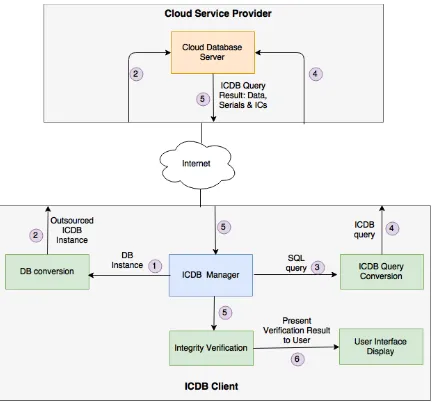
There are two components in the basic ICDB model: theICDB clientand theCloud Database Server (CDS) as shown is figure 3.1. The Cloud Service Provider uses a Cloud Database Server for data storage and various database–related operations. The ICDB client and the Cloud Service Provider are connected via the Internet. The ICDB client (on behalf of the data owner) seeks to outsource their data to the CDS, but would like to keep the capability of detecting unauthorized changes to their data. Hereafter, we will use the term ”ICDB client” instead of data owner, knowing that the ICDB client is a software client conducting ICDB operations on behalf of the data owner.
Figure 3.1: A diagram illustrating the interactions between ICDB client and cloud DB Service Provider
along with serial numbers and Integrity Codes to the ICDB manager and the ICDB manager forwards the query result to the verification module in Step 5. Finally, the results of integrity verification are presented to the user in Step 6.
The model in figure 3.1 is designed with the goal that employing the proposed ICDB technology will be transparent to the cloud service provider. The ICDB client can convert an existing database to an ICDB instance without the need to redesign existing database systems (e.g., MySQL, PostgreSQL). The CDS does not have to treat any ICDB instance differently from a standard database.
The ICDB client is responsible for the following actions:
1. Converting a database to an ICDB instance by inserting Integrity Codes (ICs) into the database before outsourcing it to the service provider:
An Integrity Code (IC) is a cryptographic code used for the integrity verification for a data item (either an attribute or a tuple). The code is constructed by applying a cryptographic function with inputs such as the data itself, the secret key of the data owner, and a unique ’Serial Number’. Each IC is generated to protect either an attribute data or the entire tuple in a table based on the level of protection granularity. For example, in the Table 3.1 below, the column ’IC’ represents the Integrity Code of the entire tuple along with a unique serial number associated with the IC. In the case of attribute level integrity protection, each attribute will have an IC column and a serial number column associated with it.
Table 3.1: An example of an ICDB table with tuple-level integrity protection
dept no
dept name
IC
serial
2. Upon receiving a SQL query, converting it to an ICDB query:
In addition to the requested data, the ICDB query should also retrieve corre-sponding ICs and serials related to the data so that the ICDB client is able to verify the integrity of requested data. In the example of Table 3.1, a SQL query to retrieve department number is written: {Select dept name From departments where dept no=’d001’;} The converted ICDB query for the given SQL query would be: {Select dept no, dept name, IC, serial number from departments where dept no=’d001’;} See below for why the ICDB query needs to retrieve extra data for the integrity verification.
3. Verifying the integrity of queried data to ensure correctness and freshness:
After the data is fetched along with the corresponding IC and serial number, verification is done by the ICDB client recomputing the IC to compare with the IC fetched from the ICDB query. Regeneration of the IC requires the dept no, the dept name, the IC and the serial number.
3.2
Dual Mode Verification (DMV) Model
1. Aggregate Verification (AV) mode: verify the integrity of all fetched data as a whole, and/or
2. Detailed Verification (DV) mode: verify the integrity of each fetched tuple or attribute in a finer granularity.
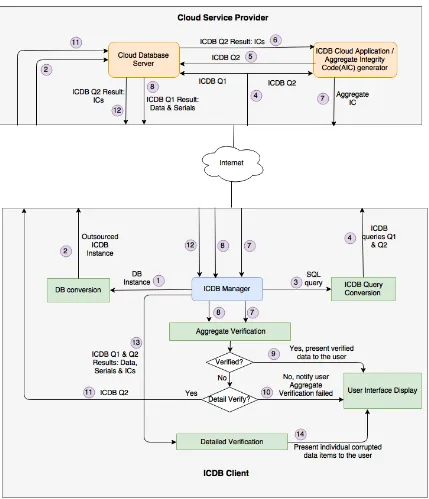
The DMV model shown in figure 3.2 is designed to reduce network overhead if the ICDB client chooses to perform data integrity verification using the AV mode only. If the AV mode verification fails, it means some data is corrupted within the fetched dataset. In this case, the ICDB client can either discard the entire dataset or can choose to perform the DV mode verification to figure out which data items (attributes or tuples) in the fetched dataset are actually corrupted. This means integrity codes will be fetched only in the DV mode if the aggregate verification fails.
database server. This restricts the computation of AIC in the cloud database server and thus the DMV model requires a separate cloud software application for AIC generation. We call this software the ICDB cloud application or the AIC generator.
CHAPTER 4
ICDB CONSTRUCTION
4.1
Definition of Variables
In this section, we will define some variables.
• d: A data item to be protected. In this thesis, it could be a field entry (an attribute value) or an entire tuple. In ICDB, each data item d will have an Integrity Code (IC) to ensure its integrity.
• D = {d1, d2, . . . , dr}: A dataset (a set of data item di’s) returned by an SQL
query, where r is a non-negative integer.
• ICSet = {IC1, IC2, . . . , ICr}: The set of corresponding integrity codes to the
datasetD. Each ICi is the integrity code for each data item di.
• s: Each integrity code IC has a unique serial number s. The construction of ICs ensures thats is an unforgeable identity of that IC.
• S ={s1, s2, . . . , sr}: The set of corresponding serial numbers to the ICSet and
thus to the dataset D. That is, each si ∈S is the corresponding serial number
to each ICi ∈ICSet and thus to eachdi ∈D.
• M ={m1, m2, . . . , mr}: A set of mi’s, returned by an ICDB query (converted
from an SQL query) so that the ICDB client has enough information to re-generate the ICs.
4.2
Integrity Codes
In the ICDB model, we protect data integrity by assuring their correctness and freshness. To accomplish this, our approach is to insert an integrity code along with a serial number into the database for each data item to be protected. By checking the integrity code to see whether it matches with the data to be protected, we are able to ensure the data’s correctness since the integrity code is constructed using a secret key known only by the data owner. Nobody, except the data owner, is able to modify the data and generate a matching integrity code for it. By checking the serial number, we are able to ensure the data’s freshness since the serial numbers for all removed data will be marked as invalid (not fresh) in the data owner’s record. The approach we use to track valid serial numbers is similar to that of the X.509 standard on maintaining the validity of public key certificates.
Given a data item d and a secret key k (known only to the data owner), the Integrity CodeIC(d) of datadis constructed using an IC generating functionG(m, k) :
IC(d) =G(m, k) (4.1)
m =T.A(e) +D+T.K(e) +A+T +s=d+D+T.K(e) +A+T +s (4.2)
where T is a table name, A is an attribute (field) name, s is a unique serial number assigned to the code, + means concatenation, T.A(e) = d is the attribute A’s value of an entity e in table T, a delimiter D for prohibiting the replacement attack as described in Section 5.2.2, T.K(e) is the primary key value of the same entity e (i.e., the primary key in the same tuple as T.A(e) is located). In OCT (One Code per Tuple) granularity, m is organized as:
m=T.A1(e) +D+T.A2(e) +. . .+T.An(e) +T +s=d+T +s (4.3)
where T is a table name, s is the unique serial number, + means concatenation, and
T.A1(e), . . . , T.An(e) are the field values in a tuple (or in other words, the attribute
A1’s,A2’s,. . .,An’s values for an entitye, respectively) andDis a delimiter in between
each field value for prohibiting the replacement attack as described in Section 5.2.2. In OCT the data item to be protected is the entire tuple, i.e.,d=T.A1(e) +T.A2(e) +
. . .+T.An(e).
Sections 4.3.1 and 4.3.2 will describe in detail why m should contain a different collection of information in OCF and OCT. Equation 4.1 above shows an integrity code’s construction, where the functionG can be one of three different cryptographic algorithms which will be described later. On top of the integrity code, let’s define an integrity unit for a data item d as a pair of < IC(d), s >, i.e., an integrity unit is an integrity code and the corresponding serial number (in clear).
4.2.1 Integrity Code Generating Algorithms
To maintain correctness, an IC must be cryptographically strong against forgery. With this in mind, we chose to use three different cryptographic algorithms to generate the integrity code: RSA, CMAC AES, and HMAC SHA [24], [7], [4], [34] [35]. In the literature, both CMAC (Cipher-based Message Authentication Code) and HMAC (Hash-based Message Authentication Code) algorithms have been designed with the objective that anyone without the secret key is unable to produce a valid (matching) MAC. A matching MAC to a data item means that anyone with the knowledge of the secret key can verify the validity of the MAC which in turn proves the integrity of the data item. In this project, we chose to use CMAC AES and HMAC SHA provided by the BouncyCastle Java library [22] to generate integrity codes in our experiments. Compared to RSA, these MAC algorithms have the advantages of smaller-size integrity codes and more efficient code generation. Despite RSA’s large memory and performance footprint, we have included RSA in our experiments because its homomorphic property [23] is useful in aggregate verification and also as a comparison to other notable publications involving the use of RSA [24], [7] and [4].
RSA
Sig(m) =my mod N (4.4)
The signature Sig(m) can be verified by checking:
m =? Sig(m)x mod N (4.5)
The homomorphic property allows the operations to be made on the ciphers without the need of decryption [30]. RSA has the multiplicative homomorphic property which allows multiplication operations to be made on the integrity code (signature). The result of these operations is equal to the integrity code of the product of the messages (or data) as shown in the the equations below:
Sig(m1) =my1 modN (4.6)
Sig(m2) =my2 modN (4.7)
Sig(m1)∗Sig(m2) = (m1∗m2)y modN =Sig(m1∗m2) (4.8)
This RSA homomorphic property [23] allows the ICDB cloud application in our ICDB model to generate a single Aggregate Integrity Code (AIC) from many indi-vidual ICs (which will be described in section 4.4), which can reduce the integrity verification process’s computational complexity in the ICDB client. Furthermore, checking the integrity of a queried dataset as a whole in the AV mode, the ICDB client only requires one AIC, rather than requiring all individual ICs for all data items in the dataset, thus greatly reducing the network load.
work in [33] have found that RSA takes less time for encryption and decryption compared to Elgamal and Paillier, though RSA’s key generation may take a longer time. We use RSA in this research only for integrity code generation/verification and not for the purpose of protecting confidentiality. The time to generate keys is not an issue since the data owner (ICDB client) will not share his/her RSA keys (both public and private keys) with anyone: neither the cloud server nor the ICDB cloud application. Thus, the keys can be generated offline. The data owner uses the private key to generate integrity codes (signatures) and uses the public key to verify the integrity codes along with data returned from clouds. The only value shared with the cloud server and the ICDB cloud application is the RSA modulus N, which will be used in modular multiplication of multiple ICs to generate one Aggregate Integrity Code (AIC). Because the public key is not shared with anyone, the known attacks on unpadded RSA are not possible. The use of unique serial number means that all data items (even with the same value) have a unique integrity code.
Cipher-based Message Authentication Code (CMAC)
Keyed-Hash Message Authentication Code (HMAC)
The second MAC algorithm we chose to use is HMAC, using SHA-128 as its digest. HMAC is a message authentication code that uses a cryptographic hash and a secret key. So HMAC can simultaneously verify both integrity and authentication. Hash functions are used in various prior works [25] for integrity protection. Hash algorithms such as SHA-1 and MD5 have been attacked in various ways [36]. One way is with length extension attacks where the attacker uses Hash(m1) and length ofm1 to
gen-erate Hash(m1||m2). Since HMAC doesn’t use the construction Hash(key||message),
HMAC is not subject to length extension attacks [35]. The cryptographic strength of HMAC depends on the properties of underlying hash function. The construction of HMAC is described as:
HM AC(k, m) =H((k0⊕opad) +H((k0⊕ipad) +m)) (4.9)
Where, H is a cryptographic hash function, k is the secret key, m is the message, k0
is a secret key derived from the original key k , + denotes concatenation, ⊕ denotes exclusive or (XOR), opadis the outer padding and ipad is the inner padding
4.2.2 Serial Number Construction
query were to return a data entry with a verifiable integrity code but with a serial number marked as revoked, the returned data is not fresh even though it is correct (not forged). The data owner will be able to detect invalid serial numbers for the data returned from the cloud by simply looking up the local ICRL file.
In case the list of revoked serial numbers grows, ICRL size can be reduced by applying the same technique used in the X.509 standard (this standard is used in keeping the size of the public key certificate revocation list small). Using this technique, ICDB maintains first valid serial number Sf. All the serial numbers less
than Sf are invalid. Here are the steps to reduce the size of the ICRL:
• Select a new first valid serial number Sf0
• All valid integrity codes in the ICDB whose serial number is less than Sf0 need to be renewed.
• Fetch the corresponding data and ICs for those serials to be renewed.
Regen-erate ICs with new serials (greater than Sf0).
• The updated ICRL now contains only those revoked serial numbers greater than
or equal toSf0, listed in an ascending order. Those revoked serial numbers less than Sf0 will be no longer kept in the list, and thus the ICRL size is reduced.
4.3
Granularity Schemes
schemes specify how data will be grouped together to construct the integrity code so that the correctness and freshness of the data can be guaranteed.
4.3.1 One Code per Field (OCF)
The OCF scheme specifies that for every field (attribute) data, there must exist a corresponding Integrity Code (IC). In other words, for every field containing user data in a table, there must exist a field to store the corresponding ICs. Furthermore, another field is also required to store the corresponding serial numbers. Table 4.1 below illustrates this ICDB OCF scheme:
Table 4.1: An example table for OCF granularity
dept no dept name dept no ic dept no serial dept name ic dept name serial d001 Marketing IC(d001) 1135980686 IC(Marketing) 1135980687 d002 Finance IC(d002) 1135980682 IC(Finance) 1135980683
Here, the OCF integrity codeICOCF(d) for a user datadis defined by the following
IC generating function:
ICOCF(d) = G(m, k) = G(T.A(e) +D+T.K(e) +A+T +s, k) (4.10)
where the symbol + means concatenation andmis a collection of information related to the user data d, including the data d=T.A(e) itself (a field A’s value of an entity
using the data owner’s secret key k. We use different information related tod in the collectionmfor preventing/detecting various attacks described in section 5.2. Each of the entity values is tied with their corresponding Primary Key value. This releases us from the burden of generating ICs for all the combinations of attributes in the table. For example, a Database University may contain a Table studentwith attributes FirstName, LastName, SSN, StudentNumber, Sex, Birthdate, Class, Degree and Address. The query fetching the values for attributesFirstNameandAddresswould require the IC to be generated by combining the same two attributes; this is also true for all other combinations of attributes. The use of the primary key value T.K(e) along with each of the attribute values/dataT.A(e) for generating the Integrity Code helps in tying each of the attributes with their respective Primary Keys - which in turn ties them with each other. This helps us get rid of multiple ICs to be generated based on the different combination of attributes. In addition, the use of attribute name A along with the data d, detects a substitution attack in the particular table since different data items with the same values cannot be related to the same Primary Key value and to the same attribute name. However, the attack may not be detected if another table in the same database contains the same attribute name with same data value and primary key value. To ensure the detection of a substitution attack in such cases, we use the table name T in the collection m, since a database cannot have multiple tables with the same name.
itself such including the corresponding integrity codes, key values, serial numbers, etc. Thus, the ICDB client needs to convert an original SQL query to an ICDB query to retrieve enough information for integrity verification.
OCF Query Conversion in the ICDB Basic Model
In the ICDB Basic model, there are only two entities: the CDS and the ICDB client.
Once the ICs are generated and inserted into the database, the ICDB client is responsible for converting any SQL query [26] to an ICDB query. The query conversion can be explained as the Algorithm A below:
Algorithm A: OCF-Basic Query Conversion. Input (an SQL query):
SELECT A1, A2, . . . Ar FROM T1, T2, . . . Tm WHERE C1and/or . . . Cn;
Output (an OCF-Basic query):
SELECT A1, A2, . . . Ar, K1, K2, . . . Km, B1, B2, . . . Bk,
IC(A1), IC(A2), . . . IC(Ar), S(A1), S(A2), . . . S(Ar),
IC(k1), IC(k2), . . . IC(km), S(k1), S(k2), . . . S(km),
IC(B1), IC(B2). . . IC(Bk), S(B1), S(B2), . . . S(Bk)
FROM T1, T2, . . . Tm
where A1. . . Ar are attribute names, K1. . . Km are key attribute names for tables
T1. . . Tm respectively, B1. . . Bk are attribute names that appear in the conditions
C1. . . Cnwithin the WHERE clause. In order to verify the integrity of these attribute
values listed above, we also need to retrieve the associated Integrity Unit (IC and serial number), one for each of these attributesA1. . . Ar,K1. . . Km ,B1. . . Bk respectively.
We use example SQL queries Query 1 and Query 2 over an ’Employees’ database to demonstrate how to apply the above query conversion algorithm, where Query 1 is a selection query from a single table and Query 2 is a query with a join operation from multiple tables. The ’Employees’ database chosen is a MySQL sample database pub-licly available online: Employees (v1.0.6) [21]. It has a total of six tables and consists of 4 million records. These six tables are departments, dept emp, dept manager, employees, salaries and titles, of which the tablesalariesis the largest. The database schema is provided in Appendix A.
Query 1 - Retrieve the salary of employees whose employee number is 1001:
The original SQL query for Query 1 is
SELECT salary FROM salaries WHERE emp no = 1001;
Applying the query conversion Algorithm A, the converted OCF-Basic query is:
SELECT salary, emp no, from date
FROM salaries
WHERE emp no = 1001;
The resulting ICDB query, in addition to ’salary’ attribute, also selects ’emp no’ and ’from date’ attributes along with their integrity unit (IC and serial). This is because these additional attributes are the primary key for the ’salaries’ table, and is required for the integrity verification process. All the example queries discussed in the following sections will follow the same pattern of fetching additional related information to the data based on the query conversion Algorithm A described earlier. In addition to a selection query from a single table, Algorithm A also describes how to convert a join query from multiple tables. We use the Query 2 below to demonstrate the conversion:
Query 2 - For each employee, retrieve the department name in which they are working and the start and end dates of their time working there.
The original SQL join query for Query 2 is:
SELECT departments.dept name, dept emp.from date, dept emp.to date FROM departments, dept emp
WHERE departments.dept no = dept emp.dept no AND departments.dept no = ’d002’;
The converted OCF-Basic query for Query 2 is:
SELECT departments.dept name, dept emp.from date, dept emp.to date, departments.dept no, dept emp.emp no,
IC(dept emp.from date), S(dept emp.from date), IC(dept emp.to date), S(dept emp.to date), IC(departments.dept no), S(departments.dept no) IC(dept emp.emp no), S(dept emp.emp no) FROM departments, dept emp
WHERE departments.dept no = dept emp.dept no AND departments.dept no = ’d002’;
In addition to selection and join queries, the ICDB was also designed to handle SQL functional queries. For any aggregate operation (sum, min, max, average, count), all the data used to determine the result of an aggregate function has to be fetched back to the ICDB client so that the ICDB client is able to perform the aggregate operation over these fetched data on behalf of the data owner. ICDB was designed in this way because in the ICDB models the cloud database server is not trustworthy to directly perform all the SQL queries, including the aggregate queries. Thus, the ICDB client will need to convert the original SQL aggregate query to an OCF query so that all the required data can be fetched to calculate the aggregate value. Consider an example SQL functional Query 3 below.
Query 3 - calculates the sum of all the salaries in the ’salaries’ table: The original SQL aggregate functional query for Query 3 is:
Select sum (salary) from salaries;
SELECT salary, emp no, from date
salary IC, salary serial, emp no IC, emp no serial, from date IC, from date serial
FROM salaries;
After all the fetched data are verified, the ICDB client can then perform the aggregate (sum) operation, i.e., all the salary data are summed. For other SQL functional queries, the query conversion and aggregate value generation processes are exactly the same as we described in this example.
OCF Query Conversion in the ICDB DMV Model (OCF-DMV)
In the ICDB Dual Mode Verification (DMV) model, there are three entities: the cloud database server, the ICDB cloud application, and the ICDB Client.
DMV model makes use of two different cloud services i.e, the cloud database server and the ICDB cloud application. So, each SQL query needs to be converted to separate ICDB queries for CDS and CA so that both of them can accomplish their respective tasks. The ICDB cloud application requires only the IC’s to generate an Aggregate Integrity Code (AIC). The ICDB client needs to fetch from the cloud database server all the data along with the serials to regenerate IC’s. The ICDB client also needs to fetch the AIC from the cloud application to verify the regenerated IC’s and thus verify the user data.
OCF Query Conversion in Aggregate Verification Mode: In an aggregate verification mode, the ICDB client has to issue a query to the cloud database server to fetch data along with the corresponding serial numbers (but not the IC’s). The ICDB client simultaneously has to issue another query to the ICDB cloud application to request the AIC of the corresponding IC’s.
The query to be issued to the cloud database server would be similar to the Algorithm A by excluding the Integrity Codes, whereas the query to be issued to the ICDB cloud application would be again similar to the Algorithm A but only retrieving the IC’s. Algorithm B below describes this query conversion.
Algorithm B: OCF-DMV Query Conversion. Input (an SQL query):
SELECT A1, A2, . . . Ar FROM T1, T2, . . . Tm WHERE C1and/or . . . Cn;
Output (an OCF-DMV query Q1 to the cloud database server and an
OCF-DMV query Q1: to be issued to the cloud database server.
SELECT A1, A2, . . . Ar, K1, K2, . . . Km, B1, B2, . . . Bk,
S(A1), S(A2), . . . S(Ar),
S(k1), S(k2), . . . S(km),
S(B1), S(B2), . . . S(Bk)
FROM T1, T2, . . . Tm
WHERE C1 and/or . . . Cn ;
OCF-DMV query Q2: to be issued to the ICDB cloud application.
SELECT IC(A1), IC(A2), . . . IC(Ar), IC(k1), IC(k2), . . . IC(km),
IC(B1), IC(B2). . . IC(Bk)
FROM T1, T2, . . . Tm
WHERE C1 and/or . . . Cn;
Upon receiving OCF-DMV query Q1, the cloud database server will return the
requested data and the corresponding serials to the ICDB client. However, when the ICDB cloud application receives OCF-DMV query Q2, it will forward the query to
the database server to retrieve all the ICs so that it can generate the AIC. Finally, the ICDB cloud application will forward the single AIC to the ICDB client. After receiving the AIC and all the data and serials (from Q1), the ICDB client is able to
OCF Query Conversion in Detailed Verification Mode: When aggregate verification fails, it means there is something wrong in the returned dataset as a whole. The ICDB client can either discard the entire dataset since it is incorrect, or the ICDB client can choose the option to verify the data in detail to identify which particular data’s integrity has been compromised. In case the ICDB decides not to take the detailed verification option, there is no need to download all the IC’s from the cloud and thus reduce the network overhead. If the ICDB client chooses to perform detailed verification, then it has to issue the query Q2 again to the cloud database
server to fetch all the individual IC’s, which is in fact the same query issued to the cloud application in the aggregate verification mode.
4.3.2 One Code per Tuple (OCT)
When bench marking the performance of the OCF schemes, results have indicated that the average ratio between an Integrity Code size and its corresponding data field size is high (see experimental results). The storage usage is inefficient since each data field usually holds only a small amount of data, but it needs to have a much larger size of storage to store the corresponding IC. For example, a tuple with an attribute First Name can contain the data, George, which is only 6 characters (48 bits) compared to an Integrity Code (IC) which are usually recommended to have a minimum of 128 bits (using MAC algorithms) or at least 1028 bits (using the RSA algorithm) to be safe from forgery.
To generate an integrity code for an entire tuple, all the data in the tuple can be concatenated before passing it to the IC-generating function, as shown in the example table 4.2.
Table 4.2: An example table for OCT granularity
dept no
dept name
IC
serial
d001
Marketing
IC(d001,Marketing,1135980685)
1135980685
d002
Finance
IC(d002,Finance,1135980689)
1135980689
IC unit is an ordered pair consisting of an IC and serial number, where the IC in OCT schemes is defined by the following IC-generating function:
ICOCT(d) = G(m, k) =G(T.A1(e)+D+T.A2(e)+. . .+T.An(e)+T+s, k) = G(d+T+s, k)
(4.11) where the symbol + means concatenation. T.A1(e), . . . , T.An(e) are the field values
in a tuple (or in other words, attributes values for an entity e), D is a delimiter in between each field values for prohibiting the replacement attack as described in 5.2.2, and in OCT the data item to be protected is d=T.A1(e) +T.A2(e) +. . .+T.An(e)
(i.e., the entire tuple). The information collection m=d+T +s represents the data itemdalong with the table nameT and a unique serial numbersassigned to the code. The purpose of including additional information related to the data item (tuple)din the collectionm is to ensure the uniqueness of m and also to prevent/detect various attacks described in section 5.2. Although each tuple in a tableT is unique within the same table due to the Primary Key constraint in the SQL standard, another tableT0
in the same database could have the exactly same tuple values, i.e., a tuple in tableT0
attack in this scenario. G(m, k) is the integrity code generating function on m using data owners secret key k.
By contrast with OCT it is not possible to determine whether a particular field entry is invalid since there is only one integrity code for the entire tuple. If the integrity code verification fails, it means some field entry in the tuple is invalid. It has no way to know which field entry in the tuple causes the verification failure. Thus OCT schemes relinquish fine-grained detection in exchange for a smaller memory footprint, and fewer ICs that need to be generated.
OCT Query Conversion in the ICDB Basic Model
In the ICDB Basic model, with only two entities, an SQL query needs to be converted to an ICDB OCT query to request enough information for the ICDB client to verify. Algorithm C below describes the query conversion.
Algorithm C: OCT-Basic Query Conversion. Input (an SQL query):
SELECT A1, A2, . . . Ar FROM T1, T2, . . . Tm WHERE C1and/or . . . Cn;
Output (an OCT-Basic query):
SELECT A1, . . . At, IC1, . . . ICm, S1, . . . Sm (Actually is SELECT ∗)
FROM T1, T2, . . . Tm
WHERE C1 and/or...Cn;
the WHERE clause. A1, . . . , Ar in the input query are some attributes from all tables
T1, . . . Tm, whereas A1, . . . , At in the output query are all attributes for all tables
T1, . . . , Tm. To regenerate IC’s, it is necessary to select all attributes of the entire
tuple. An example of OCT-Basic query conversion is provided using the same Query 1 used in the OCF query conversion example.
The original SQL query for Query 1 is:
SELECT salary FROM salaries WHERE emp no = 1001;
Applying the query conversion Algorithm C, the converted OCT-Basic query is:
SELECT emp no, salary, from date, to date, salaries IC, salaries serial FROM salaries
WHERE emp no = 1001;
SELECT departments.dept name, dept emp.from date, dept emp.to date FROM departments, dept emp
WHERE departments.dept no = dept emp.dept no AND departments.dept no = ’d002’;
The converted OCT-Basic query for Query 2 is:
SELECT *
FROM departments, dept emp
WHERE departments.dept no=dept emp.dept no AND departments.dept no=’d002’;
Just as with selection and join queries, functional queries are similar to what has been explained in the OCF query conversion. However, OCT needs to fetch all attribute values in a tuple even for a query only requesting an aggregate value over a single attribute. We use the example Query 3 used earlier in OCF query conversion to demonstrate the OCT query conversion for a functional SQL query with an aggregate operation.
The original SQL aggregate functional query for Query 3 is:
Select sum (salary) from salaries;
Select * From salaries;
Upon receiving all data from the cloud, the ICDB client will need to verify the integrity correctness for all received data, including the salary data. If all data pass the integrity check, the ICDB client can perform the aggregate operation over the received salary data and then present the aggregate result to the user.
OCT Query Conversion in the ICDB DMV Model (OCT-DMV)
In the DMV model, the communication is among three entities, which are the ICDB client, the ICDB cloud application and the cloud database server.
OCT Query Conversion in Aggregate Verification Mode: Similar to OCF schemes, for the aggregate verification mode in OCT schemes, the ICDB client has to issue a query Q1 to the cloud database server to fetch all those tuples that match
the query conditions along with the corresponding serial numbers (but not the IC’s). At the same time, the ICDB client also has to issue another query Q2 to the ICDB
cloud application to request an AIC, which is an aggregate integrity code for all the IC’s corresponding to those tuples retrieved in query Q1.
The query Q1 to be issued to the cloud database server would be similar to the
one in Algorithm C by excluding the integrity codes, whereas the query Q2 to be
Algorithm D: OCT-DMV Query Conversion Input (an SQL query):
SELECT A1, A2, . . . Ar FROM T1, T2, . . . Tm WHERE C1and/or . . . Cn;
Output (an OCT-DMV query Q1 to the cloud database server and an
OCT-DMV query Q2 to the ICDB cloud application):
OCT -DMV query Q1: to be issued to the cloud database server
SELECT A1, . . . At, S1, . . . Sm
FROM T1, T2, . . . Tm
WHERE C1 and/or...Cn;
OCT -DMV query Q2: to be issued to the ICDB cloud application
SELECT IC1, . . . ICm
FROM T1, T2, . . . Tm
WHERE C1 and/or...Cn;
As in the OCF schemes, upon receiving OCT-DMV queryQ1, the cloud database
server will return the requested data and the corresponding serials to the ICDB client. When the ICDB cloud application receives OCT-DMV query Q2, it will forward the
check the data integrity by performing an aggregate verification. The AIC generation in the ICDB cloud application and the aggregate verification process in the ICDB client will be described later in Section 4.4.
OCT Query Conversion in Detailed Verification Mode: When aggregate verification fails, it means there is something wrong in the returned dataset (a set of tuples) as a whole. Similar to the OCF-DMV scheme, the OCT-DMV scheme also provides the data owner with an option to either discard the dataset and stop, or verify the data further in the detail mode to identify which particular tuple has been compromised. To verify in the detail mode, the ICDB client has to issue the same queryQ2 to the cloud database server again to fetch all the IC’s so that it can verify
each individual tuple.
4.4
Aggregate Integrity Code Generation and Verification
We use different approaches to construct the Aggregate Integrity Code (AIC) de-pending on which cryptographic algorithm is used in generating ICs. In the previous examples, the query Q2 fetches all the ICs to the ICDB cloud application from the
cloud database server. If ICs are generated using the RSA algorithm, its homomorphic property allows multiplication to be performed on ciphers (or ICs here) without decrypting it. Making use of this property, the ICDB cloud application can modularly multiply all the fetched ICs together to generate a single AIC. According to the variable definitions in Section 4.1, let’s assume query Q1 returns a set of information
collections M = {m1, m2, . . . , mr}, which includes a dataset D = {d1, d2, . . . , dr}
query Q2 fetches the corresponding ICSet ={IC1, IC2, . . . , ICr}to the ICDB cloud
application. Equation 4.12 below describes the AIC generation for RSA algorithm.
AIC =
r
Y
i=1
ICi modN (4.12)
If ICs are generated by MAC algorithms (CMAC AES or HMAC SHA), the ICDB cloud application can generate a single AIC by concatenating all the ICs fetched from the cloud database server and then applying a hashing algorithm (SHA-256) to the concatenated ICs. The produced digest or result is the AIC. Equation 4.13 describes the AIC generation for MAC algorithms.
AIC =H(IC1+IC2+. . .+ICr) (4.13)
where H() is a hashing function implementing the SHA-256 hash algorithm.
After the AIC is generated and returned to the ICDB client, along with all the data returned by the query Q2, the ICDB client can then perform the AV mode
verification. In the AV mode verification, if RSA is the IC generating function, the ICDB client has to compute the aggregate data by modularly multiplying all mi, for
all data items di in the return dataset. The AIC can be regenerated by applying
the RSA algorithm to the aggregate data. Equation 4.14 below describes this AIC regeneration by the ICDB client.
AIC =Sig(
r
Y
i=1
mi modN) = ( r
Y
i=1
mi)y modN (4.14)
According to Equation 4.4, each ICi =Sig(mi) = (mi)y modN, where y is the RSA
by the ICDB cloud application should match with the regenerated AIC in Equation 4.14 by the ICDB client. The following derivation shows this.
Original AIC =Qr
i=1ICi modN
=IC1×IC2×. . .×ICr modN
=my1×my2 ×. . .×my
r modN
= (m1×m2×. . . mr)y modN
= (Qr
i=1mi)y modN
=Regenerated AIC
IF the IC generation function is one of the MAC algorithms (CMAC AES or HMAC SHA), the ICDB client has to regenerate all the integrity codes for all the returned datami and then regenerate the AIC from all the regenerated ICs. Equation
4.15 shows this AIC regeneration by the ICDB client.
AIC =H(M AC(m1) +M AC(m2) +. . .+M AC(mr)) (4.15)
whereH() is an SHA-256 hash function andM AC() is either the CMAC AES or the HMAC SHA algorithm. The original AIC based on Equation 4.13 generated by the ICDB cloud application should match the AIC based on Equation 4.15 regenerated by the ICDB client since each ICi =M AC(mi) and thus
Original AIC =H(IC1+IC2+. . .+ICr)
=H(M AC(m1) +M AC(m2) +. . .+M AC(mr))
=Regenerated AIC
CHAPTER 5
EXPERIMENTAL RESULTS AND ANALYSIS
5.1
Hardware and Software Used
All of our ICDB prototype implementation, testing, and benchmarking were per-formed at Boise State University’s Onyx server (See Appendix B for specifications). MySQL (MariaDB) was used as the underlying database management system, using InnoDB as its database engine. For database conversion (initial IC code generation and insertion), query conversion, and query verification, we have implemented all the modules with JAVA SE 1.8 and made them available in [16].
To test against a database with real data, we have chosen a sample MySQL database publicly available online: Employees (v1.0.6) [21] (See Appendix A). The database has size of 196.4 MB with close to 4 million tuples, which includes six tables employees, departments, dept manager, dept emp, titles, salaries. Before each experiment, the databases were returned to their original state for fair compar-ison.