VOLUME 37, ARTICLE 50, PAGES 1625
−
1658
PUBLISHED 29 NOVEMBER 2017
http://www.demographic-research.org/Volumes/Vol37/50/ DOI: 10.4054/DemRes.2017.37.50
Research Article
A reversal of the socioeconomic gradient of
nuptiality during the Swedish mid-20th-century
baby boom
Glenn Sandström
© 2017 Glenn Sandström.
This open-access work is published under the terms of the Creative Commons Attribution 3.0 Germany (CC BY 3.0 DE), which permits use, reproduction, and distribution in any medium, provided the original author(s) and source are given credit.
1 Introduction 1626
2 Data and method 1627
3 Results 1629
3.1 Time-trends in nuptiality and fertility in Sweden and in Västerbotten
1629 3.2 Cohort changes in nuptiality and socioeconomic composition
1900–1954
1631 3.3 Socioeconomic differences in nuptiality across different at-risk
cohorts (year when turning 20) 1900–1954
1636 4 Conclusions and discussion 1643 4.1 Economic recovery and the marriage boom 1644 4.2 Population polices, the welfare state, and the marriage boom 1646 4.3 Normative changes and the marriage boom 1650
A reversal of the socioeconomic gradient of nuptiality during
the Swedish mid-20
th-century baby boom
Glenn Sandström1
Abstract
BACKGROUND
Research into the causes of the mid-20th-century baby boom has concluded that the main proximate cause of the fertility increase during the 1940s was earlier and more universal marriage in the cohorts born after 1910, and that this association between nuptiality trends and fertility was particularly strong in Sweden.
OBJECTIVE
However, we do not know whether this was a general trend or if certain socioeconomic groups spearheaded the change toward earlier marriage.
METHODS
The present study uses event history analysis to investigate the marital histories of approximately 100,000 men and women in Sweden, born 1880–1934, to determine how socioeconomic differentials in nuptiality developed during the period 1900–1960.
CONCLUSIONS
The analysis shows that the sharp increase in nuptiality was not driven uniformly across different social strata, but rather took the form of earlier and more universal marriage among men in the mid and upper social strata and among economically active women, while male unskilled workers and women outside the labor market did not participate in the nuptiality boom during the peak baby boom years and even showed some signs of decreased marriage probabilities compared to earlier cohorts.
CONTRIBUTION
The results indicate that sector-specific economic growth after the depression and the breakthrough of the Swedish welfare state benefitted couples who could aspire to a middle-class identity, and that pronatalist policies made female economic activity more compatible with marriage. The results show that the shift toward a positive female socioeconomic gradient of marriage and family formation that can be observed in
1
contemporary Sweden had its beginnings already with the cohorts that participated in the mid-20th-century baby boom.
1. Introduction
The period from the mid-1930s to the late 1960s is characterized by marked shifts in demographic behavior pertaining to the family in both Sweden and other Western countries. The most pertinent features were the bottoming out of the fertility decline in the 1930s and the following marked increases in nuptiality, fertility and divorce in many Western countries, including Sweden, during the late 1930s and 1940s (Van Bavel and Reher 2013; Reher and Requena 2015; Sandström 2012; Goode 1993). In 1934 Sweden reached the lowest period fertility recorded in the world up to that time, when the total fertility rate (TFR) dropped to 1.71 children per woman. The low fertility levels resulted in an intense debate in Sweden on how to tackle the so-called “crisis in the population question” (Myrdal and Myrdal 1934), which motivated an array of political measures to stimulate fertility in the late 1930s and 1940s (Hatje 1974; Kälvemark 1980). The pronatalist measures were motivated by the fact that social scientists of the time predicted a continued sub-replacement fertility and did not at all foresee the subsequent rapid recovery that occurred from the late 1930s in many Western countries, including Sweden (Van Bavel 2010: 3–5). In Sweden, fertility rebounded sharply during the late 1930s, rose to 2.6 children per woman in 1945, and then remained above the 1934 levels into the 1970s (Statistics Sweden 2002: 95).
Since the end of the fertility transition, nuptiality and period fertility have been closely correlated in Sweden (Sandström 2014: 129), and research into the causes of the mid-20th-century baby boom has concluded that the main proximate cause of the fertility boom was earlier and more universal marriage in the cohorts born after 1910 (Caldwell et al. 1988; Glass 1968), and that this association between nuptiality and fertility was particularly strong in Sweden (Van Bavel and Reher 2013: 273). Prior to the baby boom, Sweden was a typical example of the Western European late and nonuniversal marriage pattern identified by John Hajnal (1965). Among women born during the second half of the 19th century, approximately two-thirds had not married by age 25 and one-quarter remained unmarried at age 40; but for women born in the 1920s, both of these proportions had dropped sharply to less than one-third unmarried at age 25 and less than one-tenth unmarried at age 40 (Statistics Sweden 1999: 102).
nuptiality during the baby boom also meant that nonmarital fertility dropped to the lowest levels recorded during the 20th century, reaching less than 10% of all live births during the first peak of the Swedish baby boom in the 1940s. Nonmarital fertility remained low for more or less the entire baby boom period, and did not start significantly increasing until the early 1960s (Statistics Sweden 1999: 76). In the 1960s, a shift to postponed and even forgone marriage coincided with the end of the baby boom, as period fertility entered a downward trend that would not be broken until the early 1980s (Sandström 2014: 129).
Given this close connection between nuptiality and fertility, previous research has concluded that any explanation for the baby boom must also be an explanation for the shift to earlier and more universal marriage during this period (Van Bavel and Reher 2013; Caldwell 1984). However, it has been pointed out that we know very little about how different groups in society contributed to these changes (Van Bavel and Reher 2013: 271), and we do not know whether certain groups spearheaded the transition to earlier and more universal marriage, or if this break with the late and nonuniversal marriage pattern was driven uniformly across different social strata. To understand the causes of the baby boom, it is of central importance to answer the questions of who married earlier and more, and why. Focusing on the socioeconomic position of men and women at the time of marriage, this paper is an attempt to answer some of these questions for the Swedish case. By using a unique individual-level dataset that allows us to explore changes in union formation longitudinally over the entire 20th century, it is possible for the first time to investigate the changing role of male and female socioeconomic background for marriage in a Western country during the mid-20th -century baby boom. This will allow us to better understand how the conditions for family formation changed for different groups in society during this period of massive social and economic change.
2. Data and method
information on all vital events, including marriage, childbirth, divorce, and moves within the region, as well as detailed information on the labor market experience of more than 100,000 adult men and women living in the county of Västerbotten in Northern Sweden during the period 1900–1960. The dataset thus covers both the fertility bust of the 1930s and the following baby boom during the 1940s and 1950s. The parishes included in the database are distributed throughout the coastal region of Västerbotten, and include more than two-thirds of the population in the province during the 19th and 20th centuries. The economic development presents the typical traits of most Swedish regions, being mainly rural until the early 20th century and thereafter characterized by rapid industrialization and a growing public sector.
For the purpose of the nuptiality analysis, the selection included 49,740 men and 52,180 women born in 1880–1934 who were present in the region during the period 1900–1960 and were unmarried at the start of observation (Demographic Database Umeå 2014). Consequently, the sample includes the women having both the lowest and the highest complete cohort fertility recorded among women born during the 20th century. The lowest recorded cohort fertility of 1.81 children is found among women born in 1904, while women born during the 1920s and 1930s, who were the main contributors to the high period fertility in the 1940s and 1950s, all reached complete fertility well above 2 children per woman and have ended up having the largest families of all women born during the 20th century so far (Sandström 2014: 121–122).
In the analysis, the nuptiality rate as a function of age is determined by calculating Kaplan–Meier survival estimates dependent on the respective socioeconomic status of men and women. Individuals are followed from the year they turn 15 years of age until first marriage, outmigration, or death, whichever occurs first.
The main independent variable in the analysis is the socioeconomic position of the individual prior to marriage. This was determined using the occupational information coded according to the HISCO classification system for historical occupations (Van Leeuwen, Maas, and Miles 2004). In a second step, the HISCO codes were then coded into a social stratification indicator (SES) according to the Social Power coding scheme (SOCPO) developed by Van de Putte and Miles (2005). If more than one occupation was registered prior to or at the time of marriage, the variable was set to the highest achieved SES of the individual prior to experiencing first marriage or being censored.
between missing information on occupation and censuring time resulted in the decision to exclude the category from the analysis. The group is small, and excluding it does not influence the estimates for the other social groups with the nonparametric methods applied in the analysis; it only has the effect of slightly reducing the power of the significance tests. For anyone with a special interest in this group, results are available upon request to the author.
Contrary to men, women with no occupational information exhibit a highly similar censuring pattern to that of economically active women, and are also a much larger group than economically inactive men. These gender differences are expected based on what we know about the gender regime of the time, which was still characterized by strong ideals of a male provider model. Although the economic roles of women were undergoing extensive change during the first half of the 20th century, it is clear that men and women faced different expectations regarding their economic roles in the family during the first half of the 20th century (see, e.g., Hirdman 1994: 184–189).
Consequently, economic self-sufficiency was not a prerequisite for marriage among women, while the provider model assumes this to be the case for males who wanted to attract a partner. Given the different meanings that missing information on economic activity prior to marriage has for men and women, and the role that increased female economic activity is given in the theoretical discussion on changing fertility patterns, women with no recorded occupation are retained in the analysis.
3. Results
3.1 Time trends in nuptiality and fertility in Sweden and in Västerbotten
Figure 1 shows the development of the total fertility rate in the region covered by the POPLINK database for 1900–1959 compared to the rest of Sweden. As seen in Figure 1, period fertility in the region of Västerbotten closely follows the trends in the rest of the country. The main difference between Västerbotten and the national level is that the fertility bust of the 1930s is not as pronounced as in the national average. Also, the break in the declining trend in the 1930s is delayed in Västerbotten as compared to Sweden in general, and occurs in the early years of World War II. These differences reflect the tendency for the fertility decline to be somewhat delayed in the northern part of Sweden, and that the decline started from higher pretransitional fertility levels in the North as opposed to the South (Hofsten and Lundström 1976: 96).
the 1940 level into the late 1950s, when the TFR for Västerbotten converges with the average rate for the country as a whole. Since the mid-1960s, the TFR of Västerbotten has exhibited an almost perfect match with the national average (Hofsten and Lundström 1976: 101–106; Statistics Sweden 2002: 95). In sum, the close match to the trend in the rest of the country and the marked increase in period fertility during the baby boom show that the data from Västerbotten can be used to analyze the fertility swings during this period.
Figure 1: Total fertility rate (TFR) 1900–1959 in the POPLINK sample from
Västerbotten and in Sweden 1900–1970
Source: POPLINK database, Demographic Database, Umeå University, and Statistics Sweden (2002: 95).
since the 19th century. Starting in the 1920s, crude nuptiality increased with just a minimal and short termed reversal during the depression to reach a peak in the first half of the 1940s when total fertility also reaches its baby boom maximum in both Sweden and Västerbotten.
Figure 2: Crude nuptiality (marriages per 1,000 inhabitants) 1911–1960 in
Västerbotten County and Sweden
Source: Statistics Sweden (1911).Befolkningsrörelsen (Yearbooks, 1911–1960).Statistics Sweden (SCB).
3.2 Cohort changes in nuptiality and socioeconomic composition 1900–1954
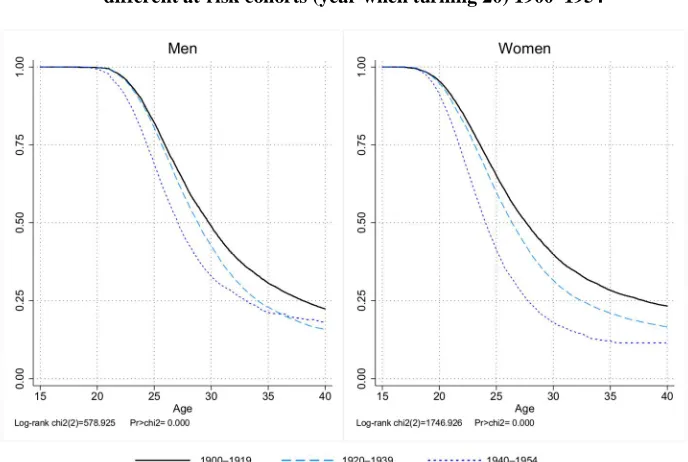
covers individuals who came of age during the end of the fertility decline and participated in the recovery in the early 1940s, but lived some of their reproductive years prior to the onset of the baby boom. The third category comprises men and women who came of age during the peak baby boom years after 1940. More finely grained versions of the cohort variable were also tested (5- and 10-year intervals). However, these do not lead to any differences in results as they tend to more or less perfectly line up as intermediate curves with those presented in Figure 3. Therefore, a three group categorization was chosen as this makes graphs less noisy and easier to interpret. An interesting aspect of the development in nuptiality in Sweden is the short term effect that the severe economic downturn in the early 1930s had on nuptiality. The depression only resulted in a rather modest dent in the trend of rapidly increasing nuptiality that characterized the 1930s (see Figure 2). That the effect of the depression on marriage rates was fairly short lived has also been shown for the United States (Hill 2015). This explains why the cohort that reached age 20 in close proximity to the depression still had significantly higher marriage rates than the cohorts that came of age during the fertility decline in the first decades of the century.
The main pattern found in Figure 3 is a sharp decrease in age at marriage for both men and women reaching their twenties in the 1940s. Comparing men and women in the 1940–1954 risk cohort with those in the 1900–1919 cohort, the median age at marriage decreased from 30.0 to 26.5 years for men and from 27.7 to 23.8 years for women. The age when 75% of the cohort had married decreased even more, from 38.7 to 30.8 for men and by more than ten years for women, from 37.7 in the first risk cohort to only 27.5 among the women who turned 20 in the 1940s and early 1950s.
Figure 3: Proportion of never-married men and women as function of age for different at-risk cohorts (year when turning 20) 1900–1954
Figure 4: Relative distribution of socioeconomic strata for at-risk cohorts
(year when turning 20) 1900–1954 for Swedish men and women in
Västerbotten County
Note: Calculation based on individuals observed to at least 30 years of age.
Source: POPLINK database, Demographic Database, Umeå University.
Turning to the issue of how the socioeconomic composition of the population changed during the first half of the 20th century, and the extent to which the increase in nuptiality was a uniform pattern across socioeconomic strata or whether certain groups contributed to the development more than others, Figure 4 shows the relative distribution of men and women according to their social strata (SOCPO classification) prior to marriage in different risk cohorts.
SOCPO classification. Further, in the last cohort the female farmer category is not differentiated from the rest of the middle class, as female farmers all but disappear and amount to only 20 women in this last risk cohort.
The changes across the cohorts follow an expected pattern, based on what we know about the economic development in the region during the first half of the 20th century. Although exact comparisons are not possible due to the differences in definitions used in the official statistics and the SOCPO classification, it is clear that there is a close correspondence between the relative size development of different social groups at the national level and in Västerbotten.
Unfortunately, there is limited quantitative information in the current literature on how the socioeconomic composition of the female labor force developed prior to the 1960s, and research has primarily focused on the changes in the overall levels of participation (Silenstam 1970; Stanfors 2003). For women, the strong increase in female labor force participation seen between the 1920–1939 cohort and those who came of age during the 1940s and 1950s is in line with previous research covering the national level in Sweden. For unmarried women aged 20–39, the employment rate on the national level increased from approximately 55% in the 1920s to almost 80% of the women in this age group in 1950, which closely corresponds to the figures found in Figure 4 (Silenstam 1970: 105).
The increase in participation rates of unmarried women had been strong already during the first decades of the century, and a majority of the unmarried women were already economically active in 1920 (Stanfors 2003: 81–83). Looking at the development of female economic activity during the 1940s and 1950s, on the surface it appears as though nothing happened, as the overall participation rate stagnated. But a closer examination shows that the composition of the female labor force underwent profound changes, as the share of women who were married and gainfully employed increased sharply. Married women comprised only 5% of all working women in 1920; however, this figure increased to 28.8% in 1950 and to 44.1% in 1960 (Frangeur 1998: 365).
For men, the literature on changes in the socioeconomic composition of the labor force is much more extensive. In an analysis of the Swedish class structure based on the census data from the 1930s to the mid-1960s, Göran Therborn finds that working-class men comprised about 60% of all men aged 15–64 during this period, a figure that showed a tendency to grow slightly from the 1930s to the 1960s (1981: 113). This pattern is closely replicated in the POPLINK sample, as seen in Figure 4. The diminishing share of farmers across the cohorts also shows proportions similar to the national average over time (Therborn 1981: 119). In sum, this leads to the conclusion that changes in the class structure do not substantially deviate from what is found in Sweden in general during these decades.
As seen in Figure 4, the most significant changes are the decrease in male farmers and a corresponding increase in the share of skilled workers. In Västerbotten, this is caused by the rapid development of an industrial sector starting in the late 19th century, based on the abundant natural resources in northern Sweden such as forestry, metal deposits, and possibilities for hydroelectric power (Sundin and Björkman 2015: 166– 203).
Increased productivity in the primary sector, as well as better transportation when the region was attached to the national railroad network around the turn of the century, facilitated a decline in the population employed in the primary sector (Sundin and Björkman 2015: 330–331). Consequently, unskilled agricultural labor and farmers were forced and incentivized to find employment in other sectors of the economy, as reflected in the reduced share of both farmers and unskilled workers among men. The shift from agricultural production to the industrial sector also explains the increased share of skilled workers, as industrial production raised the demand for labor with more specialized skills and education. This expansion of industrial production was also coupled with a growth of a tertiary sector in services, transportation, health care, and federal and local administration. The modest growth of the white-collar and elite strata is the result of basic industry dominating the region up to the 1960s, and the fact that a significant growth in tertiary education only occurred in the cohorts who came of age in the mid-1960s (Sandström 2014).
3.3 Socioeconomic differences in nuptiality across different at-risk cohorts (year when turning 20) 1900–1954
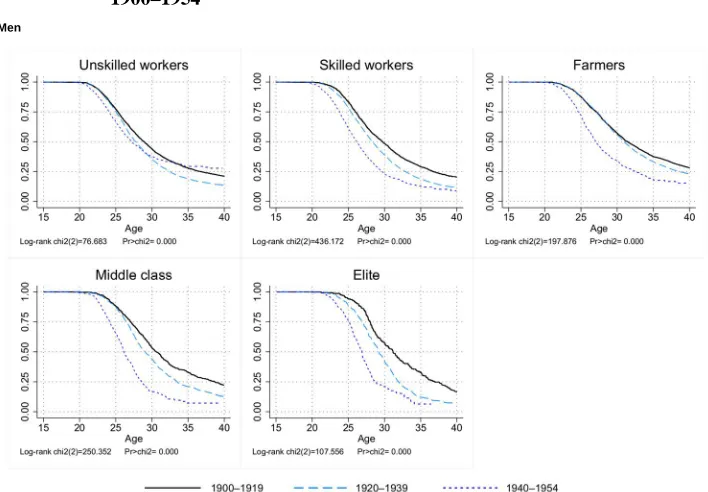
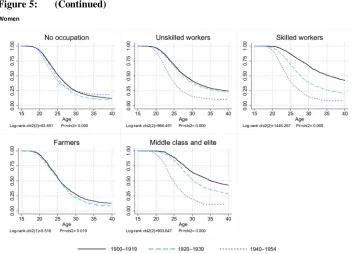
of the survivor function. Results of the test are reported in the note below each graph in Figure 5. As seen in Figure 5 there are significant differences in marriage intensities between the different cohorts (p.< .000) in all social strata among both men and women, apart from women classified as farmers, which rapidly decreases in number across the cohorts. The results in Figure 5 show that not all socioeconomic groups participated equally in the increased propensity for marriage during the baby boom. Among men, changes in marriage behavior are most substantial among skilled workers, the middle class, and the elite. These groups married at much younger ages in the baby boom cohorts, and also reached substantially higher proportions of having ever been married by age 40.
Male farmers and unskilled male workers, on the other hand, do not participate to the same extent in the general pattern of increased nuptiality. Among farmers the shift to earlier marriage is substantially delayed, and there is virtually no increase in the marriage rate for the cohort who came of age during the 1920s and 1930s, when the fertility decline shifts into the baby boom.
Figure 5: Proportion of never-married men and women as function of age in different socioeconomic strata by risk cohorts (year when turning 20) 1900–1954
Figure 5: (Continued)
Women
Source: POPLINK database, Demographic Database, Umeå University.
up the social ladder. However, the increased social mobility during the baby boom period might have resulted in an increased share of unskilled men with personal traits that were unfavorable both for social mobility as well as for the ability to attract a partner. As seen in Figure 5, men in the middle-class and elite strata have the largest relative change in marriage intensities over the risk cohorts. For these men, the age at which 75% of them had married decreases by 8–10 years. The shift to earlier marriage is slightly less pronounced for skilled workers than in the higher strata. Here the 75% level is reached at age 29, compared to age 37 in the 1900–1919 cohort. However, due to the substantial growth of the skilled worker category across the risk cohorts (see Figure 4), the change in nuptiality for this group is likely a more important factor for the general increase in period fertility during the late 1930s and 1940s. But a firm basis for such a conclusion requires an analysis of the fertility changes across SES categories during the baby boom.
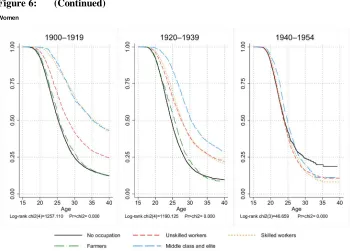
For women, much of the same pattern as among men emerges. Women in the skilled working-class occupations and the white-collar group increase their nuptiality the most. Their gains are especially evident compared to the nonemployed women, but also compared to women in unskilled occupations. The results indicate that economic activity and educational qualifications were becoming less and less an impediment to marriage for women. This is evident from the fact that the greatest increases are observed in the highest middle-class/elite group, in which secondary and even tertiary qualifications were usually a requirement for employment. Examining the occupational titles in this stratum, teachers, nurses, and clerical occupations strongly dominate the group. Almost all these women marry in the peak baby boom cohorts, compared to only about half the women in this stratum who came of age in the first decades of the century.
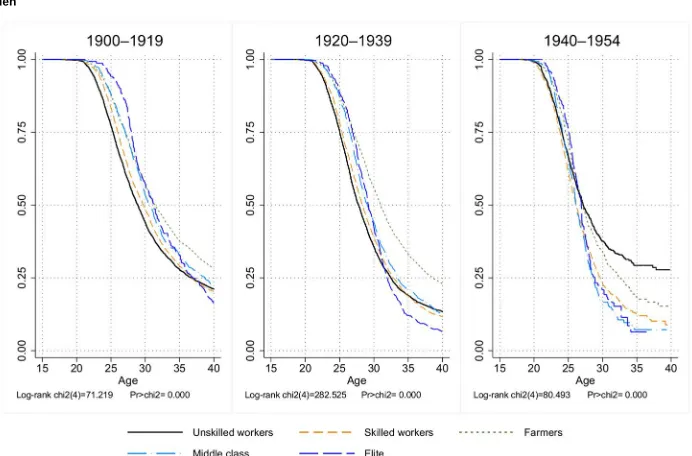
Figure 6: Proportion of men and women who have never been married as a function of age by socioeconomic stratum in different risk cohorts (year when turning 20) 1900–1954
Figure 6: (Continued)
Women
Source: POPLINK database, Demographic Database, Umeå University.
Looking first at the changes in male nuptiality, men in the lower SES strata with blue-collar occupations tended to marry earlier than higher stratum groups in the first cohort who came of age during the late stages of the fertility decline. In the subsequent cohorts, this negative socioeconomic gradient among males shifts markedly, with particularly middle-class and elite men showing strong increases in the propensity to marry early. Unskilled workers, on the other hand, do not take part in this shift in the same manner and even exhibit slightly higher levels of having never been married by age 40 in the peak baby boom cohort.
is found among women with no labor market activity prior to marriage. These women exhibit a decreased rather than an increased propensity to marry and end up being those who reach the highest levels of having never been married in the last risk cohort.
4. Conclusions and discussion
The main finding of the paper is that the strong increase in nuptiality, identified as the main proximate cause of the baby boom, did not occur evenly across socioeconomic strata. Rather, the baby boom is characterized by a shift in the socioeconomic gradient of nuptiality, as the increase in marriage is mainly concentrated to the higher strata of the working class and even more so to middle-class and elite groups among both men and women.
Prior to the baby boom, men in the lowest social strata tended to marry earlier than those in the higher social strata. Still, the postponement among men in the upper strata did not result in marked differences in the proportion of those who have ever married by age 40. This was due to a substantial recuperation at higher ages resulting in small socioeconomic differences of men who had ever married by age 40. So although the pre–baby boom gradient was negative, it was primarily a matter of differences in timing whereby those in the higher strata tended to postpone marriage to a greater extent than those in the lower strata.
This changed markedly for men who came of age in the 1920s and 1930s, and even more so for those who entered their twenties during the first peak of the baby boom in the 1940s and 1950s. Especially for the men in the peak baby boom cohort, we find a marked shift toward an opposite positive socioeconomic gradient in male nuptiality. Skilled workers and middle-class and elite strata men get married at increasingly younger ages. This is not the case among unskilled workers who rather exhibit some increase in the proportion of never getting married by age 40. Consequently, it seems that the higher strata drove the development toward earlier and more universal marriage.
reached the highest level of having ever been married, but for women entering their twenties during the peak baby boom years, these economically inactive women actually exhibit the lowest levels of ever being married by age 40.
Below are some proposed explanations for these changes in the socioeconomic patterns of nuptiality. However, it is clear that more research is needed to fully understand the driving forces for these changes; thus these proposed explanations should be regarded as hypotheses suitable for further research.
4.1 Economic recovery and the marriage boom
Given the extremely sharp downturn in the economy during the depression years of the early 1930s, and the subsequent rapid recovery in the decade’s second half, economic factors and how they affected the different social strata must be accounted for in attempts to understand the differences in behavior between socioeconomic strata. Looking at the general economic development, there are a number of changes at work from the mid-1930s to the mid-1940s that can help explain the general increase in the propensity for family formation.
The recovery from the economic decline in the early 1930s meant that unemployment dropped from almost 25% in 1934 to 12% in 1940 and further to only 3% in 1946, where it remained until the economic downturns of the 1970s (Rauhut 2002: 72; Ohlsson and Olofsson 1998). That the access to income from stable employment improved in this persistent manner during the same period as nuptiality sharply increased is hardly a coincidence. The strong economic recovery after the depression almost certainly had an impact on the readiness to form a family among Swedish men who came of age in the late 1930s and especially during the boom years of the 1940s. The access to stable employment also certainly meant that their capacity to attract a suitable partner on the marriage market improved, as the gender regime of the time still held strong ideals of a male provider model (Hirdman 1994: 184–189; Klas and Åmark 2001: 163–164).
world market had caused a sharp decline in the market prices of farming products in Sweden. As the depression hit in the early 1930s, the per capita income in the agricultural sector reached the lowest levels recorded since the government had started to collect information on income in the early 19th century (Schön 2014: 303). Recovery in the latter part of the 1930s was also primarily driven by the growth of the secondary and tertiary sectors of the economy, and the structural pressure on agricultural production continued to depress wages and decrease demand for labor throughout the 1930s. This meant that large sections of the rural population were incentivized to move to towns to find jobs in the more expansive secondary and tertiary sectors. After World War II, the shift to more capital intense and mechanized production translated into increased real incomes in the primary sector as well (Bentzel 1952: 70–71; Schön 2014: 304–307, 327–328). Therefore, real wages for farmers recovered from the very low levels of the 1930s during the peak baby boom years going into the 1950s. These economic trends are in line with the delayed shift to earlier marriage among male farmers, who only participated in the 1940–1954 cohort (see Figures 4–5).
However, even with the strong recovery in the 1940s, mean real wages in the agricultural sector remained well below the wages paid to employees in the industrial sector, which stood for most of the economic growth during the period (Bentzel 1952: 70). Farmers also continued to postpone marriage to a larger extent than skilled workers and middle-class and elite men during the peak baby boom years of the 1940s, although the difference had decreased compared to the 1930s (see Figure 5).
For unskilled workers, based on the current literature it is difficult to draw any definitive conclusions regarding how changes in the economy and the labor market contributed to their failure to participate in the upswing in nuptiality during the peak baby boom period. Regarding economic factors, the statistics on wages collected by Statistics Sweden for this period unfortunately lack detail regarding the development of skilled vs. unskilled workers for the period before 1940. The question is to what extent unskilled laborers experienced a failure to capitalize on the economic recovery during the 1930s and 1940s, and whether this explains their inability to participate in the nuptiality boom.
in the industrial sector outgrew the share in the primary sector for the first time (Nilsson and Tedebrand 2005: 46), and by 1951 employment in the primary sector had decreased by another 15% to now employ less than one-fifth of the labor force (Schön 2014: 297). This constant oversupply of unskilled labor – primarily recruited from the reserve of farm labor – meant that industrial production could grow rapidly without the need to raise wages to attract a sufficient number of workers. The precarious conditions for unskilled workers during the years of rapidly falling employment opportunities in the agricultural sector is most likely an important factor explaining their failure to participate in the trend of shifting marriage to lower ages.
At the same time, this also helps explain why women who were registered as farmers married very early. They were few in number and had in practice disappeared altogether in the last risk cohort, but married at young ages and to a very high degree. Their position as landholders apparently made them highly attractive on the marriage market in the rural community, where many men faced strong structural pressure to find labor market opportunities. In this setting it is hardly surprising that marrying a woman landholder must have been very attractive to many men. At the same time, it was likely of central importance for women landholders to find a male partner to help farm the land.
4.2 Population polices, the welfare state, and the marriage boom
The sustained economic recovery and rapid shift from an agricultural to an industrial economy, however, is only one of the substantial structural changes that influenced the conditions for family formation for different socioeconomic groups in the 1930s and 1940s. Research on the baby boom has highlighted the need to better assess how the institutional changes in many Western countries, in terms of a growing welfare state and the implementation of population policies, influenced family formation during the period (Van Bavel and Reher 2013: 281). That pronatalist policies played an independent role in the increased nuptiality and fertility in the West after the mid-1930s has been argued by a number of scholars (Caldwell 2006: 229; Chesnais 2005: 443; Sardon and Calot 1998: 44).
the result of a new industrial society that had caused an increased dependence on wage labor for a growing proportion of Swedish men and women.
In the Population Commission formed in 1935, the Myrdals argued that the incompatibility between wage labor and family formation, especially for women, made them postpone or even forgo marriage and childbearing. Consequently, they argued that population policies aiming to limit the possibilities for female economic activity would be counterproductive, and that reforms with any hope of success should rather attempt to make marriage and childbearing more compatible with female labor force participation (Myrdal 1941: 54; Hoem and Hoem 1996).
Additionally, it was the economic insecurity of wage laborers in general that depressed fertility. According to representatives of the SAP, such as the Myrdals and Minister of Social Affairs Gustav Möller, the young generation refrained from forming a family due to economic insecurity and exposure to swings in labor market demand. Consequently, they argued that if society wanted new families to be formed something had to be done about the constant risk of deprivation that the new system of production exposed the young urban population to.
So what Social Democratic intellectuals argued was essentially that the tendency for fertility to be pro-cyclical was becoming stronger due to the increased proportion of young men and women that were dependent on wage labor. Demographic research has also established that fertility has tended to respond positively to economic recoveries since the depression in the 1930s and that this tendency for procyclical fertility has grown in importance during the postwar decades in Sweden (Hoem 2000; Stanfors 2003: 104), the United States (Schneider 2015), and in most European countries (Hondroyiannis 2010; Comolli 2017).
Arguing for the importance of economic insecurity as an explanation for low fertility, the SAP effectively leveraged the population crisis to muster political support across partisan lines for a more extensive welfare state as well as for reforms that made female labor force participation and marriage more compatible (Frangeur 1998; Hatje 1974: 23–25; Hirdman 1989: 119; Kälvemark 1980: 52–59). The end result was the first breakthrough period for the typical Nordic universalistic welfare state model during the 1930s and 1940s (Esping-Andersen 1990: 46).
employment protection for women in case of pregnancy or marriage in 1939, and universal child allowances in 1947 to name a few (Hatje 1974; Kälvemark 1980).
Gérard Calot has calculated that the effect of French pronatalist policies implemented in the 1940s was a 20% increase in fertility, based on changes in fertility in socioeconomic groups that were targeted compared to those without access to new family benefits (2005). However, Swedish research on the population policies implemented in the 1930s and 1940s are divided regarding the practical impact of the pronatalist policies. Some scholars have dismissed the population policies as a direct cause of the recovery of fertility on the grounds that nuptiality, and to some extent also fertility, had already started recovering when most of the policies were implemented (see e.g., Hoem and Hoem 1996: 4–5; Schön 2014: 309), or conclude that they likely had a limited impact (Kälvemark 1980). Others have argued that the changes in overall levels of public expenditure on welfare for families are linked to changes in period fertility during the baby boom (Lindh and Hong 2011).
Although it is not possible to draw any final conclusions regarding the effect of pronatalist measures based on the results presented in this study, two things stand out from the changes in the nuptiality patterns.
Firstly, it is clear that the incompatibility between female economic activity and marriage decreased markedly for women who entered their twenties during the first breakthrough period of the Swedish welfare state, starting in the late 1930s. It is also clear that changes to the provider model were underway, which led to substantial increases in the share of the female labor force who were married. Married women only made up 10% of the female workforce in 1930, but their relative share had increased to 28.8% by 1950 and to 44.1% by 1960, just prior to the second peak of the Swedish baby boom (Frangeur 1998: 365).
Focusing on the baby boom in the United States, both Bellou and Cardia (2014) and Doepke, Hazan, and Maoz (2015) argue that the main cause for increased nuptiality and fertility in the 1940s and 1950s was that married women who experienced the depression and the war in their youth (women born 1900–1920) increased their labor force participation and consequently crowded out younger women from the labor market.
40–49 reach participation rates of 38%–39%. The fact that more and more young married women worked during the Swedish baby boom does not fit very well with the interpretation that the baby boom was caused by young women being crowded out of the labor market as Bellou and Cardia (2014) and Doepke, Hazan, and Maoz (2015) suggest. Rather, the results here indicate that an important background to the Swedish baby boom was that young women increasingly were able to combine marriage with being economically active.
Regarding the increases in the labor force participation rate of married women during this period, it is important to acknowledge that many of the pronatalist reforms implemented in the 1930s and 1940s were explicitly designed to reduce the obstacles to marriage and childbearing for employed women. The new law of female employment protection passed by Parliament in 1939 made all employers with more than four employees liable if they fired a woman or made unfavorable changes to her working conditions when she got engaged, married, or pregnant. Further, the right to three months of maternity leave with pay, later extended to six months in 1945, was implemented. The maternity benefit was not unsubstantial, and most privately employed women received about 40% of the mean monthly female salary in benefits, while government employees received even higher benefits (Frangeur 1998: 320–321). In the bill from 1939, the Social Democratic government stated that the intention of the law was to increase the possibilities for women to “combine marriage and motherhood with gainful employment” (Bill nr.114 1939).
The results presented in this analysis show the largest increases in nuptiality for economically active women, which is consistent with policies having an impact on barriers to family formation for employed women. The results show that the highest SES group nearly converges with lower-skilled women, and in the last risk cohort we can only see a slight tendency for postponement in the highest white-collar group as opposed to unskilled women. Further, economically active women surpass women outside the labor market with regard to the level of having ever been married by age 40 among the women reaching their twenties during the baby boom. This finding reinforces the results found in the studies showing that highly educated women increased their fertility more than low-educated women in a number of Western countries during the baby boom (Reher and Requena 2015; Sandström 2014; Van Bavel 2014).
the lowest social strata. Among Social Democrats, this was expressed as a concern that raised fertility among the poorest would result in an increased burden on social security systems and municipal poor relief.
But there was also a eugenic discourse that resulted in a tendency to equate middle-class status to particularly beneficial hereditary properties. This conflation of social class and genetics in the discourse on population policies resulted in the expressed goal to primarily target the upper strata of the working class, middle class, and elite in policies to increase fertility and nuptiality. It was in these better-off population segments that both Social Democrats and Conservatives preferably wanted to see fertility go up (Spektorowski and Mizrachi 2004: 344–346). These views on the association between genetics and social class were particularly explicit in the new law on sterilization and abortion passed in the late 1930s (Hatje 1974: 178–187; Hirdman 1989: 144–148), but also directed the income requirement for access to, for example, marriage loans that in practice excluded the lower classes (Kälvemark 1980: 81–82).
Looking at the results presented here, it is interesting to note that the socioeconomic pattern of nuptiality during the 1940s must have pleased the Population Commission, which stated that the most important goal of an effective population policy was to “remove all obstacles to early marriage” (Population Commission 1936: 77), and that “the low nuptiality and fertility in the middle and upper social strata was especially problematic from an eugenic standpoint” (Population Commission 1938: 57–68). In this regard, the increased nuptiality during the baby boom appears to have exactly followed the pattern desired by the Population Commission, as nuptiality increased consistently only in the groups that the pronatalist policies explicitly targeted.
This provides at least circumstantial evidence that the pronatalist polices and propaganda for earlier family formation implemented during the 1930s and 1940s were successful in influencing the behavior of the generation that came of age during the peak baby boom years of the 1940s.
4.3 Normative changes and the marriage boom
functional view of marriage (Population Commission 1936). Although, marriage was defined as the desired form for a heterosexual relationship, sexual pleasure and emotional satisfaction were recognized as the basis for a working marriage. To facilitate healthy sexual relationships, early marriages, and ‘a voluntary parenthood,’ the Population Commission came to the somewhat counterintuitive conclusion that the access to contraceptives should be improved and moved to abolish the restrictions on sales that had been in force in the country since 1910 (Kälvemark 1980: 57). In this way changing norms regarding sexuality in marriage and the increased access to contraceptives likely contributed to lowering the constraints to early marriage. However, this should also have worked to postpone childbearing among married couples and thus weakened the link between nuptiality and fertility. Therefore it is difficult to assess the net effect of these normative changes with regards to the impact on fertility during the baby boom.
References
Andersson, G., Rønsen, M., Knudsen, L.B., Lappegård, T., Neyer, G., Skrede, K., Teschner, K., and Vikat, A. (2009). Cohort fertility patterns in the Nordic countries. Demographic Research 20(14): 313–352. doi:10.4054/DemRes.2009. 20.14.
Bellou, A. and Cardia, E. (2014). Baby-boom, baby-bust and the Great Depression. Bonn: Institute for the Study of Labor (IZA Discussion Paper 8727).
https://papers.ssrn.com/sol3/papers.cfm?abstract_id=2543922.
Bentzel, R. (1952). Inkomstfördelningen i Sverige. Stockholm: Industriens utredningsinstitut.
Bill nr.114 (1939). Förslag till lag om förbud mot arbetstagares avskedande i anledning av trolovning eller äktenskap m.m.
Caldwell, J. (1984). Fertility trends and prospects in Australia and other industrialised countries.Journal of Sociology 20(1): 3–22.doi:10.1177/144078338402000101.
Caldwell, J. (2006). The Western fertility decline: Reflections from a chronological perspective.Journal of Population Research 23(2): 225–242.
Caldwell, J., Caldwell, P., Bracher, M., and Santow, G. (1988). The contemporary marriage and fertility revolutions in the West: The explanations provided by Australian participants. Journal of the Australian Population Association 5(2): 113–145.
Calot, G. (2005). The effect of pronatalist policies in industrialized countries. In: Caselli, G., Vallin, J., and Wunsch, G.J. (eds.). Demography: Analysis and synthesis: A treatise in population. Boston: Elsevier: 147–154.
Chesnais, J.-C. (2005). Population policy in France, 1896–2003. In: Caselli, G., Vallin, J., and Wunsch, G.J. (eds.). Demography: Analysis and synthesis: A treatise in population. Boston: Elsevier: 435–454.
Comolli, C.L. (2017). The fertility response to the Great Recession in Europe and the United States: Structural economic conditions and perceived economic uncertainty. Demographic Research 36(51): 1549–1600. doi:10.4054/DemRes. 2017.36.51.
Doepke, M., Hazan, M., and Maoz, Y.D. (2015). The baby boom and World War II: A macroeconomic analysis. The Review of Economic Studies 82(3): 1031–1073.
doi:10.1093/restud/rdv010.
Esping-Andersen, G. (1990). The three worlds of welfare capitalism. Cambridge: Polity.
Esping-Andersen, G. (2016).Families in the 21st century. Stockholm: SNS Förlag.
Frangeur, R. (1998). Yrkeskvinna eller makens tjänarinna? Striden om yrkesrätten för gifta kvinnor i mellankrigstidens Sverige. Lund: Arkiv.
Glass, D.V. (1968). Fertility trends in Europe since the Second World War.Population Studies 22(1): 103–146.doi:10.2307/2173355.
Goode, W.J. (1993).World changes in divorce patterns. New Haven: Yale University Press.
Hajnal, J. (1965). European marriage patterns in perspective. In: Glass, D.V. and Eversley, D.E.C. (eds.). Population in history. London: Edward Arnold: 101– 146.
Hatje, A.-K. (1974). Befolkningsfrågan och välfärden: Debatten om familjepolitik och nativitetsökning under 1930- och 1940-talen. Stockholm: Allmänna förlaget.
Hirdman, Y. (1989). Att lägga livet till rätta: Studier i svensk folkhemspolitik. Stockholm: Carlsson.
Hirdman, Y. (1994). Kvinnorna i välfärdsstaten. In: Thullberg, P. and Östberg, K. (eds.).Den svenska modellen. Lund: Studentlitteratur: 180–192.
Hoem, B. (2000). Entry into motherhood in Sweden: The influence of economic factors on the rise and fall in fertility, 1986–1997. Demographic Research 2(4).
doi:10.4054/DemRes.2000.2.4.
Hoem, B. and Hoem, J.M. (1996). Sweden’s family policies and roller-coaster fertility. Jinko mondai kenkyu52(3–4):1–22.
Hofsten, E. and Lundström, H. (1976). Swedish population history: Main trends from 1750 to 1970. Stockholm: Liber.
Kälvemark, A.-S. (1980). More children of better quality? Aspects on Swedish population policy in the 1930s. Stockholm: Almqvist and Wiksell International.
Klas, U. and Åmark, K. (2001). Social rights and social security: The Swedish welfare state, 1900–2000.Scandinavian Journal of History 26(3): 157–176.doi:10.1080/ 034687501750303837.
Lennerhed, L. (1994). Frihet att njuta: Sexualdebatten i Sverige på 1960-talet. Stockholm: Norstedt.
Lindh, T. and Hong, Y. (2011). Swedish fertility swings and public expenditure for children. Stockholm: Swedish Institute for Futures Studies (Working Paper 2).
http://core.kmi.open.ac.uk/display/6474642.
Matović, M.R. (1984). Stockholmsäktenskap: Familjebildning och partnerval i Stockholm 1850–1890. Stockholm: Liber.
Myrdal, A. (1941).Nation and family: The Swedish experiment in democratic family and population policy. New York: Harper and Brothers.
Myrdal, A. and Myrdal, G. (1934).Kris i befolkningsfrågan. Stockholm: Bonnier.
Nilsson, H. and Tedebrand, L.-G. (2005). Familjer i växande städer: Strukturer och strategier vid familjebildning i Sverige 1840–1940. Umeå: Umeå University.
Ohlsson, R. and Olofsson, J. (1998). Arbetslöshetens dilemma: Motsättningar och samförstånd i svensk arbetslöshetsdebatt under två hundra år. Stockholm: Studieförbundet näringsliv och samhälle.
Population Commission (1936). Betänkande i sexualfrågan. Stockholm: Statens offentliga utredningar.
Population Commission (1938). Slutbetänkande. Stockholm: Statens offentliga utredningar.
Rauhut, D. (2002).Fattigvård, socialbidrag och synen på fattigdom i Sverige 1918– 1997. Stockholm: Almqvist and Wiksell International.
Reher, D. and Requena, M. (2015). The mid-twentieth century fertility boom from a global perspective. The History of the Family 20(3): 420–445. doi:10.1080/ 1081602X.2014.944553.
Sandström, G. (2014). The mid-twentieth century baby boom in Sweden: Changes in the educational gradient of fertility for women born 1915–1950.The History of the Family 19(1): 120–140.doi:10.1080/1081602X.2013.871317.
Sardon, J.-P. and Calot, G. (1998). La vraie histoire du baby-boom.Sociétal 16: 41–44.
Schneider, D. (2015). The Great Recession, fertility, and uncertainty: Evidence from the United States.Journal of Marriage and Family 77(5): 1144–1156.doi:10.1111/ jomf.12212.
Schön, L. (2014).En modern svensk ekonomisk historia: Tillväxt och omvandling under två sekel. Lund: Studentlitteratur.
Silenstam, P. (1970).Arbetskraftsutbudets utveckling i Sverige 1870–1965. Stockholm: Almqvist and Wiksell.
Spektorowski, A. and Mizrachi, E. (2004). Eugenics and the welfare state in Sweden: The politics of social margins and the idea of a productive society. Journal of Contemporary History 39(3): 333–352.doi:10.1177/0022009404044443.
Stanfors, M. (2003). Education, labor force participation and changing fertility patterns: A study of women and socioeconomic change in twentieth century Sweden. Stockholm: Almqvist and Wiksell.
Statistics Sweden (1911). Befolkningsrörelsen: Årsböcker 1911–1962. Stockholm: Statistics Sweden.
Statistics Sweden (1999). Befolkningsutvecklingen under 250 år: Historisk statistik för Sverige. Stockholm: Statistics Sweden (Demografiska rapporter 1999: 2).
Statistics Sweden (2002). How many children will I have? Fertility in a life-perspective. Stockholm: Statistics Sweden (Demografiska rapporter 2002: 5).
Sundin, B. and Björkman, A. (2015).Västerbotten genom tiderna. Umeå: Västerbottens läns hembygdsförbund.
Therborn, G. (1981). Klasstrukturen i Sverige 1930–1980: Arbete, kapital, stat och patriarkat. Lund: Zenit.
Thomson, E. and Bernhardt, E. (2010). Education, values, and cohabitation in Sweden. Marriage and Family Review 46(1–2): 1–21.doi:10.1080/01494921003648431.
Van Bavel, J. (2010). Subreplacement fertility in the West before the baby boom: Past and current perspectives.Population Studies 64(1): 1–18.doi:10.1080/00324720 903362806.
Van Bavel, J. (2014). The mid-twentieth century baby boom and the changing educational gradient in Belgian cohort fertility. Demographic Research 30(33): 925–962.doi:10.4054/DemRes.2014.30.33.
Van Bavel, J. and Reher, D.S. (2013). The baby boom and its causes: What we know and what we need to know. Population and Development Review 39(2): 257– 288.doi:10.1111/j.1728-4457.2013.00591.x.
Van de Putte, B. and Miles, A. (2005). A social classification scheme for historical occupational data: Partner selection and industrialism in Belgium and England, 1800–1918.Historical Methods: A Journal of Quantitative and Interdisciplinary History 38(2): 61–92.
Van Leeuwen, M.H.D., Maas, I., and Miles, A. (2004). Creating a historical international standard classification of occupations: An exercise in multinational interdisciplinary cooperation.Historical Methods: A Journal of Quantitative and Interdisciplinary History 37(4): 186–197.doi:10.3200/HMTS.37.4.186-197.