
TECHNIQUES
by
Phuong Hue Tran
A thesis
submitted in partial fulfillment
of the requirements for the degree of
Master of Science in Electrical Engineering
Boise State University
c
2012
of the thesis submitted by
Phuong Hue Tran
Thesis Title: MATLAB/Simulink Implementation and Analysis of Three Pulse-Width-Modulation (PWM) Techniques
Date of Final Oral Examination: 11 May 2012
The following individuals read and discussed the thesis submitted by student Phuong Hue Tran, and they evaluated her presentation and response to questions during the final oral examination. They found that the student passed the final oral examination.
Said Ahmed-Zaid, Ph.D. Chair, Supervisory Committee Elisa Barney Smith, Ph.D. Member, Supervisory Committee John Chiasson, Ph.D. Member, Supervisory Committee
ACKNOWLEDGMENTS
I would like to take this opportunity to express my sincere appreciation to all the people
who were helpful in making this thesis successful. First of all, I would like to express
my gratitude to my advisor, Dr. Said Ahmed-Zaid for his valuable comments, guidance,
and discussions that guided me well in the process of my thesis. I am thankful to my
committee members ( Dr. John Chiasson and Dr. Elisa Barney Smith) for their comments
and suggestions and their willingness to be my committee members.
Most importantly, I would like to express my deepest thanks to my family for giving
me a life of opportunities and backing me up in every corner where my life has been
difficult. Thanks for all their care, support, encouragement, and inspiration all along in my
academic endeavors.
With advances in solid-state power electronic devices and microprocessors, various
pulse-width-modulation (PWM) techniques have been developed for industrial
applica-tions. For example, PWM-based three-phase voltage source inverters (VSI) convert DC
power to AC power with variable voltage magnitude and variable frequency.
This thesis discusses the advantages and drawbacks of three different PWM
tech-niques: the sinusoidal PWM (SPWM) technique, the third-harmonic-injection PWM (THIPWM)
technique, and the space-vector PWM (SVPWM) technique. These three methods are
compared by discussing their ease of implementation and by analyzing the output
har-monic spectra of various output voltages (poles voltages, line-to-neutral voltages, and
line-to-line voltages) and their total harmonic distortion (THD).
The simulation results show that both the THIPWM and SVPWM techniques have
lower total harmonic distortion than the SPWM technique. The THIPWM and SVPWM
techniques in the under-modulation region can both increase the fundamental output
volt-age by 15.5% over the SPWM technique. Moreover, the SVPWM technique can increase
the fundamental output by about 5% in each of the overmodulation regions 1 and 2,
respectively.
TABLE OF CONTENTS
ABSTRACT . . . v
LIST OF TABLES . . . .viii
LIST OF FIGURES . . . ix
1 Introduction . . . 1
1.1 Introduction . . . 1
1.2 Literature Review . . . 2
1.3 Research Motivation . . . 4
1.4 Thesis Organization . . . 5
2 Sinusoidal PWM and Third-Harmonic-Injection PWM . . . 6
2.1 Sinusoidal PWM . . . 6
2.1.1 Sinusoidal PWM Concept . . . 6
2.1.2 Modulation Index of Sinusoidal PWM . . . 9
2.2 Third-Harmonic-Injection PWM . . . 10
2.2.1 Concept and Calculation of Optimum Distortion . . . 10
3 Space Vector PWM . . . 16
3.1 Introduction . . . 16
3.2 Principle of Space Vector PWM . . . 17
3.3 Implementation Procedure of a Two-Level Space Vector PWM . . . 24
3.3.1 Angle and Reference Voltage Vector . . . 26
3.3.5 Determination of the Switching Times for Each Transistor Switch
(S1-S6) . . . 36
3.3.6 Types of Different Schemes . . . 37
4 Space Vector PWM in Over-modulation Region . . . 44
4.1 Introduction . . . 44
4.2 Over-Modulation Mode 1 . . . 45
4.3 Over-Modulation Mode 2 . . . 51
5 Simulation Results . . . 55
5.1 Introduction . . . 55
5.2 Sinusoidal PWM . . . 56
5.3 THIPWM . . . 58
5.4 Under-Modulation of Space Vector PWM . . . 59
5.5 Mode 1 in Over-Modulation of SVPWM . . . 68
6 Comparison Between SPWM, THIPWM, and SVPWM Techniques . . . 75
6.1 Simulation Results . . . 75
6.2 Total Harmonic Distortion (THD) Comparison . . . 79
7 Conclusion and Future Work . . . 86
7.1 Conclusion . . . 86
7.2 Recommendations for Future Work . . . 87
REFERENCES . . . 89
LIST OF TABLES
3.1 Space Vectors, Switching States, and On State Switches . . . 21
3.2 Vectors, Switching Vectors, Phase Voltages and Line to Line Voltages as a Function of the DC Bus VoltageVdc. . . 23
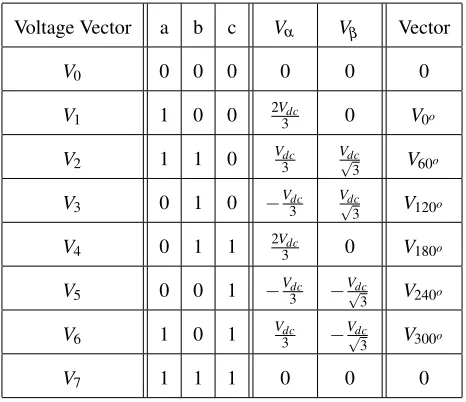
3.3 Voltage Vectors, Switching Vector,α andβ . . . 25
3.4 Sector Definition. . . 29
3.5 Time IntervalsTaandTbfor Each Sector . . . 34
3.6 Seven-Segment Switching Sequence . . . 37
3.7 Switching Pulse Pattern for the Three Phase for Each Sector . . . 41
3.8 Switching Sequence for Three-Phase PWM Technique . . . 42
4.1 The Time IntervalsTa0andTb0for Each Sector . . . 48
6.1 Pole VoltageVao in SPWM . . . 81
6.2 VoltagesVab,Van, andVao in THIPWM . . . 82
6.3 Harmonics ofVaoin Under-Modulation range of SVPWM . . . 82
6.4 Vao in Over-Modulation Region 1 of SVPWM . . . 83
6.5 Vab in the SPWM . . . 85
6.6 Van in the SPWM . . . 85
6.7 Vab in Under-Modulation of SVPWM . . . 85
6.8 Van in Under-Modulation of SVPWM . . . 85
6.9 Vab in Over-Modulation Region 1 of SVPWM . . . 85
6.10 Van in Over-Modulation Region 1 of SVPWM . . . 85
2.1 Control Signal Generator for SPWM [27]. . . 7
2.2 Three-Phase Sinusoidal PWM Inverter [27]. . . 7
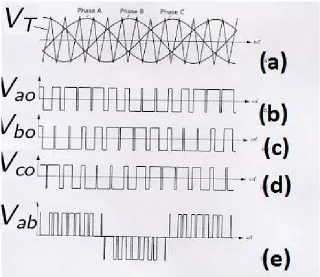
2.3 Three-Phase Sinusoidal PWM: a). Reference Voltages (a,b,c) and Trian-gular Wave b).Vao, c)Vbo, d)Vcoe) Line-to-Line Voltages [27]. . . 8
2.4 One-Phase Third-Harmonic Injection PWM [17]. . . 14
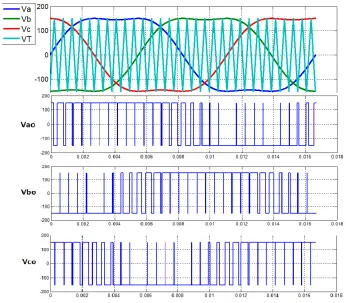
2.5 Reference Voltages (a,b,c), Triangular Waveforms (VT), and Output Volt-age (Vao,Vbo,Vco). . . 15
3.1 Under-modulation and Over-modulation Regions in Space Vector Repre-sentation [12]. . . 17
3.2 Three-Phase Bridge Inverter [11]. . . 19
3.3 Eight Switching Configuration of a Three-Phase Inverter [7]. . . 20
3.4 Space Vectors of Three-Phase Bridge Inverter [12]. . . 22
3.5 Flow Diagram for SVPWM Implementation [11]. . . 25
3.6 Fundamental of Voltage Waveform [10]. . . 28
3.7 Construction of Symmetrical Pulse Pattern for Three-Phase [20]. . . 35
3.8 Vre f Falls into Sector 1 [21]. . . 36
3.9 Switching Patterns in the Six Sectors [20]. . . 39
3.10 Switching Patterns of Six Sectors in Circle [20]. . . 40
3.11 Switching Sequence of all Six Sectors [4]. . . 43
4.1 The Two Over-Modulation Regions in Space Vector Representation [12]. . . 45
4.2 Crossover Angle vs. Modulation Index in the Mode 1. . . 46
4.3 Over-Modulation Mode Region 1 [12]. . . 47
4.4 Trajectory of Reference Voltage Vector and Phase Voltage Waveform in Mode 1 [14]. . . 49
4.5 Holding Angle vs. Modulation Index in Mode 2 [11]. . . 51
4.6 Angular Displacement of Reference and Actual Voltage Vectors in Mode 2 [12]. . . 52
4.7 Trajectory of Reference Voltage Vector and Phase Voltage Waveform in Mode 2. . . 54
5.1 SPWM System Model. . . 56
5.2 Vao,Vbo, andVcoof SPWM Waveforms. . . 57
5.3 Vao,Vbo, andVcoof SPWM after Filtering. . . 58
5.4 Neutral VoltagesVan,Vbn, andVcnof SPWM after Filtering. . . 59
5.5 Neutral VoltagesVan,Vbn, andVcnof THIPWM after Filtering. . . 60
5.6 Neutral VoltagesVab,Vbc, andVcaof THIPWM after Filtering. . . 60
5.7 Linear Modulation of SVPWM Simulation System. Diagrams for Blocks 1 to 7 are Shown in Figures 5.8 to 5.13. . . 62
5.8 Three-Phase Input Sinusoidal Voltages and Modulation Index are Detail for Block 1 in Figure 5.7. . . 63
5.9 α,β Voltages and Modulation Index are Detail for Block 2 in Figure 5.7. . . 64
5.10 Detail for Block 3 in Figure 5.7. . . 64
5.11 Switching Time Calculation is Detail for Block 4 in Figure 5.7. . . 65
5.12 Timing Signals and Triangular Waveform Details for Block 6 in Figure 5.7. 65 5.13 Inverter Output Signals to Neutral Voltages is Detail for Block 7 in Figure 5.7. . . 66
5.14 Filtered Timing Signals of Three-Phase and Triangular Waveforms in SVPWM. 67
5.18 Neutral VoltagesVan, Vbn, and Vcn of Linear Modulation SVPWM after
Filtering. . . 70
5.19 Detail of the Lookup Table in the First Block of SPVWM Over-Modulation Region 1. . . 71
5.20 Detail of the Fourth Block of Space Vector PWM in Region 1. . . 72
5.21 Vao,Vbo, andVcoof Over-Modulation Region 1 before and after Filtering. . . 73
5.22 Line-to-Neutral of Over-Modulation Region 1 after Filtering. . . 74
5.23 Line-to-Line Voltages of Over-Modulation Region 1 after Filtering. . . 74
6.1 Locus Comparison of Maximum Peak Voltage in SPWM and SVPWM [28]. 76 6.2 Loci of SPWM, SVPWM and Region 1 of SVPWM. . . 77
6.3 Locus of SPWM. . . 78
6.4 Locus of SVPWM in Linear Modulation Range. . . 78
6.5 Loci of THIPWM and SVPWM. . . 79
6.6 Locus of Over-Modulation Region 1 at a Cross Angle of 15 Degrees. . . 80
6.7 Locus of Over-Modulation Region 1 at a Cross Angle of 0 Degree. . . 80
6.8 Spectrum ofVaofor SPWM. . . 81
6.9 Spectrum ofVaofor THIPWM. . . 82
6.10 Spectrum ofVaoin The Under-Modulation Range of SVPWM. . . 83
6.11 Spectrum ofVaofor SVPWM (Over-Modulation Region 1). . . 84
1
CHAPTER 1
INTRODUCTION
1.1
Introduction
Pulse-width modulation (PWM) is a technique where the duty ratio of a pulsating
wave-form is controlled by another input wavewave-form. The intersections between the reference
voltage waveform and the carrier waveform give the opening and closing times of the
switches.
PWM is commonly used in applications like motor speed control, converters, audio
amplifiers, etc. For example, it is used to reduce the total power delivered to a load without
losses, which normally occurs when a power source is limited by a resistive element.
PWM is used to adjust the voltage applied to the motor. Changing the duty ratio of the
switches changes the speed of the motor. The longer the pulse is closed compared to the
opened periods, the higher the power supplied to the load is. The change of state between
closing (ON) and opening (OFF) is rapid, so that the average power dissipation is very low
compared to the power being delivered. PWM amplifiers are more efficient and less bulky
than linear power amplifiers. In addition, linear amplifiers that deliver energy continuously
rather than through pulses have lower maximum power ratings than PWM amplifiers.
There is no single PWM method that is the best suited for all applications and with
ad-vances in solid-state power electronic devices and microprocessors, various
pulse-width-modulation (PWM) techniques have been developed for industrial applications. For these
With advances in solid-state power electronic devices and microprocessors, various
in-verter control techniques employing pulse-width-modulation (PWM) techniques are
be-coming increasingly popular in AC motor drive applications. These PWM-based drives are
used to control both the frequency and the magnitude of the voltages applied to motors [1].
Various PWM strategies, control schemes, and realization techniques have been developed
in the past two decades [2]. PWM strategy plays an important role in the minimization of
harmonics and switching losses in converters, especially in three-phase applications. The
first modulation techniques were developed in the mid-1960s by Kirnnich, Heinrick, and
Bowes as reported in [3]. The research in PWM schemes has intensified in the last few
decades. The main aim of any modulation technique is to obtain a variable output with a
maximum fundamental component and minimum harmonics [4].
The carrier-based PWM methods were developed first and were widely used in most
applications. One of the earliest modulation signals for carrier-based PWM is sinusoidal
PWM (SPWM). The SPWM technique is based on the comparison of a carrier signal and a
pure sinusoidal modulation signal. It was introduced by Schonung and Stemmler in 1964
as reported in [5]. The utilization rate of the DC voltage for traditional sinusoidal PWM is
only 78.5% of the DC bus voltage, which is far less than that of the six-step wave (100%).
Improving the utilization rate of the DC bus voltage has been a research focus in power
electronics [6].
This problem of the under-utilization of the DC bus voltage led to the development
of the third-harmonic-injection pulse-width modulation (THIPWM). In 1975, Buja
de-veloped this improved sinusoidal PWM technique, which added a third-order harmonic
content into the sinusoidal reference signal leading to a 15.5% increase in the utilization
rate of the DC bus voltage [6].
3
technique. SVPWM was first introduced in the mid-1980s and was greatly advanced by
Van Der Broeck in 1988 [9]. Compared to THIPWM, the two techniques have similar
re-sults but their methods of implementation are completely different. With the development
of microprocessors, SVPWM has become one of the most important PWM methods for
three-phase inverters [7]. Many SVPWM schemes have been developed and extensively
investigated in the literature. The goal in each modulation strategy is to lower the switching
losses, maximize bus utilization, reduce harmonic content, and still achieve precise control
[8].
The SVPWM technique utilizes the DC bus voltage more efficiently and generates less
harmonic distortion when compared with the SPWM technique [4]. The maximum peak
fundamental magnitude of the SVPWM technique is about 90.6% of the inverter capacity.
This represents a 15.5% increase in the maximum voltage compared with conventional
sinusoidal modulation [10].
In 1991, Holtz proposed a classical over-modulation technique based on SVPWM,
which divided the over-modulation range into two modes of operation and increased the
utilization rate of the DC voltage to that of a six-step wave [6,11,12,13]. Holtz
pro-posed this technique using switching time calculations in the over-modulation region of
SVPWM.
In 1998, Lee analyzed Holtz’s over-modulation technique graphically, gave some
ap-proximate linear expressions between the modulation index and its own auxiliary
param-eter, and discussed the harmonic problem [14]. He showed that this technique generated
less harmonic distortion in the output voltages (or) the currents applied to the phases of
an AC motor and provided more efficient use of the DC input voltage. Because of its
superior performance characteristics, it has found widespread application in recent years
[4]. Accordingly, many other researchers have explored various aspects of this technique
The SPWM technique is the easiest modulation scheme to understand and to implement
in software or hardware but this technique is unable to fully utilize the DC bus supply
voltage available to the voltage source inverter. This drawback led to the development of
THIPWM and SVPWM. THIPWM is a technique that adds a third-order harmonic content
to a sinusoidal reference signal thereby increasing the utilization rate of the DC bus voltage
by 15.5%.
The implementation of the conventional SVPWM is especially difficult because it
requires complicated mathematical operations. In the under-modulation region, this
al-gorithm provides 15.5% higher output voltages compared to the SPWM technique.
More-over, the utilization of the DC bus voltage can be further increased when extending into
the over-modulation region of SVPWM.
Three-phase voltage source pulse-width modulation inverters have been widely used
for DC to AC power conversion since they can produce outputs with variable voltage
magnitude and variable frequency. For example, modern power electronics controllers
have been rapidly moving toward digital implementation. Typical solutions employ
mi-crocontrollers or DSPs [18].
This thesis discusses the principles, theories, mathematical equations, and procedures
involved for the software (MATLAB/Simulink package) implementation of these
tech-niques. This thesis synthesizes and compares the main theories behind three-phase
genera-tion of SPWM, THIPWM, and SVPWM. These three techniques are used to generate their
respective output PWM signals, which are then compared based on harmonic content and
5
1.4
Thesis Organization
This thesis is comprised of seven chapters. Chapter 1 is an introduction including a
literature review, research motivation, and thesis outline. Chapters 2, 3, and 4 provide an
in-depth look into the concepts, mathematical equations, implementation, and waveforms
generated by the SPWM, THIPWM, and SVPWM techniques. Chapter 5 presents the
Simulink models and output plots obtained from the simulation of SPWM, THIPWM,
and SVPWM in the under-modulation region and over-modulation region 1. Chapter 6
compares the results of these three techniques from Chapter 5 along with a discussion
of the output harmonic spectra of various output voltages and a THD measure for each
output. Chapter 7 summarizes the thesis with conclusions and recommendations for future
CHAPTER 2
SINUSOIDAL PWM AND THIRD-HARMONIC-INJECTION PWM
2.1
Sinusoidal PWM
2.1.1 Sinusoidal PWM Concept
The sinusoidal pulse-width modulation (SPWM) technique produces a sinusoidal
wave-form by filtering an output pulse wavewave-form with varying width. A high switching
fre-quency leads to a better filtered sinusoidal output waveform. The desired output voltage
is achieved by varying the frequency and amplitude of a reference or modulating
volt-age. The variations in the amplitude and frequency of the reference voltage change the
pulse-width patterns of the output voltage but keep the sinusoidal modulation.
As shown in Figure 2.1, a low-frequency sinusoidal modulating waveform is compared
with a high-frequency triangular waveform, which is called the carrier waveform. The
switching state is changed when the sine waveform intersects the triangular waveform.
The crossing positions determine the variable switching times between states.
In three-phase SPWM, a triangular voltage waveform (VT) is compared with three
sinusoidal control voltages (Va,Vb, andVc), which are 120◦ out of phase with each other
and the relative levels of the waveforms are used to control the switching of the devices in
each phase leg of the inverter.
A six-step inverter is composed of six switchesS1 throughS6 with each phase output
connected to the middle of each inverter leg as shown in Figure 2.2. The output of the
7
Figure 2.1: Control Signal Generator for SPWM [27].
Figure 2.2: Three-Phase Sinusoidal PWM Inverter [27].
switches in each phase make up one leg and open and close in a complementary fashion.
That is, when one switch is open, the other is closed and vice-versa. The output pole
voltagesVao,Vbo, andVcoof the inverter switch between -Vdc/2 and +Vdc/2 voltage levels
whereVdc is the total DC voltage.
waveform, the upper switch is turned on and the lower switch is turned off. Similarly,
when the sinusoidal waveform is less than the triangular waveform, the upper switch is
off and the lower switch is on. Depending on the switching states, either the positive or
negative half DC bus voltage is applied to each phase. The switches are controlled in pairs
((S1,S4), (S3,S6), and (S5,S2)) and the logic for the switch control signals is:
◦S1is ON whenVa>VT S4is ON whenVa<VT
◦S3is ON whenVb>VT S6is ON whenVb<VT
◦S5is ON whenVc>VT S2is ON whenVc<VT.
9
As seen in Figure 2.3, the pulse widths depend on the intersection of the triangular and
sinusoidal waveforms. The inverter output voltages are determined as follows:
if Va>VT then Vao = 0.5Vdc
Vb>VT then Vbo = 0.5Vdc
Vc>VT then Vco = 0.5Vdc
and if Va<VT then Vao = −0.5Vdc
Vb<VT then Vbo = −0.5Vdc
Vc<VT then Vco = −0.5Vdc.
The inverter line-to-line voltages are obtained from the pole voltages as:
Vab = Vao−Vbo
Vbc = Vbo−Vco
Vca = Vco−Vao.
2.1.2 Modulation Index of Sinusoidal PWM
The Fourier series expansion of a symmetrical square wave voltage with a peak magnitude
ofVdc/2 has a fundamental of magnitude 2Vdc/π. The maximum of the output voltage
generated by the SPWM method isVdc/2. The modulation index is defined as the ratio of
the magnitude of output voltage generated by SPWM to the fundamental peak value of the
maximum square wave. Thus, the maximum modulation index of the SPWM technique is
MI= VPW M
Vmax−sixstep =
Vdc
2 2Vdc
π
= π
fundamental peak value of a square wave.
2.2
Third-Harmonic-Injection PWM
2.2.1 Concept and Calculation of Optimum Distortion
The sinusoidal PWM is the simplest modulation scheme to understand but it is unable to
fully utilize the available DC bus supply voltage. Due to this problem, the
third-harmonic-injection pulse-width modulation (THIPWM) technique was developed to improve the
inverter performance.
Following Reference [17], consider a waveform consisting of a fundamental
compo-nent with the addition of a triple-frequency term:
y=sinθ+Asin 3θ, (2.1)
whereθ =ωtand A is a parameter to be optimized while keeping the maximum amplitude
of y(t) under unity. The maximum value of y(t) is found by setting its derivative with
respect toθ equal to zero. Thus,
dy
dθ =cosθ+3Acos 3θ =cosθ(12Acos 2
θ−(9A−1)) =0. (2.2)
The maximum and minimum of the waveform therefore occur at
cosθ =0 (2.3)
11
cosθ =
9A−1 12A
12
(2.4)
which yield, respectively,
sinθ =1 (2.5)
and
sinθ =
1+3A 12A
12
. (2.6)
The peak value of y can be found by substituting the values obtained for sinθ in (2.5) and
(2.6) into (2.1). Using the following trigonometric identity,
sin 3θ =3 sinθ−4 sin3θ, (2.7)
Equation (2.1) becomes
y= (1+3A)sinθ−4Asin3θ. (2.8)
Substituting the values in (2.5) and (2.6), for sinθ we have
b
y=1−A (2.9)
and
b
y=8A
1+3A 12A
32
, (2.10)
ferentiating (2.10) forbywith respect to A and equating the result to zero. Then, Equation
(2.10) becomes,
dby dA =
1+3A 12A
12
2− 1
3A
=0. (2.11)
Thus, the two possible values of A are
A=−1
3 and A=
1
6. (2.12)
From Equation (2.9), we can see that the negative value of A makesbygreater than unity.
Therefore, the only valid solution for A is 1/6 and the required waveform is
y=sinθ+1
6sin 3θ. (2.13)
From Equation (2.3), cosθ =0 yieldsθ =π/2. Substituting the value of 1/6 for A in (2.4)
gives cosθ =1/2, i.e.,θ =π/3,2π/3, etc. All triple harmonics pass through zero at these
values ofθ. If we substitute the values ofθ =nπ/3 in (2.13), then we have a maximum
amplitude ofyb=±√3/2 at these angles.
In Figure 2.4, it is shown that the addition of a third harmonic with a peak magnitude
of one sixth to the modulation waveform has the effect of reducing the peak value of the
output waveform by a factor of√3/2 without changing the amplitude of the fundamental.
It is possible to increase the amplitude of the modulating waveform by a factor K, so
that the full output voltage range of the inverter is again utilized [17]. If the modulating
waveform is expressed as
y=K(sinθ+1
13
the required factor K for a peak value of unity should satisfy the constraint
1=K√3/2 (2.15)
and, therefore,
K= √2
3. (2.16)
On the same figure, we see that the addition of this third harmonic produces a 15.5%
increase in the amplitude of the fundamental of the phase voltages. Figure 2.4(a) does
not have a third harmonic, only a peak value and amplitude of fundamental equal 1. The
peak of Figure 2.4(b) is√3/2 with one-sixth of the third harmonic added. The amplitude
of the fundamental equals 1. The peak amplitude in Figure 2.4(c) equals 1 while the
peak amplitude of the fundamental equals 2/√3 with one-sixth of third harmonic added.
Injecting a third harmonic component to the fundamental component gives the following
modulating waveforms for the three-phase [17]:
Van=
2
√
3
sin(ωt) +1
6sin(3ωt)
(2.17)
Vbn=√2
3
sin(ωt−2π/3) +1
6sin(3ωt)
(2.18)
Vcn=
2
√
3
sin(ωt+2π/3) +1
6sin(3ωt)
. (2.19)
The THIPWM is implemented in the same manner as the SPWM, that is, the reference
waveforms are compared with a triangular waveform. As a result, the amplitude of the
reference waveforms do not exceed the DC supply voltageVdc/2, but the fundamental
component is higher than the supply voltageVdc. As mentioned above, this is
Figure 2.4: One-Phase Third-Harmonic Injection PWM [17].
provides a better utilization of the DC supply voltage.
The three reference voltages and triangular waveform of a three-phase THPWM
15
Figure 2.5: Reference Voltages (a,b,c), Triangular Waveforms (VT), and Output Voltage
CHAPTER 3
SPACE VECTOR PWM
3.1
Introduction
Another method for increasing the output voltage about that of the SPWM technique is
the space vector PWM (SVPWM) technique. Compared to THIPWM, the two methods
have similar results but their methods of implementation are completely different. In the
SVPWM technique, the duty cycles are computed rather than derived through comparison
as in SPWM. The SVPWM technique can increase the fundamental component by up to
27.39% that of SPWM. The fundamental voltage can be increased up to a square wave
mode where a modulation index of unity is reached.
SVPWM is accomplished by rotating a reference vector around the state diagram,
which is composed of six basic non-zero vectors forming a hexagon. A circle can be
inscribed inside the state map and corresponds to sinusoidal operation. The area inside
the inscribed circle is called the linear modulation region or under-modulation region. As
seen in Figure 3.1, the area between the inside circle and outside circle of the hexagon
is called the nonlinear modulation region or over-modulation region. The concepts in the
operation of linear and nonlinear modulation regions depend on the modulation index,
17
Figure 3.1: Under-modulation and Over-modulation Regions in Space Vector Representa-tion [12].
3.2
Principle of Space Vector PWM
A three-phase mathematical system can be represented by a space vector. For example,
given a set of three-phase voltages, a space vector can be defined by
− →
V(t) = 2
3[Va(t)e
j0+V
b(t)ej
2π
3 +V
c(t)ej
4π
3 ], (3.1)
where Va(t), Vb(t), and Vc(t) are three sinusoidal voltages of the same amplitude and
frequency but with±120o phase shifts. The space vector at any given time maintains its
magnitude. As time increases, the angle of the space vector increases, causing the vector
the complex plane, the corresponding space vector takes only on one of six discrete angles
as time increases. The central idea of SVWPM is to generate appropriate PWM signals so
that a vector with any desired angle can be generated.
SVPWM is a form of PWM proposed in the mid-1980s that is more efficient compared
to natural and regularly-sampled PWM. In the space-vector modulation, a three-phase
two-level inverter can be driven to eight switching states where the inverter has six active
states (1-6) and two zero states (0 and 7).
A typical two-level inverter has 6 power switches (labeledS1toS6) that generate
three-phase voltage outputs. A detailed drawing of a three-three-phase bridge inverter is shown in
Figure 3.2. The circuit has a full-bridge topology with three inverter legs, each consisting
of two power switches. The circuit allows only positive power flow from the supply system
to the load via a full-bridge diode rectifier. Negative power flow is not possible through
the rectifier diode bridge.
The six switching power devices can be constructed using power BJTs, GTOs, IGBTs,
etc. The choice of switching devices is based on the desired operating power level,
required switching frequency, and acceptable inverter power losses. When an upper
tran-sistor is switched on, the corresponding lower trantran-sistor is switched off. Therefore, the
ON and OFF states of the upper transistorsS1,S3,S5can be used to determine the current
output voltage. The ON and OFF states of the lower power devices are complementary
to the upper ones. Two switches on the same leg cannot be closed or opened at the same
time.
The basic principle of SVPWM is based on the eight switch combinations of a
three-phase inverter. The switch combinations can be represented as binary codes that
corre-spond to the top switches S1, S3, and S5 of the inverter as shown in Figure 3.2. Each
19
Figure 3.2: Three-Phase Bridge Inverter [11].
the inverter output voltages with respect to the mid-terminal of the DC source marked as
‘O’ on the same figure. These voltages are also called pole voltages.
The pole voltages that can be produced are either Vdc/2 or −Vdc/2. For example,
when switchesS1,S6, andS2are closed, the corresponding pole voltages areVao=Vdc/2,
Vbo =−Vdc/2, and Vco =−Vdc/2. This state is denoted as (1,0,0) and, according to
Equation (3.1), may be depicted as the space vector −→V(t) = 32[Vdcej0]. Repeating the
same procedure, we can find the remaining active and non-active states shown in Figure
3.3.
The three-phase inverter is therefore controlled by six switches and eight inverter
configurations. The eight inverter states can be transformed into eight corresponding space
vectors. In each configuration, the vector identification uses a ‘0’ to represent the negative
phase voltage level and a ‘1’ to represent the positive phase voltage level. The relationship
between the space vector and the corresponding switching states is given in Table 3.1
and Figure 3.2. In addition, the switches in one inverter branch are in controlled in a
Figure 3.3: Eight Switching Configuration of a Three-Phase Inverter [7].
S1+S4=1;
S2+S6=1;
S5+S2=1.
We use orthogonal coordinates to represent the three-phase two-level inverter in the
phase diagram. There are eight possible inverter states that can generate eight space
vectors. These are given by the complex vector expressions:
− →
Vk=
2 3Vdce
j(k−1)π
3 ifk=1,2,3,4,5,6
0 ifk=0,7.
(3.2)
The entire space is divided into six equal-size sectors of 60o. Each sector is bounded
by two active vectors. −→V0 and − →
V7are two voltage vectors with zero amplitude located at
the origin of the hexagon. The eight active and non-active state vectors are geometrically
21
Table 3.1: Space Vectors, Switching States, and On State Switches
Space Vetor Swtiching State On-state Switch Vector Definition
− →
V0 [000] S4,S6,S2
− →
V0=0
− →
V1 [100] S1,S6,S2
− →
V1=23Vdcej0
− →
V2 [110] S1,S3,S2
− →
V2=23Vdcej
π 3
− →
V3 [010] S4,S3,S2
− →
V3=23Vdcej
2π 3
− →
V4 [011] S4,S3,S5
− →
V4=23Vdcej
3π 3
− →
V5 [001] S4,S6,S5
− →
V5=23Vdcej
4π 3
− →
V6 [101] S1,S6,S5
− →
V6=23Vdcej
5π 3
− →
V7 [111] S1,S3,S5
− →
V7=23Vdcej0
The reference voltage vector −→Vre f rotates in space at an angular velocity ω =2πf,
where f is the fundamental frequency of the inverter output voltage. When the reference
voltage vector passes through each sector, different sets of switches in Table 3.1 will
be turned on or off. As a result, when the reference voltage vector rotates through one
revolution in space, the inverter output varies one electrical cycle over time. The inverter
output frequency coincides with the rotating speed of the reference voltage vector. The
zero vectors (−→V0and−→V7) and active vectors (−→V1 to−→V6) do not move in space. They are
referred to as stationary vectors. Figure 3.4 shows the reference vector−→Vre f in the first
sector.
The six active voltage space vectors are shown on the same graph with an equal
magnitude of 2Vdc/3 and a phase displacement of 60o. The inverter cannot produce a
desired reference voltage vector directly. It is possible to decompose the reference vector
into vectors that lie on two adjacent active vectors and two zero vectors, which are located
at the center of the hexagon.
Figure 3.4: Space Vectors of Three-Phase Bridge Inverter [12].
voltage vector[Vab,Vbc,Vca]is shown in Equation (3.1). When the upper or lower transistor
of a phase is ON, the switching signal of that phase is ‘1’ or ‘-1’, and when an upper or
lower transistor is OFF, then the switching signal is ‘0’. The eight combinations and the
derived output line-to-line and phase voltages in terms of the DC supply voltage are:
Vab Vbc Vca
=Vdc
1 −1 0
0 1 −1
−1 0 1
S1 S3 S5 . (3.3)
Choosing a neutral load point n, we have:
Va0 = Van+Vn0
Vb0 = Vbn+Vn0
Vc0 = Vcn+Vn0
Van+Vbn+Vcn = 0.
23
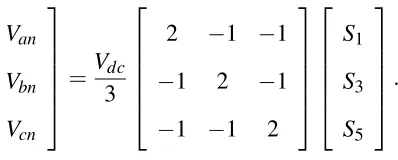
From Equations (3.3) and (3.4), the output phase voltages of the inverter depend on the
relationship between the switching variables[S1,S3,S5]and the DC voltage as follows:
Van Vbn Vcn
=Vdc
3
2 −1 −1
−1 2 −1
−1 −1 2
S1 S3 S5 . (3.5)
According to the Equations (3.3) to (3.5), the eight switching vectors, output
line-to-neutral voltage (phase voltages), and output line-to-line voltages in terms of DC linkVdc
are given in Table 3.2 along with the eight inverter voltage vectors (→−V0to−→V7).
Table 3.2: Vectors, Switching Vectors, Phase Voltages and Line to Line Voltages as a Function of the DC Bus VoltageVdc.
Voltage Switching Line-to-Neutral Line-to-Line
Vectors Vectors Voltages Voltages
a b c Van Vbn Vcn Vab Vbc Vca
V
0 0 0 0 0 0 0 0 0 0V
1 1 0 0 2Vdc3 −
Vdc
3 −
Vdc
3 Vdc 0 -Vdc
V
2 1 1 0 Vdc3
Vdc
3 −
2Vdc
3 0 Vdc -Vdc
V
3 0 1 0 −Vdc3
2Vdc
3 −
Vdc
3 -Vdc Vdc 0
V
4 0 1 1 −2Vdc3
Vdc
3
Vdc
3 -Vdc 0 Vdc
V
5 0 0 1 −Vdc3 −
Vdc
3
2Vdc
3 0 -Vdc Vdc
V
6 1 0 1 Vdc3 −
2Vdc
3
Vdc
3 Vdc -Vdc 0
V
7 1 1 1 0 0 0 0 0 0The space vector can be also represented in another reference frame with two
orthog-onal axes (α and β). We assume that the α axis is aligned in the horizontal direction
and that theβ axis is vertical. Then the abc three-phase voltage vector given in Equation
corresponding to the eight combinations of switching patterns can be mapped into α β
coordinates:
− →
Vre f =Vα+jVβ = 2
3(Va+Vbe
j2π
3 +Vce−j 2π
3 ) (3.6)
Vα+jVβ = 2
3(Va+Vbcos( 2π
3 ) +Vccos( 2π
3 )) + j 2
3(Vbsin( 2π
3 )−Vccos( 2π
3 )).
Equating real and imaginary parts, we get
Vα = 2
3(Va+Vbcos( 2π
3 ) +Vccos( 2π
3 )) (3.7)
Vβ = 2
3(Vbsin( 2π
3 )−Vccos( 2π
3 )). (3.8)
In matrix form, these equations become:
− →
Vre f =
Vα Vβ = 2 3
1 −1/2 −1/2
0 √3/2 −√3/2
Va Vb Vc . (3.9)
The values ofVα andVβ in Table 3.3 are called theα andβ components of the space
vector, and the last column in Table 3.3 shows the reference space vector. The voltagesVα
andVβ become the inputs for dwelling time calculations in the space vector PWM and are
used to compute the scalar magnitude of the reference voltage|→−VRe f|.
3.3
Implementation Procedure of a Two-Level Space Vector PWM
The SVPWM scheme is more complicated than that of the conventional SPWM. It
re-quires the determination of a sector, calculation of vector segments, and it involves region
25
Table 3.3: Voltage Vectors, Switching Vector,α andβ
Voltage Vector a b c Vα Vβ Vector
V0 0 0 0 0 0 0
V1 1 0 0 2V3dc 0 V0o
V2 1 1 0 V3dc V√dc3 V60o
V3 0 1 0 −V3dc V√dc3 V120o
V4 0 1 1 2V3dc 0 V180o
V5 0 0 1 −V3dc −V√dc3 V240o
V6 1 0 1 V3dc −V√dc3 V300o
V7 1 1 1 0 0 0
Figure 3.5: Flow Diagram for SVPWM Implementation [11].
A simplified flow diagram for the implementation of the SVPWM algorithm is shown
in Figure 3.5. The procedure for implementing a two-level space vector PWM can be
summarized as follows:
1. Calculate the angleθ and reference voltage vector−→Vre f based on the input voltage
components.
2. Calculate the modulation index and determine if it is in the over-modulation region.
4. Find the time intervals Ta andTb and T0 based onTs, and the angle θ. (For
over-modulation, findTa0,Tb0andT00is zero.)
5. Determine the modulation times for the different switching states.
3.3.1 Angle and Reference Voltage Vector
In the Space Vector PWM, the three-phase output voltage vector is represented by a
reference vector that rotates at an angular speed ofω =2πf. The Space Vector PWM
uses the combinations of switching states to approximate the reference vector −→Vre f. A
reference voltage vector−→Vre f that rotates with angular speedω in theα β plane represents
three sinusoidal waveforms with angular frequencyω in the abc coordinate system. Each
output voltage combination in Table 3.3 corresponds to a different voltage space vector.
Three sinusoidal and balanced voltages are given by the relations:
Va(t) = Vre fcos(ωt) (3.10)
Vb(t) = Vre fcos(ωt−2π/3) (3.11)
Vc(t) = Vre fcos(ωt+2π/3). (3.12)
For any three-phase system with three wires and equal load impedances, we have
Va(t) +Vb(t) +Vc(t) =0. (3.13)
The space vector with magnitudeVre f rotates in a circular direction at an angular velocity
ofω where the direction of rotation depends on the phase sequence of the voltages. If it
has a positive phase sequence, then it rotates in the counterclockwise direction. Otherwise,
27
The three-phase voltages could be described with only two components,α andβ, in a
two-dimensional plane. The magnitude of each active vector is 2Vdc/3. The active vectors
are 60o apart and describe a hexagon boundary. The locus of the circle projected by the
space reference vector−→Vre f depends on
− →
V0, − →
V1, − →
V2, − →
V3, − →
V4, − →
V5, − →
V6, − →
V7,
− →
Vre f = 2
3[Va+aVb+a
2V
c] (3.14)
where a=ej2π/3. The magnitude of the reference vector is:
|−→Vre f| = qV2
α+V
2
β. (3.15)
The phase angle is evaluated from
θ = tan−1(
Vβ Vα
), (3.16)
where θ ∈[0,2π].
3.3.2 Modulation Index of Linear Modulation
In the linear region, the rotating reference vector always remains within the hexagon. The
largest output voltage magnitude is the radius of the largest circle that can be inscribed
within the hexagon. This means that the linear region ends when the reference voltage is
equal to the radius of the circle inscribed within the hexagon.
The fundamental component of the voltage waveform is shown in Figure 3.6. From a
= 4Vdc
3π h
(−cosπ
3 +1) + (−2 cos
π
2+2 cos
π
3
i
= 4Vdc
3π h
1+cosπ 3
i
= 2Vdc
π .
(3.17)
The ratio between the reference vector→−Vre f and the fundamental peak value of the square
Figure 3.6: Fundamental of Voltage Waveform [10].
phase voltage wave (2Vdc/π) is called the modulation index. The mode of operation is
determined by the modulation index (MI). In this linear region, the MI can be expressed
as:
MI =
− →
Vre f
Vmax−sixstep
. (3.18)
From the geometry of Figure 3.1, the maximum modulation index is obtained when−→Vre f
equals the radius of the inscribed circle.
− →
Vre f(max) = 2
29
Therefore,
MImax =
2
3Vdccos(
π
6) 2Vdc
π
=0.907. (3.20)
3.3.3 Sector Determination
It is necessary to know in which sector the reference output lies in order to determine the
switching time and sequence. The identification of the sector where the reference vector
is located is straightforward. The phase voltages correspond to eight switching states: six
non-zero vectors and two zero vectors at the origin. Depending on the reference voltages
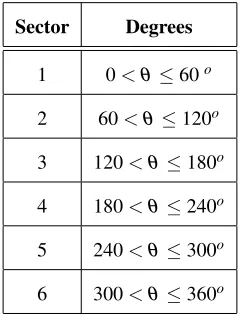
Vα andVβ, the angle of the reference vector can be used to determine the sector as per
Table 3.4.
Table 3.4: Sector Definition.
Sector Degrees
1 0<θ≤60o
2 60<θ≤120o
3 120<θ ≤180o
4 180<θ ≤240o
5 240<θ ≤300o
6 300<θ ≤360o
3.3.4 Time DurationsTa,Tb,T0
The duty cycle computation is done for each triangular sector formed by two state vectors.
The magnitude of each switching state vector is 2Vdc/3 and the magnitude of a vector
to the midpoint of the hexagon line from one vertex to another isVdc/√3. In the
plane as time increases. In each PWM cycle, the reference vector Vre f is sampled at
a fixed input sampling frequency fs. During this time, the sector is determined and the
modulation vector−→Vre f is mapped onto two adjacent vectors. The non-zero vectors can
be represented by
− →
Vk = 2
3Vdce
j(k−1)π
3 (3.21)
for k=1, 2, 3, 4, 5, 6.
Therefore, the non-zero vectors for−→Vk and−→Vk+1become
− →
Vk = 2
3Vdc[cos(k−1)
π
3+jsin(k−1)
π
3]
− →
Vk+1 = 2
3Vdce
jkπ
3 = 2
3Vdc[cos kπ
3 +jsin kπ
3 ].
Due to symmetry in the patterns in the six sectors, the integration
Z Ts2
0 − →
Vre fdt=
Z T40
0 − →
V0dt+
Z T40+Ta
T0 4
− →
Vkdt+
Z T40+Ta+Tb
T0 4+Ta
− →
Vk+1dt+
Z Ts2
T0 4+Ta+Tb
− →
V7dt(3.22)
can be carried out for only half of the pulse-width modulation period(Ts/2). Zero voltages
are applied during the null state times:
Z T40
0 − →
V0dt=
Z Ts2
T0 4+Ta+Tb
− →
V7dt=0. (3.23)
Then Equation (3.22) becomes:
Z Ts2
0 − →
Vre fdt=
Z T40+Ta
T0 4
− →
Vkdt+
Z T40+Ta+Tb
T0 4+Ta
− →
Vk+1dt. (3.24)
31
voltage multiplied by the time interval of the chosen space vectors. The reference voltage
vector−→Vre f can be expressed as function ofVkandVk+1as
− →
Vre fTs
2 =
− →
VkTa+
− →
Vk+1Tb
− →
Vre f =Vα+jVβ,
(3.25)
where Ta and Tb denote the required on-time of the active-state vectors −→Vk and −→Vk+1
during each sample period, and k is the sector number denoting the reference location.
The calculated timesTaandTb are applied to the switches to produce space vector PWM
switching patterns based on each sector. The switching time is arranged according to the
first half of the switching period while the other half is a reflection forming a symmetrical
pattern (see Figure 3.7).T0andT7are the times of the null state vectors in Figure 3.7.
If−→Vre f lies exactly in the middle between two vectors, for example between−→V1and
− →
V2 with an angle of π/6, Ta for
− →
V1 will be equal to Tb for −→V2. If −→Vre f is closer to
− →
V2 than−→V1, it means thatTb will be greater than Ta. If−→Vre f coincides with −→V2, then
Ta will be equal to zero. If the reference keeps making a circular trajectory inside the
hexagon, thenT0is greater than zero, the output voltage will be a sinusoidal waveform in
the under-modulation region.
Assuming that the reference voltage and the voltage vectors−→Vkand−→Vk+1are constant
during each pulse-width modulation periodTsand splitting the reference voltage−→Vre f into
its real and imaginary components (Vα andVβ) gives the following result:
Vα Vβ Ts 2 = 2Vdc 3 Ta
cos(k−31)π
sin(k−31)π
+Tb
coskπ
3
sinkπ
3
sin(k−31)π sinkπ
3
Tb
These equations require computations involving trigonometric functions. From the
Equa-tion (3.26), the inverse matrix is used to calculateTaandTbas:
Ta Tb = √ 3Ts 2Vdc
sinkπ
3 −cos
kπ
3
−sin(k−31)π cos(k−31)π
Vα Vβ
. (3.27)
The Space Vector PWM produces the following balanced set of three-phase voltages with
magnitude−→Vre f and angular frequencyω, given by:
Va = Vre fcos(ωt) (3.28)
Vb = Vre fcos(ωt−2π
3 ) (3.29)
Vc = Vre fcos(ωt−
4π
3 ). (3.30)
The corresponding reference voltage space vector can be expressed as
− →
Vre f =|
− →
Vre f|ejωt =|
− →
Vre f|(cosωt+jsinωt). (3.31)
Equation (3.31) then becomes:
Ta Tb = √
3Ts|
− →
Vre f|
2Vdc
sinkπ
3 −cos
kπ
3
−sin(k−31)π cos(k−31)π
cosnωTs
sinnωTs
. (3.32)
The modulation index is defined in Equation (3.18) as the ratio of the desired peak
33
MI= |
− →
Vre f|
Vmaxsixstep =
πVre f
2Vdc
(3.33)
or
|−→Vre f|=MI2
π
Vdc. (3.34)
Substituting this equation into the above equation for Ta and Tb leads to the following
duration times: Ta Tb =
MI√3Ts
π
sinkπ
3 −cos
kπ
3
−sin(k−31)π cos(k−31)π
cosnωTs
sinnωTs
. (3.35)
Since the sum of 2Taand 2Tbshould be less than or equal toTs, the inverter has to stay in a
zero state for the rest of the period. The duration of the null vectors is the remaining time
in the switching period. Since
Ts=T0+2(Ta+Tb) (3.36)
then the time interval for the zero voltage vectors is
T0=Ts−2(Ta+Tb). (3.37)
The switching times are arranged symmetrical around the center of the switching
period as shown in Figure 3.7. The zero vector −→V7 (1,1,1) is placed at the center of
the switching period, and the zero vector−→V0(0,0,0) at the start and the end, and the total
period for a zero vector is divided equally among the two zero vectors.
In the under-modulation region, as the modulation index increases, the reference
volt-age vector grows outward in magnitude. It reaches the inscribed circle of the hexagon and
fore, the modulation index will reach a maximum of 0.907 in the linear under-modulation
region.
The calculated values ofTaandTbin term ofTs/Vdcfor all six sectors are listed in Table
3.5. The time durations of two adjacent nonzero vectors in each sector are calculated
Table 3.5: Time IntervalsTaandTbfor Each Sector
Sector θ Ta Tb
1 0<θ≤60o 3Vα 4 −
√ 3Vβ
4 0Vα+
√ 3Vβ
2
2 60<θ≤120o 3Vα 4 +
√ 3Vβ
4
−3Vα 4 +
√ 3Vβ 4
3 180<θ≤240o 0Vα+
√ 3Vβ
2
−3Vα 4 −
√ 3Vβ
4
4 120<θ≤180o −3Vα 4 +
√ 3Vβ
4 0Vα−
√ 3Vβ
2
5 240<θ≤300o −3Vα 4 −
√ 3Vβ
4
3Vα 4 −
√ 3Vβ
4
6 180<θ≤240o 0Vα−
√ 3Vβ
2
3Vα 4 +
√ 3Vβ
4
based on the magnitude and phase of the reference voltage. From Figure 3.7, a zero state
vector is applied followed with two adjacent active vectors in half of the switching period.
The next half of the switching period is symmetrical to the first half.
To generate the signals that produce the rotating vector, an equation is required to
determine the time intervals for each sector. Figure 3.8 shows the pulse patterns generated
by space vector PWM in sector 1.
For example [19], when−→Vre f is in sector 1 as shown in Figures 3.7 and 3.8, the−→V1
vector is applied to the inverter during Ta interval, and consequently the vector −→V2 is
applied duringT2interval. The PWM period is shared between−→V1and−→V2for durations
Ta andTb, respectively, and the zero vectors
− →
V0 and − →
V7for a durationT0. The switching
sequence is given by−→V0 -− →
V1 -− →
V2 -− →
V7 -− →
V7 -− →
V2 -− →
V1 -− →
V0during two half-sampling periods.
35
Figure 3.7: Construction of Symmetrical Pulse Pattern for Three-Phase [20].
of each PWM period. The switching frequency is the same as the sampling frequency of
the inverter. An example of a symmetric space vector PWM waveform is shown in Figure
3.7 where it is assumed that the reference voltage is in the sector formed by vector−→V1and
− →
V2with angle 0<θ ≤60o. In Figure 3.7, switching states are required to change from
one state to the next. The progress of switching states from the left to the right of that
figure with following steps:
1. When the circuit configuration is in the −→V0 state (time interval is T0/2), all top
switches (S1,S3, andS5) of Figure 3.2 are opened.
2. When it is in the−→V1state (with a time intervalTa), switchS1is closed.
3. When it is in the −→V2state (with a time interval Tb), switchS3 is closed (S1 is still
closed).
4. When it is in the −→V7state (with a time intervalT0/2), switchS5 is closed. (S1, and
versed. All switches are closed forT0/2 seconds before the circuit configuration is back to
− →
V2, then − →
V1, and − →
V0with corresponding time intervals ofTb, Ta, andT0/2. Following a
similar process, the switching cycles are determined for the five remaining vectors.
From Tables 3.1 and 3.2 for this example the magnitude of all the space vectors is
2Vdc/3 and the phase voltages are Van =2Vdc/3,Vbn =−Vdc/3, Vcn= −Vdc/3 and the
line-to-line voltages areVab=Vdc,Vbc=0,Vca=−Vdc.
Figure 3.8:Vre f Falls into Sector 1 [21].
3.3.5 Determination of the Switching Times for Each Transistor Switch (S1-S6)
It is necessary to arrange the switching sequence so that the switching frequency of each
inverter leg is minimized. There are many switching patterns that can be used to implement
SVPWM. To minimize the switching losses, only two adjacent active vectors and two zero
vectors are used in a sector [15,20,21]. To meet this optimal condition, each switching
period starts with one zero vector and end with another zero vector during the sampling
37
Therefore, the switching cycle of the output voltage is double the sampling time, and
the two output voltage waveforms become symmetrical during Ts. Table 3.6 presents a
symmetric switching sequence.
Referring to this table, the binary representations of two adjacent basic vectors differ in
only one bit, so that only one of the upper transistors switches is closed when the switching
pattern moves from one vector to an adjacent one. The two vectors are time-weighted in a
sample periodTsto produce the desired output voltage.
Table 3.6: Seven-Segment Switching Sequence
Sector Switching Segment
1 2 3 4 5 6 7
1 ~V0,[000] ~V1,[100] ~V2,[110] ~V7,[111] ~V2,[110] ~V1,[100] ~V0, [000]
2 ~V0,[000] ~V3,[010] ~V2,[110] ~V7,[111] ~V2,[110] ~V3,[010] ~V0, [000]
3 ~V0,[000] ~V3,[010] ~V4,[011] ~V7,[111] ~V4,[011] ~V3,[010] ~V0, [000]
4 ~V0,[000] ~V5,[001] ~V4,[011] ~V7,[111] ~V4,[011] ~V5,[001] ~V0, [000]
5 ~V0,[000] ~V5,[001] ~V6,[101] ~V7,[111] ~V6,[101] ~V5,[001] ~V0, [000]
6 ~V0,[000] ~V1,[100] ~V6,[101] ~V7,[111] ~V6,[101] ~V1,[100] ~V0, [000]
3.3.6 Types of Different Schemes
There are two modes of operation available for the PWM waveform: symmetric and
asymmetric PWM. The pulse of an asymmetric edge aligned signal always has the same
side aligned with one end of each PWM period. On the other hand, the pulse of symmetric
signals is always symmetric with respect to the center of each PWM period. The
sym-metrical PWM signal is often preferred because it has been shown to have the lowest total
harmonic distortion (THD), and has been implemented in [22,23,24]. Output patterns for
technique is studied in this thesis and will be referred to as the symmetric technique.
Based on the equations forTa,Tb,T0,T7, and according to the principle of symmetrical
PWM, the switching sequence in Table 3.7 is shown for the upper and lower switches.
Figure 3.10 shows the switching patterns of all six sectors in the circle. As shown in
the same figure, the space vector for a three-phase voltage source inverter is divided into
six sectors based on six fundamental vectors. Any voltage vector in this vector space can
be synthesized using two adjacent vectors. One switching period is depicted in the same
figure. In sector 1, for example, switching is achieved by applying a zero state vector
followed by two adjacent active state vectors in a half switching period. The next half of
the switching period is the mirror image of the first half.
In order to reduce the switching loss of the power components of the inverter, it
is required that at each time only one bridge arm is switched. After re-organizing the
switching sequences, a scheme with center-aligned pulses is obtained as shown in Figure
3.9.
The switching pulse patterns of six different sectors in Figure 3.11 are shown for the
upper and lower switches of a three-phase inverter. It is obvious that in the odd sector
the active state sequence is in ascending-descending order; whereas, it is in a
descending-ascending order in an even sector. For example:
1. In an odd sector 1, the state sequence of space vectors is in the order−→V0,−→V1,−→V2,
− →
V 7,−→V7,−→V2,−→V1,−→V0.
2. In an even sector 2, the state sequence of space vectors is:−→V0,−→V3,−→V2,−→V7,−→V7,−→V2,
− →
V 3,−→V0.
Following the same procedure, we have the switching sequence summarized in Table 3.8
39
Figure
3.9:
Switching
P
atterns
in
the
Six
Sectors
41
Table 3.7: Switching Pulse Pattern for the Three Phase for Each Sector
Sector Upper Switches: S1, S3, S5 Lower Switches: S4, S6, S2
1 S1=Ta+Tb+T0/2 S4=T0/2
S3=Tb+T0/2 S6=Ta+T0/2
S5=T0/2 S2=Ta+Tb+T0/2
2 S1=Ta+T0/2 S4=Tb+T0/2
S3=Ta+Tb+T0/2 S6=T0/2
S5=T0/2 S2=Ta+Tb+T0/2
3 S1=T0/2 S4=Ta+Tb+T0/2
S3=Ta+Tb+T0/2 S6=T0/2
S5=Tb+T0/2 S2=Ta+T0/2
4 S1=T0/2 S4=Ta+Tb+T0/2
S3=Ta+T0/2 S6=Tb+T0/2
S5=Ta+Tb+T0/2 S2=T0/2
5 S1=Tb+T0/2 S4=Ta+T0/2
S3=T0/2 S6=Ta+Tb+T0/2
S5=Ta+Tb+T0/2 S2=T0/2
6 S1=Ta+Tb+T0/2 S4=T0/2
S3=T0/2 S6=Ta+Tb+T0/2
Table 3.8: Switching Sequence for Three-Phase PWM Technique
Sector Switching Sequence of the Three Phase Modulation
1 ~V0-~V1-~V2-~V7-~V2-~V1-~V0
2 ~V0-~V3-~V2-~V7-~V2-~V3-~V0
3 ~V0-~V3-~V4-~V7-~V4-~V3-~V0
4 ~V0-~V5-~V4-~V7-~V4-~V5-~V0
5 ~V0-~V5-~V6-~V7-~V6-~V5-~V0
43
CHAPTER 4
SPACE VECTOR PWM IN OVER-MODULATION REGION
4.1
Introduction
Full utilization of the DC bus voltage is important for achieving, for example, maximum
output torque under all operating conditions in AC machine drive applications.
Over-modulation aims to extend the linear operation region of the SVPWM, which leads to a
better utilization of the DC bus voltage and enhances the power utilization of the voltage
source inverter. Several approaches to over-modulation have been proposed to extend the
linear region of SVPWM over the years. It is an advanced method and possibly the best
technique for variable frequency drive applications.
For SPWM, the highest possible peak phase fundamental voltage is 0.5Vdc. With
SVPWM, the peak phase fundamental voltage can be as high as 0.577Vdc during
under-modulation when the reference vector makes a circular trajectory and it can be higher in
the nonlinear modulation region when the desired trajectory partly passes outside of the
hexagon.
The modulation index of the over-modulation region ranges from 0.907 up to 1 [11].
The over-modulation range can be considered as one region or it can be divided into two
regions (see Figure 4.1). In this thesis, the over-modulation region is considered as two
regions with two modes of operation depending on the modulation index values.
• In mode 1, the actual voltage vector keeps the angular speed of a modified reference
45
Figure 4.1: The Two Over-Modulation Regions in Space Vector Representation [12].
• In mode 2, both the amplitude and angle of the modified reference vector are varied.
4.2
Over-Modulation Mode 1
The over-modulation region starts when the reference voltage exceeds the hexagon
bound-ary, and the MI is larger than 0.907. The boundary between the under-modulation zone
and modulation region 1 starts when MI=0.907 and the boundary between the
over-modulation region 1 and the over-over-modulation region 2 starts when MI=0.952. In region
1, the crossover angle (αr) is measured from a hexagon vertex to the intersection of the
compensated voltage vector trajectory with a hexagon side (see Figure 4.3). The crossover
angle decreases as the modulation index is increased until at the limit of region 1. It
depends on the value of the modulation index and varies between π/6 at the beginning
of region 1 when MI=0.907 and 0o at the end of region 1 when MI =0.952 as shown in
the peak voltage of the square wave. This gives a modulation index of 0.952 [23].
0.91 0.915 0.92 0.925 0.93 0.935 0.94 0.945 0.95 0.955
0 5 10 15 20 25 30
Modulation Index
Cross Angle (degree)
Cross Angle vs. Modulation Index
Figure 4.2: Crossover Angle vs. Modulation Index in the Mode 1.
In mode 1, the amplitude of the desired voltage is modified to fit inside a hexagon
while the desired phase angle is not modified. It starts when the reference voltage−→Vre f
crosses the hexagon at two points in each sector. Figure 4.3 shows two crossing points at
B and C. There is a loss of fundamental voltage in the region where the reference vector
exceeds the hexagon boundary of B-C. To compensate for that loss, the output voltage
must track the modified reference voltage−→Vre f, where it must change to a larger radius.
This leads to a new reference voltage (−→V0re f), which crosses the hexagon at an angleαr.
The angle of the new reference vector is transmitted without any change.
The characteristic of the over-modulation mode 1 is that the voltage space vector moves
partially on the hexagon (along B-C) and partially on the circle providing a continuous
op-eration. The output voltage waveform is approximated by linear segments on the hexagon
trajectory and by sinusoidal segments on the circular trajectory.
When the reference voltage vector is within the hexagon, near the outer corners of a
sector on curve length A-B in the same figure, it is on a circular trajectory with switching
times ofTa, Tb, and T0 as in the under-modulation mode, but with a modified reference
voltage.
47
Figure 4.3: Over-Modulation Mode Region 1 [12].
the zero states are neglected. So, when−→Vre f is on the hexagon,T00=0, the switching times
must be calculated using the modified equations [10]:
Ta0 =
Ts 2
Ta
Ta+Tb
(4.1)
Tb0 =
Ts 2
Tb
Ta+Tb
. (4.2)
When the original reference trajectory passes outside of the hexagon, the tip of the
reference vector is located in the area between the inside circle and the outside circle of
the hexagon. TheTa and Tb equations in linear space vector PWM yield a negative and
meaningless duration for the zero vectors. Whether the trajectory is inside the hexagon or
![Figure 2.4: One-Phase Third-Harmonic Injection PWM [17].](https://thumb-us.123doks.com/thumbv2/123dok_us/8924423.1844857/25.612.187.430.88.428/figure-one-phase-third-harmonic-injection-pwm.webp)
![Figure 3.1: Under-modulation and Over-modulation Regions in Space Vector Representa-tion [12].](https://thumb-us.123doks.com/thumbv2/123dok_us/8924423.1844857/28.612.124.486.88.370/figure-under-modulation-modulation-regions-space-vector-representa.webp)
![Figure 3.4: Space Vectors of Three-Phase Bridge Inverter [12].](https://thumb-us.123doks.com/thumbv2/123dok_us/8924423.1844857/33.612.174.440.88.289/figure-space-vectors-phase-bridge-inverter.webp)
![Figure 3.8: Vre f Falls into Sector 1 [21].](https://thumb-us.123doks.com/thumbv2/123dok_us/8924423.1844857/47.612.119.471.175.450/figure-vre-f-falls-into-sector.webp)
![Figure 3.9: Switching Patterns in the Six Sectors [20].](https://thumb-us.123doks.com/thumbv2/123dok_us/8924423.1844857/50.612.126.434.147.632/figure-switching-patterns-sectors.webp)
