Macedonian Veterinary Review 27, 112 p.17-25 ( 1998) UDC 637 12'62 04105(4974)
MILK PROFILE TEST-A TWO- YEAR EXPERIENCE
T. Zadnik1
, A.Pengov1, I. J azbec1, Marija KlopciC2
1. Faculty of Veterinary Medicine, University of Ljubljana, Gerbiceva 60, 61000 Ljubljana; Slovenia,
2. University of Ljubljana, Biotechnical Faculty, Zootechnical departement, Groblje 3, 61230 Dom:lale, Slovenia
For detection of most frequent bovine diseases that adversely affect produc-tion, bulk milk samples offer several advantages over blood analysis, including ease of use and cost-effectivness. The results oJ the analysis of collective milk sample enable the nutritional and health status determination of the herd. Discussions with producers, further analyses of husbandry measures, clinical examination of animals, blood and milk samples ensure an effective health and productive management of the herd. Our findings are based on the evaluation of 1547 weekly bulk milk samples. Milk samples from four districts in Slovenia were collected weekly on 30 farms through 1993 (n= 12) I 1994 (n= 18) and analyzed for fat, protein, lactose, urea, sodium, potassium. acetone concentrations and somatic cell count. A coefficient between fat/protein and protein/urea was also calculated. The model of multiple analyses of variance revealed that the results of milk analyses were statistically significantly (P<0,05) influenced particularly by the year of the investigation, farm, season (winter/summer ration) and to a lesser extent (P>0,05) by the health status of the udder (SCC x I 000/ml) and ketolactia. The results of the milk profile test are useful for producers as well as all specialists involved in dairy industry, with emphasis on economics and cost reduction of production.
J(ey words: milk, dairy cows, milk profile test, mastitis
INTRODUCTION
Rum in ants, especially dairy cows, are among the most important producers of high quality nutritional substances. Because they represent the main source of income for milk producers, the latter will look increasingly to veterinarians for advice and knowledge about how to achieve their production objectives.
"ln Slovenia, milk delivery per dairy farm is not restricted as yet. The national trend are lower prices and increasing expenses, while it has not been agreed upon the end quality of milk or other manufacturing purposes. Currently, only few systems exist that can provide the welfare of animals in all respects (l)".
For extensive milk production highly selected cows are used: cows must be clinically normal, properly fed and well looked after. Good management of the dairies demands a
constant cooperation with professional services which can help producers detect and
18 T Zadnik et al.
the Milk Profile Test (MLPT) (2,3,4) is implemented. Namely, milk sample examinations are performed on a fairly regular basis, collection is simple and an individual animal (monthly milk control), a herd (bulk milk sample) or a greater number of cows from a certain district (bulk tank) can be monitored. Milk is a diagnostic biological medium for detection of sub-clinical metabolic, deficiency, infectious, intoxication and parasitic diseases. Milk analyses enable a broader interpretation of the health status of cows, especially subclinical udder diseases; notably, counting of somatic cells in milk as an aid for mastitis detection. lnapparent udder diseases lead to sub-optimal milk production (3,5,6,7,8,9, 10). The results of milk examinations are therefore useful for producers as well as consultants, selectionists, dairies and veterinarians and thus being of national significance (2, 3, 4, I 0, 11, 12, 13, 14, 15, 16). This paper discusses the findings of a two- year analysis of bulk milk samples on weekly basis.
MATERIAL AND METHODS
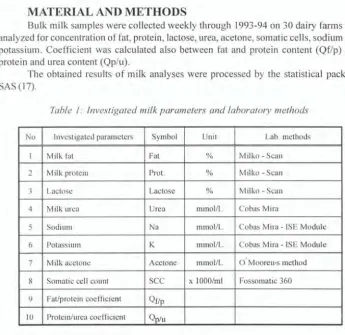
Bulk milk samples were collected weekly through 1993-94 on 30 dairy farms and analyzed for concentration of fat, protein, lactose, urea, acetone, somatic cells, sodium and potassium. Coefficient was calculated also between fat and protein content (Qf/p) and protein and urea content (Qp/u).
The obtained results of milk analyses were processed by the statistical package SAS (17).
Table I: investigated milk parameters and laboratory methods
No Investigated parameters Symbol Unit Lab. methods
I Milk fat Fat % Milko -Scan
2 Milk protein Prot. % Milko -Scan
3 Lactose Lactose % Milko -Scan
4 Milk urea Urea mmol/L Cobas Mira
5 Sodium Na mmol/L Cobas Mira - ISE Module
6 Potassium K mmol/L Cobas Mira -ISE Module
7 Milk acetone Acetone mmol/L O'Mooreu,s method
8 Somatic cell count
sec
x 1000/ml Fossomatic 3609 Fat/protein coefficient Oup
10 Protein/urea coefficient Op/u
-Milk profile lest -a Jwo year expirienc:e
Table 2: Distribution of farms with regard to year of investigation, region,
feeding season, husbandry, somatic cell count and ketolactia.
WEEKLY BULK MILK SAMPLES n=1574
1993 1994
I I I
I
19
DISTRICT SEASON SOMATIC CELL COUNT CSCC) ACETONE CONCENTRATION
1 = Gorenjska 22 farms 1 =Winter 1 =up to 100.000/ml 1 =negative•(-)
2 = Vipava 2 farms 2 =Summer 2 = 100.000 to 250.000/ml 2 =positive*' (±to+++)
3 = fdrija 4 farms 3 = 250.000 to 400.000/ ml
4 = Ljubljana 2 farms 4 = 400.000 to 750.000/ml
5 =above 750.000/ml
*
= negative (-)**=positive(±= 0, 16 mmol!L; +
=
0, 17-0,42 mmol!L; ++=
0,43-1,72 mmol/L;+++>I, 72 mmol!L)
The statistical model used was:
where:
Yijklmn
µ L· I K·
J
sk
scc
1 Acmeijklmn
Yijklmn= µ
+Li + Kj+ Sk
+SCC1 + Acm
+eijklmn
=observation resp. measured property ijklmn = mean value of observations
=influence of year i (i= 1993, 1994) = influence of farm (i= I ... 30)
= influence of ration with regard to season (k= 1,2)
k=I from I. to 17. and from 40. to 52. week of experiment
k=2 from to 18. to 39. week of experiment
=effect of SCC class (I= I ... 5)
=effect of milk acetone concentration (m= 1,2)
=residual random (error)
RESULTS AND
DISCUSSION
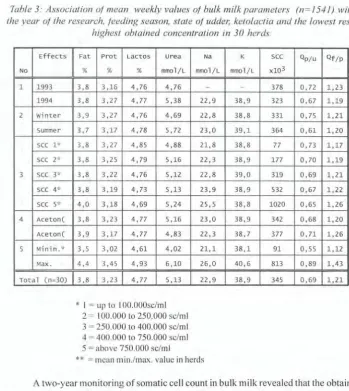
Table 3 presents mean values of parameters analyzed in weekly bulk milk samples with regard to the year of the research, feeding season, somatic eel 1 count, acetone content and the highest resp. lowest average in 30 herds.
20 'l'. Zadnik el al.
Table 3.· Association of mean weekly values of bulk milk parameters (n=J 541) with the year of the research, feeding season, state of udder, ketolactia and the lowest resp.
highest obtained concentration in 30 herds.
Effects
No
1 1993
1994
2 winter
Summer
sec F
sec 2"'
3 sec r
sec 4''
sec 5"
4 Acetone
Acetone
5 Minim."
Max.
Total en=30)
Fat Prat Lactos Urea
% % % mmol/L
3,8 3,16 4,76 4,76
3,8 3,27 4, 77 5,38
3,9 3,27 4 ,76 4,69
3,7 3,17 4 ,78 5. 72
3,8 3 ,27 4,85 4,88
3,8 3,25 4, 79 5,16
3,8 3 ,22 4,76 5,12
3,8 3,19 4,73 5 ,13
4,0 3,18 4,69 5 ,24
3,8 3,23 4,77 5,16
3,9 3,17 4,77 4,83
3,5 3 ,02 4,61 4,02
4,4 3,45 4,93 6,10
3,8 3,23 4, 77 5 ,13
*
I =up to 100.000sc/ml 2 = I 00.000 to 250.000 sc/ml 3 = 250.000 to 400.000 sc/ml4 = 400.000 to 750.000 sc/ml 5 =above 750.000 sc/ml
Na mmol/L -22, 9 22,8 23,0 21,8 22' 3 22 ,8 23,9 25,5 23,0
22, 3
21, 1
26,0
22,9
**
=mean min./max. value in herdsK sec Op/u Qf/p
mmol/L x103
- 378 0, 72 1,23
38,9 323 0,67 1,19
38,8 331 0,75 1,21
39,1 364 0,61 1,20
38,8 77 0,73 1,17
38,9 177 0, 70 1,19
39,0 319 0,69 1,21
38,9 532 0,67 1,22
38,8 1020 0,65 1,26
38,9 342 0,68 1,20
38,7 377 0, 71 1,26
38,l 91 0, 55 1,12
40,6 813 0,89 1,43
38,9 345 0,69 1,21
A two-year monitoring of somatic cell count in bulk milk revealed that the obtained
average cell count 345.000 sc/ml was too high. Namely, 30% of samples contained over
400.000 sc/ml. The results also demonstrated that from 30 monitored herds 8 exhibited
weekly elevated cell count. On the basis of these findings we recommend that producers
keep the somatic cell count in bulk milk below 250.000 sc/ml. lt was concluded that the
count exceeding 250.000 sc/ml indicated a greater number of animals with udder inflammation
(l0,18,19).
Table 3 also demonstrates that an elevated cell count in milk is closely related to a
higher Na and urea level and that protein content decreases if somatic eel 1 count increases.
Within the framework of the research the acetone content in bulk milk was also
determined on a weekly basis and 141 (9,2%) positive responses were established. A
detailed analysis has revealed that the acetone presence was mainly a reflection of feeding
grass silage with elevated butyric acid content-the so-called alimentary resp. false ketosis.
In this form of ketolactia the milk acetone was found in nearly all cows regardless of
Milk profile lest -a two year expirience 21
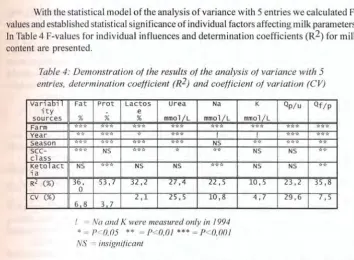
With the statistical model of the analysis of variance with 5 entries we calculated F-values and established statistical significance of individual factors affecting milk parameters. fn Table 4 F-values for individual influences and determination coefficients (R2) for milk content are presented.
Table 4: Demonstration of the results of the analysis of variance with 5 entries, determination coefficient (R2) and coefficient of variation (CV)
Vari ab1 I Fat Prot Lactos Urea Na K Gp/u Qf/p
ity e
sources % % % mmol/L mmol/L mmol/L
Farm ;': ;': ;', ;': ;'; -:. ;': -:: ;': ;':: -::: ;': -::: -:: ;': -:::-:::-::: -:::-:::-::: -:::-:::-:::
Year *-!::;': ;': ,., ;':: *•'o-!::
Season -:::;'::;'; ... ;'::;':-::: -:::-:::-::: NS ;'::-!:: -::;':;': ;':;':
sec- *;';-,'; NS ;':;':-!: ;':: *-!• NS NS ;';-/::
cl ass
Keto I act NS *-!::;', NS NS ;':-!:;': NS NS ;':;':
ia
R2 (%) 36, 53,7 32,2 27,4 22 '5 10' 5 23,2 35,8
0
CV (%) 2,1 25,5 10,8 4,7 29,6 7,5
6 8 3 7
I = Na and K were measured only in 1994
*
= P<IJ,IJ5**
=P<IJ,IJI*** =
P<IJ,IJIJINS
= insignificantThe investigated milk properties in weekly samples were statistically most significantly affected by the farm. This result is, we believe, quite objective because there are great differences among herds with regard to the management regime and health condition of dairy cows. Similar reports have been obtained also by other authors (I, 22, 23, 24,25). Season (temperature, humidity, husbandry) had also a significant effect on the majority of parameters, especially on fat, proteins and urea levels as well as somatic cell count. Through July, August and September the SCC was highest and the greatest frequency of mastitis was observed as well (I 0, 19,26). The authors rep011ed that the cell count was affected besides various causative agents of mastitis also by a whole range of other factors, among them the time of the year, and consequently alternations in the feeding and husbandry measures (1, I 0, 18,19,25,27,28).
22 T Zadnik el al.
count is below 250.000 sc/ml. Similar findings have been reported by other authors who suggested the same milk parameters as we monitored for evaluation of the energy and fat metabolism in dairy cows (4, 10, 20, 21, 29, 30, 31, 32, 33, 34, 35, 36).
Through our statistical model we managed to clarify a substantial part of variance. Determination coefficient (R2) was highest by the protein percentage in milk and as much as 53,7% of variance was explained. Determination coefficients were rather high also by other milk concentrations (above 22,5%) with the exception of K (10,5%). Thus, the model is encompassing the majority of factors significantly affecting milk composition.
CONCLUSION
The most important observations derived from our study of dairy cows and bulk milk composition on 30 farms using the MLP-test method are the following:
1. The MLP-test was well accepted by the farmers in the study region. The results of systematic weekly bulk milk composition analyses were most valuable for dairy producers especially because they were immediately informed about their performance.
2. Collection of milk samples on a weekly basis and a continuous exchange of information played an important role between the producers and researches. Soon a constructive working atmosphere was created as the producers had reason to be interested in how they can achieve the optimal production under their current farm conditions.
3. The MLP-test with its wide applicability stimulates the farmers to closely monitor their animals because the results of various analyses indicate many potential factors that either hinder or promote the realization of their production goals.
4. Last but not least, the educational potential of the MLP-test should be emphasized as well. The producers and specialists, the beginners in the first place, are compelled to meticulously record and analyze the obtained data which is essential for making progress in modern preventive medicine in dairy herds.
FUTURE CONSIDERATIONS
The MLP-test is in its essence a monitoring of health, nutritional and production problems in dairy herds' management. Because of the great practical use of the results, the test should be broadly utilized in the future. New parameters will have to be studied and included for diagnostic, epidemiological and economic objectives (2,3,4,37). The milk progesterone concentration should be evaluated because of its diagnostic utility for pregnancy and other ferti I ity problems assessment (3,3 8,39). Further, the M LP-test can be effectively used in epidemiology resp. prevention of some parasitic, bacteriological and virological diseases as well as determination of hampering and poisonous substances in milk (antibiotics, heavy metals, etc.) (5,40). Through modern diagnostic methods for
assessment of antibodies in milk it is already possible to detect ostertagiasis, brucellosis,
leucosis, BYD and winter bovine dysentery (3).
An integrated cooperation between producers, veterinarians, consultants,
Milk profile test - a two year expirience 23
ACKNOWLEDGMENTS
The authors sincerely thank the cooperating dairy producers and local veterinary service. The technical assistance of the staff at the Clinic for Ruminants, Veterinary Faculty and Zootechnical departement, Biotechnical Faculty was appreciated fully. This project was supported financially by grants from the Ministry for Science and Technology of the Republic of Slovenia (Project L4 -5473-04505-94).
REFERENCES
1. ZADNIK T. in sod. Zakljueno porocilo o enoletnem opazovanju, rezultatih in uporabnosti mlecno profilnega testa na podrocju Idrije in Vipave v letu 1994. Veterinarska fakulteta, Klinika za prdvekovalce. Ljubljana, 1995.
2. ZADNIK T., I. JAZBEC: Mleeno profilni test (MLPT):Pomen in uporabnost testa. Zbornik. Prvi Slovenski veterinarski kongres. Portoroz, 18 -20 november, 1993, str. 5 -11.
3. EMANUELSON,U., L.ANDERSON, S.ALENIUS: Milk components as routine
indicators of sub-clinical diseases and use in epidemiological research. Proceedings Society
for Veterinary Epidemiology and Preventive Medicine (1989), 117-127.
4. DIRKSEN,G.: Kontrole von Stoffwechselstorungen beim Milchkuhen an hand von Milchparameter. Proceedings. XVIII World Buiatrics Congress, Bologna, 29 August -2 September, 1994;35-47.
5. ZADNIK,T. : Vpliv transporta in shranjevanja goveje krvi ter seruma na rezultate hematoloskih in biokemijskih parametrov. Ljubljana: Veterinarska fakulteta, 1991. Disertacija.
6. PA YNE,J .M., Sylvia PAYNE: The metabolic profile test. Oxford: University Press, 1987. 7. CADONIC-SPELIC Vida: Vpliv razlicnega beljakovinskega obroka na sestavo goveje krvi in mleka. Ljubljana : Veterinarska fakulteta, 1993. Disertacija.
8. GREGOROVIC,V., F.SKUSEK, I.JAZBEC : Subklinicne presnovne motnje v
eredah molznic. 3. Metodika dispanzerizacije molznic v SR Sloveniji. Zb.Biotehn. Fak. Univ. E. Kardelja, Vet. 18 (1981) 2, 105-112.
9. PENGOV,A., T. ZADNIK: Stetje somatskih celic v hlevskih vzorcih iz bazena.
Zbornik. Prvi Slovenski veterinarski kongres. Portoroz, 18 -20 november, 1993, str. 45 -51. 10. RADOSTITS OM, LESLIE KE, FETROW J. Herd health: Food animal production medicine. 2nd edition, WB Saunders Company 1994
11. Marija KLOPCIC, J. POGACAR, Sabina KNEHTL, Ivanka JUG: PoroCilo o rezultatih AP kontrole za le to 1994/10. Biotehnicka fakulteta, Oddelek za zootehniko, Domfale, 1995:1-39.
12. WIGGANS GR. Symposium: Meeting the information needs of the dairy industry. Meeting the needs at the national level for genetic evaluation and health monitoring. J Dairy Sci. 77;1994:1976-1983.
13. PIPAN V. Informacijski sistem za vodenje reprodukcije in zdravstvenega varstva govedi. Doktorska disertacija. Veterinarska fakulteta, Ljubljana 1994.
14. PETERS RR, CASSEL EK, VARNER MA, EICKELBERGER RC, VOUGH LR,
MANSPEAKER JE, STEWART LE, WYSONG JW. A demonstration project of
interdiscip-linary dairy herd extension advising funded by Industry and users. 1. Implementation and Evaluation. J Dairy Sci. 77;1994:2438-2449.
15. PETERS RR, CASSEL EK, VARNER MA, DOUGLASS LW, VOUGH LR,
MANSPEAKER JE, STEWART LE, WYSONG JW, EICKELBERGER RC. A demonstration project of interdisciplinary dairy herd extension advising funded by Industry and users. 2.
Impact on herd performance. J Dairy Sci. 77;1994:2450-2460.
16. CASSEL EK, VOUGH LR, VARNER MA, EICKELBERGER RC,
24 1'. Zadnik el al.
interdisciplinary dairy herd extension advising funded by Industry and users. 3. Impact on
Management practices. J Dairy Sci. 1994;2461-2476.
17. SAS/STAT User's guide, Version 6, Edition 4. 1989. SAS Inst. Inc., Cary, NC.
18. PENGOV A. Determinacija in vloga potencialnih mikrobnih povzrociteljev
vimenskih vnetij. Ljubljana: Veterinarska fakulteta, 1995. Doktorska disertacija.
19. SCHUKKEN YH, BUURMAN J, GROMMERS FJ, et al. Population dynamics of
bulk milk somatic cell counts. J Dairy Sci 1990;73;1350-1356.
20. Majda NEMEC, ZADNIK T, Martina KLINKON, JAZBEC I. Ysebnost acetona
v hlevskih vzorcih mleka iz bazena. Zbornik. I. Slovenski veterinarski kongres - Portoroz, 18 - 20. november 1993, str. 38-43.
21. ZADNIKT, PIRCB, FA TUR B,JAZBECI. Maslena kislina v travni silazi in pojav
acetona v mleku. Zbornik predavanj. Posvetovanje o prehrani domacih zivali. Zadravcevi -Erjavcevi dnevi. Radenci, 27 in 28. oktober 1994. str. 130 -38.
22. SCHOLL DT. An epidemiological study of dairy farm management and farm bulk
tank milk protein concentration. Department of Herd Health and Reproduction State
University of Utrecht: 1992. Thesis.
23. KLOPCIC Marija, POGACAR J. Rezultati AP kontrole za leto 1994. Kmetovalec.
63;1995(6):15-24.
24. The national Committee on Danish Cattle Husbandry. Urea content in milk.
Controlling the protein supply of dairy cattle?. The Danish Agricultural Advisory Centre, AArhus. Extract from Report no.34, November 1993:22 ..
25. GREGOROYIC V, JAZBEC I. Fizikalne i kemijske promijenc mlijeka kod
subklinicke protrahirane kisele indigestije. Vet. glasnik 1989;43:1115-1118.
26. GREGOROVIC V, JAZBEC I. Utjecaj trulefoe indigestije na pojavljanje akutnog
koliformnog mastitisa u krava. 4. simpozij o suzbijanju mastitisa. Bled, 1983:39.
27. PEN GOV A, ZADNIK T. Stetje somatskih celic v hlevskih vzorcih mleka iz bazena. Zbornik. I. Slovenski veterinarski kongres - Portoroz, 18 -20. november 1993, str. 45-52.
28. DOHOO IR, MEEK AH. Somatic cell counts in bovine milk. Can vet J 1982;23:119-125
29. HAGERT C. Kontinuierliche Kontrolle der Energie- und Eiweissversorgung der
Milchkuh waehrend dcr Hochlaktation an Hand der Konzentrationen von Azeton, Harnstoff,
Eiweiss und Fett in der Milch. Vet.Med.Diss. Muenchen, 1991.
30. PEN A Fenomen naravne kislosti mleka. Zbornik predavanj. Posvetovanje o prehrani domacih zivali. Zadravcevi-Erjavcevi dnevi. Radenci, 27 in 28. oktober 1994. str. 72-83.
31. ROSSOW N, STA UFENBIEL B, JACOBI U. Die Nutzung von Milchinhaltsstoffen
fuer die Stoffwechseluberwachung bei Milchkuhen. Monatshefte fuer Veterinarmedizin, 45
(1990)19, 686 -690.
32. BRAND A, SCHUKKEN YH, GOODGER WJ, HOGEVEEN H. A dairy herd
health and production management protocol for hygienic milk quality. Proceedings. XVIII
World Buiatrics Congress, Bologna, 29 August -2 September, 1994;177-184.
33. LOBER U., MATTHES D., ROTTGER K., GAREISS G. Erfahrungen zur
ursa-chlichen Klaerung ernahrungsbedingter Rohmilchqualitatsmaengel. Monatshefte fur
Veterinaermedizin, 45(1990)12, 423-425.
34. PESTEVSEK, U., J. SUST, D. LIKOSAR, A VENGUST, S. PITAMIC: Vampova
fermentacija pri kravah, krmljenih z velikim delezem voluminozne krme in njen vpliv na
kolicino in kakovost mleka. Znanost ~n praksa v govedoreji, 1992;16: 119-12.
35. MIETTINEN PVA, SETClC JJ. Relationships between subclinical ketosis, milk
production and fertility in Finnish dairy cattle. Prev. Vet. Med. 1993;17:1-8.
36. SCHUKKEN YH, Van de GEER D, GROMMERS FJ, BRAND A Assesing the
repeatability of questionnaire data from dairy farms. Prev Yet Med 1989;7:31-38.
Milk profile test - a two year expirience 25
excretion of purine metabolites in relation to energy intake and milk yield in dairy cows. J
Dairy Sci 1994;77;2376-2381.
38. WATSON C. The use of milk progesterone samples for complete herd oestrous
control. Proceedings. XVII World Buiatrics Congress, St. Poul, Minesota,31 August - 4 September, 1992;310-315.
39. ROPSTAD E, REFSTAD AO. Herd reproductive performance related to urea
concentration in bulk milk. Acta. vet. Scand. 1987;28:55-63.
40. JENG SL, LEE SJ, LIN SY. Determination of cadmium and lead in raw milk by graphite furnace atomic absorption spectrophotometer. J Dairy Sci 1994;77:945-949.
TECT HA MJIEKO · ,UBEfO,UllfilHO llCKYCTBO
TX · I
T. 3a11HHK. A. IJe1-iroB, n . Ja36e1..1, MapH.Ja Know1w1
3a OTKpHBal-be Ha Haj<IeCTHTC 60JJCCTH Kaj rOBC/jaTa KOH HCraTl1BHO BJJ11jaaT Ha Hl1BHHTe npOH3B0/1HH CBOjCTBa, a1rnJJ113aTa Ha rrp11Mepo1..1H 011 rpyrrHO MJJCKO HY/1H HeKOJJKY
rrpeljHOCTl1 BO O/jHOC Ha aHaJJH3aTa Ha KpBTa, KOH ce O/jHecyBaaT rrpe11 ce Ha e/jHOCTaBHOCTa
11 HHCK11Te TpOWKOBH. Pe3yJJTaTHTe 011 aHaJJH311TC Ha rpyrrHHTe MJJeKO npo611 OB03MO)KyBaaT 011pe11yBaI·be Ha xpaHHTeJJHl10T 11 311paBCTBeH110T cTaTyc Ha cTa/joTo. Pa3ronopHTe co np0113BO/jl1TCJJl1TC, 11011anraTa aHaJJH3a Ha cj:JapMCKOTO CTOIIaHHCYBaihe, KJJl1HJ1<IKOTO l!Clll!TyBa1-1>e Im )1<11BOTHHTe H a1rnJJ113aTa Ha KpBHH H MJJeKO npo6H, OB03MO)KyBaaT
ecj:JeKTllBHO paKoB011e1be co cTa110To. Haw11Te Hao1111 ce 3acHonaaT Ha 1547 He11enHo 3eMam1, rpynH11 MJJeKo npo6H. MneKo rrpo611Te 0114 no11pa<1ja Ha CnoBeHHja 6ea co611paH11 He11enHo 011 30 cj:JapMI1 BO rrepHO/jOT 0111993 (n=l2), 1994 (n=l8) H HCIIHTyBaHll Ha MaCJJeHOCT, co11p1111HaTa Ha npoTCl1Hl1, JJaKT03a, ypea, HaTpHyM, Kan11yM, KOHL1eHTpa1..1HjaTa Ha a1..1eTOH 11 6poj Ha COMaTCKH KJJeTKH. npecMeTaHll 6ea 11 COO/jHOCHTC MacT/rrpOTCl1Hl1 11 rrpoTeHHH/ ypea. Co noMOW Ha Mo11enoT Ha MYJJT11rrna a1iaJJH3a Ha BapHjaHcaTa 6ewe YTBp/1CHO 11eKa ro1111HaTa Ha 11CDHTyBal-be, cj:JapMaTa 11 CC30HaTa (311Ma JJeTo) 11Ma CTaTl1CTWIKl1 3Ha<mTeJJHO BJJ11ja1me (P<0,05) Bp3 pe3yJJTaTHTe 011 aHaJJH3aTa Ha MJJeKOTO, 11011eKa 3/jpaBCTBeHHOT CTaTYC Ha BttMeTO (SCCx I 000/rnl) 11 KCTOJJaK1..111jaTa 11MaaT IlOMaJJO BJJHjan11e (P<0,05). pe3yJJTaTl1TC Ha TeCTOT 3a MJJe<ICH rrpocj:JMJJ ce KOp11CHl1 KaKO 3a rrpOI13B0/1HTCJJHTC, .TaKa 11 3a CttTe rne1..1HjaJJHCTH BKJJy<IeHH BO MJJC<IHaTa HH/1YCTpHja, rroce6HO 011 rne1111a TO<IKa Ha
eKOHOMCKI1 np11<J11HI1.