
Vol. 4, No. 3, Year 2012 Article ID IJIM-00190, 11 pages Research Article
A Numerical Integration Method by Using
Generalized Series of Functions
Majid Amirfakhriana∗, Zahra Saffarizadeha
(a)Department of Mathematics, Islamic Azad University, Central Tehran Branch, Tehran, Iran. ——————————————————————————————————
Abstract
In this paper, a new method is given to evaluate a definite integral. This method is ob-tained from a generalized Taylor series and using the derivatives of a integrand function at a certain point.
Keywords : Fractional integral; Fractional derivative; Generalized Taylor’s series; Numerical inte-gration.
——————————————————————————————————
1
Introduction
There are a lot of methods that evaluate a definite integral, numerically. Some of these methods use the end points (closed rules) of integral and some do not (open rules). Some of them are based on using interpolating polynomial. The most popular of such methods are Trapezoidal, Simpson, and mid-point methods which are special cases of Newton-Cots method. There are some other methods that are based on the exact integration of poly-nomials of increasing degree; in which no subdivision of the integration interval are used. Basic properties of these methods can be found in many textbooks such as [1, 18]. The ordinary Taylor’s series has been generalized by many authors. Hardy [3] introduced a new version of the generalized Taylor’s series that uses Reimann-Liouville fractional integral and Trujillo et al. [19] obtained a new formula that is based on Reimann-Liouville frac-tional derivatives. For the concept of fracfrac-tional derivative Odibat [14] adopted Caputo definition which is a modification of the Reimann-Liouville definition and introduced a generalized Taylor’s series. Zaid Odibat introduced a generalized method for solving lin-ear partial differential equations of fractional order [12, 15] and introduced a novel method for nonlinear fractional partial differential equations [13]. Hashemiparast et al. [6] intro-duced a method using derivations of function for numerical integration. There are some good textbooks in this area [11, 16], and some new works have been done on numerical
∗Corresponding author. Email address: [email protected]
integrations [2, 4, 5, 7, 22]. In [8] a novel method for integration of rapidly oscillatory integrals is presented, and then some authors worked on this area [9, 10, 21]. In this paper we introduce a new method to approximate a definite integral ∫abf(x)dxby using generalized Taylor’s series.
In Section 2 we represent some basic concepts of our work and after that use them to approximate a definite integral in Section 3. By this method of approximation a definite integral can be computed by using derivations of the integrand function at a certain point. There are some examples in Section 4.
2
Preliminaries
Watanabe [20], obtained the following formula:
f(x) =
∞
∑
k=−∞
(x−x0)α+k
Γ(α+k+ 1)(Db
α+k
γ f)(x) +Rn,m, (2.1)
with m < α, x > x0 ≥γ and
Rn,m = (Jγα+nDbγα+nf)(x) +
1 Γ(−α−m)
∫ x0
0
(x−t)−α−m−1(Dbαγ−m−1f)(t)dt, (2.2)
where Dbαγ+n is the Riemann-Liouville fractional derivative of order α+n and Jγα+n is the Reimann-Liouville fractional integral of orderα+n[3, 17]. This fractional derivative operator is defined for α >0, γ∈IR, x > γ as follows :
(Dbγαf)(x) = d
m
dxm[
1 Γ(m−α)
∫ x
γ
f(t)
(x−t)α+1−mdt], (2.3)
form−1< α≤m.
Under certain condition forf andα∈[0,1], Trujillo et al. [19] introduced the following generalized Taylor’s series:
f(x) =
n
∑
j=0
cj(x−γ)(j+1)α−1
Γ((j+ 1)α) +Rn(x, γ), (2.4)
where
Rn(x, γ) =
(Db(γn+1)αf)(ξ)
Γ(nα+α+ 1)(x−γ)
(n+1)α, γ ≤ξ ≤x, (2.5)
and
cj = Γ(α)[(x−γ)1−α(Dbγjαf)](γ), j= 0,1,· · · , n. (2.6)
For the concept of fractional derivative we will adopt Caputo definition [14] which is a modification of the Riemann-Liouville definition.
Definition 2.1. [14] A real functionf(x >0)is said to be in the space Cα(α ∈IR), if it can be written as f(x) =xpf1(x) for some p > αwhere f1 is continuous in (0,∞), and it
Definition 2.2. The Riemann-Liouville fractional integral operator of order α ≥0 of a function f ∈Cµwithγ ≥0 is defined as
(Jγαf)(x) = 1 Γ(α)
∫ x
γ
(x−τ)α−1f(τ)dτ, x >0, α >0, (2.7)
also
(Jγ0f)(x) =f(x). (2.8)
Properties of this operator can be found in [20].
Definition 2.3. The Caputo fractional derivative off of orderα >0withγ ≥0is defined as
(Dαγf)(x) = (Jγm−αf(m))(x) = 1 Γ(m−α)[
∫ x
γ
f(m)(t)
(x−t)α+1−mdt], (2.9)
for m−1< α≤m, x≥γ, f ∈C−m1, where m is a positive integer.
Definition 2.4. [14] (Generalized Taylor’s series) Suppose that Dkαθ f ∈C(θ, b] for k= 0,1, ... where 0< α≤1, then we have
f(x) =
∞
∑
i=0
(x−θ)iα
Γ(iα+ 1)D
iα
θ f(θ), (2.10)
with ∀x∈(θ, b],where
Dθnα=Dαθ.Dαθ...Dαθ (n−times). (2.11)
and we have generalized Taylor’s series with reminder as follows
f(x) =
n
∑
i=0
(x−θ)iα Γ(iα+ 1)D
iα θ f(θ) +
(D(θn+1)αf)(ξ)
Γ((n+ 1)α+ 1)(x−θ)
(n+1)α, (2.12)
with θ≤ξ≤x.
3
Numerical integration using derivatives of a function
In this section we introduce a new method to evaluate a definite integral, numerically, which uses the derivatives of the integrand function at a point.
Theorem 3.1. Let xi and xi+1 be two points such that xi+1=xi+h. Alsoxi = xi+2xi+1 and let for two positive integers r and s, we have α = rs, such that (r, s) = 1 and s is an odd number. For each m define Am= h
mα+1
2mαΓ(mα+2).
i) If r is an odd number, then for any even nonnegative integer p, there is an ηi ∈
(xi, xi+1), such that
∫ xi+1
xi
f(x)dx=
p
∑
m= 0
meven
where
Rp+2 =
h(p+2)α+1
2(p+2)αΓ(pα+ 2α+ 2)(D
(p+2)α
xi f)(ηi). (3.14)
ii)Ifr is an even number, then for any nonnegative integerp, there is aζi ∈(xi, xi+1),
such that ∫
xi+1
xi
f(x)dx=
p
∑
m= 0
meven
Am(Dmαxi f)(xi) +Rp+1, (3.15)
where
Rp+1=
h(p+1)α+1
2(p+1)αΓ(pα+α+ 2)(D
(p+1)α
xi f)(ζi). (3.16)
Proof. We know that ¯xi =xi+ h2. By using generalized Taylor’s series off at the point
¯
xi, we have ∫ xi+1
xi
f(x)dx=
∫ xi+1
xi
(
∞
∑
m=0
(x−xi)mα
Γ(mα+ 1)(D
mα
xi f)(xi))dx,
In the above equation we have
=
∞
∑
m=0
(Dxmα
i f)(xi)
Γ(mα+ 1)
(x−x¯i)mα+1
(mα+ 1)
xi+1
xi
, (3.17)
(xi+1−x¯i)mα+1−(xi−x¯i)mα+1 = (
h
2)
mα+1−(−h
2 )
mα+1= (h
2)
mα+1[1 + (−1)mα].
For the case (i) we have
(xi+1−x¯i)mα+1−(xi−x¯i)mα+1=
{
2(h2)mα+1, m even,
0, modd. (3.18)
By substituting (3.18) in (3.17) we have
∫ xi+1
xi
f(x)dx=
∞
∑
m= 0
meven
hmα+1
2mαΓ(mα+ 2)(D mα xi f)(xi),
thus ∫
xi+1
xi
f(x)dx=
p
∑
m= 0
meven
hmα+1
2mαΓ(mα+ 2)(D mα
xi f)(xi) +Rp+2,
therefore
Rp+2 =
∫ xi+1
xi
f(x)dx−
p
∑
m= 0
meven
Am(Dmαxi f)(xi) = ∞
∑
m=p+ 2
meven
By using generalized Taylor’s series with remainder there is anηi ∈(xi, xi+1) such that
Rp+2 =Ap+2(Dx(pi+2)αf)(ηi).
For the case (ii) we have
(xi+1−x¯i)mα+1−(xi−x¯i)mα+1 = (
h
2)
mα+1[1 + (−1)mα] = 2(h
2)
mα+1,
so, like the above considerations, we can drive
∫ xi+1
xi
f(x)dx=
p
∑
m=0
Am(Dmαxi f)(xi) +Rp+1,
where Rp+1 =Ap+1(Dx(pi+1)αf)(ζi).
By considering Theorem 3.1 forα = 1, we have
∫ xi+1
xi
f(x)dx=
p
∑
m= 0
meven
hm+1
2m(m+ 1)!f
(m)(x
i) +Rp+2, (3.19)
where Rp+2 = h p+3
2p+2(p+3)!f(p+2)(ηi).
Corollary 3.1. If f is a function with the property f′′(x) =σf(x), for x∈[a, b], then
∫ xi+1
xi
f(x)dx≈(
p
∑
m= 0
m even
Amσ
m
2)f(xi), (3.20)
where Am= h
m+1
2m(m+1)!.
In general, in order to computing the value of∫abf(x)dx, numerically, we can consider
h = b−na for a positive integern, and we use the pointsa=x0, x1, ..., xn=b, to evaluate
the integral, numerically.
Theorem 3.2. Let a=x0, x1, ..., xn=b are equidistance points such that xj =x0+jh.
By considering the notations of Theorem 3.1, there is an η∈(a, b), such that i) If r and s are two odd numbers, then
∫ b
a
f(x)dx=
n−1
∑
i=0
p
∑
m= 0
meven
Am(Dxmαi f)(xi) +E, (3.21)
where
E = (b−a)
h Ap+2(D (p+2)α
ii) If r is an even number and sis an odd number, then
∫ b
a
f(x)dx=
n−1
∑
i=0
p
∑
m=0
Am(Dxmαi f)(xi) +E, (3.23)
where
E = (b−a)
h Ap+1(D (p+1)α xi f)(η).
Proof.
∫ xn
x0
f(x)dx=
n−1
∑
i=0
∫ xi+1
xi
f(x)dx=
∫ x1
x0
f(x)dx+
∫ x2
x1
f(x)dx+...+
∫ xn
xn−1
f(x)dx
=
p
∑
m= 0
meven
{
(x1−x0)m+1
2m(m+ 1)! (D mα
x0 f)(x0) +...+
(xn−xn−1)m+1
2m(m+ 1)! (D mα
xn−1f)(xn−1)
}
+Ep+2,
thus ∫
xn
x0
f(x)dx=
n−1
∑
i=0
p
∑
m= 0
meven
Am(Dxmαi f)(xi) +Ep+2.
We have shown thatRp+2 =Ap+2(Dx(pi+2)αf)(ηi), so we have
Ep+2 =
n−1
∑
i=0
Ap+2(Dx(pi+2)αf)(ηi), ηi∈(xi, xi+1),
thus there is anη ∈(a, b), such that
Ep+2=Ap+2
n−1
∑
i=0
(D(xp+2)α
i f)(ηi) =Ap+2n(D (p+2)α xi f)(η),
so we have
Ep+2 =
(b−a)
h Ap+2(D (p+2)α xi f)(η).
Analogously, in the case ofα= 1 for equidistance points we have
∫ b
a
f(x)dx=
n−1
∑
i=0
p
∑
m= 0
meven
Amf(m)(xi) +Ep+2, (3.24)
where
Ep+2=
(b−a)
h Ap+2f
and Am = h
m+1
2m(m+1)!.
Letθ be a linear convex combination of the endpoints of interval [xi, xi+1],i.e.
θ=t1xi+t2xi+1, t1+t2= 1; t1, t2≥0. (3.25)
We can use generalized Taylor series of f in definite integral ∫xi+1
xi f(x)dxon the pointθ,
so ∫
xi+1
xi
f(x)dx=
∫ xi+1
xi ∞
∑
i=0
(x−θ)iα Γ(iα+ 1)(D
iα
θ f)(θ)dx,
=
∞
∑
i=0
(Diα θ f)(θ)
Γ(iα+ 1)
(x−θ)iα+1
iα+ 1
xi+1
xi , = ∞ ∑ i=0
(Diα θ f)(θ)
Γ(iα+ 2)[(xi+1−θ)
iα+1−(x
i−θ)iα+1].
Hence we can show that for any nonnegative integer pthere exists an η∈(a, b) such that
∫ xi+1
xi
f(x)dx=
p
∑
i=0
(Dθiαf)(θ)
Γ(iα+ 2)[(xi+1−θ)
iα+1−(x
i−θ)iα+1]
+ (D
(p+1)α θ f)(η)
Γ((p+ 1)α+ 2)[(xi+1−θ)
(p+1)α+1−(x
i−θ)(p+1)α+1]. (3.26)
Let α= 1 andt1 ̸=t2, thus we have
∫ xi+1
xi
f(x)dx=
p
∑
m=0
f(m)(θ) (m+ 1)! ·
{
(xi+1−xi)m+1(t1m+1+tm2 +1), m even
(xi+1−xi)m+1(t1m+1−tm2 +1), m odd
+E, (3.27)
where
E= h
p+2
(p+ 2)!
{
(tp1+2−tp2+2)f(p+1)(η), peven
(tp1+2+tp2+2)f(p+1)(η), p odd (3.28)
So it is clear that if t1 ̸= t2, then the error of the above technique is O(hp+2) and this
method is exact for the set of all polynomials of degree≤p, meanwhile fort1 =t2 = 12, the
error is O(hp+3) and this method is exact for the set of all polynomials of degree≤p+ 1.
4
Numerical examples
In this section we present some numerical examples.
Example 4.1.
We used this method for∫01xsinxdxwith the exact value 0.301168678 by considering
p approximated value 0 0.239712769 2 0.302856617 4 0.301153170 6 0.301168751 8 0.301168678
Table 1: f(x) =xsinx on [0,1]
p approximated value 0 0.303265329 2 0.265357163 4 0.264251508 6 0.264241166 8 0.264241117
Table 2: f(x) =xe−x on [0,1]
Example 4.2.
In this example, the definite integral ∫01xe−xdx with the exact value 0.264241117 is approximated by the method with α= 1 and we show the results in Table 2.
Example 4.3.
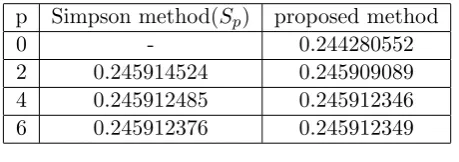
We used this method for ∫00.2e2xdx with the exact value 0.245912349 and compared the proposed method by Simpson method with p+ 1 points Sp, (where h = 0p.2). See
Table 3.
p Simpson method(Sp) proposed method
0 - 0.244280552
2 0.245914524 0.245909089 4 0.245912485 0.245912346 6 0.245912376 0.245912349
Table 3: f(x) =e2x on [0,0.2]
Example 4.4.
We used this method for∫00.2sin(3x)dxwith the exact value 0.05822146170 and com-pared the proposed method by Simpson method by considering p+ 1 points Sp, (where
h= 0p.2). See Table 4.
p Simpson method(Sp) proposed method
0 - 0.05910404134
2 0.05822411000 0.05821748072 4 0.05822162590 0.05822147024 6 0.05822149408 0.05822146170
Table 4: f(x) = sin(3x) on [0,0.2]
We used this method for the following integral by cosideringp= 20 andn= 15, then compared the result by midpoint method by considering np pointsMnp, (whereh= np1 ):
∫ 2
0 x x3+ 1dx.
The errors are shown in the Table 5.
Midpoint method(Mnp) proposed method
7.40658×10⁻⁶ 2.71536×10⁻³²
Table 5: Error off(x) =x(x3+ 2)−1 on [−1,1]
Example 4.6.
We use this method for the following improper integral withp= 20 andn= 10, then compare the result by midpoint method by considering np pointsMnp, (whereh= 0np.1):
∫ 0.1
0
exp(−1x) sin(3x)
x2 dx.
The errors are shown in the Table 6.
Midpoint method(Mnp) proposed method
−4.24748×10⁻¹⁰ 4.23516×10⁻²¹
Table 6: Error off(x) = exp(−x−1) sin(3x)x−2 on [0,0.1]
Example 4.7.
We use this method for the following improper integral withp= 20 andn= 30, then compare the result by midpoint method with np pointsMnp, (where h= np1 ):
∫ 1
0
exp(x−11 ) (x−1)2 dx.
Midpoint method(Mnp) proposed method
4.25786×10⁻⁸ −5.85352×10⁻¹⁵
Table 7: Error of f(x) = exp((x−1)−1)(x−1)−2 on [0,1]
5
Conclusion
In this work we proposed a new method to evaluate a definite integral, numerically, by using the generalized derivations of integrand function in one point. The most important advantage of this method is that this method is really convenient for the functions that their even derivatives are a constant multiply of the function.
References
[1] KE. Atkinson, W. Han, Elementary numerical analysis, John Wiley Inc, Second edi-tion, 1993.
[2] E. Babolian, M. Masjed-Jamei, MR. Eslahchi, M. Dehghan,On numerical integration methods with T-distribution weight function, Appl. Math. Comput. 174 (2006) 1314-1320.
[3] GH. Hardy, Riemanns form of Taylor’s series, J. Lond. Math. Soc. 20 (1945) 48-57.
[4] SM. Hashemiparast, Numerical integration using local Taylor expansions in nodes, Appl. Math. Comput. 192 (2007) 332-336.
[5] SM. Hashemiparast, MR. Eslahchi, M. Dehghan,Determination of nodes in numerical integration rules using difference equation, Appl. Math. Comput. 176 (2006) 117-122.
[6] SM. Hashemiparast, MR. Eslahchi, M. Dehghan, Numerical integration using the derivatives, Appl. Math. Comput. 180 (2006) 194-199.
[7] S. Kova˘c, J. Pe˘cari´c, A. Vukeli´c, A generalization of general two-point formula with applications in numerical integration, Nonlinear Anal. 68 (2008) 2445-2463.
[8] D. Levin, Fast integration of rapidly oscillatory functions, Journal of Computational and Applied Mathematics 67 (1996) 95-101.
[9] D. Levin,Analysis of a collocation method for integrating rapidly oscillatory functions, Journal of Computational and Applied Mathematics, 78 (1997) 131-138.
[10] KN. Melnik, RVN. Melnik, Optimal-by-order quadrature formulae for fast oscillatory functions with inaccurately given a priori information, Journal of Computational and Applied Mathematics, 110 (1999) 45-72.
[12] S. Momani, Z. Odibat, Numerical approach to differential equations of fractional or-der, J. Comput. Appl. Math. 207 (2007) 96-110.
[13] S. Momani, Z. Odibat, A novel method for nonlinear fractional partial differential equations: Combination of DTM and generalized Taylor’s formula, Comput. Appl. Math. 220 (2008) 85-95.
[14] ZM. Odibat, NT. Shawagfeh,Generalized Taylors formula, Appl. Math. Comput. 186 (2007) 286-293.
[15] Z. Odibat, S. Momani, A generalized differential transform method for linear partial differential equations of fractional order, Appl. Math. Lett. 21 (2008) 194-199.
[16] KB. Oldham, J. Spanier, The Fractional Calculus, Academic Press, New York, 1974.
[17] B. Riemann, Versuch einer allgemeinen Auffassung der Integration und Differentia-tion, GesammelteWerke, 1876.
[18] J. Stoer, R. Bulirsch,Introduction to numerical analysis (Texts in Applied Mathemat-ics, No 12), third ed. Springer Verlag, New York, 2002.
[19] J. Truilljo, M. Rivero, B. Bonilla, On a Riemann–Liouville generalized Taylor’s for-mula, J. Math. Anal. Appl. 231 (1999) 255-265.
[20] Y. Watanabe,Notes on the generalized derivative of Riemann-Liouville and its appli-cation to Leibntz’s formula II, Tohoku Math. J. 34 (1931) 28-41.
[21] S. Xiang, W. Gui, On generalized quadrature rules for fast oscillatory integrals, Ap-plied Mathematics and Computation, 197 (2008) 60-75.
![Table 4: f(x) = sin(3x) on [0, 0.2]](https://thumb-us.123doks.com/thumbv2/123dok_us/8878350.1818214/9.595.186.413.117.191/table-f-x-sin-x-on.webp)
