*Corresponding author: Dr. Ali Delpisheh, Psychosocial Injuries Research Center, Ilam University of Medical Sciences, Ilam, I.R. Iran; Tel: 0098412240404; E-mail:[email protected].
ijer.skums.ac.ir
INTRODUCTION
Infertility is an important problem during reproductive age and is defined as failure to conceive after one year of regular unprotected sexual intercourse without any known reproductive pathology.1,2The actual
prevalence of infertility is unclear; however, most of the couples successfully conceive
after 12 months of regular unprotected sexual intercourse.3 Previous studies have
reported that about a quarter of all couples could be affected by infertility in developing countries.4 In addition, infertility could be
divided into two main groups: the primary and secondary infertility. Primary infertility
Predictive factors for infertility of women: a univariate and
multivariate logistic regression analysis
Ashraf Direkvand-Moghadam1, Ali Delpisheh1*, Azadeh Direkvand-Moghadam2,
Parvaneh Karzani2, Parvin Saraee2, Zahra Safaripour2, Nasim Mir-Moghadam2 1
Psychosocial Injuries Research Center, Nursing and Midwifery Dept., Ilam University of Medical Sciences, Ilam, I.R. Iran;2Student Research Committee, Ilam University of
Medical Sciences, Ilam, I.R. Iran.
Received: 24/Sep/2014 Accepted: 14/Nov/2014
ABSTRACT
Background and aims:Infertility is a major problem during reproductive age. Physical and psychological effects of infertility in women are problematic. The aim of this study was to determine the potential predictive factors of infertility, among women referring both public and private health centers in Ilam province, western Iran, in 2013.
Methods:In this cross-sectional study, 1013 women referring the health care centers of Ilam province were enrolled in 2013. The participants were selected by simple random sampling method and their demographic, medical and obstetric variables were collected. The univariate and multiple logistic regression analyses were used to predict the potential risk factors of infertility.
Results: The husband’s education and occupation showed to be suitable independent predictor variables for infertility by multivariate logistic regression analysis (OR: 1.36 and 2, respectively). Overall percentage of correct classification of the model was 88.7%. It means that, considering the husband’s education and women’s occupation, the ability of the model to predict the actual category of the cases was 88.7%.
Conclusions: It seems that husband education level and women occupation are independent predictive variables. The women at risk of infertility have to be identified and high-quality counseling should be given in order to minimize the complications of infertility in both genders.
Keywords:Ilam, Female infertility, Risk factor.
O
ri
gi
n
al
ar
tic
Direkvand-Moghadam A, et al. Predictive factors for women infertility
is defined as infertile couples who have never conceived and secondary infertility refers to infertile couples who have conceived at least once before.5The incidence of female
infertility is rising6 so, that the primary or
secondary infertility occurs in almost 15% of all women worldwide.7 In fact, female
infertility is the cause of infertility in one third of all infertile couples.8 Moreover,
infertility has several physical and psychological impacts on the life of infertile couples including: societal repercussions, personal suffering, psychological disorders,9,10
sexual dysfunctions11,12and marital discord.9
There are several risk factors for infertility whose recognition is important for management of infertile couples.13, 14
Research has reported that age, high body mass index, age of onset of sexual activity, prior pelvic surgeries and stress could be considered as the most substantial risk factors associated with women's infertility.6
Other main causes of female infertility could be polycystic ovary syndrome,15 premature
ovarian failure,16 hyperprolactinemia,17
obesity,7 emotional stress,18 pelvic
inflammatory,19,20 genital infections,21,22
endometriosis,19,23 peritoneal adhesions,24
the fallopian tube obstruction,25 the uterine
malformation,26 adenomyosis,27 Asherman's
syndrome,28,29 tubal blockage,19,30 cervical
stenosis,31 smoking32 and medical
complications such as diabetes,33,34 thyroid
disorders,35life style36-38and occupation.39
Infertility, as a serious and poorly understood complication of women during the reproductive age, needs to be recognized with its epidemiological and clinical risk factors in order to predict the infertility, so
that the quality of couple’s life could be
promoted. Therefore, this study was conducted to determine the potential predictive factors of infertility, in women referring to both public and private health centers in Ilam province in 2013.
METHODS
In this cross-sectional study, the prevalence and risk factors of infertility among married women were investigated in Ilam province, western Iran in 2013. The women referring both public8 and private8
health centers in Ilam province, were selected by simple random sampling method. Totally, 1013 women were entered into the study and their related data were collected by trained research midwives. Inclusion criteria consisted of married women with failure to conceive after one year of regular unprotected sexual intercourse, and women with marriage period less than 12 months. None of the women were excluded from the study.
This study was undertaken with the approval of the Ethics Committee of the Ilam University of Medical Sciences (No: 923002/27). The purpose of the study was explained to the participants and the informed consent was obtained from all participants before enrolment. Data were collected by a two-part questionnaire. The questionnaire validity was confirmed by
content validity (Cronbach's alpha
with at least one previous pregnancy, but unable to become pregnant again.
Results were expressed as mean ± standard deviation (SD). Kolmogorov-Smirnov test was used to assess the normality for continuous variables. Independent t-test was used to compare the mean age and monthly income in two groups. To explore the relationship between the occupation and education level of women as well as
husband’s job, the Chi-square test was used. Both univariable and multiple logistic regression analyses were used to indicate the association between the dependent (infertility compared to no fertility) and independent variables. P value less than 0.05 was considered as the level of significance. All the statistical analyses were performed by SPSS software 16.
RESULTS
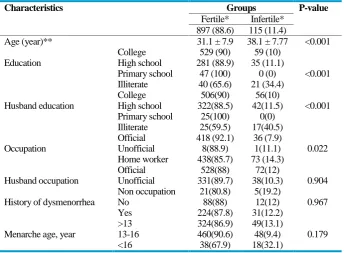
The demographic and obstetric
characteristics of all participants are presented in Table 1. A total of 1013 women were enrolled in the study. Overall, 897 (88.6%) women were fertile, while 115 (11.4%) women were assigned to the infertile group. The overall distribution of infertility was as following: primary infertility 54 (5.3%), secondary infertility 31 (3%), and 26 (2.5%) never experiencing pregnancy. Generally, 5.4% of all the participants had a female factor of infertility and 2.6% male factor of infertility. In approximately 0.5% of the participants, both men and women were involved in infertility and in 0.2%, the cause of infertility was unclear. The mean age was 31.1 ± 7.9 years in fertile women and 38.1 ± 7.77 in infertile women, with a significant difference (P<0.001).
Table 1: Comparison of the characteristics between groups
Characteristics Groups P-value
Fertile* Infertile* 897 (88.6) 115 (11.4)
Age (year)** 31.1 ± 7.9 38.1 ± 7.77 <0.001
Education
College 529 (90) 59 (10)
<0.001 High school 281 (88.9) 35 (11.1)
Primary school 47 (100) 0 (0) Illiterate 40 (65.6) 21 (34.4)
Husband education
College 506(90) 56(10)
<0.001 High school 322(88.5) 42(11.5)
Primary school 25(100) 0(0) Illiterate 25(59.5) 17(40.5)
Occupation
Official 418 (92.1) 36 (7.9)
0.022 Unofficial 8(88.9) 1(11.1)
Home worker 438(85.7) 73 (14.3)
Husband occupation
Official 528(88) 72(12)
0.904 Unofficial 331(89.7) 38(10.3)
Non occupation 21(80.8) 5(19.2)
History of dysmenorrhea No 88(88) 12(12) 0.967 Yes 224(87.8) 31(12.2)
Menarche age, year
>13 324(86.9) 49(13.1)
0.179 13-16 460(90.6) 48(9.4)
<16 38(67.9) 18(32.1)
Direkvand-Moghadam A, et al. Predictive factors for women infertility
Table 2: Association between the infertility and other variables using univariate logistic
regression analysis
Characteristics SE OR (95% CI) * P-value
Education
College 1.0 (ref.) <0.001 High school 0226 0.717 (0.72-1.47) 0.846 Primary school 5862.747 000 0.012 Illiterate 0.302 2.62 (2.60-8.51) <0.001
Husband education
College 1.0 (ref.) <0.001 High school 0.216 1.79( 0.771-1.8) 0.975 Primary school 8038.594 000 0.067 Illiterate 0.344 6.14 (3.128-12.06) <0.001
Occupation
Official 1.0 (ref.) <0.001 Unofficial 1.075 1.45 (0.177-11.93) 0.729 Home worker 0.215 1.93 (1.27-2.95) 0.002
*CI: Confidence interval
The infertility rate had a significant negative correlation with the educational level of women (-0.114) and men (-0.129). The increase in education level is associated with the decreased infertility in both men and women. The results obtained from the univariate logistic regression analysis indicated that there were significant differences in education, husband education and occupation between fertile and infertile women. By the multivariate logistic regression analysis, husband education (OR=1.36) and occupation (OR=2) were considered as independent predictive variables for infertility.
Figure 1: ROC of predicted probabilities of
multivariate logistic model
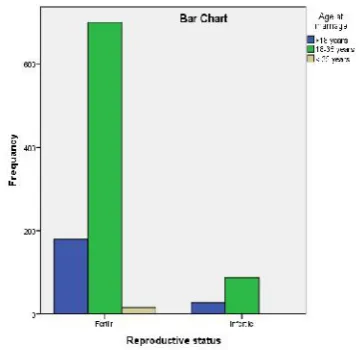
The AUROC criterion was applied to calculate both the sensitivity and specificity of the model (Figure 1). Overall percentage of (correct) classification of the model was 88.7%. It means that, considering the husband education and women occupation, the ability of the model to predict the actual category of the cases was 88.7%. There was no statistically significant differences between marriage age and infertility between groups (P=0.157) (Figure 2).
Figure 2: Reproductive status and marriage
DISCUSSION
In the present study, the causes of infertility in the study population were studied. Based on the results, 5.3% of our
population experienced the primary
infertility; however, the prevalence of primary was lower in another study in Iran, in which 0.6% to 3.4% of study population experienced primary infertility.40 In this
study, the prevalence of secondary and both types of infertility was reported 3% and 0.6%, respectively. In another study 10.5% of participants had secondary infertility.40
Based on the results, the female factor was the most common factor of infertility. In another study, similar to our results, the female factor was the main factor for infertility.6-8 It was found a significant
difference between fertile and infertile
women in mean age. Age was also
considered as a main effective factor of
woman’s fertility. Several studies evaluated the relationship between aging and women’s
fertility.6, 41, 42 Moreover; another study
reported the early and mid-twenties as the peaksof woman’s fertility.43
The risk of infertility has increased 3 times in women with menarche age more than 16 compared to menarche age less than 13 years, but the difference was not statistically significant. Maturity and proper function of the hypothalamus, pituitary and ovary axis was the potential causes of menstrual cycle in women. In fact, any deviation from this axis could create a delay in menstruation and infertility. Therefore, hypothalamus disorders may cause the female infertility.35 Moreover, several
studies reported a relationship between the pituitary gland disorders and female infertility.30, 44 Based on their results, the
risk of infertility could increase by 2 times in housewives compared to outside home jobs. In addition, another cross-sectional
study reported that infertility and spontaneous abortion was higher among female hairdressers than among women working in other jobs.39The main point was
that the insurances did not cover the costs of detection and treatment of infertility in Iran. Therefore, the housewives with no economic income were mostly unable to pay the cost of their treatment. Sometimes, the inability to treat the pelvic inflammatory disease could result in the women infertility.19, 20In the
present study, the univariate and multivariate logistic regression showed that the
husband’s education could be considered as
a predictor of female infertility. In most cases, higher income levels have been seen in people with higher education level in Iran. Therefore, we could expect that the women with husbands having higher levels of education may have fewer problems in their treatment of infertility. On the other hand, we know that sexually transmitted diseases (STDs) could be important risk factors for infertility; in fact, STDs are more likely among women living in poverty, being poorly educated, having poorly educated parents, and lacking educational and job opportunities.45
Direkvand-Moghadam A, et al. Predictive factors for women infertility
CONCLUSION
Based on our findings, there are several risk factors for infertility. In addition, it seems that aging, education level and occupation are independent predictive variables. Also, the women at risk of infertility should be identified and high-quality counseling has to be given to minimize the complications of infertility for both men and women.
CONFLICT OF INTEREST
The authors declare that they have no conflict of interests.
ACKNOWLEDGMENT
This study was approved by the Ilam University of Medical Sciences. We thank all participants, coordinators, and all others who assisted us in this study.
REFERENCES
1. Shea O. Rutstein and Iqbal H. Shah infecundity, infertility and childlessness in
developing countries DHS comparative
reports No. 9, Calverton, Maryland, USA: ORC Marco and the World Health Organization, 2004. P: 56.
2. Direkvand Moghadam A, Delpisheh A,
Khosravi A. Epidemiology of female
infertility; a review of literature. Biosci
Biotechnol Res Asia. 2013; 10(2): 559-67. 3. Bhattacharya S, Johnson N, Tijani HA, Hart R, Pandey S, Gibreel AF. Female infertility. BMJ Clin Evid. 2010.
4. Mascarenhas MN, Flaxman SR, Boerma T, Vanderpoel S, Stevens GA. National, regional, and global trends in infertility prevalence since 1990: a systematic analysis
of 277 health surveys. PLoS Med. 2012;
9(12): e1001356.
5. Tabong PT, Adongo PB. Infertility and childlessness: a qualitative study of the experiences of infertile couples in Northern
Ghana. BMC Pregnancy Childbirth. 2013;
13: 72.
6. Romero Ramos R, Romero Gutierrez G, Abortes Monroy I, Medina Sanchez HG. Risk factors associated to female infertility. Ginecol Obstet Mex. 2008; 76(12): 717-21. 7. Kumar D. Prevalence of female infertility and its socio-economic factors in tribal communities of Central India. Rural Remote
Health. 2007; 7(2): 456.
8. Unuane D, Tournaye H, Velkeniers B, Poppe K. Endocrine disorders & female infertility. Best Pract Res Clin Endocrinol
Metab. 2011; 25(6): 861-73.
9. Volgsten H, Skoog Svanberg A, Ekselius L, Lundkvist O, Sundstrom Poromaa I. Risk factors for psychiatric disorders in infertile women and men undergoing in vitro fertilization treatment. Fertil Steril. 2010;
93(4): 1088-96.
10. Volgsten H, Ekselius L, Poromaa IS, Svanberg AS. Personality traits associated with depressive and anxiety disorders in infertile women and men undergoing in vitro fertilization treatment. Acta Obstet Gynecol
Scand. 2010; 89(1): 27-34.
11. Drosdzol A, Skrzypulec V. Evaluation of marital and sexual interactions of Polish infertile
couples. J Sex Med. 2009; 6(12): 3335-46. 12. Drosdzol A, Skrzypulec V. Depression and anxiety among Polish infertile couples--an evaluative prevalence study. J Psychosom
Obstet Gynaecol. 2009; 30(1): 11-20.
13. Busso D, Onate-Alvarado MJ, Balboa E, Zanlungo S, Moreno RD. Female infertility due to anovulation and defective steroidogenesis in NPC2 deficient mice. Mol Cell Endocrinol. 2010; 315(1-2): 299-307.
14. Cai X, Song R, Long M, Wang SF, Ma YR, Li X, et al. A cross-sectional study on the current status of female infertility in
three counties of Xinjiang Uygur
Autonomous Region. Zhonghua Yi Xue Za
Zhi. 2011; 91(45): 3182-5.
15. Brassard M, AinMelk Y, Baillargeon JP.
Med Clin North Am. 2008; 92(5): 1163-92, xi. 16. Chatterjee S, Modi D, Maitra A, Kadam S, Patel Z, Gokrall J, et al. Screening for FOXL2 gene mutations in women with premature ovarian failure: an Indian experience. Reprod Biomed Online. 2007;
15(5): 554-60.
17. Motazedian S, Babakhani L,
Fereshtehnejad SM, Mojthahedi K. A comparison of bromocriptine & cabergoline on fertility outcome of hyperprolactinemic infertile women undergoing intrauterine insemination. Indian J Med Res. 2010; 131:
670-4.
18. Schenker JG, Meirow D, Schenker E. Stress and human reproduction. Eur J Obstet
Gynecol Reprod Biol. 1992; 45(1): 1-8. 19. Aziz N. Laparoscopic evaluation of female factors in infertility. J Coll
Physicians Surg Pak. 2010; 20(10): 649-52. 20. Sami N, Ali TS, Wasim S, Saleem S. Risk factors for secondary infertility among women in Karachi, Pakistan. PLoS One.
2012; 7(4): e35828.
21. Malik A, Jain S, Hakim S, Shukla I, Rizvi M. Chlamydia trachomatis infection & female infertility. Indian J Med Res. 2006;
123(6): 770-5.
22. Mares M, Socolov D, Doroftei B, Botezatu A, Goia CD. The prevalence of some bacterial markers in female patients undergoing an initial infertility evaluation in north-east Romania. Roum Arch Microbiol Immunol. 2009; 68(3): 171-4.
23. Manconi F, Markham R, Fraser IS. Culturing endothelial cells of microvascular
origin. Methods Cell Sci. 2000; 22(2-3): 89-99.
24. Alpay Z, Saed GM, Diamond MP. Female infertility and free radicals: potential role in adhesions and endometriosis. J Soc
Gynecol Investig. 2006; 13(6): 390-8. 25. Fauser BC, Devroey P, Yen SS, Gosden R, Crowley WF, Jr., Baird DT, et al. Minimal ovarian stimulation for IVF: appraisal of potential benefits and
drawbacks. Hum Reprod. 1999; 14(11):
2681-6.
26. Saravelos SH, Cocksedge KA, Li TC. Prevalence and diagnosis of congenital
uterine anomalies in women with
reproductive failure: a critical appraisal.
Hum Reprod Update. 2008; 14(5): 415-29. 27. Campo S, Campo V, Benagiano G. Infertility and adenomyosis. Obstet Gynecol
Int. 2012; 2012: 786132.
28. Buttram VC, Jr., Turati G. Uterine synechiae: variations in severity and some conditions which may be conducive to severe
adhesions. Int J Fertil. 1977; 22(2): 98-103. 29. Rochet Y, Dargent D, Bremond A, Priou G, Rudigoz RC. [The obstetrical future of women who have been operated on for uterine synechiae. 107 cases operated on (author's transl)]. J Gynecol Obstet Biol
Reprod (Paris). 1979; 8(8): 723-6.
30. Palihawadana TS, Wijesinghe PS, Seneviratne HR. Aetiology of infertility among females seeking treatment at a tertiary care hospital in Sri Lanka. Ceylon
Med J. 2012; 57(2): 79-83.
31. Pabuccu R, Ceyhan ST, Onalan G, Goktolga U, Ercan CM, Selam B. Successful treatment of cervical stenosis with hysteroscopic canalization before embryo transfer in patients undergoing IVF: a case series. J Minim Invasive Gynecol.
2005; 12(5): 436-8.
32. Delpisheh A, Brabin L, Brabin BJ. Pregnancy, smoking and birth outcomes.
Womens Health (Lond Engl). 2006; 2(3):
389-403.
10
Direkvand-Moghadam A, et al. Predictive factors for women infertility
How to cite the article: Direkvand-Moghadam A, Delpisheh A, Direkvand-Moghadam A, Karzani P, Saraee P, Safaripour Z, Mir-Moghadam N. Predictive factors for infertility of women: a univariate and multivariate logistic regression analysis. Int J Epidemiol Res. 2015; 2(1): 4-11.
33. Codner E, Merino PM, Tena-Sempere M. Female reproduction and type 1 diabetes: from mechanisms to clinical findings. Hum
Reprod Update. 2012; 18(5): 568-85.
34. Cai X, Song R, Long M, Wang SF, Ma YR, Li X, et al. A cross-sectional study on the current status of female infertility in
three counties of Xinjiang Uygur
Autonomous Region. Zhonghua Yi Xue Za
Zhi. 2011; 91(45): 3182-5.
35. Unuane D, Tournaye H, Velkeniers B, Poppe K. Endocrine disorders & female infertility. Best Pract Res Clin Endocrinol
Metab. 2011; 25(6): 861-73.
36. Olive DL. Exercise and fertility: an
update. Curr Opin Obstet Gynecol. 2010;
22(4): 259-63.
37. Gudmundsdottir SL, Flanders WD,
Augestad LB. Physical activity and fertility in women: the North-Trondelag Health
Study. Hum Reprod. 2009; 24(12): 3196-204. 38. De Souza MJ. Menstrual disturbances in athletes: a focus on luteal phase defects. Med
Sci Sports Exerc. 2003; 35(9): 1553-63. 39. Baste V, Moen BE, Riise T, Hollund BE, Oyen N. Infertility and spontaneous abortion among female hairdressers: the Hordaland Health Study. J Occup Environ
Med. 2008; 50(12): 1371-7.
40. Mascarenhas MN, Cheung H, Mathers CD, Stevens GA. Measuring infertility in populations: constructing a standard definition for use with demographic and reproductive health surveys. Popul Health
Metr. 2012; 10(1): 17.
41. Weeg N, Shalom-Paz E, Wiser A. Age and infertility: the clinical point of view.
Minerva Ginecol. 2012; 64(6): 477-83. 42. Delpisheh A, Brabin L, Attia E, Brabin BJ. Pregnancy late in life: a hospital-based study of birth outcomes. J Womens Health
(Larchmt). 2008; 17(6): 965-70.
43. Anderson SE, Dallal GE, Must A. Relative weight and race influence average age at menarche: results from two nationally representative surveys of US girls studied 25 years apart. Pediatrics. 2003; 111(4): 844-50.
44. Magon N, Agrawal S, Malik S, Babu KM. Growth hormone in the management of female infertility. Indian J Endocrinol Metab
2011; 15(Suppl 3): 246-7.
45. Smith GD. Learning to live with complexity: ethnicity, socioeconomic position, and health in Britain and the
United States. Am J Public Health. 2000;