Research Paper: Relationship Between Using Television and
Behavioral Problems of Pre-School Children
Mansooreh Asghari1, Mansoureh Karimzadeh1,2*, Robab Teymouri2
1. Department of Preschool Education, University of Social Welfare and Rehabilitation Sciences, Tehran, Iran. 2. Pediatric Neurorehabilitation Research Center, University of Social Welfare and Rehabilitation Sciences, Tehran, Iran.
* Corresponding Author:
Mansoureh Karimzadeh, PhD
Address: Pediatric Neurorehabilitation Research Center, University of Social Welfare and Rehabilitation Sciences, Tehran, Iran.
Tel: +98 (21) 22180083-92
E-mail: [email protected]
Objectives: The aim of the present study was to evaluate the relationship between the use of television and behavioral problems in children.
Methods: This is a descriptive and correlational research. The statistical population of the study included 4- to 6-year-old pre-school children in Tehran who were selected using multi-stage cluster sampling. A sample of 150 children was selected. The subjects responded to two questionnaires of Rutter’s behavioral problems and a researcher-made questionnaire on the extent of using electronic devices. Data were analyzed using SPSS 22 software in two sections: descriptive (tables and diagrams) and inferential statistics (univariate and multivariate analysis of variance and one-way and two-way Chi-square tests).
Results: The findings showed that there was a relationship between the use of television with isolation and anxiety in 4- to 6-year-old children. There was no significant relationship between having a personal computer and the time spent in watching television, but overall, the percentages of the total results indicated that children who did not have computers spent more hours watching television. Further, there was no significant relationship between the number of hours spent for playing with children and the time spent for watching television, but the results represented that children who played more than 2 hours spent less time watching television. However, there was a significant difference in aggressive behavior, neglect and childish behavior, but no significant difference in isolation and anxiety between children watching foreign movies and cartoons and those who watched Iranian movies and cartoons.
Discussion: It seems that decreasing children’s television watching can prevent behavioral problems.
A B S T R A C T
Article info:Received: 12 May 2017
Accepted:09 Aug. 2017
Keywords:
Games, Using television, Behavioral problems
Citation: Asghari M, Karimzadeh M, Teymouri R. Relationship Between Using of Television and Behavioral Problems of Pre-School Children. Iranian Rehabilitation Journal. 2017; 15(4):325-332. https://doi.org/10.29252/nrip.irj.15.4.325
:
: https://doi.org/10.29252/nrip.irj.15.4.325
Use your device to scan
and read the article online
1. Introduction
edia includes anything that carries a message or meaning to a recipient. Mass communication (radio, television, newspapers, magazines, and various print and electronic media) that affects a large number of audiences can be used for the practi-cal meaning of media. One such media is the television, which is a communication system for broadcasting and receiving moving pictures and sounds at a distance [1].
At first glance, the recent developments in the televi-sion industry seem to be very satisfactory. Films and entertainment programs can be received at the push of a button from around the world at any time of day. How-ever, this is associated with many deep concerns such as extremely easy access to inappropriate programs, espe-cially in the case of children and minors. The volume of violence scenes in media has increased along with the increasing number and variety of media [2]. In general, media shows a world where unhealthy behaviors such as physical violence, unprotected sexual behavior, smok-ing, and drinking intoxicants seem safe [3]. Hopf et al.
[4] concluded that most children who watched violent horror movies in their childhood and adolescents who played violent games exhibited more violence and crime at the age of 14 years. Also, another research showed that violent content in most of the media has a small but sig-nificant effect in the real world such as learning aggres-sive behavior, decreased sensitivity, and causing fear [5].
Children are among the main viewers of television. The effect of these media programs on various social, cultural, and psychological aspects of children is unde-niable. Children perceive things differently than adults due to the lack of sufficient experience and cognitive features that are specific to their developmental level
[6]. Living in today’s world has created a situation where television is one of the pillars of families, and this pillar can play a lot of roles among peers in terms of stimulating imagination. This non-interactive mes-senger is forced into the lives of people in several ways even when a scientific and organized effort is not used to attract audience and as such, children should be con-sidered [7]. Television can be a double-edged sword; it can be effective in forming a prosperous future for chil-dren with awareness, education and social knowledge and can also lead to antisocial problems such as poor training, mental destruction, as well as decline. It seems that factors such as family, peer group, educational en-vironments, and the media itself play a major role in children being influenced by television. These factors
can inhibit or amplify the harmful effects of television. This will consequently affect the behavior, deed, and even thoughts of children towards television.
Based on Bandura’s social learning theory [8], children learn their cognitive and social skills by observing the per-formance of those around. Similarly, they also learn to be aggressive by watching violence in the media. There are several important points to note from the aforementioned theory: first, a person may model aggressive behaviors without any reinforcement even if it emerges (latent learn-ing); and second, a person does not have to be personally rewarded to learn aggressive behavior. Tannenbaum [9]
pointed out in his arousal hypothesis that facing media violence increases aggression due to visitors’ stimulation. Similarly, the desensitization hypothesis [10] stated that constant watching of violence on television will result in reduced emotional response to violence in television. The disinhibition hypothesis [11,12] stated that people who are forbidden from aggressive behavior with training and ex-perience will lose their inhibition of aggressive actions by watching a lot of violence on television.
The Gerbner’s Cultivation Theory stated that reality watched through television affects beliefs and conse-quently, the behavior of viewers [13]. Further, the theory of cultivation stated that there are attitudes as “cultivat-ing” in watching too much television, as it is more har-monious with a world portrayed by television programs than the real world. This theory referred to the cumu-lative and dense process in which the use of television rears beliefs and convictions about social reality [14,15]. In addition, several cultivating theorists argued that tele-vision has long-term, gradual, indirect but dense and ac-cumulated effects. They emphasized that watching tele-vision has more attitudinal effects than behavioral effects
[14,16-18]. The use and gratification theory is based on the concept of audience activity, which means voluntary orientation of audiences in the selection of media, and refers to motivation based on needs and goals stated by the audience [19,20].
Studies have shown that even infants watch television for half hour, and children aged 4-6 years watch televi-sion for 2.5 hours and 6-8 hours on holidays. Also, one-third of 7-year-old children spend 4 hours a day watch-ing television, and only 10% of children have never watched television. Primary school children spend 1460 hours a year watching television. In contrast, they have less than 1000 hours of school training, and each family annually spends about 4000 hours watching television program, which has reached to 100000 hours in the late 20th century [21]. Children in the age group of 7-17 years
spend 25 hours per week watching television. Moreover, 20% of 2- to 7-year-old children, 46% of 8- to 12-year-old children and 56% of 13- to 17-year-12-year-old teens have private television in their room.
Studies have also reported that 15 to 22% of children need treatment interventions and 70 to 80% do not receive appropriate intervention for their behavioral problems. Behavioral problems begin in the early years of primary school children and reach the peak at 8 to 15 years of age
[22]. In a study by Gilson (2003), it was concluded that children who watch television a lot (most of the day) have higher behavioral disorders, anxiety, depression, and ag-gression. The findings of Ozmert [23]on behavioral prob-lems caused by watching too much television revealed that problems such as isolation, social problems, attention problems, thought problems, delinquent behavior, and ag-gressive behavior are positively correlated with the amount of time spent in television watching. In a study by Garvis and Pendergast [24], it was pointed out that television is used in families as educator and babysitter and is also used in motivating children’s physical exercise.
In addition, families also believe education programs on television to be positive. Juncal Cunado et de Gracia
[25] concluded that those who spend only one to two hours watching television reported a higher level of hap-piness than those who spend more time watching televi-sion. Naghdi Do Robati [26] concluded that pre-school education does not affect children’s social adaptability. Esmi et al. [27] concluded that there is a positive rela-tionship between watching commercials and the use of feed, accessories, and service facilities in that they sig-nificantly increase the adherence of children and adoles-cents to recreational and saving behavior, safety issues, and traffic regulations. The results of Seyedamini et al.’s study [28] indicate that there was no significant relation-ship between the behavior of primary school children and watching television a lot; however, there was a sig-nificant positive correlation with childhood obesity.
It seems that excessive use of television by children can affect their psychological behaviors and may later require rehabilitation and psychological interventions. Hence, the prevention of these behaviors may be closely linked to the extreme watching of television. The aim of the present study was to evaluate the relationship between the use of television and behavioral problems in children.
2. Methods
This is an ex-post facto descriptive study. The popu-lation of this research included all 4- to 6-year-old
pre-school children in Tehran educational districts in 2014/2015 academic year. The multistage cluster sam-pling method was used for samsam-pling. The sample size was determined to be 150 using Cochran’s method.
n=
1+N1(Z2dpq2 -1) Z2pq
d2
In general, 150 pre-school children were selected in the first stage from 19 educational districts of Tehran, and three kindergartens were selected in the second stage from three educational districts using the same method. The samples were divided into three groups with 50 sam-ples obtained from three educational districts: A. profited (Educational District 2); B. semi-profited (Educational District 6); and C. non-profited (Educational District 19). Data were obtained using two methods, namely library and field research methods. After referring to library, websites, related books and theses, data were collected using two standard questionnaires: 1. Behavioral prob-lems of preschool children questionnaires [29], and 2. a made-researcher questionnaire. Parents were asked to fill out the two questionnaires after coordination with of-ficial authorities.
The reliability of behavioral problems questionnaire using Cronbach’s alpha for the three components, i.e., aggression, neglect and childish behaviors, and isolation and anxiety, was obtained as 0.86, 0.79, and 0.84, re-spectively. Also, the internal consistency was obtained as 0.83. In the researcher-made questionnaire “Time spent for electronic devices,” the reliability of this test was obtained as 0.78 using Cronbach’s alpha for the whole questionnaire. In this research, based on the nature of the variables and hypotheses, data were analyzed using SPSS 22 software through univariate and Multivariate Analysis of Variance (MANOVA) and one-way and two-way Chi-square tests. All ethical considerations while implementing the research were considered in accor-dance with international guidelines and were approved by Ethics Committee of the University of Social Welfare and Rehabilitation Sciences.
3. Results
more than 4 hours. The results of the descriptive indica-tors and assumptions of this test are shown in Table 1.
The variance difference among the three groups showed that there was no significant difference among variances of aggression (F2.147=0.74, P=0.48), neglect and the childish behavior of children (F2.147=0.50, P=0.60), and isolation and anxiety (F2.147=2.49, P=0.08). The homogeneity of variance among groups was performed by Levene’s test.
The assumption of homogeneity of covariance matrix (Mbox=24.24, F12.32965.93=1.95, P=0.07) also con-firmed this assumption. The results of the multivariate Wilks’ Lambda test with a value of 0.80, F60.2900=6.63,
and P=0.001 showed that there was a significant differ-ence in behavioral problems between the three groups.
The univariate analysis of variance confirmed the re-sults obtained from the multivariate analysis of variance, which showed that there was no significant difference be-tween two groups, aggression (F2.1470.39, P=0.68) and neglect and childish behavior of children (F2.147=0.38, P=0.69), but a significant difference was observed in iso-lation and anxiety (F2.147=16.90, P=0.01) (Table 2).
In this study, after determining the significant differ-ence among the three groups in isolation and anxiety, the LSD post hoc test was used to determine which group is responsible for this difference. The obtained results
Table 1. The results of the three groups based on three elements of Children’s Behaviour Questionnaire
Variable Aggression Neglect and Childish Behaviors Isolation and Anxiety
M SD M SD M SD Number
2 h 0.66 0.31 0.52 0.34 0.29 0.25 72
4 h 0.67 0.34 0.56 0.34 0.41 0.26 51
˃4 h 0.73 0.34 0.58 0.30 0.65 0.35 27
Note: M: Mean; SD: Standard Deviation
Table 2. ANOVA test results
Source of Effect Variable SS df MS F P
Year
Aggression 0.08 2 0.04 0.39 0.68
Neglect and childish behavior 0.08 2 0.04 0.38 0.69
Isolation and anxiety 2.57 2 1.29 16.90 0.01
Error
Aggression 15.52 147 0.11
Neglect and childish behavior 16.42 147 0.11
Isolation and anxiety 11.19 147 0.08
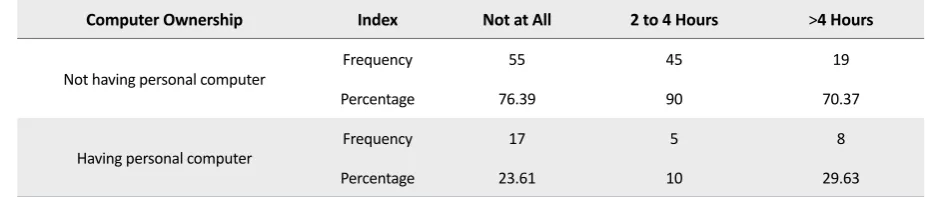
Table 3. Chi square test for the relationship between having personal computer and watching TV
Computer Ownership Index Not at All 2 to 4 Hours ˃4 Hours
Not having personal computer Frequency 55 45 19
Percentage 76.39 90 70.37
Having personal computer Frequency 17 5 8
showed that the children watching television for 2 hours are less isolated and anxious than the ones who watch television for more than 2 hours a day.
The results of the Chi-square test, which evaluated the relationship between having personal computer and the time spent for watching television, showed that there was no significant relationship X2=5.27, df=2, P=0.07). But the obtained percentages indicated that children who did not have any computers spent more hours watching television (Table 3). The Chi-square test, which evaluat-ed the relationship between the hours that parents playevaluat-ed with children and the time spent for watching televi-sion, showed that there was no significant relationship X2=2.34, df=2, P=0.30). But the percentages of the en-tire results indicated that children who spent more hours playing spent less time watching television (Table 4).
Multivariate analysis of variance was used to evaluate the aforementioned hypothesis. The descriptive indica-tors and assumptions of this test are shown in Table 5. Evaluation of variance difference among the three groups showed that there was no significant difference in vari-ances of aggression (F1.143=0.53, P=0.47), neglect and childish behavior of children (F1.143=3.27, P=0.05), and isolation and anxiety (F1.143=0.99, P=0.32). The homogeneity of variance among groups was performed by Levene’s test.
The assumption of homogeneity of covariance matrix (F6.123992.47=2.39, Mbox=14.63, P=0.05) also con-firmed this assumption. After confirming the assump-tions of multivariate analysis of variance, the results of multivariate Wilks’ Lambda test with a value of 0.92, F3.141=4.00 and P=0.01 showed that there was a
sig-Table 4. Chi square test results for the relationship between the number of hours for playing with children and time spent watching TV
Hours of Playing With Child Index Not at All 2 to 4 h More Than 4 Hours
2 h Frequency 54 36 16
Percentage 75 70.59 59.26
More than 2 h Frequency 18 15 11
Percentage 25 29.41 40.74
Table 5. The behavioral problems among children watching Iranian and foreign movies and cartoons
Variable Aggression Neglect and Childish Behavior Isolation and Anxiety Number
M SD M SD M SD
Foreign 0.75 0.34 0.61 0.28 0.40 0.29 82
Iranian 0.60 0.29 0.47 0.38 0.40 0.33 63
Note: M: Mean; SD: Standard Deviation
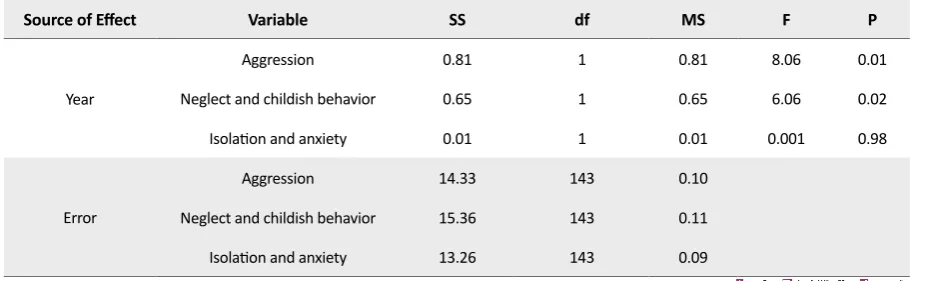
Table 6. Analysis of one-way variance
Source of Effect Variable SS df MS F P
Year
Aggression 0.81 1 0.81 8.06 0.01
Neglect and childish behavior 0.65 1 0.65 6.06 0.02
Isolation and anxiety 0.01 1 0.01 0.001 0.98
Error
Aggression 14.33 143 0.10
Neglect and childish behavior 15.36 143 0.11
nificant difference in behavioral problems among the three groups.
The univariate analysis of variance confirmed the re-sults obtained from the multivariate analysis of variance, which showed that there was a significant difference be-tween two groups, aggression (F2.146=8.06, P=0.01), neglect and the childish behavior (F2.146=6.06, P=0.02), but there was no significant difference in isolation and anxiety (F2.146=0.001, P=0.98) (Table 6). The obtained means showed that the group of children who watch for-eign movies and cartoons had more aggression, neglect and childish behavior.
4. Discussion
The results of this study showed that there was a sig-nificant difference among the three groups of children watching television for 2 hours, 4 hours, and more hours in terms of isolation and anxiety, but there was no sig-nificant difference in aggression, and neglect and child-ish behavior. The results of this study were consistent with some previous studies [23,30] and in contrast with
some others [28]. One of the studies that became famous as National Television Violence Study (NTVS) showed that in America: 1. Television violence is often presented in charismatic and exciting ways; 2. Scenes which are extremely dangerous in terms of learning violence by children under the age of 7 years are shown in specific programs and channels for this age group; and 3. The number of anti-violence programs is not much [21].
Children usually begin watching cartoon videos from the age of 2 years and become accustomed to television at the age of 6 years. Violent television programs not only have a negative impact on children in the short term but also influence their beliefs and values. Displaying power of the cinema stars and the fantasy heroes teach children that everyone with more power is right and people can gain every demand with force. When viewers are focusing on someone else’s behavior, they may try to copy that model. But, the important thing to consider is that irrespective of whether the pattern is alive or as a television program (film, cartoon, etc.), the intensity
of imitation is the same [31]. Children acquire many of their behavioral patterns, moral attributes, motivations, and attitudes through imitation, identification, and mir-roring processes. Identification is an emotional bond be-tween the child and the person identified. Another aspect of the replication is the child’s perception of his own similarity to the model and consequently, the acquisi-tion of characteristics and model reacacquisi-tions [32]. In this regard, it is worthy of note that children after viewing
animations may imagine them as similar to or far from themselves and in order to become similar to them or to avoid them, most of the time that children watch televi-sion is to watch bogus programs. For example, children before the age of 10 years pay less attention to news pro-grams, but youngsters are more interested in cartoons, fantasy heroes and comic situations than other programs. In other words, most of the children’s interest is anima-tions and stories. Based on a research [21], animation has the highest percentage of children’s interest com-pared to other television programs (songs, lyrics, poetry, interviews, films, etc.).
There is a relationship between watching television and the rough behaviors of children and teens. The child and family are affected by the culture in which they are liv-ing. Apart from home and school, multiple environmen-tal conditions affect the expectations of adults from their children and the expectations of the children themselves. Values and environmental standards are transferred to children through conditions, demands, prohibitions, and various models such as displaying violence in mass me-dia, using horror and force, changing values about sexual behaviors and issues, religious demands and restrictions, etc. Psychologists believe that watching television a lot causes inactive thinking and makes children spend less time for reading, playing, and interacting with others. On this basis, especially, at a younger age, children do not understand much of what they see on television and can-not connect the separate scenes to each other as a story, they only remember a particular disruptive behavior and also show it in their behaviors [33,34].
Prospective research has shown that children with a high degree of aggressiveness are more enthusiastic about television violence. The more they see these pro-grams, the more they are likely to resort to violence to solve their problems. In addition, many television lence scenes are displayed in the form of a joke, and vio-lence in children’s cartoons can lead to aggressive and violent behavior in children and adolescents [33, 34]. Television violence makes children heartless to aggres-sion and makes them more willing to allow aggresaggres-sion towards others [35].
States of America have shown that every child watches television on an average for 4 to 5 hours a day, which reaches 10 hours on holidays. Other studies showed that children in lower economic and social levels spend more time watching television. They watch television more than just talking to their parents, playing with their friends, playing sports, and having fun or reading books.
5. Conclusion
In general, it seems that decreasing children’s televi-sion watching can prevent behavioral problems. Based on the results of his study, it is recommended that parents should control the hours spent by their children while watching television, as well as selection of program type (Iranian and foreign). They should provide infrastructure and tools to enrich leisure and entertainment facilities for children’s development. The content of Iranian and foreign films and animations should be more focused by parents as children do not learn violent behavior from these films. The results of this study showed that foreign movies and cartoons also have a negative effect on chil-dren. Therefore, special attention must be paid to teach the management of hours spent in watching television, as well as selection of appropriate programs (type and content) by parents and education authorities.
Since the role of playing and interacting with peers is very important in learning and reducing inhibitions, there should be more information on the role of kinder-gartens, especially for children who are single or spend a lot of time at home. This will enable them to spend less time playing video games and watching television, thereby reducing the risk of isolation in children.
The limitations of this study included the difficulty in estimating the approximate time of using television and time of playing with children from parents, the lack of cooperation by some parents to fill out the questionnaires, and the focus of the research on 4- to 6-year-old children.
Acknowledgments
The paper resulted from a master’s thesis presented to the Islamic Azad University. The researchers thank and appreciate the sincere cooperation of preschool children, their parents and preschool authorities.
Conflict of Interest
The authors declared no conflicts of interest.
References
[1] Abolhassani SR, Babaei M. [A theoretical approach to the media and politics relations (Persian)]. Political Quarterly. 2012; 42(2):1-22.
[2] Carlsson U, Von Feilitzen C. Children and media violence. Yearbook from the UNESCO international clearinghouse on children and violence on the screen, 1998. Gothenburg: Gote-borg University; 1998.
[3] Brown JD, Witherspoon EM. The mass media and Ameri-can adolescents’ health. Journal of Adolescent Health. 2002; 31(6):153-70. doi: 10.1016/s1054-139x(02)00507-4
[4] Hopf WH, Huber GL, Weiß RH. Media violence and youth violence: A 2-year longitudinal study. Journal of Media Psy-chology. 2008; 20(3):79-96. doi: 10.1027/1864-1105.20.3.79
[5] Whitney C, Wartella E. Violence and Media. In: Wright J., editor. International Encyclopedia of the Social & Behavioral Sciences. London: Elsevier Science Ltd; 2001.
[6] Molagholamreza Tabasi F, Aliabadi F, Alizade Zarei M, Qor-bani M, Rostami R. Survey of behavioral problems and
sen-sory processing in children with attention deficit/hyperactiv
-ity disorder. Iranian Rehabilitation Journal. 2016; 14(1):63-8.
[7] Kenway J, Bullen E. Consuming children. Education–Enter-tainment–Advertising. Buckingham: Open University Press; 2001.
[8] Bandura A. Social learning theory of aggression. Journal of Communication. 1978; 28(3):12-29. doi: 10.1111/j.1460-2466.1978.tb01621.x
[9] Tannenbaum PH, Zillmann D. Emotional arousal in the fa-cilitation of aggression through communication. Advances in Experimental Social Psychology. 1975; 8:149-92. doi: 10.1016/ s0065-2601(08)60250-6
[10] Krahé B, Möller I, Huesmann LR, Kirwil L, Felber J, Berger A. Desensitization to media violence: Links with habitual me-dia violence exposure, aggressive cognitions, and aggressive behavior. Journal of Personality and Social Psychology. 2011; 100(4):630-46. doi: 10.1037/a0021711
[11] Josephson WL. Television violence and children's aggres-sion: Testing the priming, social script, and disinhibition pre-dictions. Journal of Personality and Social Psychology. 1987; 53(5):882-90. doi: 10.1037//0022-3514.53.5.882
[12] Aluja-Fabregat A. Personality and curiosity about TV
and films violence in adolescents. Personality and Indi
-vidual Differences. 2000; 29(2):379-92. doi: 10.1016/s0191-8869(99)00200-7
[13] Gerbner G. Cultivation analysis: An overview. Mass Communication and Society. 1998; 1(3-4):175-94. doi: 10.1080/15205436.1998.9677855
[14] Gerbner, G. Cultural indicators: The case of violence in tel-evision drama. Annals of the American Academy of Political Social Science, 1970; 388:69-81.
[15] Crook C. Technology, media, and social development. In: A. Campbell, S. Muncer editors. The Social Child. East Sussex: Psychology Press Ltd. 1998. 189-218.
vio-lent movies in Meshkinshahr (Persian)]. Woman and Family Studies. 2010; 3(9):81-96.
[17] Hammermeister J, Brock B, Winterstein D, Page R. Life without TV? Cultivation theory and psychosocial health characteristics of television-free individuals and their tele-vision-viewing counterparts. Health Communication. 2005; 17(3):253-64. doi: 10.1207/s15327027hc1703_3
[18] Shanahan J, Morgan M. Television and its viewers: Cultiva-tion theory and research. Cambridge: Cambridge University Press; 1999.
[19] Ruggiero TE. Uses and gratifications theory in the 21st
cen-tury. Mass Communication and Society. 2000; 3(1):3-37. doi: 10.1207/s15327825mcs0301_02
[20] Metani M, Hassanzadeh R, Farhangui AA. [The inves-tigation of Qaemshahr audiance attitude to the satelite TV channels (Persian)]. Culture-Communications Studies. 2013; 14(21):129-56.
[21] Moussapoor N, Dor Taj F. [Evaluation of religious anima-tions in the IRIB (Persian)]. Journal of Iran Cultural Research. 2008; 1(3):157-82.
[22] Nejati V. [Epidemiology of behavioural problems in el-ementary school students of Tehran satellite cities (Persian)]. Journal of Medical Council of Iran. 2012; 30(2):162-8.
[23] Özmert E, Toyran M, Yurdakök K. Behavioral correlates of television viewing in primary school children evaluated by the child behavior checklist. Archives of Pediatrics & Adolescent Medicine. 2002; 156(9):910-4. doi: 10.1001/arch-pedi.156.9.910
[24] Garvis S, Pendergast D. Warning-television viewing may harm your child's health: Parent perceptions of early child-hood viewing habits. Australasian Journal of Early Child-hood. 2011;36(4):22-8.
[25] Cuñado J, de Gracia FP. Does education affect happi-ness? Evidence for Spain. Social Indicators Research. 2012; 108(1):185-96. doi: 10.1007/s11205-011-9874-x
[26] Naghdi Do Robati F. [Studying the relationship between maternal employment and social adaptation of children (Per-sian)] [MA thesis]. Tehran: Tehran University; 2001.
[27] Esmi R, Sa'idipour E, Assadzadeh H. [The relationship be-tween watching TV commercials and consumption pattern in children and adolescents in Tehran (Persian)]. Communica-tion Research. 2010; 17(1):93-117.
[28] Seyedamini B, Moradi A, Malek A, Ebrahimi-Mamaghani M. [The Role of Watching TV. in Obesity and Behavioral Problems in Children (Persian)]. Iran Journal of Nursing. 2010; 23(67):8-14.
[29] Rutter M. A children's behaviour questionnaire for
comple-tion by teachers: Preliminary findings. Journal of child Psy
-chology and Psychiatry. 1967; 8(1):1-11. doi: 10.1111/j.1469-7610.1967.tb02175.x
[30] Wells NM, Lekies KS. Nature and the life course: Pathways from childhood nature experiences to adult environmental-ism. Children Youth and Environments. 2006; 16(1):1-24.
[31] Schultz Duwan P, Allen SS. Theories of Personality [Y. Seyed Mohammadi Persian trans]. Tehran: Homa Publica-tions; 2005.
[32] Raheb G, Khaleghi E, Moghanibashi-Mansourieh A, Far-houdian A, Teymouri R. Effectiveness of social work inter-vention with a systematic approach to improve general health in opioid addicts in addiction treatment centers. Psychology Research and Behavior Management. 2016; 9:309–315. doi: 10.2147/PRBM.S110705
[33] Berk L. Development through the lifespan. London: Pear-son Education; 2001.
[34] Berk LE. Development through the lifespan, 4/E. Boston: Allyn & Bacon; 2007.