Vol. 9, No. 4, 2017 Article ID IJIM-01087, 10 pages Research Article
Classical Center Location Problem Under Uncertain Environment
A. Soltanpour ∗, F. Baroughi †‡, B. Alizadeh §
————————————————————————————————–
Abstract
This paper investigates the p-center location problem on a network in which vertex weights and distances between vertices are uncertain. The concepts of theα-p-center and the expected p-center are introduced. It is shown that theα-p-center and the expectedp-center models can be transformed into corresponding deterministic models. Finally, linear time algorithms for finding the 1-center and 2-center of uncertain unweighted trees are proposed.
Keywords: Location Problem;p-center; Uncertainty theory; Uncertain Programming.
—————————————————————————————————–
1
Introduction
L
otion models in operations research and playcation problems are fundamental optimiza-a consideroptimiza-able role in proptimiza-actice optimiza-and theory. In optimiza-a classical location problem, we want to find the optimal locations of one or more new facilities on a system (graph or space) in order to serve a given set of customers. One problem which was intensively considered in the literature is the p -center problem which can be stated as follows: Let N = (V, E) be an undirected connected net-work with vertex set V and edge set E. The distance between two points onN is equal to the length of the shortest path connecting these two points. Each vertex is associated with a nonnega-tive weight that is the demand of the client at this vertex. In the p-center problem, p centers are to be located in a network, such that the maximum∗Department of Applied Mathematics, Faculty of Basic
Sciences, Sahand University of Technology, Tabriz, Iran.
†Corresponding author. [email protected], Tel:
+98(41)33459053.
‡Department of Applied Mathematics, Faculty of Basic
Sciences, Sahand University of Technology, Tabriz, Iran.
§Department of Applied Mathematics, Faculty of Basic
Sciences, Sahand University of Technology, Tabriz, Iran.
weighted distance from any demand point to its center is minimized.
Kariv and Hakimi [15] proved that the p -center problem on general networks is N P -hard. For general networks, they proposed an O(|E|p|V|2p−1log|V|/(p−1)! ) time algorithm to solve the weighted absolute p-center prob-lem. Later, Tamir [28] improved the com-plexity bounds by using dynamic data struc-ture, and showed that the weighted and un-weighted p-center on networks can be found in O(|E|p|V|plog2|V|) and O(|E|p|V|plog3|V|) times. The p-center problems in tree networks are well studied [5, 8, 9, 15, 20, 21]. Bespamy-atnikh, in [2], proposed efficient algorithms for centers in interval and circular-arc graphs. Fred-erickson and Johnson [9] solved the unweighted vertex p-center problem in cactus networks in
O(|V|.log|V|) time. Also exact algorithms to solve the vertex p-center and capacitated ver-tex p-center problems are found in [26]. In the context of the p-center location problems, the interested reader is referred to [3, 6, 22,
23, 24]. Kariv and Hakimi [15] designed an
O(|E||V|.log|V|) time algorithm for finding an absolute 1-center of a weighted network and an
O(|E||V|+|V|2.log|V|) time algorithm for
ing an absolute 1-center of an unweighted net-work, provided that the distance matrix of the network is available. Moreover, they proposed anO(|V|.log|V|) time algorithm for the absolute (or vertex) 1-center location problem on weighted trees. Later, in [20], Megiddo showed that the weighted 1-center of a tree can be obtained in
O(|V|) time, since the objective function of the problem is convex on every simple path of the tree. For the unweighted case, an efficientO(|V|) time algorithm was developed by Handler [14].
Location models involving uncertainty have at-tracted significant research efforts. This area is of great practical importance because of perva-sive effects of uncertainty in real systems. There are two types of numerical parameters character-izing a network that may be subject to uncer-tainty, weights of vertices and distances between vertices. In 2007, Liu [18] proposed uncertainty theory to describe nondeterministic phenomena, especially expert data and subjective estimation. From then on, uncertainty theory has provided a new approach to deal with non-deterministic fac-tors in programming problems. Some researchers employed uncertainty theory to deal with the lo-cation problems, such as uncertain models for sin-gle facility location problems by Yuan Gao [10], hierarchical facility location for the reverse logis-tics network design under uncertainty by Wang and Yang [29], the capacitated facility location-allocation problem under uncertain environment by Wen et al. [30], the inverse 1-median prob-lem on a tree under uncertain cost coefficients by Nguyen and Chi [25]. For a survey on uncertain optimization problems, the reader is referred to [11,13,31,32].
In this paper, the aim is to study the classical
p-center location problem on a network in which vertex weights and distances between vertices are uncertain variables. We design linear time algo-rithms for finding the uncertain 1-center and 2-center locations on unweighted trees.
The structure of this paper is organized as fol-lows: In the next section some basic concepts and properties of the uncertainty theory are intro-duced. In Section 3, the p-center location prob-lem on general networks, the 1-center and the 2-center location problems on unweighted trees are described. Section 4gives the uncertainty distri-bution of the optimal objective value of the p -center problem. Then methods for finding the
α-p-center and the expected p-center in an un-certain network are proposed. Finally, algorithms for the 1-center and 2-center problems on uncer-tain unweighted trees are presented. Section 5
gives a brief conclusion to this paper.
2
Uncertainty theory
In this section, we review some concepts of un-certainty theory [18,19].
Let Γ be a nonempty set, L a σ-algebra over Γ. A set functionM:L →[0,1] is called an un-certain measure if it satisfies the following axioms (Liu [18]):
Axiom 1: (Normality Axiom) M{Γ}= 1 for the universal set Γ.
Axiom 2: (Duality Axiom) M{Λ}+M{Λc}= 1 for any event Λ∈ L.
Axiom 3: (Subadditivity Axiom) For every count-able sequence of events Λ1,Λ2, . . .,
we have
M {∞
∪
i=1
Λi
} ≤∑∞
i=1
M{Λi}.
The triple (Γ,L,M) is called an uncertainty space, and the product uncertain measure on the productσ-algebra was defined by Liu [18] via the following Product axiom:
Axiom 4: (Product Axiom) Let (Γk,Lk,Mk) be
uncertainty spaces fork= 1,2, . . ..
Then the product uncertain measureMis an un-certain measure satisfying
M { ∞
∏
k=1
Λk
}
=
∞
∧
k=1
M{Λk},
where Λk are arbitrary chosen events fromLkfor
k= 1,2, . . ., respectively.
Definition 2.1 (Liu[18]) An uncertain variable
is a measurable function ξ from an uncertainty space (Γ,L,M) to the set of real numbers, i.e., for any Borel set B of real numbers, the following set is an event.
{ξ ∈B}={γ ∈Γ|ξ(γ)∈B}.
In order to describe an uncertain variable in practice, the uncertainty distribution was defined by Liu [18] as the following function,
for any real numberx.
Peng and Iwamura [27] showed that a function
M : ℜ → [0,1] is an uncertainty distribution if and only if it is a monotone increasing function exceptϕ(x)≡0 and ϕ(x)≡1.
For example, an uncertain variable ξ is called zigzag if it has a zigzag uncertainty distribution
ϕ(x) =
0 x≤a,
(x−a)/[2(b−a)] a≤x≤b,
(x+c−2b)/[2(c−b)] b≤x≤c,
1 x≥c.
denoted byZ(a, b, c) where a,b, c are real num-bers witha < b < c.
Definition 2.2 (Liu[17]) The uncertain
vari-ables ξ1, ξ2, . . . , ξn are said to be independent if
M { n
∩
i=1
{ξi ∈Bi}
}
= min
1≤i≤nM{ξi∈Bi}
for any Borel setsB1, B2, . . . , Bn of real numbers.
Definition 2.3 (Liu[19]) An uncertainty
distri-bution ϕ is said to be regular if its inverse func-tion ϕ−1(α) exists and is unique for each α ∈
(0,1).
It is clear that the zigzag uncertainty tion is regular. The inverse uncertainty distribu-tion of the zigzag uncertain variableξ∼ Z(a, b, c) is
ϕ−1(α) =
{
(1−2α)a+ 2αb α <0.5,
(2−2α)b+ (2α−1)c α ≥0.5.
A real-valued function f(x1, x2, . . . , xn) is said
to be strictly increasing iff satisfies the following conditions:
(1) f(x1, x2, . . . , xn) ≥ f(y1, y2, . . . , yn) when
xi ≥yi fori= 1,2, . . . , n,
(2) f(x1, x2, . . . , xn) > f(y1, y2, . . . , yn) when
xi > yi fori= 1,2, . . . , n.
Iff(x1, x2, . . . , xn) is a strictly increasing, then −f(x1, x2, . . . , xn) is a strictly decreasing
func-tion.
Theorem 2.1 (Liu[19]) Let ξ1, ξ2, . . . , ξn be in-dependent uncertain variables with regular uncer-tainty distributionsϕ1, ϕ2, . . . , ϕn, respectively. If
the function f(x1, x2, . . . , xn) is strictly increas-ing with respect to x1, x2, . . . , xn, then
ξ =f(ξ1, ξ2, . . . , ξn) is an uncertain variable with inverse uncertainty distribution
ψ−1(α) =f(ϕ−11(α), ϕ−21(α), . . . , ϕ−n1(α)).
3
The
p
-center problem on
net-works
LetN = (V, E) be a connected network with ver-tex set V, | V |=n, edge set E, |E |= m, and letpbe a constant withp≤n. Every edgee∈E
has a positive length and each vertex vi ∈ V is
associated with nonnegative weightwi that is the
demand of vertex vi. Let d(x, y) denote the
dis-tance between x, y ∈ N which is equal to the length of the shortest path connecting these two points. We say that point x lies in N, if x coin-cides with a vertex or lies on an edge of N. In the absolutep-center problem, the aim is to find a set of p pairwise different point x1, . . . , xp on
the network N which minimize the maximum of weighted distances from each vertex to its closest facility:
min
Xp⊂N,|Xp|=pmaxvi∈V wid(vi, Xp) (3.1)
where
d(vi, Xp) = min
j=1,2,...,pd(vi, xj), Xp ={x1, . . . , xp}.
An optimal solutionXp∗ of this problem is called absolute p-center.
If in problem (3.1) we restrict the facilities to be located only on the vertices of the network, then we say that the optimal solution Xp∗ is a vertex p-center location of N. We can formulate the vertex p-center problem as follows [7]:
Letdij =d(vi, vj) be the distance from demand
vertex vi to candidate facility at vertex vj. Also
let w = {wi|vi ∈ V} and d = {dij|vi, vj ∈ V}
notation, the vertex p-center problem is as:
min max
1≤i≤nwi n
∑
j=1 dijyij
s.t. ∑nj=1yij = 1 i= 1, . . . , n,
∑n
j=1xj =p,
yij ≤xj i, j= 1, . . . , n,
yij, xj ∈ {0,1} i, j = 1, . . . , n,
(3.2)
in which, yij is the variable that is equal to 1 if
demands of the vertexviare served by a facility at
the vertex vj, and 0 otherwise. Also the variable
xj is equal to 1 if there is an open facility at the
vertex vj, and 0 otherwise.
The objective function of model (3.2) mini-mizes the maximum distance between a demand vertex and the closest facility to the vertex. The first set of constraints states that all of the de-mand at vertex vi must be assigned to a facility
at some vertex for all vertex vj. The second set
of constraints stipulates that p facilities be lo-cated. The third set of constraints states that demands at vertex vi cannot be assigned to a
fa-cility at vertex vj unless a facility is located at
vertex vj. Finally, the last constraints are the
integrality constraints.
For a general network and for variable values of p, thep-center problem isN P-hard [15]. This is true for both the vertex and absolute p-center problems. In the following, we investigate the vertex (absolute) 1-center and 2-center problems on an unweighted tree.
3.1 The 1-center and 2-center prob-lems on unweighted trees
Let T = (V, E) be an unweighted tree network with vertex set V ={v1, v2, . . . , vn}and edge set
E, |E|= n−1. The distances between vertices are positive. Obviously, a vertex v∗ is a 1-center of the unweighted tree T if
max
i=1,...,nd(v ∗, v
i)≤ max
i=1,...,nd(v, vi), ∀v∈V.
As a consequence of Handler [14], we have the following theorem:
Theorem 3.1 In an unweighted tree network the
midpoint of the longest path is an absolute 1-center. The closest vertex to the absolute 1-center is a vertex 1-center of the given network.
Moreover, Handler [14] proved the following lemma:
Lemma 3.1 The absolute 1-center of an
un-weighted tree network is unique.
Based on Theorem 3.1, to solve the vertex (absolute) 1-center problem on an unweighted tree, we can use the following algorithm:
Algorithm 1
1. Pick any point on the tree and find the vertex that is farthest away from the point that was picked. Call this vertex v1.
2. Find the vertex that is farthest from v1 and
call this vertexv2.
3. The absolute 1-center of the unweighted tree is at the midpoint of the (unique) path from
v1 to v2. The vertex 1-center of the
un-weighted tree is at the vertex of the tree that is closest to the absolute 1-center. (Note that there may be two vertices that satisfy this condition if the absolute 1-center is at the midpoint of a edge).
The running time of this algorithm is O(n). To solve the vertex (absolute) 2-center prob-lem on the unweighted tree T, we can modify Algorithm 1 outlined as follows:
Algorithm 2
1. Use Algorithm 1 to find the absolute 1-center.
2. Delete from the tree the edge containing the absolute
1-center (if the absolute 1-center is on a ver-tex delete one of the edges incident on the absolute 1-center which is on the path from
v1 tov2). This divides the tree into two
dis-connected subtrees.
3. Use Algorithm 1 to find the vertex (abso-lute) 1-center of each of the subtrees. These locations constitute a solution to the vertex (absolute) 2-center problem.
4
The
p
-center problem on
un-certain networks
In this section, we first investigate the p-center problem on a network in which vertex weights and distances between vertices are uncertain. Then we present algorithms for finding the 1-center and 2-center locations on an uncertain unweighted tree.
Consider network N = (V, E) with the uncer-tain vertex weights and the unceruncer-tain vertex dis-tances. Some assumptions are listed as follows:
1. The undirected uncertain network is con-nected.
2. The weight of each vertex vi is a positive
uncertain variableηi.
3. The distance (shortest path length) between two verticesvi and vj is a positive uncertain
variableξij.
4. All the uncertain variablesηi and ξij are
in-dependent.
Define η = {ηi|vi ∈ V} and ξ = {ξij|vi, vj ∈
V}. We denote the network with uncertain ver-tex weights and uncertain verver-tex distances as
N = (V, E, η, ξ). The optimal objective value of thep-center problem may be comprehended as an uncertain variablefpc(η, ξ), wherefpcis a strictly
increasing function. For the uncertain network
N, assume that the uncertainty distribution of
fpc(η, ξ) isψ(x).
Definition 4.1 Let Vp ⊆ V, |Vp|=p and let yij
be the variable that is equal to 1 if the location of the nearest facility to the vertex vi in Vp is the vertex vj, and 0 otherwise. Also let the variable
xj be equal to 1 if vj ∈Vp, and 0 otherwise.
Using the above notations,Vp is ap-facility
loca-tion (i.e. the localoca-tion ofp facilities to satisfy the demands at the vertices) if and only if
∑n
j=1yij = 1 i= 1, . . . , n,
yij ≤xj i, j= 1, . . . , n,
∑n
j=1xj =p,
yij, xj ∈ {0,1} i, j= 1, . . . , n.
Now, let Vp be a p-facility location. Define
M(Vp) = max
1≤i≤n n
∑
j=1
ηiξijyij.
It is clear that M(Vp) is also an uncertain
vari-able.
According to Theorem2.1, we can easily obtain the inverse uncertainty distribution offpc(η, ξ).
Theorem 4.1 In networkN = (V, E, η, ξ), letηi
and ξij be independent uncertain variables with regular uncertainty distributions φi and ϕij, re-spectively. Then, the inverse uncertainty distri-bution of fpc(η, ξ) is determined by
ψ−1(α) =fpc(φ−1(α), ϕ−1(α)), where φ−1(α) ={φ−1
i (α)|vi ∈V} and ϕ−1(α) = {ϕ−ij1(α)|vi, vj ∈V}.
Through Theorem4.1, we can get the uncertainty distribution offpc(η, ξ) in a numerical sense
eas-ily.
4.1 The α-p-center
Here we give the concept of the α-p-center in an uncertain networkN = (V, E, η, ξ).
Definition 4.2 In network N = (V, E, η, ξ), Vp∗
is a p-facility location. Then Vp∗ is called the α -p-center if
min{W | M{M(Vp∗)≤W} ≥α} ≤min{W | M{M(Vp)≤W} ≥α}
for allp-facility locationVp⊆V, whereα∈(0,1) is a predetermined confidence level.
Uncertain constrained programming offers a pow-erful tool for modeling uncertain decision sys-tems. The essential idea of uncertain constrained programming of α-p-center model is to minimize
W value in network subject to uncertain con-straint holding with confidence level α. In order to find α-p-center, we propose the followingα-p -center model:
min W
s.t. M{max1≤i≤n
∑n
j=1ηiξijyij ≤W} ≥α,
∑n
j=1yij = 1 i= 1, . . . , n,
yij ≤xj i, j= 1, . . . , n,
∑n
j=1xj =p,
yij, xj ∈ {0,1} i, j= 1, . . . , n,
whereα is a predetermined confidence level. Since each ηi and ξij have the regular
uncer-tainty distributions and max1≤i≤n
∑n
j=1ηiξijyij
is a strictly increasing function with respect to
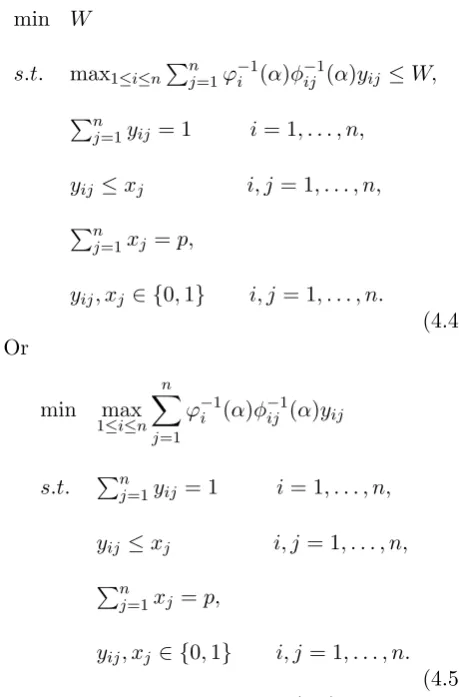
ηi and ξij, according to Theorem 2.1, the model
(4.3) can be equivalently transformed to the fol-lowing deterministic model:
min W
s.t. max1≤i≤n
∑n
j=1φ−i1(α)ϕij−1(α)yij ≤W,
∑n
j=1yij = 1 i= 1, . . . , n,
yij ≤xj i, j= 1, . . . , n,
∑n
j=1xj =p,
yij, xj ∈ {0,1} i, j= 1, . . . , n.
(4.4) Or
min max
1≤i≤n n
∑
j=1
φ−i 1(α)ϕ−ij1(α)yij
s.t. ∑nj=1yij = 1 i= 1, . . . , n,
yij ≤xj i, j= 1, . . . , n,
∑n
j=1xj =p,
yij, xj ∈ {0,1} i, j= 1, . . . , n.
(4.5) In fact, the solution to model (4.5) is just the p -center of the deterministic network N = (V , E),
V =V,E =E, and the distance between vertices
vi,vjisϕij−1(α), and the weight of vertexvi ∈V is
φ−i 1(α). According to this explanations, we have the following theorem.
Theorem 4.2 In network N = (V, E, η, ξ), let
ηi and ξij be independent uncertain variables with regular uncertainty distributions φi and ϕij, respectively. Then, the α-p-center of N = (V, E, η, ξ) is just thep-center of the network N = (V , E), V = V, E = E and the weight of the vertex vi is φ−i 1(α) and the shortest distance between the vertices vi and vj is ϕ−ij1(α).
Kariv and Hakimi proved that the absolute (vertex) p-center problem for a vertex-weighted or a vertex-unweighted network isN P-hard even
when the network is a planar graph of maximum vertex degree 3 [15]. Thus according to Theorem
4.2, we have the following theorem:
Theorem 4.3 The uncertainp-center problem is
N P-hard on general networks.
The α-1-center and α-2-center on un-certain unweighted trees
According to Theorem 4.2, we can obtain the
α-1-center and α-2-center on an uncertain un-weighted tree using the following algorithm:
Algorithm 3
1. Give a predetermined confidence levelα and calculateϕ−ij1(α) for eachξij.
2. Construct the corresponding deterministic network.
3. Use Algorithm 1 and Algorithm 2 to find the 1-center and 2-center.
4. Return 1-center and 2-center as the α -1-center andα-2-center.
Now we give an example to illustrate the conclu-sions presented above.
4.1.1 Example
Consider the unweighted treeT = (V, E) given in Figure 1 with uncertain edge lengths in Table 1. Given a predetermined confidence levelα= 0.9.
࢜1
࢜2
࢜3
࢜4
࢜5
࢜6
࢜7
࢜8
࢜9
࢜10
Figure 1: TreeT for Example4.1.1
Using the data in Table1, we computeϕ−ij1(α) for (vi, vj) ∈ E and construct the deterministic
Table 1: List of the edge lengths
Edges ξij Edges ξij
(v1, v2) Z(14, 16, 18) (v3, v10) Z(15, 16, 18)
(v1, v4) Z(15, 18, 20) (v4, v6) Z(16, 17, 18)
(v2, v3) Z(10, 11, 12) (v4, v7) Z(17, 19, 20)
(v2, v5) Z(20, 21, 22) (v4, v8) Z(8, 9, 10)
(v3, v9) Z(12, 13, 15)
Table 2: List ofϕ−ij1(0.9)
Edges ϕ−ij1(0.9) Edges ϕ−ij1(0.9)
(v1, v2) 17.6 (v3, v10) 17.6
(v1, v4) 19.6 (v4, v6) 17.8
(v2, v3) 11.8 (v4, v7) 19.8
(v2, v5) 21.8 (v4, v8) 9.8
(v3, v9) 14.6
Table 3: List of the expected values
Edges E(ξij) Edges E(ξij)
(v1, v2) 16 (v3, v10) 16.25
(v1, v4) 17.75 (v4, v6) 17
(v2, v3) 11 (v4, v7) 18.75
(v2, v5) 21 (v4, v8) 9
(v3, v9) 13.25
We begin by picking any point on tree T. Sup-pose that we pick vertex v9. Vertex v7 is the
farthest vertex from vertexv9. The farthest
ver-tex from verver-texv7 is the vertexv10. The absolute
0.9-1-center is the midpoint of the path from v7
to v10 on tree T, or 13.8 units from vertex v2
on the edge connecting vertices v1 and v2. The
vertex v1 is closest to the absolute 0.9-1-center.
Thus v1 is vertex 0.9-center. The absolute
1-center lies on edge (v1, v2). Removing this edge,
the treeT divides to two subtrees. After applying the Algorithm 1 to each of these subtrees, we ob-tain the absolute 0.9-1-center locations on edges (v4, v7) and (v3, v10). Thus the vertex 0.9-2-center
is{v3, v4}.
4.2 The expected p-center
Expected value is the average value of an uncer-tain variable in the sense of unceruncer-tain measure and represents the size of uncertain variable.
In [18], Liu introduced the concept of an ex-pected value. The exex-pected value of an uncertain variable is defined as follows: Let ξ be an
un-certain variable. Then the expected value of ξ is defined by
E[ξ] =
∫ ∞
0
M{ξ ≥r}dr− ∫ 0
−∞M{ξ ≤r}dr
provided that at least one of the two integrals is finite.
Theorem 4.4 (Liu [18]) Let ξ be an uncertain
variable with uncertainty distribution ϕ. If the expected value exists, then
E[ξ] =
∫ ∞
0
(1−ϕ(x))dx− ∫ 0
−∞ϕ(x)dx.
Theorem 4.5 (Liu [19]) Let ξ1, ξ2, . . . , ξn be in-dependent uncertain variables with regular uncer-tainty distributions ϕ1, ϕ2, . . . , ϕn, respectively. If the function f(x1, x2, . . . , xn) is strictly in-creasing with respect to x1, x2, . . . , xn then ξ =
f(ξ1, ξ2, . . . , ξn) has an expected value
E[ξ] =
∫ 1
0
As a useful representation of expected value, it has been proved by Liu [18] that
E[ξ] =
∫ 1
0
ϕ−1(α)dα
whereϕ−1 is the inverse uncertainty distribution
of uncertain variableξ. Note that ifη=Z(a, b, c) and φbe its uncertainty distribution, then
E(η) =
∫ 1
0
φ−1(α)dα= (a+ 2b+c)/4.
Now, we give the concept of the expected p -center in an uncertain network
N = (V, E, η, ξ).
Definition 4.3 In network N = (V, E, η, ξ), Vpe
is a p-facility location. Then Vpe is called the ex-pected p-center if
E(M(Vpe))≤E(M(Vp)) for all p-facility location Vp ⊆V.
Therefore, if the decision maker wants to find a scheme in the sense of expected value, then the expected value model for problem (3.2) can be written as follows:
min max
1≤i≤nE( n
∑
j=1
ηiξijyij)
s.t. ∑nj=1yij = 1 i= 1, . . . , n,
yij ≤xj i, j= 1, . . . , n,
∑n
j=1xj =p,
yij, xj ∈ {0,1} i, j = 1, . . . , n.
(4.6)
Equivalently, it can be rewritten as:
min max
1≤i≤n n
∑
j=1
E(ηi)E(ξij)yij
s.t. ∑nj=1yij = 1 i= 1, . . . , n,
yij ≤xj i, j= 1, . . . , n,
∑n
j=1xj =p,
yij, xj ∈ {0,1} i, j= 1, . . . , n.
(4.7) In other words, it can be represented as:
min max
1≤i≤n(
∫ 1
0
φ−i 1(α)dα)
n
∑
j=1
(
∫ 1
0
ϕ−ij1(α)dα)yij
s.t. ∑nj=1yij = 1 i= 1, . . . , n,
yij ≤xj i, j= 1, . . . , n,
∑n
j=1xj =p,
yij, xj ∈ {0,1} i, j= 1, . . . , n.
(4.8)
According to the above statements, we have the following theorem:
Theorem 4.6 In networkN = (V, E, η, ξ), letηi
and ξij be independent uncertain variables with regular uncertainty distributions φi and ϕij, re-spectively. Then, the expected p-center of N = (V, E, η, ξ) is just the p-center of the network N = (V , E), V = V, E = E and the weight of the vertexvi isE(ηi) and the shortest distance between the vertices vi and vj is E(ξij).
The expected 1-center and expected 2-center on uncertain unweighted trees
According to Theorem 4.6, we can obtain the ex-pected 1-center and exex-pected 2-center on an un-weighted tree with uncertain vertex distances by using the following algorithm:
Algorithm 4
1. Calculate E(ξij) for vi, vj ∈V.
2. Construct the corresponding deterministic network.
3. Use Algorithm 1 and Algorithm 2 to find the 1-center and 2-center.
4. Return 1-center and 2-center as the expected 1-center and expected 2-center.
4.2.1 Example
Consider Example 4.1.1. By using the data in Table 1 and according to definition of expected value of a zigzag uncertain variable, we obtain the values of Table 3. By using Algorithm 1 and Algorithm 2, we can find the vertex expected 1-center and 2-1-center as follows: The longest path on tree T is the path from v7 to v10. The
abso-lute expected 1-center is the midpoint of the path fromv7tov10on edge (v1, v2) or 12.625 units from
vertex v2 on the edge connecting vertices v1 and v2. The vertex v1 is closest to the absolute
ex-pected 1-center. Thus v1 is the vertex expected
1-center. Removing the edge (v1, v2), the tree T
divides to two subtrees. After applying the Al-gorithm 1 to each of these subtrees, we obtain the absolute expected 1-center locations on edges (v4, v7) and (v3, v10). Then the vertex expected
5
Conclusion
In this paper, we considered thep-center location problem on a network in which vertex weights and vertex distances are uncertain variables. We first investigated the uncertainty distribution of the optimal objective value of the p-center prob-lem and introduced the concepts of theα-p-center and the expected p-center. Then we showed that the α-p-center and the expectedp-center models can be transformed into corresponding determin-istic models. Finally, we proposed linear time al-gorithms for finding the 1-center and 2-center of uncertain unweighted trees.
References
[1] A. Al-khedhairi, S. Salhi, Enhancement to two exact algorithms for solving the vertex
p-center problem, Journal of Mathematical Modelling and Algorithms 4 (2005) 129-147.
[2] D. Bespamyatnikh, B. Bhattacharya, M. Keil, D. Kirkpatric, D. Segal, Efficient al-gorithms for centers and medians in interval and circular-arc graphs,Networks 39 (1979) 144-152.
[3] B. Ben-Moshea, B. Bhattachary, Q. Shi, A. Tamir, Efficient algorithms for center prob-lems in cactus networks, Theoretical Com-puter Science 378 (2007) 237-252.
[4] R. E. Burkard, H. Dollani, Center prob-lems with pos/neg weights on trees, Euro-pean Journal of Operations Researchs 145 (2003) 483-495.
[5] R. Chandrasekharan, A. Tamir, Polynomial bounded algorithms for locating p-centers on a tree, Mathematics in Programming 22 (1982) 304-315.
[6] T. C. E. Cheng, L. Kang, C. T. Ng, An im-proved algorithm for thep-center problem on interval graphs with unit lengths, Comput-ers and Operations Research 34 (2007, 2215-2222.
[7] M. S. Daskin, Network and discrete loca-tion: models, algorithms, and applications, 2nd ed., Department of Industrial and Op-erations Engineering, (2013).
[8] G. N. Frederickson, Parametric search and locating supply centers in trees, Workshop on Algorithms and Data Structures 519 (2005) 299-319.
[9] G. N. Frederickson, D. B. Johnson, Finding
kth paths and p-centers by generating and searching good data structures, Journal of Algebra 4 (1983) 61-80.
[10] Y. Gao, Uncertain models for single facil-ity location problems on networks, Applied Mathematical Modelling 36 (2012) 2592-2599.
[11] Y. Gao, Shortest path problem with uncer-tain arc lengths,Computers and Mathemat-ics with Applications 62 (2011) 2591-2600.
[12] Y. Gurevich, L. Stockmeyer, U. Vishkin, Solving N P-hard problems on graphs that are almost trees and an application to facil-ity location problems, Journal of the Asso-ciation for Computing Mathinery 31 (1984) 459-473.
[13] S. Han, Z. Peng, S. Wang, The maximum flow problem of uncertain network, Informa-tion Sciences 265 (2014) 167-175.
[14] G. Y. Handler, Minimax location of a facility in an undirected tree graph, Transportation Science 7 (1973) 287-293.
[15] O. Kariv, S. L. Hakimi, An algorithmic ap-proach to network location problems, I: The
p-centers,SIAM Journal on Applied Mathe-matics 37 (1979) 513-538.
[16] Y. F. Lan, Y. L. Wang, H. Suzuki, A linear-time algorithm for solving the center prob-lem on weighted cactus graphs,Information Processing Letters 71 (1999) 205-212.
[17] B. Liu, Some research problems in uncer-tainty theory, 2nd ed.,Journal of Uncertain Systems 3 (2009) 3-10.
[18] B. Liu, Uncertainty Theory, 2nd ed., Springer-Verlag, Berlin, (2007).
[20] N. Megiddo, Linear-time algorithms for lin-ear programming in R3 and related prob-lems,SIAM Journal on Computer 12 (1983) 759-776.
[21] N. Megiddo, A. Tamir, New results on the complexity of p-center problems, SIAM Journal on Computer 12 (1983) 751-758.
[22] P. B. Mirchandani, R. L. Francis, Discrete location theory, Wiley, New York, (1990).
[23] N. Mledanovic, M. Labbe, P. Hansen, Solv-ing the p-center problem with tabu search and variable neighborhood search,Networks
42 (2003) 48-64.
[24] S. M. A. Nayeem, M. Pal, Genetic algorithm to solve p-center and p-radius problem on a network,International Journal of Computer Mathematics 82 (2005) 541-550.
[25] K. T. Nguyen, N. T. L. Chi, A model for the inverse 1-median problem on trees un-der uncertain costs, Opuscula Mathematica
36 (2016) 513-523.
[26] F. A. Ozsoy, M. C. Pinar, An exact al-gorithm for the capacitated vertex p-center problem, Computers and Operations Re-search 33 (2006) 1420-1436.
[27] Z. Peng, K. Iwamura, A sufficient and nec-essary condition of uncertainty distribution,
Journal of Interdisciplinary Mathematics 2 (2010) 539-560.
[28] A. Tamir, Improved complexity bounds for center location problems on networks by us-ing dynamic data structures,SIAM Journal of Discrete Mathematics 1 (1988) 377-396.
[29] K. Wang, Q. Yang, Hierarchical facility loca-tion for the reverse logistics network design under uncertainty, World Academic Press, UK 8 (2014) 255-270.
[30] M. Wen, Z. Qin, R. Kang, The capaci-tated facility location-allocation problem un-der uncertain environment, Journal of In-telligent and Fuzzy System 29 (2015) 2217-2226.
[31] X. Zhang, Q. Wang, J. Zhou, Two uncertain programming models for inverse minimum
spanning tree problem, Industrial Engineer-ing and Management Systems 12 (2013) 9-15.
[32] J. Zhou, F. Yang, K. Wang, An inverse short-est path problem on an uncertain graph,
Journal of Networks 9 (2014) 2353-2359.
Fahimeh Baroughi received her Ph.D in Applied Mathematics from Graz University of Technol-ogy, Graz, Austria on 2010. She researches in the fields of combi-natorial optimization, location the-ory, uncertain programming and reverse optimization. Dr. Baroughi is currently an Assistant Professor at the Department of Ap-plied Mathematics, Sahand University of Tech-nology, Tabriz, Iran.
Akram Soltanpour is a Ph.D. can-didate within the Department of Applied Mathematics at the Sa-hand University of Technology, Tabriz, Iran. She received her B.Sc. degree from University of Urmia, Urmia, Iran, in 2009, and M.Sc degree from Kharazmi University, Tehran, Iran, in 2011. Her research interests are in the areas of combinatorial optimization, facility loca-tion theory, uncertain programming.