World Transport Policy & Practice
ISSN 1352-7614
Volume 6, Number 1, 2000
Mission Statement
World Transport Policy & Practice is a quarterly journal which provides a high quality medium for original and creative work in world transport.
WTPP has a philosophy based on the equal importance of academic rigour and a strong commitment to ideas, policies and practical initiatives that will bring about a reduction in global dependency on cars, lorries and aircraft.
WTPP has a commitment to sustainable transport which embraces the urgent need to cut global emissions of carbon dioxide, to reduce the amount of new infrastructure of all kinds and to highlight the importance of future generations, the poor, those who live in degraded environments and those deprived of human rights by planning systems that put a higher importance on economic objectives than on the environment and social justice.
WTPP embraces a different approach to science and through science to publishing. This view is based on an honest evaluation of the track record of transport planning, engineering and economics. All too often, these interrelated disciplines have embraced quantitative, elitist or mechanistic views of society, space and infrastructure and have eliminated people from the analysis.
World Transport Policy & Practice
ISSN 1352-7614
Volume 6, Number 1, 2000
Contents
3 Abstracts & Keywords 4 Editorial
5 Traffic reduction versus development pressures: sustainable transport in Liverpool Paul Tranter & Peter Lonergan
15 The ten myths of automobile dependence Peter Newman & Jeff Kenworthy
26 ‘Moving together’ – on shaping automobilisation Jörg Beckmann
31 Sustainable Development & Transportation: Past Experiences and Future Challenges Edward Akinyemi & Mark Zuidgeest
40 Sustainable Transport – A Comparative Analysis of Israel, the Netherlands and the United Kingdom Pnina O. Plaut & Deborah F. Shmueli
59 Notes for contributors
——————————————————————————————————————————————————
© 2000 Eco-Logica Ltd ISSN 1352-7614
Editor
John Whitelegg
Professor of Environmental Studies, Liverpool John Moores University, Clarence Street, LIVERPOOL, L3 5UG, U.K.
Editorial board Eric Britton
Managing Director, EcoPlan International, The Centre for Technology & Systems Studies, 8/10 rue Joseph Bara, F-75006 Paris, FRANCE.
John Howe
Professor of Transportation Engineering, International Institute for Infrastructural, Hydraulic & Environmental Engineering, P.O.Box 3015, 2601 DA Delft, THE NETHERLANDS.
Mikel Murga
Leber Planificacion e Ingenieria, S.A., Apartado 79, 48930-Las Arenas, Bizkaia, SPAIN. Paul Tranter
School of Geography and Oceanography, University College, University of New South Wales, Australian Defence Force Academy, Canberra ACT 2600, AUSTRALIA
Publisher
Eco-Logica Ltd., 53, Derwent Road, LANCASTER, LA1 3ES, U.K. Telephone +44 1524 63175 Fax +44 1524 848340
Abstracts & Keywords
Traffic reduction versus development pressures: Sustainable transport in Liverpool, United Kingdom Paul Tranter & Peter Lonergan
This paper examines sustainable transport in Liverpool, in the context of broader changes in societal awareness and in Government policy. After a brief discussion of the concept of sustainable transport and the role of traffic reduction within this concept, the paper briefly evaluates changes in national transport policy. It then focuses on Liverpool, examining policies directed at sustainable transport and the barriers to achieving this goal. The paper concludes with a discussion of the importance of Government support and leadership on sustainable transport.
Keywords: Liverpool, public policy, sustainable transport, traffic reduction
The Ten Myths of Automobile Dependence Peter Newman & Jeff Kenworthy
The myths about automobile dependence are analysed and dismissed as no longer having the inevitability they once had. The myths relate to wealth, climate, space, age, health and social problems, rural life styles, the road lobby, land developers, traffic engineering and town planning praxis. Only the tenth one seems to continue to have an inevitability due to entrenched practices which should now be updated and replaced.
Keywords: Automobile dependence, cities, development, engineering, myths, new urbanism, planning, traffic.
‘Moving together’ – on shaping automobilisation Jörg Beckmann
This article draws attention to how automobilisation as a mobility paradigm is shaped by social agencies such as national automobile owners associations. The author argues that by means of their reflexivity and their distinct responses to the risks of
automobilisation, these clubs contribute to the reproduction of automobilisation. They do so, in that they mediate between the omnipresent expert systems that are embedded in the car and the individual lay user. Hence, these ‘car custodians’ enable what can be seen as the ‘auto-man’ – a hybrid consisting of the car and its user.
Keywords: Automobilisation, breakdown & recovery services, cars, car clubs, members’ magazines
Sustainable Development & Transportation: Past Experiences and Future Challenges
Edward Akinyemi & Mark Zuidgeest
The term ‘sustainable transportation development’ is a combination of sustainable development and transportation. As a concept, it involves the
application of the sustainable development idea to transportation systems. This paper deals with how the concept of sustainability is currently used and how it should be used in the future engineering of transportation systems. First, the current definitions of sustainable development are reviewed and it is shown that there is a need for definition and criteria that can be used by engineers for planning, design and operation of transportation systems. Second, the current approaches of sustainability in transportation planning are reviewed and discussed. Subsequently, it is proposed that the focus should be on a sustainably developed transportation system, i.e. a system that meets the people’s needs, with the available or affordable environmental, financial and social resources. Finally, it is shown that a sustainably developed transportation problem is basically a mathematical problem.
Keywords: Sustainable development, transportation engineering, optimisation problem
Sustainable Transport – A Comparative Analysis of Israel, the Netherlands and the United Kingdom Pnina O. Plaut & Deborah F. Shmueli
In recent years ‘sustainability’ has become an important issue in policy discussion and decision making, especially with regard to transportation. Here the role of ‘sustainability’ and the forms of its incorporation into transportation policy is surveyed and compared for Israel, the Netherlands and the U.K. In particular, comparisons are made and discussed across these countries based on several factors, including existence of plans (strategic and integrative), specific objectives and targets, institutional arrangements, environmental impact assessment processes, implementation tools, and political and public commitment and involvement. The comparisons highlight two major tenets of the Israeli system that present obstacles to the
establishment of transportation and environmental linkages. The first involves the lack of transparency in the planning process and the corresponding dearth of political and public participation, consensus and commitment to plans. The second is the existing institutional structure.
Editorial
This is the first issue of this journal to be produced in electronic format only. It is not available in print and it is free of charge. The first five years of this journal’s life have made us aware of the importance of access to high quality information. For all the hype and pseudo-sophistication of the so-called information age we begin the 21st century with serious information deficits and serious flaws in the channels of communication that are available to deliver this information to places where it is needed and at times when it is needed. Making this journal available free of charge is a contribution to putting right one of these major flaws. We have been impressed (and
occasionally depressed) by the many and sometimes urgent requests for copies of the journal from contacts in Eastern Europe, India or Africa who have no resources for purchasing information or journals and yet are at the sharp end of detecting and resolving the most intransigent of global transport problems. They also need high quality information that has been through a selection and editing process against a known set of criteria. We are now delighted that we can support our colleagues in Calcutta, Delhi, Harare, Bucharest and Bratislava without the imposition of a financial barrier to communication.
In recent weeks one of our editorial board (Eric Britton in Paris) has demonstrated very eloquently indeed the value of quality information. This value lies in the capacity to identify what is important and discard what is not, to make that information
available speedily and to facilitate a process of development where the information itself becomes an agent of social change. Eric has performed all of these overlapping roles in the case of Bogota’s car free day in February 2000. This one event will very soon be seen as a spark that ignited a movement. The information flows galvanised Bogota’s leading thinkers on this subject by giving them confidence that success was certain for their endeavour. The social support networks that came with the information provided reassurance when it was needed and the success will now be self-propagating.
A car free day requires everyone to rethink basic assumptions and basic assumptions cannot be
challenged or re-cast in an information vacuum. Eric’s web site has information on car free issues (including Bogota) and also hosts this journal
http://www.ecoplan.org
In the late 1960s and early 1970s the Swedish geographer, Torsten Hägerstrand, (based at a delightful car free university campus in Lund) wrote about the way that the world was polarised into the mobility rich and mobility poor groups. This most basic of insights which still fails to inform the policies of social democratic governments everywhere has now reappeared in the world of information. Many of us have far too much information and cannot even come anywhere near to coping with it whilst others have very little and are locked into unequal struggles with those who are building flyovers in Calcutta or getting rid of non-motorised vehicles in Indonesia. Information makes a powerful contribution to redressing a democratic deficit. We can learn from Hägerstrand’s work and avoid information deficits in those parts of the world that need the information content and the social support networks that go with quality information.
Information also requires feedback. Is it the right kind, expressed in the right way for the right target audience? We need to know. Please let us know by contacting the editor directly on [email protected]
We have produced a large number of specific papers in the past. We have also produced thematic issues on sustainable freight, telematics and
teleworking, and car share. Geographical themes are also possible and we have special issues on Calcutta and Israel. We will add to this list and we need to identify the researchers and practitioners out there who also have high standards, a vision of what is possible and a strong commitment to work with citizens to make it happen. Feedback helps us to do this. Please help us to get the information content right.
Abstract
This paper examines sustainable transport in Liverpool, in the context of broader changes in societal awareness and in Government policy. After a brief discussion of the concept of sustainable transport and the role of traffic reduction within this concept, the paper briefly evaluates changes in national transport policy. It then focuses on Liverpool, examining policies directed at sustainable transport and the barriers to achieving this goal. The paper concludes with a discussion of the importance of Government support and leadership on sustainable transport.
Keywords
Liverpool, public policy, sustainable transport, traffic reduction
Introduction
Over the last ten years there has been a growing awareness of the negative impacts of road traffic – social, economic and environmental – in the United Kingdom. However, despite this changing awareness, and despite changes in UK transport policy, car ownership and use continue to rise.
This paper examines sustainable transport in Liverpool, in the context of broader changes in societal awareness and in Government policy. After a brief discussion of the concept of sustainable transport and the role of traffic reduction within this concept, the paper briefly evaluates changes in national transport policy. It then focuses on Liverpool, examining policies directed at sustainable transport and the barriers to achieving this goal. The paper concludes with a discussion of the importance of Government support and leadership on sustainable transport.
Sustainable Transport
This paper takes a broad view of the meaning of
sustainable transport. In environmental terms, a sustainable transport system is one in which: • the rates of use of renewable resources do not
exceed their generation,
• the rates of use of non-renewable resources do not exceed the rate at which sustainable renewable resources are developed, and
• the rates of pollution do not exceed the assimilative capacity of the environment (Green & Wegener, 1997).
But as well as the physical environment, the economic and social environment is an important component of sustainable transport. A transport system cannot be seen as sustainable if it has high levels of injury-producing accidents, or if its continued use generates greater demand for ever more
infrastructure and space. Nor is a sustainable transport one in which there are gross inequities in the access to transport and in the sharing of the burdens of transport. Equity among generations, nations and individuals is also generally regarded as integral to the definition of sustainability (Green & Wegener, 1997, 178).
By any definition, transport systems in the United Kingdom are manifestly unsustainable. The U.K. transport system fails the basic test of being able to meet the transport needs of the current generation without compromising the ability of future
generations to meet their transport needs. Excessive car use has been identified by the Royal Commission on Environmental Protection as a major cause of the unsustainability (RCEP, 1994).
Bringing about a reduction in motor vehicle traffic will not only reduce energy use and pollution
(particularly carbon dioxide levels) , but it will also effectively address the range of other issues related to sustainability. It will help bring economic gains to city centre retailing as well as national economic
Traffic reduction versus development pressures: Sustainable
transport in Liverpool.
Paul Tranter & Peter Lonergan
Address for correspondence
Paul Tranter
School of Geography and Oceanography, University of New South Wales, Australian Defence Force Academy, Canberra ACT 2600, Australia.
<[email protected]> Peter Lonergan
Tranter & Lonergan: Traffic reduction versus development pressures: Sustainable transport in Liverpool, United Kingdom
World Transport Policy & Practice, Volume 6, Number 1, (2000) 5–14 6
—————————————————————————————————————————————————— benefits. It will promote healthy neighbourhoods,
reduce the cost of new infrastructure, and will spread the benefits of transport more equitably toward children, the elderly, the poor and those with disabilities.
National transport policy in the U.K.: Revolution or Rhetoric?
In the 1980s transport policy in the U.K. was based on a ‘predict and provide’ approach which assumed that increases in road traffic reflected a growing and vibrant economy. Such a belief was evident in the 1989 Conservative Government White Paper Roads for Prosperity (DoT, 1989), which stressed the importance of continued road building for economic development.
The 1990s saw an apparent reversal in Government transport policy. A number of documents illustrate a growing awareness of the importance of sustainability and environmental protection. The Royal Commission on Environmental Pollution (1994) provided an influential indictment of the impact of transport. It highlighted many of the environmental problems caused by road-based traffic, including climate change, local air pollution, noise, community
severance and resource use. The Commission advocated strong policies to restrict road traffic growth,
recognising that new technology alone could not lead to a sustainable transport system.
Another important turning point in Government transport policy was a report from the Standing Advisory Committee on Trunk Road Assessment (SACTRA, 1995), which recognised that new road construction simply generated more traffic. Awareness of the need to reduce traffic growth was also reflected in Planning Policy Guidance Note 13: Transport (Department of the Environment & DoT, 1994), which clearly recognised the need to promote acceptable alternatives to the private car. It provided a clear attempt to guide local authorities to locate new developments in areas more easily served by public transport, or more accessible by walking and cycling. Also, and significantly, it highlighted the
importance of limiting the amount of car parking in new developments.
In 1996, the Conservative Government Green Paper on Transport acknowledged that continued road building was not a viable option, either
environmentally or financially (Chadwick & Ampt, 1998). Yet the Government would still not fully commit to policies for restraint. In 1998, the Labour Government published its policies in a Transport White Paper A New Deal for Transport: Better for Everyone (DETR, 1998). This document provided
encouraging rhetoric about sustainable transport. It recognised the problems created by cars and by
privatisation and deregulation. It stated clearly that more roads would not solve the problems of the car: the policy of ‘predict and provide’ didn’t work. The importance of local as well as national action was addressed, and it promised new planning tools for local councils, including levies on workplace parking.
Despite these positive policy statements, A New Deal for Transport: Better for Everyone presents a very weak approach to solving the problems created by the car. Indeed, it does not even aim to reduce traffic. Instead, it suggests: ‘We need to reduce the rate of traffic growth’ (Paragraph 1.35, p.16). This statement can also be interpreted as ‘We shall allow road traffic growth to keep on increasing!’ Other aspects of the document indicate a lack of commitment to real change. It suggests that more people will be able to afford a car and that we must have a better deal for motorists. Such statements are not compatible with a realistic view of sustainable transport. Also, while a change in Government policy on transport was becoming evident, other Government policies
encouraged more, not less, traffic. One of the most significant of these relates to education policy, where the notion of school catchment areas has been
considerably eroded, leading to longer journeys to school and increasing reliance on cars.
A strategic initiative in sustainable transport policy was provided by the Road Traffic Reduction Bill, launched in July 1995 by the Friends of the Earth, the Green Party and Plaid Cymru. The Bill required local authorities to set targets for reducing levels of local traffic. Since 1997 two Acts of Parliament have been passed for road traffic
reduction. Both cases involved intense lobbying for the inclusion of specific national targets for reductions, but in order to gain approval these clauses were deleted. At present the campaigning groups are pressing for the introduction of a third bill, the Road Traffic
Reduction (Further Provisions) Bill which, if enacted, would require the Government to cut traffic by 10% by the year 2010.
Liverpool: The current transport context
Tranter & Lonergan: Traffic reduction versus development pressures: Sustainable transport in Liverpool, United Kingdom
World Transport Policy & Practice, Volume 6, Number 1, (2000) 5–14 7
—————————————————————————————————————————————————— economic centre. In fact, Liverpool is one of the most
economically deprived areas in Britain, with high unemployment and poverty levels, and a shrinking population, falling from 516,700 in 1981 to 468,000 in 1998. In 1993, Merseyside was awarded Objective One status by the European Union, in recognition of Merseyside’s economically disadvantaged position, well below the European average. Objective One status makes it eligible for special funding from the EU to improve its economy.
Liverpool City Council (LCC) is now one of five councils in Merseyside (including the unitary authorities of Wirral, St Helens, Sefton and Knowsley). The former Metropolitan County of Merseyside (comprising these five councils) was abolished in 1986 by a previous Conservative Government in a move that did little to assist the provision of integrated transport in Merseyside. In order to counteract this missing Government level, the five councils work together on transport issues in an attempt to produce a co-ordinated plan, even though this cannot ensure that policies will be uniformly implemented in all council areas. One outcome of this co-ordination is a joint submission for the Merseyside Package Bid (a submission for Government funding for transport projects). LCC also develops its own
Transport Policies and Programme submission (TPP). Compared with cities such as Leeds, Sheffield or Birmingham, Liverpool has little traffic congestion. That is largely due to the very low car ownership levels (0.224 cars per head). Car ownership levels have increased by about 10% in Liverpool from 1991 to 1996. Across all of Merseyside, car driver trip mileage increased by over 20% from 1988 to 1996, from 6.1 to 7.6 km per day, mainly due to more trips per person. This indicates that though car usage levels are still low by national standards, traffic is still increasing.
Traffic growth forecasts suggest that between 1996 and 2031, traffic growth levels for
Merseyside at 43% will be lower than the national average, predicted to be about 52%. However, all councils within Merseyside recognise that even this lower figure ‘is unsustainable in economic and environmental
terms, and therefore unacceptable’ (Merseyside 1999/2000 Package Bid, 1998, p.9).
The current low level of car ownership in Liverpool means that a greater percentage of the population is dependent on public transport. The majority of public transport provision is by buses, all of which are operated by private companies. Approximately 38% of all trips into the city centre are made by bus,
compared to 10% by rail (LCC, 1998b, p.7). The Mersey electric rail system is extensive, offering frequent and reliable services and includes a loop serving five stations in the city centre. It is, however, considerably under-utilised, and is subsequently heavily
subsidised. It has the potential to reduce car trips if other measures, such as parking reduction, were implemented.
Since the deregulation of bus services, LCC has little direct input into the provision of buses. However, an organisation called Merseytravel is responsible for ensuring the effective provision of public transport in Merseyside. Merseytravel has been proactive in producing environmental and public transport strategies, but its funding and powers are inadequate. It has little control over the private bus operators, and has to negotiate with them even to get them to use new bus facilities (see below). It also provides financial support for non-commercial bus services as well as to the local rail network. It operates both the Mersey Ferries and the Mersey tunnels, and finances the most comprehensive concession travel scheme outside London.
[image:7.595.270.543.549.733.2]While congestion is not a pressing problem in Liverpool, air pollution is. The city has been shown to exceed the maximum recommended levels of air pollutants in the form of PM10s for over 50 days in one year. Merseytravel’s own Environmental Strategy has
Table 2: Main Mode of transport to work by region Main Mode of transport to work by region Main Mode of transport to work by region Main Mode of transport to work by region Main Mode of transport to work by region Main Mode of transport to work by region Main Mode of transport to work by region of workplace, Autumn 1997
of workplace, Autumn 1997 of workplace, Autumn 1997 of workplace, Autumn 1997 of workplace, Autumn 1997
Workplace car/van/ minibus
2wmv bicycle bus rail walk
West
Yorkshire 0.7
-2 13
-12 South
Yorkshire 71
-2 13
-12 Metropolitan
West Midlands 73
-2 12 2 9
Merseyside
67
-3 13 4 11
Great Britain
71 1 4 8 5 11
DETR (1998) Transport Statistics Great Britain DETR (1998) Transport Statistics Great Britain DETR (1998) Transport Statistics Great Britain DETR (1998) Transport Statistics Great Britain DETR (1998) Transport Statistics Great Britain DETR (1998) Transport Statistics Great Britain
Table 1: Liverpool & National car Liverpool & National car Liverpool & National car ownership & use
ownership & use
Liverpool National
Car ownership (%)
Car ownership (%) 22.4 69
Average daily use (km)
Average daily use (km) 7.1 13
DETR (1998) Transport Statistics Great Britain DETR (1998) Transport Statistics Great Britain DETR (1998) Transport Statistics Great Britain DETR (1998) Transport Statistics Great Britain
Tranter & Lonergan: Traffic reduction versus development pressures: Sustainable transport in Liverpool, United Kingdom
World Transport Policy & Practice, Volume 6, Number 1, (2000) 5–14 8
—————————————————————————————————————————————————— acknowledged that buses are a contributory factor to
localised air pollution, particularly in relation to particulate pollution. As in many other provincial cities, competition on bus routes is unhelpful in
environmental terms. Many operators over-supply the market, and the city centre often has line-ups of buses holding each other up, each with small passenger numbers.
Policies directed at sustainable transport in Liverpool Liverpool, like many other local authorities throughout the U.K., has made some useful progress towards more sustainable transport. A significant part of its approach is to develop a balanced transport system, based on a multifaceted approach to
sustainable transport. It aims to achieve this through co-operation with Merseytravel and public transport operators to produce a good quality public transport service, by promoting and supporting initiatives for walking and cycling, as well as targeting roads with high traffic volumes for traffic management (LCC, 1998a). The discussion about Liverpool in this paper focuses mainly on Liverpool City Council, with some reference to other organisations and other councils. The information for this section is based on published documents from LCC and Merseytravel, as well as semi-structured interviews with transport planners, transport researchers, members of the public and representatives of transport lobby groups. Initiatives in the following areas are discussed: parking, walking and cycling, public transport, inner city revitalisation, leading by example, working with other councils, road construction, and marketing.
Parking
Control over parking availability and cost is one of the most effective strategies for reducing car use in cities, even more so than levels of public transport provision in areas well served by public transport (Dasgupta, 1994; DoE & DoT, 1994; Hine, 1998).
LCC, along with other authorities in Merseyside, has accepted as a broad policy principle that there should be no overall increase in the supply of car parking beyond current levels in the main centres, except to meet the minimum operational needs of major town centre developments (Merseyside
1999/2000 Package Bid, 1998, p.25). While this falls short of a more radical move to actually significantly reduce car parking availability, the City Centre car parking strategy is primarily aimed at reducing commuter travel and thus encouraging a modal shift to public transport. The council is reducing its provision of long stay car parks, while still providing for short term parking to meet the needs of shoppers. Also, the
controlled parking zone (maximum of two hour parking) around the city centre has been extended, thus further limiting commuter parking.
Local authority control over parking is limited by the large number of privately operated off-street parking spaces in Liverpool. More than 70% of the 15,000 available spaces are privately controlled. The council does have control over the construction of additional car parking in new developments. Indeed, PPG 13 has encouraged the use of parking restrictions on new developments. However, recent evidence suggests that developers are able to evade any limitations on maximum car parking spaces. Indeed, even published planning documents suggest that planners are very sympathetic to the demands of developers for more parking space: the key issue of parking will continue to be reviewed in light of the numerous redevelopment proposals now being considered in the City Centre, many of which are requiring a level of car parking seen as essential to the developers to sustain their developments (LCC, 1998b, 15).
Some recent developments in Liverpool city centre (e.g. Queen Square) have been accompanied by large car parking structures. Approximately 65% of the 650-space car park for Queen Square development is for public use. A large number of cleared/vacant sites are used for parking (both long and short stay).
It is unlikely that council policies will have any impact, especially in the short term, on the
availability of car parking in central Liverpool. What is desperately needed is the development of strong disincentives for workplaces (including
universities and hospitals) to add to their own supply of private long term non-residential parking, as well as incentives for these workplaces to encourage non-car modes for the journey to work.
Walking and Cycling
Walking and cycling are arguably the only truly sustainable modes of transport. Not only do they have widely recognised health benefits, but also they are crucial to any urban transport policy. Despite low car ownership levels, walking and cycling levels in Liverpool fall well below the national average for person trips by these modes. This is largely due to the danger and unpleasantness associated with walking and cycling in Liverpool. Thus there is considerable potential for enhancing these modes.
Tranter & Lonergan: Traffic reduction versus development pressures: Sustainable transport in Liverpool, United Kingdom
World Transport Policy & Practice, Volume 6, Number 1, (2000) 5–14 9
—————————————————————————————————————————————————— been particularly effective in ensuring that cycle
facilities are included in all significant development applications. Liverpool also has a privately run cycle centre in the city, the ‘Liverpool Cycle Centre and Hub Café’. Aimed at encouraging cycle commuting, it includes a cycle shop, café, showers and changing facilities, and cycle storage. However, because this is a commercial venture, it has had to cut back on some of its most innovative areas. For example, its opening time was put back to 10 a.m. Local authority funding for such a venture could greatly assist the
development of cycling.
LCC has developed a comprehensive cycling strategy, which acknowledges the current poor level of provision for cyclists. A network of cycle routes is planned for development over the next few years, including 130 km of strategic cycle network and 124 km of secondary connecting network. The measures to be introduced include: dedicated cycle lanes, advisory routes and traffic calming measures to promote safety for cyclists, and cycle parking facilities. In addition, cyclists are permitted to use newly created bus lanes throughout Merseyside.
A number of targets were set for Liverpool in relation to cycling, including specific targets for overall modal share for cyclists (from 1.5% in 1998, to 4% in 2001, 8% by 2007 and 12% by 2012). Recently,
these targets were lowered (e.g. to 8% by 2012). If the original targets could be achieved, Liverpool would change from one of the lowest levels of cycle usage in the U.K., to levels that approximate cycling rates in Germany (see Table 3). Although the council believes that it has set itself ambitious targets for increasing cycling, other urban areas in UK already have much higher levels of cycling. In York, Oxford and
Cambridge 20-25% of all journeys are made by bicycle. In Groningen in the Netherlands, the current figure is about 50%! A continued commitment to the bicycle strategy should allow Liverpool’s targets to be achieved.
The pedestrian environment in Liverpool is currently inferior, even compared with many other areas in the U.K.. Although there is a significant and well designed pedestrianised area within the city centre, outside this area pedestrians are poorly served. Pavements are often poorly maintained, street lighting is poor, and crossing busy roads is often difficult, even for able-bodied adults. The council has expressed a commitment to promote walking, through the provision of facilities for pedestrians, making key pedestrian routes as direct as possible, removing conflict with vehicular traffic (LCC, 1998b, p.19). Traffic calming is also seen as a way of improving the environment for pedestrians. However, though the council does recognise the importance of walking as a mode of transport, it has not set any specific targets to improve the modal share, as it has for cycling.
Instead it seems content to continue with its program of general maintenance repairs to footways and
upgrading of pedestrian crossings (including new dropped crossings). Given the current standard of footways and crossings, it appears that the budget for such maintenance has been inadequate for many years, indicating that until now, pedestrian movement has
Table 3: Percentage of all trips made by bicycle Table 3: Percentage of all trips made by bicycle Table 3: Percentage of all trips made by bicycle
Netherlands 30
Denmark 20
Germany 12
York (England) 20
Erlangen (Germany) 26
Groningen (Netherlands) 50
Sources: International Bicycle Fund, DETR, 1998, p.36 Sources: International Bicycle Fund, DETR, 1998, p.36 Sources: International Bicycle Fund, DETR, 1998, p.36
http://www.ibike.org/statistics http://www.detr.gov.uk/http://www.detr.gov.uk/
Table 4: Transport Priorities – York & Liverpool Table 4: Transport Priorities – York & Liverpool
York Liverpool
1 Pedestrians To encourage modes other than the private car
2 Disabled People To implement measures to reduce private car use
3 Cyclists To improve conditions for walking and cycling
4 Public Transport Passengers To reduce dangers to road users
5 Commercial / business vehicles requiring access To create a safer environment to increase independent mobility
6 Car-borne shoppers
7 Coach-borne visitors
8 Car-borne long stay commuters and visitors
Tranter & Lonergan: Traffic reduction versus development pressures: Sustainable transport in Liverpool, United Kingdom
[image:10.595.58.538.64.741.2]World Transport Policy & Practice, Volume 6, Number 1, (2000) 5–14 10
Tranter & Lonergan: Traffic reduction versus development pressures: Sustainable transport in Liverpool, United Kingdom
World Transport Policy & Practice, Volume 6, Number 1, (2000) 5–14 11
—————————————————————————————————————————————————— not been a transport priority.
Unlike the cycling strategy LCC has no inspiring policy on walking. It could follow the example of York, which places pedestrians clearly at the top of its hierarchy of users, which already has
pedestrianised a significant proportion of its central area, and which is also implementing a pedestrian route network throughout the city, linking the city centre to residential areas, shops and schools.
Another element within the area of walking and cycling is the concept of Safe Routes to School, which is a key element within the Schools Transport Policy identified within the Liverpool Cycling strategy. The Government has highlighted children’s travel to school as a key example of where changes in travel behaviour can make a real difference. Safe Routes to School have already been implemented by a number of local authorities throughout the U.K. However, Liverpool has been slow to develop any initiatives in this area.
Another problem with the journey to school in Liverpool may be an attitudinal one. Both children and staff in Liverpool schools are not supportive of cycling to school. For many children, cycling is seen as not cool and some school principals do not seem to want the responsibility of encouraging children to cycle to school, partly because of problems with bicycle theft and partly due to traffic dangers. Consequently, some schools actively discourage cycling by their students. To break this vicious circle, the local authority needs to be proactive: facilitating cycling generally and safe routes to school, but also giving more publicity to cycling as a realistic alternative to other transport modes.
Public transport
Before World War 2, Liverpool had one of the most extensive tramway systems outside London. This included lengths of segregated rights of way. However, there was a lack of investment in the system, and a decision was made in 1945 to replace it with a bus network. Deterioration set in, and the tramway system was closed down in 1957. Liverpool now has no trams or light rail, though these are showing a resurgence in other UK cities (e.g.
Manchester, Sheffield). By contrast, public transport in Liverpool now consists of a train network and private bus operators.
LCC now has little control over public transport. Even Merseytravel has limited power to improve the system. Many of the improvements Merseytravel and the council are making involve tinkering with a
fundamentally flawed model of deregulated, privately-operated public transport. Even the Government’s Transport White Paper explains: ‘Privatisation and deregulation of public transport failed the passenger because they fragmented networks and ignored the public interest’ (Paragraph 1.4, p.10).
Instead of being able to develop a fully co-ordinated and well-planned system of public transport, improvements are limited to such actions as: quality partnerships (in which, for example, changes are made to bus lanes, and bus shelters and facilities are improved); publicity campaigns; and educational campaigns for school children.
Co-ordination of bus services in Merseyside is extraordinarily difficult. This is even more of a concern, considering that 85% of all public transport trips in Merseyside are made by bus. One of the most important strategies for improving bus services is the development of Quality Bus Corridors based on the innovative SMART services. SMART bus services include such features as: low flat-floor buses to assist wheelchair users and adults with young children; bus priority measures offering slightly reduced and more reliable travel times; high quality bus shelters, some of which provide real-time information; and special driver training. A demonstration experiment with SMART buses, funded with EU support, was
implemented along a route considered commercially non-viable. The success of this scheme has stimulated further development of the Quality Bus corridors.
Merseytravel has reported difficulties convincing some operators to use new bus stations and facilities. For example, it took up to three years to get some operators to use new bus facilities in Queen Square, where exceptionally well designed bus shelters, with glazing from floor to roofline, increase the sense of personal security by allowing for passive surveillance by other citizens.
Given the difficulties facing Merseytravel and LCC in their attempts to increase the efficiency of bus services, it is hardly surprising that the targets in the Package Bid for transport funding are not inspiring for buses. The specific target was simply to maintain bus patronage at the 1994/1995 level while increasing rail by 10% (Merseyside 1999/2000 Package Bid, 1998, p.101).
As well as improvements to existing bus services, there are plans to develop new public transport systems based on different technology. For example. Merseytravel, in co-operation with LCC and
Tranter & Lonergan: Traffic reduction versus development pressures: Sustainable transport in Liverpool, United Kingdom
World Transport Policy & Practice, Volume 6, Number 1, (2000) 5–14 12
—————————————————————————————————————————————————— Transit guided trolley bus system, to run from Page
Moss to the city centre as the first stage in a three-line system. Another proposal, by the Liverpool Light Rail Group, is to run from Speke via the airport to the city centre. While LCC supports this scheme as well, it would be funded from private finances.
Unfortunately these have been rejected for Government funding, suggesting a lack of real commitment to improving public transport. Inner City Revitalisation
LCC is aiming to re-establish a residential population in the city centre, as well as to encourage the managed development of on-street activities such as pavement cafés, which add to the life and vitality of the city centre (LCC, 1998a, p.52). Recent examples of this include residential redevelopment of docks, and redevelopment of Concert Square with residential apartments, offices, bars and cafés, set around a public space. Such actions show an awareness of the
importance of facilitating exchange between people (Engwicht, 1992) in order to create the social conditions for a truly sustainable city. This type of inner city revitalisation (with both housing and social activity) will help achieve a sustainable transport system by reducing the need for travel, as well as making the city a more attractive place for people and for investment.
Leading by example
One of the most important ways to encourage people to leave their cars at home, or to avoid buying one in the first place, is to provide examples of how leaders of society can reduce their own car travel. Local authorities can provide such examples, setting the highest standards of non-use of the car,
eliminating on-site car parking, and encouraging alternative forms of transport (especially walking and cycling). Given that local authorities are often among the top generators of traffic themselves, this is particularly important.
Local authorities in Merseyside, including LCC, are aware of the importance of leading by example. However, LCC has been tardy in setting standards for sustainable transport. Although there has been an attempt to raise awareness about transport issues, and to secure TravelWise pledges from staff, little has been done to reduce car use or encourage other modes in the operation of the council itself. For example, councillors are not encouraged to leave their cars at home. Planners had to lobby strongly even to get a bicycle cage in the basement of the new council offices. LCC has car parking for senior executives, and a car users allowance.
This situation contrasts strongly with the situation in the City of Edinburgh Council, where senior
executives make a point of coming to work by means other than a car. Two individuals in particular, Councillor David Begg and the Director of City Development, George Hazel, have been instrumental in effecting this policy of leading by example. There is no parking provision for private cars, only a car park for operational needs. There are bicycle parking facilities and showers. There is a mileage allowance for people who use a bicycle for work purposes. There is also a Staff Travel Information Pack that
encourages council employees to walk or use a bus token rather than using a car on council business. Edinburgh thus provides an excellent example to other local authorities.
Road Building
Although, road building in Liverpool has been substantially curtailed, there is still a belief that some circumstances may justify capacity improvements on some roads or additions to the highway network, but only where they are considered essential to improve access (LCC, 1998b, pp.15, 32). Such a view is partly understandable, given that it may be
impossible, under the current deregulated public transport system, to develop public transport solutions to improved access. However, in principle, if a sustainable transport system is to be developed, building more road capacity can only encourage more car use, and hence create a less sustainable system. Marketing
One of the biggest obstacles to people changing their travel habits is a lack of awareness of
alternative modes of transport. In 1997, the five local authorities in Merseyside joined with Merseytravel to launch the TravelWise campaign. This encourages people to change their travel behaviours, limiting car use to essential journeys and using public transport, walking and cycling wherever possible. The SMART bus initiatives have also helped with the marketing of public transport. However, much more can be done, for example, with strategies to make public transport more attractive through travel card schemes with transfer ticketing.
Tranter & Lonergan: Traffic reduction versus development pressures: Sustainable transport in Liverpool, United Kingdom
World Transport Policy & Practice, Volume 6, Number 1, (2000) 5–14 13
—————————————————————————————————————————————————— sustainability, seem to dominate decisions made by
local authorities in many areas of Britain. A survey of Scottish local planning authorities showed that while traffic reduction was a consideration when assessing new developments, economic development was regarded as the most important factor (Hine, 1998). In the Merseyside Transport Strategy, Core Policy One reflects the importance which the Partners (local authorities and Merseytravel) place on
economic regeneration (Merseyside 1999/2000 Package Bid, 1998, iv). This emphasis seems to be influencing the decision of LCC, for example to allow the construction of new car parks in the city centre.
A possible explanation for the lack of resistance to developers who require more car parking relates to the perceived competition for inward investment from other areas, including nearby cities such as
Manchester. Indeed, there is a perception that any traffic reduction strategy may reduce the
competitiveness of a city, and allow investment and retail activity to be attracted to other areas. However, such a perception may be unfounded. Research in England and Wales has indicated that there is no relationship between accessibility to the road system and economic prosperity (Whitelegg, 1997, p.15). This argument has been supported by the SACTRA (1999) Report, which questions whether road investment provides any economic gain at all (Chadwick and Ampt, 1998). Similarly, research in Germany shows that there is no link between the levels of car parking in the city centres and the amount of retail spending. Thus, city centre retailers may be better off without high levels of car parking, as long as access by other modes is encouraged. This would attract investment and retail activity through the creation of a more people-friendly environment.
Another problem in reducing car use relates to the phenomenon of unintended consequences. For example, restricting car parking in the city centre may not achieve overall reductions in car use over the
metropolitan area. While it may reduce the number of trips to the central area, not all of these trips will be replaced by public transport. Some people may continue to use their cars, but use them to visit suburban or out-of-town centres instead. Thus
restricting the availability of city centre car parking will reduce overall car use only if it is combined with wider policies of car restraint (possibly including increased car parking charges at suburban centres).
Liverpool has few really innovative or strong policies for a move toward sustainable transport. Instead, existing policies seem to be aimed only at moderating the upward trend in car use (LCC, 1998b,
19) rather than actually reducing traffic. The lack of local authority control and the restrictions on local authority interference in public transport means that innovation is very difficult in Britain. In contrast, many European countries are much more progressive concerning public transport. Public investment in new public transport systems (often rail based) is
commonplace in France and Germany for example. In contrast, in Britain, the local authorities must involve the private sector, and rely on complicated
arrangements with private companies whose interests are more concerned with profit making than with developing integrated transport systems.
Despite these limitations, Liverpool can look to other British cities for examples of stronger policies on sustainable transport. One of the best examples of innovative policy can be found in Edinburgh (Hazel, 1998), where a range of initiatives exist, based on the recognition that a first class economy and a first class environment must go hand in hand and that a holistic approach to transport is needed. The policy
statements in transport documents are strong, mentioning radical measures and the need to reduce traffic levels. There is even the promotion of car free residential areas and city car clubs (based on car share schemes). The significance of such schemes is not in the immediate impact on overall car use in Edinburgh, but in the effect it has on the mind set of Edinburgh residents. They allow residents to see that there are alternatives to the way cars are usually used by people.
Conclusion
The creation of more sustainable transport systems through significant reductions in traffic is an
achievable goal. The formula for success is the combination of local initiatives with strong central Government support and intervention. Perhaps the most significant obstacle to the creation of sustainable transport in Liverpool is the absence of Government support. The White Paper promised this support (DETR, 1998). It proposed that local authorities should have powers to introduce road pricing and car parking taxation and keep the money to spend on improved public transport and improved conditions for cyclists and pedestrians.
Tranter & Lonergan: Traffic reduction versus development pressures: Sustainable transport in Liverpool, United Kingdom
World Transport Policy & Practice, Volume 6, Number 1, (2000) 5–14 14
—————————————————————————————————————————————————— bad old days of road construction. More recently, the
consultation draft to update PPG 13 contains parking maxima which are more generous than, and thus undermine, those of many local authorities.
What this suggests is that the road lobby has again effectively stifled any national innovations in sustainable transport. In the short term, it is unlikely that support for local authorities will be improved. Consequently, there is even more pressure on local authorities to do everything they can to reduce car use on their own initiatives, working within the
constraints of an appalling privatised public transport system and a market-oriented neo-liberal climate which promotes competition rather than co-operation. Local authorities need to develop their own regional partnerships, and come to agreements about regional norms on car parking provision to discourage a competitive bidding up process. They need to lead by example, to take radical steps, to model their changes on best practice models (from cities throughout the world) and concentrate on the creation of attractive and livable environments rather than on a narrow vision of car dependent economic development.
References
Chadwick, N. & Ampt, L. (1998) ‘UK transport policy – a shift toward a green agenda?’ Papers of the 22nd Australasian Transport Research Forum. Sydney, ATRF.
Dasgupta, M. (1994) ‘Impact of transport policies in five cities’ Project Report 107. Crowthorne, Transport Research Laboratory.
Department of the Environment Transport and the Regions (1998) A New Deal for Transport: Better for Everyone London, HMSO.
Department of the Environment & Department of Transport (1994) Planning Policy Guidance Note 13: Transport London, DoE/DoT.
Department of Transport (1989) Roads for Prosperity London, HMSO.
Engwicht, D. (1992) Towards an Eco -City: Calming the Traffic Sydney, Envirobook.
Green, D.L. & Wegener, M. (1997) ‘Sustainable transport’ Journal of Transport Geography 5(3): 177-190.
Hazel, G. (1998) ‘Sustainable transport: Edinburgh's approach’ World Transport Policy & Practice 4(4): 16-23.
Hine, J. (1998) ‘Roads, regulation and road user behaviour’ Journal of Transport Geography 6(2): 143-158.
Liverpool City Council (1998a) ‘Liverpool Planning and Transportation Handbook’ Liverpool, LCC. ____ (1998b) ‘Transport Policies and Programme, 1999/2000’ Liverpool, LCC.
Merseyside 1999/2000 Package Bid (1998) ‘Merseyside Transport Strategy and Investment Programme 1995-2004’ Liverpool, Merseytravel.
Royal Commission on Environmental Pollution (1994) Eighteenth Report: Transport and the Environment Oxford, Oxford University Press.
SACTRA (1995) Trunk Roads and the Generation of Traffic London, HMSO.
SACTRA (1999) Transport Investment, Transport Intensity and Economic Growth London, The Stationery Office.
Whitelegg, J. (1997) Critical Mass: Transport
Abstract
The myths about automobile dependence are analysed and dismissed as no longer having the inevitability they once had. The myths relate to wealth, climate, space, age, health and social problems, rural life styles, the road lobby, land developers, traffic engineering and town planning praxis. Only the tenth one seems to continue to have an inevitability due to entrenched practices which should now be updated and replaced.
Keywords
Automobile dependence, cities, development, engineering, myths, new urbanism, planning, traffic. Introduction
Cities show varying degrees of automobile
dependence (Newman & Kenworthy, 1989, 1999). The rationale for justifying the extent of car-based low density dispersal has many different forms which are encountered whenever discussions are held showing the variations in different city forms and
transportation patterns.
In Table 1, we list 10 of the most common reasons which have been suggested to explain the
phenomenon of automobile dependence. This paper will argue that none of them are sufficient in themselves. They are therefore called ‘myths about automobile dependence’. They are the basis for addressing public policy and administration issues to do with cities and cars as they reach to the
The Ten Myths of Automobile Dependence
Peter Newman & Jeff Kenworthy
Address for correspondence
Peter Newman
Professor of City Policy, Director, Institute for Science and Technology Policy, Murdoch University, Perth, Australia <[email protected]>
Jeff Kenworthy
Senior Lecturer in Urban Environments, Institute for Science and Technology Policy, Murdoch University, Perth, Australia <[email protected]>
Table 1: 10 Myths about the Inevitability of Automobile Dependence Table 1: 10 Myths about the Inevitability of Automobile Dependence
1 Wealth Automobile dependence is an inevitable consequence of wealth. People will always buy cars and larger amounts of private urban space, thus alternative urban forms, public transport and non-motorised modes will inevitably die out as people get richer.
2 Climate Automobile dependence is inevitably induced by warm climates where people can enjoy low density suburban lifestyles, whereas compact, transit-oriented cities are mostly in cold climates.
3 Space Automobile dependence is inevitably part of countries that are very spacious, whilst those with little space have compact cities.
4 Age Automobile dependence is an inevitable feature of modern life and thus new cities developed predominantly after 1945 show it more than old cities.
5 Health and Social Problems Automobile dependence is inevitably created by the reaction to density and its health and social problems.
6 Rural Lifestyles Automobile dependence is inevitably created by the attraction of rural lifestyles in the suburbs with their associated promise of withdrawal from the evils of city lifestyles.
7 Road Lobby Automobile dependence is inevitably created by the powerful combination of road interests.
8 Land Developers Automobile dependence is inevitably created by the powerful interests of land speculators and developers and there is little that planning can do to stop them.
9 Traffic Engineering Automobile dependence is an inevitable outcome of the standard processes of transportation planning.
Newman & Kenworthy: The Ten Myths of Automobile Dependence
World Transport Policy & Practice, Volume 6, Number 1, (2000) 15–25 16
—————————————————————————————————————————————————— assumptions that are causing so many policy makers,
practitioners and activists to feel there is nothing they can do about automobile dependence.
Dispelling the myths about automobile dependence
Wealth
Automobile dependence is an inevitable consequence of wealth. People will always buy cars and larger amounts of private urban space thus alternative urban forms of transportation will inevitably die out as people get richer.
Many urban commentators suggest there is an inevitable link between rising living standards and rising demands for private space and car use (e.g. Gomez-Ibanez, 1991). ‘As soon as people get enough money they will buy a car and move to the suburbs’ is how the inevitability is generally expressed.
Stopping these sprawling car-based cities is therefore like being the hapless King Canute.
Rising living standards obviously do impact on transportation and land use (Schafer & Victor, 1997). Historical analysis shows how cities have moved outwards following trams and trains, and then cars, as people developed the economic means to take
advantage of these technologies. Also, increasing incomes meant that people could afford to buy bigger homes and more spacious surroundings which
they appreciated for cultural reasons. However, the link between living standards and a more car-based, low density city is not automatic. In fact, the
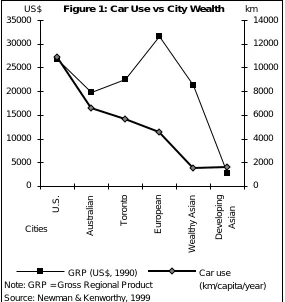
correlations are very weak and in more recent times are going in the opposite direction (see Newman & Kenworthy, 1999, and Figure 1). Thus the future does not necessarily bring more automobile dependence. Technological determinism based on cars can be switched into transit if a quality service is available and the major road and freeway systems are operating close to capacity. Cultural choices vary and the dream of space in the suburbs can be replaced for some with a dream of urban living near to the full range of amenities and cultural attractions. In addition to this, the economic processes which link wealth and urban form, as suggested above, are much more complex than conventional argument has considered.
An analysis by Frost (1991) provides a detailed understanding of the link between wealth and urban form based on whether
wealth is mostly reinvested in new suburban
infrastructure or into industrial development. North American and Australian cities have mainly done the former and hence have developed low density, car-based cities while others have become more compact as they reinvested more into industrial innovation. Frost seriously questions whether any cities can continue to move in the direction which assumes growing wealth from our rural hinterlands is the basis of urban growth patterns. The financial problems with urban sprawl have led the Bank of America to reject investment in dispersed suburbs in favour of more compact development (Bank of America, 1994)
Other urban researchers (reviewed in Newman & Kenworthy, 1989) have shown how levels of car ownership and use are significantly less in higher density areas of cities at all levels of wealth (why use a car if you can walk or take transit more quickly and conveniently?).
Our global cities data (Newman & Kenworthy 1989, 1999) reveal a significant difference between U.S./Australian and European/Asian cities in their density and in their car use patterns – and yet European city incomes are higher. Indeed many European cities have per capita incomes 20% to 50% higher than in Australian and U.S. cities, yet are four
0 5000 10000 15000 20000 25000 30000 35000
U.S.
Australian
Toronto
European
Wealthy Asian
Developing
Asian
0 2000 4000 6000 8000 10000 12000 14000
GRP (US$, 1990) Car use
[image:16.595.260.545.432.734.2](km/capita/year)
Figure 1: Car Use vs City Wealth
Cities
US$ km
Newman & Kenworthy: The Ten Myths of Automobile Dependence
World Transport Policy & Practice, Volume 6, Number 1, (2000) 15–25 17
—————————————————————————————————————————————————— times as dense and two to three times less intensive in
their car use.
When we talk to European planners they are adamant that their urban policies are determined to minimise sprawl. Most European urban and
transportation policy documents indicate a strong commitment to, and belief in, physical planning policies intended to contain sprawl and to provide effective alternatives to the car. These policies have taken a while to begin working, but results are becoming more evident in some cities.
Perhaps some of the last European cities to tackle automobile dependence are those in the U.K., but their Planning Policy Guidance Notes (PPG) 6 (1996) and 13 (1994) favour re-urbanisation and reducing the need to travel. The new policies suggest that there should be no more new ‘out of town’ shopping centres. This has come in response to the decay of their cities under Thatcherism, which was stopped equally by the 900 anti-motorway groups and the business owners in traditional centres whose trade was dying. As the Royal Commission on Environmental Pollution (1994) put it:
‘There has been a significant shift in thinking away from what Lady Thatcher once called the ‘great car economy’.
In the U.K. they seriously question the notion that greater wealth means greater use of cars and more sprawl. Examples of the old way of car-based thinking still emerge and some steps backward are taken, but the universal belief in the car as a source of wealth is no longer quite as dominant. Mobility and wealth have become decoupled as the quest for the sustainability agenda becomes more and more mainstream.
There are now many examples of wealthy cities in which densities have gone up and in which transit and walking/cycling have grown at the expense of car travel. The data trends show that European cities were in general reducing in density but at a slower rate than in U.S. cities. Now they are reversing like Stockholm which grew in density in each part of its city in the 1980s and also grew in wealth. The changes towards re-urbanisation that have occurred rather than being due to incomes reducing, have often occurred because of the attraction of market processes which appear to favour compact urban nodes. This appears to be because of the new information-based city which favours more intense multi-nodal urban environments, or simply because of different planning priorities, e.g. transit preferred to highways due to the politics of high capacity roads which are no
longer favoured by communities.
Finally, it is worth remembering that the most expensive places to live in all U.S. cities are in their high density downtowns such as in New York
(Manhattan), Boston (Beacon Hill), Philadelphia (Society Hill), San Francisco (Knob Hill or Mission Bay) and so on. There appears to have been a long term market in the U.S. for these areas which favour dense, walking-based urbanity and increasingly there is a shift in the suburban market to nodes that are more city-like. See, for example, the publications from the Center for the Livable Communities which show this change in urban values very clearly (Center for the Livable Communities, various dates).
Climate
Automobile dependence is inevitably induced by warm climates where people can enjoy low density suburban lifestyles, whereas compact transit-oriented cities are mostly in cold climates.
The argument generally goes like this: a warm, low rainfall climate means people spend time outdoors, they travel more and have large private blocks of land for their houses so they can enjoy gardening, barbecues, swimming in private pools and so they can give children the extra space for sports and games. In relation to Perth, one early 1980s transportation study proudly proclaimed:
‘Our climate promotes the ‘quarter-acre’ and ‘fifth acre’ block: we seek space for garages and gardens, pools and patios, barbecues and boats’ (Director General of Transport, 1982, p.65).
Conversely, the argument is that in cold climates, snow and ice motivate people to take transit rather than drive a car on dangerous roads and that people don’t mind living in compact, apartment settings because outdoors is so unattractive. An interesting variation on this occurs in Calgary (renowned for its frigid winters). Here the planners say that the reason Calgarians so much like their low density, single family homes is because the climate is so cold! How so? ‘Well if you live in such an awful climate you want to be able to rush outside as soon as the weather turns nice!’ (Calgary City Planner personal
communication).
Our global cities study of 32 cities found there was no correlation between gasoline consumption (a key indicator of automobile dependence) and average annual temperature, or between urban density and average annual temperature (Newman & Kenworthy, 1989).
Newman & Kenworthy: The Ten Myths of Automobile Dependence
World Transport Policy & Practice, Volume 6, Number 1, (2000) 15–25 18
—————————————————————————————————————————————————— weather, as such, which induces travel or sprawling
cities. Conversely, there appears to be nothing about cold climates which induces people to drive little and cram together in apartments. Certainly, indoor activities can be just as attractive in hot weather as in cold weather. The positive effect of climate on certain outdoor activities such as gardening and games is not limited to hotter climates, particularly considering the popularity of winter sports.
The use of transit seems also to be related to more than just climate. All our data show that it depends on how fast transit is relative to cars, how frequently it comes and how easy it is to get to.
If we go beyond the scope of the global cities study, it is easy to find cities that are not cold and yet have a high density urban form with good transit and much more use of non-motorised transportation. In Europe there are Athens, Barcelona, Madrid and Rome. In the Middle East there are, for example, Istanbul, Cairo, Jerusalem and Teheran, with many Middle Eastern cities continuing to build in a compact way to create micro climates with shade and orientation of
buildings and public spaces to optimise cool breezes. In South and Central America almost every city has a hot climate – Mexico City, São Paulo, Rio de Janeiro, Lima, Buenos Aires – and all are compact and high density. In the U.S. there are Honolulu which features some very high density areas such as in Waikiki, and the dense, compact city centre of old San Francisco. In Asia, again all cities are densely
populated regardless of the climatic conditions. Alternatively, many cold northern cities are low density and car oriented. Detroit and Denver have few supposed car-enhancing climate features for much of the year, but are totally dominated by the
automobile and extensive, low density suburban land use.
If low density planning and high car use are encouraged in a city, it is probably for deeper reasons than lifestyle induced by the climate.
Space
Automobile dependence is inevitably part of countries that are very spacious, whilst those with little space have compact cities.
‘It might just be that here, in the biggest State in the sparsest continent, we love space... It may be a faintly amusing concept to many of us to imagine Perth people crammed together in a transportation efficient city on the edge of the wheatbelt and outback, and next to the void of the Indian Ocean’ (Western Australian Director General of Transport,
1982, p.65).
A number of points can be raised about such assertions. Other countries with ‘plenty of space’ have not developed sprawling cities along the lines of those in Australia and North America with densities of about 10 to 20 people per ha.
Central and South America have vast areas of rural land similar to the U.S. and Australia but their cities are all high density (Buenos Aires 80 per ha, Salvador 90 per ha, Santiago 144 per ha, Lima 171 per ha, Caracas 175 per ha and Mexico City 224 per ha). Russia has no shortage of land but its cities are very efficient users of space (Moscow 139 per ha and St Petersburg 85 per ha).
However, more compact cities in countries with lots of space are not limited to developing world
situations. In fact Stockholm, historically one of the world’s most wealthy cities, has consciously sought to develop in a more compact way despite having an abundance of space (Cervero, 1995). Sweden has vast expanses of rural land, mostly forest, but the few cities are for the most part highly compact with little wasted space. Sweden has a long tradition of planning urban services in an equitable and efficient manner. Stockholm has no ‘need’ to concentrate its land use because of lack of space, but its planners believe that a good city has:
• a railway station within 500 to 900 meters (i.e. short walking or cycling distance) of most housing; • a train service without a timetable, i.e. a frequency
of 12 minutes or less; and
• people living not more than 30 minutes from the city centre.
These policies ensure a compact urban form based around a fast electric train with housing and other land uses concentrated around stations. Indeed, as is shown in our latest data, Stockholm is the only city which actually lowered its per capita use of cars a little between 1980 and 1990, it grew in transit use from 302 to 348 trips per capita and, at the same time, it grew in density in its central city, its inner city and its outer area.
If a nation has ‘plenty of space’ it does not
automatically lead to a low density urban form where land use is highly inefficient, although this