125
IMPROVING TEACHER PERFORMANCE COMPETENCY THROUGH
EFFECTIVE HUMAN RESOURCE PRACTICES IN EKITI STATE
SECONDARY SCHOOLS
DR. Olaleye, Florence Oluremi Faculty of Education
Department of Educational Foundations and Management Ekiti State University
Ado-Ekiti Nigeria
ABSTRACT
This study examined human resource practices and teacher performance competency. It is a descriptive design of the survey type, the study population comprised all the secondary schools and teachers in Ekiti State. Out of which a sample of 100 secondary schools were randomly selected, 500 hundred teachers, 100 principals and 120 vice principals were randomly selected for the study, 25 items questionnaire was used to elicit information from the respondents selected. The questionnaire was based on the eight areas of human resources practices and their links with teacher performance competency. Data collected were analysed using simple means and percentages. Findings showed that teachers recruitment should not be based on political affiliation. Recruitment should be advertised on the media and internet. Selection should be on merit. Newly recruited were not mentored by experienced teachers. Regular-in-service programmes should be organized for teachers to enhance better performance. Based on the findings, recommendations were made that mentoring of teachers enhanced better performance and this should be imbibed.
Keywords: Performance, Competency, Human Resources, Self Development, Recruitment, Mentoring
Improving Teacher Performance Competency through effective Human Resource Practices
The success or failure of any nation depends largely on the quality of its educational system. This in turns depends on the quality of her teachers. Akinpelu (2005). In Nigeria, the attention paid to teaching at all levels appears to negate the importance of teacher education as a tool for national development. According to Lassa (1998), education is the key to National development and only teachers hold the key to it. All educational enterprises revolves around teachers. Ukeje (2007) noted education is so powerful that it can “heal and kill” it can build up or tear apart, it can lift up or impoverish. He however noted that much would depend on the type of education and particularly on the teacher who is the hub of the education process. It is therefore expected that only the intellectually promising, morally stable and qualified are needed in teaching.
126
identifiable characteristics of teachers that are predictive of their success in the classroom. (Darling-Hammond and Youngs, 2002; Wayne & Youngs, 2003). Consequently, improving the quality of teacher performance is a viable and important strategy for improving student achievement. Recognition of this strategy led to a minimum certificate requirement for teachers in the classroom which should be a Nigeria Certificate of Education.
Two major strategies for quality improvement of teachers are highlighted in this paper. Namely improvements in instructional practices and improvement in human resources practices. Instructional practices improvement focuses on changing teacher’s content knowledge and pedagogical skills. Human resource practices improvement involves the organizations acquisition, induction, development, and motivation of teachers including the principal. The human resources practices are often over looked in discussion of teachers quality and student achievement whereas teachers quality is highly dependent on the acquisition, induction development and motivation practices of the school administrators.
It has however been observed that in Nigeria poor quality of teachers are recruited and this has led to low performance of students in public examination (Olalube (2006) Ofoegbu (2004) argued that the falling standards in education can be attributed to the use of teachers who are unqualified for instructional purpose. Recruitment of teachers is majorly based on political affiliation. This does not allow for fairness and merit.
The Concept of Human Resources Management
The Human Resources Management in Nigeria educational system includes the management of teachers and the non-teaching staff. The activities involve getting the teachers and non-teaching staff to work towards the attainment of educational goals. The goals are to attract, develop, motivate and retain staff in order to achieve the purpose of education.
Getting the right result through people is the most important function of management. The process involve attracting the right staff and retaining them to work effectively towards the success of the educational system. The efficiency of the school depends largely on the teachers competence. Nwankwo (1985) Olukunle (2001) noted that education anywhere has to attract high caliber of teachers so as to improve quality and productivity.
The qualities of school personnel are vital to the operative of good schools. The ministry of education manages the available human resources through the Teaching Service Commission (TESCOM) and State Universal Basic Education Board (SUBEB).
The success of education to a large extent depends on the quality of personnel that goes into it. It has been observed recently that people who are recruited into teaching force are of poor quality. Lop-sided recruitment will not produce better performance, Improvement in instructional practices will not occur. Dubbin (1990) once argued that the most important single variable for staff development effort is motivation. The existence of low morale in school today has in a sense resulted in a negative driving force to staff development activities in Human resources practices. Research in private sector organizations has explored the links between human resource management practices and work unit, to organization effectiveness (Batt 2002, Becker and Genhart 1996). This study however seeks to examine the link between human resources practice and teacher performance competency.
Human Resources Practices
127
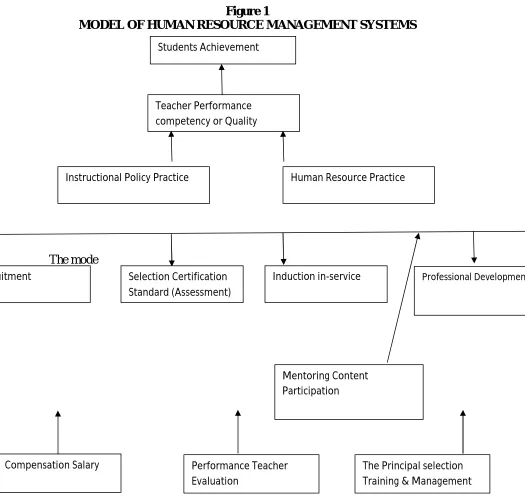
salary. Each area has certain practices that would influence teacher competency. The question raised in this paper is how can teacher performance be improved through effective human resource practices? See figure 1
Figure 1
MODEL OF HUMAN RESOURCE MANAGEMENT SYSTEMS
The mode
The model showed the link between human resource practices and teacher’s performance competency.
The variables to be assessed in Human resources are highlighted in the model and examined. In examining the variables above the following research questions are raised.
Students Achievement
Teacher Performance competency or Quality
Human Resource Practice Instructional Policy Practice
Recruitment Selection Certification Standard (Assessment)
Induction in-service Professional Development
Mentoring Content Participation
Compensation Salary Performance Teacher Evaluation
128
1. How does recruitment and selection link to teachers performance competency. 2. How does induction and self development link to teachers performance competency. 3. How does compensation or salary align to teachers performance competency.
4. How does mentoring and principal management style link to teachers performance competency.
Method
The study adopted descriptive survey design. Survey design enables one to observe situations as they are without any manipulation of the variables. The study population of this study comprised all secondary school principals, vice principals and teachers in Ekiti State. A sample of 500 teachers, 120 principals and 100 Vice principals were randomly selected from 100 randomly selected secondary schools in the state. Questionnaire was used to collect data for the study. The questionnaire was in two sections. Section A was based on bio-data of the respondents while the second section was on a 25 items eight Human Resources practice such as recruitment, selection, induction, mentoring professional Development, compensation and Teacher Evaluation.
Instructional leaders
Responses to the items were based on agree and disagree. The content validity of the instrument was determined by expert in Test and Measurement who match all the items with the research questions to ascertain whether the instrument actually measured what it was supposed to measure. The questionnaires were distributed to the respondents and the data for each of the eight functional Human Resource areas were analyzed using percentages.
Results:
Research Question 1: How does well planned recruitment and selection link to teachers performance competency? Respondents: 720
S/N Items Agreed % Disagree % Total 1 Advertised the job through media or the
internet
610 84.72 110 15.28 720
2 Build a pool of candidates for the job through completed application form
550 76.39 170 23.61 720
3 Attract the right candidate to apply for the job
640 88.89 80 11.11 720
4 Experienced and professional teachers are recruited
550 76.39 170 23.61 720
On selection
5 Select possible candidate through tests 500 69.4 220 30.6 720 6 Job offer preference is given to applicants
with degrees in the subject area in which they plan to teach
410 56.9 310 43.1 720
7 Selection is based on merit not on political affiliation.
498 69.2 222 0.8 720
8 Applicants who performed well in the interview are offered jobs immediately
129
Table 1 showed that 84.7% of the respondents agreed that if teaching jobs are advertised through the media or internet, recruitment of the right candidate will be accomplished and this would enhance the performance competency of teachers. 88.89% of the respondents agreed that through this means experienced and professional teachers are recruited for better performance. In other words, perfect recruitment encourages better performance on the part of teachers recruited. It also enhances better academic growth of the school. 69.2% of the respondents agreed that selection based on merit is linked with better performance and 56.9% also agreed that when teachers are given jobs on the subject area in which they plan to teach, they perform better in the classroom.
Research Question 2: How does Induction and Self Development link to teachers Performance competency?
S/N Items Agreed % Disagree % Total 9 Teachers who are employed are properly
oriented to ensure better performance from them.
605 84.02 115 15.9 720
10 Get familiar with the available facilities such as library, classrooms, laboratories, instructional materials and so on
702 97.4 18 2.6 720
11 Expose teachers to the three teaching domains and ensure standard.
640 88.8 180 2.4 720
12 Teacher understands clearly the job he is expected to perform
615 85.4 105 14.6 720
13 Workshops Conference and seminars for teachers development are organized.
605 84.02 115 15.9 720
14 Refresher courses are regularly organized for teachers for effective performance
578 80.2 142 19.8 720
15 Training development programmes are designed for newly employed teachers
515 71.5 205 28.5 720
130
Research Question 3: How does compensation and salary align to teacher’s performance competency?
S/N Items Agreed % Disagree % Total 16 Prompt and regular payment of salaries
and allowances
704 97.7 16 0.3 720
17 Promotions are not delayed 618 85.8 102 14.2 720 18 Conditions of service is attractive 692 96.2 28 3.8 720 19 Rewards are given to the best performed
teachers
702 97.5 18 2.5 720
20 Promotion is based on performance 655 90.9 65 9.1 720
Table 3 showed that 97.7% of the respondents agreed that prompt payment of salaries and allowance are linked to teacher’s performance competency. 96.2% agreed that attractive condition of service motivates teachers to better performance 90.9% agreed that promotion based on performance not on year of qualification on mass promotion are all linked to performance competency of teachers.
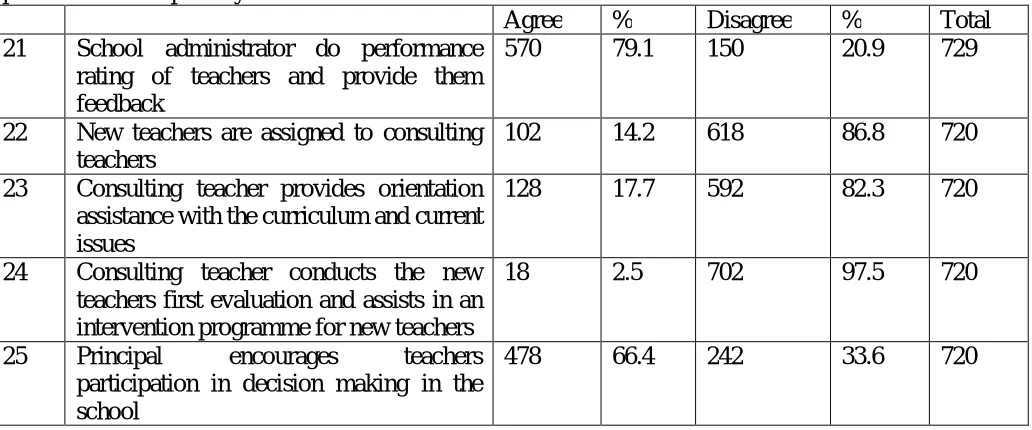
Research Question 4: How does mentoring and principal management style link to teachers performance competency?
Agree % Disagree % Total 21 School administrator do performance
rating of teachers and provide them feedback
570 79.1 150 20.9 729
22 New teachers are assigned to consulting teachers
102 14.2 618 86.8 720
23 Consulting teacher provides orientation assistance with the curriculum and current issues
128 17.7 592 82.3 720
24 Consulting teacher conducts the new teachers first evaluation and assists in an intervention programme for new teachers
18 2.5 702 97.5 720
25 Principal encourages teachers participation in decision making in the school
478 66.4 242 33.6 720
Table 4 showed that 79.1% of the respondents agreed that when school administrators do performance rating of teachers and provide them feedback the performance competency of teachers is enhanced. 86.8% disagreed that assigning teachers to a consulting teachers is linked to teachers performance competency: 97.5% disagreed that consulting teachers evaluation has link with teachers competency. Whereas 66.4% agreed that teachers participation in decision making is to link to teachers performance competency.
Discussion of Findings
131
competency in Ekiti State secondary schools. Particular attention to alignment appears for recruitment, selection, orientation. There are also alignment for self development and salaries. Though teachers are to regularly negotiate for salary increase, the present salary scale is a motivating factor for teachers performance competency. Alignment is totally lacking in areas of mentoring. This was because there was lack of mentoring on the apart of the principal and consulting teachers.
New teachers were not assigned to a consulting teachers hence new teachers had to rely on their own experience and knowledge. There was no provision for mentoring for new teachers. Hence teachers performance might be adversely affected. The principal leadership style has alignment with teachers performance competency. If the school administrator imbibed transformational leadership style, the teachers perform better and this would affect academic growth of the school. Thus school administrator should adopt various strategies that would enhance teachers performance competency. In the area of self development the findings showed that capacity building, training and retraining of teachers are linked to teacher’s performance. These findings are in support of Baldore (2003) Lydiah and Nasongo 2009).
Conclusion and Recommendations
The study pointed out there is significant relationship between the eight human resources practices and teacher job performance competency. The area highlighted were recruitment and selection, induction and self development, compensation and salary, mentoring and Principal leadership all these variables identified affect teachers performance, Shadare and Hammed (2009) in their study on influence of work motivation, leadership effectiveness and time management on employee’s performance in some selected industries in Ibadan, Oyo State, Nigeria found out that motivation and conditions of service contributed to employees performance.
Hiredo (2003) noted that a motivated worker is easy to spot by his or her agility, dedication, enthusiasm, zeal and general performance. This study therefore found out that there is a positive and significant correlation between each of the independent variables on teachers’ performance.
Recommendations
The following recommendations are made that:
Recruitment of teachers should not be placed on political affiliation, selection of teachers should be based on merit.
Qualified teachers with teaching certificate should be recruited. so that high Caliber of people, professionals would be attracted to teaching. This would enhance performance. Making the Salary and compensation of teachers very attractive will enhance teachers
performance
Promotion of teachers should be based on performance, this will encourage productivity and efficiency.
Regular in-service training are needed for teachers to enhance high performance in the classroom.
Mentoring of newly recruited teachers is necessary for teachers performance. Thus newly recruited teacher should be attached to a mentor for effective performance in the classroom.
132 REFERENCES
Akinpelu (2005): Essays in philosophy and Education: Ibadan Stirling Horden Publishers (Nig/Ltd).
Baldoni, J. (2003). Great communication secrets of great leaders, New York McGraw-Hill.
Batt, Rosemary (2002). Managing Customer services; Human resources practices, quit, rates and sale growth. Academy of Management Journal, 45(3), 587-598.
Becker, Brain & Genhart, Barry (1996). The impact of Human resource management on organizational performance: progress and prospects/ Academy of Management Journal 39 (4), 779-801.
Darling-Hammond, Linda & Youngs, Peter (2002). Defining “highly qualified teachers”.
Dubbin S.S. (1990). Maintaining competence through updating in S.L. Wills & S.S. Dubin (eds) Maintaining Professional competence San Francisco. Jossey Bass.
Lassa, P. (1998). Teacher Production: A focus in Nigeria.
Nwankwo, H.E. (1985). Effective management for executives. A practical manual for managers, Ibadan. Spectrum Books Ltd.
Ofoegbu, F.I. (2004). Teacher motivation; a factor for classroom effectiveness and school improvement in Nigeria College student journal march. Retrieved from http://www. Articles. Com
Olalube N.P. (2006). Teacher education, school effectiveness and improvement; A study of academic and professional qualification on teachers’ job effectiveness in Nigeria secondary schools. The African symposium 5(3) pp 17-37.
Ukeje, J.A. (2007). Educational reforms in Nigeria http//www.Kantoline.com/publications. Educational reforming Nigeria.
Wayne, Andrew J., and Young Peter (2003). Teacher characteristics and student achievement gains. A review Review of Educational Research 73(1) 89-122.
What does “ Scientifically-based research” actually tell us? Educational Researcher, 31(9), 13-15.
Lydia, LM & Nasongo, J.W. (2009). Role of the Lead teacher in academic achievement in secondary schools in Vihiga district, Kenya Current Research. Journal of Social Sciences 1(3) 84-92.