Medical Students’ Perception of Using Electronic Learning Tools in an
ESP program
Iman Alizadeh
English Language Department, School of Nursing, Midwifery and Paramedical Sciences, Guilan University of Medical Sciences, Rasht, Iran
E-mail: [email protected]
Received: December 24, 2017 Accepted: February 11, 2018 Online Published: March 20, 2018
Abstract
Given the burgeoning interest in the use of technology and electronic tools for educational purposes among students, this study set out with the purpose of investigating medical students’ perception of using e-learning tools and applications in an English for Specific Purposes (ESP) program at an Iranian medical university. The study also aimed to discover the extent to which the students prefer to use paper dictionaries, offline mobile dictionaries, computer-based dictionaries and Internet-computer-based dictionaries. To do so, an electronically-mediated course plan was designed and implemented for eight weeks. The course plan required the students to use different types of resources, including electronic learning tools. Then, a questionnaire eliciting the students’ perception of the significance of using electronic learning tools in the program and asking the students the extent to which they used different resources (paper dictionaries, offline mobile dictionaries, computer-based dictionaries and software and Internet-based applications and tools) was developed and used. The results showed that the majority of the students perceived that employing electronic tools and applications for educational purposes in the program was highly significant. It was also discovered that the students gave a high priority to offline mobile dictionaries; Internet-based applications, paper dictionaries and computer-based dictionaries were other resources they used in the program in order of priority. The study carries practical implications for teachers and educational policymakers, especially in the developing countries where problems with the Internet linger on.
Keywords: Electronic learning, paper dictionaries, mobile dictionaries, electronic dictionaries, internet-based apps
1. Introduction
According to Lahti et al. (2014), electronic learning and computer-assisted learning methods have been increasingly used in medical and nursing education. English for Specific Purposes (ESP) is one of the compulsory courses at Iranian medical universities. Studies in the area of ESP in Iran have mostly focused on students’ needs (Atai & Mohamadzadeh, 2007; Esfandiari, 2015; Khanjani, 2005; Shahini & Riazi, 2001). Few studies (Dashtestani, 2013; Yaghoubi et al., 2008), however, have investigated Iranian students’ perception of using electronic learning in the ESP course. To examine the perception Iranian medical students have of employing electronic learning tools and to enrich the literature in this area, the present study investigated medical students’ perception of the significance of using e-learning tools in an ESP course at an Iranian medical university.
Moreover, as in Iran English is a foreign language, students usually find the ESP course challenging. In the specialized English courses at Iranian universities, students make frequent use of different types of dictionaries to find the meaning of words. The dictionaries the students use can be categorized as paper dictionaries, offline electronic dictionaries on cell phones (mobile dictionaries), dictionaries on personal computers, and Internet-based or online dictionaries. Dictionaries are one of the first educational resources to which students resort when they face an unknown vocabulary and advances in technology have caused transformations in the industry of dictionaries. Having knowledge of the resources students prefer to use, professors at universities can aid students in using more appropriate resources, tools,
and applications in the ESP course. Therefore, the present study aimed to discover the extent to which medical students prefer to use paper dictionaries, offline mobile dictionaries, computer-based dictionaries, and Internet-based dictionaries. Having these goals in mind, the researcher sought to answer the following questions:
1. What is medical students’ perception of the significance of using electronic learning tools in the ESP program?
2. How much do medical students prefer to use computer-based dictionaries, offline mobile dictionaries, internet-based applications tools and paper dictionaries in the ESP program?
2. Review of the Literature
Clark and Mayer (2016) define e-learning as the instruction delivered on a digital device (such as a desktop computer, laptop computer, tablet, or smart phone) that is intended to support learning. Likewise, discussing different approaches to e-learning, Sarsa and Escudero (2016) point out that such a modality of learning aims to better learning by means of some kind of technology. Power (2014) defines e-learning as the use of digital or electronic technologies and materials to support teaching and learning. Raab et al. (2002) explain, E-learning [...] uses network technologies to create, foster, deliver, and facilitate learning, anytime and anywhere. The use of technology for educational purposes has become increasingly popular among students and many educational institutions organize all or part of their educational programs online. Wende (2003) argues that the availability of the internet and the expansion of information and communication technologies has brought e-learning to the limelight.
Despite the expansion of the e-learning, few studies in the Iranian context in general and in the medical education context in particular have investigated students’ perceptions of using electronic learning tools in the ESP course. Yaghoubi et al. (2008), for example, investigated perceptions and attitudes of virtual students towards e-learning in Iran. The findings of the study revealed that Iranian students have positive perception of e-learning. It was also shown that students’ assessment about competency of e-learning, access to internet, computer, internet usage, and assessment of current higher education system’s shortcomings played a key role in their perception and attitudes toward the e-learning. Dashtestani (2013) compared English as a Foreign Language (ELF) teachers’ and students’ perspectives on the use of electronic dictionaries for learning English, reporting that both EFL teachers and students held moderately positive attitudes toward the use of electronic dictionaries for learning EFL. It was also reported in the study that ELF learners preferred electronic dictionaries to paper dictionaries.
Omidinia et al. (2011) also note that that the use of information communication technology for educational purposes has been widely accepted in Iran’s educational institutions, adding that providing appropriate content and infrastructure for such a modality of learning remains as the major obstacles in the way of broad adoption of e-learning. Likewise, Mahmodi (2017) investigated the main factors of e-learning acceptance by the students of Garmsar branch of Payam Noor University, Garmsar, Iran. The results of the study showed that behavioral intention was under the influence of three factors of perceived ease of use, perceived usefulness, and attitude.
Electronic learning can be either online or offline; the former may not be readily implemented in areas where there is an absence of the Internet or the cost of the Internet is high. According to the International Telecommunication Union (2015), as many as 3.2 billion people are benefiting from the internet across the world. The union reports that only 2 billion people in the developing countries have access to the internet and as many as 4 billion others remain offline. To put it more simply, 2/3 of the people living in the developing countries do not have access to the internet which necessitates consideration for offline mode of learning. Therefore, as Greenhalgh (2001) points out, offline e-learning can be employed in cases facing geographical, financial, and temporal problems.
Stressing the role electronic learning plays in learning languages, Beatty and Ulasewicz (2006) point out that the spread of smartphones and the Internet have stimulated students’ interest in using technology and online resources to learn new languages. In the Iranian Medical Education System, medical students should take up a specialized English course which accounts for at least two units of course work. Discipline-based English for Academic Purposes programs have been developed after the Islamic Revolution in Iran (1978) by the Ministry of Science, Research, and Technology (Eslami, 2010). The activities which are commonly practiced in the ESP classes are reading, writing, and translation.
Moreover, studies in the Iranian context have shown that that Iranian ESP students more than any other language skills need translation, reading, and writing (Amiri, 2000; Khoramshahi, 2015; Shahini, 1988). Translation of specialized English texts, however, is, as Malekan and Hajimohammadi (2017) holds, a problem to which Iranian EFL learners are frequently encountered. To cope with translation problems, medical students use paper dictionaries, offline electronic dictionaries on cellphones (mobile dictionaries), dictionaries on personal computers, and Internet-based or online dictionaries.
Research has shown that e-electronic dictionaries, as they facilitate a quick search of words and help students easily find the required information, have proved helpful (Golonka et al., 2014). In the same vein, Loucky (2005), investigating the benefits of combining electronic and online dictionaries with Computer Assisted Language Learning websites to produce effective and enjoyable vocabulary and language learning lessons, reported that Japanese students preferred electronic dictionaries to paper dictionaries because of being more readily accessible and handy.
Some researchers in the area of second or foreign language teaching (Bataineh, 2014; Osaki, Ochiai, Iso, & Aizawa, 2003) believe that e-dictionaries compared to paper dictionaries help foreign language learners to learn language skills better. Some researchers, however, argue that there is no significant difference between e-dictionaries and paper dictionaries (Hamdi, 2015; Kobayashi, 2007; Koyama & Takeuchi, 2007).
3. Methods
In this section, the design of the study, the participants, the data collection process, and the data analysis process are described.
3.1 Design of the Study
This study is based on the quantitative research approach. It employs a cross-sectional descriptive design to discover perceptions medical students have of employing electronic learning tools in an ESP course. The participants and setting of the study, the data collection method, the instrument, and the data analysis process are explained below.
3.2 Participants
The participants of the present study were 92 students enrolling on and attending an ESP program at Guilan University of Medical Sciences. They were in the first or second semester of their junior year. They had all passed the general English course, which is a prerequisite for the ESP course. They all had an Android cell phone.
3.3 Data Collection
To conduct the study, a course plan was designed to implement the ESP program in the university classes with an eye to using electronic tools and applications. The course plan, which was implemented for eight weeks, required the students to employ different types of dictionaries and e-learning tools to complete the ESP assignments. After the eighth week, a questionnaire was used as the instrument in the present study.
Based on the objectives of the study, the questionnaire consisted of five items; the first item was on the students’ overall perception of the significance of e-learning in the ESP course. To examine the validity of the instrument, the first draft of the questionnaire was given to a panel of 10 experts in the field. The experts’ comments on different items of the questionnaire were collected. The questionnaire was revised based on the experts’ comments and was finalized. Cronbach Alpha Coefficient was used to calculate the reliability of the questionnaire, which was estimated at %0.76.
The students were asked to show their perception of the significance of e-learning in the ESP course by selecting one of the five options of “very little”, “little”, “average”, “much” and “very much.” The other items were on the extent to which the students used different types of dictionaries, applications or tools (paper, offline mobile, computer-based or internet-based) to meet the requirements of the course. The students were asked to indicate their responses by choosing one of the five options of “very little”, “little”, “average”, “much” and “very much.” They were asked to complete the questionnaire in a 7-day time and return it. They were also advised to consider their experiences of using different types of e-learning tools while answering the items on the questionnaire.
3. 4 Data Analysis
After completing the data collection phase, the quantitative data were analyzed using SPSS (Statistical Package for the Social Science) version 19. Descriptive statistics were used to calculate the frequencies and percentages of the students’ responses.
4. Results
The present study aimed to discover the significance the medical students attach to the role of e-learning in the ESP program. Table 1 below shows the findings.
Table 1. Students’ perception of the significance of using e-learning tools in the ESP course
Item Very little Little Average Much Very much Overall, how significant do you perceive that the
use of e-learning tools is in the ESP program?
1.1 6.5 34.4 47.8 9.8
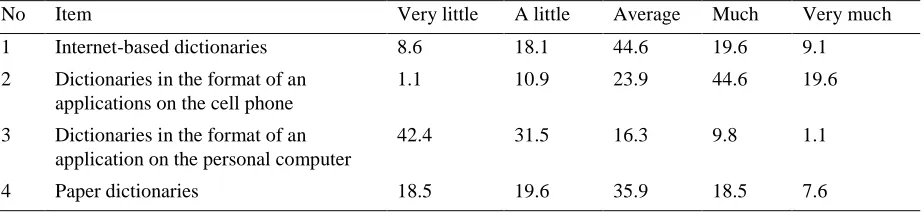
The study also aimed to find out the type of dictionary (ies) and/or applications medical students use in the ESP course. The findings pertaining to this goal of the study are given in Table 2 below.
Table 2.Medical students’ use of different types of dictionaries and tools in the ESP course
Very much Much Average A little Very little Item No 9.1 19.6 44.6 18.1 8.6 Internet-based dictionaries 1 19.6 44.6 23.9 10.9 1.1 Dictionaries in the format of an
applications on the cell phone 2 1.1 9.8 16.3 31.5 42.4 Dictionaries in the format of an
application on the personal computer 3 7.6 18.5 35.9 19.6 18.5 Paper dictionaries 4 5. Discussion
The findings of the study showed that the majority of the medical student perceived that the role of e-learning in the ESP program is “much significant.” The finding is in agreement with the findings of the study by Yaghoubi et al. (2008), which underlined as significance discovering students’ attitudes and perceptions toward using technologies and electronic learning. One of the reasons for such a perception could be the role electronic devices and technology plays in the life of individuals and particularly the youth.
Prenksy (2001) uses terms like ‘Net Generation’, ‘Digital Natives’ or the ‘Y Generation’ to describe young people who have spent their entire lives surrounded by and using computers, videogames, digital music players, video cams, cell phones, and all the other toys and tools of the digital age. Other studies have also reported that students are very familiar with electronic devices such as cell phones, laptops, personal computers, social networking sites, etc and use them frequently (Green & Hannon, 2007; Kennedy et al., 2006; Salaway, 2008). These devices provide enjoyment and interest for students who are obliged to spend much time doing assignments, studying, and researching.
It seems quite natural for the students to tend to have both enjoyment and learning in one place. As e-learning seems to provide this ground and opportunity for them, they develop a liking and show a preference for such a modality of learning. The reason why some students believed that the significance of e-learning is “average” could be the fact that they may not completely agree with using e-learning for all types of educational purposes. As Paechter and Maire (2010) observe that students may prefer online or face-to-face learning components of a course. According to the findings of their study, students believed that online learning has the potential to provide a clear and coherent structure of the learning material, provide support for self-regulated learning, and help the distribution of information, whereas face-to-face learning proved suitable for communication purposes, which require a shared understanding and the establishment of interpersonal relations.
In the present study, electronic dictionaries on cellphones (offline mobile dictionaries) and electronic dictionaries on personal computers were the most and least popular ones among the medical students. According to the findings, the majority of the students preferred to use electronic dictionaries as an application on their cellphones. It was also discovered that Internet-based dictionaries were more favorable than paper dictionaries and electronic dictionaries on personal computers. The students, however, preferred paper dictionaries to electronic dictionaries on personal computers. The reason for the students’ preference for using electronic dictionaries on their cellphones (offline mobile dictionaries) can be the mobile phone itself. As Squire and Dikkers (2012) reported that youth mobile media consumption has blossomed. Johnson et al. (2010) also pointed out that virtually all higher education students carry some form of mobile device. Along the same line of discussion, Batoso and Machado (2016) hold that the burgeoning popularity of smart phone” as well as their “multiple functionalities” have made them “a valuable asset to teaching and learning.
As the students can have not only one but also many dictionaries on their cell phones which are readily accessible and user-friendly, they prefer to use electronic dictionaries on their cell phones. The reason why electronic dictionaries on personal computers were the least popular ones among the medical students could be that fact that personal computers are not portable and that computers, as long as this service or function is concerned, have been somehow replaced with mobile phones. Another reason for the students’ preference for using electronic dictionaries on cellphones can be the benefits of mobile learning.
According to Trifanova and Ronchetti (2003), mobile device is any device that is small, autonomous, and unobtrusive enough to accompany us in every moment; thus, it can be safely claimed that using electronic dictionaries on mobile phones can be regarded as a form of mobile learning which according to Klopfer and Squire (2008) has such affordances as (a) Portability, (b) Social interactivity, (c) Context sensitivity, (d) Connectivity, and (e) Individuality. Having the potential to amplify learning is another benefit of this mode of learning which is reported by Squire and Dikkers (2012). Still another reason for the students’ preference for electronic dictionaries could be the problems with paper dictionaries. As Nesi (1998) discusses, paper-dictionaries are heavy, static, and cannot comprehensively store information to meet the needs of the contemporary society.
It was also discovered that the medical students preferred mobile dictionaries to Internet-based dictionaries. The reason for the preference could be the problems with the Internet, which can easily disrupt the process of learning; the cost of the Internet could have discouraged the students from using Internet-based applications. The findings of the present study are inconsistent with the results of a study by Collins (2016) where Japanese learners preferred Internet-based dictionaries. The discrepancy can be for the condition of the Internet in the two countries.
6. Conclusion
The present study set out to discover medical students’ perception of the significance of using e-learning in the ESP program. The findings showed that the students had a positive view about using this modality of learning in the program. As students constitute one of the main pillars of the teaching and learning processes in any education institution, it seems that the grounds are prepared for implementing e-learning programs in university program as long as students’ attitudes and willingness are concerned. Therefore, educational policymakers should provide the necessary infrastructure for the expansion of this type of learning so that medical students can benefit from its merits. In addition, professors can also employ at least partially this type of learning in their courses. It was also found that the medical students mostly preferred to use offline mobile dictionaries; it could, however, be concluded that the reason for such a preference could be possibly the fact that they do not have full access to free quality Internet. If they had access to the quality Internet, they might have decided otherwise. University authorities and high-ranking policymakers can make provisions to ameliorate the infrastructure for the implementation of online e-learning facilities such as online mobile learning and help students enjoy the benefits of free quality Internet for educational purposes.
References
Amiri, M. (2000). A study on the English language programs at B.A. level at Tehran universities. Master’s thesis,
Allameh Tabatabai University, Tehran, Iran.
Atai, M. R., & Mohamadzadeh, A. (2007). A needs analysis of graduate ESAP students of Humanities: A triangulated perspective. Proceeding of the sixth international AELFE conference; Teaching and Learning ESP; Learning
the boundaries. IFCAL, LISBOA.
Bastos, H. P. P., & Machado, G. P. F. (2016). Dictionaries on Smartphones: Learners’ assessment of features and potential of dictionary apps as pedagogical tools. In Rocha Á., Correia A., Adeli H., Reis L., Mendonça Teixeira M.(eds), New Advances in Information Systems and Technologies. Advances in Intelligent Systems
and Computing (Vol. 445). Springer, Cham.
Bataineh, A. M. (2014). The effect of electronic dictionaries and hypermedia annotations on English major students’ reading comprehension and vocabulary learning. International Journal of Linguistics, 6(4), 102-115. doi:10.5296/ijl.v6i4.6025 URL: http://dx.doi.org/10.5296/ijl.v6i4.6025
Beatty, B., & Ulasewicz, C. (2006). Faculty perspectives on moving from blackboard to the module learning management system. Research and Practice to Improve Learning, 50(4), 36-45.
Clark, R. C., & Mayer, R. E. (2016). E-learning and the science of instruction: Proven guidelines for consumers and designers of multimedia learning. John Wiley & Sons.
Collins, J. B. (2016). Changes in electronic dictionary usage patterns in the age of free online dictionaries: Implications for vocabulary acquisition. APU Journal of Language Research, 1, 36-49.
Dashtestani, R. (2013). EFL teachers’ and students’ perspectives on the use of electronic dictionaries for learning English. CALL-EJ, 14(2), 51-65.
Esfandiari, R. (2015). An investigation into ESP needs of Iranian students of law. The Journal of Teaching Language Skills (JTLS), 7(3), 29-59.
Golonka, E. M., Bowles, A. R., Frank, V. M., Richardson, D. L., & Freynik, S. (2014). Technologies for foreign language learning: a review of technology types and their effectiveness. Computer Assisted Language Learning, 27(1), 70-105.
Green, H., & Hannon, C. (2007). Their space: Education for a digital generation. London: Demos.
Greenhalgh, T. (2001). Computer assisted learning in undergraduate medical education. BMJ, 322(7277), 40-44. Eslami, Z. R (2010). Teachers’ voice vs. students’ voice: A needs analysis approach to English for academic purposes
(EAP) in Iran. English Language Teaching, 3(1), 3-11. doi: http://dx.doi.org/10.5539/elt.v3n1p3
Hamdi, C. (2015). The effects of electronic dictionary use on reading comprehension and vocabulary retention of EFL learners. Paper presented at Bejaia University International Conference (BUIC2015), Constantine University, Algeria.
Johnson, L., Levine, A., Smith, R., & Stone, S. (2010). The 2010 horizon report. Austin, Texas: The New Media Consortium.
Kennedy, G., Krause, K. L., Gray, K., Judd, T., Bennett, S., & Maton, K. (2006). Questioning the net generation: A collaborative project in Australian higher education. In L. Markauskaite P. Goodyear & P. Reimann (Eds.),
Who’s learning? Whose technology? Proceedings ascilite. Sydney, 413-417.
Khanjani, A. (2005). A needs analysis of the ESAP programs for science students of Guilan University. Unpublished master’s thesis. Kharazmi University, Tehran.
Khoramshahi, E. (2015). A needs analysis study on the curriculum of simultaneous interpretation major in applied-scientific comprehensive university (MA Thesis). Islamic Azad University, Saveh-Science and Research Branch. Saveh, Iran.
Klopfer, E., & Squire, K. (2008). Environmental detectives–the development of an augmented reality platform for environmental simulations. Etr & D-Educational Technology Research and Development, 56(2), 203-228.
Kobayashi, C. (2007). Comparing electronic and printed dictionaries: Their effects on lexical processing strategy use, word retention, and reading comprehension. In K. Bradford-Watts (Ed.), JALT 2006 conference proceedings
(pp. 657-671). Tokyo: JALT.
Koyama, T., & Takeuchi, O. (2007). Does look-up frequency help reading comprehension of EFL learners? Two empirical studies of electronic dictionaries. CALICO Journal, 25(1), 110-125.
Lahti, M., Hätönen, H., Välimäki, M. (2014). Impact of eLearning on nurses’ and student nurses’ knowledge, skills, and satisfaction: a systematic review and meta-analysis. International journal of nursing studies, 51(1), 136-49.
Loucky, J. P. (2005). Combining the benefits of electronic and online dictionaries with CALL websites to produce effective and enjoyable vocabulary and language learning lessons. Computer Assisted Language Learning, 18(5), 389-416.
Mahmodi, M. (2017). The analysis of the factors affecting the acceptance of E-learning in higher education. Interdiscip J Virtual Learn Med Sci, 8(1), 1-9. doi: 10.5812/ijvlms.11158.
Malekan, F., & Hajimohammadi, R. (2017). The relationship between Iranian ESP learners’ translation ability and resilience in reading comprehension. International Journal of Education & Literacy Studies, 5(2), 47-52. Omidinia, S., Masrom, M., & Selamat, H. (2011). Review of e-learning and ICT infrastructure in developing countries
(Case study of Iran). American Journal of Economics and Business Administration, 3(1), 120-125.
Osaki, S., Ochiai, N., Iso, T., & Aizawa, K. (2003). Electronic dictionary vs. printed dictionary: Accessing the appropriate meaning, reading comprehension, and retention. Paper presented at 3rd ASIALEX conference, Tokyo, Japan.
Nesi, H. (1998). Dictionaries on computer: How different markets have created different products. Paper presented at the Symposium on Language Learning and Computers held at Chemnitz University of Technology in February 1998.
Paechter, M., & Maire, M. (2010). Online or face-to-face? Students’ experiences and preferences in e-learning. The Internet and Higher Education, 13(4), 292-297.
Power, T. (2014). Educational technology topic guide. HEART: Health and education advice and resource team. London: The Health & Education Advice & Resource Team (HEART).
Prensky, M. (2001). Digital natives, digital immigrants Part 1. On the horizon, 9(5), 1-6, https://doi.org/10.1108/10748120110424816
Raab, R. T., Ellis, W. W., & Abdon, B. R. (2002). Multispectral partnerships in e-learning: a potential force for improved human capital development in the Asia Pacific. The Internet and Higher Education, 4(3), 217-229. Salaway, G., Caruso, J. B., & Nelson, M. R. (2008). The ECAR study of undergraduate students and information
technology. Boulder, CO: EDUCAUSE. Center for Applied Research.
Sarsa, J., & Escudero, T. (2016). A roadmap to cope with common problems in E-Learning research designs.
Electronic Journal of E-learning, 14(5), 336-349.
Shahini, G. H. (1988). A needs assessment for EFL courses at Shiraz University (M.A. thesis). Shiraz University, Shiraz, Iran.
Shahini, G. M., & Riazi, A. M. (2001). A needs assessment for English language courses at Shiraz University. Indian Journal of Applied Linguistics,27(1), 147-155.
Squire, K., & Dikkers, S. (2012). Amplifications of learning: Use of mobile media devices among youth. Convergence:
The International Journal of Research into New Media Technologies, 18(4), 445-464.
https://doi.org/10.1177/1354856511429646
The International Telecommunication Union. (2015). ICT facts & figures: the world in 2015. International Telecommunication Union: Geneva.
Trifonova, A., & Ronchetti, M. (2003). Where is mobile learning going? In A. Rossett (Ed.), Proceedings of E-Learn
2003--World Conference on E-Learning in Corporate, Government, Healthcare, and Higher Education (pp.
1794-1801). Phoenix, Arizona, USA: Association for the Advancement of Computing in Education (AACE). Wende, M. C. (2003). Globalisation and access to higher education. Journal of Studies in International Education,
7(2), 193-206.
Yaghoubi, J., Mohammadi, M. I., Iravani, H., Attaran, M., & Gheidi, A. (2008). Virtual students’ perceptions of e-learning in Iran. The Turkish Online Journal of Educational Technology–TOJET, 7(3), 89-95.