
Realistically Evaluating Small Scale SFD Programmes Professionalisation and Praxis
Kevin David James Harris
A thesis submitted in partial fulfilment of the requirements of the Nottingham Trent University and Southampton Solent University for the degree of Doctor of Philosophy
Copyright statement
Abstract
Within the last decade a lack of evidence discourse (Nichols et al, 2010) has emerged raising issues around limited Monitoring and Evaluation (M and E) practice and capacity of Sport For Development (SFD) programmes to elicit change. Critics (Coalter, 2013; Harris and Adams, 2016) have argued that a deeper understanding of what works for whom and why (Pawson and Tilley, 1997) is required when evaluating SFD interventions. This thesis explored practitioner involvement in M and E, and drew upon a realist participatory M and E framework (delivered in two phases), developed to train student sport development practitioners (SSDPs) to make sense of how and why their SFD interventions worked.
The framework was evaluated at each phase, utilizing Realist Evaluation (RE) to ascertain if, how, and why the framework worked for SSDPs. The evaluation at phase one (involving interviews, blogs, and questionnaires) led to a series of context mechanism and outcome (CMO) configurations explaining how and why the framework worked for SSDPs. This led to refinements of the framework at phase two embedding Schula et al’s (2016) collaborative principles of evaluation. Evaluation of phase two embedded Q factor analysis (Watts and Stenner, 2012), interviews and reflective blogs. Findings emerged surrounding the value of RE for SSDPs. Schula et al’s (2016) principles enabled practical and transformational characteristics to unfold for SSDPs within the framework. Four sub groups of practitioners emerged depicting how the framework worked. These sub groups were made up of ‘travelling far in M and E competency’, ‘polished problem solvers’, ‘passive passengers’, and ‘proficient yet skeptical practitioners’. These were underpinned by holistic narratives demonstrating subjective views about the framework. A new compilation of CMO configurations informing refinements to the framework followed. In conclusion, participatory approaches of M and E can work with practitioners and should be embedded to enable application of RE.
Contents
PAGE Chapter 1: Introduction
1.1 Sport as a solution to social ills 1.2 Questioning the evidence base
1.3 Why and how might programmes work?
1.4 Developing teachable M and E techniques to benefit practitioners 1.5 Introducing the M and E framework and sample
1.6 Transition of framework 1.7 Aims and Objectives 1.8 Methodology and methods 1.9 Methodological transition 1.10 Ethics
1.11 Thesis structure 1.12 Chapter summary
1-9 1 2 2 3 4 4 4 5 6 7 7 9 Chapter 2: Conceptualising SFD within the context of evidence
2.1 Emergence of (SFD)
2.2 SFD reservations and the lack of evidence discourse 2.3 Problematising the meaning and power of sport
2.4 Emerging approaches and resourcing Monitoring and Evaluation 2.5 Optimism for the field
2.6 Moving and progressing the field: Understanding the practitioner within the context of evidence
2.7 Chapter summary
10-23 10 13 14 15 18 20 22 Chapter 3: Conceptualising and reviewing approaches to evaluation
3.1 The meaning of evaluation – defining monitoring and evaluation 3.2 Contextualising evidence within policy
3.3 Positioning suitable approaches to the SFD field 3.4 Respecting, but omitting experimental techniques 3.5 Theory Driven Evaluation (TDE)
3.6 Theory of change approaches (TOC) 3.7 Realist Evaluation (RE)
3.8 TDE for industry?
3.9 The Participatory Research Paradigm (PRP) as a context 3.10 Participatory Evaluation
3.11 PE in the field
3.12 Developmental Evaluation 3.13 Empowerment Evaluation
3.14 Principles for Collaborative Evaluation 3.15 PE in SFD
3.16 Moving the SFD field forward 3.17 Chapter summary
23-48 23 24 27 28 29 31 33 36 37 38 39 39 40 42 46 47 48 Chapter 4: Conceptualising the SFD Practitioner
4.1 Defining the Sport Development Practitioner (SDP) 4.2 What does it mean to be a SDP
4.3 Problematising the professional field
4.4 The emerging practitioner in Higher Education 4.5 Reflexive practitioners
4.6 Developing programmes 4.7 Building capacity in M and E
4.8 Chapter summary 62 Chapter 5: Presenting the M and E Framework
5.1 A realist orientation of the framework
5.2 Making a case for realistic approaches to evaluation 5.3 Fusing realistic and participatory approaches 5.4 Structure and agency
5.5 Positioning the case study – introducing the Coaching Innovation Programme and Student Sport Development Practitioner
5.6 Underlying assumptions of M and E framework 5.7 No panacea to M and E
5.8 Candidate CMOs in accordance with framework 5.8.1 Key resources
5.8.2 Proposed CMO configurations 5.9 Chapter summary
64-83 64 65 65 66 69 72 80 81 81 82 83 Chapter 6 Methodology
6.1 Philosophical foundations underpinning research 6.2 Ontology and Epistemology
6.3 Realist foundations
6.4 Realist Evaluation foundations and positioning this research 6.5 The Pawson application of realism with Realist Evaluation 6.6 Confirming the philosophical position of the research 6.7 Methodology: Study 1
6.8 Positioning realism at the centre of the evaluation of the M and E framework
6.9 Methodology and methods (study 1) 6.10 Sample (study 1)
6.11 Data analysis (study 1) 6.12 Ethics
6.13 Methodology: Study 2 6.14 Introducing Q methodology
6.15 Synthesising Q with Realist approaches – rationale 6.16 Implementing Q methodology within study 2 6.17 Study 2 design and implementation
6.18 Using blogs and interviews to clarify narratives and CMOs 6.19 Sample (study 2)
6.20 Data analysis (study 2) 6.20.1 Factor anlaysis 6.20.2 Factor interpretation 6.20.3 Clarification of factors 6.21 Chapter summary
84-111 84 86 86 87 89 91 92 92 92 94 95 96 97 97 100 101 103 104 105 107 107 108 108 111 Chapter 7 Study 1 Findings
7.1 Context 7.2 Mechanisms
7.2.1 Conceptualisation to application 7.2.3 Ownership and autonomy 7.3 Informing M and E practice
7.4 Secondary data analysis of CIP adherence to framework 7.4.1 CIP final poster and discussion within presentation 7.4.2 CIP M and E report and supporting documents
7.4.3 Implications of secondary analysis 7.5 Chapter summary
127 128 Chapter 8 Refining the framework and transition for phase two testing
8.1 Progressing with Realist Evaluation
8.2 To what extent is a participatory dimension needed within the framework?
8.3 Reasons for doing Empowerment Evaluation 8.4 A digression from Empowerment Evaluation 8.5 Future direction of M and E framework refinement 8.6 Refined programme theory to be tested in study 2 8.6.1 Resources
8.6.2 CMO configurations 8.7 Chapter summary
129-143 129 130 130 131 132 136 136 139 143 Chapter 9 Study two results
9.1 Results
9.2 Factor 1 theme: “From zero evaluators to accomplished” 9.3 Factor 2 theme: “Polished Problem solvers”
9.4 Factor 3 theme: “Passive Passengers”
9.5 Factor 4 theme: “Proficient, competent and cautiously optimistic” 9.6 Chapter summary
144-165 137 138 143 149 152 165 Chapter 10 Study two and final discussion
10.1 Factor 1 discussion: Zero to accomplished 10.1.2 Travelling far in M and E competency 10.1.3 Less transformational – less reflexive 10.1.4 Reliance on control and support
10.2 Factor 2 discussion: Polished problem solvers 10.2.1 Fostering use in M and E
10.2.2 Realising and prioritising RE and M and E for the future
10.2.3 Detecting and solving problems through conceptual engagement 10.2.4 Quasi autonomous control
10.3 Factor 3 discussion: Passive passengers 10.3.1 Competent on the surface in how and why 10.3.2 Passengers
10.4 Factor four discussion: “Proficient, competent and cautiously optimistic”
10.4.1 Avenues for use based on strong relationships 10.4.2 Optimism of findings (for own praxis and partners)
10.4.3 RE sceptics 10.5 Summary of discussion pertaining to collaborative principles 10.6 Key refinements to framework moving forward
10.7 Chapter summary
165-194 166 166 169 171 173 173 174 176 178 180 180 181 182 182 183 184 186 191 194 Chapter 11 Conclusion and asserting the contribution to knowledge
11.1 Summarising Aims and Objectives 11.2 Summarising stage one
11.3 Summarising stage two
11.4 Implications for progressing the field 11.5 Overall contribution to knowledge 11.6 Limitations and scope of study 11.7 Chapter summary
Chapter 12 References 206-219 Chapter 13 Appendices
Appendix 1: Ethics evidence Appendix 1.1: Ethics approval Appendix 1.2: Informed consent
Appendix 1.3: Participant information briefing sheet
Appendix 2: Information relating to Coaching Innovation Programme Appendix 2.1: CIP brochure
Appendix 3: Framework resources
Appendix 3.1: Conceptualising Programme Theory Appendix 3.2: Mobilising M and E
Appendix 3.3: Workshop slides
Appendix 4: Evidence supporting methodology in study 1 Appendix 4.1: Interview schedule
Appendix 4.2: Sample blog Appendix 4.3: Questionnaire
Appendix 4.4: Realist transcribed interview
Appendix 4.5: Sample evidence of analysis supporting study 1 Appendix 4.6: Sample NVIVO screenshots
Appendix 4.7: Student practitioner work informing secondary data analysis
Appendix 5: Evidence supporting methodology (study 2) Appendix 5.1: Watts and Stenner Crib sheet
Appendix 5.2: Provisional holistic narrative (factor 1 sample) Appendix 5.3: Sample realist interview schedule (factor 1 sample) Appendix 5.4: Sample blog and transcribed realist interview Appendix 5.5: Factor analysis data pertaining to four factors Appendix 5.6: CMMO crib sheets
Appendix 5.7: CMMO final factor configuration document (factor 1 sample)
Appendix 5.8: Sample NVIVO screenshots Appendix 6: Refined M and E framework
Appendix 6.1: Model 1: Developing Programme Theory
Appendix 6.2: Model 2: Mobilising M and E (refined from study 1) Appendix 7: Refined M and E framework (from testing at study 2) Appendix 7.1: Model 1: Developing programme theory
Appendix 7.2: Model 2: Mobilising M and E Appendix 7.3: CMO configurations
Appendix 8: Peer reviewed publications supporting thesis Appendix 8.1: Adams and Harris (2014)
Appendix 8.2: Harris and Adams (2016)
List of Acronyms
CMO Context – Mechanism – Outcome
RE Realist Evaluation
SFD Sport For Development
CIP Coaching Innovation Project
PAR Participatory Action Research
TDE Theory Driven Evaluation
PRP Participatory Research Paradigm
SDP Sport Development Practitioner
SSDP Student Sport Development Practitioner
HE Higher Education
PPE Practical Particpatory Evaluation
TPE Transformational Particpatory Evaluation
DCMS Department For Culture Media and Sport
PESSCL Physical Education School Sport and Club Links
List of figures
Figure Pg no
1: Philosophical considerations 85
2: Illustration of study 2 design 103
3: Illustartion of study 2 sample 106
4: Disaagregating the programme mechanism 109
5: Supporting evidence of secondary data analysis 126
6: Conceptualising programme theory model (refined from study 1) 138
7: Factor matrix and defining sort 144
8: Factor arrays pertaining to shared viewpoints 145
9: Conceptualising programme theory refined from study 2 (focusing on stage 3) 191 10: M and E model refined from study 2 (focusing on action learning sets) 192 11: CMO configuration snapshot for cohort 1 post study 2 193 12: CMO configuration snapshot for cohort 2 post study 2 193
List of models
Model Pg no
1.1: Conceptualising programme theory (Background to programme theory stage 1) 73 1.2: Conceptualising programme theory (Making explicit programme theories and
outcomes stage 2)
74
1.3: Conceptualising programme theory (Hypothesizing programme mechanisms stage 3)
75
1: Conceptualising programme theory (full) 76
List of Tables
Table Pg no
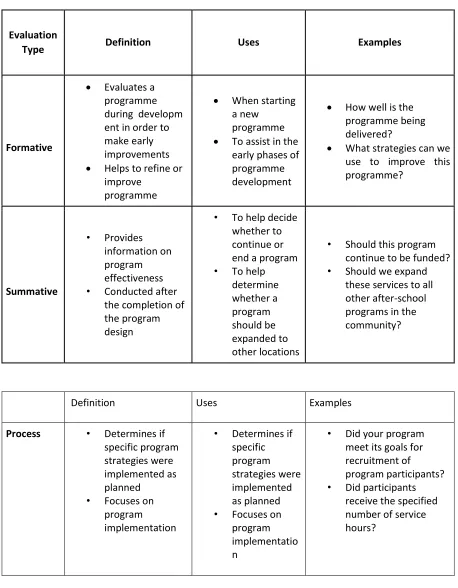
1: Types of Evaluations 26
2: Empowerment Evaluation principles 40
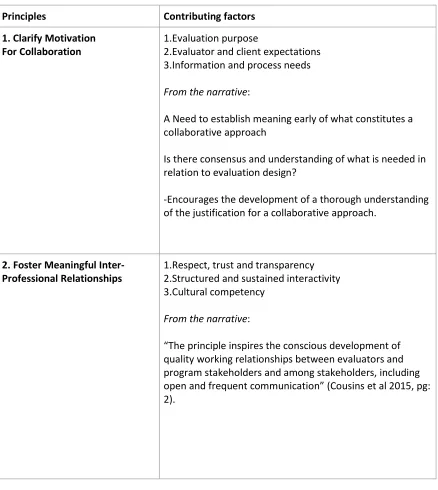
3: Collaborative Principles for Evaluation 43
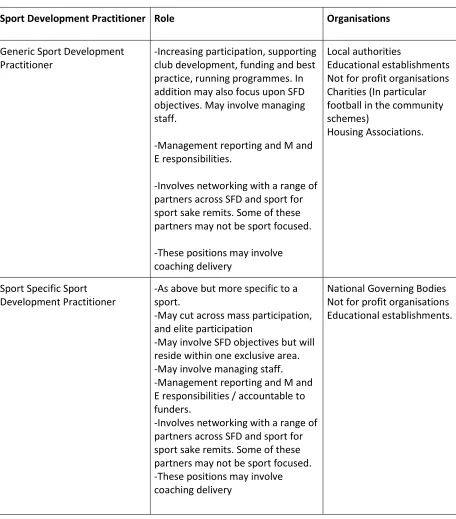
4: Job titles in Sport Development 51
5: Brief clarification of Sport Development roles pertaining to UK 52
6: Participatory continuum 67
7: Empowerment Evaluation priniciples 68
8: Factors impacting on and influencing framework 70
9: Workshop descriptions 77
10: Alignment to Empowerment Evaluation principles 79
11: Study 1 sample characteristics 94
12: Iterative process for Q method 98
13: Study 2 sample of CIPs and characteristics 105
14: Study 2 CMO data analysis table 110
15: Study 2 CMMO configuration statements template 110
16: Study 1 underlying contexts 113
17: Contexts and mechanisms (conceptualization to application) 115 18: Contexts and mechanisms (structure to enable agency) 119
19: Contexts and mechanisms (ownership and autonomy) 120
20: Study 1 CMO configurations 123
21: Framework alignment to Schula et al (2016) 133
22: Illustration of key resources produced within the framework 137 23: Refined framework CMO configurations for testing at study 2 139
24: Distinguishing differences amongst factors 145
25: Factor 1 CMO configurations 148
26: Factor 2 CMO configurations 152
27: Factor 3 CMO configurations 159
29: Summary of factors and alignment to collaborative principles 187
Acknowledgements
This thesis represents a significant journey in my life. Throughout this period I have learnt so much and I would like to thank the following people who have been there for me in so many different capacities along the way:
My Director of Studies, Professor Steven Henderson, whose wisdom and guidance from the very beginning has been phenomenal. This has led to an excellent working relationship and friendship that will extend way and beyond this work. Steven, thank you.
The remaining supervisory team; Dr Oscar Mwaanga, and Dr Andy Adams. Oscar, you have been an inspiration since the day we met and I would like to thank you for your support and guidance. Andy, your insight and warnings against the ‘corridors’ has been so helpful, and has kept me on track. Thank you for supporting and working with me on my publications to date.
Sincere thanks to Dr Brian Wink for his support in guiding me through Q methodology. All of the student practitioners who participated in this thesis.
Cheryl, my rock and my support. You came into my life at the beginning of this process and this has been as part of your life as it has mine. Thank you for being you. I would not have been able to do this without your love and support. I dedicate this to you.
My dearest friends. Dr Joe Viana, thank you for your ability to make me laugh and forget about my research every now and then. Nath, thanks for introducing me to the bike and the many miles we have covered together. Thank you Mark Turner for being my rock at Solent. May our scholarly friendship and support continue for many years to come.
1 Chapter 1 Introduction
The following chapter attempts to provide a context and rationale for this thesis. To begin, the context surrounding SFD will be discussed. This context will subsequently lead to the underlying rationale and research question underpinning this thesis. Following on from this, the chapter will clearly articulate the methodology and methods that will be mobilised to meet the aims and objectives in accordance with this thesis. In addition to acknowledging ethical procedures, the chapter will conclude with a succinct synopsis of each chapter making up this thesis.
1.1 Sport as a solution to social ills
The SFD landscape has seen major growth in policy intervening programmes globally using sport based interventions as tools to address social issues (Levermore, 2011). For example in the global south an abundance of SFD programmes (Edusport, Matare Youth Sport Association) exist; and within the UK, programmes such as Street Games and Kickz have been mainstays within the sport for change spotlight. Whilst recognizing their contextual distinctions and differences, all these programmes share common characteristics of using sport as a tool and or as a site for development. Whilst the term ‘development’ requires further conceptualizing (Girginov, 2008), development within the context of these programmes often pertains to using sports based interventions to for example empower the marginalized (Mwaanga, 2011), promote self esteem, tackle health issues, build community cohesion (Adams, 2008) and tackle anti social behaviour (Crabbe, 2007). According to Kidd (2010) under the right circumstances and with astute leadership sport can become a favourable ground for change.
The last fifteen years has seen the proliferation of SFD orientated movements across the world (Coalter, 2010; Harris and Adams, 2016). Within the U.K in particular the move to austerity in 2010 under the coalition government and focus upon legacy (in connection with the 2012 Olympics) has seen sport policy focus primarily upon sport for sport sake goals of increasing participation in sport (Collins, 2010a). This has manifested itself through government strategies such as Creating a Sporting Habit for Life (DCMS, 2012) and Sport England strategies of ‘Grow Sustain Excell’ (2008) whereby much of exchequer and lottery funding has made its way into National Governing Bodies of Sport (NGBs) challenged with increasing participation.
However, despite this primary focus on sport for sport sake (Collins, 2010a) the SFD field within the U.K has continued to exist. This existence has been maintained through the likes of organisations such as Street Games, Catch 22 (formerly Crime Concern), football in the community schemes and Higher Education (H.E) provision. In addition, at the time of writing the most recent government strategy published in late 2015 (‘A sporting Future’) has indicated a significant move towards a SFD focus whereby sport and health should combine to address the wide range of social issues facing society such as obesity. Indeed, this is by no means new given that before 2010 the New Labour administration focused a number of their strategies; eg: ‘Sporting Future for All (2000), and ‘Game Plan’ (2002) around the symbiotic relationship between sport and health. Nevertheless, the contemporary climate would certainly indicate a strong focus on SFD and as such a large variety of practitioners working across different domains and organisations in this field.
2
provision) is on the increase. As such, a large volume of HE institutions particularly within the UK are currently mobilising students as practitioners to contribute towards SFD and community development goals in their communities.
1.2 Questioning the evidence base
Despite the perceived power of sport it has been expressed explicitly the caution one must tread in presuming that sport has the power to address society’s ills (Jarvie, 2014; Coalter, 2007; Kidd, 2010). This has not stopped governments from utilizing sport in this evangelist sense. As Kay (2009) highlights “contemporary rhetoric and policy have raised the profile of sport in these roles often expressing very high expectations of the instrumental role sport may play” (pg: 1178). What has emerged is a field defined by its claims opposed to its results. A significant level of scholarly critique has done much to puncture early optimism. Sceptics question the anecdotal claims, poor evaluation techniques and the ‘given’ assumption that sport can solve a multitude of problems (Coalter, 2007; 2010; Kay, 2009; Levermore, 2011; Smith and Leach, 2010; Harris and Adams, 2016) which Nicholls et al (2010) summarise pejoratively as the ‘lack of evidence discourse’. Consequently, the emerging profession of Sport and Development Practitioners (SDPs) arguably find themselves with no clear professional praxis and, indeed, little compelling evidence that their profession has significant impacts on the problems it purports to relieve. This is particularly evident within what has been a vibrant discourse of evidence based policy over the last decade (Sullivan, 2011; Nutley et al, 2012). SFD has found itself under the spotlight concerning the limitations of its impact and size of evidence base. These limitations are currently embroiled in a lack of evidence discourse (Nichols et al, 2010). This discourse has focused upon the limited evidence base, weak M and E process and level of competence (Coalter, 2007; Hylton and Hartley, 2011). Others have called for a greater need for practitioner involvement in M and E (Adams and Harris, 2014; Nichols et al, 2011; Harris and Adams, 2016) given the increasing role of externally funded M and E (the full paper’s relating to Adams and Harris 2014 and Harris and Adams, 2016 can be located in appendix 8.1 and 8.2). Power dynamics in evidence and different approaches employed to legitimise the evidence base (Lindsey and Gratton, 2012; Kay, 2009; Levermore, 2011; Harris and Adams, 2016) have all been critically examined. Jeanes and Lindsey (2014) and Lindsey and Culbertson (2013) highlight a key issue within the SFD field that the recent calls for evidence do little to move the field forward. This is because these calls promote legitimacy of SFD’s worth and proof that these types of programmes are positive and work. This is aligned with literature within other fields pointing out that evidence based policy is flawed (Whyte, 2013) and often superseded by ideology. Lindsey and Culbertson’s conclusion is simple. It is not about developing evidence to prove that sport works. Instead more openness is required to be more open and develop an evidence base of understanding how and why sport might work or not.
1.3 Why and how might programmes work?
3
theories via context mechanism outcome configurations (CMOs), then testing them via the following questions of what works for whom, in what circumstances and why. This generative approach to causality is premised within a realist epistemology of viewing causality in terms of mechanisms of change. In this sense according to Westhorp (2014) mechanisms are best explained as the reaction of participants to the resources provided within a programme. In many cases these mechanisms are not directly observable, yet they are key for explaining how and why programmes work. This theory driven epistemology concerning causality has been at the heart of Coalter’s suggestion for moving the field of SFD forward (2012, 2013) because it may be able to enhance learning and understanding based upon how and why programmes may work. Yet, whilst there is application of theory driven evaluation principles in his work (Coalter, 2013) there is no distinct application of the key characteristic at the heart of Pawson and Tilley’s methodology. Away from Coalter, apart from (Nichols, 2007) and (Richards et al, 2012) there has been limited application of realist programme theory derivation and testing of this within M and E in SFD. Furthermore, there has been no evidence or literature published within the field of SFD that has involved practitioners directly in employing Pawson and Tilley’s realistic methodology. Moreover, there is also limited research (Nichols et al, 2010) and understanding of sport development practitioners and their engagement with M and E (Adams and Harris, 2014).
1.4 Developing teachable M and E techniques to benefit practitioners
This thesis aims to contribute to this gap by exploring the role of practitioners in M and E work, drawing upon how they may be able to grasp an understanding of it, particularly around understanding how and why programmes may work, or not. In accordance with Harris and Adams (2016) and Nichols et al (2010), this thesis explores the role that SFD practitioners play within evidence generation. Although there is a clear argument (Shufflebeam, 1994) that evaluation work should be external and objective to avoid bias (thus, not carried out by practitioners within programmes), there is also an argument to involve practitioners in the process (Fetterman, 2005; Schula et al, 2016). The benefits here may be associated with the knowledge they may have about their programmes and how this may inform learning and progression (Nichols et al, 2010).
Linking in with Adams and Harris, (2014) and Nichols et al (2010), this thesis moves away from conventional methods and externalisation of evaluation (Greenwood and Levin, 2007) to collaborative (Schula et al, 2016) and more participatory based approaches involving and embedding the practitioner in the process. As Schula et al (2016) and Fetterman (2005) assert, practitioners are crucial players in the generation of evidence because they are at the coalface of programme delivery and knowledge generation. Therefore, it can be suggested that M and E skills and competencies should be at the heart of their professional practice. This is where participatory and collaborative forms of evaluation may hold potential because they position programme stakeholders (eg staff) at the heart of the process whilst linking them with external evaluation ‘experts’ or trainers (Fetterman, 2005). Whilst recognising that participatory approaches to M and E in SFD are not new (Levermore, 2011) there is limited understanding around how these approaches may work with practitioners, and indeed mobilise conceptual approaches to M and E such as realist methodologies. Thus, with such close attention afforded to the practitioner, this thesis seeks to make a novel contribution to knowledge in answering the following research questions:
4
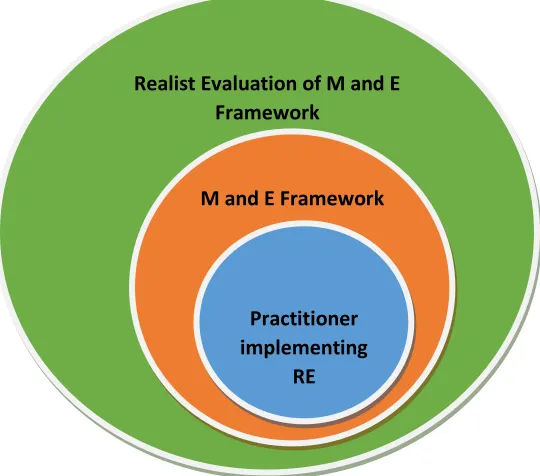
To answer these questions this study draws upon the testing of a newly formed participatory based M and E framework which embeds realist (Pawson and Tilley, 1997) and participatory based approaches to M and E. The key premise for mobilising realist approaches is because they hold value in opening and demystifying the black box of social change programmes (Pawson and Tilley, 1997). However, it is also important to acknowledge the conceptual complexity that realist evaluation bares. Pawson and Manzano-Santaella (2012) for example highlighted a number of evaluations that claimed to be realist but failed to show full characteristics of the approach. This highlights the importance for those conducting the evaluation to be competent in carrying it out. Therefore, providing a collaborative and participatory dimension to building practitioner capacity and competency in realist evaluation may be an appropriate starting point for progressing the field. 1.5 Introducing the M and E framework and sample
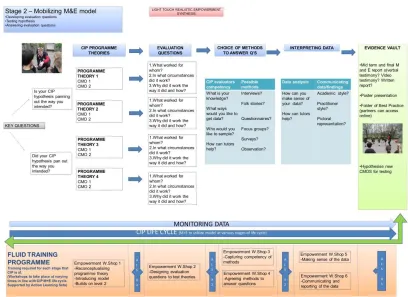
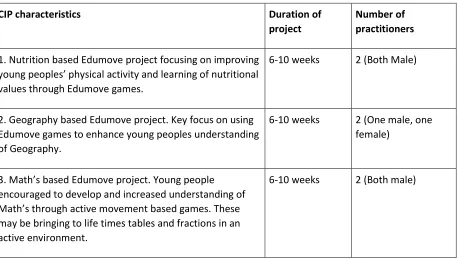
To be clear, the M and E framework was constructed with the intention to enable practitioners delivering small scale SFD projects to be able to independently carry out M and E of these programmes. With a focus on HE service based learning provision, the framework consisted of building this capacity with Student SFD Practitioners (SSDPs) within a participatory environment. SSDPs were selected because of the significant contribution they make to SFD goals, and also because they may be seen as future practitioners occupying industry. Specifically, the framework attempted to train SSDPs to be able to carry out a ‘Realist Evaluation’ (RE) of their own small scale projects named ‘Coaching Innovation Projects’ (CIPS). CIPs are implemented by SSDPs (usually groups of four) as part of their curriculum and involve researching the needs of a community then developing and delivering a SFD project in partnership with additional practitioners in the city of Southampton. These projects last between eight and twenty weeks but must address issues of sustainability where in many respects they are continued either through passing projects on to industry practitioners or back to new cohorts of SSDPs coming through. The participatory dimension of the framework involved providing workshops and action learning sets (separate from the curriculum) to support M and E competency in addition to the provision of specific models to foster use.
1.6 Mobilisation and transition of framework through the thesis
To mobilise and test the framework, this was done in two distinct phases in line with the curriculum. Phase one involved testing the framework on a small sample of CIPs who were given the option to take part in the framework. These CIPs were classified within the ‘Edumove’ approach which involves increasing physical literacy, enjoyment and learning through key stages one to four in education. The participatory dimension of the framework in particular drew upon Fetterman’s (2005) Empowerment Evaluation (EE) principles which aim to enable practitioners to take control and accountability in M and E. The second phase of the framework involved refining the framework (in line with the methodology) and testing it again on another sample of CIPs who could opt in. In phase two the CIPs were broader and more diverse in their focus whereby some focused on educational settings with others focusing on diverse community development environments. In line with the refinements to the framework, the second phase also involved dispensing EE as the participatory dimension and instead mobilised Schula et al’s (2016) collaborative approaches to evaluation which focus on the practical and transformational aspects of M and E.
1.7 Aims and Objectives
5 Aims:
1. To develop a Monitoring and Evaluation (M and E) framework enabling deeper understanding of SFD programmes for Sport Development Practitioners (SDPs)
2. To test and refine framework according to practitioner praxis 3. To synthesise and evaluate professional practice in light of aim 2 Objectives:
1. Review a range of approaches to M and E to develop criteria for a practice based framework 2. Create M and E framework synthesising participatory principles and realist evaluation
methodology
3. Within framework test realist evaluation’s capability for Coaching Innovation Programme (CIP) practitioners to evaluate and understand their SFD programme
4. Test collaborative / participatory principles underpinning framework for building capacity for CIP practitioners
5. Refine framework in accordance with research findings
6. Having refined framework repeat objectives three four and five upon broader CIPs
7. Draw conclusions concerning the utility of combining realist evaluation and collaborative / participatory principles for enhancing M and E use and competency
It is crucial to make clear that the purpose of the thesis is to not establish whether SFD works, but regardless of sports success investigate the ways it can be evaluated, how practitioners can learn and improve, and how the profession may develop on evidence based lines. This, again reiterates the contribution to knowledge asserted above.
1.8 Methodology and methods
In order to test the framework it is important to firstly establish that this constituted ‘evaluation’ opposed to that of ‘research’. This is because in line with the spirit of evaluation practice – which is to assess the merit or worth of something (Scriven, 1991) this was at the heart of the methodology for this thesis. In similar respects to the evaluation approach followed by the SSDPs within the framework a realistic methodology (Pawson and Tilley, 1997) was implemented to make sense of what aspects of the framework worked for whom in what circumstances and why. The evaluation and testing of the framework were constituted by two distinct studies in accordance with the phases of the framework’s mobilisation.
6
the framework. Secondly, to establish the degree of engagement and reaction to the empowerment (Fetterman, 2005) characteristics of the framework, and finally the overall competency and praxis of those receiving the training.
1.9 Methodolgical transition and refinement
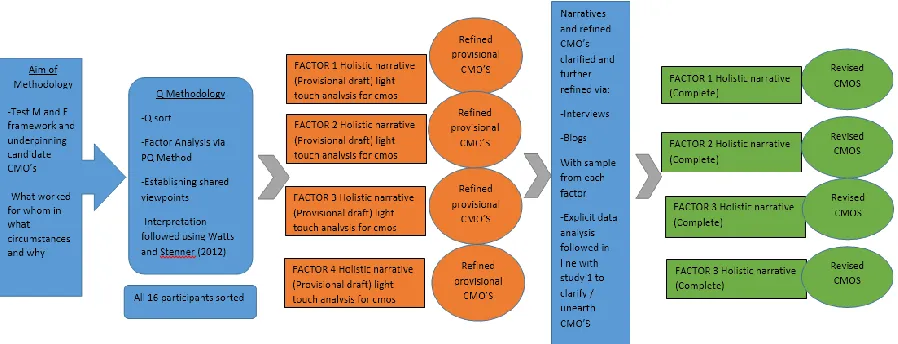
The second phase / study of the thesis involved refining the framework for further testing based on the findings from study one. This again was mobilised in the form of RE. However, crucially, this stage represented key changes in the application of a different methodological approach. This approach drew upon Q methodology. Q, which focuses on subjectivity (Watts and Stenner, 2012) was mobilized to understand the subjective viewpoints of the SSDPs across five diverse CIPs involved in the framework. For Watts and Stenner (2012) Q asks its participants to decide what is ‘meaningful’ and hence what does (and what does not) have value and significance from their perspective (Watts and Stenner, 2005). This was mobilized alongside realist interviews and blogs. There are a number of key arguments for this change in methodological affordance to Q. Firstly, whilst recognizing philosophical nuances within any methodological approach, Q shared a number of alliances with a realist approach to evaluation. In line with realist thinking, Q provided a useful way to understand not simply individual view points of individuals, but collective and shared viewpoints synthesizing multiple subjective accounts of reality (Watts and Stenner, 2012). Through the Q sorting exercise, embedded in Q the qualitative interpretation of data enables the evaluator to employ the logic of abduction as a tool (building theory) to unearth the retroductive understanding of the hidden causal mechanisms at play in social programmes. This is in strong synergy with realist approaches to evaluation that seek to do these very things. Moreover, the implemtation of Q symbolized the methodological advancement and development of the thesis over time evidencing growth, wider reading and competent scholarship. Embedding Q represented an opportune time to mobilise an approach rarely before synthesized with RE.
Q’s alignment with RE in this thesis firstly involved the carrying out of a Q sorting exercise where each SSDP would rank their subjective viewpoints pertaining to the M and E framework. Factor analysis, which enabled the compilation of shared viewpoints uncovered provisional holistic narratives (Watts and Stenner, 2012) depicting the journey of each SSDP, which then enabled the identification of in what circumstances, and for whom did the framework work. As a means of clarification, realist blogs and interviews were employed to make sense of the holistic narratives leading to a clear understanding of the varying ways in which different groups of practitioners engaged with the framework. This, then led to further refinements and recommendations for the framework and any future testing.
7
qualitative research methods where the research participants were able to convey their subjective viewpoints about the framework through the Q sort process.
1.10 Ethics
It is important to recognize and state the ethical position of the researcher within this thesis. First and foremost, the researcher occupied the position of course leader and unit leader within the respective curriculum where the M and E framework was mobilized. This bares ethical implications in relation to the perceived dangers of the evaluation influencing the SSDPs based on their relationship with the researcher, and how reliable their responses may be. To address these potential limitations a number of key steps were put into place. These involved firstly making the M and E framework optional for SSDPs to enroll in. Whilst the involvement in the framework may have led to positive or negative outcomes in the curriculum, this was separate from the respective units it was associated with. Secondly, it was ensured that the researcher would not be involved in any assessment of the work students produced resulting from this.
Ethics for both research / evaluation phases was applied for through Southampton Solent University in line with the Ethics Policy (2011) of the institution. For both studies SSDPs were provided participant information briefing sheets and consent forms which were returned and filed in a safe space. Anonymity was also maintained (see appendix 1.1, 1.2 and 1.3 for ethical documents).
1.11 Thesis structure
The following provides a succinct overview of each chapter making up this thesis. The thesis has been structured in such a way to demonstrate the journey and path of the thesis. In essence, the chapters articulate the way in which the framework was developed, refined and retested.
Chapter 2: Conceptualising SFD within the context of evidence
In this opening chapter, two key aims are addressed. Firstly, SFD is conceptualized to provide an understanding of what constitutes the field. On this backdrop, within the context of evidence SFD is then discussed highlighting issues and tensions within the literature surrounding M and E practice and unanswered questions. Essentially, the chapter calls for more work to address the lack of evidence discourse and where practitioners may be placed to address this.
Chapter 3: Reviewing approaches to evidence and arguing for a realistic approach to M and E Having highlighted the issues and concerns surrounding M and E and the lack of evidence in SFD, this chapter reviews examples of current approaches to M and E and attempts to distinguish what M and E is. Given that limited understanding associated with how and why programmes work, the chapter then goes on to review theory driven approaches to evaluation that may assert value for moving the SFD field forward. Specifically RE is argued as an appropriate evaluation methodology for the SFD field. This is then followed by a review of some participatory approaches to evaluation. It is argued that participatory approaches to evaluation may be key vehicles to enable practitioners to mobilise RE.
Chapter 4: Conceptualising the sport development practitioner
8
and SFD practices. Having defined the SDP, the chapter attempts to problematise the field; in particular it draws upon key questions surrounding the profession and key gaps. This is then followed by the introduction of H.E and more specifically the role of the SSDP and the contribution they make to the field.
Chapter 5: Introducing a Realistic participatory based M and E framework
This chapter introduces the M and E framework proposed for testing at phase one. In particular this chapter argues for a realistic participatory based framework drawing upon Fetterman’s (2005) Empowerment Evaluation. Within the chapter, the case study used to test the framework (The Coaching Innovation Programme) is introduced and key models underpinning the framework are presented and discussed.
Chapter 6: Methodology (stage one and two)
The methodology chapter is split up and presented in two distinct parts. This is because, although the realist philosophical underpinnings of RE were consistent across both studies, each study entailed different samples and methods as part of the testing and development of the M and E framework. Therefore, study one opens with an in depth discussion of the philosophical dimensions of the thesis. This is then followed by an explicit and reflexive overview of the methodology and methods adopted as well as data analysis in study one. The chapter then moves on to the next phase of testing (study two) and explains key distinguishing characteristics between it and study one. This section explains how and why Q methodology was applied and synthesized with realist evaluation, and in turn data analysis is discussed.
Chapter 7: Study 1 findings
This chapter draws upon and critically discusses the findings from study one. Furthermore, the chapter goes on to suggest potential improvements and refinements to the M and E framework to be further tested within study two. Part of this analysis, and within accordance with RE involves the articulation of a new compilation of context mechanism and outcome configurations. This leads to the refinement of a new programme theory for testing in phase two.
Chapter 8: Refinement of framework and transition
Within this chapter the findings from study one are firmly evaluated in respect of informing the refinements to the framework. Crucially, significant consideration and critique is afforded to the deposing and retaining of certain elements underpinning the M and e framework. Through the support of current literature on participatory evaluation being explored the chapter then proposes a new set of principles for collaborative evaluation by Schula et al (2016). In essence the chapter demonstrates the key refinements of framework for further testing at study two.
Chapter 9: Study 2 results
9 Chapter 10: Discussion
Chapter 10 draws upon the results presented in chapter 9 and critically discusses the implications of the findings. The chapter is structured in line with each respective factor that emanated from the Q and realist methodology employed within study two. Specifically each factor discussion evaluates the key mechanisms explaining how and why the framework impacted upon the practitioners with key focus upon the collaborative principles of evaluation tested. This then leads to the discussion of key concluding refinements to the framework for future mobilization and testing
Chapter 11: Conclusion and contribution to knowledge
The final chapter captures and summarises the key findings across each study and illustrates the journey of the framework. This chapter discussed the potential of the framework to be mobilized in wider fields of SFD and other sectors. The contribution to knowledge of the thesis is asserted alongside reflexive recognition of any limitations linking to the thesis.
1.12 Chapter summary
This chapter has attempted to set the scene for the research underpinning this thesis. Having problematized sport for social change in its limitations to evidence how and why programmes may work, a rationale has been put forward for developing teachable M and E techniques for practitioners working within the field. The M and E framework underpinning this thesis has been succinctly introduced alongside the methodological realist evaluation framework that will put it to test. Given that the thesis spans across two evaluation studies, these and their methodological transition from study one to two have been discussed. The aims and objectives have also set out a clear strategy for the thesis.
10
Conceptualising SFD within the context of evidence
The aim of this chapter is to conceptualise (SFD) within the context of evidence. This is a pivotal chapter for positioning the thesis aims and objectives within a contextual understanding of what constitutes the SFD field. As a nebulous concept sports development has found itself open to varying interpretations and framings (as discussed below). The chapter begins with reviewing the various definitions of what SFD is. Having conceptualized SFD, this is then positioned within the context of evidence and issues in M and E. Following this, the current industry approaches pertaining to M and E in SFD are firmly critiqued. The chapter concludes by drawing attention to positive developments supporting the SFD field and then implications for progressing the field. At the heart of this progression is the firm argument of involving practitioners more closely in evidence based approaches, which underpin the aims and objectives of this thesis.
2.1 Emergence of (SFD)
Sport development is a contested term that is often used simplistically to indicate the application of both policy and practice in encouraging, increasing and possibly sustaining participation in sport (Hylton and Bramham, 2008; Houlihan and Green, 2011). There are a number of varying conceptualisations of sport development (SD) which presents a dichotomy in how SD is conceived of and implemented within programmes (Adams and Harris, 2014). Within UK practice and its historical origins, development of sport and development through sport (Houlihan and White 2002) have gained recognition as the two broader categories underpinning sport development practice. The former, now also known by the alias of sport for sport sake (Collins, 2010) and sport plus (Coalter, 2007), tends to leverage sport participation, in the first instance, for the benefit of those participating (Adams and Harris, 2014). Development through sport, plus sport (Coalter, 2007), sport development and peace (Guillianotti 2011; Sugden, 2010) and SFD on the other hand tend to use sport as a vehicle to address a range of wider social issues emanating from the social problems industry (Hartmann and Kwauk, 2011) such as improving health, reducing crime and tackling obesity (Houlihan and White 2002). In defining SFD Lyras and Welty Peachey (2011) assert that it is “the use of sport to exert a positive influence on public health, the socialisation of children, youths and adults, the social inclusion of the disadvantaged, the economic development of regions and states, and on fostering intercultural exchange and conflict resolution. (pg: 311)
It is important to conceptualise what SFD is, becausethe question of what is SFD and how is it driven is pertinent for understanding how it is used in society. As a starting point SFD as a conceptual hub is not distinctive in its own right because there are similar terms that have been derived which may mean the same thing. For example, Houlihan and White’s (2002) ‘development through sport’ and Coalter’s (2007) sport plus and plus sport are arguably synonymous terms. Nevertheless, to conceptualise, the SFD concept takes into consideration the role that sport can play in addressing a plethora of social issues omnipresent within society. The foundation of SFD is positioned within a discourse that suggests sport can do good, and can make a positive contribution to society.
11
be clear Hylton and Bramham (2008) interpret functionalism on the basis that society is based on broad agreement whereby the social system regulates and reflects balance between differing interests. For them, functionalism and sport development intersect in that sport development addresses gaps in provision distributing social justice applying “the glue to bind diverse strands into an integrated whole” (pg: 65). This functionalist framing of SFD has unsurprisingly been politically and ideologically driven (Houlihan, 2011) as a resource for the social problems industry (Pitter and Andrews, 1997) with governments investing heavily in sporting programmes to address social issues. As Kay (2009) states “contemporary rhetoric and policy have raised the profile of sport in these roles often expressing very high expectations of the instrumental role sport may play” (pg: 1178). Indeed, as Guilianotti (2011) states the SFD expansion has been driven in part by the United Nations, which dedicated 2005 to be its International Year of Sport and Physical Education.
The growth and expansion of SFD programmes now saturates the global world. The landscape has seen major growth in policy intervening programmes globally, using sport based interventions as tools to address social issues (Levermore, 2011; Guilianotti, 2011). The international context according to Mwaanga (2013) has specifically adopted this neo liberal, westernised functionalist application of SFD. Thus, this SFD movement is now operationalized by practitioners at various levels using the good of sport to frame an equal society. Within this conceptual hub questions emerge surrounding what development actually is and that it is impossible to define in a universal way (see Girginov, 2008). However, quite clearly within the context of SFD we are referring to a process of social change that reaches community empowerment and individual development (Harris and Adams, 2016).
To date, an abundance of SFD programmes exist and have run their course. These programmes have an international global presence. For example, in the global south which represents countries of Africa, Latin America and developing Asia, organisations (eg: Edusport and the Matawe Youth Sport Association) exist. Within these programmes, there has been a strong emphasis on empowering individuals and communities to take more control over their lives, be it in tackling poverty or utilizing sport as a tool to confront issues surrounding HIV and AIDS (Mwaanga, 2013). Additionally, the likes of Sugden (2008) have been instrumental in exploring the utility of sport for peace within Israel to tackle violence and conflict. Community cohesion and social capital have thus been central focuses for alleviating such tensions (Coalter, 2007b).
12
eight years. Moreover, at the time of writing, under the new government strategy (A Sporting Future, 2016) a much closer symbiosis between sport and public health has been desired, which may indeed lead to an increased focus on the role of SFD programmes.
It is not the purpose of this chapter to provide a comprehensive review of all of the SFD programmes that have come under existence given that this is not at the heart of the aims and objectives of this thesis. The purpose here is to draw attention to the wider context that constitutes SFD practice across the world. Whilst recognising their contextual distinctions and differences, all these programmes, whether UK based, global south or middle east, share common characteristics of using sport, and or physical activity as a site for development. Whilst the term ‘development’ requires further conceptualizing (Girginov, 2008), development within the context of these programmes often pertains to using sports based interventions to empower the marginalized (Mwaanga, 2013), promote self esteem, tackle health issues, build community cohesion (Adams, 2008) and tackle anti social behaviour (Crabbe, 2007). According to Kidd (2010), under the right circumstances, and with astute leadership, sport can become a favourable ground for change. Significant to note also is Green’s (2009) statement that it is not sport per se that is responsible for certain outcomes, but the way it is implemented. Indeed, as Coalter (2007) suggests, it is also how it is combined with other interventions that may truly indicate the contribution it can make.
By way of theorising SFD and strengthening its application Lyras and Welty Peachy (2011) recently developed a theoretical framework breaking down what constitutes SFD as ‘SFD Theory’ (SFDT). According to them, in similar respects to the preceding authors they assert that by blending sport with cultural enrichment and education can provide a foundation for addressing social issues. Moreover, in developing a more robust theoretical insight into SFDT the authors suggest that SFD interventions should encompass and take into account key components comprising impact assessment, organisational contexts, sport and physical activity, education and cultural enrichment. Their presentation of ‘impacts assessment’ suggest that micro, meso and macro levels of change should come under close scrutiny by way of evaluation. For example infrastructures would be a key area for investigation (macro) whereas social networks, social capital and cohesion would be investigated at the meso level. On a micro level, this pertains to individual and psychological impacts in line with individual empowerment (Mwaanga, 2013).
13
Whilst it may appear that this framework provides a robust set of dimensions, it can be asserted that a key omission is made surrounding the crucial role context plays in the formulation of programmes. Although organizational contexts are referred to, there is limited focus on the cultural contexts which shape and influence the successful (or not) mobilization of programmes. Within a realist orientation, it could be argued that context (the circumstances that surround the programme on organizational, environmental, social, individual, psychological, macro and micro levels (Pawson and Tilley, 1997) is crucial. According to Westhorp (2014), these contextual variables will influence the ways in which participants’ reason against the resources (mechanisms) provided in the programmes. Thus, the programme outcomes will be determined by these mechanisms. It is suggested that the framework put forward by the above authors would benefit from a deeper appreciation of these contexts.
Of the limited frameworks available, Lyras and Welty Peachey’s (2011) SFDT may provide a useful framework and guidance for good practice in the SFD field. Firstly, its strengths lie within its robust appreciation of the key dimensions set forth in the previous narrative. These dimensions of impact assessment, organizational contexts, sport and physical activity, education and cultural enrichment are all crucial considerations applicable to SFD programmes. The authors recognizing the importance of organizational staff in designing programmes, not over conflating the role of sport, and recognizing sports capabilities are not independent or exclusive to its relationship with other educational environments and processes (Coalter, 2007). With the addition of the contextual dimension discussed above it is suggested that this framework can hold considerable value in helping one to conceptualise what SFD is. Thus, for the purpose of this thesis such a conceptualization of SFD will provide a foundation for the following discussions pertaining to evidence.
Furthermore, with an increasing global focus on SFD, the field has regularly been required to demonstrate accountability for investment made by funders via robust and systematic approaches to evidence that centre upon proving the place of sport within development (Kay, 2012). Whilst accepting differences in global contexts, it is clear that similarities persist in the dominance of accountability and efficiency. Globally the march to modernisation has ensured that neoliberal disciplines have dominated the contexts and frameworks within which SFD has operated (Coakley, 2011, Sam, 2009). Consequently, modernisation has ensured an acceptance that public institutions and public services must change in accordance with the rational and scientific processes of managerialism, evidence-based policy, measurement, audit and technologies of accountability (Newman, 2001, original emphasis; Adams and Harris, 2014). SFD has been affected by this in that the programmes and interventions that fall under it are duly obliged to demonstrate robust, efficient and accountable ways of how they demonstrate impact and change.
2.2 SFD reservations and the lack of evidence discourse
14
DFE, 2002) that attempted to increase the number of volunteers and social capital of those involved, and Positive Futures (a home office funded nationwide social inclusion programme to tackle crime through sport) are prime examples. Consequently, government departments were, and continue to be keen to see evidence of these issues being addressed. As a consequence, it can be suggested that much of the evidence required has been focused towards establishing an answer to the question of whether these SFD programmes work or not.
This climate and impact of modernisation has unsurprisingly unearthed some key questions about the SFD field and what it attempts to achieve. The last decade has witnessed significant scholarly critique, questioning the anecdotal claims, poor evaluation techniques and the ‘given’ assumption that sport can solve a multitude of problems (Coalter, 2007, 2010, Kay, 2009, Levermore, 2011, Smith and Leach, 2010). The following section will review these scholarly critiques in more detail within the context of the aims and objectives of this thesis.
2.3 Problematising the meaning and power of sport
Fred Coalter has been at the heart of the scholarly critique focusing on SFD. His book ‘A Wider Social Role for Sport’ (2007) was one of the first academic contributions that began to raise questions about sport and the perceived impacts it may have on participants. He presents severe reservations about the assumptions programmes make particularly around what sport (as a collective noun) actually means within programmes, and its causal powers to generalise evangelical outcomes for those involved. Sport, on political and practical levels, has subsequently been perceived as a magic box (Coalter, 2007, 2013), yet Coalter has highlighted that there are major limitations over ‘sport’s’ powers to elicit change given the complexity of the social issues they attempt to overcome and the diversity of participants in programmes. In line with this critique, Hartman and Kwauk (2011) assert the need to deconstruct SFD as a collective entity that can explain and account for social change. Like Coalter, they suggest that a problem with SFD interventions is the over emphasis placed upon sport. Instead they suggest that the power of a SFD intervention and any positive outcomes that it fosters should be considered in light of how it engages with non sport elements. Like Lyras and Welty Peachy (2011) for SFD to be successful, additional development characteristics concerning education and cultural enrichment must be embodied in the process. Thus, understanding the impact of SFD would require a consideration of how the constituent parts of the intervention (eg, sport, educational aspects and wider development applications) intertwine.
15
Harris and Adams (2016), Levermore, (2011), Smith and Leach, (2010), Guillianotti, (2011), Sugden, (2010) and Kidd (2008) have also joined the critique.
To highlight this challenge further, Coalter (2010) and Kay (2012) point out that the varying funders or donors of these programmes are often insistent of addressing goals that are unrealistic and may not fit the context or local issues that the programs should address. In summary, both funders and practitioners are likely to develop over optimistic projects, coupled with inadequate evaluation processes, resulting in confused and unverified claims because they are trapped within the view that sport works, thus they have to prove that it works. This, to a large degree, perpetuates a profession based around what can be funded rather than what may be effective. Jeanes and Lindsey (2014) and Lindsey and Culbertson (2013) also highlight a key issue within the SFD field that the recent calls for evidence do little to move the field forward. This is because these calls promote legitimacy of SFD’s worth and proof that these types of programmes are positive and work. This is aligned with literature within other fields pointing out that evidence based policy is flawed (Whyte, 2013) often superseded by ideology. This prioritizing of ideology over evidence is explained by power interests (eg: governments and interest groups) prioritizing their manifestos, visions and ideas over evidence that may well contradict them. As a result evidence bares no impact on practice or strategy (Houlihan, 2011).
2.4 Emerging approaches and resourcing Monitoring and Evaluation
In light of the issues raised above, the SFD field is currently involved in a significant level of M and E work. Whilst there is evidence of this in the U.K through online monitoring and evaluation tools and commissioned work, it is particularly prevalent in international contexts (Levermore, 2011). This is mainly in response to the perceived evidence gap within the field and has particularly picked up momentum in the last ten years. An abundance of technocratic processes underpinning evidence which focuses on performance, efficiency, and cost effectiveness which resonate well with new public management (Choinard, 2013). An immediate interpretation may look upon this in a positive light as a way of addressing the gaps in knowledge and the evidence base. However, despite the positives emerging from this expansion in M and E work and interest, the following arguments draw attention to some of the cautions associated with this.
Within this contemporary context, Levermore’s (2011) small scale audit of M and E practice within the field of SFD is a useful source for illuminating what constitutes M and E work. Levermore’s starting point is one that recognizes the limitations and questions surrounding the meaning and power and sport. He goes on to summarise two key and most prevalent approaches to evaluation practice in development assistance – namely the logical framework approach (using logic models and top down matrices to quantify findings through inputs to outputs and outcomes) and the participatory approach (involving stakeholders within the design and process of the evaluation). (These are discussed in more depth in chapter 3). Levermore immediately provides a critique of these two approaches wherein the former can be perceived as too rigid and not conducive for community development settings (Lindsey and Gratton, 2012). For participatory approaches, he points out that whilst they may involve practitoners and stakeholders within the process there are dangers surrounding subjectivity, bias and the influence of the evaluation being overly top down orientated.
16
M and E was undertaken, the methods used and whether the findings were made public. Levermore’s findings were interesting on the basis that eleven of the fourteen organisations targeted had evidence of M and E practice. The main characteristics of these M and E approaches were focused around the use of the log frame and participatory approaches either used separately, or combined to improve credibility. Many utilized the use of monitoring reporting systems, surveys and online systems. What was also interesting was the increasing involvement of external consultants in the process.
This useful exercise by Levermore unearths a series of critiques. Firstly, the exposure of the log frame approach in itself commonly used across these programmes raises issues around its compatability with community development settings of SFD. Lindsey and Gratton (2012) have joined this critique emphasizing this potential incompatability, also concerning how it may alienate practitioners and stakeholders from the process due to its’ over technical and linear representation. Secondly, Levermore refers to key limitations of the participatory dimension in these M and E approaches adopted in that they may follow overly top down westernized approaches whereby the decision making lies with the donor or the external evaluator at the mercy of the local stakeholders mobilizing the programmes (Cracknell, 2000 cited in Levermore, 2011). As Kay (2009) and Nichols et al (2010) have pointed out, the crucial questions to ask in light of this are who decides on these approaches to evaluation and who enforces them? Levermore’s final conclusion centres upon the overt pressure for “easy empirical generalization” (pg: 352) that fail to fully recognize cultural nuances.
A key focus of this critique stems from the very philosophical foundations underpinning the approaches to M and E being mobilized within the SFD field asserted by Lindsey and Culbertson (2013). The question of ‘does sport work’ is firmly rooted in this foundation. Clearly funders and politicians who invest money and resource into SFD want to see results and impact. Thus, it is of little surprise to identify that the point of departure for any approach to M and E is to find evidence to support positive outcomes or show proof (Harris and Adams, 2016) that these programmes work. This is hugely problematic because it is sport may give rise to positive or negative outcomes (Coalter, 2010). Moreover, social change orientated programmes operate in the social world, they cannot be controlled and they will produce diverse outcomes for all involved (Westhorp, 2014). SFD programmes are no different which means that it is practically impossible to demonstrate positive outcomes for everyone. The framing of M and E around proof and accountability leads to clear tensions. These tensions are illustrated through those leading on evaluation implicitly and explicitly encouraged to illuminate positive outcomes (Adams and Harris, 2014; Harris and Adams, 2016). For practitioners themselves this may be in fear of having funding revoked (Smith and Leach, 2010). For academics this may be associated with funding being received from the donar or funder commissioning the M and E. Therefore, the reflexive, and open reporting of evidence that captures the disparity of outcomes in programmes may be lost.
17
implemented by practitioners. In fact, in most cases, many of these techniques are carried out either by academics independently (Kay, 2012) or within participatory frameworks (Levermore, 2011) as discussed above, that may involve SDPs. This is of little surprise given that the enactment of such methods requires skill and a high level of competency; which in many respects SDPs may not possess (Hylton and Hartley, 2011; Coalter, 2012; Harris and Adams, 2016) because limited CPD or training around such approaches are provided (see chapter 4). This proposes significant implications around the extent to which the findings of any M and E work are recognized by those on the ground or inform programme improvement. Furthermore, Harris and Adams (2016) assert that an evaluation process that does not embed practitioners input or knowledge may have negative consequences. This is because, firstly, it may fail to recognize the strengths and limitations of what can be achieved, and secondly may limit the practitioners in regards to learning about and improving their programmes. As a result, an evidence based community of practice may be out of reach (Harris and Adams, 2016).
This sets up the third point of caution emanating from the literature. In most cases the decisions concerning M and E are made by funders or donors via the influence of academics and policy makers (Kay, 2009) with little input from practitioners on the ground (Nichols et al 2010). As a result, programmes in receipt of funding are expected to follow approaches regardless of the competence of programme staff to do this. For example, in relation to the participatory evaluations, in most cases these approaches are imposed upon practitioners on the ground and tied towards funding streams which mobilise external academics as consultants to build capacity with practitioners (Lindsey and Gratton, 2012), regardless of the cultural implications and differences. In many cases, organisations in receipt of funding are increasingly buying in support for evaluation and Levermore’s (2011) audit is evidence of this. It is important to highlight here that there is nothing wrong or immoral in principle for commissioning evaluation work. However, the issue according to the likes of Kay (2009), Harris and Adams, (2016) and Nicholls et al, (2010) concerns the passive nature and unheard voices of practitioners in deciding on M and E approaches and bringing to life the real dynamics of the programs. Nichols et al (2010) in particular, point out that these approaches require or are carried out by academics and either downplay or call into question the knowledge, reliability and integrity of practitioners who may possess knowledge and understanding of their programme which undoubtedly may inform the evidence.
18
theorise academia (simplify) into terms that are more transferable to on the ground practice opposed to only being confined to journals and academic conferences. Whilst theory may have a significant role to play in enabling greater understanding of SFD, unless it is explained and applied in a clear way, it may only intimidate and alienate industry.
The final argument presented here concerns the way M and E is perceived and implemented in programmes. Whilst monitoring tracks changes in programmes, and evaluation assesses merit and worth (Scriven, 1991) this approach does not necessarily manifest itself in practice. Firstly, the technocratic (Choinard, 2013) results based focus on numbers and figures has lead to monitoring taking precedence, often over evaluation practice. Tracking participation levels and ticking boxes in accordance with performance indicators (Smith and Leach, 2010) in connection with funding is now common place in SFD practice. This fascination with monitoring over evaluation, and / or monitoring as evaluation can also be connected with confusion, misinterpretation and competence on practitioner level of what constitutes the two forms (Adams and Harris, 2014). As a result, the meeting of targets becomes more of a measure of success for a practitioner opposed to understanding how and why their programme has worked. This does little to develop learning and understanding surrounding SFD programmes (Harris and Adams, 2016). It is thus no surprise that within policy spaces the wheel continues to be reinvented concerning what SFD is mobilised to tackle.
2.5 Optimism for the field


![[−2]proPSA versus ultrasensitive PSA fluctuations over time in the first year from radical prostatectomy, in an high-risk prostate cancer population: A first report](data:image/gif;base64,R0lGODlhAQABAIAAAP///wAAACH5BAEAAAAALAAAAAABAAEAAAICRAEAOw==)