doi:10.3926/jiem.2011.v4n2.p339-360 JIEM, 2011 – 4(2): 339-360 – Online ISSN: 2013-0953 Print ISSN: 2013-8423
Exploring technology acceptance for mobile services
Kenny Phan, Tugrul Daim
Portland State University (USA)
[email protected]
;
[email protected]
Received December 2010 Accepted March 2011
Abstract:
Purpose: Mobile phone industries are no longer relying on voice services. It is
predicted that data services are expected to be a remediation for the declining of
average revenue per user (ARPU) in telecommunication market. The purpose of
this paper is to find the factors that influence the acceptance/adoption of mobile
services.
Design/methodology/approach: This paper utilizes quantitative method.
Questionnaire were distributed to collect the data. The questionnaires are designed
specifically to address the factors related to mobile services. Later on, this paper
uses Analytical Hierarchical Process (AHP) and Cluster analysis to identify the
factors that influence the adoption of mobile services.
Findings: The results show that ease of use and usefulness are top two factors
that influence the adoption of mobile services.
Research limitations/implications: The sample for the study is relatively small.
For future research, the sample should be increased. The data collection should
also look into different devices and operating system of mobile phones to find if
there is any significant difference in adopting mobile services.
doi:10.3926/jiem.2011.v4n2.p339-360 JIEM, 2011 – 4(2): 339-360 – Online ISSN: 2013-0953 Print ISSN: 2013-8423
Originality/value: This is the follow on research on the previous study that
employed different method. This study is to confirm and support the findings
from previous study.
Keywords: mobile services, Technology Acceptance Model (TAM), technology adoption
1 Introduction
Telecommunication industries especially in mobile phones are moving into era where data and video usages will be as important as voice usages. In other words, it is slightly moving from mere communication-oriented services such as voice calls to more complex content-oriented services (Vesa, 2005). Nowadays, Mobile Phones are not used for voice services only, but also for data services such as: texts messaging, gaming, download music, payment services, etc. Therefore, the future of the mobile telecommunications is expected to count on mobile services (Carlsson et al., 2006). Mobile services are expected to be a remediation for the declining of average revenue per user (ARPU) in telecommunication market (Knutsen et al., 2005). Another study also emphasizes that the future of telecommunications sector will be depending on mobile internet services development in addition to voice services (Bouman et al., 2006). It is believed that the market of mobile data services is likely to scale up in the future. The main goal of this paper is to identify the factors affecting the adoption of mobile services and proposed a framework to enhance TAM (Technology Acceptance Model) that will represent the factors that influence mobile services adoption. This paper will try to understand how and why people adopt mobile services (Carlsson et al., 2006). The framework is expected to help industry players when designing their services and defining their current and future business models.
doi:10.3926/jiem.2011.v4n2.p339-360 JIEM, 2011 – 4(2): 339-360 – Online ISSN: 2013-0953 Print ISSN: 2013-8423
method. Results and Conclusions are going to be explained in fifth and sixth part respectively.
2 Literature review
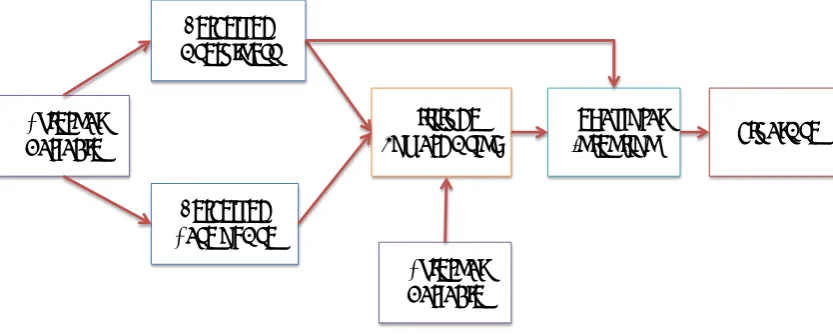
This paper studied and analyzed literature on several theoretical models and mobile services adoption to form an understanding of the concepts, theories and models that influence mobile services adoption. There have been several papers explain the concept of technology adoption. One of the widely accepted and applied models is the Technology Acceptance Model (Davis, 1989). Technology Acceptance Model (TAM) proposes that usefulness and ease of use are important factors in determining user attitude towards adopting a new technology (Malhotra & Galletta, 1999). Technology Acceptance model has been used in a number of studies on mobile services which focus on users (Amberg, 2004; Pagani, 2004; Samtani et al., 2003, Teo & Pok, 2003). Even though TAM is supposedly used to explaining the adoption of technology within organization, the constructs of the model are actually meant to be general and universal (6). TAM, as illustrated in Figure 1 below, includes 6 concepts (Malhotra & Galletta, 1999, Davis et al., 1989):
• External Variables (EV) which is defined as variables that affect perceived usefulness (PU), perceived ease of use (PEU), and Attitude toward Using.
• Perceived Usefulness (PU) which means that a person believes that using the particular system/technology will improve his or her action (Venkatesh & Davis, 2000).
• Perceived Ease of Use (PEU) which means that a person believe that using the particular system/technology will simple and not complicated (Venkatesh et al., 2003)
• Attitudes towards use (A) which is defined as the users’ desirability to use the particular system/technology (Malhotra & Galletta, 1999).
doi:10.3926/jiem.2011.v4n2.p339-360 JIEM, 2011 – 4(2): 339-360 – Online ISSN: 2013-0953 Print ISSN: 2013-8423
Figure 1. “Technology Acceptance Model”. Source: Davis et al. (1989)
TAM model has been both extended and modified. It is believed that perceived ease of use play important role and get more attention (Venkatesh & Davis, 1996), while the perceived usefulness is believed as equally important as ease of use and lean toward service-dependent (Venkatesh & Davis, 2000). Technology Acceptance Model (TAM) has been used as a conceptual tool to identify central issues. Actually, Technology Acceptance Model is based on Theory of Reasoned Action (TRA) model (Fishbein & Ajzen, 1975). TRA is used to explain the ‘reasoned action’ by identifying causal relations between beliefs, attitudes, intentions, and behavior (Kwon & Chidambaram, 2000). Technology Reasoned Action (TRA) also has been applied to clarify the adoption of various technologies and applications (Liker & Sindi, 1997). Lee et al. (2003) underlined the usage of TAM in Information System field. Lee, et al. did a survey among 32 information system researchers to examine the usage of TAM for the future directions. The finding shows that TAM has been applied to communication systems, including mobile phones. However, utilizing TAM has to be really careful. Benbasat et al. (2007) stressed that researchers have to pay a lot of attention to other factors when utilizing Technology Acceptance Model (TAM) as research instruments to formulate model. Even though TAM is popular in Information System, its application is limited due to the nature of constantly changing IT environments. Authors suggested looking into more factors in order to reach more comprehensive understanding of what influences adoption of IS in order to give more useful recommendations.
After we investigated the models above, we are going to look into factors that might affect the adoption of mobile services. Those factors will be explored through
External Variable
Perceived Usefulness
Perceived Ease of Use
Attitude
Toward Using Behavioral Intention Actual Use
doi:10.3926/jiem.2011.v4n2.p339-360 JIEM, 2011 – 4(2): 339-360 – Online ISSN: 2013-0953 Print ISSN: 2013-8423
several literature reviews. In the models above, we have found several factors such as: Ease of Use, Usefulness. There are several papers that support usefulness and ease of use as important determinants of the adoption of mobile services. According to Rogers (2003), innovativeness is important because it is distinguishes by individual as something new therefore leads to adoption. Kleinrock stated the benefits by using mobile phones are the ability to provide “anytime and anywhere computing”, in other word ‘mobility’ (Kleinrock, 1996). Dunlop affirmed that screen sizes (visual factors) is quite important and will improve in resolution and color yet might remain small due to the need for portability (Dunlop & Brewster, 2002). The visual factor will be improved, yet the mobility will be taken into high consideration. Social factors also affect the social interaction might be influenced by using the mobile services. Especially for young people, the adoption of the mobile services can be encouraged by a “theory of fashion” which is influenced by social environment (Ling, 2001). Lee et al. (2002) studied user acceptance of the mobile services and found that social factors significantly affect on perceived usefulness and perceived ease of use, respectively, while perceived ease of use and perceived usefulness will leads to attitude toward using.
doi:10.3926/jiem.2011.v4n2.p339-360 JIEM, 2011 – 4(2): 339-360 – Online ISSN: 2013-0953 Print ISSN: 2013-8423
affection/sociability, relaxation, mobility, immediate access, instrumentality, and reassurance. Holflich and Rossler (2001) conducted gratifications study on text messaging which can be categorized as mobile services and identified the following gratifications; reassurance, sociability, immediate access/availability, instrumentality, and entertainment/enjoyment. Eldridge (2001) also studied the adoption of text messaging (one of mobile services) among teenagers and found that text messaging were favorable compare to other media because it was considered quicker, cheaper, easier and more convenient to use. I-LAB-Bocconi University (2002, 2003) showed that awareness, familiarity/habit, and involvement influence attitude toward using a new service.
doi:10.3926/jiem.2011.v4n2.p339-360 JIEM, 2011 – 4(2): 339-360 – Online ISSN: 2013-0953 Print ISSN: 2013-8423
will use quantitative (questionnaire) method which will be discussed in the next session. Yu et al. (2005) also did a research in T-commerce by utilizing Technology Acceptance Model (TAM). T-commerce is electronically mediated commerce using interactive television. It is considered as mobile services in telecommunication industry. In this sense, it has similar pattern with the mobile services in telecommunication. They identified several factors that influence the adoption in T-commerce. Those factors can also be applied to adoption of mobile services. Those attributes are perceived ease of use, perceived usefulness, perceived enjoyment, trust, attitude, normative belief of family and friends, and subjective norm.
3 AHP model for the adoption model
Analytical Hierarchical Process (AHP) is used to this particular case. AHP has been applied in wide range applications in different fields for the last 25 years (Saaty, 1990; Kodali & Chandra, 2001; Chan & Lynn, 1991). AHP is comprehensive, logical and a structured framework that requires the subjective opinion from the experts (Delphi method) in order to obtain weight for the criteria. AHP will help in the sense of simplify the decision process by categorizing multiple criteria into hierarchical process which make it easier to be evaluated (Liu et al., 2010; Drake, 1998; Saaty, 2008). Pairwise comparison among criterion is the key step in AHP process to acquire the priority weight or relative importance for each criterion in the hierarchy (Hepler & Mazur, 2007). Pairwise comparison method will compare two criteria at a time and their relation to each other. By comparing the criteria, no single criterion could dominate all other criteria in a clear-cut fashion. The favor of a single criterion is more important than the other criteria would be the result of Pairwise comparison (Yang & Shi, 2002).
From the literature review, this paper listed the factors that are going to be examined; Service Quality, Simplicity, Innovativeness, Visual Factor, Speed, Time Efficiency, Enjoyment, Cost, Mobility, Content, Habits, Technology, Social Factors, Usefulness and Ease of Use.
doi:10.3926/jiem.2011.v4n2.p339-360 JIEM, 2011 – 4(2): 339-360 – Online ISSN: 2013-0953 Print ISSN: 2013-8423
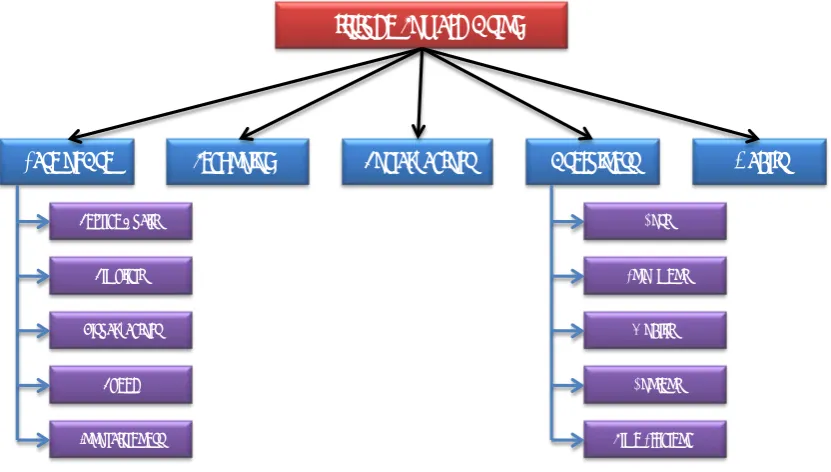
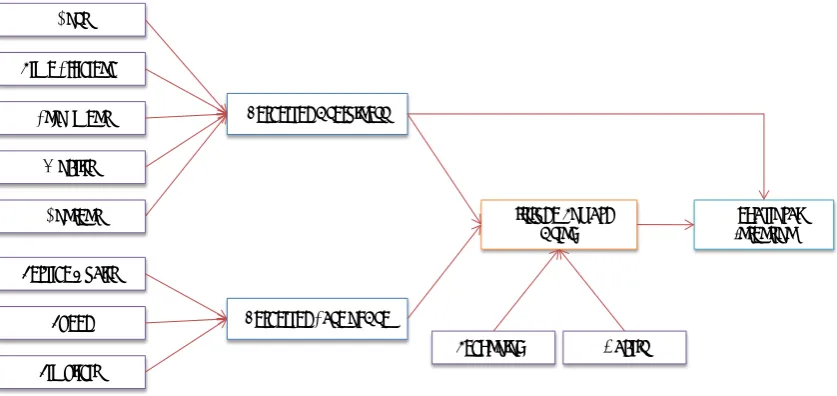
Ease of use and usefulness factors have their own sub category. Ease of use consists of service quality, simplicity, visual factors, speed, and innovativeness. Usefulness comprises of cost, enjoyment, mobility, content, and time efficiency. The categorization is based on literature review and experts’ judgments.
The proposed AHP model for the adoption of mobile services can be found in the following figure.
Figure 2. “AHP Model for the Adoption of Mobile Services”.
4 Methodology
This paper used a quantitative method to collect the data in order to study the factors that influence the adoption of mobile services. Questionnaires were distributed to the respondents who are mobile phone users and have used mobile services. The purpose of this method is to understand correctly the user preference when the factors are identified. The respondents assigned scores to the factors that they favor better. The respondents are being asked to compare two items at a time. This method is well known as Pairwise Comparison. Pairwise Comparison Matrices (PCM) software was used after the data were collected from the respondents. The PCM software will give the mean of each factors based on the responses.
Attitude Toward Using
Ease of Use Technology Social Factors
Service Quality
Simplicity
Speed Visual Factors
Innovativeness
Usefulness Habits
Cost
Enjoyment
Mobility
Content
doi:10.3926/jiem.2011.v4n2.p339-360 JIEM, 2011 – 4(2): 339-360 – Online ISSN: 2013-0953 Print ISSN: 2013-8423
The participants are mostly university graduate students and professional workers. The participants were notified through email, phone, or face to face. The study was explained in term of the scope and explanation about the research. The questionnaires can be found in Appendix A. A total of 15 people participated in the study. All of the respondents must have at least one mobile device.
Target interviewees were people whose aged between 20 to 60 years old. The distribution of gender in this study was 33% female and 67% male.
All the respondents should have used at least short message services. Without short message services experiences, the respondents will be automatically not considered as part of the analysis. The study is not limited to specific brands and operating system of the mobile phones. The purpose of this study is to find the factors that influence the adoption of the mobile services in general. If the focus is on specific brand or operating system, the results would not be able to be generalized. Therefore, the respondents of this study use a variety of different phones and operating system.
The results will identify the factors that affect the adoption of mobile services. The factors will be integrated to the Technology Acceptance Model (Davis, 1989). The following section will explore the results from the questionnaires including the analysis.
5 Results and analysis
doi:10.3926/jiem.2011.v4n2.p339-360 JIEM, 2011 – 4(2): 339-360 – Online ISSN: 2013-0953 Print ISSN: 2013-8423
going to use 0.1 as the border limit of the inconsistency level. There are two respondents who yielded inconsistency percentages greater than the limit (0.1).
Figure 3. “Main Criteria – Attitude toward Using”.
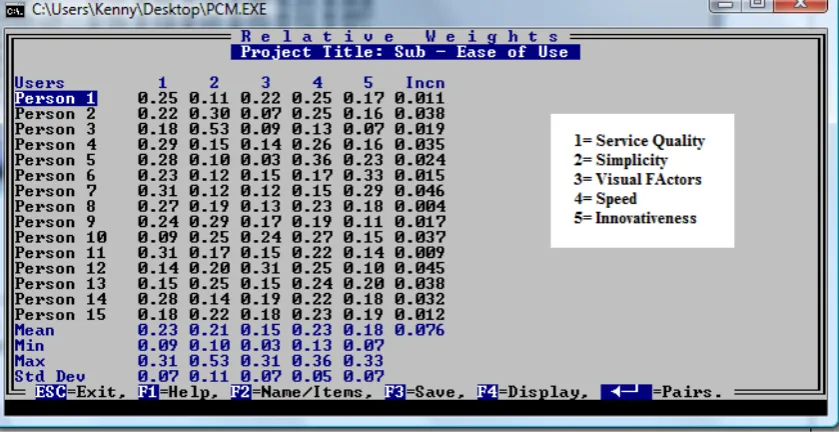
Figure 4. “Sub Criteria – Ease of Use”.
doi:10.3926/jiem.2011.v4n2.p339-360 JIEM, 2011 – 4(2): 339-360 – Online ISSN: 2013-0953 Print ISSN: 2013-8423
of use factor, while speed contributes 23% to the ease of use factor. Visual factors and Innovativeness do not get as high percentage as the others with only 15% and 18% respectively. All the respondents show the level of acceptable inconsistency with nobody exceeding the limit of 0.1.
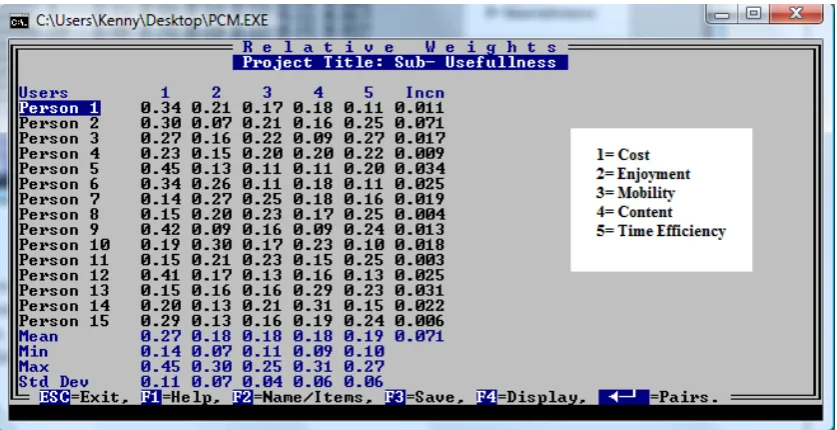
The second sub criteria are related to usefulness. After the calculation by using PCM software, only cost really has significant percentages compared to enjoyment, mobility, content and time efficiency. Cost generated 27% contribution to the usefulness factor while enjoyment, mobility, and content throw in equally with the percentage of 18%, to the usefulness factor and time efficiency contributes 19% to usefulness factor. The inconsistency level of all respondents is also below the 0.1 limit.
Figure 5. “Sub Criteria – Usefulness”.
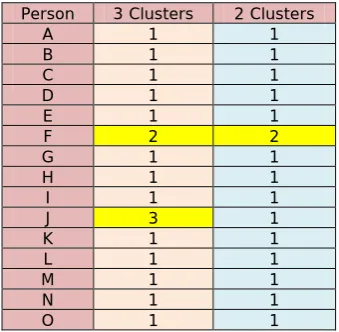
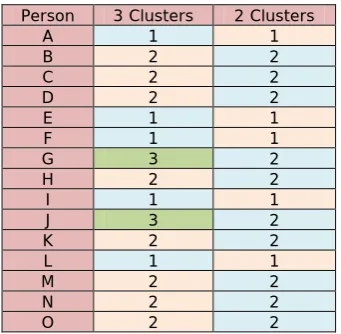
The results from the PCM software calculation were also analyzed by using cluster analysis. Respondents who participated in the questionnaires will be clustered by using SPSS software. Since the number of respondents is only 15 people, we choose the solution of 2-3 clusters. The cluster analysis for the main criteria – attitude toward using is presented in the table below.
doi:10.3926/jiem.2011.v4n2.p339-360 JIEM, 2011 – 4(2): 339-360 – Online ISSN: 2013-0953 Print ISSN: 2013-8423
distinguished. Same thing also happened if we grouped the data into 3 clusters. Only 2 people do not belong to the cluster number 1. The people that do not belong to the majority cluster can be assumed as outliers. One of the possible explanations of the homogenous clustering is because all the respondents are students. Therefore, they are clustered into the same group.
Person 3 Clusters 2 Clusters
A 1 1
B 1 1
C 1 1
D 1 1
E 1 1
F 2 2
G 1 1
H 1 1
I 1 1
J 3 1
K 1 1
L 1 1
M 1 1
N 1 1
O 1 1
Table 1. “Cluster Analysis for Main Criteria – Attitude toward Using”.
Person 3 Clusters 2 Clusters
A 1 1
B 1 1
C 2 2
D 1 1
E 3 1
F 1 1
G 1 1
H 1 1
I 1 1
J 1 1
K 1 1
L 1 1
M 1 1
N 1 1
O 1 1
Table 2. “Cluster Analysis for Sub Criteria – Ease of Use”.
doi:10.3926/jiem.2011.v4n2.p339-360 JIEM, 2011 – 4(2): 339-360 – Online ISSN: 2013-0953 Print ISSN: 2013-8423
number 1 and 10 people belong to cluster number 2. If we investigate the data, apparently 10 people that belong to cluster number 2 are all Ph.D. students and the rest are Master students. If we choose 3 clusters, there are two people from the Ph.D. Students fit in cluster number 3. After the analysis, 2 of the people that belong to cluster number 3 are Ph.D. students from Thailand.
Person 3 Clusters 2 Clusters
A 1 1
B 2 2
C 2 2
D 2 2
E 1 1
F 1 1
G 3 2
H 2 2
I 1 1
J 3 2
K 2 2
L 1 1
M 2 2
N 2 2
O 2 2
Table 3. “Cluster Analysis for Sub Criteria – Usefulness”.
6 Conclusion
This paper is built upon prior work (Phan et al., 2010; Kargin et al., 2009a; Kargin et al., 2009b). The objective was to discover the factors that influence the mobile service adoption. Quantitative method e.g. questionnaires were conducted to find the weight of each factors which were identified through literature review. The factors identified have been integrated to the TAM model to help the mobile services provider to develop a better business model or services that can attract users to use mobile services. This study may provide insights to designers and marketing experts to create better and more attractive mobile services.
doi:10.3926/jiem.2011.v4n2.p339-360 JIEM, 2011 – 4(2): 339-360 – Online ISSN: 2013-0953 Print ISSN: 2013-8423
kind of services. The significant finding from the results above is cost. In order to encourage people to use the mobile services, mobile services provider should not charge premium price. Price has always been a barrier for the users to use mobile services. If the price of using the services is reasonable, users will not hesitate to use it. Below is the proposed framework that can help the mobile services provider to design their services if they want users to adopt and use mobile services.
Figure 6. “Proposed Framework”.
There is a limitation of this study. The sample size is quite small due to the time limitation for collecting the data. However the result from the analysis, show the similarity with the one that has been done by the author in his other classes. The other paper (Phan et al., 2010) is investigating the same matter but use different models and different data collection method. The other one use the qualitative methods to identify the most important factors. No special software was involved in the data analysis. The factors were identified and analyzed through the response during the open ended interview method. The results show slight differences with the results of this paper. Therefore, the sample size for this paper should be acceptable.
Another limitation is the classification of the factors into the AHP model. The factors classification is based on literature research. The pairwise comparison can’t validate if the categorization is 100% accurate. Different people might look at those factors differently and have different opinions about the model. Thus, the classification of the factors might be different.
Perceived Usefulness
Perceived Ease of Use
Attitude Toward
Using Behavioral Intention
Technology Habits Cost
Time Efficiency
Enjoyment
Mobility
Content
Service Quality
Speed
doi:10.3926/jiem.2011.v4n2.p339-360 JIEM, 2011 – 4(2): 339-360 – Online ISSN: 2013-0953 Print ISSN: 2013-8423
For future research, the data collection should also look into different devices and operating system of mobile phones to find if there is any significant difference in adopting mobile services. It could give a more comprehensive conclusion to mobile service providers. It is also suggested to collect more data to get more accurate results. The respondent that excess the limit of the inconsistency should also be excluded or revisit his/her answer. Further in depth literature review also might identify more factors that can be integrated into the AHP model. The factors classification should be justified by expert panels. There should be consensus in how did the factors organized. A second option to factors classification could be double data collection. First, we can start by asking the respondent to give their opinion about the factors. For example: the questionnaire can ask the respondents whether they think “service quality” belongs to ease of use or usefulness. Or else, asking the respondents to give the weight whether they think “service quality” is more favor in ease of use or usefulness. The respondents should give higher weight to the group that they think the factors belong to. From the results, we can find the ideal classification. Then we conduct the second data collection. The results might be more justified.
Appendix
Pairwise comparison
Name (optional):
Use pair wise comparison to quantify your judgment. Allocate a total of 100 points to express your judgment about the ratio of one criterion to the other one in pair.
Main criteria comparison
Attitude toward using
Criterion Weight Weight Criterion
Ease of Use Usefulness
Ease of Use Social Factors
Ease of Use Technology
doi:10.3926/jiem.2011.v4n2.p339-360 JIEM, 2011 – 4(2): 339-360 – Online ISSN: 2013-0953 Print ISSN: 2013-8423
Usefulness Social Factors
Usefulness Technology
Usefulness Habits
Social Factors Technology
Social Factors Habits
Technology Habits
Sub criteria comparison
Ease of use
Criterion Weight Weight Criterion
Service Quality Simplicity
Service Quality Visual Factors
Service Quality Speed
Service Quality Innovativeness
Simplicity Visual Factors
Simplicity Speed
Simplicity Innovativeness
Visual Factors Speed
Visual Factors Innovativeness
Speed Innovativeness
Usefulness
Criterion Weight Weight Criterion
Cost Enjoyment
Cost Mobility
Cost Content
Cost Time Efficiency
Enjoyment Mobility
Enjoyment Content
doi:10.3926/jiem.2011.v4n2.p339-360 JIEM, 2011 – 4(2): 339-360 – Online ISSN: 2013-0953 Print ISSN: 2013-8423
Mobility Content
Mobility Time Efficiency
Content Time Efficiency
References
Amberg, M., Hirschmeier, M., & Wehrmann, J. (2004). The Compass Acceptance Model for the Analysis and Evaluation of Mobile Services. International Journal of Mobile Communications, 2(3), 248-259.
Benbasat, I., & Barki, H. (2007). “Quo vadis, TAM?”. Journal of the Association for Information Systems, 8(4), 211-218.
Biljon, J., & Kotze, P., (2007). Modelling the Factors that Influence Mobile Phone Adoption. ACM International Conference Proceeding Series, 226, 152-161.
Bouman, H., Carlsson, C., Moline-Castillo, F., & Walden, P. (2006). Barriers and Drivers in the Adoption of Current and Future Mobile Services in Finland. Telematics and Informatics.
Carlsson, C., Carlsson, J., Hyvonen, K., Puhakainen, J., & Walden, P. (2006). Adoption of Mobile Devices/Services – Searching for Answers with the UTAUT. Finland: Abo Akademi.
Chan, Y., & Lynn, B. (1991). Performance Evaluation and the Analytic Hierarchy Process. Journal of Management Accounting Research, 3, 57-87.
Davis, F.D. (1989). Perceived Usefulness, Perceived Ease of Use, and User Acceptance of Information Technology. MIS Quarterly, 13(3), 319-340.
doi:10.2307/249008
Davis, F.D., Bagozzi, R.P., & Warshaw, P.R. (1989). User Acceptance of Computer Technology: A Comparison of Two Theoretical Models. Management Science, 35(8), 982-1003.
doi:10.1287/mnsc.35.8.982
doi:10.3926/jiem.2011.v4n2.p339-360 JIEM, 2011 – 4(2): 339-360 – Online ISSN: 2013-0953 Print ISSN: 2013-8423
Dunlop, M., Brewster, S. (2002). The Challenge of Mobile Devices for Human Computer Interaction. Personal and Ubiquitous Computing, 6(4), 235-236.
doi:10.1007/s007790200022
Eldridge, M., & Ginter, R. (2001). Studying Text Messaging in Teenagers. Presented at the HCI 2001 Workship on Mobile Communication.
Fishbein, M., & Ajzen, I. (1975). Belief, Attitude, Intention and Behavior: An Introduction to Theory and Research. MA, USA: Addison-Wesley.
Hepler, C., & Mazur, G. (2007). The Analytic Hierarchy Process – Methodologies and Application with Customers and Management at Blue Cross-blue Shield of Florida. International Symposium on QFD 2007, pp. 137-149.
Holflich, J.R., & Rossler, P. (2001). Mobile Schriftliche Kommunikation Oder: E-Mail fur das Handy. Median & Kommunikationswissenschaft, 49, 437-161.
Hyvönen, K., & Repo, P. (2004). Diffusion of Mobile Services in Finland. Proceedings of the 3rd International Business Information Management Conference (IBIMA), Cozumel, Mexico, 2004.
I-LAB Centre for Research on the Digital Economy (2002). Contenuti Multimediali Convergenti: Strategie Di Offerta Multipiattaforma E Comportamenti Della Domanda. Internal Report, Universita Bocconi, Milan, Italy.
I-LAB Centre for Research on the Digital Economy (2003). Modelli Di Business Nei Mercati Multimediali Europei. Internal Report, Universita Bocconi, Milan, Italy.
Kargin, B., Basoglu, N., & Daim, T. (2009a). Adoption factors of Mobile Services. International Journal of Information Systems in the Service Sector, 1(1), January – March 2009, 15-34.
doi:10.4018/jisss.2009010102
Kargin, B., Basoglu, N., & Daim, T. (2009b). Factors affecting the adoption of mobile services. International Journal of Services Science, 1(2), 29-52.
doi:10.3926/jiem.2011.v4n2.p339-360 JIEM, 2011 – 4(2): 339-360 – Online ISSN: 2013-0953 Print ISSN: 2013-8423
Kleijnen, M., Wetzels, M., & De Ruyter, K. (2004). Consumer Acceptance of Wireless Finance. Journal of Financial Services Marketing, 8(3), 206-217.
doi:10.1057/palgrave.fsm.4770120
Kleinrock, L. (1996). Nomadicity: Anytime, Anywhere in a Disconnected World. Mobile Networks and Applications, 1(4), 351-357.
Knutsen, L. et al. (2005). Acceptance and Perceptions of Advanced Mobile Services: Alterations during a Field Study. International Conference on Mobile Business. doi:10.1109/ICMB.2005.13
Kocaoglu, D. F. (1983). A Participative Approach to Program Evaluation. IEEE Transactions on Engineering Management, 30.
Kodali, R., & Chandra, S. (2001). Analytical Hierarchy Process for Justification of Total Productive Maintenance. Production Planning Control The Management of Operations, 12, 695-705.
doi:10.1080/09537280010024045
Kwon, H.S., & Chidambaram, L. (2000). A Test of the Technology Acceptance Model; the Case of Celluar Telephone Adoption. Hawaii International Conference on System Sciences proceedings, pp. 1-10.
Lee, W.J., Kim, T.U., Chung, J. (2002). User Acceptance of the Mobile Internet. Athens, Greece: M-Business.
Lee, Y., Kozar, K. A., & Larsen, K.R.T. (2003). The Technology Acceptance Model: Past, Present, and Future. Communications of AIS, 12, 752-780.
Leung, L., & Wei, R. (2000). More than just Talk on the Move: Uses and Gratifications of the Cellular Phone. J&MC Quarterly, 77, 308-320.
Liker, J.K., & Sindi, A.A. (1997). User Acceptance of Expert Systems: A test of the Theory of Reasoned Action. Journal of Engineering and Technology Management, 14, 147-173.
doi:10.1016/S0923-4748(97)00008-8
doi:10.3926/jiem.2011.v4n2.p339-360 JIEM, 2011 – 4(2): 339-360 – Online ISSN: 2013-0953 Print ISSN: 2013-8423
Liu, C.C., Chuang, L.M., Huang, C.M., & Tsai, W.C. (2010). Construction of Index Weight for Organizational Innovation in Taiwanese High-tech Enterprises. Journal of Business, 4, 594-598.
Malhotra, Y., & Galletta, D.F. (1999). Extending the Technology Acceptance Model to Account for Social Influence: Theoritical Bases and Empirical Validation. Hawaii International Conference on System Sciences Proceedings, pp. 1006-1020.
Pagani, M. (2004). Determinants of Adoption of Third Generation Mobile Multimedia Services. Journal of Interactive Marketing, 18(3), 46-59.
doi:10.1002/dir.20011
Pederson, E. (2003). Adoption of Mobile Internet Services: An Exploratory Study of Mobile Commerce Early Adopters. Journal of Organizational Computing and Electronic Commerce, 15(3), 203-222.
doi:10.1207/s15327744joce1503_2
Pederson, E., & Thorbjornsen, H. (2002). Adoption of Mobile Services. Model Development and Cross-Service Study. SNF Report.
Phan, K., Daim, T., Basoglu, N., Kargin, B. (2010). Comparing Factors Affecting the Adoption of Mobile Services in Developed versus Developing Countries: Case of Turkey versus United States. International Journal of Service Science, 3(2/3), 216-231.
doi:10.1504/IJSSCI.2010.032224
Rogers, E.M. (2003). Diffusion of Innovation (5th edition). New York: The Free Press.
Saaty, T.L. (1990). How to Make a Decision: The Analytic Hierarchy Process. European Journal Of Operational Research, 48, 9-26.
doi:10.1016/0377-2217(90)90057-I
Saaty, T.L. (2008). Decision Making with the Analytic Hierarchy Process. International Journal of Services Sciences 2008, 1, 83.
doi:10.3926/jiem.2011.v4n2.p339-360 JIEM, 2011 – 4(2): 339-360 – Online ISSN: 2013-0953 Print ISSN: 2013-8423
Samtani, A., Tze, T.L., Hoon, M.L., & Gin, J.G.P. (2003). Overcoming Barriers to the Successful Adoption of Mobile Commerce in Singapore. International Journal of Mobile Communications, 1(1-2), 194-231.
Teo, T.S.H., & Pok, S.H. (2003). Adoption of WAP-Enabled Mobile Phones Among Internet Users. Omega: The International Journal of Management Science, 31(6), 483-498.
Venkatesh, V., & Davis, F.D. (1996). A Model of the Antecedents of Perceived Ease of use: Development and Test. Decision Sciences, 27, 451-481.
doi:10.1111/j.1540-5915.1996.tb01822.x
Venkatesh, V., & Davis, F.D. (2000). A Theoretical Extension of the Technology Acceptance Model: Four Longitudinal Field Studies. Management Science, 46(2), 186-204.
doi:10.1287/mnsc.46.2.186.11926
Venkatesh, V., Morris, M.G., Davis, G.B., & Davis, F.D. (2003). User Acceptance of Information Technology: Toward a Unified View. MIS Quarterly, 27(3), 425-478.
Vesa, J. (2005). Mobile Services in the Networked Economy. Hershey, PA, USA: IRM Press.
doi:10.4018/978-1-59140-584-9
Yang, J., & Shi, P. (2002). Applying Analytic Hierarchy Process in Firm’s Overall Performance Evaluation: A Case Study in China. International Journal, 7.
Yu, J., Ha, I., Choi, M., & Rho, J. (2005). Extending the TAM for a T-Commerce. Information & Management, 42(7), 965-976.
doi:10.1016/j.im.2004.11.001
doi:10.3926/jiem.2011.v4n2.p339-360 JIEM, 2011 – 4(2): 339-360 – Online ISSN: 2013-0953 Print ISSN: 2013-8423
Journal of Industrial Engineering and Management, 2011 (www.jiem.org)
Article's contents are provided on a Attribution-Non Commercial 3.0 Creative commons license. Readers are allowed to copy, distribute and communicate article's contents, provided the author's and Journal of Industrial Engineering and Management's names are included. It must not be used for commercial purposes. To see the complete