405
Copyright © 2011-15. Vandana Publications. All Rights Reserved.
Volume-5, Issue-3, June-2015
International Journal of Engineering and Management Research
Page Number: 405-410
Seismic Behavior Of Reinforced Concrete Buildings Under Varying
Frequency Contents
Mr. Suryakant T. Narhire1, Dr.S.A.Bhalchandra2
1
M.E. Student (Applied Mechanics Dept.), Government college of Engineering, Aurangabad, Maharashtra, INDIA
2
Associate Professor (Applied Mechanics Dept.), Government college of Engineering, Aurangabad, Maharashtra, INDIA
ABSTRACT
Earthquake causes loss of life, damages the built and natural environment. In order to take precaution for the loss of life and damage of structures due to the ground motion, it is important to understand the characteristics of the ground motion. The important dynamic characteristics of earthquake are PGA, frequency content, and duration. These characteristics play predominant role in studying the behaviour of structures under seismic loads. Ground motion has different frequency contents such as low, intermediate and high. Present work deals with study of frequency content of ground motion on RC buildings. Linear time history analysis is performed in structural analysis and design (SAP2000) software. The proposed method is to study the response of low, mid, and high- rise reinforced concrete buildings under low, intermediate, and high frequency content ground motions. The responses of each ground motion for each type of building in terms of floor displacement, floor velocity, floor acceleration, and base shear are studied and compared. The results show that high frequency content ground motions have significant effect on RC buildings.
Keywords— Frequency content, Ground Motion, Reinforced concrete buildings, Time history analysis.
I.
INTRODUCTION
An earthquake is the result of a rapid release of strain energy stored in the earth’s crust that generates seismic waves. Structures are vulnerable to earthquake ground motion and damages the structures. In order to take precaution for the damage of structures due to the ground motion, it is important to know the characteristics of the ground motion. The most important dynamic characteristics of earthquake are peak ground acceleration (PGA), frequency content, and duration. These
406
Copyright © 2011-15. Vandana Publications. All Rights Reserved.
content of the ground motion. Based on the frequency content the ground motion records are classified into three categories [2].
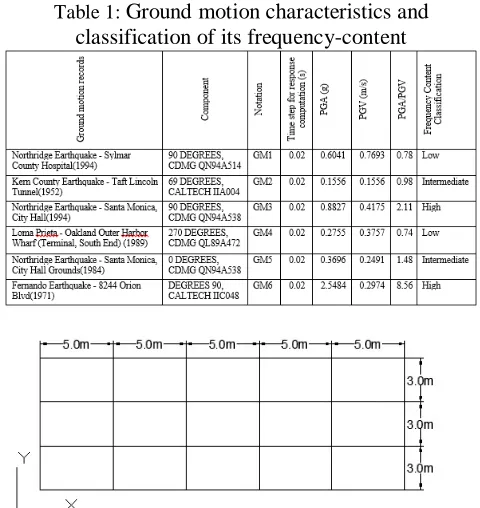
High-frequency content PGA/PGV > 1.2
Intermediate-frequency content 0.8< PGA/PGV< 1.2 Low-frequency content PGA/PGV < 0.8
A few research is carried out to study the frequency content of the ground motion. The purpose of this project is to study the response of low, mid, and high rise RC buildings under low, intermediate, and high-frequency content ground motions in terms of story displacement, story velocity, story acceleration and base shear preforming linear time-history analysis using structural analysis and design (SAP 2000) software. The responses of RC buildings are strongly dependent on the frequency content of the ground motions.
II.
MODELLING AND ANALYSIS
The building is modeled using SAP 2000 software. Beams and columns are modeled as two node beam element with six degrees of freedom at each node. Slabs are modeled as rigid membrane elements and diaphragm constraint is assigned. The area loads are applied on the slabs. Building modeled as a bare frame however the dead weight of infill is assigned as uniformly distributed load over beams. Model is consists of G+2, G+8 and G+20 story reinforced concrete buildings, which are considered as low, mid, and high-rise building. The beam length in x-direction is 5m and in y-direction is 3m. Figure 1shows the plan of the three buildings having five bays in x-direction and three bays in y-direction. The story height for each floor and plinth height is kept as 3m and 1.5m respectively. The RC frame consists of beam and column of sizes 0.3m x 0.5m and 0.45m x 0.45m respectively also slab thickness is taken as 0.12m. The concrete of grade M20 and steel of grade Fe 415 is considered. Self weight of building is automatically calculated by the software. Live load of 3.5 kN/m2 is provided in accordance to IS 875 (Part2) Floor finishes of
analysis of all building is carried by linear time history in accordance with IS: 1893 (Part 1):2002. In the analysis the number of modes considered is more than 90 percent of the total seismic mass.
Table 1: Ground motion characteristics and classification of its frequency-content
407
Copyright © 2011-15. Vandana Publications. All Rights Reserved.
Figure 2: Elevation of G+2, G+8, G+20 story building
III.
RESULTS AND DISCUSSION
The results of G+2, G+8 and G+20 story reinforced concrete buildings in terms of floor displacement, floor velocity, floor acceleration, and base shear are presented in x direction. Also the roof displacement, roof velocity, and roof acceleration for each building due to each ground motion is illustrated in x direction.
a) G+2 Story RC Building
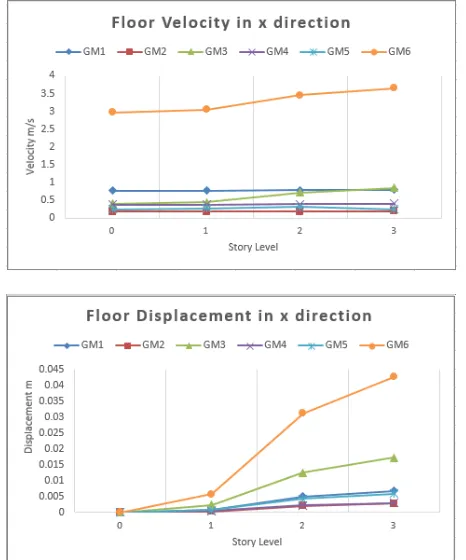
Following shows Floor acceleration, velocity, displacement of G+2 RC building due to ground motion GM1, GM2, GM3, GM4, GM5, and GM6.
Figure 3: Floor Acceleration, velocity and displacement of G+2 building in x direction due to Ground motion GM1,
GM2, GM3, GM4, GM5 and GM6
Figure 3 shows floor acceleration is maximum due to ground motion GM6 and minimum due to ground motion GM4 and GM2. The floor velocity is maximum due to ground motion GM6 and minimum due to ground motion GM2. The floor displacement is maximum due to ground motion GM6 and minimum due to ground motion GM4. It indicates that the building undergoes high floor displacement due to high frequency content ground motion and high floor velocity and acceleration due to high frequency content ground motion. However, it experiences low floor displacement, velocity, and acceleration due to low frequency content ground motion in x direction.
408
Copyright © 2011-15. Vandana Publications. All Rights Reserved.
Figure 4: Base shear due to ground motion GM1, GM2, GM3, GM4, GM5 and GM6
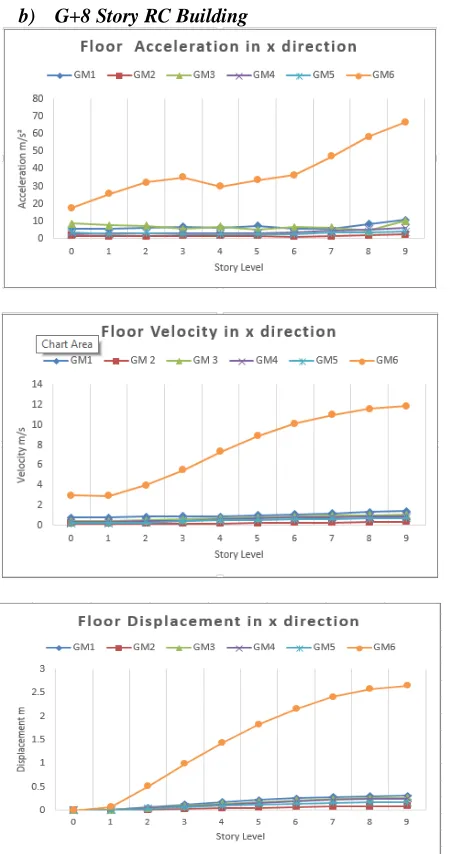
b) G+8 Story RC Building
Figure 5: Floor acceleration, velocity and displacement of G+8 building due to Ground motion GM1, GM2, GM3,
GM4, GM5 and GM6
and acceleration due to intermediate frequency content ground motion in x direction.
Figure 6: Base shear due to ground motion GM1, GM2, GM3, GM4, GM5 and GM6
Figure 6 shows that the building has maximum base shear due to GM6 and minimum base shear due GM2 in x-direction.
409
Copyright © 2011-15. Vandana Publications. All Rights Reserved.
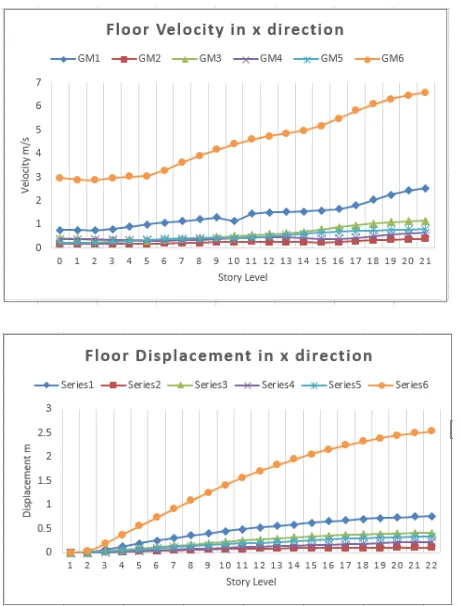
Figure 7: Acceleration, velocity and displacement of G+20 building due to Ground motion GM1, GM2, GM3, GM4,
GM5 and GM6
Figure 7 shows Floor acceleration, velocity, displacement of G+20 RC building due to ground motion GM1, GM2, GM3, GM4, GM5, and GM6. The floor acceleration is maximum due to ground motion GM6 and minimum due to ground motion GM2. The floor velocity is maximum due to ground motion GM6 and minimum due to ground motion GM2. The floor displacement is maximum due to ground motion GM6 and minimum due to ground motion GM2. It indicates that the building undergoes high floor displacement due to high frequency content ground motion and high floor velocity and acceleration due to high frequency content ground motion. It experiences low floor displacement, velocity, and acceleration due to intermediate frequency content ground motion in x direction.
Figure 8: Base shear due to ground motion GM1, GM2, GM3, GM4, GM5 and GM6
Figure 8 shows that the building has maximum base shear due to GM6 and minimum base shear due GM2 in x-direction.
The maximum and minimum values of floor displacement, Floor velocity, floor acceleration, and base shear of G+2, G+8, G+20 RC building due to GM1 to GM6 in x direction are summarized in Table 2
Table 2: Two, six, and twenty-story regular RC building responses due to GM1-GM6 in x direction
V.
CONCLUSION
It is concluded that high frequency content ground motion has significant effect RC buildings responses. However, Intermediate frequency content ground motion has very less effect on responses of RC buildings. It is found that the low frequency content ground motion has less effect than high frequency content ground motion and more effect than Intermediate frequency content ground motion on the RC buildings.
REFERENCES
[1] T. Cakir, "Evaluation of the effect of earthquake frequency content on seismic behaviour of cantiliver retaining wall including soil-structure interaction," Soil
Dynamics and Earthquake Engineering, vol. 45, pp.
96-111, 2013.