2016 International Conference on Wireless Communication and Network Engineering (WCNE 2016) ISBN: 978-1-60595-403-5
A Comprehensive Evaluation Approach Based on AHP-BP Neural
Network for Resource Allocation in Distributed
Satellite Cluster Network
Xu-dong ZHONG
1,*and Yuan-zhi HE
21College of Communication Engineering, PLAUST, Nanjing, China 2Institute of China Electronic System Engineering Corporation, Beijing, China
*Corresponding author
Keywords: Evaluation, Resource allocation, AHP-BP neural network, DSCN.
Abstract. The distributed satellite cluster network (DSCN) is a novel concept in satellite communication field. Considering the dynamism and heterogeneity of the DSCN, the resource allocation algorithm must make adjustments dynamically according to the requirements of users as well as the utility and availability of the resource. This paper investigates the evaluation problem of the resource allocation utility in DSCN. Considering the heterogeneity of DSCN and the multi-dimensional of the resource, a distributed evaluation architecture and a multi-index evaluation system are constructed. To solve the multi-index evaluation problem, a comprehensive evaluation approach based on analytic hierarchy process and back-propagation (AHP-BP) neural network is proposed. Via several simulation results, we verify the effectiveness of the proposed approach.
Introduction
With the continuously development of inter-satellite communications and distributed computing technology in space systems, DSCN have becoming a hot research topic in both industrial and academic community in the past decades. In 1984, Molette et al. proposed the concept of fractionated satellite [1]. In 2006, Brown et al. proposed the fractionated satellite system (FSS) that is a cluster of distributed modules as an alternative to the monolithic satellite [2,3]. The defense advanced research projects agency (DARPA) put forward the F6 program with the concept of FSS [4]. The DSCN consists of multiple clusters of independent satellite distribute at the same or adjacent orbit, in which satellites exchange information and sharing resource to accomplish task with demand of users [5].
To realize cooperative communication between different clusters, satellites and terminals, an efficient resource allocation algorithm is needed. The topology structure and the system performance were investigated in [6]. A resource control architecture base on service oriented cooperation architecture was formed in [7]. Some researchers presented some resource allocation algorithms in DSCN [8,9,10], and indexes and objectives they use to measure the performance is different. DSCN is highly dynamic and its resource is multi-dimensional and distributed in different satellites. A comprehensive evaluation approach can offer an efficient feedback to adjust the resource management and allocation algorithm. This paper investigates the evaluation problem with multi-dimensional index in DSCN. To solve the problem we proposed a comprehensive evaluation approach using AHP-BP neural network.
The rest of the paper is organized as follows. In section II, we present the description of the evaluation system. In section III, we present the evaluation approach base on AHP-BP neural network. Some simulation results are carried out in IV. Finally, we provide conclusions in section V.
The Description of the Multi-index Evaluation System
The Distributed Resource Utility Evaluation Architecture
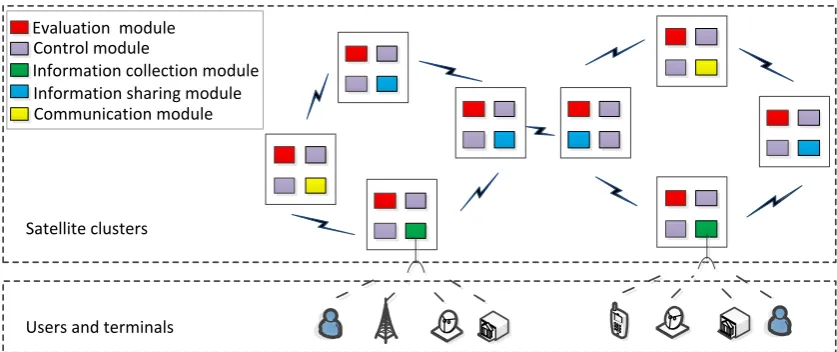
ground users and terminals must be considered. [7] proposed a distributed function architecture to realize the cooperation of satellites. On this basis, we construct a distributed resource utility evaluation architecture, shown as Figure 1.
Evaluation module Control module
Information collection module Information sharing module Communication module
Satellite clusters
[image:2.595.92.511.125.301.2]Users and terminals
Figure 1. The distributed resource utility evaluation architecture.
In the beginning of the evaluation, the control modules communicate each other to select a header of the cluster. Then, the header changes the communication module into information collection module. The information collection modules collect the performance indexes from multiple users, and then transmit indexes into evaluation modules. The evaluation can be obtained by calculation of evaluation modules with the cooperation of the information sharing module. Finally, the information sharing module broadcast the results into the whole network to adjust the allocation algorithm and the resource distribution. The header selected by the information of occupation can provide a free communication module to collect the feedback information for resource evaluation without influence to other services.
The Multi-index Evaluation System
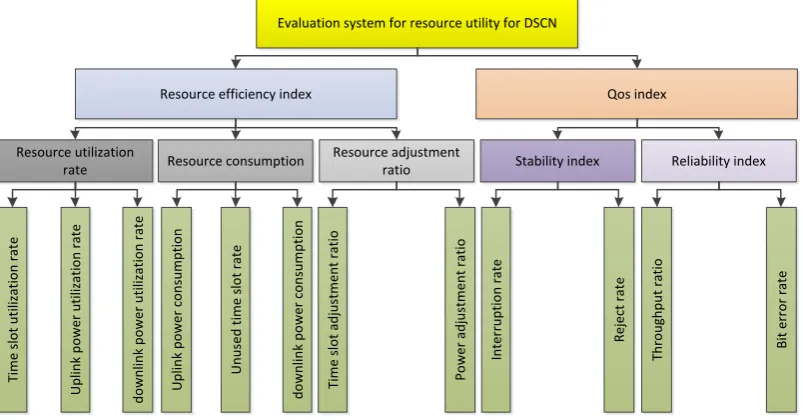
The distributed resource utility evaluation architecture provides a flexible scenario to collect information and calculate the resource efficiency. By considering the distribution of the satellites and their resource, this architecture can provide more survivability. The resource of DSCN is distributed among different modules in satellites, which can be shared and reused by multiple services. Therefore, the evaluation indexes must be hierarchical. According to [8-10], the performances of DSCN can be divided into two parts: the resource efficient performance and the quality of service (QoS). Hence, the evaluation indexes should be formulated as a two-dimensional index system.
Generally, common methods of index selection are expert investigation method, minimum mean square error method and minimax deviation method. In this paper we combine the first two ways to find indexes. We investigate 10 experts to get initial indexes, then obtain the final indexes by compare their mean square error values. The minimum mean square error method can formulated as:
𝑥̅𝑗 = 1
𝑛∑ 𝑥𝑖𝑗
𝑛
𝑖=1 (1)
𝑠𝑗 = (1
𝑛∑ (𝑥𝑖𝑗− 𝑥̅𝑗) 2 𝑛
𝑖=1 )
1
2 (2)
Evaluation system for resource utility for DSCN
Resource efficiency index Qos index
Resource utilization
rate Resource consumption
Resource adjustment
ratio Stability index Reliability index
[image:3.595.89.491.73.283.2]Ti m e sl o t u ti liz at io n r at e U p lin k p o w er u ti liz at io n r at e d o w n lin k p o w er u ti liz at io n r at e U p lin k p o w er c o n su m p ti o n d o w n lin k p o w er c o n su m p ti o n P o w er a d ju st m en t ra ti o Ti m e sl o t ad ju st m en t ra ti o In te rr u p ti o n r at e R ej ec t ra te Th ro u gh p u t ra ti o B it e rr o r ra te U n u se d t im e sl o t ra te
Figure 2. The multi-index evaluation system for resource utility in DSCN.
In the evaluation system, the resource utilization rate means the ratio of required resource to the allocation resource. The resource consumption is the rate of unused resource. And the resource adjustment rate represents the adjustment rate of resource allocation. The sample values of indexes is coming from simulation results by using the resource allocation algorithms in [8,9,11] .
Comprehensive Evaluation Approach Based on AHP-BP Neural Network
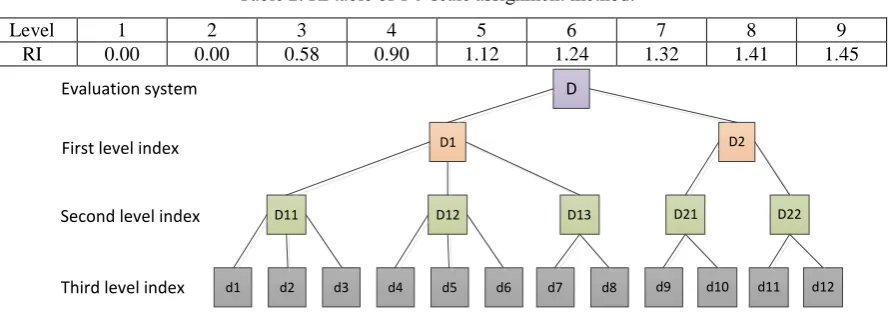
The proposed evaluation system is a three level multi-index system. The most important problem is to obtain weight of indexes. BP neural network is an efficient method to calculate evaluation result by adjusting the weight and threshold automatically. However, the computation complexity increases significantly when the number of the input index is raising. In [11], an approach combining AHP and BP neural network is proposed to decrease the complexity. It can be used to solve the evaluation problem in this paper. Without getting into too much more detail because of the limitation of space, we present the algorithm we designed based on the approach in [11] directly. The algorithm is shown in Table 1. Through analysis of the system shown in Figure 2, we present the hierarchy in Figure 3.
Table 1. The comprehensive evaluation approach based on AHP-BP neural network.
Initialize the AHP-BP network, and set the terminal condition:𝑒𝑟𝑟𝑜𝑟𝑡ℎ= 𝑒 and the maximum iteration𝑡𝑛.
Step1 Analyze the hierarchy of the multi-index system and list the judgemental matrixes𝐷𝑗.
Obtain the weight values of indexes𝜔𝑖𝑗of 𝐷𝑗by AHP
Step2 Collect indexes sample values from DSCN, and divide them into training dataset{𝑥𝑡𝑟,(𝑖𝑗)}
and testing dataset{𝑥𝑡𝑒,(𝑖𝑗)}. Obtain the test result by investigating experts with the testing dataset
Step3 Obtain the training evaluation result 𝑟 by using the formula: 𝑟 = ∑ ∑ 𝜔𝑖 𝑗 𝑖𝑗× 𝑥𝑡𝑟,(𝑖𝑗)
Step4 Use𝑟as the input of the AHP-BP neural network, and train the network with the training dataset{𝑥𝑡𝑟,(𝑖𝑗)}.
Step5 Calculate the error 𝐸 by compare the output of the network and the value of expectation, If 𝐸 < 𝑒 or 𝑡 < 𝑡𝑛, return to step 6, otherwise, return to step 4
Step6 Test the evaluation network by using the testing dataset. If𝐸 < 𝑒, finish the iteration, otherwise, return to step 1.
The step1 in Table 1 can be formulated as:
𝑀𝑖 = ∏𝑛𝑗=1𝐷𝑖𝑗 (4)
𝜔𝑖 = 𝛿𝑖
∑𝑛𝑖=1𝛿𝑖
(6)
In (4), 𝐷𝑖𝑗 is the element of the judgment matrixes, and it can be obtained by the 1-9 scale assignment table in [11] with the investigation results of the experts. 𝜔𝑖 is the weight values.Through the calculation of maximum eigenvalue of judgment matrix 𝜆𝑚𝑎𝑥, calculating index 𝐶𝐼 that denotes value of the judgement matrix deviating from the consistency:
𝜆𝑚𝑎𝑥 = ∑ (𝐶𝜔)𝑖
𝑛𝜔𝑖
𝑛
𝑖=1 (7)
𝐶𝐼 =𝜆𝑚𝑎𝑥−𝑛
𝑛−1 (8)
If 𝐶𝑅 =𝐶𝐼
𝑅𝐼< 0.10, the weight values are acceptable, otherwise, we must reconstruct the 𝐷𝑖𝑗. 𝑅𝐼
can be obtained by the 𝑅𝐼 table shown as Table 2.
Table 2. RI table of 1-9 scale assignment method.
Level 1 2 3 4 5 6 7 8 9
RI 0.00 0.00 0.58 0.90 1.12 1.24 1.32 1.41 1.45
D
D1 D2
D11 D12 D13
d1 d2 d3 d4 d5 d6 d7 d8
D22
d11 d12
D21
d9 d10
Evaluation system
First level index
Second level index
Third level index
Figure 3. The hierarchical relationship of the multi-index evaluation system.
[image:4.595.79.525.269.425.2]Simulation Results
Table 3. The weight values of the indexes
Index system
The 1th
level index Weight
The 2nd
level index Weight
The 3rd
level index Weight
D
D1 0.75
D11 0.105
d1 0.55
d2 0.069
d3 0.381
D12 0.637
d4 0.263
d5 0.573
d6 0.167
D13 0.258 d7 0.25
d8 0.75
D2 0.25
D21 0.75 d9 0.75
d10 0.25
D22 0.25 d11 0.25
d12 0.75
According to the hierarchical relationship in figure 3 and the calculation approach of judgment matrixes in [11], we can obtain judgment matrixes (𝐷, 𝐷1, 𝐷2, 𝐷11, 𝐷12, 𝐷13, 𝐷21, 𝐷22). Then we
used the Matlab platform simulate the algorithm in Table 1.
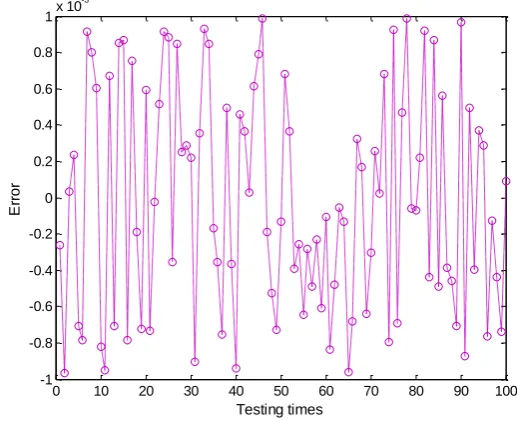
As we can see from Figure 4, the convergence rate of AHP-BP is quicker than the BP neural network because of the inputs handling based on AHP. The Figure 5 shows the testing performance of the comprehensive evaluation algorithm for resource utility in DSCN. We used 100 testing datasets to simulate the performance. It can be seen that the error of the evaluation is below 0.001. It is acceptable in the engineering application.
Figure 4. Performance comparison between AHP-BP and BP neural network.
Figure 5. The testing performance of the comprehensive evaluation algorithm.
Summary
In this paper, we investigate the resource allocation utility evaluation problem in DSCN. Considering the heterogeneity of DSCN and the multi-dimensional of the resource, we construct a distributed evaluation architecture for resource utility evaluation in the free modules. According to the characteristics of the evaluation architecture we proposed, we designed a comprehensive multi-index evaluation system. We then present an algorithm based on AHP-BP neural network proposed in [11] to set the weights of indexes in the evaluation system. Finally, we prove the effectiveness of our evaluation approach both in training convergence rate and the error constrain condition. The approach proposed in this paper can be easily promoted to other satellite and wireless communication network. The results of the efficient evaluation approach can be used as a feedback to the resource
0 50 100 150 200
10-4 10-3 10-2 10-1 100 101
Training times
E
rr
o
r
AHP-BP BP
0 10 20 30 40 50 60 70 80 90 100
-1 -0.8 -0.6 -0.4 -0.2 0 0.2 0.4 0.6 0.8
1x 10
-3
Testing times
E
rr
o
[image:5.595.162.421.390.601.2]allocation algorithm or resource control center, and help the algorithm or manager to adjust the distribution of the resource.
Acknowledgement
This research was financially supported by the National Natural & Science Foundation of China under grant (No. 61231011. 91338021).
References
[1] Molette, P., Cougnet, C., and Saint-Aubert, Ph., Technical and economical comparison between a modular geostationary space platform and a cluster of satellites, Acta Astronautica, 1984, pp. 771-784.
[2] Owen Brown, Paul Eremenko, The Value proposition for fractionated space architectures. AAIA Reinventing Space Conference. Los Angeles, 2006, pp. 1-22.
[3] Owen Brown, Paul Eremenko. Application of value-centric design to space architectures: the case of fractionated spacecraft. AAIA Reinventing Space Conference. 2008 pp. 1-31.
[4] Owen Brown, Paul Eremenko. Value-centric Design Methodologies for Fractionated Spacecraft: Progress Summary from Phase 1 of the DARPA System F6 Program. AAIA Reinventing Space Conference. 2009 pp. 1-15.
[5] Qi-Yue Yu, Wei-Xiao Meng, Ming-Chuan Yang, Virtual multi-beamforming for distributed satellite clusters in space information networks, IEEE Wireless Communications, 2016, pp. 95-101.
[6] Fei-hong Dong, Xiao-qiang Li, Qing Yao, et al., Topology structure design and performance analysis on distributed satellite cluster networks, The 4th International Conference on Computer Science and Network Technology (ICCSNT 2015), 2015, pp. 881-884.
[7] Xiao-Bo Guo, Hong-bin Zhou and Gang Liu, Service oriented cooperation architecture for distributed satellite networks, The 8th International Conference on Wireless Communications & Signal Processing (WCSP2015), Nanjing, 2015, pp. 1-5.
[8] Xu-dong Zhong, Yuan-zhi He, Zhou-quan Du, Downlink power allocation in distributed satellite system based on dynamic multi-objective optimization, The 8th International Conference on Wireless Communications &Signal Processing (WCSP2015), Nanjing, 2015, pp. 1-5.
[9] Xu-dong Zhong, Yuan-zhi He, Quan Liu, Power control approach in distributed satellite cluster network based on presetting and prediction, 2016 IEEE Information Technology, Networking, Electronic and Automation Control Conference (IEEE ITNEC2016), Chongqing, 2016, pp. 265-269.
[10] Qi-Yue Yu, Wei-Xiao Meng, Ming-Chuan Yang, Virtual multi-beamforming for distributed satellite clusters in space information networks, IEEE Wireless Communications, 2016, pp. 95-101.