117
Copyright © 2011-15. Vandana Publications. All Rights Reserved.Volume-5, Issue-1, February-2015
International Journal of Engineering and Management Research
Page Number: 117-121
Energy Recovery Analysis through Adding Solid Food Waste Pulverizer
for the Existing Biogas Plant
Mohanasaravanan P S1, Prabhakar M2, Kannan C3, Ganesh Karthikeyan M4, Jayasingh T5 1
Final Year PG Student, Department of ME, TRP Engineering College (SRM Group), Irungalur, Trichy, INDIA 2
Vice Principal, Department of ME, TRP Engineering College (SRM Group), Irungalur, Trichy, INDIA 3, 4, 5
Assistant Professor, Department of ME, TRP Engineering College (SRM Group), Irungalur, Trichy, INDIA
ABSTRACT
In this research work, a biogas plant which is producing biogas from the human waste and been implemented in the backyard of a college hostel is being considered for the objective implementation. The main objective of the project work is to enhance the production of biogas by digesting the food waste too from the hostel mess. Thick or solid food waste are not too easy for the microorganisms to digest as easily, while the carbohydrates and the lipids of the food waste are easily degradable, the proteins are protected from the enzymatic hydrolysis by the cell wall. In order to break the cell wall pre-treatment to be done, a mechanical pretreatment is going to be followed in this research work. The mechanical pre-treatment is being successfully achieved by a pulverizer unit which is designed and fabricated for this work. This unit grinds the solid particles thus increasing the surface area. An increased surface area provides better contact between particles and bacteria, thus enhancing digestion process. From this arrangement, we can obtain more yield of biogas which will be utilized for the process of cooking and thus reducing the dependency on fossil fuel. A detailed investigation report on the influence of this pre-treatment process on biogas is also reported in this paper.
Keywords--- Biogas, mechanical pretreatment, pulverizer
etc.
I. INTRODUCTION
A huge amount of food waste is being disposed into the environment, which causes the public health hazards and diseases like malaria, cholera, typhoid etc. The dumping of waste food into the environment also emits unpleasant odour & methane, which is a major greenhouse gas and partially contributing to the global warming.
Food waste is an organic material has the high calorific value and nutritive value to microbes. In order to make this system extremely efficient, the kitchen waste/food wastes are being considered.
II. PRE-TREATMENT METHODS
The pre-treatment methods can be categorized as
• Mechanical pre-treatment
• Thermal pre-treatment
• Chemical pre-treatment
• Biological pre-treatment or
• combination of all the above
A. Mechanical pre-treatment
Mechanical pre-treatment disintegrates and/or grinds solid particles of the substrates, thus releasing cell compounds and increasing the specific surface area. An increased surface area provides better contact between substrate and bacteria, thus enhancing the digestion process. A larger particle radius results in lower chemical oxygen demand (COD) degradation and a lower methane production rate.
The advantages of mechanical pre-treatment include no odour generation, an easy implementation, better dewaterability of the final residue and moderate energy consumption.
B. Thermal pre-treatment
During thermal pre-treatment, lignocelluloses are heated from 150°C to 1100o
Chemical pre-treatment include acid pre-treatment, alkaline pre-treatment and oxidative pre-treatment. When treated with acid, carbohydrate can be hydrolyzed. Lignocelluloses materials are resistant to hydrolysis due to their structure and composition. Commonly used alkali is lime and sodium hydroxide. Oxidative pre-treatment with hydrogen peroxide or ozone affect lignocelluloses in similar C. Due to thermal hydrolysis, thermal pre-treatment is effective at increasing methane production. Thermal pre-treatment is only effective up to a certain temperature. However, that temperature depends on pre-treatment retention time.
C. Biological pre-treatment
The objective of biological pre-treatment is to enhance the hydrolysis process in addition to the main digestion process. The enzyme can catalyse biological reactions. Enzymes such as hydrolysases, lyases, isomerases, ligases etc are being utilized. An enzyme catalyzed- reaction is produced by the cracking of the compounds of cell wall.
118
Copyright © 2011-15. Vandana Publications. All Rights Reserved.way to alkaline pre-treatment. This pre-treatment was carried out at room temperature for a long time for nearly seven days.
E. Combined pre-treatment
Combined pre-treatment can be followed to obtain further enhancement of biogas production. Matched pre-treatment (chemical and thermal pre-pre-treatment) is found to have a great effect on increasing biogas production. However, the use of combined pre-treatment will potentially increase the complexity of process operation and require higher input economically.
III. SELECTION OF PRE-TREATMENT
According to the literature, the mechanical pre-treatment was found to have better efficiency of biogas production, while considering the parameters such as cost, maintenance and the handling of equipment. Thermal pre-treatment is only effective in particular temperature in order to maintain the temperature separate mechanism is needed. Chemical pre-treatment was carried out at room temperature for a long time. Combined process increases the complexity of operation and design.
Mechanical pre-treatment includes ultrasonication, grinding and high pressure homogenization. In that, grinding and high pressure homogenization has high efficiency but the design of high pressure homogenization is complicated. Hence, grinding is a better choice. Knife mills and roller mills are mostly used for the size reduction of substrate. Knife mills just cut the substrate into small pieces which consumes more energy, but roller mill grind the substrate and it gives better performance for slurry preparation. Finally conclude from the study, mechanical roller mill will be used for the pre-treatment process in this research work.
IV. FIELD STUDY
This field study mainly focused on how much food waste was generated in the hostel mess. Food waste calculation was done for ten days and makes an average from that data. This study also includes analyzing the existing biogas plant digester type and its effect on the biogas production.
A. Result obtained from field study
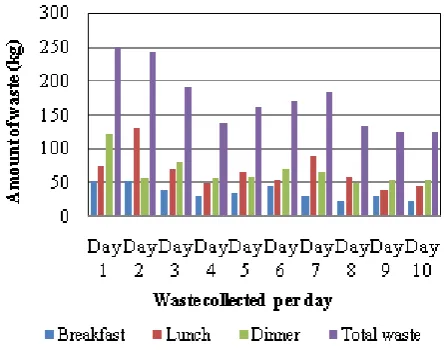
The existing biogas plant implemented in the backyard of college hostel produces biogas from human waste and it was being utilized for cooking nearly two hours in a day. The main objective of this field study is to estimate the amount of food waste in an institute’s mess and it was successfully accomplished. Maximum waste in a day is 250 kg while the minimum waste in a day is 125 kg. The above result was estimated by a field work on the span of ten days, based on the result, the following charts are plotted.
Fig 1.Calculated food waste based on remaining food and dustbin waste
Fig 2. Final and cumulated average food waste on an institute’s hostel mess
V. DESIGN OF SOLID FOOD WASTE
PULVERIZER
The design of solid food waste pulverizer was carried out in three stages. They are preliminary design, detailed proposal design and final design.
A. Preliminary design
This design often concerns about the mass and material against corrosion, indentation, resistance to damage etc. In this stage, a comparative study between roller mill and knife mill was carried and based on so many factors discussed earlier; a mechanical roller mill was finally selected for fabrication.
B. Detailed proposal design
3D models of proposed roller mill components were
119
Copyright © 2011-15. Vandana Publications. All Rights Reserved.volume of collector tank should be 0.221m3 based on the field study and all other components were designed accordingly. The collector tank was divided into two sections i.e. cylinder section and cone section. The volume of cylinder section was 0.153m3 while the volume of cone section was 0.068m3
Fig 3.3D model of Collector tank .
For driving this food waste pulverizer, an electric motor was being used. That motor must work on three phase supply to give better efficiency than single or two phase motor. One HP motor running at 1800 rpm was selected for operating this pulverizer unit.
3D CAD models for both roller and knife mill designs were given below.
Fig 4.3D model of Motor and pulley
The complete assembly of knife mill design was given in Fig 5.
Fig 5.3D model of Knife mill design
The components and assembly of roller mill design were given in Fig 6 and 7 respectively.
Fig 6.3D model of Roller and gear
Fig 7.3D model of roller mill assembly
VI. FABRICATION OF ROLLER MILL
Roller mill grinds the solid particle which is necessary for produce an efficient amount of biogas. During fabrication, we mainly focused on quality and performance on various components of this unit.
A. Material selection for fabrication
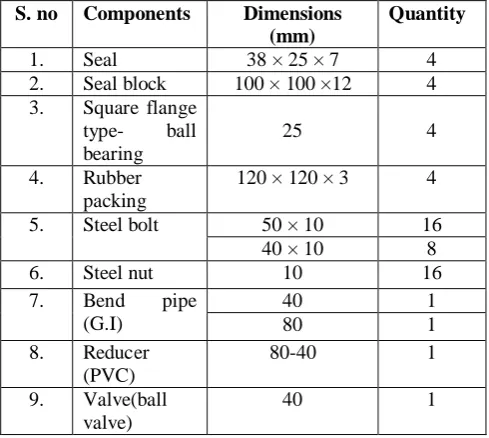
In this unit outer frame is made up of mild steel sheet metal with thickness 4mm. The main element for grinding the substrate is roller. It is fabricated with hard mild steel pipe and make a groove on the surface and shaft fixed dummy is attached at both end of the rollers. Some other major element to be fabricated is pulley and gear in that pulley is selected according to the required RPM. Gear teeth to be formulated based on the diameter of roller and the type of gear used here is spur gear. In order to transport slurry, pipelines are attached in that roller mill. Materials and dimensions of auxiliary element are listed in table as below.
S. no Components Dimensions
(mm)
Quantity
1. Seal 38 × 25 × 7 4
2. Seal block 100 × 100 ×12 4 3. Square flange
type- ball bearing
25 4
4. Rubber packing
120 × 120 × 3 4
5. Steel bolt 50 × 10 16
40 × 10 8
6. Steel nut 10 16
7. Bend pipe
(G.I)
40 1
80 1
8. Reducer (PVC)
80-40 1
9. Valve(ball valve)
40 1
Table 1. Dimensions of auxiliary components
B. Equipment used for fabrication
120
Copyright © 2011-15. Vandana Publications. All Rights Reserved.required structure lathe is used, which rotates the work piece on its axis to perform various operations such as facing turning etc. milling machine is used for make keyway slot and gear cutting. Assembling is done mainly by welding and using bolt nut. Finally grinding machine is used to obtain smooth finish.
C. Fabricated model and its dimensions
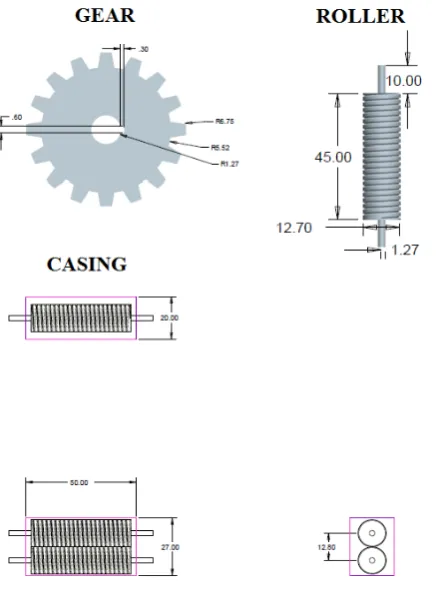
Japan black is an anti corrosive paint is painted inside of this unit, where the area of slurry preparation take place and inside food storage unit. The complete assembly of fabrication and dimensions are figured as below.
Fig 8.Dimensions of major components
Fig 9.Fabricated model
VII. INFLUENCE OF PRETREATMENT
ON BIOGAS PRODUCTION
As of now, the biogas produced from the existing plant was being utilized for nearly 90 minutes per day. After adding a pulverized food waste in that plant, it works 110 minutes per day.
A. Volume of biogas calculation before adding pulverized food waste
Velocity of biogas from outlet pipe is nearly 0.75 m/s Area of outlet pipe is 0.00051 m2
Volumetric flow rate of biogas is 0.0004 m3/s
Maximum burning time of biogas in a plant is 90 min/day Volume of biogas producing per day is 2.16 m3/day
B. Volume of biogas calculation after adding pulverized food waste
Volume of biogas producing per day is increased by 22.2 % and the yield of biogas is 2.64 m3
Fig 10.Comparison of biogas production before and after adding pulverized food waste
From the literature, it has been learnt that the biogas from food waste contains 50-70% of methane and 30-35% of carbon dioxide along with small amount of other gas which depending on the upon substrate and typically has a calorific value of 21- 24 MJ/m
/day.
121
Copyright © 2011-15. Vandana Publications. All Rights Reserved.C. Comparing the result before and after adding pulverizing food waste
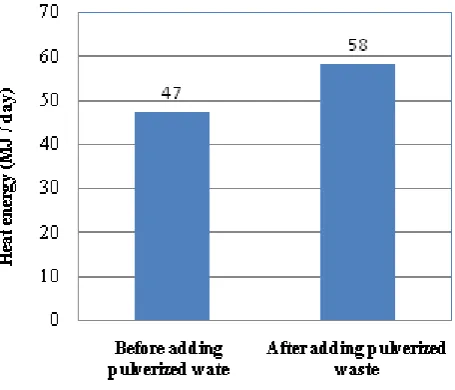
Fig 11.Energy produced before and after pulverized waste
After the successful implementation of waste food pulverizer unit to the existing biogas plant, it was observed that heat energy producing in existing plant was increased to 58 MJ/day from 47 MJ/ day.
ACKNOWLEDGEMENT
The authors are very much thankful to the management of TRP Engineering College (SRM Group), Irungalur, Trichy – 621 105 for granting permission to do their field study in the college hostel mess and also for the approval for the modification in the existing biogas plant.
REFERENCE
[1] R. Ananthakrishnan, K. Sudhakar, Abhishek Goyal and S. Satya Sravan, “Economic Feasibility Of Substituting LPG With Biogas For MANIT Hostels,” International Conference on Global Scenario in Environment and Energy, 14th – 16th March 2013.
[2] Tom Bond, Michael R. Templeton, “History and future of domestic biogas plants in the developing world,” International Energy Initiative, Published by Elsevier Inc, 2011.
[3] Ylva Borgstrom, “Pretreatment technologies to increase the methane yields by anaerobic digestion in relation to cost efficiency of substrate transportation,” Department of Water and Environmental Studies (WES), Linkoping Institute of Technology, Linkoping University,2011.
[4] Berlian Sitorusa, Sukandarb, Seno D. Panjaitanc, “Biogas recovery from anaerobic digestion process of mixed
fruit - vegetable wastes,” International Conference on Sustainable Energy Engineering and Application, 2012. [5] Ajit Kumar, Amish Kumar, Rajeev Kumar and J.S. Sudarsan, “Biogas manure (BGM) from mixed kitchen Waste: a trail study,” Journal of Environmental Research And Development, Vol. 5 No. 1, July-September 2010. [6] Vipul Vaid and Shivangi Garg, “Food as Fuel: Prospects of Biogas Generation from Food Waste,” International Journal of Agriculture and Food Science Technology, Volume 4 No. 2 (2013).
[7] R. K. Somashekar, rinku verma, manzoor ahmad naik, “ Potential of biogas production from food waste in a uniquely designed reactor under lab conditions,” Volume – 2 Issue – 2 April 2014.
[8] Debadayita Raha, Pinakeswar Mahanta, Michèle L. Clarke, “The implementation of decentralised biogas plants in Assam, NE India: The impact and effectiveness of the National Biogas and Manure Management Programme,” Published by Elsevier Ltd, 2014.
[9] Suyog vij, “Biogas production from kitchen waste,” A Seminar Report submitted in National Institute of Technology, Rourkela, 2011.
[10] I.I.I. Ghanem, Gu Guowei, Zhu Jinfu, “Leachate production and disposal of kitchen food solid waste by dry fermentation for biogas generation,” Published by Elsevier Science Ltd, 2011.
[11] S. P. Kale and S. T. Mehetre, “Biogas plant based on kitchen waste,” Nuclear Agriculture and Biotechnology Division.
[12] T. Subramani S. Ponkumar, “Anaerobic Digestion of Aerobic Pretreated Organic Waste,” International Journal of Modern Engineering Research, Vol.2, Issue.3, May-June 2012.