Available Online at www.ijpret.com
551
INTERNATIONAL JOURNAL OF PURE AND
APPLIED RESEARCH IN ENGINEERING AND
TECHNOLOGY
A PATH FOR HORIZING YOUR INNOVATIVE WORK
APPLICATION FOR INTERFACING ANDROID MOBILE WITH SURVEILLANCE
CAMERA
SMITA M. DESHPANDE, APURVA M. NAIK, NIMISHA M. NAIR, PRIYAJA K. NAIR B.E Students, Department of Computer Engineering, SIEM, Nasik, India
Accepted Date: 27/02/2014 ; Published Date: 01/05/2014
\
Abstract: Video surveillance is to use cameras and other surveillance equipment to monitor
properties and assets from a separate location. In our project, we will be implementing video surveillance using wireless networks. The main objective is to create an application for interfacing surveillance camera with mobile device so that the manager of the company can have an eye on the staff. It is often used as a force multiplier or asset protection device for areas where it is not possible, practical, or affordable to install a cable network. It is commonly deployed in city and campus applications, or any place where it is difficult to monitor the surroundings using common means. Remote surveillance is a great opportunity to use wireless technologies for connectivity due to the flexibility they provide. A video surveillance system is only as reliable as the network it is connected to, so careful planning of the network technologies and equipment choices are crucial. Staff monitoring is the main result of this project which will help the manager/user to get a view of the happenings inside the company.
Keywords: Android Platform, Json, Database, Php, Web designing (HTML)
Corresponding Author: MS. SMITA M. DESHPANDE
Access Online On:
www.ijpret.com
How to Cite This Article:
Available Online at www.ijpret.com
552 INTRODUCTION
This chapter contains a brief idea about the need of implementing the concept of staff monitoring. The objective of implementing this, its necessity are discussed in this chapter. Our project deals with the interfacing of surveillance camera with the mobile device. For security reasons, nowadays many organizations are setting up surveillance cameras. Video has been an important media for communications and entertainment for many decades. Our project mainly deals with staff monitoring. The surveillance camera captures the images and store them in DVR. DVR is Digital Video Recorder. All the captured images and recorded videos are stored. Then, these images as well as videos are sent to the server. These images and videos received from the DVR are stored in the server's database according to date and time. Now, using the video streaming concept and video compression, the server sends these images and videos in the form of packets through wireless connection using UDP. These images and videos are received by the authorized mobile device and then these videos are de-compressed to achieve proper picture quality. Security in residential complexes is restricted to limited geographical locations. Reason for this is the traditional devices and process used for securing any apartment or complexes. The on demand video surveillance and video capturing are accessed in a limited location from a central setup for surveillance. Users cannot afford to buy expensive surveillance devices for their personal use as they are expensive and need high setup and connections. It is difficult to keep a watch on security from different remote locations. As it need standard platform to access surveillance devices and secure connection protocol. This prevents the user for keeping a watch on security location from any remote place via a standard platform of accessing remote surveillance device. Today software is the most expensive element of virtually all computer-based systems. Software project estimates can be transformed from a black art of a series of systematic steps that provide estimate with acceptable risk. Lines of code and function point data are used in two ways doing software project estimation as an estimation variable to size each element of the software and as base line matrices collected from past projects and used in conjunction with estimation variable to develop cost and effort estimation.
Literature survey
A. A Brief Introduction of video surveillance
Available Online at www.ijpret.com
553 The video or the images are recorded on the DVR from the camera. These recorded videos are then undergone with the process of video streaming. Video streaming helps the user to see the video in clear and needed format. The quality of the video is increased with the help of the video streaming. This videos are then viewed on the screen.
B. A Brief Introduction of video streaming
Streaming is a process of transmitting video packets from the server to the end-user. It refers to
the data transmission over the internet which is played according to the date and the time. Streaming is a process of compressing video into packets one by one. In video streaming, there is a delay of only a few seconds or tens of seconds after the video start playing. During this time, the users mobile decompress the compressed video. The video starts playing and at the same time, the remaining part of multimedia files continuously downloads at the background.
C. Brief Introduction of video compression
The video compression is an important process to be carried out in order to obtain the proper view of the videos. The process of compression includes various methods as given below:
Picture Preparation:
In this Analog-to-digital conversion is done then generate its appropriate digital representation then further divide picture into macro blocks (usually 8x8) and then fix the number of bits per pixel.[4]
Picture Processing:
The output from Picture preparation is taken as input to picture processing in this the image is transform to frequency domain for E.g., use the Discrete Cosine Transform (DCT) and then compute motion vectors for each block[4]
Quantization and Coding:
The output from Picture Processing is taken as input to Quantization in this process mapping of real numbers to integers is done for E.g., the DC and AC coefficients from DCT are real numbers, but only want to store as integers[4]
Entropy coding:
In this process compression of a sequential bit stream without loss is done.[4]
D. A Brief Introduction of Android
Available Online at www.ijpret.com
554 management methods. These methods are used to improve the working of the mobile devices. A variety of different proprietary platforms emerged and developers are still actively creating applications for them. Some smart phone devices ran Palm OS and RIM Blackberry OS. Sun micro system took its popular java platform and J2ME emerged. Chipset market Qualcomm developed and licensed its binary runtime environment for wireless. Other platforms such as Symbian OS, were developed by handset manufacturers such as Nokia, Sony Ericson, Motorola and Samsung. The Apple iPhone OS joined the ranks in 2008.The Android platform is now considered a success. It has shaken the mobile marketplace, gaining ground steadily against competitive platforms such as the Apple iPhone, RIM BlackBerry, and Windows Mobile. Android is hailed as “the first complete, open, and free mobile platform”:
Complete: The designers took a comprehensive approach when they developed the Android platform. They began with a secure operating system and built a robust software framework on top that allows for rich application development opportunities.
Open: The Android platform is provided through open source licensing. Developers have unprecedented access to the handset features when developing applications.
Free: Android applications are free to develop. There are no licensing or royalty fees to develop on the platform. No required membership fees. No required testing fees. No required signing or certification fees. Android applications can be distributed and commercialized in a variety of ways.[3]
E. A Brief Introduction of JSON
Available Online at www.ijpret.com
555 data integration scenarios where it becomes necessary to discover at least partially the underlying structure in order to properly process the data.
According to the principle of JSON data transmission and system design, it is necessary that the Web server and the phones client cooperate with each other during designing the system architecture. And development mode should be the MVC pattern. So the overall framework consists of two parts: the phones client and the Web server.
Through the introduction of the preceding article, the design and implementation of this case will achieve the following three objectives:
1.We will use the lightweight JSON data format for data exchange and it will be better for us to update and query the data and then the limitations of android platforms for data storage will be solved .
2. Using the extension and integration of MVC model, establish a remote database server for android platform. It will provide a solid background framework.
3. Through the control among the classes, we can complete the operation on the android client and the data model, by using the object-oriented programming mechanism.
The System which we are developing is a android based application executing on a web-server and connected to a database server. Its job procedure is as follows:
1. Android application gets some data is given as an input by users and some operating instructions through the interface and assembles data relative to operational database into Request JSON by using the existing JSON assembly tools and then sends it to the Web server.
2. After the Web server received Request JSON, by means of the existing JSON analytical tools for analysis, it can get the actual request data. Then use these data to do the corresponding operation on the database and at the same time, get operating results. The results data will be assembled into Response JSON and return to Android application.
3After Android application received Response JSON, it can get the result data and show it to the users by using the existing JSON analytical tools for analytical [2].
Available Online at www.ijpret.com
556 F. System Architecture
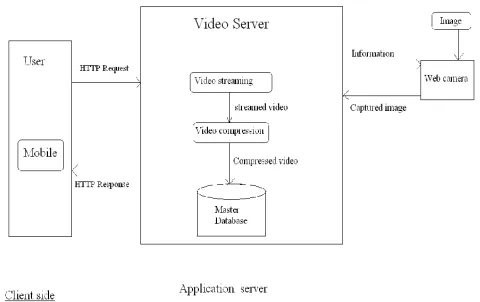
Fig. System Architecture
Initially the video is captured through the surveillance camera. This video is thus stored in video server. In the video server the videos undergo with the video streaming process. The streamed video is then compressed. Then the streamed and the compressed video is stored in the master database. All this methods are carried out in the application server.
Now at the client side, the user sends the HTTP Request to the application server. The application server respond to the client server in the HTTP format that is the videos which are stored in the master database. This video is then viewed on the android mobile with the help of an android application.
III. CONCLUSION
Thus, this report we have decided the modules and divided the work in different phases. In the first phase, we have analysed the IEEE paper and collected the raw data and elaborated on literature survey. Then, we have designed the process flow and according to that we have designed report. Also we have divided project work and documentation time. Thus we have prepared project report according to modules decided.
After developing this application, a person can monitor the area anywhere at any time as and when he wishes to. Staff monitoring can be achieved with this project which will help the manager in having a view at the happenings and also security can be achieved.
ACKNOWLEDGMENT
Available Online at www.ijpret.com
557 REFERENCES
1. Designing smart camera networks using smartphone platforms: a case study” yusuf simonson, robert fowler renaissance computing institute chapel hill, north carolina 27517 lobaton, ron alterovitz the department of computer science the university of north carolina at chapel hill chapel hill, north carolina 27517.
2. Wireless sensor systems: security implications for the industrial environment “dr. Peter l. Fuhr chief scientist rae systems, sunnyvale, ca [email protected].
3. Android wireless application development- lauren darcey, shane conder.
4. Introduction to image and video compression
5. Smart video security surveillance with mobile remote control tasleem mandrupkar dept of computer engg pune university, pune, india manisha kumari dept of computerengg pune university, pune, india rupali mane dept of computer engg, pune university, pune, india.
6. The overview and appliance of some streaming video software solutionsyan qinthesis (uas) bachelor’s thesis | abstract turku university of applied sciences bachelor of engineering | information technology 22.05.2010
7. Video streaming: concepts, algorithms, and systems john g. Apostolopoulos, wai- tian tan, susie j. Wee mobile and media systems laboratory hp laboratories palo alto hpl-2002-260 september 18th , 2002.