Antimicrobial Activities of Bacteriocin-Like Extracellular Metabolites Produced by
Soil Bacteria
Adedire O. M.
1*, Odeniyi O. A.
21
Federal College of Agriculture, P.M.B 5029 Ibadan, Oyo, Nigeria
2Department of Microbiology, University of Ibadan, P.M.B 5116 Ibadan, Oyo, Nigeria
Article Information Received 16 December 2016 Received in revised form 24 Aug 2017 Accepted 25 August 2017
Abstract
In an attempt to competitively inhibit other organisms within the same environment, microbial cells produce a wide range of bioactive bacteriocins and bacteriocin-like extracellular metabolites (BLEM). Bacterial species (Bacillus and Pseudomonas) were isolated from soil samples, screened for BLEM production and the crude activity of cell free metabolites determined by agar diffusion assay. Partial purification of metabolites was achieved by protein precipitation with ammonium sulfate and BLEM sensitivities to temperature, pH, surfactant and ultraviolet radiation along with the mode of action of partially purified BLEM on indicator strains and other pathogens were characterized. Bacillus subtilis SF8 and
Pseudomonas aeruginosa SF4 produced BLEM inhibitory to closely related strains with partially purified activity units of 768 and 2048AU/mL respectively. BLEMs retained large percentages of their inhibitory activities over a wide range of temperature and pH, 71%, 92% and 80% activity was retained by BLEM from B. subtilis SF8 while 91%, 81% and 89% activity was retained by BLEM from P. aeruginosa SF4 after 60 minutes of BLEM pre-incubation at 900C, pH 4 and 10, respectively. Ultraviolet radiation enhanced BLEM production in P. aeruginosa SF4 but not in B. subtilis SF8. Fourier Transformed Infrared (FTIR) spectroscopy revealed that BLEMs from both B. subtilis SF8 and P. aeruginosa SF4 interfered with cell membrane components of B. macerans SF2 and P. fluorescence BS2 respectively. The BLEM also had a broad inhibitory range on test bacterial and fungal pathogens.
Keywords:
Bacteriocin-like metabolite, activity unit,
Bacillus subtilis, Pseudomonas aeruginosa
Corresponding Author: E-mail : [email protected] Mob.: +2348034771628
1 Introduction
Microbial bacteriocin-like peptides are unique groups of extracellular antimicrobial metabolites produced by living microbial cells within a particular environment and also considered to be part of the host innate immunity1. Bacteriocins and bacteriocin-like metabolites are usually produced as excretory metabolites of microbial cells usually against closely related and at times distant species to the producing organism1,2. The bacteriocin family includes diverse microbial excretory proteins in terms of size, mode of action, transportation, release, microbial target and immunity mechanisms and can be broadly divided into those produced by Gram-negative and Gram-positive bacteria3.
Bacteriocins from Gram positive bacteria are often shorter chain, low molecular weight peptides and generally divided into classes based on their morphology, size, physical, and chemical properties4. The genus Bacillus contains a number of bacteriocinogenic species, which produce bacteriocins such as subtilin, subtilosin, coagulin and megacin as well as bacteriocin-like metabolites2, 5. Several species of Pseudomonas are
excellent bacteriocin and bacteriocin-like metabolite producers.
Pseudomonas aeruginosa presents an example of such excellence, and many of its strains produce bacteriocins such as the phage tail pyocins, pore formers and several other bacteriocin-like inhibitory metabolites as well as an uncharacterized array of bacteriocins6,7.
UK Journal of Pharmaceutical and Biosciences
Available at www.ukjpb.com
Some limitations ascribed to the use of prescribed therapeutic antibiotics include possible initiation of allergic reactions in individuals, elimination of normal flora when administered, and ineffectiveness against several antibiotic-resistant resistant microorganisms. The search for antimicrobial bacteriocins, some of which are already proven to kill bacteria in animal models8, is imperative due to their activity against antibiotic resistant isolates, safety, as well as reduced allergic reactions in individuals when compared to regular microbial antibiotics as regards their clinical utilization and in food and feed production9. The intent of this research work was therefore to screen for, partially purify and characterize bacteriocin-like extracellular antimicrobial metabolites from Pseudomonas and Bacillus
species isolated from soil and study their inhibitory effects on closely related species, other representative pathogenic bacteria and fungi.
2 Materials and Methods
2.1Sample collection, microbial isolation and identification
Soil samples were taken from several locations within Ibadan, Oyo state and used in the isolation of bacteria. Ten grams (10g) of each soil sample were placed in 90 mL distilled water and vortexed vigorously. Serially diluted soil samples were thereafter plated on nutrient agar, tryptone soy agar and
Pseudomonas isolation agar using the pour plate method and incubated at 30oC. The isolated bacteria were identified morphologically and biochemically10 as Bacillus and Pseudomonas strains.
2.2 Screening for bacteriocin-like metabolite production by
Bacillus and Pseudomonas species
Primary screening was done by growing pure cultures of bacterial isolates in 10ml of Nutrient broth at 37° C for 24 hours. Aliquots, (2μl), of the cultures were spotted onto Nutrient agar plates which after 18 hrs were overlaid with 5ml of 0.7% soft agar inoculated with the cell suspension of the test indicator strain. The plates were then incubated at 30°C for 24-72 hours. Inhibition against indicator organism was scored positive if the zone formed was wider than or equal to 2mm in diameter under each test condition11. The antimicrobial activity of metabolites from the selected species of Pseudomonas and Bacillus against other closely-related bacterial species isolated from the same ecological niche (secondary screening) was determined by the agar-well diffusion assay method, using the cell-free metabolites of the producer strains12.
2.3 Bacteriocin titre determination
The titre of inhibitory metabolites produced was quantified by a two-fold serial dilution of the metabolites in saline solution13.
The unit of antimicrobial activity of the metabolite was then defined as the reciprocal of the highest dilution showing at least
2mm diameter inhibition of the indicator lawn and expressed in Activity units per ml (AU/ml).
2.4 Partial purification of bacteriocin-like metabolite
Partial purification of cell free bacteriocin sample was done by protein precipitation with ammonium sulfate from 0% - 70% saturation followed by 70% - 90% saturation and centrifuged after storing overnight at 4oC14. The centrifuged precipitates were pooled, re-suspended in 10mM phosphate buffered saline (pH 7) to the initial volume of culture filtrate; then dialyzed against the same buffer in a tubular cellulose membrane (spectra por number four dialysis tube) for 18 hours at 4°C for further purification and elimination of salt.
2.5 Characterization of partially purified metabolite
2.5.1 Sensitivity to temperature and pH
To determine the effect of temperature and pH on the residual activity of partially purified bacteriocin-like metabolites produced by selected Pseudomonas and Bacillus species, aliquots (500µl) of their partially purified metabolite contained in screw-capped tubes was incubated at various temperatures (30, 40, 50, 60, 70, 80, 90 and 100 °C) for 15, 30 and 60 minutes to determine their sensitivity to temperature. Incubation of equal volumes of BLEM (500µl) was done with appropriate buffers at pH 3.0, 4.0, 5.0, 6.0, 7.0, 8.0, 9.0 and 10 to determine the effect of pH on the activity of these partially purified metabolites15. The inhibitory activity of untreated metabolite, in each case of percentage residual activity determination (assayed at room temperature and pH 7), was measured as control at 100% inhibition.
2.5.2 Effect of ultra violet radiation on BLEM production
Fresh four hour old cultures of each of Bacillus and
Pseudomonas species, (500µL) were exposed to ultraviolet irradiation within time ranges of 2 to 10 minutes at 25oC16; at a distance of 30 cm from an 8W (254 nm) UV transilluminator. To compare the yield of their inhibitory metabolites, nutrient broth cultures of these organisms grown in the absence of ultraviolet irradiation were used as controls. The amount of bacteriocin-like inhibitory metabolite expressed by these cultures was then determined using the agar well diffusion method and compared.
2.5.3 Hemolysis and hemagglutination tests
For hemolysis test, 5% mice erythrocytes in Nutrient agar plate were inoculated with purified BLEM, incubated for 24hours and observed for clearing zones (positive) while 50% (v/v) BLEM was mixed with 5% mice erythrocytes for 15minutes and observed for settling (negative) or agglutination (positive).
2.5.4 Mode of action of partially purified bacteriocin-like
metabolite
UK J Pharm & Biosci, 2017: 5(4); 49 after subjecting to the treatment described below. The purified
Bacillus BLEM was added at 10% (v/v) to 0.5 McFarland cell suspensions of the indicator organism, B. macerans SF2, while the Pseudomonas BLEM was added to P. fluorescence BS2. After incubation for 60 minutes, both treated and untreated (control) cells of the indicator organisms were washed 3 times with sterile distilled water and 20µL of each bacterial sample (treated and control indicator cells) was evenly applied onto the spectroscope’s ZnSe optical plate, dried for approximately 15 minutes and then analyzed to generate curves based on the detection and abundance of cellular molecules through bond vibration frequency. The effect of each BLEM on indicator cells was determined through the differences observed in the orientation and peaks of generated curves with both experimental and control cultures17.
2.5.5 Antimicrobial spectrum of bacteriocin-like metabolites
Antifungal properties of the bacteriocin-like extracellular metabolites of the producer bacteria (B. subtilis and P. aeruginosa) on post-harvest spoilage and pathogenic fungal species was carried out by introducing 50µl of BLEM into a 6 mm well bored in a potato dextrose agar plate which had been surface seeded with 0.5 ml haemotocytometer-count of 5 x 10⁶
indicator fungal cells per ml18. The plates were incubated at 28±2oC and observed daily over 5 days19.
Inhibitory activity of BLEM on methicillin-resistant
Staphylococcus aureus, Enterococcus faecalis, P. aeruginosa
ATCC 29853, Salmonella typhi 33458, E. coli 35218 and E. coli
23218 was performed using the agar well diffusion procedure12. 50µl each of BLEM was introduced into 6mm agar wells in nutrient agar plates seeded with 0.5 McFarland cell suspensions of the bacteria cells and incubated at 37oC for 24 hours. In all tests, a clear zone (≥ 2mm) around the well was taken as inhibition against each test pathogen, while the cell suspension solution (saline solution or buffer) without the cells was used as control for each case of BLEM activity determination.
3 Results and Discussion
3.1 Microbial isolation and screening for BLEM production
Eleven of the 46 isolate screened were found positive for the spot and/or agar overlay inhibitory metabolite production test(s) and thereafter subjected to further screening based on the characteristics of their inhibitory metabolites. Cell-free extracellular metabolite of Bacillus subtilis SF8 (pH 6.8) had higher activities and inhibited the growth of closely related strains; B. cereus, B. subtilis SC1 and B. macerans SF2 while the metabolite from Pseudomonas aeruginosa SF4 (pH 7.3) inhibited the growth of P. aeruginosaATCC29853 and P. fluorescence BS2 (Table 1). In contrast to traditional antibiotics, bacteriocins usually target organisms closely related to the producer species (although some exceptions exist)24.
As a result, Bacillus maceransSF2 and Pseudomonas fluorescence BS2 were selected as indicator organisms for subsequent tests with the BLEMs produced by Bacillus subtilisSF8 and Pseudomonas aeruginosaSF4 respectively. It was also observed that BLEMs were not inhibitory to the producer-strain in each case.
3.2 Partial purification of bacteriocin-like metabolite
As similarly reported for partial purification of bacteriocins from
Lactobacillus species14, inhibitory activity was detected only in
the salt precipitate and not in the supernatant of both strains of
Bacillus and Pseudomonas species. The activity unit of inhibitory metabolite of B. subtilis SF8 against its indicator strain (B. macerans SF2) increased from 640 to 768 AU/ml after partial purification (Table 2) while a higher increment was observed in the partially purified excretory metabolite of P. aeruginosa SF4 (1536 AU/ml to 2048 AU/ml).
3.3 Characterization of partially purified metabolites
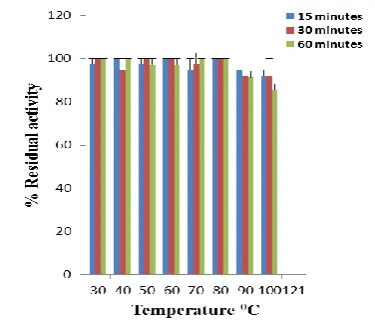
One fascinating property of bacteriocins and BLEM is their ability to retain large percentages of their inhibitory activities over a wide range of temperature25. Analysis of the effect of temperature on the stability of the inhibitory activities of BLEMs from B. subtilis SF8 and P. aeruginosa SF4 showed that these metabolites were relatively thermostable, more than 70% residual activity was retained by the partially purified inhibitory metabolites of both B. subtilis SF8 and P. aeruginosa SF4 at 300C to 900C pre-incubation temperature range for 60minutes
(Figures1a and 1b). At 1000C, the bacteriocin-like excretory metabolite of B. subtilis SF8 exhibited 83.3, 54.3 and 41% residual activities after pre-incubation periods of 15, 30 and 60min, respectively. Likewise, the bacteriocin-like extracellular metabolite of P. aeruginosa SF4 retained more than 90% inhibitory activity at 900C even after 60 minutes pre-incubation time. Residual activities of 92.1, 92.1 and 85.3% were retained at 1000C after 15, 30 and 60 minutes pre-incubation periods respectively. All activity was lost in both BLEMs after autoclaving the metabolites for 15 minutes.
more than 80% of its inhibitory activity within the pH range of 4-8 with optimum activity recorded at pH 6 to neutral pH. The addition of surfactants to the partially purified metabolite of
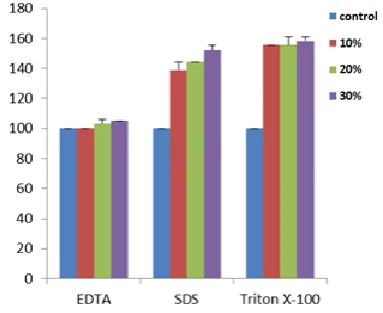
B. subtilis SF8 recorded an increment in percentage inhibition varying between 0 and 9% with the addition of 30% SDS and EDTA, and 4.5% increment with triton X-100 (Fig. 3a). The
range of increment in percentage inhibition of 38.9 - 58.3% was measured with the addition of different concentrations of SDS to the bacteriocin-like inhibitory metabolite of P. aeruginosa SF4 while the range of increment in activity of 55.5 – 58.3% was measured when different concentrations of triton X-100 was added to this metabolite (Fig. 3b).
Table 1: Activity of crude and partially purified BLEMs of B. subtilis SF8 and P. aeruginosa SF4on indicator strains
BLEM Producer strains
Activity Unit (AU/mL) Indicator strain/Zone of inhibition (mm)
Crude Partially
purified
P. fluorescence
BS2
P. putida
P. aeruginosa
ATCC9853
B. macerans
SF2
B. cereus
SF4
B. subtilis
SC1
B. subtilis SF8 640±42.4 768±36.77 0±0.00 0±0.00 7±0.00 12±2.83 11±0.00 11±2.83
P. aeruginosaSF4 1536±25.46 2048±0.00 18±2.83 12±4.24 8±1.41 0±0.00 0±0.00 0±0.00
*
results are average of triplicate values
Table 2: Antimicrobial activities of BLEM from B. subtilis
SF8 and P. aeruginosa SF4 on plant pathogenic fungi and clinical pathogenic bacteria
Indicator organisms
BLEM producer strain/Diameter of inhibition
(mm)
B. subtilis
SF8
P. aeruginosa
SF4
Rhizopus nigricans
ART98 4 0
Penicillium oxalicum
ILE1-OB 5 0
Penicillium chrysogenum
TZPB10 4 6
Fusarium oxysporum
RA1486 0 0
Fusarium compacticum 0 0
Aspergillus niger OK1482 0 0
Methicillin Resistant
S.aureus 0 13
Enterococcus faecalis 0 0
P. aeruginosa ATCC
29853 7 8
Salmonella typhi 33458 0 0
Escherichia coli 35218 0 0
Escherichia coli 23218 0 6
Fig 1a: Effect of temperature on the stability of BLEM produced by B. subtilis SF8
Fig 1b: Effect of temperature on the stability of BLEM produced by P. aeruginosa SF4
UK J Pharm & Biosci, 2017: 5(4); 51 of Gram-positive bacteria, is generally thinner; though the outer
membrane in the former group protects cells from many external agents. It is, however, possible to weaken the protective abilities of this outer membrane by various membrane-disorganizing permeabilizers like EDTA and surfactants, which could result in an increased permeability of such membrane to toxic agents29.
Fig 2: Effect of pH on the activity of BLEMs produced by B. subtilis SF8 and P.aeruginosa SF4
Fig 3a: Effect of surfactants on the activity of BLEM produced by B. subtilisSF8
Fig 3b: Effect of surfactants on the activity of BLEM produced by P. aeruginosaSF4
3.4 Effect of ultra violet radiation on BLEM production
The activity of bacteriocin-like metabolite produced by B. subtilis
SF8 was reduced by 12.5 and 50% after the exposure of young cultures of this strain to ultraviolet radiation for 8 and 10 minutes respectively. Increment in antimicrobial activity of 28 and 11% was observed for bacteriocin-like metabolite from P. aeruginosa
SF4 after 6 and 8 minutes UV irradiation of its young cultures respectively. An abrupt reduction in the inhibitory activity was observed for the culture irradiated for 10 minutes (Fig. 4). It was reported that the biosynthesis of Gram-negative bacteriocins is regulated by host’s SOS gene cluster system, which could be induced under stress conditions such as UV exposure and DNA damage30.
Fig 4: Effect of ultraviolet radiation on the production of BLEMs by B. subtilis SF8 and P. aeruginosa SF4
3.5 Hemolysis and hemagglutination tests
Negative hemolysis and hemagglutination results were recorded for the BLEM from B. subtilis SF8, however, tests on BLEM of
P. aeruginosa SF4 showed that this metabolite exhibited both hemolysis and hemagglutination properties. Hemolysin, lectin and other extracellular metabolites with phospholipase and agglutination properties produced by P. aeruginosa could be precipitated (as proteins) along bacteriocin-like excretory metabolites of this organism31, 32, 33 which could be responsible for the hemolysis and agglutination observed in its partially purified metabolite. However, such hemolysin and lectin within the metabolites of P. aeruginosa SF4 appeared to exist alongside the BLEM produced by this strain due to the inhibitory characteristics of this metabolite, including the inhibition of very closely related strains and strains from similar ecological niche, as well as its characteristic mode of action revealed by FTIR.
3.6 Mode of action of partially purified BLEM
(2093.00 and 2097.14 cm-1), NH2 bending, C=O stretching and
amides I and II (1645.90 and 1644.09 cm-1)34. While FTIR
spectroscopy also revealed a large difference in the peaks of curves generated as a result of the inhibitory effects of P. aeruginosa SF4 metabolite on P. fluorescence BS2 at 2092.21 cm-1 (13.5%), 2092.26 cm-1 (17.5%) and 1259.06 cm-1 (10%),
1269.91 cm-1 (13.5%) of untreated, treated cell suspensions; with assignments of P=O antisymmetric stretching and C-H aliphatic stretching respectively (Figures 6a and 6b).
Fig 5a: FTIR analysis of B. macerans SF2 cell suspension
Fig 5b: Effect of partially purified BLEM of B. subtilis SF8 on B. macerans SF2
These regions correspond to membrane fatty acids of bacteria17. Several factors may be responsible for the wide disparity observed in the generated curves, these could include the possible production of multiple bacteriocin-like extracellular metabolites (by B. subtilis SF8) targeting different sites on the membrane of indicator strain, as well as the release of intracellular components.
3.7 Antimicrobial spectrum of bacteriocin-like metabolites
Bacteriocin-like metabolite of B. subtilis SF8 inhibited the growth of Rhizopus nigricans ART98, Penicillium oxalicum ILE1-OB and P. chrysogenum TZPB10 while the metabolite produced by P. aeruginosa SF4 inhibited the growth of Penicillium
chrysogenum TZPB10.Antifungal activities of bacteriocins and bacteriocin-like excretory metabolites of bacteria, especially from Bacillus and Pseudomonas species, have been reported19. BLEM from P. aeruginosa SF4 was inhibitory to P. aeruginosa
ATCC 29853, methicillin resistant Staphylococcus aureus, and
E. coli 23218, while that from B. subtilisSF8 also inhibited P. aeruginosa ATCC 29853.
Fig 6a: FTIR analysis of P. fluorescence BS2 cell suspension
Fig 6b: Effect of partially purified BLEM of P. aeruginosa
SF4 on P. fluorescence BS2
Researchers have reported and documented the antimicrobial activities of bacteriocins against closely related and distant species to the producing bacterium24.
4 Conclusion
UK J Pharm & Biosci, 2017: 5(4); 53 exhibited against clinical and economically significant
pathogenic and spoilage organisms is a fascinating property with prospective agriculture and medically relevant potentials. These metabolites could therefore be further investigated and in translation, applied (in place of conventional antibiotics) in various fields.
5 Conflict of interest
The authors declare that there are no conflicts of interest.
6 Author’s contributions
AOM carried out the laboratory assay of bacteriocins and manuscript writing. OOA evaluated the work, gave research instructions and edited the manuscript. Both authors read and approved the final manuscript.
7 References
1. Rodney HP, Takeshi Z, Kenji S. Novel bacteriocins from lactic acid bacteria (LAB): various structures and applications. Microbial Cell Factories. 2014; 13(Supp l1): S3.
2. Heng NC, Burtenshaw GA, Jack RW, Tagg JR. Ubericin A, a class IIa bacteriocin produced by
Streptococcus uberis. Appl. Env. Microbiol. 2007; 73: 7763–7766.
3. Gordon DM, O’Brien CL. Bacteriocin diversity and the frequency of multiple bacteriocin production in
Escherichia coli.Microbiol. 2006; 152: 3239–3244. 4. Lee H, Kim, HY. Lantibiotics, class I bacteriocins from
the genus Bacillus. J.Microbiol. Biotechnol. 2011; 21(3): 229-235.
5. Shayesteh F, Ahmad A, Usup G. Partial Characterization of an Anti-Candida albicans Bacteriocin Produced by a Marine Strain of Bacillus
spp., Sh10. Advance Journal of Food Science and Technology 2015; 9 (9): 664-671.
6. Michel-Briand Y, Baysse C. The pyocins of
Pseudomonas aeruginosa. Biochim. 2002; 84: 499–
510.
7. McCaughey LC, Grinter R, Josts I, Roszak AW, Waløen KI, Cogdell RJ. Lectin-Like Bacteriocins from
Pseudomonas spp. Utilise D-Rhamnose Containing Lipopolysaccharide as a Cellular Receptor. PLoS Pathog. 2014; 10 (2).
8. Yang SC, Lin CH, Sun CT, Fang JY. Antimicrobial activities of bacteriocins: application in food and pharmaceuticals. Frontiers in Microbiology, 2014;5: 241.
9. Lipsky BA, Holroyd KJ, Zasloff M. Topical versus systemic antimicrobial therapy for treating mildly infected diabetic foot ulcers: a randomized, controlled, double-blinded, multicenter trial of pexiganam cream. Cli. Infect. Dis. 2008;47: 1537–1545.
10. Olutiola PO, Famurewa O, Sonntag HG. An introduction to General Microbiology. A practical Approach, 1st Edition, Heldelberg: Heidelberger Verlagsanstalt and Druckerei GmbH, Heidelberg, Federal Republic of Germany. 1991; pp: 157-180. 11. Graciela M, Vignolo M, de Kairuz N, Aida AP, de Ruiz
H, Oilver G. Influence of growth conditions on the production of lactocin 705, a bacteriocin produced by
LactobacillucaseiCRL 705. J. Appl. Bacteriol. 1995; 78: 5-10.
12. Motta AS, Brandelli A. Characterization of an antibacterial peptide produced by Brevibacterium linens. J. Appl. Microbiol. 2002; 92: 63-70.
13. Montel MG, Ale CE, Nader-Macías MEF, Pasteris SE. Characterization of a Bacteriocin Produced by
Enterococcus gallinarum CRL 1826 Isolated from Captive Bullfrog: Evaluation of its Mode of Action against Listeria monocytogenes and Gram-Negatives. J Bioprocess Biotech. 2015; 5: 250.
14. Ogunbanwo ST, Sanni AI, Onilude AA. Characterization of bacteriocin produced by
Lactobacillus plantarumF1 and Lactobacillus brevisOG1. Afr. J.Biotechnol. 2003; 2 (8): 219-227. 15. Joseph B, Dhas B, Hena V, Raj J. Bacteriocin from
Bacillus subtilis as a novel drug against diabetic foot ulcer bacterial pathogens. As. Pac. J. Trop. Biomed. 2003; 3(12): 942–946.
16. Saranya S, Hemashenpagam N. Purification and characterization of bacteriocin produced by different
Lactobacillus species isolated from fermented food. Int.J. of Microbiol. Res. 2013; 5(1): 341-348.
17. Bizani D, Motta A, Morrissy J, Terra R, Souto A, Brandelli A. Antibacterial activity of cerein 8A, a bacteriocin-like peptide produced by Bacillus cereus. Int.Microbiol. 2005;8: 125-131.
18. Kemal J. Laboratory Manual and Review on Clinical Pathology. OMICS Group eBooks, 731 Gull Ave, Foster City, USA. 2014; 10-12.
20. Gupta AK, Ahirwar NK, Shinde N, Choudhary M, Rajput YS, Singh A. Phytochemical Screening and Antimicrobial Assessment of Leaves of Adhatoda vasica, Azadirachta indica and Datura stramonium. UK Journal of Pharmaceutical and Biosciences. 2013; 1(1): 42-47.
21. Hassan Nageh, Metwally Ezzat, Mohammed Ghanim, Ahmed Hassanin, Ahmed Abd El-Moneim. Evaluation of Antibacterial Activity and Drug Release Behavior of Chitosan-Based Nanofibers (In Vitro Study). UK Journal of Pharmaceutical and Biosciences.2014; 2(3): 01-05.
22. Baydaa Hameed Abdullah, Suhad Faisal Hatem, Widad Jumaa. A Comparative Study of the Antibacterial Activity of Clove and Rosemary Essential Oils on Multidrug Resistant Bacteria. UK Journal of Pharmaceutical and Biosciences. 2015; 3(1): 18-22.
23. Ravi K, Bharavi K, Ravi KP, Vamsi KB. Phytochemical Screening and Antibacterial Activity of Ethanol Extract of Leaves and Twigs of Azadirachta indica A. Juss. UK Journal of Pharmaceutical and Biosciences. 2015; 3(6): 56-59.
24. Riley MA, Goldstone CM, Wertz JE, Gordon D. A phylogenetic approach toassessing the targets of microbial warfare. J.Evol.Biol. 2003; 16(4): 690-697. 25. Cherif A, Ouzari H, Daffonchio D, Cherif H,
Ben-Slama K, Hassen A, Jaoua S, Boudabous A. Thuricin 7: anovel bacteriocin produced by Bacillus thuringiensis BMG 1.7, a new strain isolated from soil. Lett.Appl.Microbiol. 2001; 32: 243-247.
26. Torkar KG, Matijasic BB. Partial characterization bacteriocins produced by Bacillus cersusisolates from milk products. Fd. Technol.Biotechnol. 2003; 41, 121-129.
27. Syed IA, Muhammad K, Muhammad S, Aqeel A, Shakeel A. Partial characterization of bacteriocin like inhibitory substance from Bacillus subtilisBS15, a local soil isolate.Pak. J. Bot. 2011; 43(4): 2195-2199. 28. Sehar AN, Sheikh AR. Isolation, production and characterization of bacteriocins produced by strains from indigenous environments. Pak. J. Bot. 2013; 45(1): 261-267.
29. Vaara M. Agents that increase the permeability of the outer membrane. Microbiol. Rev. 1999; 56: 395-411. 30. Cascales E, Buchanan SK, Duche D, Kleanthous C, Lloubes R, Postle K. Colicin biology. Microbiol. Mol. Biol. Rev. 2007; 71: 158–229.
31. Berka RM, Gray GL, Vasil ML. Studies of phospholipase C (heat- labile hemolysin) in
Pseudomonas aeruginosa. Infect. Immun. 1981; 34: 1071–1074.
32. Elleboudy N, Aboulwafa M, Hassouna N. .Phospholipases C from Pseudomonas aeruginosaand Bacillus cereus isolates, chromosome-mediated enzymes with roles in virulence. Turk. J. Biol. 2013; 37: 433-442.
33. Hameed M, Sinan I. Isolation and identification of
Pseudomonas aeruginosaand its ability in lectinproduction. Iraq. J.Biotechnol. 2009; 8(3): 640-648.