Available Online At www.ijpret.com
INTERNATIONAL JOURNAL OF PURE AND
APPLIED RESEARCH IN ENGINEERING AND
TECHNOLOGY
A PATH FOR HORIZING YOUR INNOVATIVE WORK
CRYPTOGRAPHY, STEGANOGRAPHY &NETWORK SECURITIES
SHITAL C. PATIL1, PROF. R. R. KEOLE2
1. PG Students H.V.P.M’s college of Engg. & Tech., Amravati, India. 2. Faculty in H.V.P.M’s college of Engg. & Tech., Amravati, India.
Accepted Date:
27/02/2013 Publish Date:
01/04/2013
Keywords
Cryptography,
Steganography,
Authentication,
Security Techniques
Corresponding Author Ms. Shital C. Patil
Abstract
This paper presents a classification of network security techniques such as:
secrecy, authentication and Non-repudiation. The secrecy techniques are of
two categories: cryptography and steganography. Cryptographyis, traditionally,
the study of means of converting information from its normal, comprehensible
form into an incomprehensible format, rendering it unreadable without secret
knowledge, the art of encryption. Steganography is the art and science of
writing hidden messages in such a way that no one, apart from the sender and
intended recipient, suspects the existence of the message, a form of security
through obscurity. Steganography is often confused with cryptography
because the two are similar in the way that they both are used to protect
confidential information. The difference between the two is in the appearance
in the processed output; the output of steganography operation is not
apparently visible but in cryptography the output is scrambled so that it can
draw attention. Authentication is the act of confirming the truth of an attribute
of a datum or entity.If both cryptography and steganography are used then the
Available Online At www.ijpret.com 1. INTRODUCTION
During the last few decades there is a
tremendous development in information
and communication technology. So security
in communication through internet has
become a concern. Network security
problems can be categorized roughly into
four areas: secrecy, authentication,
non-repudiation and integrity control. Secrecy,
also called confidentiality concerns with
keeping the information away from the
unauthorized users. That means
unauthorized users should not be able to
read and/or understand the information on
transit.
There are mainly two techniques to achieve
secrecy. Those are: cryptography and
steganography. Cryptography is a technique
in which the secret information is
transformed to a new form such that the
intruder can not understand information.
The Cryptographic algorithms are again two
types. They are: symmetric key
cryptography and public key cryptography.
Steganography is a technique of converting
communication in which the intruder can
not suspect that communication is going on
[1].The main goal of steganography is to
communicate securely in a completely
undetectable manner and to avoid drawing
suspicion to the transmission of a hidden a
data. It is not to keep others from knowing
hidden information even exist. If a
steganography method causes someone to
suspect the carrier medium then the
method has failed [2].
Authentication is the act of confirming the
truth of an attribute of a datum or entity.
This might involve confirming the identity of
a person or software program, tracing the
origins of an artifact, or ensuring that a
product is what its packing and labeling
claims to be.
Non-repudiation refers to a state of affairs
where the purported maker of a statement
will not be able to successfully challenge
the validity of the statement or contract [1].
2. CRYPTOGRAPHY
Cryptography is the art of protecting
information by encrypting it into an
unreadable format, called cipher text. Only
Available Online At www.ijpret.com
decipher(or decrypt) the message into plain
text.
2.1. Symmetric Key Cryptography
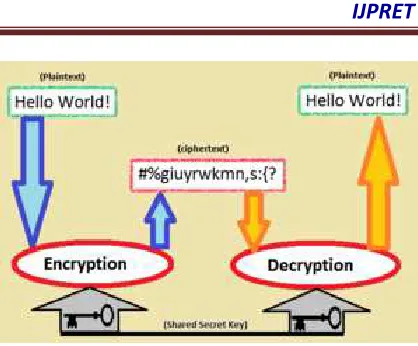
This is the traditional cryptography known
as private key cryptography too. The sender
uses a key and the encryption procedure to
encrypt the message (plain text) into cipher
text. The receiver uses the decryption
procedure and the key to decrypt the cipher
text to message. The key at sender is same
as the key at the receiver. The encryption
and decryption procedures except the key
are known to the adversary, so the
protection of the data or message depends
on the key only. Fig.1 is a diagrammatical
representation of Symmetric Key
Cryptography . There are a good number of
symmetric key algorithms. Some well
known algorithms are: DES (Data Encryption
Standard), IDEA (International Data
Encryption Algorithm), Triple-DES, AES
(Advanced Encryption Standard), RC6 [1].
Figure 1: Symmetric Key Cryptography
2.2. Public Key Cryptography
In 1976 Diffie and Hellman developed a two
key crypto system, called public key
cryptography. The distinguishing technique
used in public-key cryptography is the use
of asymmetric key algorithms, where
the key used to encrypt a message is not
the same as the key used to decrypt it. Each
user has a pair of cryptographic keys –
a public encryption key and a private
decryption key. The publicly available
encrypting-key is widely distributed, while
the private decrypting-key is known only to
its proprietor, the recipient. Messages are
encrypted with the recipient's public key,
and can be decrypted only with the
corresponding private key. Some well
Available Online At www.ijpret.com
(Rivest, Shamir and Adelman),
Diffie-Hellman etc [1].
3. STEGANOGRAPHY
Steganography is a technique for invisible
communication. This is achieved by hiding
information inside another information,
thus hiding the existence of the
communicated information.The word
steganography is ofGreek origin and means
"concealed writing" from the Greek words
steganos means "covered or protected",
and grapheimeans "writing".The advantage
of steganography over cryptography alone
is that messages do not attract attention to
themselves.
Modern techniques of steganography
Steganographic techniques are based on
the four types of cover files i.e. text, image,
audio and video files.
3.1 Text Steganography: [3]
In this technique the message is hidden
within a plain text file using
differentschemes like use of selected
characters, extra white spaces of the cover
text etc.
•Use of selected characters of cover Text.
Sender sends a series of integer number
(Key) to the recipient with a prioragreement
that the secret message is hidden within the
respective position ofsubsequent words of
the cover text. For example the series is ‘1,
1, 2, 3, 4, 2, 4,’and the cover text is “Ateam
of five men joined today”. So the
hiddenmessage is “Atfvoa”. A “0” in the
number series will indicate a blank space
inthe recovered message. The word in the
received cover text will be skipped if
thenumber of characters in that word is less
than the respective number in theseries
(Key) which shall also be skipped during the
process of message unhide.
•Use of extra white space characters of
cover text.
A number of extra blank spaces are inserted
between consecutive words of covertext.
This numbers are mapped to a hidden
message through an index of alookup table.
3.2 Image Steganography:
The most widely used technique today is
hiding of secret messages into a
Available Online At www.ijpret.com
exploits the weakness of the human
visualsystem (HVS). HVS cannot detect the
variation in luminance of color vectors
athigher frequency side of the visual
spectrum. A picture can be represented by
a
collection of color pixels. The individual
pixels can be represented by their
opticalcharacteristics like 'brightness',
'chroma' etc. Each of these characteristics
can bedigitally expressed in terms of 1s and
0s.For example: a 24-bit bitmap will have 8
bits, representing each of the threecolor
values (red, green, and blue) at each pixel
[4].If we consider just the bluethere will be
28different values of blue. The difference
between 11111111 and11111110 in the
value for blue intensity is likely to be
undetectable by thehuman eye. Hence, if
the terminal recipient of the data is nothing
but humanvisual system (HVS) then the
Least Significant Bit (LSB) can be used
forsomething else other than color
information.
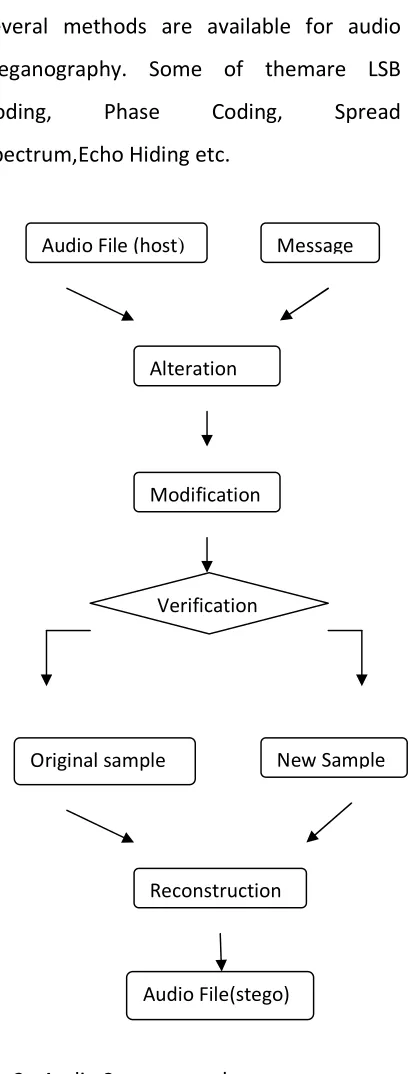
3.3 Audio Steganography[5,6,7]
In audio steganography, secret message is
embedded into digitized audio signalwhich
result slight altering of binary sequence of
the corresponding audio file.There are
several methods are available for audio
steganography. Some of themare LSB
Coding, Phase Coding, Spread
Spectrum,Echo Hiding etc.
Fig 2 : Audio Steganography
Audio File (host) Message
Alteration
Modification
Verification
Original sample New Sample
Reconstruction
Available Online At www.ijpret.com 3.4 Video Steganography
Video files generally consist of images and
sounds, so most of the relevant techniques
for hiding data intoimages and audio are
also applicable to video media. In the case
of video steganography sender sends the
secretmessage to the recipient using a
video sequence as cover media. Optional
secret key ‘K’ can also be used
duringembedding the secret message to the
cover media to produce ‘stego-video’. After
that the stego-video iscommunicated over
public channel to the receiver. At the
receiving end, receiver uses the secret key
along with extraction algorithm to extract
the secret.
4. APPLICATIONS
4.1. Applications of Cryptography:
Cryptography is used for securing
transmission of messages, protection of
data, and to provide privacy and security in
any situation where information is not
intended for public consumption. Examples
include political campaign plans,
extramarital affairs, cover-ups, ecommerce,
business transactions, and private
communications.
4.2. Applications of steganography:
Usage in modern printers: Steganography is
used by some modern printers, including HP
and XEROX brand color laser printers. Tiny
yellow dots are added to each page. The
dots are barely visible and contain encoded
printer serial numbers, as well as date and
time stamps.
Alleged use by intelligence services: In
2010, the Federal Bureau
ofInvestigation revealed that the Russian
foreign intelligence service uses customized
steganography software for embedding
encrypted text messages inside image files
for certain communications with "illegal
agents" (agents under non-diplomatic
cover) stationed abroad.
To Control Terrorist Activities: How to
control terrorist activities is a big question
before many countries. The government
and anti-terrorism offices can communicate
secretly to monitor or stop the terrorist
Available Online At www.ijpret.com
terrorists can be careful and change their
plans.
5. CONCLUSION
This paper presents a classification of
network security techniques and the recent
research work in the field of steganography.
Cryptography like Steganography is a very
useful technique to achieve secrecy in
communication. In areas where
cryptography and strong encryption are
being outlawed, citizens are looking at
steganography to circumvent such policies
andpass messages covertly.
REFERENCES
1. Gandharba Swain, Saroj Kumar Lanka, “A
Quick review of Network Security and
Steganography”, International Journal of
Electronics and Computer Science
Engineering, (IJECS- 2012),2012
2. M.I.Khalil, “Image Steganography: hiding
Short Audio Message within Digital Images”
,( JCS&T, 2011), 2011.
3. Soumyendu Das, Subhendu Das, Bijoy
Bandyopadhyay, Sugata Sanyal, “
Steganography and Stegnalysis: Different
Approaches”,
http://arxiv.org/ftp/arxiv/papers/111/358.p
df
4. Babloo Shaha and Suchi Sharma, “
Steganographic Techniques of Data Hiding
using Digital Images” , Defence Science
Journal, vol 62, No.1, 2012.
5. Bhavsar Jaimin H, Imaran Khan, “
Techniques of Steganography And
Steganalysis”,
http://ssrn.com/abstract=2029407.
6. Udit Budhiaa andDeepa Kundur, “Digital
video steganalysis exploiting collusion
sensitivity” - Sensors, Command Control,
Communications and Intelligence (C3I)
Technologies for Homeland Security and
Homeland Defense, Edward M.Carapezza,
ed., Proc. SPIE (vol. 5403), Orlando, Florida,
April 2004.
http://www.ece.tamu.edu/~deepa/pdf/Bud
Kun04.pdf
7. Methods of Audio Steganography,