Ms Kruti N Pandya
Executive Microbiology (R&D), Vasu Research Centre
A Division of Vasu Healthcare Pvt. Ltd,
896/4, GIDC Makarpura, Vadodara [Gujarat] India E-mail:[email protected] / [email protected]
Address for correspondence
Access this article online www.japer.in
Evaluation of safety and
in-Vitro
Efficacy study of Anti-Fungal
Cream
INTRODUCTION
Candida albicans and other related species are known to cause infections in humans. There are a wide range of infections such as skin infection, oral and genital infection. The major habitat of commensal Candida
species is believed to be the gastro intestinal tract. It has been shown that, fungaemia and funguria is commonly caused by C. albicans, if present in sufficient higher numbers. [1]
The human skin is considered as the largest organ of the body. It is the outer covering of the body. As it interacts with the environment, skin plays a major role in protecting the body against pathogens like bacteria and fungus. Other functions of the skin are
also important such as
insulation, temperature regulation, sensation etc. Hence before applying any topical formulation one
should completely be aware of the safety of the formulation. [2]
Epithelial cells (ECs) at mucosal surfaces provide first line of defense against fungal infections as they are being in constant contact with this fungus. Because of Increasing in number of the fungal invasion and recognition of antifungal resistance, there is need for clinically relevant antifungal susceptibility testing. [3-6]
The herbo-mineral formulation used for this study had been carefully designed to treat fungal skin infections. It contains different oils like Azadirachta indica (Neem) oil, Pongamia pinnata (Karanj) oil, Mahamarichyadi taila, Cinamom camphora (Karpoor) oil, C. citratas (Lemongrass) oil, and metals like Shuddha Tankan powder (purified boric acid), Shuddha Tuttha powder (Purified Copper sulphate) and Shuddha Gandhak powder (Purified sulphur).
MATERIALS AND METHODS
Sample Preparation:
The sample was first determined for its solubility properties. Different solvents were used in order to test the solubility. 0.5g of the sample was accurately weighed and dispensed in different test tubes
Evaluation of Antifungal activity of herbo-mineral formulation and its ingredients were tested
In-vitro against yeast Candida albicans by various methods using Miconazole as standard drug. Simultaneously safety study (skin irritation test) of herbal-mineral formulation was also performed according to OECD guidelines. Safety of the formulation was proved by skin irritation test and efficacy of the formulation was proved by In-vitro antifungal bio-assay.
Materials & Methods: The product was first checked for its solubility followed by anti fungal activity using both the Cup Method and Kirby Bauer Method. The Skin irritation test was carried out on Healthy adult male Wistar rats weighing 250-300g. All experiments and protocols described in present study were approved by the Institutional Animal Ethics Committee (IAEC) (Approval No.: KBIPER/IAEC/2012/353) of KBIPER (K.B. Institute of pharmaceutical education and research) and with permission from Committee for the Purpose of Control and Supervision of Experiments on Animals (CPCSEA) (Reg. No.: 35/1999/CPCSEA), Ministry of Social Justice and Empowerment, Government of India
Results & Discussion: The study clearly shows that the herbo-mineral formulation is showing good in-vitro anti-fungal activity against C. albicans and no skin irritation or adverse effects were observed in animals during the entire study.
Keywords: Skin irritation, Candida albicans, anti-fungal, Cutis cream, Herbo-mineral formulation.
ABSTRACT ABSTRACT ABSTRACT ABSTRACT Kruti N Pandya2*, Alok J Shah1*,
Sonal S Patel1, Vidhi B Parikh2,
Ghanshyam R Patel2, Hardik K
Soni2
1* K. B. Institute of Pharmaceutical
Education and Research (KBIPER) Gh-6, sector 23, Gandhinagar
2* Vasu Research Centre
A Division of Vasu Healthcare Pvt Ltd 896/A, GIDC, Makarpura, Vadodara, India
containing the solvents to be checked for. The results are as tabulated in Table 1.
The Cream was dissolved in 5mL of DMSO solvent taken in sterile screw capped containers. The mixture was vortexed and sonicated to get a uniform suspension and stored for not more than 24hours at 4°C till use.
Media Preparation:
Saboraud’s Dextrose Broth was used for determining the activity. Media was prepared according the Manufacturer’s instructions. The pH of the same was adjusted as per requirement; a known amount of sterile corn oil was added in order to enhance the growth of Candida. The media was then autoclaved at 15lbs pressure for 20minutes. The media was then allowed to cool down to about 45°C and then poured in sterile petri plates. The plates were then allowed to solidify overnight. The plates were then kept at 4°C till use.
Plating:
Two methods were followed for plating: The Kirby Bauer Method and the cup method.
0.1mL of the freshly revived culture (24h old culture) was pipette out and evenly spread with the help of a sterile cotton bud saturated with the culture. The plate was swirled at 45° angle and evenly spread throughout. The plate was kept aside for 5 minutes and allowed to dry.
a) Disk diffusion method: Sterile disks of about 6mm were dipped in the sample and gently placed on the agar plate with the help of sterile forceps. The disk was then gently touched with the forceps to ensure its contact with the media. The plates were incubated at 25°C for 4 to 5 days. The Zone of inhibition was then measured with the help of a standard antibiotic zone reader and recorded. [7]
b) Well diffusion method: After swabbing the
culture, wells were made in the middle of the plate with the help of a sterile cork borer. 0.1mL of the sample was then filled in the well to the brim. The
plates were then incubated at 25°C for 4 to 5 days. The Zone of inhibition was then measured with the help of a standard antibiotic zone reader and recorded. The samples were done in triplicates and after which the SD was calculated. [8] The results of both the methods
are as tabulated as in Table 2
Skin Irritation test of Cutis Cream:
Animals:All experiments and protocols described in present study were approved by the Institutional Animal Ethics Committee (IAEC) (Approval No.: KBIPER/IAEC/2012/353) of KBIPER (K.B. Institute of pharmaceutical education and research) and with permission from Committee for the Purpose of Control and Supervision of Experiments on Animals (CPCSEA) (Reg. No.: 35/1999/CPCSEA), Ministry of Social Justice and Empowerment, Government of India. Healthy adult male Wistar rats weighing 250-300g were used. Rats were housed in polypropylene cages, maintained under standardized condition (12Nil hour light/dark cycle, 24°C, 35 to 60% humidity) and provided free access to palleted ‘Sabardan’ diet and purified drinking water. [8-12]
Procedure: Skin irritation test was performed in 6 albino rats (either sex) were taken for the study. Procedure for this test was followed according to the OECD TG 404, 2002 guideline.
Rats were divided into two groups, (group A & group B), three rats in each group.
Rats were anesthetized and 1cm2 area on the back was
shaved.
Group A:Considered as a control group
Group B: 0.5 g of Cutis cream was applied to the shaved area on the back of rats.
After that continuous visual inspection of the rats of both the group were done at 2 hr, 4 hr. 6 hr, 24 hr and up to 48 hr.
Rats were observed for the production of any irritant response such as erythema, edema, and irritation after a single topical application.
RESULTS:
Table 1: Solubility Test of Cutis Cream.
S. No Observation Time Solubility in different solvents
Water DMSO Hexane Chloroform Acetone Methanol
1 2 min ++ +++ + + + ++
2 10 min ++ +++ + + + ++
Keys: + (weakly soluble), ++ (Partially soluble), +++ (soluble), DMSO (Di Methyl Sulphoxide), Based on the above data DMSO was chosen as the solvent for test.
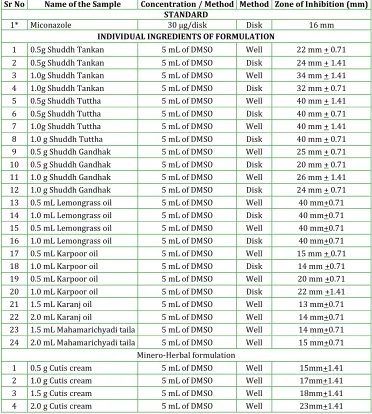
Table 2: The Zone of Inhibition
Sr No Name of the Sample Concentration / Method Method Zone of Inhibition (mm)
STANDARD
1* Miconazole 30 µg/disk Disk 16 mm
INDIVIDUAL INGREDIENTS OF FORMULATION
1 0.5g Shuddh Tankan 5 mL of DMSO Well 22 mm + 0.71
2 0.5g Shuddh Tankan 5 mL of DMSO Disk 24 mm + 1.41
3 1.0g Shuddh Tankan 5 mL of DMSO Well 34 mm + 1.41
4 1.0g Shuddh Tankan 5 mL of DMSO Disk 32 mm + 0.71
5 0.5g Shuddh Tuttha 5 mL of DMSO Well 40 mm + 1.41
6 0.5g Shuddh Tuttha 5 mL of DMSO Disk 40 mm + 0.71
7 1.0g Shuddh Tuttha 5 mL of DMSO Well 40 mm + 1.41
8 1.0 g Shuddh Tuttha 5 mL of DMSO Disk 40 mm + 0.71
9 0.5 g Shuddh Gandhak 5 mL of DMSO Well 25 mm + 0.71
10 0.5 g Shuddh Gandhak 5 mL of DMSO Disk 20 mm + 0.71
11 1.0 g Shuddh Gandhak 5 mL of DMSO Well 26 mm + 1.41
12 1.0 g Shuddh Gandhak 5 mL of DMSO Disk 24 mm + 0.71
13 0.5 mL Lemongrass oil 5 mL of DMSO Well 40 mm+0.71
14 1.0 mL Lemongrass oil 5 mL of DMSO Disk 40 mm+0.71
15 0.5 mL Lemongrass oil 5 mL of DMSO Well 40 mm+0.71
16 1.0 mL Lemongrass oil 5 mL of DMSO Disk 40 mm+0.71
17 0.5 mL Karpoor oil 5 mL of DMSO Well 15 mm + 0.71
18 1.0 mL Karpoor oil 5 mL of DMSO Disk 14 mm +0.71
19 0.5 mL Karpoor oil 5 mL of DMSO Well 20 mm +0.71
20 1.0 mL Karpoor oil 5 mL of DMSO Disk 22 mm +1.41
21 1.5 mL Karanj oil 5 mL of DMSO Well 13 mm+0.71
22 2.0 mL Karanj oil 5 mL of DMSO Well 14 mm+0.71
23 1.5 mL Mahamarichyadi taila 5 mL of DMSO Well 14 mm+0.71
24 2.0 mL Mahamarichyadi taila 5 mL of DMSO Well 15 mm+0.71
Minero-Herbal formulation
1 0.5 g Cutis cream 5 mL of DMSO Well 15mm+1.41
2 1.0 g Cutis cream 5 mL of DMSO Well 17mm+1.41
3 1.5 g Cutis cream 5 mL of DMSO Well 18mm+1.41
4 2.0 g Cutis cream 5 mL of DMSO Well 23mm+1.41
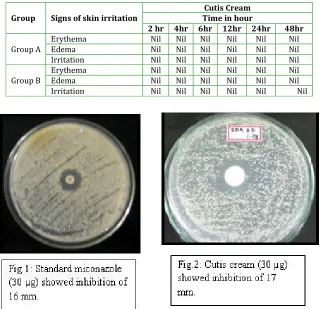
Comparison of formulation with standard.
Preparation of standard plate:
Miconazole patch having concentration of 30 µg was placed in the center of the plate.
Preparation of test plate:
Table 3: Skin irritation test of Antifungal Cutis Cream
After applying topical dose of 2.0 g of the preparations the rats were visually observed up to 48 hrs and there was no sign of any untoward response.
Group Signs of skin irritation
Cutis Cream Time in hour
2 hr 4hr 6hr 12hr 24hr 48hr
Group A
Erythema Nil Nil Nil Nil Nil Nil
Edema Nil Nil Nil Nil Nil Nil
Irritation Nil Nil Nil Nil Nil Nil
Group B
Erythema Nil Nil Nil Nil Nil Nil
Edema Nil Nil Nil Nil Nil Nil
Irritation Nil Nil Nil Nil Nil Nil
DISCUSSION
From the above compiled data the study clearly shows that the herbo-mineral formulation is showing good
in-vitro anti-fungal activity against C. albicans and no skin irritation or adverse effects were observed in animals during the entire study.
CONCLUSION
Present study showed that the Herbo-mineral formulation can be employed as safe and effective remedy against fungal skin infections, especially of
Candida sp.
ACKNOWLEDGEMENT
The authors would like to express their gratitude to Vasu Research Centre, A Division of Vasu Healthcare Pvt. Ltd, Vadodara, India, for providing state of the art testing facility and financial support to carry out this research work and also Dr. Prateek Patel Ex DGM Vasu Research Centre for his support & Guidance
throughout. We also thank Dr Maitreyi Zaveriof K.B. Institute of Pharmaceutical Education & Research, Gandhinagar for her valuable support and guidance.
REFERENCES
1. Julian R. Naglik et. al., Candida albicans interactions
with epithelial cells and mucosal immunity, Microbes
and Infection 13 (2011) 963-976
2. Walter LF, Gundula S. Histopathology of the skin. 3rd
Edn., Boston, Massachusetts: Lippincott; 1981.
p.156-64.
3. Johnson EM. Issues in antifungal susceptibility testing.
J Antimicrob Chemother 2008; 61 Suppl 1:i13.
4. Pfaller MA. New developments in the antifungal
susceptibility testing of Candida. Curr Fungal Infect
Reports 2008; 2:125.
5. Rex JH, Pfaller MA. Has antifungal susceptibility testing
come of age? Clin Infect Dis 2002; 35:982.
6. Pfaller MA. Antifungal drug resistance: mechanisms,
epidemiology, and consequences for treatment. Am J
7. Walter LF, Gundula S. Histopathology of the skin. 3rd
Edn., Boston, Massachusetts: Lippincott; 1981.
p.156-64.
8. Bauer, A. W., W. M. M. Kirby, J. C. Sherris, and M. Turck.
1966. Antibiotic susceptibility testing by a
standardized single disk method. Am. J.
Clin. Pathol. 36:493-496.
9. Isolation of Air Borne Bacteria & Testing Antimicrobial
Activity of Plant Extracts; Journal of Pharmaceutical
and Biomedical Sciences; 2012, 18 (01) Vol. 18, Issue
18; Pg 1-3
10.OECD 1992. OECG Guidelines for testing of chemicals,
No 404; Acute Dermal Irritation/Corrosion,
Organisation for Economoc Co operation and
Development, Paris.
11.Draize J.H., Woodard, G., Calvery, H O., 1944. Methods
for the study of irritation and toxicity of substances
applied topically to the skin and mucous membranes.
Journal of Pharmacology and Experimental
Therapeutics 82, 377-390.
12.Botham, P.A., Earl, L.K., Fentem J.H., Roguet, R., van de
Sandt, J J M., 1998. Alternative methods for skin
irritation testing; the current status. ECVAM skin
irritation task force report I.ATLA 26, 195-211.
How to cite this article: Kruti N Pandya2*, Alok J Shah1*,
Sonal S Patel1, Vidhi B Parikh2, Dr Ghanshyam R Patel2,
Hardik K Soni2; Evaluation of safety and in-Vitro Efficacy
study of Anti-Fungal Cream; J. Adv. Pharm. Edu. & Res. 2013: 3(3): 201-205.