Jarosław Szewczyk
1, B, Rafał Koszowski
1, A, Radosław Juźwiak
2, D,
Joanna Śmieszek-Wilczewska
1, CA Radiographic Assessment of the Regeneration Process
in Post-Operative Alveolar Bone Defects in Patients
with Different IL-1B-511 Genotypes
Ocena radiologiczna przebiegu regeneracji kostnej
w ubytkach pooperacyjnych wyrostków zębodołowych
u pacjentów z różnymi genotypami IL-1B-511
1 Department of Oral Surgery in Bytom, Silesian Medical University, Katowice, Poland 2 Regional Police Forensic Science Laboratory, Wrocław, Poland
A – research concept and design; B – collection and/or assembly of data; C – data analysis and interpretation;
D – writing the article; E – critical revision of the article; F – final approval of article; G – other
Abstract
Background. IL-1 is the main regulator of inflammatory reactions. This cytokine also plays an important role in bone tissue remodeling processes. The IL-1α-coding gene and the IL-1β-coding gene are located on the long arm of chromosome 2. These genes contain polymorphic sites. Polymorphic modifications in IL-1-coding genes deter-mine the level of IL-1 release, which can affect bone tissue regeneration.
Objectives. The objective of the present study was to assess the correlation between IL-1B-511 genetic polymor-phism and the regeneration of the alveolar ridge bone.
Material and Methods. The study was carried out at the Department of Oral Surgery in Bytom, Poland, which is part of the Silesian Medical University of Katowice. The study population comprised 92 patients with mandibu-lar or maxilmandibu-lary alveomandibu-lar bone defects which had developed following the surgical removal of tooth roots or the enucleation of impacted teeth or cysts. Genetic material was obtained from the epithelial cells of the inner buccal surface. The IL-1B-511 genotype was determined in each patient by means of the phenol-chloroform technique, in order to enable DNA isolation, as well as by the PCR-RFLP method. Once this had been achieved the patients could be classified into 3 groups according to the following genotypes: IL-1B-511 1/1, IL-1B-511 1/2 and IL-1B- -511 2/2. Bone regeneration was assessed radiographically using Digora 2.5 software. A comparison was made over a 6-month follow-up period of post-operative bone loss regeneration observed in patients with different types of the IL-1B-511 gene (alleles 1/1, 1/2, 2/2).
Results. A careful analysis of the X-ray images showed that the average increase in the optical density of post-operative bone defects was statistically lower in patients with the IL-1B-511 2/2 genotype than in those possessing the IL-1B-511 1/1 or IL-1B-511 1/2 genotypes. The results indicate that alveolar bone regeneration proceeds more slowly in patients with the IL-1B-511 2/2 genotype compared to those with alleles 1/1 and 1/2 (Adv Clin Exp Med 2013, 22, 6, 847–854).
Key words: IL-1, genetic polymorphism, bone tissue regeneration, radiographic analysis, bone defects, alveolar processes.
Streszczenie
Wprowadzenie. IL-1 jest głównym regulatorem reakcji zapalnej. Cytokina ta pełni ważną rolę w procesach przebu-dowy tkanki kostnej. Geny kodujące IL-1α, oraz IL-1β znajdują się na długim ramieniu chromosomu 2. W obrębie tych genów znajdują się miejsca polimorficzne. Polimorficzne odmiany genów kodujących IL-1 decydują o pozio-mie uwalniania IL-1, co może wywierać wpływ na przebieg procesu regeneracji tkanki kostnej.
Adv Clin Exp Med 2013, 22, 6, 847–854 ISSN 1899–5276
ORIGINAL PAPERS
IL-1 is an important regulator of inflamma-tory reactions. It is produced by macrophages and monocytes. Its essential function is to af-fect bone reconstruction processes. It increases the intensity of osteolytic processes by activating osteoclasts [1–3].
Located in the IL-1 region is a family of parti-cles that includes the following: IL-1α, IL-1β, IL-1γ, IL-1δ, IL-1ε, IL-1Ra, IL-1H, IL-1H2, IL-1HY2 and FIL 1γ. The genes encoding IL-1α and IL-1ß are on the long arm of chromosome 2. Located around the genes are 3 sites where genetic polymorphism can be expected, namely IL-1A-889, IL-1B-511 and IL-1B + 39549 [4, 5].
In 1992 Di Giovine et al. carried out a study on alleles A1 and A2 of the gene encoding IL-1B-511. Allele A1 was found in 59% of the patients and al-lele A2 in 41%. Of these 51% were heterozygotes 1/2 [6]. A study by Santilla et al. revealed that the production level of IL-1B was higher in patients with allele 2IL-1B-511 than in those with no allele 2. The researchers observed a correlation between the polymorphism of genes encoding IL-1 beta and the level of IL-1 beta produced by mononuclear leuco-cytes obtained from peripheral blood [7].
To date, a number of studies have demonstra-ted that the production level of IL-1 has a signifi-cant effect on the development of chronic periodon-tal diseases [8–10]. On the other hand, Shimpuku found that patients with the IL-1B-511 2/2 geno-type are exposed to a significantly higher risk of bone loss around dental implants than patients with the IL-1B-511 1/1 or IL-1B-511 1/2 geno-types [11]. The polymorhism of genes encoding IL-1 can also affect the progress of systemic diseas-es with autoimmunological etiopathogendiseas-esis such as lichen planus, systemic lupus erythematosus, Graves-Basedow’s disease, iridocyclitis, ulcerative
inflammation of the large intestine and juvenile rheumatoid arthritis [12, 13].
IL-1 beta is one of the factors responsible for the increased activity of mature osteoclasts and the differentiation of osteoclast precursors. It therefore plays an important role in regulating bone tissue reconstruction processes. The available literature includes no data on the relationship between allele 2/2 IL-1B-511 and mandibular or maxillary alve-olar bone tissue regeneration. Further studies are needed in order to answer the question of wheth-er a relationship exists between genetic IL-1 poly-morphism and the regeneration processes during the healing of bone defects.
Objectives
The aim of the study was to assess the influ-ence of genetic polymorphism IL-1B-511 on bone tissue regeneration processes in patients who had undergone surgical procedures involving the alve-olar processes.
The authors decided to investigate whether any radiographic differences were visible among patients with alleles 1/1, 1/2 and 2/2 to confirm that post-operative bone tissue regeneration was not the same in such patients.
Material and Methods
The study was conducted at the Department of Oral Surgery in Bytom, Poland, which is part of the Silesian Medical University of Katowice. The study was approved by the Ethics Committee of the Sile-sian Medical University of Katowice (ref. no. NN-6501-8/05).
Cel pracy. Ocena związku polimorfizmu genetycznego IL-1B-511 z procesami regeneracji tkanki kostnej wyrost-ków zębodołowych.
Materiał i metody. Badania przeprowadzono w Katedrze i Zakładzie Chirurgii Stomatologicznej w Bytomiu Śląskiego Uniwersytetu Medycznego w Katowicach na grupie 92 osób z ubytkami kostnymi wyrostków zębodołowych szczęk i żuchwy, powstałymi po operacyjnym usunięciu korzeni zębów, wyłuszczeniu zębów zatrzymanych oraz torbieli. Materiał genetyczny uzyskiwano ze złuszczonych komórek nabłonka wewnętrznej części powierzchni policzka. Posługując się techniką fenolowo-chloroformową, umożliwiającą izolację DNA, oraz używając metody PCR i RFLP oznaczono genotyp IL-1B-511 u każdej z badanych osób, co umożliwiło wyodrębnienie 3 grup pacjentów, mających jeden z możliwych genotypów: IL-1B-511 1/1, IL-1B-511 1/2 oraz IL-1B-511 2/2. Analizę radiologiczną regeneracji kostnej przeprowadzono posługując się programem komputerowym Digora 2.5. Porównano obraz radiologiczny regeneracji kostnej w ubytkach pooperacyjnych w 6-miesięcznym okresie pozabiegowym u pacjentów mających różne odmiany genu IL-1B-511 (allele 1/1, 1/2, 2/2).
Wyniki. Przeprowadzona analiza radiogramów wykazała istotnie mniejszy statystycznie przyrost średniej gęsto-ści optycznej kogęsto-ści w obrazie radiologicznym ubytków pooperacyjnych u osób mających genotyp IL-1B-511 2/2 w stosunku do osób mających genotyp IL-1B-511 1/1 oraz IL-1B-511 1/2. Uzyskane wyniki wskazują na wolniejszy przebieg regeneracji tkanki kostnej wyrostków zębodołowych u osób mających genotyp IL-1B-511 2/2 w stosunku do osób mających allele 1/1 oraz 1/2 (Adv Clin Exp Med 2013, 22, 6, 847–854).
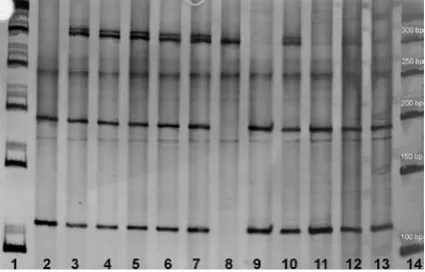
Fig. 1. Sample result of restriction analysis of PCR product subjected to AVAI enzyme digestion. Paths 3, 4, 5, 6, 7, 10: heterozygous samples IL-1B-511 ½; paths 2, 9, 11, 12, 13: homozygous samples IL-1B-511 1/1; path 8: homozygous samples IL-1B-511 2/2; paths 1, 14: standard size of DNA (50 pz DNA ladder of Invitrogen)
The patients were undergoing surgical treat-ment in the region of the mandibular or maxillary alveolar processes (cystectomies, extraction of im-pacted teeth or tooth roots). The study population comprised 100 patients aged 18–70 with no syste-mic diseases and who had signed a written consent. Patients suffering from osteoporosis, metabolic dis-orders, taking hormonal drugs, immunosuppres-sive drugs or antithrombotic drugs were exclud-ed. Eight of the patients did not participate in the 6-month follow-up examination and were also ex-cluded from the study; as were pregnant women.
The operations were performed by the same team of surgeons and by means of the same tech-nique for preparing the soft tissue and bone tis-sue. The same instruments were used, and bone tissue cutting was accompanied by abundant ex-ternal cooling. Prior to the operations the patients either underwent dental restoration treatment or they were instructed in oral hygiene with the aim of reducing the influence of infectious factors as much as possible. Once the procedures had been performed, the patients were given the same reco-mmendations with regard to oral antibiotic ther-apy, cold compresses and rinsing the mouth with a chlorhexidine solution.
Genetic material was obtained from the epi-thelial cells of the internal buccal surfaces. For this purpose standard test-tubes were first dampened with deionized water and then rubbed against the internal buccal surface. Each patient was assigned a different identification number, and each tube was labeled with the respective patients’ numbers. Finally, the tubes were sent to the Department of Biology and Genetics of the Regional Police Foren-sic Science Laboratory in Wroclaw.
The DNA material was isolated using the phe-nol-chloroform method. The DNA samples were subjected to a polymerase chain reaction (PCR) using start oligonucleotides with an open reading frame (ORF) and a restriction site for AVAI. The PCR product was then analyzed with regard to re-striction fragment length polymorphism (RFLP).
This method makes it possible to cut the DNA ma-terial (obtained through duplication via the PCR method) with restriction enzymes in characteris-tic sites. The fragments thus obtained were sepa-rated on polyacrylamide gel using electrophoresis and were then assessed.
Once the electrophoretic separation pro-cess was completed, the band arrangement was assessed according to allele 1 and allele 2. The bands (allele 1) – 114 bp + 190 bp were regard-ed as a homozygote of IL-1B-511 1/1. The bands (allele 2) – 304 bp were regarded as a
homozy-gote ofIL-1B-511 2/2. The bands (allele 1 and
al-lele 2) – 114 bp + 190 bp + 304 bp were regarded as a heterozygote of IL-1B-511 1/2. Upon being treated with restriction enzymes, standard DNA 50 bp DNA ladder (Alab) was used to assess the products (Fig. 1).
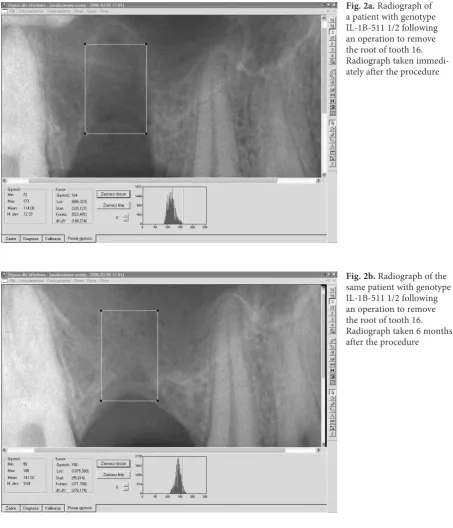
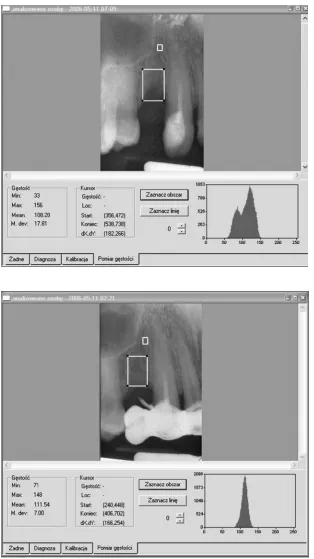
Intraoral dental X-rays were performed (us-ing the right-angle technique) immediately after the operation and 6 months postoperatively for the purpose of assessing the course of the regeneration process in postoperative bone defects. The projec-tion condiprojec-tions were made as similar as possible by using silicone impression material Regidur (Bisico) to fix the film holder. The X-ray images were exam-ined using digital densitometric analysis based on Windows Digora 2.5 software. This software helps measure optical bone density within a range of 256 shades of grey (black: 0, white: 255).
the minimum (Gmin) and the maximum (Gmax) were determined in the study field (Fig. 2 and 3). Changes in levels observed 6 months postopera-tively were compared with those observed imme-diately after the operation. An increase in the ave-rage optical density (∆ Gmean) was considered the most important, as it offered a reliable picture of the bone regeneration process.
Differences in optical bone density were sub-mitted to statistical analyses. The necessary database was created in MS Excel 2000 using Statistica 6.1 PL software. Each parameter was expressed according to descriptive statistics (mean value, SD, SEM). An
ANOVA test, Kruskal-Wallis analysis and Mann- -Whitney U test were used to compare differen-ces between the groups, and the chi-square test was used for qualitative variables. Any P value less than 0.05 was considered statistically significant.
Results
Of the 92 study patients, 46 had the IL- -1B-511 1/1 genotype, 34 had the IL-1B-511 1/2 genotype, and 12 had the 2/2 genotype. The IL- -511 1/1 group comprised 30 women and 16 men;
Fig. 2a. Radiograph of a patient with genotype IL-1B-511 1/2 following an operation to remove the root of tooth 16. Radiograph taken immedi-ately after the procedure
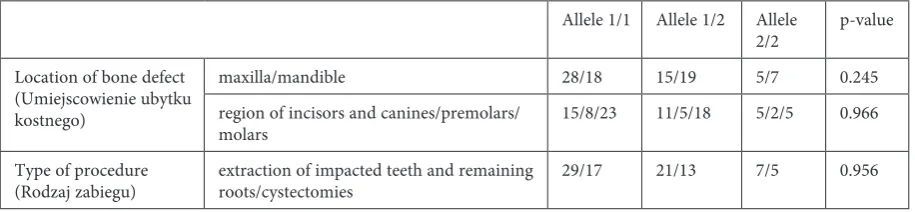
the IL-1B-511 1/2 group comprised 21 women and 13 men; and the IL-1B-511 2/2 group consisted of 8 women and 4 men (Table 1). There were no sig-nificant differences between the groups in terms of age, gender or the type of surgical procedures per-formed (Tables 1 and 2).
There were no statistically significant differ-ences between the 3 study groups as far as chang-es in minimal optical density are concerned. An increase of 9.20 in the minimum optical density
of the study field (∆ Gmin) was observed in the IL-1B-511 1/1 group, 12.5 in the IL-1B-511 1/2 group, and 18.2 in the IL-1B-511 2/2 group.
Nor were any statistically significant differ-ences noted between the 3 study groups as far as changes in maximum optical density were con-cerned. The IL-1B-511 1/1 group showed a change (∆Gmax) of 3.93. The IL-1B-511 1/2 group had ∆Gmax 5.94, and the IL-1B-511 2/2 had ∆Gmax – 6.00.
Fig. 3a. Radiograph of a patient with genotype IL-1B-511 2/2 fol-lowing an operation to remove the root of tooth 14. Radiograph taken immediately after the pro-cedure
On the other hand, statistically significant dif-ferences were noted in the increased average opti-cal density (∆Gmean) levels. The highest increase was observed in the IL-1B-511 1/2 group (15.1). The group with the 1/1 allele had ∆Gmean = 13.3. The ∆Gmean was significantly lower in the IL- -1B-511 2/2 group (5.95) (Table 3, Fig. 4).
Discussion
Of the 92 study patients, 46 (50%) had al-leles 1/1 in the IL-1B-511 polymorphic site, 34 (36.96%) had alleles 1/2, and 12 (13.04%) had the IL-1B-511 2/2 genotype. Landahl et al. demon-strated that among 153 patients in a Danish pop-ulation, in the position of IL-1B-511, 45.1% had
Table 1. The age, number and gender of patients in the different genotype groups Allele 1/1 Allele 1/2 Allele 2/2 p-value Age (yeras)
(Wiek – lata) 40.5 ± 14.7 35.0 ± 11.6 39.2 ± 12,8 0.271 Number of patients (n)
(Liczba pacjentów – n) 46 34 12 –
Men/women (n)
(Mężczyźni/kobiety – n) 30/16 21/13 8/4 0.932
Table 2. The location of post-operative bone defects and the types of procedure performed in the different genotype groups Allele 1/1 Allele 1/2 Allele
2/2 p-value
Location of bone defect (Umiejscowienie ubytku kostnego)
maxilla/mandible 28/18 15/19 5/7 0.245
region of incisors and canines/premolars/
molars 15/8/23 11/5/18 5/2/5 0.966
Type of procedure
(Rodzaj zabiegu) extraction of impacted teeth and remaining roots/cystectomies 29/17 21/13 7/5 0.956
Table 3. The average optical density of the radiographic image (Gmean) taken immediately after the operation and 6 months later, as well as the increase in the average optical density of radiographic image (ΔGmean)
Allele 1/1 Allele ½ Allele 2/2 p-value
mean SD mean SD mean SD
Gmean immediately after operation
(Gśr bezpośrednio po zabiegu) 98.7 22.7 101 22.7 111 12.0 0.176
Gmean after 6 months
(Gśr po 6 miesiącach) 112 22.4 116 27.0 117 12,5 0.468
ΔGmean
(ΔGśr) 13.3 8.27 15.1 7.51 5.95 3.05 0.001
Fig. 4. Increase in average optical density of radio-graphic image (ΔGmean). Data presented as mean ± SE
0 2 4 6 8 10 12 14 16 18 20
ΔGmean
allel 1/1 allel 1/2 allel 2/2
alleles 1/1, 42.5% had alleles 1/1, 42.5% had alleles 1/2, and 12.4% had alleles 2/2 [14].
Studies carried out to date confirm a relation-ship between the genetic polymorphism of the genes encoding IL-1 and the incidence of peri-odontitis in adult patients. Some authors have identified a correlation between the polymor-phism of IL-1A-889 or IL-1B + 3954 genes and severe periodontitis [9, 10]. Kornman et al. dem-onstrated that patients with IL-1A-889 allele 2 or IL-1B + 3954 allele 2 were more susceptible to se-vere periodontitis than patients with no such al-leles [9]. Gore et al. observed a significantly higher occurrence of IL-1 + 3954 allele 2 in patients with severe periodontitis. Among patients with mild or moderate periodontitis only 30% had IL-1B+3954 allele 2, and among patients with severe periodon-titis as many as 67% had allele 2 [15]. Engebertson et al. detected a 2.5 times higher concentration of IL-1 beta in gingival pocket fluid in patients with IL-1A-889 allele 2 or IL-1B + 3954 allele 2 com-pared with patients with no such alleles [8]. More-over, a correlation was observed between genetic polymorphism IL-1B-511 and bone loss around implants following the insertion of intraosseous dental implants. In 2003, after carrying out a study of 39 patients with 251 implants and their genes encoding IL-1, Shimpuku et al. suggested the pres-ence of a very strong inhibitory factor affecting os-seointegration. They found that the risk of bone loss around an implant was 10.86 times higher in patients with IL-1B-511 1/1 or IL-1B-511 1/2 gen-otypes. They concluded that this might be con-nected with an increased level of IL-1 production, which obviously leads to intense osteolysis during osseointegration in patients with the IL-1B-511 2/2 genotype [8].
IL-1 is a powerful stimulator of bone re-sorption. Since it activates osteoclasts [1–3], an
increased concentration during the bone tissue healing process could delay regeneration. No pre-vious studies have analyzed the healing process of mandibular and maxillary alveolar bones in pa-tients with various types of IL-1B-511 gene. Based on the assumption that the level of IL-1 production depends on genetic factors (i.e., the alleles in posi-tion IL-1B-511), the authors of the current study tried to determine whether any relationship ex-ists between the polymorphism of IL-1B-511 and bone regeneration in postoperative mandibular or maxil lary alveolar bone defects.
The current study was based on a radiographic assessment of the bone-forming process in postop-erative mandibular or maxillary alveolar bone de-fects in 3 groups of patients classified according to IL-1B-511 genotypes (1/1, 1/2, 2/2). The Gmean, Gmin and Gmax values were assessed along with changes in these values (i.e., ∆Gmean, ∆Gmin and ∆Gmax) over a 6-month follow-up period. No sta-tistically significant differences were observed in ∆Gmin between the 3 groups; nor were any statis-tically significant differences observed in ∆Gmax between the 3 groups.
However, among the 92 patients in the study, the increase in average optical bone den-sity was significantly lower in patients with the IL-1B-511 2/2 genotype compared with those with the IL-1B-511 1/1 or IL-1B-511 1/2 genotypes. This indicates that the postoperative bone regen-eration process was slower in patients with the IL-1B-511 2/2 genotype than it was in those pa-tients with alleles 1/1 or 1/2. This observation was confirmed by the statistical analysis.
The authors conclude that radiographic anal-ysis indicates that the postoperative regeneration of mandibular or maxillary alveolar bone defects is slower in patients with the IL-1B-511 2/2 genotype compared to those with the 1/1 or 1/2 genotype.
References
[1] Taki N, Tatro JM, Lowe R, Goldberg VM, Greenfield EM: Comparison of the roles of IL-1, IL-6, and TNF alpha in cell culture and murine models of aseptic loosening. Bone 2007, 40, 1276–1283.
[2] Kwan Tat S, Padrines M, Théoleyre S, Heymann D, Fortun Y: IL-6, RANKL, TNF-alpha/IL-1: interrelations in bone resorption pathophysiology.Cytokine Growth Factor Rev 2004, 15, 49–60.
[3] Wei S, Kitaura H, Zhou P, Ross FP: Teitelbaum SL.IL-1 mediates TNF-induced osteoclastogenesis. J Clin Invest 2005, 115, 282–290.
[4] Heath J, Saklatvala J, Meile M, Atkinson S, Reynolds J: Pig interleukin 1 (catabolin) is a potent stimulator of bone resorption in vitro. Calcif Tissue Int 1985, 37, 95–97.
[5] Dinarello CH, Wolff S: The role of interleukin –1 in disease. N Engl J Med 1993, 328 (2), 106–113.
[6] di Giovine FS, Takhsh E, Blakemore AI, Duff GW: Single base polymorphism at –511 in the human interleukin 1β gene (IL1β). Hum Mol Genet 1992, 450.
[7] Santtila S, Savinainen K, Hurme M: Presence of the IL-1RA alllele 2 (IL1RN*2) is associated with enhanced IL-1β production in vitro. Scand J Immunol 1998, 47, 195–198.
[8] Engebretson S, Lamster I, Herrera-Abreu M, Celenti R, Timms J, Chaudhary A, di Giovine F, Kornman K:
[9] Kornman K, Crane A, Wang H-Y, di Giovine F, Newman M, Pirk F, Wison Jr, T, Higginbottom F, Duff G: The interleukin-1 genotype as a severity factor in adult periodontal disease. J Clin Periodontol 1997, 24, 72–77.
[10] McDevitt M, Wang H, Knobelman C, Newman M, di Giovine F, Timms J, Duff G, Kornman K: Interleukin-1 genetic association with periodontitis in clinical practice. J Periodontol 2000, 71, 156–163.
[11] Shimpuku H, Nosaka Y, KawamuraT, Tachi Y, Shinohara M, Ohura K: Genetic polymorphisms of the inter-leukin-1 gene and early marginal bone loss around endosseous dental implants. Clin Oral Impl Res 2003, 14, 423–429.
[12] Tarlow J, Clay F, Cork M, Blakemore A, Mc Donagh A, Messenger A, Duff G: Severity of alopecia areata is asso-ciated with a polymorphism in the interleukin–1 receptor antagonist gene. J Invest Dermatol 1994, 103, 387–394.
[13] Blakemore A, Watson P, Weetman A, Duff G: Association of Graves` disease with allele of the interleukin-1 receptor antagonist gene. J Clin Endocrinol Metab 1995, 80, 111–115.
[14] Langdahl B, Lokke E, Carstens M, Stenkjaer L, Eriksen E: Osteoporotic fractures are associated with an 86-base pair repeat polymorhism the interleukin-1-receptor antagonist gene but not with polymorphisms in the interleu-kin-1B gene. J Bone Res 2000, 15, 402–414.
[15] Gore EA, Sanders JJ, Pandey Y, Galbraith GMP: Interleukin-1b+3954 allele 2: association with disease status in adult periodontitis. J Clin Periodontol 1998, 25, 781–785.
Address for correspondence:
Joanna Wilczewska Pl. Akademicki 17 41-902 Bytom Tel.: +48 322 827 478 E-mail: [email protected]
Conflict of interest: None declared