Łukasz Dobrek
a–D, Beata Skowron
B, agnieszka Baranowska
B, Piotr J. Thor
e, fSpectral Heart Rate Variability Analysis in Experimental
Obstructive and Chemical Overactive Bladder Models*
Analiza widmowa zmienności rytmu serca
w eksperymentalnych modelach obstrukcyjnego
i chemicznego nadaktywnego pęcherza moczowego
Department of Pathophysiology, Jagiellonian University, Medical College, Cracow, Poland
A – research concept and design; B – collection and/or assembly of data; C – data analysis and interpretation;
D – writing the article; E – critical revision of the article; F – final approval of article; G – other
Abstract
Background. Overactive bladder (OaB) is a clinical entity with complex, still incompletely understood pathophys-iology, involving central and peripheral autonomic nervous system (aNS) disturbances.
Objectives. The aim of the study was to estimate aNS activity using spectral analysis of heart rate variability (HRV) in two experimental overactive bladder models: chemical, evoked by cyclophosphamide treatment (COaB), and obstructive, produced by proximal partial bladder outlet obstruction (OOaB).
Material and Methods. 10 COaB rats and 10 OOaB rats with appropriate control groups were studied (40 animals total were enrolled in the study). In all studied groups, resting HRV recordings were performed. Standard spectral HRV parameters were analysed. The bladder overactivity was confirmed by urodynamic recordings and histologi-cal assessment.
Results. In COaB, all non-normalized spectral HRV parameters were diminished, while OOaB rats were mostly characterized by pronounced Lf (Low frequency) and Hf (High frequency) decrease. Normalized (nLf and nHf) parameters achieved similar values in both COaB and OOaB comparing to appropriate controls. In the analysis of percentages of the individual components in the total HRV power, the OOaB group showed almost double VLf (Very Low frequency) percentage as compared to the control. OOaB rats also displayed the highest disproportion between VLf and both Hf and Lf percentages. Contrary to the OOaB, there were small differences in the percent-age participation of the separate HRV components in COaB.
Conclusions. for both COaB and OOaB models, the authors demonstrated a decrease in the values of spec-tral HRV parameters, which may reflect aNS disturbances. Moreover, in OOaB animals, apart from total HRV power reduction, exaggerated differences between VLf percentage and the remaining components were revealed. In authors’ opinion, their findings concerning VLf differences may reflect increased autonomic disturbances in the OOaB model (Adv Clin Exp Med 2013, 22, 3, 337–346).
Key words: overactive bladder, cyclophosphamide, bladder outlet obstruction, heart rate variability, autonomic nervous system.
Streszczenie
Wprowadzenie. Zaburzenia patofizjologiczne leżące u podstaw rozwoju nadaktywności pęcherza moczowego są złożone i wciąż nie w pełni poznane. Patogeneza tej choroby jest związana między innymi z dysfunkcją autono-micznej kontroli pęcherza.
Cel pracy. Oszacowanie aktywności autonomicznego układu nerwowego (aNS) za pomocą analizy widmowej (częstotliwościowej) zmienności rytmu serca (HRV) w dwóch doświadczalnych modelach pęcherza nadaktywnego
adv Clin exp Med 2013, 22, 3, 337–346 ISSN 1899–5276
ORIgINaL PaPeRS
© Copyright by Wroclaw Medical University
Overactive bladder (OaB) is a clinical entity with complex pathogenesis and symptomatology; its global prevalence approaches 11.8% (including 10.8% of men and 12.8% of women). In general, OaB affects all ages, but its occurrence increases with aging and is more common in women than in men [1].
OaB was defined in 2002 by the International Continence Society (ICS) as urinary urgency with or without urge incontinence, usually associated with frequency and nocturia, in the absence of proven bladder disorders [2]. However, the OaB description, including the diagnostic and thera-peutic guidelines, has been evolving. The current OaB definition, revised in 2006, constitutes ur-gency with or without urur-gency incontinence (UI), usually with increased daytime frequency and nocturia. “Urgency” is defined as “the complaint of a sudden compelling desire to pass urine, which is difficult to defer” [3, 4]. Thus, “urgency urinary incontinence” is “the complaint of involuntary leakage accompanied by or immediately preceded by urgency”; “increased daytime frequency” is “the complaint by the patient [...] that he/she voids too often by day”, while “nocturia” is defined as “the complaint that the individual has to wake at night one or more times to void” [3, 4].
The mechanisms that underlie OaB are com-plex and still incompletely understood. generally, the urinary bladder plays a role in urine storage and voiding. Its functioning is regulated by the peripheral and central nervous systems. The blad-der is innervated with both the sympathetic nerves (originating from the intermediolateral nuclei in the thoracolumbar region (Th10-L2) of the spinal
cord) and the parasympathetic ones (arising from the sacral S2-S4 spinal parasympathetic nucleus). Detrusor contractions, which are responsible for bladder emptying, are initiated via acetylcholine (ach) release and muscarinic receptors activation. Two main periods in bladder functioning may be distinguished: storage and emptying (voiding). Physiologically, during the storage phase, no spinal parasympathetic activity or bladder contractions occur, while an increased sympathetic discharge contributes to bladder relaxation with urethral smooth muscle and urethral and pelvic floor striat-ed muscles keeping the outflow closstriat-ed. In contrast, during voiding, the decreased sympathetic activity contributes to bladder outflow opening, which in connection with increased parasympathetic input, lead to bladder contractions and emptying. Hence, normal bladder function is dependent on the in-tricate interplay of neurogenic and myogenic cells; disruption of any of these may lead to urinary dys-function [5, 6].
Two main theories, neurogenic and myogenic, have been proposed to address the pathophysi-ological processes. The first focuses on the cen-tral and peripheral autonomic nervous systems (aNS) disturbances affecting bladder contractility and functioning. The main neurogenic theory de-scribes the pathophysiological problem of OaB in connection with the damage of descending inhibi-tory pathways arising from higher brain centers, while according to the peripheral neural theory, OaB development results from an increased sen-sitization of bladder afferent terminals. Regardless of the central or peripheral reason, generalized, nerve-mediated excitation of the detrusor muscle
(OaB): chemicznego (COaB), wywołanego przez podawanie cyklofosfamidu oraz obstrukcyjnego (OOaB), zwią-zanego z częściową, podpęcherzową blokadą odpływu moczu.
Materiał i metody. Badania przeprowadzono na grupie 40 szczurów, podzielonych na dwie grupy z danym mode-lem OaB (COaB, OOaB) oraz dwie odpowiednie im grupy kontrolne (liczebność każdej z grup n = 10). W każdej z badanych grup przeprowadzono spoczynkowe zapisy zmienności rytmu serca, oceniając standardowe parametry widmowe. Nadaktywność pęcherza była potwierdzana badaniami urodynamicznymi oraz morfologiczną i histolo-giczną oceną tkanek pęcherza.
Wyniki. W grupie COaB wartości wszystkich nieznormalizowanych parametrów analizy spektralnej były zmniej-szone, podczas gdy w grupie OOaB zaznaczył się głownie spadek składowej niskiej (Lf) i wysokiej i (Hf) często-tliwości. Znormalizowane parametry (nLf i nHf) osiągały podobne wartości w obydwu grupach z OaB i odpo-wiadającym im grupach kontrolnych. Oceniając procentowy udział poszczególnych składowych w mocy całkowitej widma HRV, w grupie OOaB uwidoczniono niemal dwukrotnie większy odsetek składowej bardzo niskiej czę-stotliwości (VLf) w porównaniu z odpowiednią grupą kontrolną. Ponadto grupę OOaB cechowała największa dysproporcja między odsetkową wartością VLf i pozostałymi składowymi widma (Lf i Hf). Przeciwnie, w grupie COaB, różnice między procentowym rozkładem składowych widma HRV nie były aż tak zaznaczone, w porówna-niu do odpowiedniej grupy kontrolnej.
Wnioski. Zarówno w grupie COaB, jak i OOaB wykazano zmniejszenie wartości parametrów analizy widmowej HRV, co sugeruje zaburzenia autonomicznego układu nerwowego. Ponadto grupę OOaB cechowała zaznaczona dysproporcja w procentowym rozkładzie VLf i pozostałych składowych widma. Wyniki te mogą wskazywać na bardziej nasilone zaburzenia autonomicznego układu nerwowego w tym modelu OaB model (Adv Clin Exp Med 2013, 22, 3, 337–346).
takes place. The myogenic theory suggests that bladder over-reactivity may be associated with re-modeling of the bladder wall and abnormal elec-trical excitation of cells resulting from excitatory stimulus spreading across a large number of cou-pled smooth muscle cells [5, 7]. The detailed de-scription of both the anatomical and physiological aspects fundamental to the neural and myogenic theories of OaB development goes beyond the constraints of the present work. Basic OaB patho-physiology concepts with current management and future OaB pharmacotherapy perspectives were discussed in the authors’ reviews published in the last year [8, 9].
In view of the neurogenic OaB pathophysi-ological theory, it is necessary to assess the auto-nomic nervous system. In humans, the “ewing car-diovascular tests battery” and catecholamine level measurements evaluate aNS activity [10]. How-ever, according to current guidelines, the heart rate variability (HRV) study is regarded to be the best non-invasive method of aNS indirect assess-ment for both experiassess-mental and clinical purposes. Heart rate variability phenomenon is the tempo-rary variation of normal to normal beat intervals, observed in an eCg recording of the subject with dominant sinus rhythm, that is influenced by car-diac autonomic innervation [11, 12]. Two main types of HRV analysis may be distinguished: time domain analysis, based on mNN [ms] (main pa-rameter) as well as other statistical derivatives, and frequency (spectral) analysis, that is based on the HRV power spectrum and its components (TP – Total Power, VLf – Very Low frequency, Lf – Low frequency – and Hf – High frequency) as-sessment. generally, the total HRV power (TP) re-flects global autonomic tension, Lf – sympathetic/ parasympathetic tone, nLf (normalized Low fre-quency) – pure sympathetic or Hf, nHf (normal-ized High frequency) – pure parasympathetic activity. There is no unanimous agreement con-cerning VLf; however, this component is believed to mirror both the various short-term physiologi-cal regulations as well as autonomic inflammatory influences [11–13].
Thus, one may ask what kind of autonomic dysfunctions are present in the two entities – hem-orrhagic cystitis (during cyclophosphamide treat-ment) and bladder outlet obstruction, both mani-fested by OaB symptoms, but resulting from other pathogenic mechanisms.
The aim of this study was an autonomic activ-ity assessment using HRV spectral analysis estima-tion in the two animal models of overactive blad-der (OaB) – evoked by cyclophosphamide (CYP) administration (chronic chemical OaB; COaB – Chronic Overactive Bladder) and by partial
ure-thral obstruction (bladder outlet obstruction – ob-structive OaB; OOaB – Obob-structive Overactive Bladder).
Material and Methods
Ethics
The study was conducted after obtaining the first Local ethic Committee in Cracow agreement (decision No 126/2010).
Animals and Studied Groups
The authors used rats from the Pharmacy Department animal house. firstly, after arrival at the Pathophysiology Department, the animals were kept in groups of five per cage for one week to assure them the acclimatization period to new laboratory conditions. In general, the animals were housed with the retaining of 12–12 hours day-night cycle, room temperature, standard food (Labofeed, Kcynia) and ad libitum water.after the acclimatization period, the animals were randomized into studied groups. The authors carried out their experimental research in two es-sential groups: with COaB and OOaB models, with two suitable control populations. Therefore, four groups were studied: COaB (mean body weight 289.3±42.0 g), control group (1) (mean body weight 273.3±36.0 g), OOaB (mean body weight 243.3±13.5 g) and control group (2) (mean body weight 236.3±6.3 g). each group consisted of ten 10-week-old female Wistar rats; thus the ex-periment employed 40 animals.
COAB Model
was also the next evidence for bladder inflamma-tory change intensification. On the 8th day, after HRV recording registration, the animals were eu-thanized using a pentobarbital (Morbital, Biowet, Puławy) overdose (100 mg/kg body weight).
Control Group (1)
The studied animals received saline i.p. in-jection four times (similarly to COaB) in similar amounts as those ones administrated in the COaB rats. HRV recordings were also performed on the 8th day of the experiment.
OOAB Model
The animals enrolled into the OOaB group underwent surgery to evoke partial bladder out-let obstruction associated with secondary bladder overactivity. The experimental method used to produce bladder outlet obstruction was described previously by several investigators [16, 17]. Brief-ly, rats were anesthetized i.p. with pentobarbital (brand name: Morbital, Biowet, Puławy; 35 mg/ kg body weight). In the surgical procedure, the authors exposed the bladder and proximal ure-thra through an abdominal midline incision and placed a 1 mm diameter stainless steel rod to the proximal urethra to tie a 4/0 silk ligature around the inserted rod. after experimental urethral nar-rowing, the catheter was removed, leaving the ure-thra partially occluded. The abdominal wall was sutured and the animals were allowed to recover. During the first three days of the recovery period, two antibiotics (neomycin – Neomycin spray, oxy-tetracycline – Oxycort spray) were administrated to the surgery wound to prevent inflammatory complications. at 2 weeks after surgery, HRV re-cordings were collected.
Control Group (2)
10 rats underwent sham surgery in which the authors also exposed the bladder and catheterized the proximal urethra but without its ligation. The post-surgery protocol was similar to the OOaB an-imals. Consistently, HRV studies were performed 2 weeks after the sham procedure, similarly to the OOaB animals.
HRV Studies
20 minute eCg recordings were performed in resting conditions under urethane anesthe-sia (1200 mg/kg body weight; Sigma-aldrich) in the studied animals. Urethane was chosen based on literature reports suggesting its proportional
(up to the applied dose) influence on both sym-pathetic and parasymsym-pathetic tonic activity, and a relatively small impact on cardiac reflexes [18, 19]. after extrasinusal extopics elimination, the remaining sinus eCg signal was subjected to HRV analysis to obtain standard spectral (VLf, Lf, Hf and TP – all expressed in [ms*ms] and normalized nLf and nHf, calculated in normal-ized units [n.u.]) parameters. The authors set the range for the respective spectral components at: 0.18<VLf<0.28<Lf<0.78<Hf<3; and admit-ted commonly accepadmit-ted interpretation criteria, as mentioned in the introduction. The initial results were calculated as values ± SD.
Bladder Overactivity
Verification
In the last step,after HRV registration, 45 min-ute urodynamic recordings were conducted to con-firm bladder overactivity in all the studied groups.
The authors also performed the urodynamic recordings using urethane because this anesthetic agent is regarded to have a relatively small potential for impairing urinary bladder motility, as mentioned previously [18, 19]. In the still anaesthetized rat, the abdomen was opened and the bladder was exposed using similar surgery as that applied in the OOaB and control (2) groups. a urodynamic polyethylene catheter (external diameter 0.97 mm/internal diam-eter 0.58 mm, BaLT Poland), was inserted into the bladder dome through a small incision and fixed in place with 4-0 silk ligature. The catheter was con-nected to a pressure transducer that is a part of the analysis hardware (Power Lab; Chart 5 Pro v.5.4.2, aD Instruments). after bladder catheterization and system calibration, a 15 minute stabilization period was allowed. following the initial procedures, the baseline recordings were registered during con-tinuous saline infusion at a rate of 0.046 ml/min for 30 minutes (using an injection pump Unipan 340a). During the urodynamic studies, as well as the HRV ones, the studied animals were put under a heating lamp to avoid a body temperature fall through the uncovered abdominal layers that could negatively influence bladder activity and autonomic tension. Based on the obtained urodynamic record-ings, the authors calculated standard urodynamic parameters (peak number – PN, peak number per minute – PNM, intercontraction interval – ICI [s] and micturition voiding pressure – MVP [cm H2O]) to ascertain bladder contractility.
The authors checked that both the COaB and BOO (Bladder Outlet Obstruction) animals dis-played urodynamic OaB findings by performing a visual urodynamic records inspection as well as calculating the values of urodynamic parameters. In the case of these groups, the authors observed increased global bladder contractility (manifested in PN together with PNM increase and ICI and MVP decrease, as compared to the control).
The control rats (sham-operated or treated) displayed normal bladder contractility without urodynamic features of its overactivity. The au-thors have concluded that this finding may also be regarded as further indirect evidence of bladder disturbances recorded in BOO animals.
Statistical Analysis
The authors performeda statistical estimation of the obtained results in paired studied groups
(COaB vs. control 1 and OOaB vs. control 2), af-ter expressing them in the natural logarithmic val-ues, using a parametric fischer-Snedecor test with α = 0.05. The necessity of the HRV spectral param-eter values’ expression in the form of their natural logarithms was the consequence of the lack of their normal distribution. The authors verified the null (H0) hypothesis of equality of analyzed parameter variations in the two studied populations versus the alternative H1 hypothesis of their inequality (thus, their statistically significant differences).
Urinary Bladder Assessment
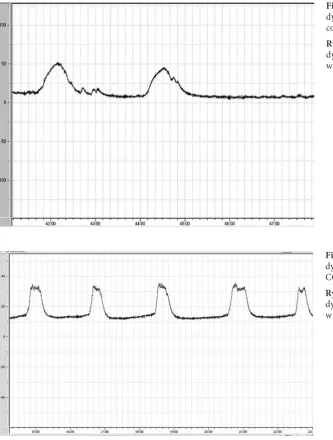
The bladders were collected in both COaB and OOaB rats, as well as in the controls, after urodynamic recordings and pentobarbital over-dose (100 mg/kg body weight). In the OOaB sub-jects, before bladder excision, the authors careful-ly removed the urethral ligature. In both studiedFig. 1. an example of the uro-dynamic recordings obtained in control rats
Ryc. 1. fragment zapisu uro-dynamicznego rejestrowanego w grupie kontrolnej
Fig. 2. an example of the uro-dynamic recordings obtained in COaB rats
groups, the authors revealed gross inflammatory changes (the bladders were swollen, red, and in most cases covered by abundant serosal petechial suffusions). In a microscopic bladder assessment, leukocyte infiltration was demonstrated in both OOaB and COaB groups, however, the observed histological inflammatory lesions were more pro-nounced in rats with HC development due to CYP treatment. The control rats displayed no morpho-logical or histomorpho-logical bladder abnormalities.
Results
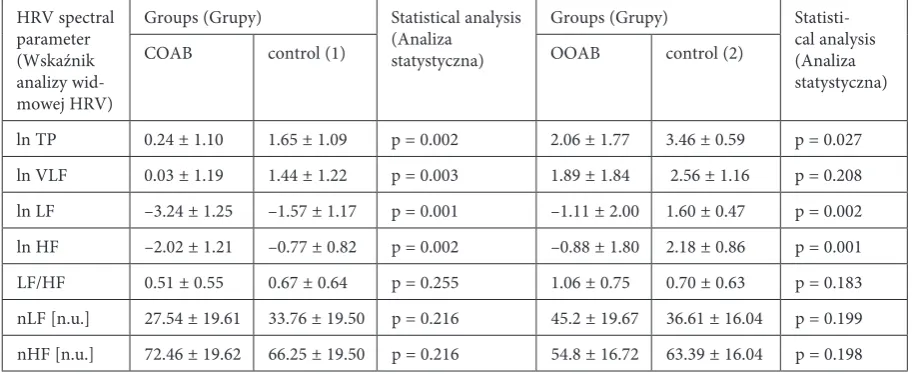
The statistical estimation of spectral HRV pa-rameters (expressed as ln values) showed inter-group differences (control 1 vs. COaB and con-trol 2 vs. OOaB) referring to all non-normalized spectral parameters.
With regards to COaB and control 1 group, it should be noted that all non-normalized spectral
HRV parameters were lower in COaB rats and the differences were statistically significant. In OOaB, a pronounced decrease in Lf and Hf values was re-vealed when compared to control 2 group, whereas VLf reached almost the same value in both analyzed populations. OOaB rats were also characterized by a low TP value. Contrariwise to the results described above, the normalized (nLf and nHf) spectral pa-rameters achieved in all studied groups (COaB and OOaB) were similar as compared to the suitable controls and did not possess statistical significance.
The results referenced above are given in Ta-ble 1.
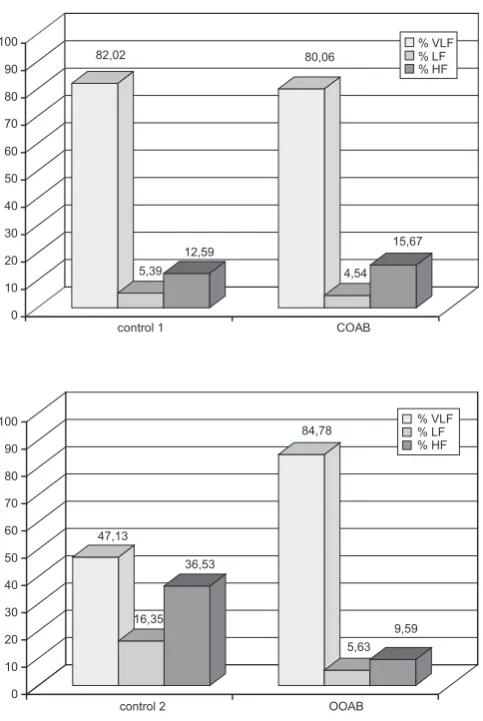
Moreover, intergroup differences (control 1, COaB, control 2, OOaB) of the non-normalized HRV parameters (VLf, Lf, Hf) were also calcu-lated as an expression of their percentage partici-pation related to the total power in each group. When compared in the appropriate pairs (COaB vs. control 1 and OOaB vs. control 2), more
pro-Fig. 3. an example of the uro-dynamic recordings obtained in OOaB rats
Ryc. 3. fragment zapisu urodyna-micznego rejestrowanego w gru-pie OOaB
Table 1. HRV frequency (spectral) domain analysis parameters Tabela 1. Parametry analizy widmowej (spektralnej) HRV
HRV spectral parameter (Wskaźnik analizy wid-mowej HRV)
groups (grupy) Statistical analysis (analiza statystyczna)
groups (grupy) Statisti-cal analysis (analiza statystyczna)
COaB control (1) OOaB control (2)
nounced differences were revealed for the animals from OOaB/control 2 than from COaB/control 1. The OOaB group showed almost double the VLf percentage compared to control 2, while Lf% was almost three times, and Hf% – almost four times lower. OOaB rats also displayed the highest disproportion between VLf and Hf percentages among all the analyzed groups. Contrary to the OOaB and control 2 rats, the differences in per-centage participation of the separate HRV com-ponents in COaB and control 1 group were very small. In these populations, similar values of HRV power spectrum percentage distribution were ob-served. The results described above are presented in figures 4 and 5 below.
Discussion
The main conclusion of this study was the demonstration of autonomic abnormalities in both the CYP-induced hemorrhagic cystitis (COaB) and bladder outlet obstruction (OOaB). Both COaB and OOaB groups were character-ized by diminished global aNS tension and lower values of the non-normalized HRV components.
These differences were especially pronounced for Lf and Hf. However, in both groups, normalized Lf and Hf comparing to appropriate controls did not differ significantly. Thus, the VLf differences seem to possess a particular significance. The VLf relations to the remaining HRV components were more visible in the intergroup comparison when the percentages of individual HRV components in each group were calculated (figures 1 and 2). In OOaB/control 2 groups, the disproportion be-tween %VLf/%Lf/%Hf was clearly emphasized, while in COaB/control 1 they were not so dis-tinct.
The TP and all non-normalized HRV param-eters decrease in both OaB rats may be a conse-quence of autonomic damage caused by either chemical or mechanical chronic stimuli. accord-ing to the HRV components interpretation, it seems that autonomic disturbances observed in both COaB and OOaB rats affect both the sym-pathetic and parasymsym-pathetic branch. a common agreement exists that efferent vagal activity is a major contributor of the Hf component. Many experimental and clinical studies of autonomic maneuvers, such as electrical vagal stimulation, vagotomy, respiratory sinus arrhythmia, or
mus-82,02
5,39 12,59
80,06
4,54 15,67
0 10 20 30 40 50 60 70 80 90 100
control 1 COAB
% VLF % LF % HF
47,13
16,35 36,53
84,78
5,63 9,59
0 10 20 30 40 50 60 70 80 90 100
control 2 OOAB
% VLF % LF % HF
Fig. 4. Percentage participation in total power of particular spectral components in control and COaB rats
Ryc. 4. Udział procentowy poszczególnych składowych widma w grupie kontrolnej i COaB
Fig. 5. Percentage participation in total power of particular spectral components in control and OOaB rats
carinic receptor blockage/excitation have pro-duced pronounced changes in Hf tension. The interpretation of the origin of the Lf component is more controversial and ambiguous. Lf is con-sidered to be either a marker of pure sympathetic modulation (especially when expressed in normal-ized units – nLf increase is observed during tilt or mental or physical stress which activates the sym-pathetic branch) or a parameter reflecting both the sympathetic and parasympathetic influences. Moreover, during sympathetic overexcitation, Lf power was even found to be diminished, reflecting the decreased responsiveness of the sinus node to the neural inputs [11, 20].
a reduction in HRV has mostly been observed in cardiac diseases. Patients with myocardial in-farction, following cardiac transplantation or suf-fering from chronic heart failure, are character-ized by decreased heart rate variability. Similarly, patients with diabetes also present reduced HRV and this finding is regarded to be a marker for the development of autonomic neuropathy [11, 20].
In the urology field, studies focused on aNS assessment and HRV are rare. In a Choi et al. study [21], lower spectral parameters in female patients with idiopathic OaB were found, thus suggesting impaired autonomic functioning in this population. In one of the latest published works, Ben-Dror et al. [22] also demonstrated a reduced sympa-thetic tone (reflected in lower Lf values) during blad-der filling in women with idiopathic OaB. Moreover, they revealed that in women with OaB, sympathetic activity decreased before maximal bladder capacity was reached. Because continual increase in sympa-thetic activity during bladder filling is necessary to enable the bladder to expand without detrusor con-tractions, the observed sympathetic dysfunction may result in sensation of urgency [22].
In another study, Juszczak et al. [23], using autonomic ewing’s battery tests, revealed rest-ing sympathetic overstimulation in benign pros-tatic hyperplasia (BPH) patients with concurrent bladder overactivity symptoms. Moreover, di-minished suspected parasympathetic response to vagal stimulation during deep breathing tests was demonstrated. Taking into consideration the re-sults obtained, they concluded that these patients developed mixed autonomic disturbances [23]. Other investigators confirmed autonomic neurop-athy in BPH patients. Both Mc Vary et al. [24] and Meigs et al. [25] found that patients with BPH are more likely to have sympathetic overactivation. They also revealed an indisputable dependence between BPH development and sympathetic over-activity. Thus, according to these authors, aNS disturbances may have a causal meaning in BPH development and progression.
It is difficult to uncritically and simultane-ously compare results obtained from clinical and experimental results. There are essential meth-odology differences (e.g. Ben-Dror [22] – HRV estimating throughout monitored bladder filling; the present experiment – HRV assessment inde-pendently on bladder phase) and also the impor-tant limitations of animal modeling. first of all, OaB is a symptom-based condition in which the conscious perception of urgency is central to the diagnosis. There is no way of knowing certainly whether an animal is experiencing urgency, even if pseudo-affective changes in behavior may sug-gest it. Moreover, none of the animal models can reproduce all the facets of human conditions. Thus, it must be emphasized that an OaB animal model is a tool rather than a replica and is usually only relevant to the complex human condition with regards to resolving a particular experimental hy-pothesis. However, it is widely accepted that studies using muscle strips or animal OaB models provide a crucial link to the clinical context, enabling both a more detailed pathophysiological description and discovering more effective treatment [26].
Most animal models used to study OaB are induced models, meaning that a relevant patho-physiological challenge is experimentally applied to a healthy animal. One of the peripheral models, chronic chemical hemorrhagic cystitis (HC), re-sults from direct damage to the bladder evoked by chronic or single cyclophosphamide (CYP) admin-istration. This model, first proposed by Cox [27], reflects bladder damage with its overactivity in the course of oxazaphosphorine therapy and is frequently used, often with minor modifications, by numerous researchers in the OaB field. The other OaB experimental model, reflecting bladder outlet obstruction (BOO), produces storage symp-toms that often persist even after the obstruction is surgically corrected. Disturbances similar to those observed in human BOO are relatively straightfor-ward to reproduce in experimental conditions by ligating the urethra to produce partial obstruction. This experimental approach also reflects urethral obstruction due to benign prostatic hyperplasia (BPH) in men, often associated with OaB symp-toms [26, 28]. Thus, much of the current knowl-edge from this field has come from experimental studies and not only from clinical ones.
group (fig. 1). Contrary to this, in the OOaB animals, apart from total power reduction, there were differences between VLf percentage and the remaining components with regards to VLf in-crease in total aNS activity. Hence, in the authors’ opinion, the VLf apparent, relative increase in OOaB may constitute the key element, depending on the causative character (mechanical or chemi-cal) of the OaB etiological agent. However, it is not possible to interchangeably elucidate whether augmented sympathetic or parasympathetic ten-sion contributes to the revealed VLf changes, be-cause the mechanisms responsible for VLf devel-opment in the HRV spectrum remain unknown and require further clarifying.
as was already mentioned in the introduc-tion, VLf is regarded as reflecting neuroendocrine rhythms, thermoregulatory actions, renin-angio-tensin system activity, and hemodynamic feed-back delays. Regardless of the only partly defined VLf origin mechanisms, there is great interest in this component with regards to humans. The slow rhythms reflected in the HRV spectrum in very low – VLf and even ultra-low frequencies – ULf ranges are said to be predictors of severe cardiac disorders, including cardiac death [11]. Thus, de-spite the fact that an unambiguous VLf meaning is still not clearly determined, most HRV guidelines consider this spectral component as a determinant of sympathetic tension. In this view, the authors’ findings regarding VLf in the OOaB group may be due to sympathetic overactivity associated with simultaneous parasympathetic withdrawal. On the other hand, there are also premises to regard VLf as the reflection of parasympathetic excitation. according to Taylor et al. [29], VLf mainly results from the parasympathetic outflow, not the sympa-thetic. These authors demonstrated that atropine administration led to almost complete VLf power abolishment and other spectral components powers reduction, suggesting that the VLf band is driven
by parasympathetic tension. Silva Soares et al. [30] revealed in their study that stimulation with pyr-idostigmine (a reversible cholinesterase inhibitor) produced a strong increase in VLf [30]. Therefore, contrary to the clinical observations in cardiology suggesting a strong link between VLf power and sympathetic-mediated severe cardiac disturbances, it seems that VLf oscillations may also derive from the parasympathetic mechanisms. Taking into account such a point of the view, the authors’ VLf findings may also reflect parasympathetic predominance, contributing to the exaggerated but ineffective blad-der motor activity in bladblad-der outlet obstruction and resulting in overactive bladder symptoms. Chemical bladder damage caused by CYP and its metabolites could be reflected to a larger degree in the range be-yond very low frequency.
The authors revealed autonomic nervous sys-tem disturbances in both CYP-induced hemor-rhagic cystitis (COaB) and bladder outlet obstruc-tion (OOaB).
Both COaB and OOaB groups were char-acterized by diminished global aNS tension and lower values of Lf and Hf values. However, in both groups, normalized Lf and Hf did not dif-fer significantly when compared to appropriate control subjects. VLf percentage, calculated as an expression of its participation related to the appro-priate total power was the highest in OOaB. Con-trary to these findings, COaB rats displayed very small differences in percentage participation of the separate HRV components. Thus, the VLf differ-ences seem to possess a particular significance in OaB associated with bladder outlet obstruction.
The authors realize that the conclusion on the differential role of VLf in OaB may be pre-mature and too far-reaching. However, in their opinion, this finding seems to be very interesting and worth detailed exploration, being a promis-ing research direction for further theoretical and clinical studies.
References
[1] Irwin DE, Milsom I, Hunskaar S, Reilly K, Kopp Z, Herschorn S, Coyne K, Kelleher C, Hampel C, Artibani W, Abrams P: Population-based survey of urinary incontinence, overactive bladder and other lower urinary tract symptoms in five countries: results of the ePIC study. eur Urol 2006, 50, 1306–1315.
[2] Abrams P, Cardozo L, Fall M, Griffiths D, Rosier P, Ulmstein U, van Kerrebroeck P, Victor A, Wein A: The standardisation of terminology of lower urinary tract function: report from the Standardisation Sub-committee of the International Continence Society. Neurourol Urodyn 2002, 21, 167–178.
[3] Abrams P, Artibani W, Cardozo L, Dmochowski R, van Kerrebroeck P, Sand P: Reviewing the ICS 2002 termi-nology report: The ongoing debate. Neurourol Urodyn 2006, 25, 293.
[4] Hashim H, Abrams P: Overactive bladder: an update. Curr Opin Urol 2007, 17, 231–236. [5] Andersson KE, Pehrson R: CNS involvement in overactive bladder. Drugs 2003, 63, 2595–2611.
[6] Abrams P, Andersson KE: Muscarinic receptor antagonists for overactive bladder. BJU Int 2007, 100, 987–1006.
[7] Chu FM, Dmochowski R: Pathophysiology of overactive bladder. am J Med 2006, 119(3 Suppl. 1), 3S–8S.
[9] Dobrek Ł, Juszczak K, Wyczółkowski M, Thor P: Current management and future perspectives of overactive bladder (OaB) pharmacotherapy. acta Pol Pharm Drug Res 2011, 68, 807–821.
[10] Zygmunt A, Stanczyk J: Methods of evaluation of autonomic nervous system function. arch Med Sci 2010, 6, 11–18.
[11] Malik M, Bigger JT, Camm AJ: guidelines. Heart rate variability. Standards of measurements, physiological interpretations and clinical use. Task force of The european Society of Cardiology and The North american Society of Pacing and electrophysiology. eur Heart J 1996, 17, 354–381.
[12] Rajendra Acharya U, Joseph KP, Kannathal N, Lim CM, Suri JS: Heart rate variability: a review. Med Bio eng Comput 2006, 44, 1031–1051.
[13] De Jong MMJ, Randall DC: Heart rate variability analysis in the assessment of autonomic function in heart fail-ure. J Cardiovasc Nurs 2005, 20, 186–195.
[14] Dinis P, Churrua A, Avelino A, Yaqoob M, Bevan S, Nagy I, Cruz F: anandamide-evoked activation of vanilloid receptor 1 contributes to the development of bladder hyperreflexia and nociceptive transmission to spinal dorsal horn neurons in cystitis. J Neurosci 2004, 24, 11253–11263.
[15] Chopra B, Barrick SR, Meyers S, Beckel JM, Zeidel ML, Ford APDW, de Groat WC, Birder LA: expression and function of bradykinin B1 and B2 receptors in normal and inflamed rat urinary bladder urothelium. J Physiol 2005, 562(Pt 3), 859–871.
[16] Calvert RC, Thompson SC, Khan MA, Mikhailidis DP, Morgan RJ, Burnstock G: alternations in cholinergic and purynergic signalling in a model of the obstructed bladder. J Urol 2001, 166, 1530–1533.
[17] Das AK, Leggett RE, Whitbeck C, Eagen G, Levin RM: effect of doxazosin on rat urinary bladder function after partial outlet obstruction. Neurol Urodyn 2002, 21, 160–166.
[18] Maggi CA, Meli A: Suitability of urethane anesthesia for physiopharmacological investigations in various systems. Part 1: general considerations. experientia 1986, 42, 109–114.
[19] Maggi CA, Meli A: Suitability of urethane anesthesia for physiopharmacological investigations in various systems. Part 2: cardiovascular system. experientia 1986, 42, 292–297.
[20] Sztajzel J: Heart rate variability: a noninvasive electrocardiographic method to measure the autonomic nervous system. Swiss Med Wkly 2004, 134, 514–522.
[21] Choi JB, Cha MH, Seo KS, Ahn BC, Kim BT, KIm YS: analysis of heart rate variability in patients with an over-active bladder. Continence 2005, 1, 9–12.
[22] Ben-Dror I, Weissman A, Leurer MK, Eldor-Itskovitz J, Lowenstein L: alternations of heart rate variability in women with overactive bladder syndrome. Int Urogynecol J 2012, 23, 1081–1086.
[23] Juszczak K, Mazur M, Wyczółkowski M, Filipek M, Thor PJ: autonomic nervous system activity in patients with lower urinary tract symptoms secondary to benign prostatic hyperplasia estimated by heart rate variability. Open Urol Nephrol J 2008, 1, 44–49.
[24] Mc Vary KT, Rademaker A, Lloyd GL, Gann P: autonomic nervous system overactivity in men with lower uri-nary tract symptoms secondary to benign prostatic hyperplasia. J Urol 2005, 174(4 Pt1), 1327–1433.
[25] Meigs JB, Mohr B, Barry MJ, Mc Naughton CM, Mc Kinlay JB: Risk factors for clinical benign prostatic hyper-plasia in a community-based population of healthy aging men. J Clin epidemiol 2001, 54, 935–944.
[26] Parsons BA, Drake MJ: animal models in overactive bladder research. In: Handbook of experimental Pharmacology 202. eds.: andersson Ke, Michel MC, Berlin Heidelberg: Springer-Verlag 2011, 15–43.
[27] Cox PJ: Cyclophosphamide cystitis – identification of acroleine as the causative agent. Biochem Pharmacol 1979, 28, 2045–2049.
[28] Mc Murray G, Casey JH, Naylor AM: animal models in urological disease and sexual dysfunction. Br J Pharmacol 2006, 147(Suppl. 2), S62–S79.
[29] Taylor JA, Carr DL, Myers CW, Eckberg DL: Mechanisms underlying very low frequency RR-interval oscilla-tions in humans. Circulation 1998, 98, 547–555.
[30] Silva Soares P, da Nobrega ACL, Ushizima MR, Irigoyen MCC: Cholinergic stimulation with piridostigmine increases heart rate variability and baroreflex sensivity in rats. auton Neurosci 2004, 113, 24–31.
Address for correspondence:
Łukasz Dobrek
Department of Pathophysiology Jagiellonian University, Medical College Czysta Str. 18
31-121 Cracow Poland
Tel./fax: 12 632 90 56 e-mail: [email protected]
Conflict of interest: None declared