M
ARCINA
DAMCZAK1, E
WAR
ZEPKA2, U
RSZULAS
PIECHOWICZ−Z
ATOŃ1, A
NDRZEJW
IĘCEK1Increased Plasma Neuropeptide Y Concentration
in Elderly Subjects
Zwiększone stężenie neuropeptydu Y w osoczu
u osób w wieku podeszłym
1 Department of Nephrology, Endocrinology, and Metabolic Diseases, Medical University of Silesia, Katowice,
Poland
2 Emergency Department, Klimontowicza General Hospital, Gorlice, Poland
Adv Clin Exp Med 2008, 17, 2, 161–166 ISSN 1230−025X
ORIGINAL SCIENTIFIC PAPERS
© Copyright by Silesian Piasts University of Medicine in Wrocław
Abstract
Background.It is well known that aging is associated with several hormonal and metabolic alterations. Elderly patients are also characterized by increased activity of the sympathetic nervous system. As neuropeptide Y (NPY) is a mediator of the sympathetic nervous system.
Objectives. The aim of the present study was to determine the plasma NPY concentration in elderly subjects.
Material and Methods. Sixty apparently healthy elderly subjects 65–93 years old were included in this study. They were divided into two groups: those between 65 and 80 years old and those older than 80. The control group consisted of 57 apparently healthy younger subjects 20–64 years old. Plasma NPY concentration was measured by radioimmunoassay in blood samples drawn three times in one day, at 8 a.m., 4 p.m., and midnight.
Results.Plasma NPY concentration was significantly higher in the subjects between 65 and 80 and those older than 80 years than in the subjects younger than 65. In the entire studied group, significant positive correlations were found between the plasma NPY concentrations measured at 8 a.m., 4 p.m., and midnight and age.
Conclusions.Elderly subjects are characterized by significantly elevated plasma NPY concentration (Adv Clin Exp Med 2008, 17, 2, 161–166).
Key words:neuropeptide Y, aging, elderly.
Streszczenie
Wprowadzenie.U osób w wieku podeszłym stwierdza się liczne zmiany hormonalne i metaboliczne w porówna− niu z osobami młodszymi. Dla osób w wieku podeszłym jest również charakterystyczne zwiększenie aktywności współczulnego układu nerwowego. Uważa się, że neuropeptyd Y jest jednym z przekaźników współczulnego ukła− du nerwowego.
Cel pracy. Ustalenie stężenia neuropeptydu Y w osoczu u osób w wieku podeszłym.
Materiał i metody. Badaniem objęto 60 zdrowych osób w wieku 65–93 lat. Osoby te ze względu na wiek zostały przydzielone do 2 grup: w wieku 65–80 lat oraz powyżej 80 lat. Grupę kontrolną stanowiło 57 osób zdrowych w wieku 20–64 lat. U każdej osoby próbki krwi do oznaczenia stężenia neuropeptydu Y w osoczu pobierano 3−krotnie: o godz. 8.00, 16.00 i 24.00. Stężenie neuropeptydu Y w osoczu oznaczono za pomoca metody radioim− munoenzymatycznej.
Wyniki. Stężenie neuropeptydu Y w osoczu o godz. 8.00; 16.00 i 24.00 było istotnie większe u osób w wieku 65–80 lat i powyżej 80 lat w porównaniu z osobami młodszymi niż 65 lat. Analizując całą grupę badaną, stwier− dzono występowanie istotnej dodatniej korelacji między stężeniem neuropeptydu Y w osoczu a wiekiem.
Wnioski.W porównaniu z osobami młodszymi osoby zdrowe w podeszłym wieku charakteryzują się zwiększo− nym stężeniem NPY w osoczu (Adv Clin Exp Med 2008, 17, 2, 161–166).
Aging is associated with several hormonal and metabolic alterations in humans [1]. Neuropeptide Y (NPY) is a mediator of the sympathetic nervous system. NPY is a 36−amino−acid peptide widely distributed in both the central [2] and the peripher− al nervous system [3]. NPY is stored together with noradrenaline in the postganglionic vesicles of sympathetic nerve endings [3]. Stimulation of the sympathetic nervous system triggers the release of NPY [4, 5]. The major source of plasma NPY is the peripheral nervous system [6]. Elderly patients are characterized by elevated activity of the sym− pathetic nervous system. In the elderly subjects, an increase in the activity of sympathetic fibers dis− tributed in the company of motor nerves, measured by microneurographic recordings, was shown [7, 8]. Moreover, results of the measurement of the spillover of the sympathetic neurotransmitter nora− drenaline in plasma have confirmed an increase in sympathetic nervous system activity with aging [9, 10]. Considering that NPY is a sympathetic nervous system mediator and an increase in sym− pathetic nervous system activity with aging has been observed, the determination of plasma NPY concentration in apparently healthy elderly sub− jects seems interesting and justified.
Material and Methods
Sixty apparently healthy subjects (31 females and 29 males) 65 to 93 years old were included to this study after giving their informed consent. The subjects were in good physical health, fully ambu− latory, and well nourished. None of them had had clinical features of endocrine, metabolic, and other intercurrent disease. The subjects were divided into two groups: those between 65 and 80 years old and those older than 80 years of age. The control group consisted of 57 apparently healthy younger subjects (26 females and 31 males) less than 65 years old.
Blood samples for NPY measurement were drawn three times in one day, i.e. at 8 a.m., 4 p.m., and midnight. Biochemical parameters were mea− sured once in the blood samples drawn in the morning after overnight fasting. The clinical and biochemical characteristics of the persons in the three groups are given in Table 1. Plasma NPY concentration was measured by radioimmunoas− say using kits from Peninsula Laboratories (Denmark) after the extraction procedure on Sep− Pac C18 cartridges (Waters Associates, Milford, MA, USA). Other parameters were assessed by routine laboratory methods. Glomerular filtration rate (GFR) was calculated as endogenous creati− nine clearance according to the formula of Cockroft and Gault: GFR = (140 – age in years)/
/72 × serum creatinine concentration in mg/dl × body mass in kg ×0.85 (for females).
Statistical evaluation of the results was per− formed using ANOVA followed by the Duncan test (comparison between age subgroups). Correlation coefficients were calculated according to the Spearman correlation test. All results were expressed as means ±standard deviations (SD).
Results
As shown in Table 1, the studied age subgroups did not differ significantly with respect to body mass index (BMI). Moderate, though significant, differences between the age subgroups were observed with respect to mean arterial blood pres− sure and serum glucose concentration, with the highest values in the group between 65 and 80 years of age (Table 1). Calculated values of GFR were significantly reduced and plasma creatinine concen− trations were slightly increased in the elderly sub− jects (Table 1). The age subgroups did not differ sig− nificantly with respect to serum triglycerides or total cholesterol concentrations (Table 1).
Plasma NPY concentrations measured in the blood samples drawn three times in one day, i.e. at 8 a.m., 4 p.m., and midnight, were significantly higher in the subjects between 65 and 80 and those older than 80 years of age than in the subjects younger than 65 (Table 2). Moreover, plasma NPY concentration tended to be higher, albeit not statis− tically significantly so, in the very elderly subjects (older than 80 years) than in the group of subjects between 65 and 80 (Table 2). Females and males of the entire studied group did not differ signifi− cantly with respect to plasma NPY concentration measured at 8 a.m., 4 p.m., and midnight (82.0 ± ± 41.1 vs. 87.1 ± 46.0, 77.4 ± 41.0 vs. 84.3 ± 46.7, 76.1 ± 45.4 vs. 80.5 ± 42.4, respectively).
Table 1.Clinical and biochemical characteristics of the subjects in different age groups (mean values and standard devia− tions)
Tabela 1.Kliniczna i biochemiczna charakterystyka badanych grup wiekowych (średnia i odchylenie standardowe) Groups of subjects
(Grupy badanych)
< 65 years 65–80 years > 80 years ANOVA
Number of subjects 57 35 25 –
(Liczba badanych)
Females/males 26/31 19/16 12/13 –
(Kobiety/mężczyźni)
Age – years 44 ± 17 72 ± 4*** 85 ± 3***### p< 0.001
(Wiek – lata)
BMI 26.2 ± 3.6 27.0 ± 3.4 25.8 ± 3.4 ns.
kg/m2
MAP 98 ± 11 108 ± 9*** 102 ± 11# P< 0.001
mmHg
Creatinine (Kreatynina) 0.8 ± 0.1 0.9 ± 0.2* 1.0 ± 0.3** P< 0.05 mg/dl
GFR 110 ± 27 71 ± 15 ### 51 ± 16***### P< 0.001
ml/min
Glucose (Glukoza) 4.5 ± 1.1 5.2 ± 1.5* 5.1 ± 1.7 P< 0.05
mmol/l
Triglycerides 1.6 ± 1.1 2.1 ± 1.4 1.5 ± 0.7 ns.
(Trójglicerydy) mmol/l
Total cholesterol 5.6 ± 1.0 5.9 ± 1.3 5.4 ± 1.0 ns.
(Cholesterol całkowity) mmol/l
BMI – body mass index. BMI – wskaźnik masy ciała.
MAP – mean arterial blood pressure MAP – średnie ciśnienie tętnicze.
Statistical significance vs. subjects younger than 65 years. Istotność statystyczna względem osób młodszych niż 65 lat. * p< 0.05, ** p< 0.01, *** p< 0.001. * p< 0,05; ** p< 0,01; *** p< 0,001.
Statistical significance vs. subjects between 65 and 80 years old. Istotność statystyczna względem osób w wieku 65–80 lat. # p< 0.05, ## p< 0.01, ### p< 0.001. # p< 0,05; ## p< 0,01; ### p< 0,001.
Table 2.Plasma neuropeptide Y concentration (NPY) at 8.00 a.m., 4.00 p.m., and 12.00 p.m. in subjects in different age groups (mean value and standard deviation)
Tabela 2.Stężenie neuropeptydu Y w osoczu (NPY) o godz. 8.00, 16.00 i 24.00 w poszczególnych grupach wiekowych (średnia i odchylenie standardowe)
Groups of subjects (Grupy badanych)
< 65 years 65–80 years > 80 years ANOVA
Number of subjects 57 35 25 –
(Liczba badanych)
NPY 8 a.m. 71.6 ± 36.4 91.5 ± 50.4* 104.5 ± 42.2*** p < 0.01
pg/ml
NPY 4 p.m. 69.1 ± 33.9 90.2 ± 50.1* 94.2 ± 48.2* p < 0.05
pg/ml
NPY 12 p.m. 65.4 ± 35.3 83.7 ± 52.9* 100.2 ± 38.2*** p < 0.001
pg/ml
Statistical significance vs. subjects younger than 65 years. Istotność statystyczna względem osób młodszych niż 65 lat. * p < 0.05, ** p < 0.01, *** p < 0.001. * p < 0,05; ** p < 0,01; *** p < 0,001.
Multiple regression analysis performed for the entire group with plasma NPY concentration at 8 a.m. as the dependent variable and BMI, mean arterial blood pressure, age, gender, and serum glucose and creatinine concentrations as the inde− pendent variables showed that in this model (R2 =
0.16), plasma NPY concentration significantly depended only on age (β= 0.33, p= 0.0006).
Discussion
As this study shows, plasma NPY concentra− tion increased significantly with age (Table 2). Moreover, using univariate correlation analysis and multiple regression analysis, a significant pos− itive relationship was found between plasma NPY concentration and age (Table 3, Fig. 1). In the lit−
erature there are very few studies concerning plas− ma NPY concentration in apparently healthy elder− ly subjects. Moreover, the result of these studies are inconsistent. In contrast to the results of the present study, Choidera et al. reported that plasma NPY concentration in healthy elderly subjects was significantly reduced [11]. The reason for the dis− cordance between the results presented in the pre− sent paper and those published by Choidera et al. is not clear. However, it is important to stress that in the latter study the number of participating sub−
Table 3.Results of correlation analysis (Spearman’s test) between plasma neuropeptide Y concentrations (NPY) at 8 a.m., 4 p.m., and 12 p.m. and age and glomerular filtra− tion rate (GFR) in the whole studied group, n = 117 Tabela 3.Wyniki analizy korelacji (test Spearmana) mię− dzy stężeniem neuropeptydu Y w osoczu (NPY) o godz. 8.00, 16.00 i 24.00 i wiekiem oraz wielkością filtracji kłębuszkowej (GFR) przeprowadzonej w całej badanej grupie (n =117)
Age GFR (Wiek)
R p R p
NPY 8 a.m. 0.33 < 0.001 –0.32 < 0.001 NPY 4 p.m. 0.26 < 0.01 –0.26 < 0.01 NPY 12 p.m. 0.39 < 0.001 –0.38 < 0.001
Fig. 1.Correlation between plasma neuropeptide Y concentration at 8 a.m. (NPY) and age in the entire studied group
Ryc. 1. Korelacja między stężeniem neuropeptydu Y w osoczu o godz. 8.00 (NPY) i wiekiem w całej badanej populacji.
NPY 8 a.m. pg/ml
age – years wiek – lata 0
50 100 150 200 250
10 20 30 40 50 60 70 80 90 100
R = 0.33, n = 117 p = 0.001
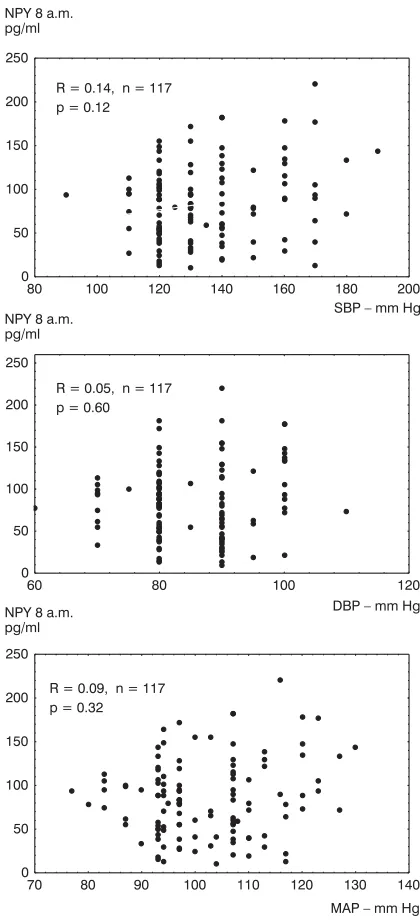
Fig. 2.Correlation between plasma neuropeptide Y concentration at 8 a.m. (NPY) and systolic (SBP), diastolic (DBP), and mean arterial pressure (MAP) in the entire studied group
Ryc. 2.Korelacja międzu stężeniem neuropeptydu Y w osoczu o godz. 8.00 (NPY) i skurczowym (SBP), rozkurczowym (DBP) oraz średnim ciśnieniem tętni− czym krwi (MAP) w całej badanej grupie
0 50 100 150 200 250
80 100 120 140 160 180 200
0 50 100 150 200 250
60 80 100 120
0 50 100 150 200 250
70 80 90 100 110 120 130 140
NPY 8 a.m. pg/ml
SBP – mm Hg
DBP – mm Hg
MAP – mm Hg R = 0.14, n = 117
p = 0.12
R = 0.05, n = 117 p = 0.60
R = 0.09, n = 117 p = 0.32 NPY 8 a.m. pg/ml
jects was lower (36 vs. 117 in the present study), correlation analysis (due to the low number of sub− jects) was not performed, and plasma NPY con− centration was measured only once (three times in one day in our study). In another study, Baranowska et al. showed that a group of elderly females had significantly higher plasma NPY con− centrations than younger females [12]. These results are in line with the results of the current study, in which these observations were extended to both sexes.
The pathogenesis of higher plasma NPY con− centration in elderly subjects remains to be eluci− dated. NPY is a mediator within the sympathetic nervous system [2, 3]. It was documented that progressive sympathetic activation occurs with aging [9, 10]. Therefore it seems very clear that the elevation of plasma NPY concentration in elderly subjects might reflect the increased sympa− thetic activity during aging. Based on the correla− tion analysis performed in this study it was found that in apparently healthy subjects, plasma NPY concentration inversely depended on the calculat− ed GFR. Therefore one may suspect that age−relat− ed deterioration of kidney function may also par− ticipate in the pathogenesis of elevated plasma NPY in elderly subjects.
Patients with chronic kidney disease are char− acterized by elevated plasma NPY levels [13, 14]. Zoccali et al. found in their prospective study that a high plasma NPY concentration is a variable pre− dictor of cardiovascular events in patients with chronic kidney disease (CKD) [15]. Higher plas− ma NPY concentration was found in CKD patients with left ventricular hypertrophy and systolic dys− function [16]. However, the present authors previ− ously showed that plasma NPY concentration did not change significantly in patients after success− ful kidney transplantation [17]. Based on the results obtained in the latter study it seems that the kidney did not play a dominant role in NPY degra− dation and/or elimination. Some experimental and
clinical studies suggest that afferent impulses from impaired kidneys are transported to the hypothala− mus and activate the centers controlling the sym− pathetic nervous system [18, 19]. Converse et al. [20], using microneurographic methods, found increased sympathetic nervous system activity in patients with chronic renal failure. Moreover, Esler et al. [10] found a tendency to higher renal spillover of the sympathetic neurotransmitter nora− drenaline in plasma in elderly subjects. Taking into account the results of these studies one can specu− late that the negative correlation between plasma NPY concentration and calculated GFR might not be due to impaired kidney NPY excretion, but to the stimulation of sympathetic nervous activity by injured kidneys.
A limitation of the present study was that it is only an observational study. It was therefore not possible to follow plasma NPY concentrations in aging individuals.
What is the biological meaning of these find− ings? It is well known that aging is very often accompanied by increased blood pressure [21]. The intravenous administration of NPY causes an increase in blood pressure in both humans [22] and animals [23]. NPY can also cause vasoconstriction by activation of the Y1subtype of NPY receptors
in the central nervous system and postsynaptic receptors in arteries and veins [6]. This peptide can also potentiate the vasoconstricting effects of other vasomediators, such as angiotensin II, noradrena− line, and adenosine tri−phosphate (ATP) [6, 24]. It is thought that NPY plays a role in the pathogene− sis of hypertension [25–27]. Therefore, increased plasma NPY concentration may contribute to blood pressure elevation with aging. However, no significant correlation was found between plasma NPY concentration and blood pressure values in the present study.
The authors concluded that the results obtained in this study suggest that aging in accom− panied by increased plasma NPY concentration.
References
[1] Lamberts SWJ, van den Beld A, van der Lely A:The endocrinology of aging. Science 1997, 278, 419–424.
[2] Tatemoto K: Neuropeptide Y: complete amino acid sequence of the brain peptide. Proc Natl Acad Sci U S A 1982, 79, 5485–5489.
[3] Sundler F, Bottcher G, Ekbald E, Hakanson R:PP, PPY and NPY: Occurrence and distribution in the periphery, In: The biology of neuropeptide Y and related peptides. Eds. Colmers WF, Wahlstead C, Humana Press, Totowa 1993, 1.
[4] Morris MJ, Russell AE, Kapoor V, Cain MD, Elliott JM, West MJ, Wing LM, Chalmers JP:Increases in plas− ma neuropeptide Y concentrations during sympathetic activation in man. J Auton Nerv Syst 1986, 17, 143–149.
[5] Pernow J, Lundberg JM, Kaijser L, Hjemdahl P, Theodorsson−Norheim E, Martinsson A, Pernow B:
Plasma neuropeptide Y−like immunoreactivity and catecholamines during various degrees of sympathetic activa− tion in man. Clin Physiol 1986, 6, 561–578.
[6] Michel MC, Rascher W:Neuropeptide Y: a possible role in hypertension? J Hypertens 1995, 13, 385–395.
[8] Yamada Y, Miyajima E, Tochikubo O, Matsukawa T, Ishii M:Age−related changes in muscle sympathetic nerve activity in essential hypertension. Hypertension 1989, 13, 870–877.
[9] Veith RC, Featherstone JA, Linares OA, Halter JB:Age differences in plasma norepinephrine kinetics in humans. J Gerontl 1986, 41, 319–324.
[10] Esler M, Hastings J, Lambert G, Kaye D, Jennings G, Seals DR:The influence of aging on the human sym− pathetic nervous system and brain norepinephrine turnover. Am J Physiol Integrative Comp Physiol 2002, 282, R909–R916.
[11] Chiodera P, Volpi R, Pilla S, Cataldo S, Coiro V:Decline in circulating neuropeptide levels in normal elderly human subjects. Eur J Endocrinol 2000, 143, 715–716.
[12] Baranowska B, Bik W, Baranowska−Bik A, Wolinska−Witort E, Szybinska A, Martynska L, Chmielowska M: Neuroendocrine control of metabolic homeostasis in polish centenarians. J Physiol Pharmacol 2006, 57, 55–61.
[13] Bald M, Gerigk M, Rascher W:Elevated plasma concentrations of neuropeptide Y in children and adults with chronic and terminal renal failure. Am J Kidney Dis 1997, 30, 23–27.
[14] Hegbrant J, Thysell H, Ekman R:Plasma levels of vasoactive regulatory peptides in patients receiving regular hemodialysis treatment. Scand J Urol Nephrol 1992, 26, 169–176.
[15] Zoccali C, Mallamaci F, Tripepi G, Benedetto FA, Parlongo S, Cutrupi S, Iellamo D, Bonanno G, Rapisarda F, Fatuzzo P, Seminara G, Cataliotti A, Malatino LS: Prospective study of neuropeptide Y as an adverse cardio− vascular risk factor in end−stage renal disease. J Am Soc Nephrol 2003, 14, 2611–2617.
[16] Zoccali C, Mallamaci F, Tripepi G, Benedetto FA, Parlongo S, Cutrupi S, Bonanno G, Rapisarda F, Fatuzzo P, Seminara G, Cataliotti A, Malatino LS: Neuropeptide Y, left ventricular mass and function in patients with end stage renal disease. J Hypertens 2003, 21, 1355–1362.
[17] Adamczak M, Kokot F, Witkowicz J, Więcek A:Plasma neuropeptide Y concentration in kidney transplant patients during the early posttransplant period. Ann Transplant 2004, 37, 72–75.
[18] Campese VM, Kogosov E:Renal afferent denervation prevents hypertension in rats with chronic renal failure. Hypertension 1995, 25, 878–882.
[19] Ye S, Ozgur B, Campese VM:Renal afferent impulses, the posterior hypothalamus, and hypertension in rats with chronic renal failure. Kidney Int 1997, 51, 722–727.
[20] Converse RL, Jacobsen TN, Toto RD, Jost CM, Cosentino F, Fouad−Tarazi F, Victor RG:Sympathetic over− activity in patients with chronic renal failure. N Engl J Med 1992, 327, 1912–1918.
[21] Burt VL, Whelton P, Roccella EJ, Brown C, Cutler JA, Higgins M, Horan MJ, Labarthe D:Prevalence of hypertension in the US adult population. Results from the Third National Health and Nutrition Examination Survey, 1988–1991. Hypertension 1995, 25, 305–313.
[22] Ullman B, Pernow J, Lundberg JM, Astrom H, Bergfeldt L:Cardiovascular effects and cardiopulmonary plas− ma gradients following intravenous infusion of neuropeptide Y in humans: negative dromotropic effect on atri− oventricular node conduction. Clin Sci (Lond) 2002, 103, 535–542.
[23] Zukowska−Grojec Z, Haass M, Bayorh MA:Neuropeptide Y and peptide YY mediate nonadrenergic vasocon− striction and modulate sympathetic responses in rats. Regul Pept 1986, 15, 99–110.
[24] Oberhauser V, Vonend O, Rump LC: Neuropeptide Y inhibits acetylcholine release in human heart atrium by activation of Y2−receptors. J Am Soc Nephrol 1999, 10, 1179–1185.
[25] Wocial B, Ignatowska−Switalska H, Pruszczyk P, Jedrusik P, Januszewicz A, Lapinski M, Januszewicz W, Zukowska−Grojec Z:Plasma neuropeptide Y and catecholamines in women and men with essential hypertension. Blood Press 1995, 4, 143–147.
[26] Halawa B, Salomon P:Concentration of neuropeptide Y in serum of patients with essential hypertension. Pol Arch Med Wewn 1996, 95, 420–426.
[27] Erlinge D, Ekman R, Thulin T, Edvinsson L: Neuropeptide Y−like immunoreactivity and hypertension. J Hypertens 1992, 10, 1221–1225.
Address for correspondence:
Andrzej Więcek
Department of Nephrology, Endocrinology and Metabolic Diseases Medical University of Silesia
Francuska 20/24 40−027 Katowice Poland
Tel.: +48 32 255 26 95
E−mail: [email protected]
Conflict of interest: None declared