Usman Z. Paracha
1, Rehan Z. Paracha
2, Waseem Hassan
1, Ghulam Murtaza
3Examining the Efficacy of Sorafenib – a Meta-Analysis
Ocena skuteczności sorafenibu – metaanaliza
1 Department of Pharmacy, Hajvery University, Lahore, Pakistan
2 Department of Virology, National University of Sciences and Technology, Islamabad, Pakistan
3 Department of Pharmaceutical Science, COMSATS Institute of Information Technology, Abbottabad, Pakistan
Abstract
Objectives. The recently approved drug sorafenib has been found to be effective against renal cell carcinoma and hepatocellular carcinoma. A meta-analysis to examine the extent to which this drug is effective in comparison to a placebo-based therapy regimen was conducted.
Material and Methods. We performed a literature survey and recognized randomized controlled trials that had judged the efficacy of sorafenib in comparison to placebos in preventing renal cell carcinoma or hepatocellular carcinoma. The authors have evaluated the data separately.
Results. This analysis contains data from 3,659 patients. The percentage of patients who responded either com-pletely or partially to a sorafenib-based therapy regimen was 6.5% as compared to 2.2% from a placebo-based therapy regimen (log odds ratio = 0.48, 95% CI = 2.893, –1.933). It has also been found that the mean time for progression free survival (PFS) is 5 months for the sorafenib-based therapy regimen as compared to 2.88 months, which is the mean time for progression free survival with a placebo-based therapy regimen.
Conclusions. It was concluded that a sorafenib-based therapy regimen yields a better response and more time for progression free survival in patients with renal cell carcinoma or hepatocellular carcinoma as compared to a placebo-based therapy regimen (Adv Clin Exp Med 2011, 20, 3, 335–342).
Key words: carcinoma management, placebo, randomized controlled trials, progression free survival.
Streszczenie
Cel pracy. Niedawno zatwierdzony lek sorafenib okazał się skuteczny w leczeniu raka miąższu nerki i raka wątro-bowokomórkowego. Przeprowadzono metaanalizę, aby ocenić zakres skuteczności leku w porównaniu ze schema-tem leczenia opartym na placebo.
Materiał i metody. Autorzy przeprowadzili przegląd literatury i uznanych randomizowanych badań klinicznych, które miały ocenić skuteczność sorafenibu w porównaniu z placebo w zapobieganiu rakowi nerki lub rakowi wątro-bowokomórkowemu. Autorzy dokonali oceny danych oddzielnie.
Wyniki. Analiza zawiera dane 3659 pacjentów. Całkowita liczba pacjentów, u których stwierdzono odpowiedź całkowitą lub częściową na leczenie za pomocą sorafenibu to 6,5% w porównaniu z 2,2% pacjentów, którym poda-wano placebo (logarytm ilorazu szans = 0,48; 95% CI = 2,893; –1,933). Stwierdzono również, że średni czas prze-życia bez progresji choroby (PFS) wynosi 5 miesięcy w grupie leczonej sorafenibem w porównaniu z 2,88 miesiąca średniego czasu przeżycia wolnego od progresji choroby w grupie otrzymującej placebo.
Wnioski. Stwierdzono, że leczenie za pomocą sorafenibu daje lepsze odpowiedzi i dłuższy czas przeżycia bez pro-gresji choroby u pacjentów z rakiem nerki lub rakiem wątroby w porównaniu z podawaniem placebo (Adv Clin Exp Med 2011, 20, 3, 335–342).
Słowa kluczowe: leczenie raka, placebo, randomizowane badania kliniczne, przeżycie bez progresji choroby.
Adv Clin Exp Med 2011, 20, 3, 335–342 ISSN 1230-025X
ORIGINAL PAPERS
© Copyright by Wroclaw Medical University
Sorafenib tosylate (BAY43-9006) was approved by the Food and Drug Administration (FDA) on No-vember 16, 2007 [1]. The development of the drug and testing of the success of sorafenib against cancer took about 11 years. After the approval of sorafenib
against advanced renal cell carcinoma (RCC), it be-came the first new treatment in more than ten years [17]. Moreover, it is also recommended for the treat-ment of unresectable hepatocellular carcinoma [1].
treatment of advanced renal cell carcinoma and unresectable hepatocellular carcinoma [4]. It has two distinct aspects of inhibition as it is not only an inhibitor of Raf but also causes inhibition of vascular endothelial growth factor receptor (VEG-FR). It has shown preclinical anti-cancer effects against a wide range of human cancers [5]. The Raf is a form of protein which is of prime importance as an effector of the Ras, which is a small GTPase protein which sends activating signals from growth factors to Raf and from there to mitogen-activated protein kinase (MAPK). There are three structur-ally protected serine-threonine kinases i.e. A-Raf, B-Raf and C-Raf (Raf-1) [4]. Sorafenib was found to work well in a dose of 400 mg twice daily [6].
RCC is considered as the 14th most common
form of cancer throughout the world [7]. It has been found that of all new cancer cases, 2% belong to RCC [8]. More than 20% of the cases of RCC are either cigarette smokers or obese people [9].
The drug-related adverse effects were mild to moderate in sorafenib treatment, comprising diar-rhea, fatigue and skin toxicities in phase I studies [6, 10]. Rashes, fatigue, diarrhea and hand-foot syn-drome were found as the most common side effects observed in phase II trials [11]. Work is ongoing in reducing skin toxicity caused by sorafenib [3].
The objective of this study was to illustrate and compare the efficacy of sorafenib in comparison to a placebo from seven different studies.
Material and Methods
Searching
We did search on Pubmedcentral.com, high-wire.stanford.edu, sciencedirect.com and scholar. google.com (1990–2009) using the search terms “Sorafenib”, “Sorafenib and Placebo”, “Sorafenib versus Placebo”, “Sorafenib and randomized con-trolled trial” and “Sorafenib and renal cell carci-noma” studying humans and clinical trials.
Selection
For this meta-analysis, only randomized con-trolled trials that showed the efficacy of sorafenib as a first-line therapy for RCC either alone or in com-bination with other chemotherapeutic agents were studied. As we did not have direct contact with the patients, we checked the median age of the patients and included studies only on subjects above 50 years of age. Only articles in English were included.
Validity Assessment
Outcome data was extracted separately.
Data Abstraction
In order to prevent bias in the collection pro-cess of data, two observers separately checked out the trials and examined the similarities and differ-ences among the results. The following informa-tion was taken from each of the selected articles: number of randomly assigned patients, percent-age of male patients, median percent-age of the patients, therapy regimen and median progression free sur-vival. Dacarbazine was used in the trial McDer-mott et al. [12] as a combination therapy regimen with sorafenib and placebo whereas Paclitaxel and Carboplatin were taken as a combination therapy regimen in the trial of Aggarwala et al. [13].
The data separately taken was examined for coherence and differences were resolved by mu-tual conversation. For evaluation of the responses, the only trials used contained measurable infor-mation about the disease of the patients and were examined with well-accepted criteria.
For the analysis of the data and construction of the graphs, Microsoft Excel version 2007 and the “mult-compare” function of Matlab R2007a were used.
Study Characteristics
Quantitative Data Synthesis
In this study, we calculated log odds ratios (i)
from odds ratios (ORs) by using 2 × 2 tables for the number of responding patients from the ab-stracted data. Variances of the log odds ratios for the subjects who received a sorafenib-based therapy regimen relative to that of a placebo-based therapy regimen were calculated from the tables. Moreover, inverse of the variance, standard error for the log odds ratio and 95% confidence interval (CI) for the log odds ratio were also calculated from the tables. The line at “0” is the unity line and a value above “0” shows that a sorafenib-based therapy regimen is better than a placebo-based therapy regimen.
A hazard ratio (HR) was assessed for the pro-gression free survival (PFS) of the sorafenib-based therapy regimen as compared with the placebo-based therapy regimen. An HR value above the unity line shows that the sorafenib-based therapy regimen is better than a placebo-based therapy regimen. Heterogenity was calculated.
Results
Trial Flow
Study Characteristics
The important characteristics of the seven trials are presented in Table 1. Of the total 3,659 patients, 1851 patients were randomly assigned to sorafenib-based chemotherapy whereas 1808 pa-tients were randomly assigned to placebo-based therapy/chemotherapy.
From these trials, six trials [9, 13–17] are ran-domized trials from phase III whereas one trial [12] was a randomized trial from phase II. These trials were placebo-controlled trials. Furthermore, two trials [12, 13]) contained mixed drug therapy with sorafenib on one arm and placebo on the other arm.
Quantitative Data Synthesis
Number of Responding Patients
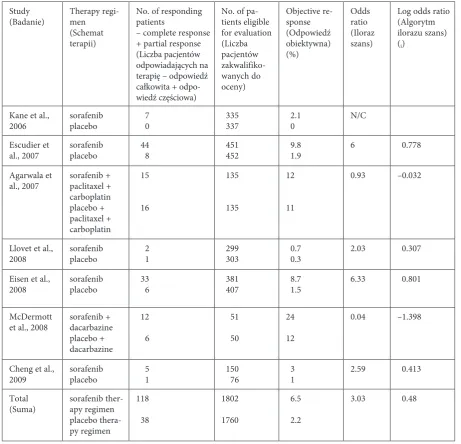
The number of responding patients calculated by the sum of complete responses and partial re-sponses was available in all the trials. The total number of responding patients to a sorafenib-based therapy regimen to that of a placebo-sorafenib-based
therapy regimen was significantly greater. 6.5% of the patients responded to the sorafenib-based ther-apy regimen and 2.2% responded to the placebo-based therapy regimen (log odds ratio = 0.48, 95% CI = 2.893, –1.933). The fixed-effects estimate show a log odds ratio of 0.193 (95% CI = 0.597, –0.211). From Table 5, the Q-statistic is somewhat significant (p = 0.02) showing some heterogeneity amongst the studies but the overall assessment of the treatment difference shows a salutary effect of the sorafenib therapy regimen (= 0.193) and the U-statistic is not significant (p = 0.350). The significant value of the Q-statistic may have arisen due to the trials contain-ing different types of sorafenib-based therapy regi-mens and placebo-based therapy regiregi-mens.
In the graph of “log odds ratio of sorafenib therapy regimen relative to placebo therapy regi-men”, the trial of McDermott et al. [12] shows a difference only from the trials of Escudier et al. [15] and Eisen et al. [9] and the fixed effects estimate and does not show any difference from other studies. The remaining trials were similar to each other.
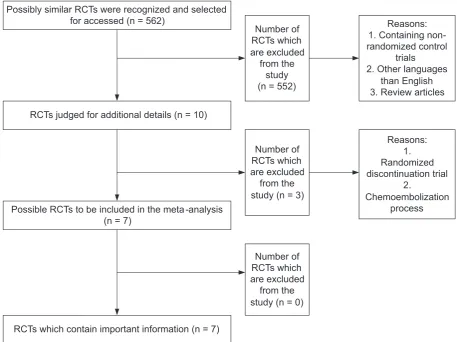
Fig. 1. A QUOROM statement flow diagram presenting the progress of trials through the review. RCT – randomized controlled trials
Ryc. 1. Algorytm QUOROM przedstawiający postęp badań w ramach przeglądu. RCT – randomizowane badania kliniczne
Possibly similar RCTs were recognized and selected for accessed (n = 562)
RCTs judged for additional details (n = 10)
Possible RCTs to be included in the meta-analysis (n = 7)
RCTs which contain important information (n = 7)
Number of RCTs which are excluded
from the study (n = 552)
Reasons: 1. Containing non-randomized control
trials
2. Other languages than English 3. Review articles
Number of RCTs which are excluded
from the study (n = 3)
Reasons: 1. Randomized discontinuation trial
2.
Chemoembolization process
Number of RCTs which are excluded
Progression Free Survival
From Table 2, it is clear that progression free survival (PFS) for patients with a sorafenib-based therapy regimen was longer than with patients with a placebo-based therapy regimen. Mean time
for PFS in a sorafenib-based therapy regimen was 5 months as compared with a placebo-based ther-apy regimen which was 2.88 months. Moreover, its graph on hazard ratio shows no significant differ-ence among the different trials.
Table 1. Characteristics of trials of sorafenib vs. placebo
Tabela 1. Charakterystyka badań sorafenibu w porównaniu z placebo Study
(Badanie) No. of randomly assigned patients (Liczba wylosowa-nych pacjentów)
Therapy regimen
(Schemat terapii) Male (Płeć) (%)
Median age of the patients (Średni wiek pacjenta)
Kane et al., 2006 384
385 sorafenibplacebo 72 < 65 (67%) < 65 (73%) Escudier et al., 2007 451
452 sorafenibplacebo 72.5 5859 Agarwala et al., 2007 135
135 sorafenib + paclitaxel + carboplatinplacebo + paclitaxel + carboplatin 63 57 Llovet et al., 2008 299
303 sorafenibplacebo 87 64.9 ± 11.266.3 ± 10.2 Eisen et al., 2008 381
407 sorafenibplacebo 73.1 5758 McDermott et al., 2008 51
50 sorafenib + dacarbazineplacebo + dacarbazine 70 5560 Cheng et al., 2009 150
76 sorafenibplacebo 85.4 51 (23–86)52 (25–79)
Table 2. Progression free survival data in the trials of sorafenib vs. placebo
Tabela 2. Dane na temat czasu wolnego od progresji choroby w badaniach sorafenibu w porównaniu z placebo Study
(Badanie) Therapy regimen (Schemat terapii) Median progression free survival (Średni czas wolny od rozwoju choroby) time in months HR (95% CI) P Kane et al., 2006 sorafenib
placebo 5.62.8 0.44 (0.35–0.55) < 0.000001 Escudier et al., 2007 sorafenib
placebo 5.52.8 0.51 (0.43–0.60) < 0.001 Agarwala et al., 2007 sorafenib + paclitaxel + carboplatin
placebo + paclitaxel + carboplatin 4.354.48 0.906 (N/A) 0.492 Llovet et al., 2008 sorafenib
placebo 5.52.8 0.58 (0.45–0.74) < 0.001 Eisen et al., 2008 sorafenib
placebo 5.982.98 0.55 (0.47–0.66) N/A McDermott et al., 2008 sorafenib + dacarbazine
placebo + dacarbazine 5.282.9 0.665 (0.42–1.03) 0.068 Cheng et al., 2009 sorafenib
Fig. 2. Hazard ratio of medi-an PFS along with
95% CI
Ryc. 2. Ryzyko względne mediany PFS wraz z 95% CI
Table 3. Responses in the trials comparing sorafenib vs. placebo therapy regimen
Tabela 3. Odpowiedzi w badaniach sorafenibu w porównaniu z placebo Study
(Badanie) Therapy regi-men (Schemat terapii)
No. of responding patients
– complete response + partial response (Liczba pacjentów odpowiadających na terapię – odpowiedź całkowita + odpo-wiedź częściowa)
No. of pa-tients eligible for evaluation (Liczba pacjentów zakwalifiko-wanych do oceny)
Objective re-sponse (Odpowiedź obiektywna) (%)
Odds ratio (Iloraz szans)
Log odds ratio (Algorytm ilorazu szans) (i)
Kane et al.,
2006 sorafenibplacebo 7 0 335 337 2.1 0 N/C Escudier et
al., 2007 sorafenibplacebo 44 8 451 452 9.8 1.9 6 0.778 Agarwala et
al., 2007 sorafenib + paclitaxel + carboplatin placebo + paclitaxel + carboplatin
15
16
135
135
12
11
0.93 –0.032
Llovet et al.,
2008 sorafenibplacebo 2 1 299 303 0.7 0.3 2.03 0.307
Eisen et al.,
2008 sorafenibplacebo 33 6 381 407 8.7 1.5 6.33 0.801
McDermott
et al., 2008 sorafenib + dacarbazine placebo + dacarbazine
12
6
51
50
24
12
0.04 –1.398
Cheng et al.,
2009 sorafenibplacebo 5 1 150 76 3 1 2.59 0.413 Total
(Suma) sorafenib ther-apy regimen placebo thera-py regimen
118
38
1802
1760
6.5
2.2
Table 4. 95% CI for log odds ratio
Tabela 4. 95% CI dla logarytmu ilorazu szans
i Var i wi (=1/ var i) se (i) (=) 95% CI (= i±1.96/)
Escudier et al., 2007 0.778 0.152 6.58 0.389 1.54, 0.016
Agarwala et al., 2007 –0.032 0.144 6.94 0.378 0.712, –0.776 Llovet et al., 2008 0.307 1.506 0.66 1.227 2.722, –2.106 Eisen et al., 2008 0.801 0.202 4.95 0.449 1.684, –0.082 McDermott et al., 2008 –1.398 0.29 3.45 0.535 –0.345, –2.451 Cheng et al., 2009 0.413 1.22 0.82 1.104 2.578, –1.752 Total
(Suma) 0.48 0.036 27.78 0.19 2.893, –1.933
Table 5. Fixed effects meta-analysis of the log-odds ratio of sorafenib therapy regimen relative to placebo therapy regimen
Tabela 5. Model z efektem stałym metaanalizy logarytmu ilorazu szans w badaniach sorafenibu w porównaniu z placebo Study
(Badanie) Therapy regimen (Schemat terapii)
No. of responding patients – complete re-sponse + partial rere-sponse (Liczba pacjentów odpowiadających na terapię – odpowiedź całkowita + odpowiedź częściowa)
No. of patients eli-gible for evaluation (Liczba pacjentów zakwalifikowanych do oceny)
i wi (=1/
var i)
i wi i2 wi
Escudier et
al., 2007 sorafenibplacebo 44 8 451452 0.778 6.579 5.12 3.98
Agarwala et
al., 2007 sorafenib + paclitaxel + carboplatin placebo + paclitaxel + carboplatin
15
16
135
135
–0.032 6.99 –.224 0.01
Llovet et al.,
2008 sorafenibplacebo 2 1 299303 0.307 0.664 0.204 0.06 Eisen et al.,
2008 sorafenibplacebo 33 6 381407 0.801 4.95 3.96 3.18 McDermott
et al., 2008 sorafenib + dacarbazine placebo + dacarbazine
12
6
51
50
–1.398 3.49 –4.88 6.82
Cheng et al.,
2009 sorafenibplacebo 51 15076 0.413 0.82 0.34 0.14 Overall
(Suma) 23.493 4.523 14.189
U (Model sum of squares) = (4.523)2/23.493 = 0.871; (1df) p = 0.350.
Discussion
In this meta-analytic review, we demonstrated the efficacy of sorafenib against cancer in random-ized controlled trials. In these trials, we have found a significant response and progression free sur-vival in the patients of a sorafenib-based therapy regimen.
Like all meta-analyses, this meta-analysis does have some technical limitations. The authors are not able to design this review according to indi-vidual patients and so the information is based on abstracted data. It is suggested that further studies must be done on individual patient data (IPD) as this will show better results. Moreover, in each of the trials, overall survival rate was not mentioned
which could not be written in this review. Hetero-geneity among trials can be a limitation notwith-standing that heterogeneity was taken into account for this study.
Considering all the results, it has been con-cluded that sorafenib (alone or in combination with certain other anti-cancer agents) is an effec-tive new medicine for the treatment of hepatocel-lular carcinoma. Further assessment and analysis is needed in hepatocellular carcinoma as well as in the issue regarding treatment of other forms of cancer using a sorafenib-based therapy regimen, desirably in combination with other chemothera-peutic agents, so that more data will be available for proper treatment.
Fig. 3. Log odds ratio of sorafenib therapy regimen relative to placebo therapy regimen
Ryc. 3. Logarytm ilorazu szans w badaniach sorafenibu w porów-naniu z placebo
Acknowledgement. We wish to thank Dr. G. A. Miana, Rector and Director, Riphah Institute of Pharmaceutical Sciences (RIPS), Islamabad, Rizwan Nasir Paracha, PhD, scholar in Chemistry, Auckland University and Dr. Zahid Iqbal, Assistant Professor, RIPS, Islamabad, for their help in collecting the data. We also wish to thank Mr. Asif Iqbal Paracha, MS Scholar in Computer Science, Muhammad Ali Jinnah University, Islamabad, for his support in data man-agement of the trials.
References
[1] Kane RC, Farrell AT, Madabushi R, Booth B, Chattopadhyay S, Sridhara R: Sorafenib for the treatment of Unresectable Hepatocellular Carcinoma. Oncologist 2009, 14, 95–100.
[2] Wilhelm S, Carter C, Lynch M, Lowinger T, Dumas J, Smith RA: Discovery and development of sorafenib: A multikinase inhibitor for treating cancer. Nat Rev Drug Discov 2006, 5, 835–845.
[3] Bracarda S, Caserta C, Sordini L, Rossi M, Hamzay A, Crino L: Protein kinase inhibitors in the treatment of renal cell carcinoma: sorafenib. Ann Oncol 2007, vi22–vi25.
[4] Ma WW, Adjei AA: Novel agents on the Horizon for Cancer Therapy. CA Cancer J Clin 2009, 59, 111–137.
[5] Wilhelm S, Carter C, Tang LE: BAY43-9006 exhibits broad spectrum oral antitumor activity and targets the RAF/ MEK/ERK pathway and receptor tyrosine kinases involved in tumor pregression and angiogenesis. Cancer Res 2004, 64, 7099–7109.
[6] Strumberg D, Clark JW, Awada A, Moore MJ, Richly H, Hendlisz A: Safety, Pharmacokinetics, and Preliminary Antitumor Activity of sorafenib: A review of four phase I trials in patients with advanced refractory solid tumors. Oncologist 2007, 12, 426–437.
[7] Scelo G, Brennan P: The epidemiology of bladder and kidney cancer. Clin Pract Urol 2007, 4, 205–217.
[9] Eisen T, Oudard S, Szczylik C, Gravis G, Heinzer H, Middleton R.: Sorafenib for older patients with renal cell carcinoma: Subset analysis from a randomized trial. J Natl Cancer Inst 2008, 100 (20), 1454–1463.
[10] Strumberg D, Richly H, Hilger RA: Phase I clinical and pharmacokinetic study of the Novel Raf kinase and vas-cular endothelial growth factor receptor inhibitor BAY 43-9006 in patients with advanced refractory solid tumors. J Clin Oncol 2005, 23, 965–972.
[11] Abou Alfa GK, Schwartz L, Ricci, SE: Phase II study of sorafenib in patients with advanced hepatocellular carci-noma. J Clin Oncol 2006, 24, 4293–4300.
[12] McDermott DF, Sosman JA, Gonzalez R, Hodi FS, Linette GP, Richards J: Double-Blind Randomized Phase II Study of the combination of sorafenib and dacarbazine in patients with advanced melanoma: A report from the 11715 study group. J Clin Oncol 2008, 26 (13), 2178–2185.
[13] Agarwala SS, Keil Holz U, Hogg D, Robert C, Hersey P, Eggermont A: Randomized phase III study of paclitaxel plus carboplatin with or without sorafenib as second-line treatment in patients with advanced melanoma. J Clin Oncol 2007, 25 8510.
[14] Cheng A, Kang Y, Chen Z, Tsao C, Qin S, Kim J: Effi cacy and safety of sorafenib in patients in the Asia-Pacific region with advanced hepatocellular carcinoma: a phase III randomised, double-blind,placebo-controlled trial. Lancet Oncol 2009, 10, 25–34.
[15] Escudier B, Eisen T, Stadler WM, Szczylik C, Oudard S, Siebels M: Sorafenib in advanced clear cell renal cell carcinoma. N Engl J Med 2007, 356 (2), 125–134.
[16] Llovet JM, Ricci S, Mazzaferro V, Hilgard P, Gane E, Blanc JF: Sorafenib in Advanced Hepatocellular Carcinoma. N Engl J Med 2008, 378–390.
[17] Kane RC, Farrell AT, Saber H, Tang S, Williams G, Jee JM: Sorafenib for the treatment of advanced renal cell carcinoma. Clin Cancer Res 2006, 12 (24), 7271–7278.
Address for correspondence:
Ghulan Murtaza
Department of Pharmaceutical Science
COMSATS Institute of Information Technology Abbottabad
Pakistan
Tel.: 92 314 208 28 26
E-mail: [email protected]
Conflict of interest: None declared