Ayten Saracoglu
1, Kemal T. Saracoglu
1, Tumay Umuroglu
2, Abdulkadir But
1The Effectivity of Fentanyl Versus Tramadol
as Intravenous Patient-Controlled Analgesia
After Cesarean Section*
Skuteczność fentanylu i tramadolu jako dożylnego znieczulenia
kontrolowanego przez pacjentkę po cięciu cesarskim
1 Division of Pain Medicine, Department of Anesthesiology, Central Education and Research Hospital, Erzurum,
Turkey
2 Division of Pain Medicine, Department of Anesthesiology, Medical School of Marmara University, Istanbul,
Turkey
Abstract
Background. Patient-controlled analgesia (PCA) is the most widely used treatment method for post-cesarean sec-tion pain.
Objectives. To compare two different opioids with respect to analgesic quality and side effects.
Material and Methods. Sixty patients undergoing electivecesarean surgery were enrolled into two groups. Group F (n = 30) had postoperative IV PCA with fentanyl and Group T (n = 30) had IV PCA with tramadol. Postoperative pain scores, opioid requirements, side effects and patient satisfaction were compared.
Results. The patient demographics were similar in both groups. Group F patients consumed 638.4 ± 179 µg of
fentanyl, and Group T patients consumed 559.5 ± 207 mg of tramadol. The number of patients requiring additional opioid was similar in both groups. Patient satisfaction did not differ in the two groups.
Conclusions. Both fentanyl and tramadol provide sufficient postoperative analgesia and patient satisfaction when used in PCA (Adv Clin Exp Med 2010, 19, 6, 739–743).
Key words: analgesia, patient-controlled; postoperative pain, cesarean section, fentanyl, tramadol.
Streszczenie
Wprowadzenie. Leczenie bólu kontrolowane przez pacjenta (PCA) jest najczęściej stosowaną metodą leczenia bólu po cesarskim cięciu.
Cel pracy. Porównanie dwóch różnych opioidów w odniesieniu do działania przeciwbólowego i działań niepożą-danych.
Materiał i metody. Sześćdziesiąt pacjentek poddanych planowemu cięciu cesarskiemu zakwalifikowano do dwóch grup. W grupie F (n = 30) zastosowano dożylne znieczulenie kontrolowane przez pacjentkę (PCA) fentanylem pooperacyjnie i w grupie T (n = 30) dożylne PCA tramadolem. Porównano ocenę bólu pooperacyjnego, wymagania opioidów, skutki uboczne i zadowolenie pacjentek.
Wyniki. Wskaźniki demograficzne pacjentek były podobne w obu grupach. Grupa F otrzymała 638,4 ± 179 µg fen-tanylu, a grupa T 559,5 ± 207 mg tramadolu. Liczba pacjentek wymagających dodatkowych opioidów była podobna w obu grupach. Satysfakcja pacjentek nie różniła się w obu grupach.
Wnioski. Zarówno fentanyl, jak i tramadol użyty w PCA daje wystarczające znieczulenie pooperacyjne i zadowo-lenie matek (Adv Clin Exp Med 2010, 19, 6, 739–743).
Słowa kluczowe: znieczulenie kontrolowane przez pacjenta, ból pooperacyjny, cięcie cesarskie, fentanyl, tramadol.
Adv Clin Exp Med 2010, 19, 6, 739–743
ISSN 1230-025X
oRIGINAL PAPERS
© Copyright by Wroclaw Medical University
Patient-controlled analgesia (PCA) is widely used for postoperative pain management [1]. As Prakash et al. wrote: “PCA allows patients to self-administersmall predetermined doses of analgesic medication within limitsprescribed by their phy-sician, resulting in improved painrelief, avoidance of over- and undermedication, and greaterpatient satisfaction” [2]. Fentanyl, as a potent opioid, is commonly used to prevent postoperative pain. Traditionally, fentanyl is administered via the oral, IV or transdermal routes. As Roussier et al. noted: “Fentanyl is frequently preferred because of its high lipid solubility resultingin rapid onset of analgesia, a low incidence of side-effectsand a low risk of delayed respiratory depression” [3]. our goal in this prospective, double blind, randomized study was to compare postoperative pain scores and analgesic requirements for both kinds of opi-oidsin patients following cesarean section, and we found that pain scores and opioid consumption levels were similar. Effectiveness was evaluated by comparing postoperative analgesic needs and side effects.
Material and Methods
The study protocol was approved by the re-gional ethics committee. After providing written informed consent for this randomized, prospec-tive, double-blind study, 60 patients undergoing electivecesarean surgery for pregnancy were en-rolled. Exclusion criteria included patient refusal to join the study, allergy to opioids, a history of chronic pain, an American Society of Anesthesi-ologists(ASA) physical status grade more than 3, inability to understand how to usethe PCA device, age less than 18 years, and extreme obesity (body mass index > 40). All surgical procedures were per-formed byone of three surgeons. The anesthetists that collect the data were not aware of the patient groups. Patients were monitored by finger pulse oximetry, electrocardiogram and non-invasive blood pressuremonitoring in the operating room. The patients were randomly assigned to receive eitherintravenous fentanyl (Group F, n = 30) or tramadol (Group T, n = 30) by PCA. The patients were randomly allocated according to a computer-generatedrandomization list. All the patients were premedicated with atropin 0.01 mg kg–1 im 45
mi-nutes before the surgical procedure. The use of the PCA system and a standard visual analogue scale (VAS) forpain was explained to the patients the day before the operation; in the VAS, 0 would me-an “no pain” me-and 100 would meme-an “worst possible pain imaginable”. General anesthesia was induced by propofol 2 mg kg–1 and atracurium 0.4 mg kg–1.
The patients’ lungs were mechanically ventilated and ventilation was adjusted to maintain end-expiratoryCo2 between 32–36 mm Hg. Afterthe
baby was born, anesthesia was maintained by se-vofluranewith an end-tidal concentration of 1.5% in oxygen–nitrous oxide(FIo2 = 0.5). Isotonic
sali-newas used for intraoperative fluid maintenance. Postoperatively, patientsin Group F received an initial dose of 1 µg kg–1 fentanyl IV. For the
PCA, 1 mg of fentanyl was diluted in 100 ml of isotonicsaline.The PCA boluses were 20 mcg, and the lockout interval was 8 minutes without an in-fusion rate. Patients in Group T received 1 mg kg–1
tramadol as an initial dose, and 1 g of tramadol was diluted in 100 ml of isotonic saline for the PCA device. The demand dose was 20 mg; the lockout interval was 8 minutes without basal infusion. The patients began to receive analgesic medication via PCA immediately after the initial doses.
For 24 hours following the surgery, pain scores were recorded using the VAS at rest and after cou-ghing. The intensity of pain was assessed at 0, 1, 2, 4, 8, 12 and 24 hours by the 100-point VAS, and the pain scores were recorded. If the VAS score was more than 30, the physicianin charge could give a 2-cc bolus via PCA without changing the bolusdose and lockout interval. The time interval to the first analgesia requirement was recorded, as were side effects like pruritus,nausea and vomi-ting: 0 = no episode; 1 = at least one episode.The level of sedation was assessed by the Ramsey scale (1 = anxious, agitated, restless; 2 = cooperative, oriented, tranquil; 3 = responds to comments on-ly; 4 = brisk response to light glabellar tap or loud noise; 5 = sluggish response to light glabellar tap or loud noise; 6 = no response).
Nausea and vomiting were treated with me-toclopramide 10 mg IV. Pruritus was treated with diphenhydramine 25 mg IV. All patients were gi-ven a questionnaire at the end of the 24th hour, asking if they would accept the same anesthetic procedure and the same analgesic method in the future. The answers and the related reasons were noted and accepted as the criteria for satisfaction. All the patients were interviewed about their level of satisfaction by a blinded interviewer.
The Statistical Package for Social Sciences (SPSS) for Windows 10.0 program was used for statistical analysis. Group size was selected by us-ing proportionssample size estimates (ά: 0.05, β: 0.09). Values were expressed as mean ± SD. The paired t-test was used for comparisons between groups with normal distribution parameters, and the unpaired t-test was used for abnormally dis-tributed parameters. Qualitative data were com-pared by using the c² test (p < 0.05). A p-value <
Results
All 60 patients who were enrolled in the study were included in the analyses. The patients’ ages, weights, heights, ASA physical status and oper-ating room time were similar in the two groups (Table 1). There were no major anesthetic or sur-gical complications. In Group F, 76% of the partu-rients were ASA1 and 24% were ASA2; in Group T 80% of parturients were ASA1 and 20% of them were ASA2 (Table 1). Group F patients consumed 638.4 ± 179.10 mcg fentanyl and Group T patients consumed 559.5 ± 207.04 mg tramadol (Table 2) (p > 0.05); 44 ± 26.471 mcg additional fentanyl
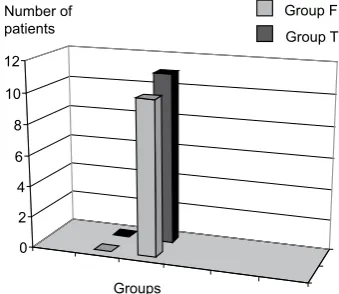
and 62.6 ± 32.688 mg additional tramadol was re-quired (Table 2). The number of patients requiring opioids in the first 24 hours was similar in both groups. In Group F, 24 patients (80%) required ad-ditional opioid; in Group T, 22 patients (86%) re-ceived an additional opioid bolus dose (Figure 1). Postoperative pain was compared at 1, 2, 4, 8, 12 and 24 hours after surgery. There was no significant difference between the two groups’ pain scores in the postoperative period (Table 3). Postoperative nausea and vomiting scores were similar in both groups (p > 0.05). Antiemetics were necessary for 10 patients in Group F and 11 in Group T (Fig-ure 2). The time to the first analgesic requirement was also significantly shorter for the general anes-thesia group as compared with spinal anesanes-thesia (p < 0.05).All patients received paracetamol 1 g IV
Table 1. Patients’ demographics and duration of surgery (Values are mean)
Tabela 1. Dane demograficzne pacjentów oraz czas trwania operacji (wartości średnie)
Group F
(Grupa F) Group T (Grupa T)
Age – years
(Wiek – lata) 26.32 ± 8.69 28.06 ± 11.47
Weight – kg
(Masa ciała – kg) 73.58 ± 10.42 74.96 ± 10.21
Height – cm
(Wzrost – cm) 65 ± 10.02 64 ± 18.38
Duration of surgery – min
(Czas operacji – min) 124.87 ± 58.16 121.25 ± 38.27
ASA 76%
ASA1, 24% ASA2
80% ASA1, 20% ASA2 Group F (n = 30): Fentanyl PCA group. Group T (n = 30): Tramadol PCA group.
Grupa F (n = 30): PCA fentanylem. Grupa T (n = 30): PCA tramadolem.
Fig. 1. Additional opioid consumption of groups (%). Group F (n = 30): Fentanyl PCA group. Group T (n = 30): Tramadol PCA group. P > 0.05
Ryc. 1. Dodatkowe spożycie opioidów w grupach – %. Grupa F (n = 30): PCA fentanylem. Grupa T (n = 30): PCA tramadolem. P > 0,05
0 20 40 60 80 100
Percentage
Groups
Group F Group T
Table 2. opioid consumption values of groups (Values are mean)
Tabela 2. Spożycie opioidów w grupach (wartości średnie) Group F – µg
(Grupa F) Group T – mg (Grupa T)
Total opioid con-sumption
(Całkowita ilość po-danych opioidów)
638.4 ± 179.10 559.5 ± 207.04
Additional opioid consumption (Dodatkowa ilość podanych opioidów)
44 ± 26.471 62.6 ± 32.688
Group F (n = 30): Fentanyl PCA group. Group T (n = 30): Tramadol PCA group.
Grupa F (n = 30): PCA fentanylem. Grupa T (n = 30): PCA tramadolem.
Fig. 2. Antiemetic drug requirements of groups. Group F (n = 30): Fentanyl PCA group. Group T (n = 30): Tramadol PCA group. P > 0.05
Ryc. 2. Zapotrzebowanie na leki przeciwwymiotne w grupach. Grupa F (n = 30): PCA fentanylem. Grupa T (n = 30): PCA tramadolem. P > 0,05
0 2 4 6 8 10 12 Number of patients
Groups
postoperatively every six hours as a prophylactic analgesic. Two patients from Group F and three patients from Group T stated that they would not accept the same analgesic procedure in the future, because of incidences of nausea and vomiting.
Discussion
As Karamanlıoğlu et al. wrote: “IV PCA is effective for individual pain relief in the postop-erativeperiod. Is generallywell tolerated, the most common adverse events being nauseaand vomit-ing” [13]. Several opioids or local anesthetics are used for PCA. Morphine, meperidine, fentanyl, tramadol or remifentanyl are the most preferred opioids [5–7]. In the 1998 study by Baraka et al., tramadol was “associated with a high incidence of intraoperative maternal recall [and] lower umbili-cal vein Po2 and higher PCo2” than fentanyl [8], but in that study the opioids were given preopera-tively, as preemptive analgesia. Preemptive analge-sia is a recommended technique for postoperative pain treatment [9], but there is always a potential risk of respiratory depression for the newborns when parturients receive opioids as a preemptive analgesic agent. For this reason, the authors of the current study did not use opioids in the preopera-tive period.
Postoperative treatment of acute pain by multi-modal analgesia is an effective method [10]. In this method, nonsteroidal anti-inflammatory drugs or paracetamol reduce the consumption of opioids [11]. As Karamanlioglu et al. pointed out, “Reu-ben and Connelly [12] demonstrated significant opioid-sparingeffects with celecoxib and rofecoxib when used in conjunctionwith PCA morphine af-ter spinal fusion surgery” and they themselves ob-served “a significant analgesic benefit with regard to postoperative pain relief and a decrease in opi-oid requirementafter thyroid surgery” using the same procedure [13]. The authors of the current study gave paracetamol 1 g to all patients 4 times a day. The first dose was given before the surgical process ended. This provided both preemptive an-algesia and multimodal anan-algesia at the same time. In the current study, there were no differences in adverse effects in the two groupsduring the first 24 postoperative hours.
Sudheer et al. compared the analgesic efficacy and side effects of tramadol with morphine after craniotomies, and reported: “Morphine produced significantly better analgesia than tramadol at all time points” [14]. The analgesic effect of morphine is of long duration, so it is a better choice for major cranial operations. While cesarean section is not a minor type of surgery it was the authors’ assess-ment that both tramadol or fentanyl provided suf-ficient analgesia and the doses used via PCA were not overdoses. This also limited the incidence of side effects.
other studieshave demonstrated that trama-dol is as effective as morphine for PCA pain con-trol after major surgery [15, 16]. In another study, researchers demonstrated that tramadol can also be used as an additional agent with other opioids, with better results than in single opioid usage [17]. PCA Fentanyl has also been found to be safe and effi-cient for postoperative analgesia for children [18].
The present study comparing fentanyl with tramadol did not find a significant difference in postoperative pain scores. The pain scores and PCA opioid consumption duringthe first 24 hours after surgery in patients who had undergone ce-sarean section were similar. Further studies can be performed with different types of opioids by IV, epidural or transdermal PCA.
Table 3. Postoperative VAS scores of groups (values are mean)
Tabela 3. Pooperacyjne ocena VAS dwóch grup (wartości średnie)
Hours
(Godziny) Group F(Grupa F) Group T(Grupa T)
0 1 2 4 8 12 24
50 ± 15.3 31.6 ± 14.8 20.3 ± 16.5 19 ± 10.2 24 ± 13.5 28 ± 15.8 15.3 ± 7.7
52.6 ± 10.48 36.6 ± 15.3 28.6 ± 14.07 22 ± 13.2 20.6 ± 11.7 22.6 ± 10.1 11.3 ± 10.0 Group F (n = 30): Fentanyl PCA group. Group T (n = 30): Tramadol PCA group. P > 0.05.
Grupa F (n = 30): PCA fentanylem. Grupa T (n = 30): PCA tramadolem. P > 0,05.
References
[1] Mota FA, Marcolan JF, Pereira MH, Milanez AM, Dallan LA, Diccini S: Comparison study of two different patient-controlled anesthesia regiments after cardiac surgery. Rev Bras Cir Cardiovasc 2010, 25, 38–44.
[2] Prakash S, Fatima T, Pawar M: Patient-Controlled Analgesia with Fentanyl for Burn Dressing Changes. Anesth Analg 2004, 99, 552–555.
[4] Chazan S, Buda I, Nesher N, Paz J, Weinbroum AA: Low-Dose Ketamine via Intravenous Patient-Controlled Analgesia Device After Various Transthoracic Procedures Improves Analgesia and Patient and Family Satisfaction. Pain Manag Nurs 2010, 11, 169–176.
[5] Ko JS, Choi SJ, Gwak MS, Kim GS, Ahn HJ, Kim JA, Hahm TS: Intrathecal morphine combined with intrave-nous patient-controlled analgesia is an effective and safe method for immediate postoperative pain control in live liver donors. Liver Transpl 2009, 15, 381–389.
[6] Baltali S, Turkoz A, Bozdogan N, Demirturk OS, Baltali M, Turkoz R, Arslan G: The efficacy of intravenous patient-controlled remifentanil versus morphine anesthesia after coronary artery surgery. J Cardiothorac Vasc Anesth 2009, 23, 170–174.
[7] De Cosmo G, Congedo E, Lai C, Primieri P, Dottarelli A, Aceto P: Preoperative psychologic and demographic predictors of pain perception and tramadol consumption using intravenous patient-controlled analgesia. Clin J Pain 2008, 24, 399–405.
[8] Baraka A, Siddik S, Assaf B: Supplementation of general anaesthesia with tramadol or fentanyl in parturients undergoing elective caesarean section. Can J Anaesth 1998, 45, 631–634.
[9] Fleckenstein J, Kramer S, Offenbächer M, Schober G, Plischke H, Siebeck M, Mussack T, Hatz R, Lehmeyer L, Lang PM, Heindl B, Conzen P, Irnich D: Etoricoxib – preemptive and postoperative analgesia (EPPA) in patients with laparotomy or thoracotomy – design and protocols. Trials 2010, 27, 11–66.
[10] Savoia G, Alampi D, Amantea B, Ambrosio F, Arcioni R, Berti M, Bettelli G, Bertini L, Bosco M, Casati A, Castelletti I, Carassiti M, Coluzzi F, Costantini A, Danelli G, Evangelista M, Finco G, Gatti A, Gravino E, Launo C, Loreto M, Mediati R, Mokini Z, Mondello E, Palermo S, Paoletti F, Paolicchi A, Petrini F, Piacevoli Q, Rizza A, Sabato AF, Santangelo E, Troglio E, Mattia C: Postoperative pain treatment SIAARTI Recommendations 2010. Short version. Minerva Anestesiol 2010, 76, 657–667.
[11] Buvanendran A, Kroin JS: Multimodal analgesia for controlling acute postoperative pain. Curr opin Anaesthesiol 2009, 22, 588–593.
[12] Reuben SS, Connelly NR: Postoperative analgesic effects of celecoxib or rofecoxib after spinal fusion surgery. Anesth Analg 2000, 91, 1221–1225.
[13] Karamanlioglu B, Turan A, Memis D, Ture M: Preoperative oral Rofecoxib Reduces Postoperative Pain and Tramadol Consumption in Patients After Abdominal Hysterectomy Anesth Analg 2004, 98, 1039–1043.
[14] Sudheer PS, Logan SW, Terblanche C, Ateleanu B, Hall JE: Comparison of the analgesic efficacy and respiratory effects of morphine, tramadol and codeine after craniotomy. Anaesthesia 2007, 62, 555–560.
[15] Hadi MA, Kamaruljan HS, Saedah A, Abdullah NM: A comparative study of intravenous patient-controlled analgesia morphine and tramadol in patients undergoing major operation. Med J Malaysia 2006, 61, 570–576.
[16] Ng KF, Yuen TS, Ng VM: A comparison of postoperative cognitive function and pain relief with fentanyl or tra-madol patient-controlled analgesia. J Clin Anesth 2006, 18, 205–210.
[17] Kocabas S, Karaman S, Uysallar E, Firat V: The use of tramadol and morphine for pain relief after abdominal hysterectomy. Clin Exp obstet Gynecol 2005, 32, 45–48.
[18] Chiaretti A, Genovese O, Antonelli A, Tortorolo L, Ruggiero A, Focarelli B, Di Rocco C: Patient-controlled analgesia with fentanil and midazolam in children with postoperative neurosurgical pain. Childs Nerv Syst 2008, 24, 119–124.
Address for correspondence:
Kemal T. Saracoglu
Bolge Egitim ve Arastirma Hastanesi Ameliyathanesi Cat Yolu Yildizkent Palandoken 25100 Erzurum
Turkey
E-mail: [email protected] Tel.: +90 5385478620
Conflict of interest: None declared