R E V I E W
Open Access
Overview of the development of the
Aerosol Loading Interface for Cloud
microphysics In Simulation (ALICIS)
Takamichi Iguchi
1,2*, In-Jin Choi
3, Yousuke Sato
4, Kentaroh Suzuki
5and Teruyuki Nakajima
6Abstract
This review summarizes the scientific background of and past/prospective update strategies for the development of the Aerosol Loading Interface for Cloud microphysics In Simulation (ALICIS). ALICIS provides a novel approach for coupling downscaled mesoscale cloud-resolving simulations to large-scale aerosol-transport simulations. Realistic aerosol loading, including spatio-temporal aerosol variations and particle-size spectra, is implemented in the cloud-resolving simulations. Prior studies employing ALICIS have demonstrated how the interface introduction
significantly improves the reproducibility of the simulated microphysical cloud structure through better representation of aerosol effects on cloud.
Keywords:Cloud microphysics, Cloud and aerosol, Regional modeling, Dynamical downscaling
Review Introduction
Aerosol effects on cloud in atmospheric models
The coexistence of the three phases of hydrogen mon-oxide is, within the solar system, unique to the Earth’s atmosphere. The liquid and solid phases in the atmos-phere (i.e., cloud and precipitation) play critical roles in determining the Earth’s radiation balance and hydrological cycle by driving considerable changes in the atmospheric hydrometeor distribution and charac-teristics. The hydrometeor behavior is controlled by various factors, not limited to phase changes affected by temperature, dry-air and vapor pressure, advection by background winds, and gravitational falling.
Particulate matter that is dispersed colloidally with a variety of the particle sizes, shapes, and chemical compo-nents in the Earth’s atmosphere is referred to as aerosol. Aerosol particles are closely related to the liquid and solid particles making up clouds and precipitation; they are not only necessary for the nucleation process of hydrometeor particles but are also a source of impurities in these
particles. To date, the aerosol influence on cloud has been investigated in a number of ways, from the perspectives of weather and climate research, as well as in the context of weather modification and geo-engineering, starting from a series of studies by Twomey and Squires who examined microphysical cloud structure under various airmass con-ditions using in situ aircraft measurements in the 1950s and 1960s (e.g., Squires 1956). A well-known example demonstrating the effects of aerosol is that of the system-atic difference in microphysical properties between con-tinental and oceanic clouds. Concon-tinental clouds generally have a smaller mean particle size and a higher particle number concentration than oceanic clouds. These differ-ences are attributed to the disparity in aerosol concentra-tion and characteristics between the regions.
Aerosol was not represented explicitly in most numer-ical models of the Earth’s atmosphere on global or regional scales until the 1990s, despite its significance for clouds and climate. This was due in part to the fact the models were generally aimed at analyses of the atmosphere’s dynamical structure and at land-surface rainfall predic-tions. Researchers thus considered aerosol unimportant in the basic framework of atmospheric models, because it had no direct influence on mass or energy conservation in the atmosphere and its fluid dynamics. In addition, com-putational resources were insufficient to explicitly include * Correspondence:[email protected]
1Earth System Science Interdisciplinary Center, University of Maryland, College Park, MD, USA
2Code 612 NASA Goddard Space Flight Center, Greenbelt, MD, USA Full list of author information is available at the end of the article
aerosol. Aerosol effects on cloud were thus tacitly in-cluded in the models in the form of parametrizations con-sisting of empirical equations. For example, saturation adjustment (Soong and Ogura 1973; Tao et al. 1989) is a reasonable assumption for calculations of the nucleation of cloud droplets and their condensation growth from water vapor. Even though the presence of aerosol is a requirement for the droplets’ nucleation process, the details are not important because of the wealth of aerosol particles that can be activated as cloud condensation nuclei (CCN) in the troposphere.
In the 1990s and 2000s, increasing interest in aerosol brought the issue under consideration even in the context of atmospheric modeling approaches. The most significant turning point was the recognition that aerosol might counter the anthropogenic gases that cause global warming through their greenhouse effect. Tropospheric aerosol particles have a direct impact on the Earth’s radiative balance through the scattering and absorption of short- and longwave radiation (i.e., aerosol direct radiative forcing). In addition, aerosol particles have an indirect influence on the Earth’s radiative balance through altering optical cloud properties by serving as CCN (i.e., aerosol indirect radiative forcing). An increase in the concentration of tropospheric aerosol particles may enhance cloud reflectance for solar irradiance as a result of the increased droplet number concentration and reduced droplet size for a fixed liquid water path (Twomey 1974, 1977; Twomey et al. 1984). On the other hand, a decrease in droplet size may inhibit droplet growth through collisional coagulation during warm-rain formation; this effect has an influence on the Earth’s cloud coverage through altering cloud lifetimes owing to the suppression of rain formation (Albrecht 1989).
Including the aerosol influence proved necessary in assessments of the Earth’s radiation balance and, conse-quently, the surface air temperature, not only in the future but also in the past. Simultaneously, researchers have become gradually more interested in changes in the precipitation amount through modification of cloud dy-namical/microphysical structures by anthropogenic fac-tors related to aerosol (Levin and Cotton 2008; Tao et al. 2012). Many numerical models have been developed competitively to represent aerosol–cloud interactions and their impacts on climate and weather phenomena on global and regional scales. In addition, remote and in situ measurements have been conducted worldwide to provide chances for modelers to justify their results. Sat-ellite measurements have produced global projections of the distribution and characteristics of aerosol and clouds on the basis of measurements of their optical properties through spaceborne remote sensors (e.g., Nakajima et al. 2001; Rosenfeld et al. 2014). Continuous observations of aerosol by ground-based networks allow researchers to
trace long-term transitions in their characteristics (e.g., Aerosol Robotic Network (AERONET) Holben et al. 1998; US Department of Energy (DOE), atmospheric ra-diation measurement (ARM) Stokes and Schwartz 1994). Many intensive field campaigns have also been con-ducted to produce comprehensive views of aerosol– cloud interaction by coupling observation results ob-tained from spaceborne satellites with ground-based, seaborne, and airborne instruments, as well as model simulations (e.g., INDian Ocean Experiment (INDOEX) Ramanathan et al. 2001; Asian Pacific Regional Aerosol Characterization Experiment (ACE–Asia) Huebert et al. 2003; Atmospheric Brown Clouds (ABC) Nakajima et al. 2007; Ramanathan et al. 2007; and Distributed Regional Aerosol Gridded Observation Networks (DRAGON) Eck et al. 2012).
Modeling approaches to aerosol and its activation in droplet nucleation
An essential physical process connecting aerosol with cloud is the nucleation of hydrometeor particles. All aerosol parti-cles that can potentially be activated as nuclei of cloud droplets are referred to as condensation nuclei (CN). CCN are a subset of CN; they can be activated to initiate droplet formation at the low supersaturation observed in the tropo-sphere. In contrast, ice-forming nuclei (IN) are defined as aerosol particles that act as the base of the deposition nu-cleation of cloud–ice particles or the heterogeneous freez-ing of supercooled droplets. At present, our knowledge of IN is less complete than that of CCN because of insufficient availability of measurements and experimental data to model the complicated ice-nucleation process (Pruppacher and Klett 1997).
A fundamental theory about CCN activation is sum-marized in a chart relating the relationship between the vapor saturation ratio and the equilibrium droplet size formed in CCN (Köhler 1936, Appendix 1). CN size dis-tribution spectra, as well as ambient supersaturation and temperature, are essential factors in determining the droplet nucleation process. Several additional factors have a potential impact on the balance of the vapor sat-uration ratio and the equilibrium droplet size under more complex assumptions, other than the basic Köhler theory, such as changes in the amount of dissolving sol-utes in a droplet, temperature variations through latent heating/cooling by vapor condensation and evaporation, and the existence of insoluble and multiple soluble chemical components in impacted CN.
to the temporal and spatial resolutions, and the aerosol rep-resentation in the models: (i) the use of supersaturation and aerosol size distribution spectra explicitly predicted for each spatial grid point; (ii) the use of parametrization involving predicted grid-scale supersaturation or updraft wind vel-ocity, as well as the mass and/or number concentration of aerosol particles; (iii) the use of parametrization including the diagnosed maximum supersaturation or updraft wind velocity instead of predicted grid-scale values, as well as the mass and/or number concentration of aerosol particles; and (iv) the use of parametrization that implicitly assumes the presence of aerosol.
The first approach has been employed in a limited number of cloud-resolving models (CRMs) that aim at accurate calculation of cloud microphysics (e.g., Kogan 1991; Chen and Lamb 1994; Feingold et al. 1999; Khain et al. 2000; Geresdi and Rasmussen 2005; Lynn et al. 2005a; Kuba and Fujiyoshi 2006; Suzuki et al. 2006, 2010; Li et al. 2008; Shima et al. 2009; Misumi et al. 2010; Xue et al. 2010; Fan et al. 2012). The so-called sectional representation (e.g., Abdul-Razzak and Ghan 2002) is employed to numerically handle aerosol size distribution spectra in most of these models. Köhler theory is used to directly calculate the CCN number concentration and, consequently, the increased cloud droplet number concentration (CDNC) from the pre-dicted aerosol size distribution spectra and supersatur-ation. Consumption of aerosol particles through the nucleation process is explicitly represented in the size dis-tribution spectrum predicted. Miscellaneous aerosol types are often simplified to monotype CN to reduce the com-plexity. These CRMs sometimes lack a grid structure of full three-dimensional Cartesian coordinates, i.e., they may have only a two- or one-dimensional grid structure. Large computational resources are required to ensure suf-ficient accuracy to explicitly resolve aerosol size distribu-tion spectra. In addidistribu-tion, very fine grid spacings in both time and space are required to represent minute variations in supersaturation. Such CRMs are generally employed to simulate idealized and simplified clouds to investigate the basic mechanisms of cloud and precipitation formation, and to discuss the sensitivity to various factors, including aerosol concentration. Typical size distribution forms of aerosol particles are often prescribed using reference measurement data.
The second approach is employed in high-resolution regional models that can be used for aerosol–cloud interaction studies based on idealized experiments or case studies. Generalized aerosol size distribution func-tions are usually assumed instead of their explicitly re-solved spectra. The total or species-distinguished aerosol concentration is explicitly predicted in bulk-moment forms in some models (e.g., Hashino and Tripori 2007; Muhlbauer and Lohmann 2009; Onishi and Takahashi
2012; Saleeby and van den Heever 2013; Thompson and Eidhammer 2014), whereas the aerosol concentration is not predicted but tacitly parametrized in some models (e.g., Rasmussen et al. 2002; Seifert and Beheng 2006; Morrison and Grabowski 2007; Seiki and Nakajima 2014; Seiki et al. 2015). In most of these models, the ac-tivated CCN number concentration is parametrized on the basis of the basic Köhler theory, using the predicted supersaturation or vertical wind velocity. An empirical parametrization was suggested by Twomey (1959a, 1959b) to calculate the activated CCN number concen-tration from the predicted supersaturation or vertical wind velocity and prescribed coefficients representing the ambient aerosol loading. A more generalized param-etrization was proposed by Abdul-Razzak et al. (1998), which combines Twomey’s parametrization with a log-normal representation of the aerosol size distribution (Ghan et al. 1993); these authors also extended the parameterization to cases including multiple externally mixed aerosol types (Abdul-Razzak and Ghan 2000). On the other hand, Saleeby and Cotton (2004) proposed the use of pre-calculated lookup tables through Lagrangian parcel model calculations instead of empirical parametri-zations; aerosol size distribution spectra are explicitly represented using a sectional approach in the parcel model. The lookup tables are used to calculate the pro-portion of aerosol particles activated for droplet nucle-ation by referring to the vertical wind velocity predicted in their main model framework.
microphysics cannot directly incorporate the activated CCN number concentration into the microphysics calcu-lations in the form of a CDNC change. Diagnosed CDNC can be included in the calculation of the auto-conversion rate from cloud to rain to represent the am-bient CN effect on clouds (e.g., Liu and Daum 2004).
The fourth approach is adopted in model simulations on any scale. Since aerosol particles are necessary for the nucleation of cloud particles, the presence of aerosol particles is always assumed in cloud microphysics in a steady form. Explicit representation of aerosol and its effect on cloud may cause excess computational costs and uncertainties in regular operational runs for short-time weather forecasting. Speedy and stable simulation is important in these runs. Even coarse parametrizations based on empirical formulas work reasonably well for such short-time simulations where aerosol loading has little direct influence and minor feedback on the prog-nostic variables.
Solutions to the problem related to aerosol-to-cloud modeling
The best approach to accurately simulating aerosol-to-cloud effects is obviously the first option discussed in
“Modeling approaches to aerosol and its activation in droplet nucleation”, i.e., using the explicitly predicted supersaturation and aerosol size distribution. However, predictions of the two components under realistic condi-tions are contradictory problems in a single-model frame-work because of scale gaps between aerosol and cloud. A small computational domain is preferable to define the grid spacing as finely as possible to represent minor varia-tions in supersaturation. In contrast, a large computa-tional domain is preferred to strictly predict transitions in the aerosol concentration and size distribution from sources of aerosol-particle formation. The limited capabil-ity of present computational resources places results in in-sufficient domain size and grid spacing in a single-model framework.
Several methods can be employed to solve the scale di-lemma in aerosol-to-cloud modeling in the present com-puting environment. Thompson and Eidhammer (2014) used monthly aerosol climatology data as input into their Weather Research and Forecasting (WRF) model simula-tions (Skamarock et al. 2005). The aerosol climatology data were derived from multiannual global aerosol model simulations using the NASA Goddard Earth Observing System model coupled with the Goddard Chemistry Aero-sol Radiation and Transport model (GEOS–GOCART, Ginoux et al. 2001; Chin et al. 2002; Colarco et al. 2010). The climatological data were composed of mass-mixing ratios of the five aerosol species with 0.5° × 1.25° horizon-tal grid spacing. The mass-mixing ratios were converted into two bulk number concentrations. One is the number
concentration of simplified hygroscopic aerosol particles based on combining all aerosol species except for dust and black carbon. The second is that of simplified ice-nucleating particles based on the accumulation of dust particles with diameters larger than 0.5μm. Both number concentrations were explicitly predicted in the WRF model simulations as tracers affected by interactions with hydrometeors and emission from the land surface. The predicted aerosol number concentrations were used in calculating the activation process of aerosol particles in the bulk cloud microphysics scheme. Aerosol acti-vation (i.e., cloud droplet nucleation) was calculated using a method employing pre-calculated lookup ta-bles (e.g., Saleeby and Cotton 2004). Cloud-ice nucle-ation and heterogeneous freezing of supercooled droplets were calculated using the parametrizations of Bigg (1953), Koop et al. (2000), Phillips et al. (2008), and DeMott et al. (2010).
Shi et al. (2014) used aerosol and chemical-transport model simulations as a tool to provide a realistically di-agnosed aerosol field for their cloud microphysics calcu-lation in the main model framework with the same domain configuration. They incorporated the following two individual models off-line: the GOCART solo-module version of the WRF coupled with chemistry (WRF–Chem; Grell et al. 2005), and the National Aero-nautics and Space Administration (NASA) Unified WRF (NU–WRF; Peters-Lidard et al. 2015). The activated CCN number concentration in the NU–WRF simulation was diagnosed based on the air temperature and super-saturation on the NU–WRF side, and the mass concen-tration of multiple aerosol species on the WRF–Chem GOCART side. The diagnosed CCN number concentra-tion was used to modulate the autoconversion rate from cloud to rain through CDNC diagnosis in the framework of the single-moment bulk cloud microphysics in the NU–WRF simulation.
the authors proposed the use of an additional intermediate module. The intermediate aerosol loading module com-plemented the information of the aerosol size distribution spectra in the dynamical downscaling framework. The aerosol size distribution spectra and their total number/ mass concentrations should be as realistic as possible, such as those observed at times and locations pertaining to the simulations.
The objective of this review is to summarize our devel-opment activities and prospective update strategies for the aerosol loading interface since the publication of IG08. The interface connects small-scale CRM simulations to large-scale aerosol transport simulations in a dynamical downscaling framework and complements information about aerosol size distribution spectra. This interface is currently undergoing development in order to couple it with regional models, including a detailed cloud micro-physical scheme, referred to as spectral-bin microphysics (SBM; e.g., Khain et al. 2015). Since this paper aims at reviewing the aerosol loading interface in detail, detailed descriptions of SBM are not included. Such descriptions can be found in Khain et al. (2000, 2015), among others.
Description of ALICIS Brief overview
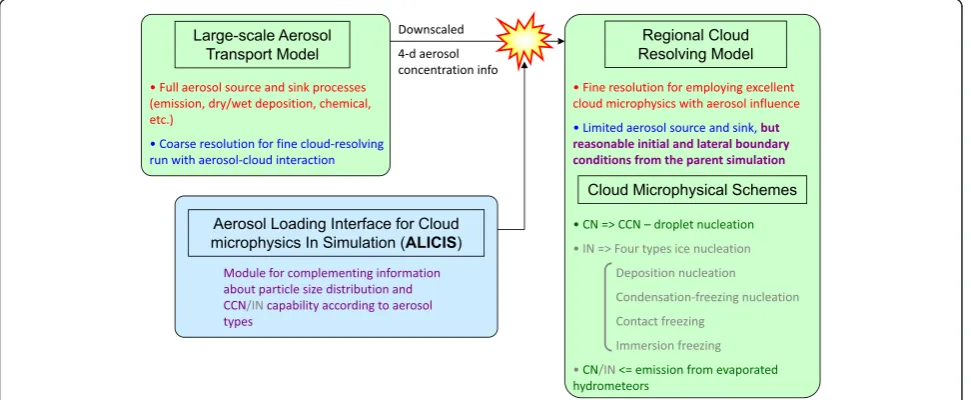
Our aerosol loading module is referred to as the Aerosol Loading Interface for Cloud microphysics In Simulation (ALICIS). Figure 1 provides a schematic illustration of how ALICIS works as an intermediate module between large-scale aerosol transport models and regional-large-scale CRMs. So far, this interface has been employed in the framework con-necting global-scale simulations using the spectral radiation transport model for aerosol species (SPRINTARS; e.g.,
Takemura et al. 2000) with regional-scale simulations using the Japan Meteorological Agency Non-Hydrostatic Model (JMA–NHM; Saito et al. 2006) coupled with SBM (IG08). The SBM scheme originates from the corresponding part of the Hebrew University Cloud Model (HUCM; e.g., Khain et al. 2000). ALICIS was first published by IG08 and subse-quently updated by Sato et al. (2012; hereafter SA12) and Choi et al. (2014; hereafter CH14).
CN modeling in the original HUCM
The representation of aerosol in the original HUCM is significantly simplified for idealized CRM simulations (e.g., Khain et al. 1999). The CN size distribution spectrum for a single chemical component is calculated as prognostic variables for each of the model’s spatial grid points. The chemical composition of CN is assumed to consist of pure ammonium sulfate. The CN particle shape is assumed to be completely spherical. The size distribution spectrum is approximated by 33 discrete size bins, covering a particle radius ranging from 1.23 × 10⁻³to 2 μm. The representative particle radius of each CN size bin is defined as follows. The CN particle mass of the maximum size bin (i.e., the 33rd bin) is assumed to be identical to the particle mass of the smallest droplet size bin; the smallest droplet radius is assumed to be 2 μm. The CN particle mass of each size bin is determined by doubling the mass bins; that is, a series of CN bins are characterized in the form of a geometric progression of particle masses with a ratio of 2 between subsequent bins. The CN particle radius of each size bin is tied to the par-ticle mass of the bin and the CN parpar-ticle density.
The initial CN size distribution spectrum in the HUCM is determined using the Köhler equation (Eq. 11) and
Twomey’s empirical parametrization described byNCCN=
N0Sk. Here, NCCN is the number concentration of CCN
activated at supersaturation S, and N0 and k are
environment-dependent coefficients (e.g., Twomey 1959a, 1959b). The following equation for the CN number dens-ity function can be obtained by coupling both equations (Khain et al. 2000):
dNCN
dðlnrCNÞ¼1:5N0k
4A3 27BrCN
1:5k
; ð1Þ
where A and B are calculated from Eq. 8 for a
temperature of 288.15 K, and the molecular weight, the van’t Hoff factor, and the CN particle density are identical to those of a typical ammonium sulfate aerosol particle. The spectral shape of the initial CN size distribution is common to all spatial model grid points. The initial spatial distribution is vertically inhomogeneous, since the CN number density function decreases exponentially with a scale height of 2 km above an altitude of 2 km (Khain and Sednev 1996). CN particles with radii larger than 0.6 μm are eliminated from the size distribution spectrum in standard simulations to prevent artificially rapid formation of large droplets at the initial simulation stage.
The governing equation of the number density concen-tration in each CN bin (Eq. 3.4 of Khain and Sednev 1996) is calculated numerically for all model grid points and each time step. Gravitational sedimentation of CN parti-cles is neglected. CN production in the atmosphere or on the terrain surface is ignored. No direct CN source term is assumed. The CN sink is limited to consumption through the droplet nucleation process. Scattering and absorption of short- and longwave radiative fluxes by CN particles are not included, because no radiation process is calculated in the HUCM. A flat horizontal gradient of the CN number density concentration is assumed at the model’s lateral boundaries; the CN size distribution spectra are thus hori-zontally constant near the lateral boundaries. Conse-quently, CN consumed within the simulation domain is replenished by advection from the lateral boundaries.
The microphysical process of CN is limited to activa-tion of droplet nucleaactiva-tion. The process is calculated on the basis of the following approach. If the predicted supersaturation at a grid point is positive, the critical ra-dius of CCN is calculated based on Eq. 11 using super-saturation and the air temperature. All CN larger than the critical radius are immediately activated and con-verted into cloud droplets, with their corresponding radii calculated using Eq. 10. Hygroscopic growth of CN is neglected.
An early version of ALICIS: Iguchi et al. (2008)
Recently, regional models using SBM have been widely applied, even to realistic simulations resolving clouds.
However, most studies have employed a similarly coarse approach to the CN representation (Lynn et al. 2005a, 2005b; Khain et al. 2010; Fan et al. 2012; Iguchi et al. 2012a, 2012b, 2014). Such an approach may be insuffi-cient in realistic simulations, because in reality, the spatial distribution of aerosol particles is inhomogeneous and variable. The environment-dependent parameters in Eq. 1,N0 and k, are determined on the basis of limited
reference observations (Pruppacher and Klett 1997). Substitution of arbitrary values for those parameters causes large uncertainties in determining the CN con-centration and size distribution spectra that should be consistent with their real counterparts. In particular, the uncertainties may be increased under conditions where anthropogenic pollution has a large impact on the aero-sol distribution. Aeroaero-sol–cloud interaction is of great interest as a research problem under such conditions. In addition, the simplified vertical CN distribution may be problematic. The vertical CN profile assumed in the HUCM is based on a typical observed profile of the ver-tical aerosol distribution. However, severe aerosol con-tamination is sometimes observed even in the middle troposphere (Marenco et al. 2014); such highly concen-trated aerosol is transported from distant intensive sources through lifting by convection and it even has a significant impact on the local cloud properties as well as on the radiation balance.
IG08 developed the aerosol loading module ALICIS to overcome the deficiencies in CN modeling associated with the original HUCM. The module provides inhomogen-eous initial CN and time-variant lateral boundary condi-tions with a specified particle-size distribution through a dynamical downscaling approach using output from glo-bal aerosol transport simulations of SPRINTARS (e.g., Takemura et al. 2000). The SPRINTARS model includes the five types of tropospheric aerosol, i.e., organic carbon-aceous, black carboncarbon-aceous, soil dust, sulfate, and sea salt. Aerosol mass-mixing ratios are predicted in the frame-work of the atmospheric general circulation model (AGCM). Aerosol particle size spectra are incompletely resolved in SPRINTARS.
basis of a four-dimensional variational data assimilation method (Yumimoto and Takemura 2013). The vertical aerosol distribution was validated through a compari-son of the aerosol extinction with lidar measurements at several locations in Japan (Goto et al. 2015). In addition, the SPRINTARS model is included in the
Aerosol Comparisons between Observations and
Models (AEROCOM) project (e.g., Kinne et al. 2006). Model performance has been evaluated by comparing the global modeling outcomes of numerous aerosol modules.
IG08 determined the CN size distribution spectrum of the initial and time-variant lateral boundary conditions in their nested model simulations through the following process. Among the five types of tropospheric aerosol, organic carbonaceous, sulfate, and sea salt aerosol parti-cles are assumed to be CN activatable as CCN. Bulk number concentrations of the three types of aerosol in SPRINTARS are calculated based on the predicted mass-mixing ratios for the grid points of the global simulation under the assumption that all aerosol parti-cles are dry. The calculated bulk number concentrations are then temporally and spatially interpolated at the grid points of the simulation domain of the nested model. The interpolated bulk number concentrations are converted into aerosol size distribution spectra at each grid point. The conversion employs different built-in size distribution functions, according to aerosol type. Finally, accumulating the three-type aerosol size spectra yields the CN size distribution spectrum at a given grid point for the initial and boundary conditions.
The particle size distribution of organic carbonaceous aerosol is assumed to be a lognormal function with a single mode. The corresponding fraction of organic carbonaceous aerosol in the CN size distribution spectrum is given in units of the number density concentration,
dNCN OCð Þ dðlnrCNÞ¼
Nffiffiffiffiffiffib OCð Þ
2π p
σOCexp −
1 2
ln BCN=1=3 BOC1=3⋅rCN=rm OCð Þ
σOC 8
< :
9 = ; 2 2
6 4
3 7
5;
ð2Þ
where Nbis the bulk aerosol number concentration of
the SPRINTARS simulation, and rm and σ are the mode
radius and the standard deviation of the lognormal aerosol size distribution, respectively. The subscripts, CN and OC, distinguish the variables pertaining to CN and organic carbonaceous aerosol, respectively; rm(OC)= 0.1 μm and
σOC= 1.8 is assumed. Note that Eq. 2 applies the
adjust-ment of the difference in the B coefficients (Eq. 8) be-tween organic carbonaceous aerosol and CN with a certain soluble component.
Sulfate aerosol is also assumed to have a single-mode lognormal particle size distribution. The corresponding
portion of the sulfate aerosol in the CN size distribution spectrum is also given by Eq. 2 in units of the number density concentration, but for parameters typical of sulfate aerosol;rm= 0.0695μm andσ= 2.03 is assumed.
The particle size distribution function of sea salt aero-sol is assumed to be a power law. The corresponding fraction of sea salt aerosol in the CN number density concentration is given by
dNCN SAð Þ
dðlnrCNÞ ¼1:5Nb SAð Þk
BSA
BCN
rm SAð Þ
r3 CN
k
; ð3Þ
where rm(SA)= 0.1 μm and k= 0.6 is assumed. The
subscript SA denotes sea salt aerosol. This equation also includes adjustment of the difference in theBcoefficient between CN and sea salt aerosol.
In the version of ALICIS presented here, the CN size spectrum is discretely approximated by 13 size bins with a radius ranging from 10−3to 1 μm. The use of a small number of CN bins compared with the 33 bins in the original HUCM yields improved computational effi-ciency. The CN concentration in each bin is numerically computed every time step, using almost the same gov-erning equations as the standard scalar tracers.
The chemical component of CN in the nested model can be arbitrarily determined by substituting a proper, corresponding value into the B coefficient of CN in the conversion equations (Eqs. 2 and 3). No microphysical processes causing a change in the CN size spectra are assumed, except for activation to droplet nucleation. Droplet nucleation is calculated using the same ap-proach as that employed in the original HUCM; the value of the B coefficient of CN in Eqs. 2 and 3 is substituted into Eqs. 10 and 11 to determine the critical CCN radius and the corresponding radius of the gener-ated cloud droplet. Although atmospheric radiation is calculated in the nested model, absorption and scattering of the radiative fluxes by CN are not included at present. The reason for this is that the optical properties of each aerosol species are eliminated once the multiple aerosol types have been bundled into standardized CN. In addition, the other two types of aerosol (i.e., black car-bonaceous and dust aerosol) are not included in the nested model, so that this version of ALICIS has a lim-ited capability to simulate direct aerosol effects on at-mospheric radiation.
methods of the CCN number concentration using a CCN counter were summarized by Ishizaka (2004) and Adhikari et al. (2005); some additional detailed information about the measurements on the event days can also be found in IG08. Figure 2 compares the results for the two individual cases. The simulations reproduced the observed CCN concentration profiles reasonably well. In the April 2 case (Fig. 2a), the observed CCN concentration ranged from approximately several tens to close to 1000/cm3. The ob-served concentration decreased a little with increasing altitude. The three-type simulated CCN concentrations ranged from approximately 100 to 1000 cm−3at heights of up to 5500 m; the small decrease with increasing altitude was generally reproduced. In the April 8 case (Fig. 2b), the observed CCN concentration was approximately 1000 cm −3
at heights below 1000 m, which decreased with increas-ing altitude to roughly 100 cm−3at 3000 m. The vertical profiles of the simulated CCN concentrations showed a log-linear decrease with increasing altitude, similar to the observed profile.
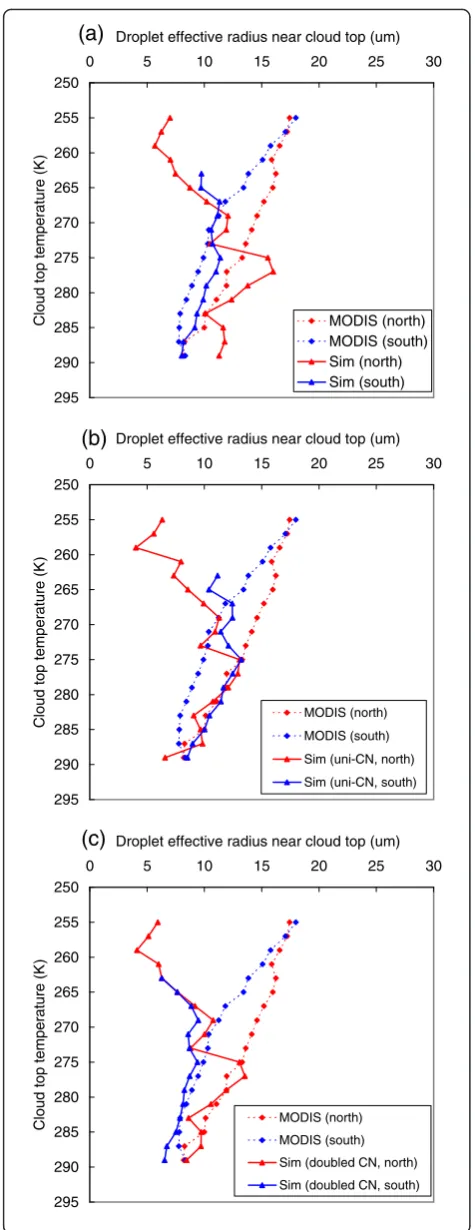
Second, the horizontal distribution of the liquid cloud properties in the nested model simulations was com-pared with that estimated from data of the Modulate Resolution Imaging Spectroradiometer on the Terra satellite (Terra/MODIS) based on the satellite’s retrieval algorithm (Nakajima and Nakajima 1995; Nakajima et al. 2005); plots of the horizontal distribution are shown in Fig. 6 of IG08. Figure 3 shows the relationship between the liquid cloud-top temperature and the droplets’ ef-fective radius near the cloud tops in the satellite mea-surements and the simulation for the April 2 case. These parameters were averaged separately in the northern and southern halves of the simulation domain to highlight spatial differences in the droplet radius distribution. The north–south difference is likely to have resulted from a horizontal bias in the CN concentration. The model simulation performed satisfactorily in reproducing the overall tendency of the north–south gradients of the observed droplet radius in warm-cloud regimes with temperatures in excess of 273 K, despite some overesti-mation (Fig. 3a). The observed radius monotonously in-creased with decreasing cloud-top temperature. The observed radii averaged in the northern half had larger values than those in the southern half; the maximum north–south difference was roughly 5 μm. The simu-lated radius generally increased with decreasing cloud-top temperature down to 275 K and roughly decreased or remained constant below 275 K. The simulated radii in the northern half attained larger values than those in the southern half for temperatures greater than 275 K; the north–south difference was roughly 5 μm on aver-age. In addition, two sensitivity simulations were con-ducted to highlight the effects of the aerosol loading module on the simulation results (Fig. 3b, c). The
simulation assuming horizontally homogeneous initial and boundary CN conditions failed to reproduce the structure of the north–south gradients (Fig. 3b). The simulated profiles of the average droplet effective radius are almost identical for the northern and southern halves. The simulated north–south gradients in the control run were thus caused by a horizontally inhomo-geneous CN distribution introduced by aerosol down-scaling. This result proved that the implementation of realistic, inhomogeneous CN fields is essential for more accurate simulations of cloud microphysical properties. On the other hand, the simulation assuming a doubled CN number concentration compared with the control run had smaller effective radii (Fig. 3c). The simulated effective radius profiles were in better agreement with the observed profiles than those in the control run. This result indicates that the control run underestimated the CCN number concentration.
Update by Choi et al. (2014): Aerosol particle size distribution revision and type multiplication
The IG08 version of ALICIS still contained many limita-tions. Among them was the absence of two aerosol spe-cies, i.e., black carbonaceous aerosol and dust particles. In reality, they often work as CCN if soluble compo-nents are combined with the particles, either externally or internally (e.g., Sullivan et al. 2009). In addition, the modeling of the other three types of aerosol still offered room for significant improvements. For example, the ap-plication of a power-law function to the size distribution spectra of sea salt aerosol might cause an overestimation of the activated CCN number concentration because of the continuous increase in the CCN number concentra-tion with increasing supersaturaconcentra-tion.
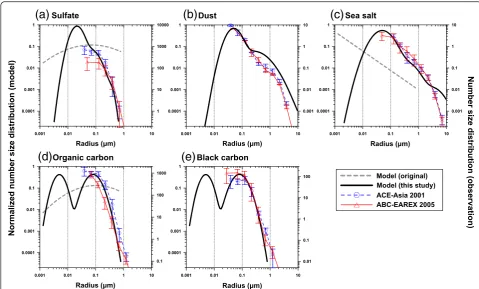
The aerosol loading module was comprehensively up-dated by CH14. The conversion from the various types of aerosol to standardized CN, as implemented by IG08, has been removed. The same five aerosol species used in the SPRINTARS model are employed in nested models. The discretization of the size distribution spectra of each aerosol type has been extended to 17 size bins with radii ranging from 10−3to 10μm. The use of more size bins and a wider range of particle sizes compared with those in the old version allows the representation of aerosol particles with radii larger than 1μm. Such large aerosol particles are possibly included in the sea salt and dust aerosol categories (Fig. 4).
(a) April 2, 2003
0 1000 2000 3000 4000 5000 6000
1 10 100 1000 10000
CCN number concentration (cm-3)
Altitude (m)
Flight Measurement Sim (cloud-free; 30.5N) Sim (control; 30.5N) Sim (cloud-free; 31.5N) Sim (cloud-free; 32.5N)
(b) April 8, 2003
0 500 1000 1500 2000 2500 3000 3500
1 10 100 1000 10000
CCN number concentration (cm-3)
Altitude (m)
Flight Measurement
Simulation (cloud-free; 30.5N) Simulation (control; 30.5N)
dN dðlnraÞ¼
Xnm
i¼1
NSPRffiffiffiffiffiffifi
2π p
σi
exp −lnra−lnrmi 2σi2
; ð4Þ
where ra is the aerosol particle radius, i the index of a
given mode, nm the total number of modes in the size
distribution, NSPR the bulk number concentration of
each aerosol type obtained from the SPRINTARS simu-lation, andfthe weight factor required to normalize the multi-modal distribution. The variables nm, f, rm, and σ
are the functions of aerosol type as listed in Table 1 of CH14; the values have been determined on the basis of observational results (d’Almeida et al. 1991; Chuang et al. 1997; Penner et al. 1998; Herzog et al. 2004).
Figure 4 compares the aerosol size distribution spec-tra. Two size distribution spectra were calculated for each aerosol type using the assumptions employed by CH14 and IG08. No size distribution was assumed for dust or black carbonaceous aerosol in the study by IG08. A set of observed spectra was obtained from in situ measurements during the ACE–Asia field cam-paign in 2001 (Huebert et al. 2003). The set of spectra was calculated from the size-segmented aerosol mass
concentration measured using the Micro-Orifice
Uniform Deposit Impactor (MOUDI) onboard a re-search vessel; the marine aerosol sampling performed
during ACE–Asia 2001 is summarized by Mochida
et al. (2007). Another set of observed spectra was
obtained from ground-based measurements using
MOUDI at the Gosan site on Jeju Island (Republic of
Korea) during the Atmospheric Brown Cloud–East
Asian Regional Experiment (ABC–EAREX) in 2005
(Nakajima et al. 2007).
In Fig. 4, the size distribution spectra employed by CH14 are in better agreement with those from the mea-surements, although the observed size spectra lack multi-modal distributions. The observed aerosol num-ber densities monotonously decrease with increasing aerosol particle size. The observed size distributions of sulfate and organic/black carbonaceous aerosol extend to the radii of 2 μm, whereas those of dust and sea salt aerosol extend to over 5μm. The spectra of CH14 re-produce the distinct structure of the observed spectra according to aerosol type reasonably well, especially
250
255
260
265
270
275
280
285
290
295
0 5 10 15 20 25 30
Droplet effective radius near cloud top (um)
Cloud
top temperature (K
)
MODIS (north) MODIS (south) Sim (north) Sim (south)
250
255
260
265
270
275
280
285
290
295
0 5 10 15 20 25 30
Droplet effective radius near cloud top (um)
Cloud
top temperature (K
)
MODIS (north)
MODIS (south)
Sim (uni-CN, north)
Sim (uni-CN, south)
250
255
260
265
270
275
280
285
290
295
0 5 10 15 20 25 30
Droplet effective radius near cloud top (um)
Cloud
top temperature (K
)
MODIS (north)
MODIS (south)
Sim (doubled CN, north)
Sim (doubled CN, south)
(a)
(b)
(c)
those of sulfate and organic/black carbonaceous aero-sol. In contrast, the spectra of IG08 exhibit several se-vere insufficiencies. The number density concentration of sulfate aerosol is overestimated across the full par-ticle size range shown and the sea salt aerosol concen-tration is significantly underestimated. The organic carbonaceous aerosol concentration is underestimated for particle radii smaller than 0.1μm and overestimated for radii larger than 0.4μm.
The activation process of aerosol particles to form cloud droplets was calculated for each aerosol type on the basis of basic Köhler theory by CH14, unlike in IG08. Because the five types of aerosol have different soluble capabilities, different B coefficients are employed in determining the critical radius of CCN in Eq. 11. TheBcoefficients are as-sumed to be 0.51 for sulfate, 1.16 for sea salt, 0.14 for dust, 0.14 for organic carbonaceous, and 0.05 × 10⁻⁵ for black carbonaceous aerosol (Ghan et al. 2001).
CH14 employed the same build-up process of ini-tial and time-variant boundary conditions of binned aerosol concentrations in their nested model simula-tions as IG08. The time evolution of each binned concentration was numerically computed for each time step. Microphysical processes producing or los-ing aerosol particles were excluded, except for con-sumption through the nucleation of cloud droplets.
Any direct aerosol effects on atmospheric radiation were excluded, even by CH14, although the five types of aerosol were fully managed.
CH14 evaluated the performance of the updated version of the aerosol loading module in their simulation analysis. They conducted numerical simulations of two cloudy cases observed during the ABC–EAREX 2005 field campaign over an East China Sea region. Corresponding simulations using the old version of the aerosol loading module of IG08 were performed simultaneously for comparison.
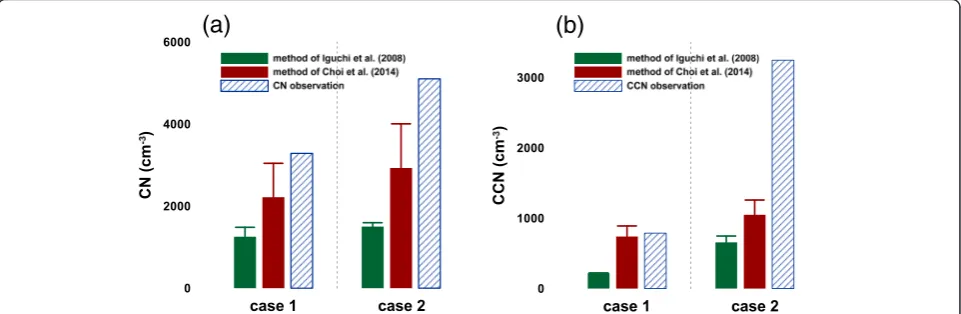
First, the simulated CN and CCN number concentra-tions were evaluated in comparison with those obtained from ground-based measurements. The CN comparison yielded a new perspective on the validation of ALICIS, in addition to the CCN comparison also discussed by IG08. Figure 5 compares the concentrations (CCN at 0.6 % supersaturation) derived from the different as-sumptions made by both IG08 and CH14 with those obtained from in situ measurements at the Gosan site. The observed CN and CCN concentrations were mea-sured using a TSI (Shoreview, MN, USA) condensation particle counter model 3010, which detected particles with diameters larger than 10 nm, and using a stream-wise thermal-gradient CCN counter (Roberts and Nenes 2005); details of the measurements can be found in Yum et al. (2007). The large underestimation of the
(a)
(b)
(c)
(d)
(e)
number concentrations in the outdated IG08 version has been alleviated in the updated CH14 version. The improvement is attributed to the application of more realistic distribution functions to the aerosol size spec-tra rather than the new inclusion of dust and black carbonaceous aerosol into the categories. However, underestimation of CN and CCN concentrations still remained in the simulations using the updated CH14 version, especially for the second case. This insuffi-ciency is probably caused by an underestimation of the aerosol concentration in the SPRINTARS simulation over highly polluted regions affected by anthropogenic aerosol emissions.
Second, CH14 evaluated droplet effective radii near cloud tops, liquid water paths, and cloud optical thicknesses calculated in their simulations in compari-son with those obtained from the Terra/MODIS satel-lite measurements through retrieval (see Table 2 in CH14); details of the retrieval algorithm are described by Nakajima et al. (2005). Simulations using the up-dated and outup-dated aerosol loading modules led to different values of the variables, although the cloud distribution patterns were similar. The droplet effect-ive radii were smaller, and the liquid water paths and cloud optical thicknesses were larger in the updated simulation compared with the outdated simulation. These differences resulted from larger CDNC attrib-uted to the larger CN and CCN number concentra-tions. Overall, the values in the updated simulation were in better agreement with those estimated from the satellite measurements, reflecting the better reproduction of the CN and CCN concentrations in the updated version.
Update by Sato et al. (2012): Aerosol emission from evaporated cloud droplets
SA12 introduced an aerosol particle generation process from completely evaporated droplets into the framework of the HUCM SBM, coupled with the ALICIS module. Absence of an aerosol regeneration process might cause underestimation of the CN and CCN number concentra-tions and, consequently, an underestimation of CDNC, particularly in long-term simulations. The process was not included in the original HUCM SBM, and was not considered by IG08 or CH14, mostly because of the fol-lowing technical issue. Once the activation to droplet nucleation has been calculated in the models, the size and composition information about the aerosol particles used was eliminated. Some state-of-the-art models fully predict solute components in hydrometeor particles at the expense of increased computational cost (e.g., Chen and Lamb 1994). Such models have the advantage of enabling explicit calculations of aerosol particle emission from completely evaporated or sublimated hydrometeor particles.
The parametrization of the aerosol emission process by SA12 was based on the third approach described by Feingold et al. (1996). SA12 assumed that one aerosol particle was regenerated when one droplet had com-pletely evaporated (Mitra et al. 1992). Solute compo-nents in the droplet were not fully predicted, so that the sizes of regenerated aerosol particles could not be calcu-lated explicitly; alternatively, the size distribution spectrum of the regenerated aerosol was determined based on the change of the domain-averaged aerosol number concentration from the initial condition to the present time step. The additional aerosol number
(a)
(b)
concentration to thek-th aerosol size bin resulting from this regeneration process (Rk) is as follows (see Eqs. 3
and 4 in Feingold et al. 1996):
Rk¼NRXnbinϕk
k¼1
ϕk
; ð5Þ
ϕk ¼N0;k−Nk
N0;k
; ð6Þ
whereNRis the total number concentration of the
re-generated aerosol particles, which is equivalent to the number concentration of completely evaporated drop-lets; nbin is the total number of aerosol size bins; and
N0;k and Nk are the domain-averaged aerosol number concentrations of the k-th size bin in the initial and present conditions, respectively. SA12 assumed that all CN were composed of ammonium sulfate; therefore, the chemical component of aerosol particles generated through this emission process was assumed to be am-monium sulfate.
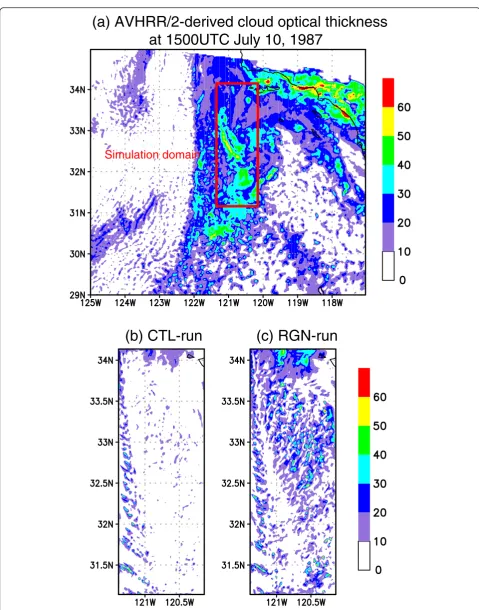
SA12 evaluated the performance of the aerosol regen-eration parametrization in their simulations by resolving stratocumulus over a region off the coast of California. Two types of simulation (i.e., with and without the re-generation parametrization) were conducted simultan-eously to investigate the influence of this process. The simulation results were validated using retrieval results from the space-borne AVHRR/2 data over the region of interest (Nakajima and Nakajima 1995).
Figure 6 shows the horizontal distribution of the cloud optical thickness retrieved from the AVHRR/2 space-borne measurements (Nakajima and Nakajima 1995) and calculated in the regional model simulations exclud-ing or includexclud-ing the aerosol regeneration process. Cloud optical thickness ranged from 10 to 60 over the domain of interest in the observation region. The southern half of the domain exhibited relatively thick stratocumulus. In contrast, the simulated cloud fields show a more dis-persed structure. Cloud optical thicknesses simulated with the aerosol regeneration parametrization were at least in better agreement with the satellite measure-ments than those not based on this parameterization. Large optical thicknesses of more than 30 are patchily and widely distributed in the simulation including the regeneration process, whereas the corresponding values were less than 20 in the simulation without the regener-ation process, except for areas that were close to a lat-eral boundary of the simulation. Implementation of the aerosol regeneration process caused an increase of ap-proximately 20 % in the aerosol number concentration averaged over the domain. A large fraction of aerosol particles emitted from evaporated droplets was used
again as CCN. The regeneration of aerosol particles caused increased CDNC and cloud optical thickness.
Sato (2012) tested another approach used by Feingold et al. (1996) for the aerosol regeneration process, be-cause the parametrization based on Eq. 5 was not very appropriate for downscaled realistic simulations. The new approach assumed that the particle size distribution of regenerated aerosol was the same as the horizontal average at the corresponding vertical level for the initial conditions. Sato’s (2012) tests using this approach showed that the reproducibility of cloud optical thick-ness was improved as well.
SA12 also conducted a quantitative comparison on the basis of correlation analysis between the droplet effective radii and cloud optical thicknesses (e.g., Fig. 8 of SA12). Only simulations including the aerosol regeneration par-ametrization reproduced a characteristic pattern in the correlation plots based on the satellite measurements. Their results demonstrate that implementation of the aerosol regeneration process is necessary to adequately simulate the cloud microphysical structure of strato-cumulus over the region of interest.
Prospective ALICIS update strategy IN modeling
The behavior of aerosol particles as IN is implicitly in-cluded in the framework of the HUCM SBM tied to the present ALICIS module. The IN effect is tacitly contained in parametrizations to calculate ice-nucleation and freez-ing processes without consumption of predicted aerosol particles in the model. This coarse approach is due to the present poor knowledge about complicated microphysics in ice/mixed-phase clouds. Nevertheless, introducing an explicit representation of IN activation and the resultant depletion is important for developing a more comprehen-sive scheme of cloud microphysics for aerosol–cloud interaction studies. Improvement of the SBM and ALICIS to manage the IN effect is a worthwhile challenge.
Solid hydrometeor particles in the atmosphere primar-ily form through either homogenous freezing of super-cooled droplets without IN action or heterogeneous nucleation/freezing with catalysis by IN. In addition, the latter heterogeneous processes can be divided into four different categories (Vali 1985): deposition nucleation, condensation-freezing nucleation, contact freezing, and immersion freezing.
(a) AVHRR/2-derived cloud optical thickness
at 1500UTC July 10, 1987
(b) CTL-run
(c) RGN-run
Simulation domain
to completely dissolve in the droplet. The droplet that is formed then immediately freezes from the non-dissolved impurity. Distinguishing these two types of nucleation process is difficult in measurements where supersaturation with respect to water is positive. Supersaturation (i.e., hu-midity) rather than temperature is an important factor con-trolling the progress of these processes. Contact freezing possibly occurs when supercooled droplets collide with aerosol particles. The collision is usually caused by Brownian diffusion, thermophoresis, diffusiophor-esis, electrophordiffusiophor-esis, and/or inertial impaction. The concentration of aerosol particles that can act as contact-freezing IN at the relevant temperature is the most important factor in determining the freezing probability. Immersion freezing originates from im-purities already present inside a supercooled droplet. Unlike condensation-freezing nucleation, immersion freezing does not have to start immediately upon the formation of a supercooled droplet. The freezing can occur when the temperature of the supercooled drop-let decreases.
Among the four types of heterogeneous cloud glaciation processes, deposition nucleation is the simplest because the process does not proceed through a state of super-cooled droplets. An increase in the number of aerosol par-ticles that can work as deposition IN directly causes the number of ice cloud particles to increase, just like the rela-tionship between CCN and cloud droplets. In contrast, cloud glaciation through the other three processes is more complicated. If the number concentrations of all types of aerosol increase, promotion of heterogeneous freezing through increasing IN may be in competition with depres-sion of the freezing efficiency caused by a decrease in the particle sizes of supercooled droplets through increasing CDNC. In contrast, increased cloud height and decreased cloud temperature caused by the particle size change of supercooled droplets (e.g., Pincus and Baker 1994) may accelerate cloud glaciation through heterogeneous or homogenous freezing.
Unlike droplet nucleation summarized in Köhler theory, no comprehensive theory has been developed to formulate each ice-nucleation or freezing process. Parametrizations of these processes are constructed empirically on the basis of in situ measurement data or experimental laboratory data acquired under certain conditions. The four types of mechanisms of heterogeneous nucleation/freezing can rarely be distinguished through measurements or experi-ments, so that empirical parametrization may cover mul-tiple components for each of the four types of the mechanisms. In addition, identifying the chemical compo-nents of IN is difficult for most measurements.
Appendix 2 summarizes our testbed for how to im-prove IN parametrization in the HUCM SBM coupled with the ALICIS module. Fan et al. (2014) improved the
ice-nucleation parts of the HUCM SBM by introducing up-to-date IN parametrizations that include prognostic dust aerosol concentrations. The parametrizations were based on results by Tobo et al. (2013) and DeMott et al. (2015) for deposition/condensation-freezing nucleation
and immersion freezing, and by Muhlbauer and
Lohmann (2009) for contact freezing. We may modify the parametrizations into suitable forms to use the aero-sol size distribution spectra predicted by models coupled with the ALICIS module. In addition, more comprehen-sive and generalized parametrizations of heterogeneous ice-nucleation/freezing should be implemented in future updates. Phillips et al. (2008, 2013) proposed a flexible framework where various empirical parametrizations can be bundled into a versatile form since parameters in the formulation can be easily constrained by various obser-vational data. Note that the application of any proposed parametrizations to actual model simulations is still affected by large uncertainties. The uncertainties come from the limited applicability of findings from in situ measurement and laboratory experiment results for IN, and the coarse translation from results to developer-friendly parametrizations in a numerical scheme.
Introduction of regional variability into the aerosol size distribution and hygroscopicity parameters
The present ALICIS module includes fixed aerosol size distribution functions with constant parameters, as de-scribed in “An early version of ALICIS: Iguchi et al. (2008)”. The size distribution spectra were validated for application to simulations of regions in Northeast Asia through comparisons with those obtained from on-site measurements. The spectra might thus be inappropriate if applied to simulations pertaining to other regions. For example, mineral dust aerosol particles in East Asia and North Africa (Sahara) have different physical and chem-ical properties (Formenti et al. 2011). The dust proper-ties depend not only on the source region but also on the distance from the emission site.
Second, introducing intercontinental variability into the ALICIS module is a valuable challenge for further improvement. Although many measurements of the aerosol size distribution have been conducted worldwide, most obtained a bulk aerosol size distribution containing all chemical components. Internal mixing of aerosol par-ticles is highly problematic in constraining the aerosol size distribution of an individual chemical component in relation to the measurement data. Few recent studies have conducted global simulations using an aerosol transport model predicting the aerosol size distribution (e.g., Spracklen et al. 2005; Zhang et al. 2010; Jacobson 2012). These simulation results are useful for comple-mentary provision of aerosol size distribution informa-tion, particularly over pelagic regions and in the upper troposphere where few in situ measurements are avail-able. The results may be employed to construct climat-ology data of the aerosol size distribution or they may be used as direct input to simulations through dynamical downscaling approaches.
Introduction of aerosol representation to internal mixing, source/sink, and direct radiative effects
Compared with typical aerosol transport models, the present SBM coupled with the ALICIS module still lacks modeling of many aspects of aerosol behavior and its ef-fects. Some may have a critical influence on cloud micro-and macrophysics. Their implementation is necessary to conduct more comprehensive simulations of aerosol–cloud interactions (e.g., Saleeby and van den Heever 2013). Vari-ous approaches have been proposed to introduce these as-pects into models. We will include them in future updates while considering the limitations of the available computa-tional resources.
In reality, aerosol particles are often characterized by internally mixed states with multiple chemical composi-tions. These aerosol particles are mostly dominant in re-gions at great distances from their major emission sources. The chemical and physical properties of aerosol particles may change through gas absorption/deposition or they may coagulate with other particles during migra-tion. The question of how to numerically model an in-ternal mixture is a delicate problem in calculating the nucleation process of cloud hydrometeor particles from aerosol particles, as well as their scattering and absorp-tion of atmospheric radiaabsorp-tion. Various modificaabsorp-tions of the Köhler theory have been proposed to represent the hygroscopic growth of internally mixed particles. For ex-ample, reformulation of the Köhler equation was sug-gested to consider the effects of soluble gases and slightly soluble solid substances in the droplet nucleation process (Laaksonen et al. 1998). A modified Köhler theory with a single solute hygroscopicity parameter (κ-Köhler theory) has also been proposed (Petters and Kreidenweis 2007);
the new parameter represents the CCN capability of dry particles with arbitrary mixtures and can be constrained easily with observational data.
Wet scavenging (i.e., impaction of aerosol particles by hydrometeor particles) does not only cause a sig-nificant decrease in aerosol concentration but also triggers several cloud microphysical processes, such as
contact or immersion freezing. The scavenging
process is divided into two types: dissolution or im-paction as a result of the nucleation process through condensation or deposition of water vapor on aerosol particles, and impaction through collision between aerosol particles and already extant hydrometeor par-ticles. As highlighted in the section about contact freezing, Brownian diffusion, thermophoresis, diffusio-phoresis, electrodiffusio-phoresis, and/or inertial impaction are major causes of collisions between aerosol and hydrometeor particles. There are significant uncertain-ties associated with modeling these effects, especially as regards the electromagnetic attraction between aerosol and hydrometeor particles, because of insuffi-cient theoretical knowledge and measurement data. In addition, tracing solutions and impurity components in hydrometeor particles is technically difficult if only limited computational resources are available. At present, a few models explicitly predict solution and impurity components in hydrometeor particles in their SBM frameworks (e.g., Chen and Lamb 1994). As an alternative approach, solution and impurity compo-nents are assumed to be statistically (Poissonian) distributed according to the volume of a hydrometeor particle when the total mass of the components scav-enged by hydrometeor particles is predicted (Phillips et al. 2008). Although these authors applied this approach to their parametrization for immersion freezing, the same approach is applicable to the calcu-lation of aerosol particle emission from evaporated hydrometeor particles.
of aerosol influence is referred to as the aerosol semi-direct radiative effect (Ackerman et al. 2000).
Aerosol optical properties are a key determinant of their influence on the Earth’s radiation budget. We plan to fol-low standard methods employed in existing aerosol trans-port models (e.g., GOCART, SPRINTARS, ECHAM: Pozzoli et al. 2011; the Hadley Centre Global Environment Model HadGEM: Bellouin et al. 2011) to determine the aerosol optical properties. The single-scattering properties of spherical aerosol particles can be approximated using Mie scattering theory in radiative flux calculations. The wavelength of light, the radius of a particle, and the re-fractive index of its medium at the relevant wavelength are required to determine the extinction coefficient, single-scattering albedo, and asymmetry factor. The effect of water uptake on hygroscopic aerosol particles is ap-proximated by calculating the particle radius and refract-ive index for a series of relatrefract-ive humidity values; the refractive indices are calculated on the basis of the volume-weighted mixing assumption between water and dry components (e.g., Haywood et al. 1997; Takemura et al. 2002; Eq. 3). The internal mixture effect is also approxi-mated using the volume-weighted mixing assumption for multiple different components. Non-spherical dust parti-cles are approximated as their corresponding spherical particles in calculating their optical properties, because relative errors introduced by this assumption are very small (Fu et al. 2009). We will generate lookup tables of extinction coefficients, single-scattering albedos, and asymmetry factors computed using a Mie theory program for the discretized series of aerosol particle radii, relative humidity values, and band wavelengths as applicable to each aerosol type. An internal mixture will be assumed only for organic and black carbonaceous aerosol particles at this stage to avoid heavy computational loads by includ-ing all mixture combinations; lookup tables for the mixed particles will also be prepared.
Conclusions
This review paper describes the scientific background and update strategies in the development of the aerosol loading module referred to as ALICIS. The module is used for coupling a downscaled CRM simulation with a large-scale aerosol transport simulation. The most im-portant function of the module is to provide realistic temporally and spatially inhomogeneous distributions of aerosol combined with accurate aerosol size distribution information for downscaled simulations. Introduction of the module yields better simulations of cloud micro-physical structure by avoiding the adoption of inad-equate aerosol loading as artificially defined by users.
ALICIS has been subject to two major updates since its initiation by IG08. The assumption of the aerosol size dis-tribution spectra was significantly improved as the
spectrum shapes better matched their observed counter-parts in the first update (CH14). The aerosol emission process from evaporated cloud droplets was added in the second update (SA12). However, many points remain to be improved in future updates, including but not limited to the management of heterogeneous ice nucleation/freezing, aerosol direct/semi-direct effects on atmospheric radiation, addressing internal mixtures of different chemical compo-nents in aerosol particles, the introduction of regional variability into the aerosol size distribution, and the repre-sentation of wet scavenging.
So far, ALICIS has been employed only in the frame-work connecting SPRINTARS aerosol transport
simula-tions to JMA–NHM coupled with the HUCM SBM. We
are now working on implementing the aerosol loading module into the bridge between the Modern Era Retrospective analysis for Research and Applications
Aerosol Reanalysis (MERRAero) or GEOS–GOCART
model simulations and WRF coupled with HUCM SBM (WRF–SBM) (e.g., Iguchi et al. 2012a). This extension will readily increase the applicability of ALICIS to more diverse simulation scenes and styles. In addition, we plan to develop the coupling of ALICIS to bulk cloud microphysics instead of SBM to enhance the simulation capability.
In future updates, models coupled with the ALICIS module will include a more comprehensive representa-tion of aerosol and related chemical species, like the WRF–Chem model. Such state-of-the-art models also enable better simulation of cloud microphysics, although they require much larger computational resources and loads. Improvement in model functionality is in compe-tition with improvement in various resolutions such as spatial grid spacing, time-step sampling, and/or particle size bins. Keeping a balance between model performance and computational efficiency in the context of limited resources is a delicate problem in model development. Adequate sorting of the priorities between the introduc-tion of various model funcintroduc-tions and improvement in various resolutions is an important task assigned to researchers.
Appendix 1: Basic Köhler theory for droplet nucleation
The supersaturation around a droplet in equilibrium with the ambient vapor is determined by the following equation (e.g., Rogers and Yau 1989), assuming that the dissolved amount of solutes in the droplet does not change:
Sw¼ A
rw−
Br3 CN
r3 w
; ð7Þ
A≈3:310
−5
T ðcmÞandB≈ 4:3v MCN
4πρCN 3
; ð8Þ
where Sw is the equilibrium supersaturation, rw the
droplet radius, and T the skin temperature of the drop-let;rCNis the radius of the dry CN particle before
dissol-ution; and v, MCN, and ρCN are the van ’t Hoff factor
(e.g., Low 1969), molecular weight, and density of the CN component, respectively. The CN particle is as-sumed to be composed of a single soluble ingredient that has been completely dissolved in the droplet. In Eq. 7, there is a unique peak of the supersaturation
Scrit(w)under the condition that dSw/drw= 0,
Scrit wð Þ¼ 2A
3rcrit wð Þ; ð9Þ
rcrit wð Þ¼
ffiffiffiffiffiffiffiffiffiffiffiffiffi 3Br3
CN
A r
; ð10Þ
where rcrit(w) is the critical radius of the droplet that
matches Scrit(w). Once the ambient supersaturation
reaches approximatelyScrit(w), droplets with radii greater
than rcrit(w) can exist stably. The critical radius of CN,
rcrit(CN), can also be determined uniquely:
rcrit CNð Þ¼ 274 A
3
B 1
Scrit wð Þ2
!1=3
: ð11Þ
Equation 11 represents the critical radius of CN as a function of supersaturation. If the radius of CN is larger than rcrit(CN), CN is activated as CCN and the formed
droplet exists stably under the ambient supersaturation, in excess ofScrit(w).
Appendix 2: Future plans for improving IN parametrization
Deposition and condensation-freezing nucleation
A common approach to measuring ambient IN is by counting the change in the number of ice particles in a sampled airmass for a series of air temperature or super-saturation measurements. DeMott et al. (2010) provided an equation for the activated IN number concentration as a function of both temperature and the number con-centration of aerosol particles with diameters larger than 0.5 μm, by combining measurement data at multiple
locations from the Arctic to the Amazon Basin. This equation is represented by
nIN;Tk ¼að273:16−TkÞ b
na>0:5
ð Þðcð273:16−TkÞþdÞ; ð12Þ
where a= 0.594 × 10⁻⁴, b= 3.33, c= 0.0264, and d= 0.0033; Tk is the cloud temperature (in Kelvin), na>0.5 is
the number concentration (in cm−3) of aerosol particles with diameters larger than 0.5μm, andnIN,Tkis the active
IN number concentration (std L−1). This parametrization may cover all heterogeneous ice nucleation types (i.e., de-position nucleation, condensation-freezing nucleation, contact freezing, and immersion freezing) because it is based on measurement data under water saturation condi-tions. However, Demott et al. (2010) indicated thatnIN,Tk
corresponds to the maximum number concentration of ambient IN activated mostly through deposition nucle-ation, because deposition nucleation is the primary con-tributor in mixed-phase clouds at temperatures above −35 °C (Phillips et al. 2008). The measurement data were sampled at a temperature range between−9 and−35 °C.
Several issues need to be solved before implementation of the parametrization described by Eq. 12 into a model coupled with the ALICIS module. Equation 12 can be interpreted in several ways in terms of how to connect the maximum number concentration of ambient IN at a given temperature to the number growth rate of cloud ice particles in a microphysics scheme. An approach de-scribed by Khain et al. (2000) can be appropriated to deal with this problem. A possible assumption is that new IN activation occurs only if the temperature de-creases at a certain grid point. The number concentra-tion of newly activated IN per time interval is given in a differential form:
dnIN
dt ¼
−dnIN
dT dT
dt ; if dT=dt ≤ 0 0; if dT=dt > 0
; 8
<
: ð13Þ
dT dt ¼
∂T ∂t þu
∂T ∂x þv
∂T ∂y þw
∂T ∂z
; ð14Þ
whereu,v, andware the wind velocities in the frame-work of the three-dimensional Cartesian coordinates x,
y, andz, respectively. The number of newly activated IN is directly applied to that of newly generated cloud ice particles.
Another problem is how to connectna>0.5in Eq. 12 to