Rediscovery of Angiopteris tonkinensis (Marattiaceae)
after 100 years, and its revision
Ting Wang1,2,3, Bo Xiao4, En-De Liu5, Khang Sinh Nguyen6, Jie-Qiu Duan2,7,
Kang-Lin Wang8, Yue-Hong Yan3, Jian-Ying Xiang1,2
1 Southwest Forestry University, College of Biodiversity Conservation, Kunming 650224, China 2 Southwest Forestry University, Yunnan Academy of Biodiversity, Kunming 650224, China 3 Shanghai Chenshan Plant Science Research Centre, Chinese Academy of Sciences, Chenshan Botanical Garden, Shanghai 201602, China 4 Forest Bureau of Malipo County, Malipo 663600, China 5 Key Laboratory of Biodiversity and Biogeography, Kunming Institute of Botany, Chinese Academy of Sciences, Kunming 650204, China 6 Institute of Ecology and Biological Resources, Vietnam Academy of Sciences and Technology,18 Hoang Quoc Viet, Nghia Do, Cau Giay, Hanoi, 100000, Vietnam 7 Southwest Forestry University, College of life Science, Kunming 650224, China 8 Southwest Forestry University, Green Development Institute, Kunming 650224, China
Corresponding author: Jian-Ying Xiang ([email protected])
Academic editor: Thais Almeida | Received 1 June 2020 | Accepted 19 August 2020 | Published 15 September 2020
Citation: Wang T, Xiao B, Liu E-D, Nguyen KS, Duan J-Q, Wang K-L, Yan Y-H, Xiang J-Y (2020) Rediscovery of
Angiopteris tonkinensis (Marattiaceae) after 100 years, and its revision. PhytoKeys 161: 1–9. https://doi.org/10.3897/ phytokeys.161.54912
Abstract
The border area between south-eastern Yunnan, China and northern Vietnam is one of the regions with richest biological diversity including that of the fern genus Angiopteris (Marattiaceae). Based on the analy-sis of morphology and DNA sequences of multiple chloroplast regions (atpB, rbcL, rps4-trnS spacer and
trnL-F spacer), we revised Angiopteris tonkinensis (Hayata) J.M.Camus and proposed a new combination
Angiopteris tamdaoensis (Hayata) J.Y.Xiang & T.Wang, comb. nov., which was previously regarded as a synonym of A. tonkinensis. We found support for a monophyletic Angiopteris including Protomarattia. This discovery adds two new distribution sites of A. tonkinensis, one in China (Malipo, Yunnan) and one in Vietnam (Quan Ba, Ha Giang). We suggest A. tonkinensis should be categorised as Critically Endan-gered (CR) species according to the criteria of IUCN.
Keywords
Archangiopteris tamdaoensis, fern phylogeny, morphology, Protomarattia tonkinensis, taxonomy http://phytokeys.pensoft.net
Copyright Ting Wang et al. This is an open access article distributed under the terms of the Creative Commons Attribution License (CC BY 4.0), which permits unrestricted use, distribution, and reproduction in any medium, provided the original author and source are credited.
Introduction
The fern genus Angiopteris Hoffmann (1796) comprises about 30–40 species in the world and 28 species (17 endemic) in China (He and Christenhusz 2013). The bor-der area between south-eastern Yunnan, China and northern Vietnam is one of the re-gions with the richest biological diversity including that of Angiopteris. According to He and Christenhusz (2013), there are 16 species (five endemic) in this area. The endemic species in this area include Angiopteris bipinnata (Ching) J.M.Camus (Camus 1989), A. dianyuecola Z.R.He & W.M.Chu (He and Chu 2006), A. latipinna (Ching) Z.R.He, W.M.Chu & Christenh. (He and Christenhusz 2013), A. sparsisora Ching (Ching 1982) and A. subrotundata (Ching) Z.R.He & Christenhusz (He and Christenhusz 2013).
During our fieldwork in Malipo (south-western China) on 18 May 2018 and Quan Ba (northern Vietnam) on 10 Oct 2019, two small populations of ferns caught our attention (Fig. 1). We identified them as Protomarattia tonkinensis Hayata (1919), a very rare species known only from the type specimen collected in Monte Tamdao (Tonkin) of Vietnam and that had never been recorded again since 1919.
Protomarattia Hayata (1919), a monotypic genus of Marattiaceae endemic to the Vietnam, was described based on Protomarattia tonkinensis. The author pointed out that it differs from its morphologically-similar species, Archangiopteris tamdaoen-sis Hayata (1919) by elongated linear synangia. Based on the morphological study on the isotype of Protomarattia tonkinensis, Christensen and Tardieu-Blot (1935) suggested that ‘the sori are young, pressed against each other, compressed, but not fused into ‘synangia’” and treated P. tonkinensis as a synonym of Ar. tamdaoensis. Later, Ching (1958) treated P. tonkinensis and Ar. tamdaoensis as synonyms of Ar. tonkinensis (Hayata) Ching (1958). Based on previous studies and her own morphological study, Camus (1989) merged Protomarattia and Archangiopteris into Angiopteris and trans-ferred Ar. tonkinensis to Angiopteris under the new combination Angiopteris tonkinensis
(Hayata) J.M.Camus (1989). In the modern phylogenetic era, Camus’ (1989) treat-ment has generally been accepted by many researchers (Murdock 2008a, b; He and Christenhusz 2013; Yan and Zhou 2018; Tropicos (www.tropicos.org)).
In this study, we aimed to explore the identity of the materials collected from Malipo, Yunnan, China and Quan Ba, Ha Giang, Vietnam by means of morphological and phylogenetic studies. We inferred the phylogeny of Protomarattia tonkinensis and Archangiopteris tamdaoensis based on four chloroplast regions (atpB, rbcL, rps4-trnS and trnL-F), then we revised their taxonomic status.
Material and methods Morphological analysis
The Voucher specimens were deposited at Southwest Forestry University (SWFU), the herbarium of Institute of Ecology and Biological Resources, Hanoi, Vietnam (HN) and Shanghai Chenshan Botanical Garden Herbarium (CSH). For morpho-logical comparisons, primary literature (Hayata 1919) and the specimens were criti-cally checked. Petiole scales were observed with a Nikon ECLIPES E100 biological microscope. Sporangia and venation of Protomarattia tonkinensis were observed with a LEICA M165 FC stereoscopic fluorescence microscope. The ornamentation of spores was observed with a ZEISS electron scanning microscope.
Phylogenetic analysis
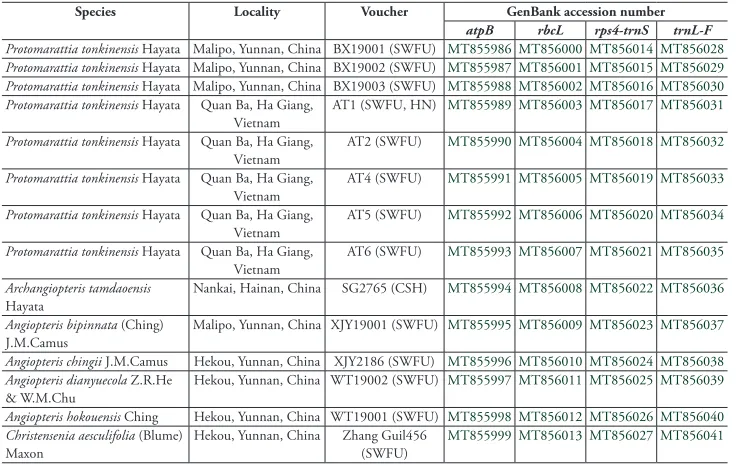
We analysed 19 samples of Marattiaceae with DNA sequences of four chloroplast regions (atpB, rbcL, rps4-trnS spacer and trnL-F spacer). Fourteen sequences of seven species were newly generated for this study and their voucher information and GenBank acces-sion numbers are presented in Table 1. Additional sequences of five species were down-loaded from GenBank and their GenBank accession numbers are presented in Table 2.
Total genomic DNA was extracted from silica-gel dried leaves using the TSINGKE plant DNA extraction kit (generic). The sequences were amplified using the primers designed by previous studies: primers e and f for trnL-F gene (Li and Lu 2006), F1 and R4 for rbcL gene (Murdock 2008a), rps5’ (Nadot et al. 1994) and trnS R (Smith and Cranfill 2002) for rps4-trnS, atpB-F1 (Murdock 2008a) and atpE 384R (Wolf 1997) for atpB. Sequencing was performed using the ABI 3730XL DNA analyser (Applied Biological Systems, Foster City, CA, USA).
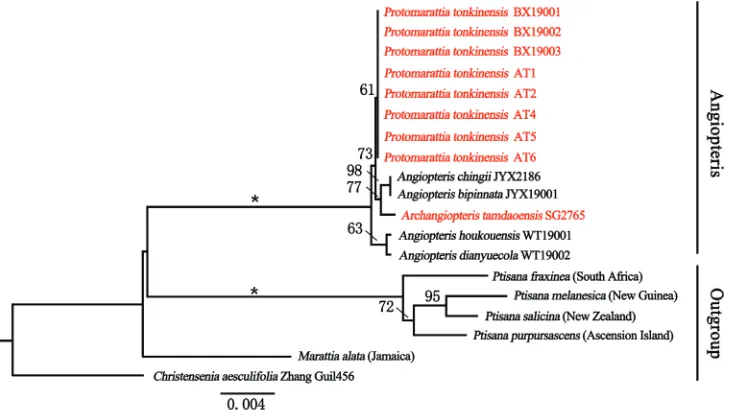
model for subset1 was GTR+G and for subset2 was GTR+I+G. Maximum Likelihood analyses were performed using IQ-TREE v.1.6.8 (Nguyen et al. 2015) with 1000 thor-ough bootstrap replicates. Bootstrap values were labelled on the tree branches.
Endangered categories analysis
Following the Red List Categories and Criteria (IUCN 2001), we used the GEO-CAT tool (http://geocat.kew.org/; Bachman et al. 2011) to assess the current status of Poromarattia tonkinensis.
Results
The spores of Protomarattia tonkinensis were roundish-oblong. The ornamentation of the external perispore was coarsely echinate with spines occasionally forked at their apices and fused at their bases. Scales peltate, reddish-brown lanceolate, margin entire to sparsely denticulate, apex acuminate and scale cells elongate (Fig. 2). Protomarattia tonkinensis is morphologically quite similar to Archangiopteris tamdaoensis Hayata (Table 3), especially the horizontal dorsiventral rhizomes and simply pinnate fronds, but the former has submarginal synangia, ca. 4–6 mm, sporangia fully fused into synan-gia which lack pedicels, whereas the latter has medial sori, ca. 7–10 mm, sporansynan-gia respectively fused at base into receptacles (Hayata 1919; He and Christenhusz 2013).
Table 1. Details o.f material newly generated in our study.
Species Locality Voucher GenBank accession number
atpB rbcL rps4-trnS trnL-F
Protomarattia tonkinensis Hayata Malipo, Yunnan, China BX19001 (SWFU) MT855986 MT856000 MT856014 MT856028
Protomarattia tonkinensis Hayata Malipo, Yunnan, China BX19002 (SWFU) MT855987 MT856001 MT856015 MT856029
Protomarattia tonkinensis Hayata Malipo, Yunnan, China BX19003 (SWFU) MT855988 MT856002 MT856016 MT856030
Protomarattia tonkinensis Hayata Quan Ba, Ha Giang,
Vietnam AT1 (SWFU, HN) MT855989 MT856003 MT856017 MT856031
Protomarattia tonkinensis Hayata Quan Ba, Ha Giang,
Vietnam
AT2 (SWFU) MT855990 MT856004 MT856018 MT856032
Protomarattia tonkinensis Hayata Quan Ba, Ha Giang,
Vietnam AT4 (SWFU) MT855991 MT856005 MT856019 MT856033
Protomarattia tonkinensis Hayata Quan Ba, Ha Giang,
Vietnam
AT5 (SWFU) MT855992 MT856006 MT856020 MT856034
Protomarattia tonkinensis Hayata Quan Ba, Ha Giang,
Vietnam AT6 (SWFU) MT855993 MT856007 MT856021 MT856035
Archangiopteris tamdaoensis
Hayata
Nankai, Hainan, China SG2765 (CSH) MT855994 MT856008 MT856022 MT856036
Angiopteris bipinnata (Ching)
J.M.Camus Malipo, Yunnan, China XJY19001 (SWFU) MT855995 MT856009 MT856023 MT856037
Angiopteris chingii J.M.Camus Hekou, Yunnan, China XJY2186 (SWFU) MT855996 MT856010 MT856024 MT856038
Angiopteris dianyuecola Z.R.He & W.M.Chu
Hekou, Yunnan, China WT19002 (SWFU) MT855997 MT856011 MT856025 MT856039
Angiopteris hokouensis Ching Hekou, Yunnan, China WT19001 (SWFU) MT855998 MT856012 MT856026 MT856040
Christensenia aesculifolia (Blume)
The combined data matrix included up to 2788 nucleotides for each of the 19 se-quences of 12 species. The phylogenetic analyses (ML) resolved eight accessions of Pro-tomarattia tonkinensis in a clade clearly separated from Archangiopteris tamdaoensis (Fig. 3). Angiopteris, Archangiopteris and Protomarattia form a monophyletic group with high support value, which proved that they were more closely related than with Ptisana.
Discussion
In the field, the populations of Protomarattia tonkinensis have eight mature individuals in Malipo and seven mature individuals (clones of the same individual excluded) in Quan Ba. Before our study, the species had not been recorded since its publication about 100 years ago. The assessment result shows that P. tonkinensis should be assessed as Critically Endangered (CR). More fieldwork is needed in similar forest regions in south-western China, Myanmar and Vietnam to confirm its distribution and conservation status.
There have been a number of controversies surrounding Protomarattia tonki-nensis since its publication. Some suggested that it should be treated as a syno-nym of Archangiopteris tamdaoensis (Christensen and Tardieu-Blot 1935; Copeland 1947; Ching 1958; Ching 1959; Chen 1964; Camus 1989; He and Christen-husz 2013), while others regarded P. tonkinensis as a “good” species and argued that Protomarattia should be treated as a different genus (Pichi-Sermolli 1968,
Table 3. Morphological comparison of Protomarattia tonkinensis and Archangiopteris tamdaoensis.
Characters Protomarattia tonkinensis Hayata(BX19001
and AT1-2)
Archangiopteris tamdaoensis Hayata(SG2765; Hayata 1919; He and Christenhusz 2013)
Frond 20–30 cm 10–40 cm
Stipe 30–40 cm 40–45 cm
Rhizome Long creeping Long creeping
Scales of stipe Reddish-brown lanceolate scales, with teeth on
the edge. Brown lanceolate scales, with teeth on the edge.
Pulvinus of stipe 1 1
Laminae Once pinnate; pinnae 2 or 3 opposite or
alternate pairs, elliptic. 25–28 cm × 5–6 cm. Once pinnate; pinnae 2–4 alternate pairs, elliptic. 20–25 cm × 4–5 cm.
Veins Obvious Obvious
Sori Synangium; locules have numerous sori; 3–5
mm from margin, ca. 4–6 mm. Sporangia are independent of each other; medial between the costa and margin, 0.7–1 cm.
Exospores Coarsely echinate Rod-like ornamentation
Table 2. Details of material downloaded from GenBank and their accession numbers.
Species Genbank accession number
rps4-trnS atpB rbcL
Marattia alata Sw. EU439108 EU439060 EU439082
Ptisana fraxinea (Sm.) Murdock. EU439131 EU439067 EU439088
Ptisana purpurascens (de Vriese) Murdock EU439132 EU439068 EU439089
Ptisana melanesica (Kuhn) Murdock EU439134 EU439069 EU439090
Figure 2. Morphological observation. Protomarattia tonkinensis (BX19001): A habit B frond
C, E, F, G, H, M, O sporangia D rhizome N scale of stipe P exospores. Protomarattia tonkinensis (AT1-2):
I whole plant J rhizome K stipe L sporangia. Archangiopteris tamdaoensis (SG2765): Q, U whole plant
R frond S, T sporangia; Archangiopteris tamdaoensis (Ching 1958): V whole plant W, X1 sporangia
X2 exospores X3 scale.
Taxonomic treatment
Angiopteris tonkinensis (Hayata) J.M.Camus
Protomarattia tonkinensis Hayata, Bot. Gaz. 67: 88. 1919; Archangiopteris tonkinensis (Hayata) Ching, Ic. Fil. Sinic. V (1958) t. 209. Basionym
Type. Vietnam. Tonkin, 30 July 1917, Bunzo Hayata s.n. (Holotype, K001057735!)
Additional specimens examined. China. Yunnan: Zhuang-miao Autonomous Prefecture of Wenshan, Malipo, Hua mountain, Chouyang river, 850 m alt., 18 May 2018, J. Y. Xiang, T. Wang, M. F. Long, BX19001 (SWFU); Vietnam. Ha Giang: Quan Ba, Thai An Commune, Seo Lung, 925 m alt., 10 October 2019, L. Averyanov, Nguyen Sinh Khang, T. Maisak, AT1 (SWFU, HN).
Distribution. Yunnan, China and Northern Vietnam.
Angiopteris tamdaoensis (Hayata) J.Y.Xiang & T.Wang, comb. nov.
urn:lsid:ipni.org:names:77211596-1
Archangiopteris tamdaoensis Hayata, Bot. Gaz. 67: 88. 1919; Protangiopteris tamdaoensis (Hayata) Hayata, Bot. Mag. Tokyo 42(498): 309. 1928. Basionym
Type. Vietnam Tonkin, August 1917, Bunzo Hayata, s.n.
Distribution. Hainan, China and Northern Vietnam.
Acknowledgements
We thank Ming-Feng Long for help in our fieldwork. Thanks go to Hui Shang, Jiang-Ping Shu and Hong-Jin Wei for their help in providing the materials of Angiopteris tamdaoensis, as well as Rrgengaowa Mo and Zuo-Ying Wei for their help in analysis. We are grateful to Samuli Lehtonen, Andrew Murdock, Thais Almeida and Li-Bing Zhang for their valuable comments.
References
Bachman S, Moat J, Hill AW, de la Torre J, Scott B (2011) Supporting Red List threat assess-ments with GeoCAT: Geospatial conservation assessment tool. ZooKeys 150: 117–126.
https://doi.org/10.3897/zookeys.150.2109
Burland TG (1999) Dnastar’s lasergene sequence analysis software. Bioinformatics Methods and Protocols 132: 71–91. https://doi.org/10.1385/1-59259-192-2:71
Camus JM (1989) The limits and affinities of Marattialean fern genera in China and the west Pacific. Proceedings of the International Symposium on Systematic Pteridology, 34–35. Chen HY (1964) Flora of Hainan. Vol. 1. Science Press, Beijing.
Ching RC (1958) Icones Filicarum Sinicarum. Vol. 5. Science Press, Beijing.
Ching RC (1959) Pteridophyta. In: Qian SC, Chen HY (Eds) Flora of China, Vol 2. Science Press, Beijing.
Ching RC (1982) Angiopteris sparsisora Ching, sp. nov. – a putative bigeneric hybrid. Zhiwu Fenlei Xuebao 20(3): 347.
Christensen C, Tardieu-Blot M (1935) Notulae Systematicae Vol. 5. Les Fougères de l’Indochine IV: Marattiaceae, Paris.
Copeland EB (1947) Genera Filicum – the genera of ferns. Cbronica Botanica Company, Waltham. Hayata B (1919) Protomarattia, A New Genus of Marattiaceae, and Archangiopteris. Botanical
Gazette (Chicago, Ill.) 67(1): 84–92. https://doi.org/10.1086/332399
He ZR, Christenhusz MJM (2013) Angiopteris Hoffmann. In: Wu ZY, Raven PH, Hong DY (Eds) Flora of China, Vol 2–3 (Pteridophytes). Science Press, Beijing and Missouri Botanical Garden Press.
He ZR, Chu WM (2006) Angiopteris Hoffmann. In: Kunming Institute of Botany, Chinese Acad-emy of Sciences (Eds) Flora of Yunnanica, Vol 20 (Pteridophytes). Science Press, Beijing. Hoffmann GF (1796) Angiopteris evecta (G.Forst.) Hoffm. Commentationes Societatis Regiae
Scientiarum Gottingensis 12: 29.
IUCN (2001) IUCN Red List Categories and Criteria: Version 3.1. IUCN Species Survival Commission. IUCN, Gland, Switzerland and Cambridge, UK, 30 pp.
Kumar S, Stecher G, Tamura K (2016) MEGA7: Molecular evolutionary genetics analysis ver-sion 7.0 for bigger datasets. Molecular Biology and Evolution 33(7): 1870–1874. https:// doi.org/10.1093/molbev/msw054
Morphologi-cal Phylogenetic Analyses. Molecular Biology and Evolution 34(3): 772–773. https://doi. org/10.1093/molbev/msw260
Li CX, Lu SG (2006) Phylogenetic and origin time of Chinese Angiopteris: Evidence from chloroplast rbcL and trnL-F sequences. Chinese Science Bulletin 23: 2761–2766.
Millay MA (1976) Synangia of north American Pennsylvanian petrified marattialeans. Ph. D. Thesis, Univ. Illinois.
Murdock AG (2008a) Phylogeny of marattioid ferns (Marattiaceae) inferring a root in the absence of a closely related outgroup. American Journal of Botany 95(5): 626–641. https:// doi.org/10.3732/ajb.2007308
Murdock AG (2008b) A taxonomic revision of the eusporangiate fern family Marattiaceae, with description of a new genus Ptisana. Taxon 57(3): 737–755. https://doi.org/10.1002/ tax.573007
Nadot S, Bajon R, Lejeune B (1994) The chloroplast gene rps4 as a tool for the study of Poaceae phylogeny. Plant Systematics and Evolution 191(1–2): 27–38. https://doi.org/10.1007/ BF00985340
Nguyen LT, Schmidt HA, von Haeseler A, Minh BQ (2015) IQ-TREE: A Fast and Effective Stochastic Algorithm for Estimating Maximum-Likelihood Phylogenies. Molecular Biol-ogy and Evolution 32(1): 268–274. https://doi.org/10.1093/molbev/msu300
Pichi-Sermolli REG (1968) The fern-genus Protomarattia Hayata. Webbia 23(1): 153–158.
https://doi.org/10.1080/00837792.1968.10669883
Smith AR, Cranfill RB (2002) Intrafamilial relationships of the thelypteroid ferns (Thelypteridaceae). American Fern Journal 92(2): 131–149. https://doi.org/10.1640/0002-8444(2002)092[0131:IROTTF]2.0.CO;2
Wolf PG (1997) Evaluation of atpB nucleotide sequences for phylogenetic studies of ferns and other pteridophytes. American Journal of Botany 84(10): 1429–1440. https://doi. org/10.2307/2446141