Formation of environmentally-persistent free
radicals (EPFR) on
a
-Al
2
O
3
clusters
Niveen W. Assaf,aMohammednoor Altarawneh, *a
Marian W. Radny,b Jomana Al-Nu'airataand Bogdan Z. Dlugogorskia
Alumina oxides assume prominent catalytic applications in a wide range of industrial processes. However, alumina surfaces also serve as potent promoters in the heterogeneous formation of the notorious environmentally-persistent free radicals (EPFR). Herein, we theoretically examine dissociative adsorption mechanisms of phenol molecules over Al2O3and hydrated Al2O3$nH2O clusters that mimic dehydrated
and hydrated alumina structures, respectively. We show thatfission of the phenol's hydroxyl bond over dehydrated alumina systematically incurs lower energy barriers in reference to the hydrated structures. A 1,2-water elimination step marks the most feasible channel in the interaction of phenol with hydrated clusters. The relevance of the acidity sites to the catalytic activity of alumina is clearly supported by the finding that the catalytic activity of the alumina surface in producing the phenoxy/phenolate species reversibly correlates with the degree of hydroxyl coverage. Desorption of adsorbed phenolates requires sizable desorption energies, and thus is expected to facilitate surface-mediated condensation into dioxin-like moieties.
1.
Introduction
Alumina oxide represents one of the most important catalytic and catalyst-support materials,1–3for chemical reactions. It also
nds direct applications in dielectric materials, substrates for electronics, packing materials and radiation dosimeters.4,5Over
the last two decades, the surface chemistry of alumina oxides has been a distinct research topic in catalysis chemistry. Most of these studies have focused on the surface/water interface conditions, where the chemistry of the surface is greatly affected and accordingly alters its reactivity and catalytic performance.6–8 The interaction of alumina surfaces with water molecules6,9–14 results in water- and hydroxyl-covered surfaces, in which the degree of coverage is highly sensitive to temperature.15Heating
and cooling processes can reversibly either add or remove hydroxyl groups from the surfaces, as conrmed experimentally by IR and NMR measurements.16,17For instance, X-ray diff
rac-tion data by Dyer et al.18 revealed the formation of Al(OH) 3
on the g-Al2O3 surface, which disappeared aer heating to
473.15 K. This has also been conrmed by Raman and infrared spectroscopy where several sharp peaks in the region around 3600 cm1have been observed aer hydration of theg-Al2O3
powder. X-ray photoemission experiments by Liuet al.19pointed
out to water dissociation; most likely at surface defect sites.
It has become evident that,3,15,20,21 the differences of the
coordination of Al atoms of the alumina surface lead to form different terminal hydroxyl termination or interactive phases. An experimental study by Pimentel and McClellan22revealed
that, surfaces encompasses two main categories of surface hydroxyl groups; isolated hydroxyl groups with a sharp infrared bands (>3600 cm1), and self-associated hydroxyl groups with a broad, intense band (<3600 cm1). Apart from this, self-associated hydroxyl groups differ from the isolated groups in the presence of the hydrogen bond connection between adja-cent moieties. Detailed examination of chemical sites on Al2O3
surface23,24conrmed thendings of Pimentel and McClellan.22
Overall,ve different classes of isolated hydroxyl groups have been detected by IR spectroscopy.21,24Kn¨ozingeret al.3attribute
the difference in vibrational frequencies among these classes to the coordination number of alumina (i.e.; either tetrahedral and/or octahedral coordination).
The chemical makeup (i.e.; adsorption and decomposition) of the hydroxyl groups over alumina surface constitutes a key factor in clarifying the reactive/catalytic nature of alumina. As stated earlier, heating can reversibly remove the hydroxyl groups from the alumina surface,16,17,25leading to the formation
of Lewis acid–base pair sites, and thus increases the catalytic activity of the surface. Along a similar line of enquiry, Ballinger and Yates26 have performed a detailed investigation into the
correlation between Al–OH group removal and the number of Lewis acid sitesviaCO molecular adsorption. The authors have found that, heating leads to the decomposition of the associ-ated hydroxyl groups, leaving only isolassoci-ated hydroxyl groups on aSchool of Engineering and Information Technology, Murdoch University, Perth,
Australia. E-mail: [email protected]; Tel: +61 8 9360 7507 bSchool of Mathematical and Physical Sciences, The University of Newcastle, NSW,
Australia
Cite this:RSC Adv., 2017,7, 52672
Received 28th August 2017 Accepted 25th October 2017
DOI: 10.1039/c7ra09527a
rsc.li/rsc-advances
PAPER
Open Access Article. Published on 15 November 2017. Downloaded on 08/12/2017 05:08:47.
This article is licensed under a
Creative Commons Attribution 3.0 Unported Licence.
View Article Online
the surface at a temperature range of 475–800 K. This has been viewed as the driving force of the catalytic activity of alumina, eitherviahydrogen bonding to the hydroxyl group and/orvia
lone pair donation to Lewis acid sites. A study by Hendriksen
et al.27measure the heat of adsorption of water on botha- andg
-alumina powdersviaimmersion calorimetry. It has been indi-cated that, the heat of adsorption on both termination depends primarily on the degree of hydration prior to water adsorption. Over a wide range of operational pressure and temperatures, alumina exhibits a variety of crystallographic structures such as
aphase or corundum, which is the most thermodynamically
stable phase,28and other alumina phases such asd,b,k,h,q
andg.29,30Literature density function theory (DFT)
investiga-tions have considered water adsorption and dissociation overa -Al2O3surfaces from the dry to the fully hydroxylated surfaces. A
detailed analysis and discussion on the subject was presented by Wanget al.31The authors have found that, a fully hydrated
alumina a-Al2O3 (0001) surface, when the surface Al atom is
triply hydroxylated, exhibits relatively inertness toward further hydroxylation. In an insightful analysis into the interaction of water molecules and aa-Al2O3(0001) surface, Wirth and
Saal-frank32found that 1,2-dissociation pathway is the most
kineti-cally feasible mechanism, where Al surface atoms are hydroxylated and the nearby oxygen atoms are protonated.
Recent theoretical investigations addressed the interaction of hydrated and dehydrateda-Al2O3surfaces towards different
molecules.33–35 Shukla and Hill33 have performed a detailed
investigation of the molecular interaction of 2,4,6-trinitrotol-uene (TNT) molecule with thea-Al2O3(0001) surface
demon-strating that TNT acquires strong covalent interaction in a parallel orientation with the surface. The same group34
found that molecular adsorption of TNT over hydroxylated alumina surface is much weaker when compared to the dehydrated surface. Similarly, Rohmannet al.35 investigated
molecular interaction of carbon monoxide with hydroxylated alumina surface, reporting that molecular CO exhibits strong interaction with a 25% degree of hydroxylated surface and this interaction is signicantly stronger when compared with that over the clean dehydrated alumina. In a follow-up study on H2S removal via g-Al2O3 surfaces with different hydroxyl
coverage, Renet al.36 revealed that, the bonding strength of
H2S on hydrated alumina surface is lower than that the over
a dehydrated termination. For example, calculated binding energy for 8.9 OH per nm2hydroxyl coverage forg-Al2O3(110)
amounts to68 kJ mol1whereas the corresponding value of the dehydrated surface stands at114 kJ mol1. XPS studies by Kelberet al.37investigated the interaction between Cu and
the hydrated a-Al2O3 (0001) surface to report an enhanced
interaction of copper to the surface of alumina owing to the presence of a surface hydrated layer. There is a rather limited literature account on reactions of hydrocarbons on alumina clusters. Most of relevant studies have considered extended surfaces of alumina.34,35,38Nonetheless, it has been shown that
alumina clusters encompass effective catalytic active sites present on surfaces; i.e., the surface Al–O bonds.39,40
There-fore, alumina clusters in many theoretical studies (i.e.
(Al2O3)n¼4) are being applied as representative models for both
a-Al2O3 andg-Al2O3 surfaces. Alumina clusters imitate both
the experimental measurements and DFT surface properties. Additionally, clusters41,42were shown to illustrate an effective
stability against relaxation oen encountered in extended alumina surfaces.
Phenol molecule is among the most commonly discussed precursors for the synthesis of poly chlorinated dibenzo-p
-dioxins and dibenzofurans (PCDD/Fs).43–45 Heterogeneous
formation of PCDD/Fs viasurface-mediated coupling of chlo-rinated phenols were investigated on many oxide systems, including Al2O3,46,47Co3O4,46CuO,48,49TiO2(ref. 47) and Fe2O3.50
In our recent study,51we theoretically investigate the interaction
of phenol molecule with the dehydrateda-Al2O3(0001) surface.
We have found that, alumina surface is catalytically very active in producing phenolate (i.e., surface-bounded phenoxy) with a modest activation energy of 43 kJ mol1, thus, signifying as an accessible route for the formation of persistent surface-bound radicals. However, when considering the temperature range of the cooling-down zone of the combustor (i.e.; 746–1146 K), all
models of alumina (i.e.; polymorphs, surfaces and\or clusters) assume different hydration coverage. Therefore, the effect of the degree of hydration, on dissociative adsorption of phenol, can play an important role in attaining a detailed understanding of the catalytic activity of the surface. Thus, it is very important to shed light into the generation of the environmentally persistent free radicals (EPFRs)52,53 on alumina surface with varying
hydroxyl coverages.
In summary, the current work is part of our ongoing effort to reveal mechanistic and kinetic factors dictating the catalytic role of alumina surfaces in surface-mediated formation of phenoxy-type EPFR. The study provides a detailed investigation of the interaction of a phenol molecule with different hydration coverage of alumina clusters and therefore offers important insights into the role of the surface adsorbed water in the catalytic activity of alumina toward the generation of adsorbed phenoxy radicals. The present study expands on our recent investigation,51 in which we considered a dehydrated a-Al
2O3
(0001) surface. Overall, this study has a three-fold aim; (i) to report modes of interaction of phenol with different hydration coverages of alumina clusters, (ii) to compare between the catalytic activity of hydrated and dehydrated alumina clusters toward the formation of the adsorbed phenolateviatwo distinct pathways; namely directssion of the phenol' O–H bond and elimination of water molecules and to (iii) to construct a simplied kinetic model for the conversion of phenol into adsorbed phenoxy radicals.
2.
Methodology
DMol3program54,55performs all structural optimization, energy
calculations and vibrational frequencies based on the general-ized gradient approximation (GGA) of the
Perdew–Burke–Ern-zerhof (PBE) functional.56 The computational methodology
comprises Grimme dispersion correction,57together with the
basis set of double numerical plus polarization (DNP). Total energy and forces on each atom converge with tolerance to less than 106eV and 104eV˚A1, respectively.
Open Access Article. Published on 15 November 2017. Downloaded on 08/12/2017 05:08:47.
This article is licensed under a
We computed the binding energies (Eb) for the adsorption
based on the energies of a phenol/Al2O3systemEcluster+phenol,
the clean alumina cluster Ecluster, and an isolated phenol
moleculeEphenol:
Eb¼Ecluster+phenolEclusterEphenol (1)
Reaction rate constants were estimated based on the conventional transition state theory (TST),58wet reaction rate
constants to the two-parameters Arrhenius formula, k(T) ¼
Aexp(Ea/(RT), over the temperature range of 300 K to 1000 K,
according to:
kðTÞ ¼ kBT
seh exp
DSs
R
exp
DHs RT
(2)
where:kBis Boltzmann's constant,hsignies Plank's constant,R
is the universal gas constant. Calculated vibrational frequencies enable to calculate thermodynamic functions;i.e., entropies and enthalpies. DSs and DHs stand for temperature-depended entropy and enthalpy of activation, correspondingly. se
repre-sents the reaction degeneracy number. DMol3computes entropy values based on well-documented statistical thermodynamics equations.59The enthalpy (at the desired temperature) has been
competed relatively to the zero-point energy at 0 K.
3.
Results and discussions
3.1. Water adsorption on Al2O3cluster
Starting with dehydrated alumina clusters, Fig. 1 displays two water-free geometrical monomers of alumina near-cyclic AlO3Al
that adaptD3h symmetry, and a linear O]Al–O–Al]O chain
structure. As illustrated in Fig. 1, the cyclic dehydrated alumina, AlO3Al, contains three Al–O bonds with distances of1.82A.˚
This structure was found to be energetically less stable60than
the linear chain structure due to the repulsion between the two cations (Al3+). In the latter conguration, alumina adapts a linear structure with one bridging and two non-bridging oxygen atoms. Calculated bond angle and bond lengths, in both structures, are in agreement with the literature analogous values.60,61
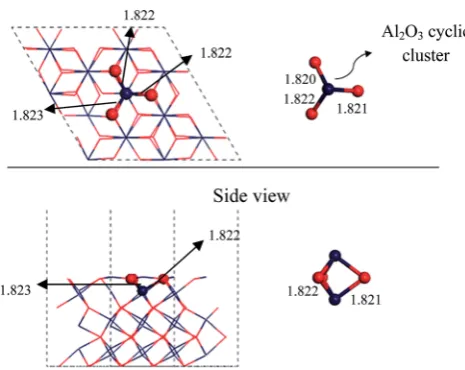
Moving on now to consider how the geometries of alumina cluster are compared with those in alumina surface. Fig. 2 displays top and side views ofa-Al2O3(0001) surface (i.e., the
thermodynamically most stable alumina surface62,63) and the
D3h structure. As can be seen from the gure, Al–O bonds
lengths in both structures are within 0.01 ˚A. This close
agreement serves to testify that considered cyclic dehydrated structure contains similar active sites to those present in the surface.
A study by Johnson and Panas60examine water adsorption
and hydrolysis on molecular Al oxides and hydroxides solvation
versuscluster formation. They found that, dehydrated alumina clusters, both cyclic and linear chain, reacts with water mole-cules through accessible energy barriers in the range of 33– 110 kJ mol1. Further addition of water molecules leads to a series of Al2O3$nH2O structures.
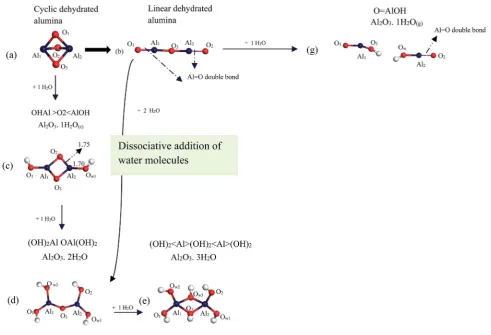
Fig. 3 illustrates mechanism of successive addition of water molecules to the dehydrated cluster of alumina (i.e.; cyclic and linear clusters). Starting with the cyclic structure of alumina,
D3h, the addition of a water molecule to the Al2–O1bond results
in the formation of the Al2O3$1H2O(c)cluster (c) which has been
reported to be the most stable structure among the various congurations of Al2O4H2 clusters.60 Typically, this structure
assumes cisand trans congurations, with very similar ther-modynamic stability.60 Thus, we have performed our
subse-quent calculations considering the cis planar molecule
congurations with theC2vsymmetry as it is marginally more
thermodynamically stable than its trans counterpart; by
3 kJ mol1. Calculated Al2–O2and Al2–Ow1bond lengths amount
to 1.75A and 1.70˚ A, respectively. These values concur very well˚ with the corresponding literature values by Johnson and Panas;60i.e., 1.75˚A and 1.69˚A, respectively.
Fig. 1 Optimised geometries for dehydrated Al2O3clusters with the main geometrical parameters (inA). Bond lengths in parentheses signify the˚
corresponding experimental or theoretical values from the literature a,60b.61
Fig. 2 Geometrical comparison between Al2O3cyclic cluster and the
a-Al2O3(0001) surface.
Open Access Article. Published on 15 November 2017. Downloaded on 08/12/2017 05:08:47.
This article is licensed under a
Turning now to the linear chain structure, the addition of water can proceed eitherviacluster Al]O double bond site or
via cleaving the central Al–O–Al bond.60 This results in the
formation of the Al2O3$2H2O cluster (d) and O]AlOH (g),
respectively. Considering the double bond pathway; further addition of a water molecule produces the cluster Al2O3$3H2O
(e), with theC2hsymmetry. Energetics for the formation of the
hydrated alumina structures in Fig. 3 has been reported by Johnson and Panas.60The authors found that formation of (c)
and (e) structures display an exothermic process with calculated enthalpies of310 kJ mol1and184 kJ mol1, respectively.
The formation of structure (g) is slightly endothermic with a low activation enthalpy at 33 kJ mol1.60
3.2. Reaction of phenol with dehydrated alumina cluster
We studied the interaction of a phenol molecule with the two dehydrated alumina clusters (i.e.; cyclic and linear clusters in Fig. 3a and b). Two different reactions have been considered, denoted as pathway a and pathway b. These pathways involve the interaction of phenol molecule with cyclic and linear dehydrated alumina clusters, respectively. The optimized geometries for the reactants, transition states and products are presented in Fig. 4. Table 1 lists energies for physisorbed congurations and dissociative structures as well as prominent interatomic distances for all pathways.
Werst consider the interaction along the cyclic alumina structure, pathway a. Fig. 4(a) shows, phenol molecule phys-ically adsorbed on the cluster through a van der Waals interaction between Ophenol atom and Alcluster atom with
a binding distance of 1.909A. The interaction proceeds˚ via
ssion of the hydroxyl's bond over Al–O cluster bond where phenoxy moiety attaches to Alcluster and deducted hydrogen
atom binds to Ocluster atom. This has resulted in the
opti-mised dissociation productPa. Hence, the length of this bond
increases by 13.4% with respect to that of the clean cyclic cluster (1.822˚A). This value concurs with results obtained in our recent study51of the dissociative adsorption of phenol on
the dehydrated a-Al2O3 (0001) surface (11.9%). In
compar-ison, Wanget al.31showed that the elongation of Al–O bond
increased by 6.4% upon the dissociation of a water molecule over this Al–O bond.
The reaction is highly exothermic with an energy barrier of only 41 kJ mol1. Calculated binding energy of the reactant,Ra,
and the product, Pa, are 129 kJ mol1 and 241 kJ mol1,
respectively (based on eqn (1) in reference to separated reac-tants). These values also agree with the results obtained in our recent study.51We found that, phenol molecule strongly
inter-acts with the dehydrateda-Al2O3(0001) surfaceviaphysisorbed
binding energies in the range of 127 kJ mol1 to
202 kJ mol1, leading to the formation of an adsorbed
phenolate with a modest activation energy of 48 kJ mol1. Fig. 3 Structures of the Al2O3+nH2O.
Open Access Article. Published on 15 November 2017. Downloaded on 08/12/2017 05:08:47.
This article is licensed under a
Considering the second reaction, where phenol molecule interacts with the linear cluster chain of alumina (pathway b), phenol molecule physically adsorbs on the active Al]O double bond site of the cluster with a calculated binding distance of 2.26˚A. The O–H bond length of phenol molecule inRb(Fig. 4)
increases from the equilibrium 0.97A distance in the gas phase˚ to 1.016˚A. The exothermic formation of the productPbrequires
a trivial activation energy of 10 kJ mol1(viadirectssion of the phenol's O–H bond catalysed by the cluster's Al–O linkage). Calculated binding energies of the reactant,Rb, and the product,
Pb, are152 kJ mol1and345 kJ mol1, respectively (in
refer-ence to the separated reactants, Fig. 4).Pbappears relatively more
stable than Pa. Activation barrier via pathway b is lower by
31 kJ mol1than that along pathway a. This indicates that, the
linear chain cluster of alumina is catalytically more active in producing phenolate than the cyclic dehydrated cluster.
Test computations employing the dependence of the reac-tivity of alumina cluster on the cluster size has been considered. We investigated physisorption and chemisorption interactions of phenol with the larger (Al2O3)4 reported in the literature.64 Fig. 4 Optimised geometries for species in the reaction of phenol with dehydrated alumina clusters. Values (in kJ mol1) of energies are in reference to physisorbed reactant.
Table 1 Binding energies (using eqn (1)) and geometrical parameters for phenol interaction with Al2O3and Al2O3$nH2O clusters
Structure
Phenol-cluster spacing in the reactant (˚A)
O–H phenol bond distance in the reactant (˚A)
Al–O bond distance in the reactant (A)˚
Binding (for reactants) and reaction (for products) energies (kJ mol1)
Pathway a 1.909 0.982 1.788 Ra¼ 129
Pa¼ 241
Pathway b 2.260 0.985 2.260 Rb¼ 152
Pb¼ 345
Pathway c1 2.007 0.997 1.793 Rc1¼ 143
Pc1¼ 225
Pathway c2 1.979 0.991 1.739 Rc2¼ 147
Pc2¼ 167
Pathway c3 1.997 0.990 1.742 Rc3¼ 129
Pc3¼17
Pathway g 1.940 1.009 1.630 Rg¼ 166
Pg¼ 360
Pathway d 1.725 1.004 1.733 Rd¼ 81
Pd¼ 74
Pathway e 1.75 1.007 1.738 Re¼ 99
Pe¼ 135
Open Access Article. Published on 15 November 2017. Downloaded on 08/12/2017 05:08:47.
This article is licensed under a
Stable optimised structures are shown in Fig. 5 calculated binding energies of the physisorbed and the chemisorbed structures are150 kJ mol1and315 kJ mol1, respectively, both values are in a good agreement with the corresponding values we obtained for the smaller dehydrated clusters (i.e.,
129 to 152 kJ mol1 and241 to 345 kJ mol1, respec-tively). Furthermore, binding energies obtained for the larger (Al2O3)4 cluster are consistent with the calculated binding
energies in our recent study51for the interaction of phenol with
a seven-layer slab of the 2 2 (0001) surface alumina
(127 kJ mol1to202 kJ mol1). Thus, it can be concluded that energies of the surface interaction of phenol with alumina surface do not display sensitivity toward the cluster size. The same observation has been observed by Pan et al.65 in their
study of the reaction of 2-chlorophenol over the dehydrated and hydroxylated silica clusters with (SiO2)3 and (SiO2)8 clusters.
They have found that binding energies of reactants and prod-ucts using both structures are within (0.4–17.4) kJ mol1.
3.3. Reaction of phenol with Al2O3$nH2O cluster
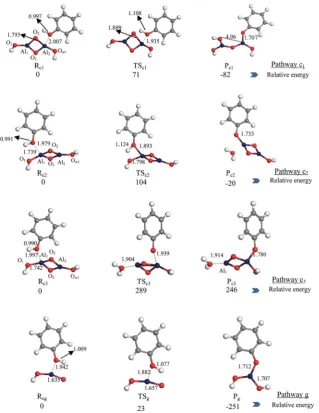
We now turn our attention to investigate the interaction of a phenol molecule with hydrated alumina clusters entailing different hydroxylation coverages, (i.e., all the hydrated alumina clusters shown in Fig. 3). The detailed mechanism of the interaction is presented in Scheme 1. Fig. 6 depicts optimised geometries of reactants, transition states, and products; along with their energy proles.
First, we have studied the interaction of a phenol molecule with the (c) structure, Fig. 3. Three possible pathways have been considered, denoted as c1, c2and c3in Scheme 1. As Scheme 1
demonstrates, these reaction pathways characterise (i)ssion of hydroxyl's bond over the same Al2–O2bond (bridging bond), (ii)
H2O elimination mechanism over the same Al–OH bond (1,2
non-bridging) and (iii) H2O elimination route over two Al–OH
bonds (1,4 non-bridging linkage), respectively (Fig. 3 illustrates atomic numberings). The reaction is initiated by the physisorbed-type interaction between Ophenol and Alcluster via
binding spacings of 2.007A, 1.979˚ A and 1.997˚ A in the reactants˚
Rc1,Rc2andRc3, respectively (Fig. 6). Calculated binding energies
of the three reactants stand at143 kJ mol1,147 kJ mol1
and129 kJ mol1, respectively (in reference to the separated reactants). Regarding to the structural changes induced to the cluster; we observe that Al2–O2 bridging bond in Fig. 6, Rc1
elongates by 2.4% when compared with the corresponding value in the Fig. 3(c) structure while Al1–O1inRc2and Fig. 6,Rc3
increases by 8.1% and 8.2%, respectively. Dissociative desorp-tion of phenolviathese pathways leads to the formation ofPc1,
Pc2 and Pc3 (Fig. 6) intermediates with reaction energies of 225 kJ, 167 kJ mol1 and 17 kJ mol1, respectively. The thermodynamic penalty associated with the product Pc3 most
likely stem from the low coordinated Al1that display a 2-fold
coordination.66
Next, we examine the dissociative adsorption of phenol over the Fig. 3(g) structure. The reaction proceedsviathe active Al] O double bond site of the cluster. We found a slight increase in the O–H bond length of the physisorbed phenol in pathway g (1.009˚A, Scheme 1), in reference to the gas phase value (0.97˚A). The corridor g in Scheme 1 characterisesssion of the O–H bond in the phenol molecule in a noticeably exothermic reac-tion of 360 kJ mol1. The physisorbed state Fig. 6 (R
g) in this
channel resides 166 kJ mol1 below the separated reactants.
Compared to Fig. 3(d), the size of hydrated alumina cluster (g) with one water molecule is smaller and it has a planner struc-ture. Therefore, as temperature increases, molecules move faster and they are more likely to collide and hence positively affect the collision frequency,A.
Reaction pathways c1, c2and g proceedsviamodest energy
barriers of 71 kJ mol1, 104 kJ mol1and 23 kJ mol1, respec-tively, whereas pathway c3incurs a very sizable energy barrier of
289 kJ mol1. Three concluding remarks can be drawn from values in Fig. 6. First, within Al2O3$1H2O system (i.e.;
pathways: g, c1, c2, c3), as expected, reaction pathway g is the
most favourable channel, presumably due to the presence of the active Al]O double bond site. Second, phenol dissociation catalysed/accompanied with water elimination (pathways c2
and c3) is more energy demanding than phenol decomposition
through surface-assisted ssion of its hydroxyl O–H bond
(pathways c1). For instance, the activation energy in pathway c1
is lower by 33 kJ mol1than that along pathway c2. Third, the
activation energy in reaction pathway c3as well as the calculated
binding energy of the productPc3 are higher when contrasted
with the corresponding values in pathway c2, this indicates that
water elimination preferentially occurs at the same A-OH linkage;i.e., 1.2-elimination step rather than at different A-OH sites (i.e., 1,4-elimination). This has prompted us to exclude this mechanism (i.e.; pathway c3) from further consideration in
our subsequent discussion.
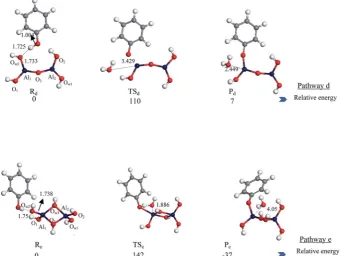
Phenol interaction with higher hydrated alumina clusters (Al2O3$2H2O (d) and Al2O3$3H2O Fig. 3(e)) is presented in
pathways d and e in Scheme 1, with Fig. 7 illustrates optimised geometries and relative energies for species involved in path-ways d and e.
Water eliminationviapathways d and e (Scheme 1) results in the formation of a phenolate moietyviaactivation barriers of 110 kJ mol1and 142 kJ mol1, respectively. Pathways d and e characterise dissociative adsorption of phenolviawater elimi-nation through 1,2-route;i.e., attachment of the phenoxy'O at Fig. 5 Optimised geometries for the reaction of phenol with the
(Al2O3)4cluster.
Open Access Article. Published on 15 November 2017. Downloaded on 08/12/2017 05:08:47.
This article is licensed under a
the Al atom and the simultaneous departure of the OH group attached to the same Al atom with the hydroxyl'H as a water molecule. Higher energy barrier for pathway e in reference to
pathways c2 and d can be rationalised in energy penalty
required for the rupture of the Al–O linkage in the former. The degree of hydration of alumina; could be viewed as a factor that partially dictates the catalytic activity of aluminaviacontrolling the surface-acid properties.67In this regard, Al atom in structure
(e) (the Al2O3$3H2O system), is coordinated by four hydroxyl
groups, whereas Al atom in c2and d, is less coordinated
pre-senting more acidic structures as illustrated in Scheme 2. From the scheme, we can see that, the addition of water molecule in the structure dblocks the Lewis active site and accordingly
decreases the catalytic activity of the cluster. This view is sup-ported by Digneet al.68who argued that the lower the Al atom
coordination, the stronger – the Lewis acidity. Calculated atomic Mullikan charges on Al atom for (c), (d) and (e) were shown to have more positive values on the four coordinated Al atom of 1.69e(structure (e)) when compared to the three coor-dinated Al atom (i.e., 1.52ein structures (c) and (d)). A positive correlation is found between the calculated energy barrier and calculated Mulliken atomic charges;i.e., the higher the atomic charges on Al atom, the higher energy required to break Al–OH bond toward generating water molecule (accompanied with the dissociative adsorption of phenol). Thus, the observed increase
in barrier for pathway e in reference to pathways c2 and
Scheme 1 Reaction of phenol with the hydrated Al2O3cluster. The highlighted reactions proceedviaH2O elimination (presenting H2O
elimi-nation mechanism over the same Al–OH bond (1,2 non-bridging)).
Open Access Article. Published on 15 November 2017. Downloaded on 08/12/2017 05:08:47.
This article is licensed under a
d correlates with partial atomic charges;i.e., a prominent elec-tronic descriptor that determines the acidity character.
Overall, we can compare between hydrated and dehydrated alumina from two different perspectives. First, withinssion of hydroxyl's bond reactions over the same Al–O bond; contrasting pathway Fig. 6 c1with pathway a reveals that, the energy barrier
required in hydrated alumina clusters (i.e.; c1¼71 kJ mol1) are
signicantly higher than that over the dehydrated one (i.e.; a¼ 41 kJ mol1), respectively. Second, saturation of Al]O double bonds in the course of the hydroxylation of cluster b into d (refer to Fig. 3) signicantly increases the barrier required for water elimination from only 10 kJ mol1to 110 kJ mol1. Together,
thesendings indicate that dehydrated alumina cluster are more active in producing phenolate than hydrated alumina clusters. This observation agrees with thendings of Pan et al.65who
found that, the dehydrated silica cluster (with the presence of two ends of S]O double bonds sites) produces chlorophenolate from 2-chlorophenol through an energy barrier of only 21 kJ mol1,
compared with 70 kJ mol1over the hydrated cluster (the same cluster aer the two Si]O double bonds sites become saturated). The most obviousnding to emerge from inspection of data in Table 1 is that, in both hydrated and dehydrated alumina, the dissociated productviaAl]O double bonds site of the cluster is more stable than that leading to Al–O bond cleaving. For example, reaction energies that mark the formation ofPgandPb
(double bonds sites) amount to 360 kJ mol1 and
345 kJ mol1, respectively, while the analogous energies ofPc1
and Pa are 225 kJ mol1 and 241 kJ mol1, (A–O bond
ssion), respectively. Thisnding is in agreement with those obtained by Pan et al.65 The authors found that dissociative
adsorption of 2-chlorophenol through rupture of its hydroxyl's bond over a S]O double bonds site forms more stable product by 136 kJ mol1than that leading to Si–O bond cleaving.
Desorption of the phenolate moiety from both dehydrated alumina cluster and hydrated alumina clusters, was found to be highly endothermic by 334–373 kJ mol1. This nding is in Fig. 6 Optimised geometries involved in the reaction of phenol with c and g clusters. Values (in kJ mol1) of energies are in reference to
physisorbed reactants.
Open Access Article. Published on 15 November 2017. Downloaded on 08/12/2017 05:08:47.
This article is licensed under a
accord with those reported in our recent study for the interac-tion of phenol51 and chlorophenol69molecules over alumina
surfaces and silica clusters, 394 kJ mol1 and 379 kJ mol1 respectively. This profound stability of phenolate enables it to undergo bimolecular reactions via the so called Eley–Rideal
(ER) and Langmuir–Hinshelwood (LH) mechanisms48 to
produce dibenzo-p-dioxin and dibenzofuran; respectively. In alternative corridor, decomposition of phenolate on the surface is expected to initiate the formation of soot.
3.4. Kinetic consideration
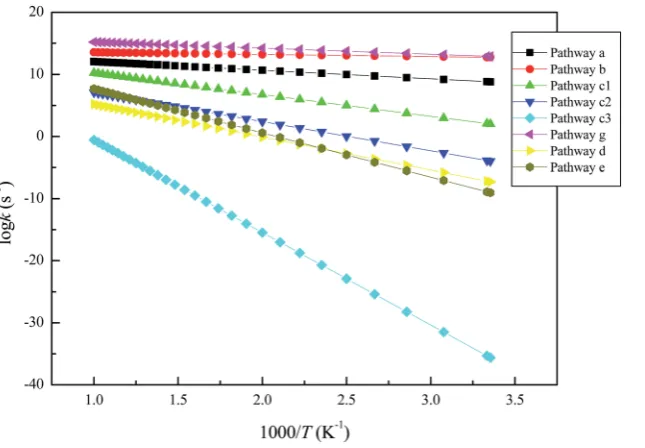
We conclude the study by implementing a microkinetic analysis of the abovementioned reactions in this study. Fig. 8 represents
Arrhenius plots while Table 2 displays the calculated reaction rate parameters. Within the considered temperature limit, reactions pathway c3displays the highest activation energy and
relatively high dependence on temperature. For all reactions, the tted Arrhenius energy of activation (Ea) largely reects
corresponding energy barriers presented in Fig. 3, 6 and 7.
Calculations of the conversion-temperature proles were
carried out based on a simplied plugow reactor (PFR) model. The material balance equations were solved by Polymath soware:70
rB¼ rA¼
dðFÞ
dðWÞ (3)
Fig. 7 Optimised geometries involved in the reaction of phenol with d and e clusters. Values (in kJ mol1) of energies are in reference to
physisorbed reactants.
Scheme 2 Structure of acidic and basic site of alumina cluster.
Open Access Article. Published on 15 November 2017. Downloaded on 08/12/2017 05:08:47.
This article is licensed under a
In the considered reaction, (A/B), A and B represents the molecularly adsorbed phenol and the dissociative structures; respectively.rdenotes the reaction rate,Fsymbolizes the molar
ow rate of phenol in mol s1, and W stands for alumina catalyst weight in kg. The reaction is considered to berst order with respect to phenol. The model utilises reaction rate constants given in Table 2. The catalytic destruction of phenol molecule over Al2O3$nH2O catalysts as a function of
tempera-ture is presented in Fig. 9. It can be seen that all hydrated coverage of alumina clusters exhibits a highly catalytic destruction activity for phenol molecule, evident by high conversion at low temperatures. Calculated temperature of 90% destruction of phenol molecule (T90%) occurs at 350 K, 925 K,
425 K and 425 K for pathways c2, c3, d and e, respectively. To the
best of our knowledge, literature provides no conversion values pertinent to interaction of phenol witha-Al2O3. Considering the
very high desorption energy for phenolate, formation of gas Fig. 8 Arrhenius plots for the studied reactions.
Table 2 Arrhenius kinetic parameters
Reaction Ea(kJ mol1) A(s1)
Pathway a 27 2.761013
Pathway b 7 7.501013
Pathway c1 67 5.601013
Pathway c2 90 6.351011
Pathway c3 285 2.091014
Pathway g 19 1.501016
Pathway d 102 3.291010
Pathway e 136 6.281014
Fig. 9 Conversion values for phenol molecule decomposition over Al2O3$nH2O clusters.
Open Access Article. Published on 15 November 2017. Downloaded on 08/12/2017 05:08:47.
This article is licensed under a
phase phenoxy should be hindered. The LR and LH mecha-nisms operated by the highly stable surface-bounded phenolate species, remains largely speculative.
4.
Conclusion
This study sets out to assess the effect of surface acidity on the interaction of alumina with phenol molecules. Interaction of phenol molecule with dehydrated alumina clusters proceedsvia
ssion of the hydroxyl's bond over either Al–O single bond or Al]O double bond. Clusters with the active Al]O double bond (i.e., b) are catalytically more active in producing phenolate when compared to structures where all bonds are saturated (i.e., a, Al–O single bonds). Overall, c channels that proceeds through
ssion of the hydroxyl's bond over Al–O (i.e.; c1) are more
feasible than those proceedingviaH2O elimination routes (i.e.;
c2and c3). The most obviousnding to emerge from this study
is that adding water molecules increases the coordination number of Al atoms and acts to black available Lewis acid sites for uptake of phenol molecules. Simplied kinetics model suggests dissociation of phenol molecules at low temperatures; however, subsequent desorption of adsorbed phenolate into gas phase phenoxy radicals is hindered by very sizable desorption energies.
Con
fl
icts of interest
There are no conicts of interests to declare.
Acknowledgements
This work has been supported by the Australian Research Council (ARC) (Project no. DP140104493). The National Computational Infrastructure (NCI), Australia and Pawsey Supercomputing Centre in Perth are also acknowledged grants of computational time. N. A. and J. A. greatly appreciated
Murdoch University for the award of a postgraduate
scholarship.
References
1 K. Tanabe,Catalysis science and technology, Springer-Verlag, Berlin, 1981.
2 H.-P. Boehm and H. Kn¨ozinger, Catalysis science and
technology, Springer, Berlin, 1983.
3 H. Kn¨ozinger and P. Ratnasamy,Catal. Rev.: Sci. Eng., 1978,
17, 31–70.
4 W. H. Gitzen, Alumina as a ceramic material, American Ceramic Society, Columbus, 1970.
5 R. H. French,J. Am. Ceram. Soc., 1990,73, 477–489.
6 P. J. Eng, T. P. Trainor, G. E. Brown Jr, G. A. Waychunas, M. Newville, S. R. Sutton and M. L. Rivers, Science, 2000,
288, 1029–1033.
7 J. W. Elam, C. E. Nelson, M. A. Cameron, M. Tolbert and S. M. George,J. Phys. Chem. B, 1998,102, 7008–7015.
8 K. C. Hass, W. F. Schneider, A. Curioni and W. Andreoni,J. Phys. Chem. B, 2000,104, 5527–5540.
9 S. E. Mason, C. R. Iceman, T. P. Trainor and A. M. Chaka,
Phys. Rev. B: Condens. Matter Mater. Phys., 2010, 81, 125423–125439.
10 D. Argyris, T. Ho, D. R. Cole and A. Striolo,J. Phys. Chem. C, 2011,115, 2038–2046.
11 K. C. Hass, W. F. Schneider, A. Curioni and W. Andreoni,
Science, 1998,282, 265–268.
12 A. C. Thomas and H. H. Richardson,J. Phys. Chem. C, 2008,
112, 20033–20037.
13 L. Zhang, C. Tian, G. A. Waychunas and Y. R. Shen,J. Am. Chem. Soc., 2008,130, 7686–7694.
14 H. A. Al-Abadleh and V. H. Grassian, Langmuir, 2003, 19, 341–347.
15 D. B. Mawhinney, J. A. Rossin, K. Gerhart and J. T. Yates,
Langmuir, 1999,15, 4789–4795.
16 O. Glemser and G. Rieck,Angew. Chem., 1956,68, 182. 17 O. Glemser,Angew. Chem., 1961,73, 785–805.
18 C. Dyer, P. J. Hendra, W. Forsling and M. Ranheimer,
Spectrochim. Acta, Part A, 1993,49, 691–705.
19 P. Liu, T. Kendelewicz, G. E. Brown, E. J. Nelson and S. A. Chambers,Surf. Sci., 1998,417, 53–65.
20 J. B. Peri and R. B. Hannan,J. Phys. Chem., 1960,64, 1526–
1530.
21 J. Peri,J. Phys. Chem., 1965,69, 220–230.
22 G. C. Pimentel and A. L. McClellan, The Hydrogen Bond, Freeman, San Francisco, 1960.
23 T. H. Ballinger and J. Yates,J. Phys. Chem., 1992,96, 1417–
1423.
24 M. I. Zaki and H. Kn¨ozinger,Mater. Chem. Phys., 1987,17, 201–215.
25 D. D. Eley, H. Pines and P. B. Weisz,Advances in Catalysis, Academic Press, New York, London, 1966.
26 T. H. Ballinger and J. T. Yates Jr,J. Phys. Chem., 1992,96, 1417–1423.
27 B. A. Hendriksen, D. R. Pearce and R. Rudham, J. Catal., 1972,24, 82–87.
28 J. M. McHale, A. Navrotsky and A. J. Perrotta,J. Phys. Chem. B, 1997,101, 603–613.
29 C.-K. Lee, E. Cho, H.-S. Lee, K. S. Seol and S. Han,Phys. Rev. B: Condens. Matter Mater. Phys., 2007,76, 245110–245117.
30 I. Levin and D. Brandon,J. Am. Ceram. Soc., 1998,81, 1995–
2012.
31 B. Wang, H. Hou, Y. Luo, Y. Li, Y. Zhao and X. Li,J. Phys. Chem. C, 2011,115, 13399–13411.
32 J. Wirth and P. Saalfrank,J. Phys. Chem. C, 2012,116, 26829–
26840.
33 M. K. Shukla and F. Hill,J. Phys. Chem. C, 2013,117, 13136–
13142.
34 M. K. Shukla and F. Hill,J. Comput. Chem., 2014,35, 1977–
1985.
35 C. Rohmann, J. B. Metson and H. Idriss,Phys. Chem. Chem. Phys., 2014,16, 14287–14297.
36 R.-P. Ren, X.-W. Liu, Z.-J. Zuo and Y.-K. Lv,RSC Adv., 2015,5, 55372–55382.
37 J. A. Kelber, C. Niu, K. Shepherd, D. R. Jennison and A. Bogicevic,Surf. Sci., 2000,446, 76–88.
Open Access Article. Published on 15 November 2017. Downloaded on 08/12/2017 05:08:47.
This article is licensed under a
38 S. D. Chakarova-K¨ack, Ø. Borck, E. Schr¨oder and B. I. Lundqvist,Phys. Rev. B: Condens. Matter Mater. Phys., 2006,74, 155402.
39 E. Fern´andez, R. Eglitis, G. Borstel and L. Balb´as, Comput. Mater. Sci., 2007,39, 587–592.
40 A. D. Zdetsis and A. B. Kunz,Phys. Rev. B: Condens. Matter Mater. Phys., 1985,32, 6358.
41 J. Wittbrodt, W. Hase and H. Schlegel,J. Phys. Chem. B, 1998,
102, 6539–6548.
42 S. Biswas, A. Pramanik and P. Sarkar, Nanoscale, 2016,8, 10205–10218.
43 M. Altarawneh and B. Z. Dlugogorski,Environ. Sci. Technol., 2015,49, 2215–2221.
44 M. Altarawneh, M. W. Radny, P. V. Smith, J. C. Mackie, E. M. Kennedy, B. Z. Dlugogorski, A. Soon and C. Stamp,
J. Chem. Phys., 2009,130, 184505–184512.
45 M. Altarawneh and B. Z. Dlugogorski, Phys. Chem. Chem.
Phys., 2015,17, 1822–1830.
46 Y. Qian, M. Zheng, W. Liu, X. Ma and B. Zhang,Chemosphere, 2005,60, 951–958.
47 M. C. Patterson, N. D. Keilbart, L. W. Kiruri,
C. A. Thibodeaux, S. Lomnicki, R. L. Kurtz, E. D. Poliakoff, B. Dellinger and P. T. Sprunger, Chem. Phys., 2013, 422, 277–282.
48 S. Lomnicki and B. Dellinger,J. Phys. Chem. A, 2003,107, 4387–4395.
49 S. Lomnicki and B. Dellinger,Proc. Combust. Inst., 2002,29, 2463–2468.
50 S. Nganai, S. Lomnicki and B. Dellinger, Environ. Sci.
Technol., 2008,43, 368–373.
51 N. W. Assaf, M. Altarawneh, I. Oluwoye, M. Radny,
S. M. Lomnicki and B. Z. Dlugogorski, Environ. Sci.
Technol., 2016,50, 11094–11102.
52 B. Dellinger, S. Lomnicki, L. Khachatryan, Z. Maskos, R. W. Hall, J. Adounkpe, C. McFerrin and H. Truong,Proc. Combust. Inst., 2007,31, 521–528.
53 M. C. Patterson, C. A. Thibodeaux, O. Kizilkaya, R. L. Kurtz, E. D. Poliakoffand P. T. Sprunger,Langmuir, 2015,31, 3869–
3875.
54 B. Delley,Chem. Phys., 1990,92, 508–517.
55 B. Delley,Chem. Phys., 2000,113, 7756–7764.
56 J. P. Perdew, K. Burke and M. Ernzerhof, Phys. Rev. Lett., 1996,77, 3865.
57 S. Grimme,J. Comput. Chem., 2006,27, 1787–1799.
58 K. J. Laidler and M. C. King,J. Phys. Chem., 1983,87, 2657–
2664.
59 R. H. Fowler and E. A. Guggenheim, Statistical
Thermodynamics, 1941.
60 J. R. T. Johnson and I. Panas,Phys. Chem. Chem. Phys., 2001,
3, 5482–5488.
61 R. Li and L. Cheng,Comput. Theor. Chem., 2012,996, 125–
131.
62 I. Manassidis and M. J. Gillan,J. Am. Ceram. Soc., 1994,77, 335–338.
63 M. Gautier-Soyer, F. Jollet and C. Noguera,Surf. Sci., 1996,
352, 755–759.
64 S. M. Woodley,Proc. R. Soc. A, 2011,467, 2020–2042.
65 W. Pan, W. Zhong, D. Zhang and C. Liu,J. Phys. Chem. A, 2011,116, 430–436.
66 R. Cavallotti, J. Goniakowski, R. Lazzari, J. Jupille, A. Koltsov and D. Loison,J. Phys. Chem. C, 2014,118, 13578–13589.
67 S. Yoshida, inTheoretical Aspects of Heterogeneous Catalysis, Van Nostrand-Reinhold, New York, 1990.
68 M. Digne, P. Sautet, P. Raybaud, P. Euzen and H. Toulhoat,J. Catal., 2004,226, 54–68.
69 S. Mosallanejad, B. Z. Dlugogorski, E. M. Kennedy, M. Stockenhuber, S. M. Lomnicki, N. W. Assaf and M. Altarawneh,Environ. Sci. Technol., 2016,50, 1412–1418.
70 POLYMATH is copyrighted by M. Shacham, B. M. Cutlip
and M. Elly, POLYMATH,
http://www.polymath-soware.com/, accessed Feb 23, 2016.
Open Access Article. Published on 15 November 2017. Downloaded on 08/12/2017 05:08:47.
This article is licensed under a