R E S E A R C H
Open Access
A dedicated database system for handling
multi-level data in systems biology
Natapol Pornputtapong
†, Kwanjeera Wanichthanarak
†, Avlant Nilsson, Intawat Nookaew and Jens Nielsen
*Abstract
Background:Advances in high-throughput technologies have enabled extensive generation of multi-level omics
data. These data are crucial for systems biology research, though they are complex, heterogeneous, highly dynamic, incomplete and distributed among public databases. This leads to difficulties in data accessibility and often results in errors when data are merged and integrated from varied resources. Therefore, integration and management of systems biological data remain very challenging.
Methods:To overcome this, we designed and developed a dedicated database system that can serve and solve
the vital issues in data management and hereby facilitate data integration, modeling and analysis in systems biology within a sole database. In addition, a yeast data repository was implemented as an integrated database environment which is operated by the database system. Two applications were implemented to demonstrate extensibility and utilization of the system. Both illustrate how the user can access the database via the web query function and implemented scripts. These scripts are specific for two sample cases: 1) Detecting the pheromone pathway in protein interaction networks; and 2) Finding metabolic reactions regulated by Snf1 kinase.
Results and conclusion:In this study we present the design of database system which offers an extensible environment to efficiently capture the majority of biological entities and relations encountered in systems biology. Critical functions and control processes were designed and implemented to ensure consistent, efficient, secure and reliable transactions. The two sample cases on the yeast integrated data clearly demonstrate the value of a sole database environment for systems biology research.
Background
Systems biology aims to gain insight into complex bio-logical systems by integrating disparate piece of data from various sources and from different levels (such as genome, transcriptome, proteome, metabolome, interactome or reactome), and formulate models that describe how the systems work [1]. The explosive growth in biological and biochemical data is beneficial for systems biology research and it has driven the development of diverse types of bio-logical databases, such as GenBank [2], UniProt [3], SGD [4], HMDB [5], BioGRID [6], KEGG [7], ArrayExpress [8] and GEO [9]. However only 20% of the millions of depos-ited data in GEO have been referred in other work [9], indicating a bottleneck in utilization of large-scale data. Even though these public repositories ensure easy access
to data and hence represent a platform for systems biology research, they were in many cases implemented in isolated groups with a particular purpose in mind. Furthermore, these databases often have distinct data models, different file formats, varied semantic concepts and specific data ac-cess techniques [10], and they often contain incomplete data. All in all, those factors make data management and data integration extremely challenging and error-prone.
Attempts have been made to resolve these key issues through the development of numerous data standards (e.g. SBML [11], CellML [12], PSI-MI [13], BioPAX [14], GO [15] and SBO [16]), the implementation of central-ized and federated databases (e.g. cPath [17], PathCase [18] and Pathway Commons [19]) and the proposal of de-sign methodologies for software and databases (e.g. I-cubed [20] and [21]). Although, there are still no best practices or solutions to this problem, research and development are underway by making use of current computational technologies, standards and frameworks (see [22] for a * Correspondence:[email protected]
†Equal contributors
Department of Chemical and Biological Engineering, Chalmers University of Technology, Göteborg, Sweden
review). Here we describe the development of a dedicated database system for handling multi-level data that repre-sents an ongoing endeavor to serve researchers in systems biology and provide alternative solutions for vital issues in data handling, data access and integration of data in a sin-gle database. The database system was designed and de-veloped by taking into account: 1) the ability to integrate multi-level data; 2) that biological data are complex, heterogeneous, and dynamic [23]; 3) diversities of re-sources in terms of data model, semantic heterogeneity, data completeness and data correctness; 4) reusability, ex-tensibility and interoperability of the system; and 5) integ-rity, consistency and reliability of data in the database. The design of database schema is adapted from BioPAX and implemented based on an object-oriented concept which represents practical information as an object with related attributes and a variety of relationships. This concept is applicable for biological information, which is apparently heterogeneous and sophisticated [24]. The database API was developed in C++ and included a library providing important functions to manage and interact with the system.
To illustrate the integration of multi-level data under a sole database environment, a yeast data repository was developed. The database contains multi-level data of yeast Saccharomyces cerevisiae (e.g. genome, annotation data, interactome and metabolic model) from different resources. Data population, data management and data access are managed by the database system. A simple query interface is provided to access the data and related information. Furthermore, two research cases were pre-sented to demonstrate extensibility and efficiency of the database and the underlining database system in facili-tating data integration tasks to achieve specific requests.
Implementation Database system design
In order to organize complex data structure efficiently, a specific data model and management library is required to serve the bases of ACID properties including atom-icity, consistency, isolation and durability to ensure the correctness of data when used. To control the validity of data changes occurring when the user performs updates to the database, the atomicity concept was applied. In particular, only successful transactions will be committed to the database, otherwise nothing will be committed. Consistency ensures control of data integrity when mul-tiple users are working at the same time. The isolation concept is used for preventing interference between two transactions working on the same data object. The last concept considered was durability, which ensures that committed data will never be lost [25]. The design of the data model follows the basic concepts of a ANSI/X3/ SPARC proposed architecture, which uniquely separates
the view of the data structure into three layers [26]: 1) an external layer, the first layer of data abstraction in the database system, represents the entities of data to users or applications when querying; 2) a conceptual layer, the sec-ond data abstraction layer, represents entities of data that are assembled from the physical layer and are transformed to the external layer as needed; and 3) a physical layer rep-resents the concrete data structure that is implemented in an actual file system and it is only used by the database system. These three layers are set up independently.
The conceptual data structure was implemented based on an object-oriented data model. This data model orga-nizes data as a virtual object, which is a group of attributes and their values. The structure of an object is described as a class representing a well-defined state, properties, identity and behaviors of a tangible object that data collected from [27]. A class is comprised of two parts: attributes represent-ing data schema and methods representrepresent-ing abilities to query and transform data of classes. This modeling concept is applicable for assorted and complicated data such as biological data. In this database system, class schema is adapted from Biological Pathway Exchange (BioPAX) and implemented in a database API library to assure the ac-curacy and completeness of inserted data.
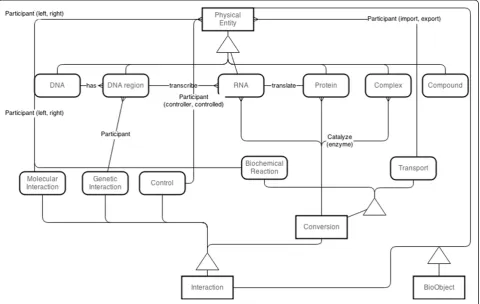
The classes were implemented in database API library and were wrapped together, called data wrapper class. This wrapper class was designed by taking in to account the advantage of inheritance feature of object-oriented data model to reduce code implementation and com-plexity. Therefore, the data classes were inherited hier-archically from the most super class called ‘BioObject’ class as shown in Figure 1. The‘BioObject’class was im-plemented with common attributes such as object id, names, function, cross-references as well as data query and validation methods that share among data wrapper classes. Wrapper classes were separated into two major classes: PhysicalEntity for storing in formation of tangible biological entities and Interaction for storing interaction among PhysicalEntity objects, as shown in the second level sub-classes in Figure 1.
reliability of data with its relationship is maintained by data classes themselves, but integrity and consistency are maintained by create, read, update and delete (CRUD) function of the library as described in Additional files 2 and 3.
The instances of the data classes are managed as docu-ments classified by property“type”and pooled together in a document collection, whereas relationships between ob-jects are separated from their own instances and pooled in another document collection to improve the efficiency of managing high complexity relationship of data. In order to optimize query time, an indexing system was applied in common query fields.
Global system architecture
The database system was developed based on the MongoDB library (www.mongodb.org), thus the underlying data structure is a document-oriented data model. MongoDB was chosen on account of: 1) the database system can eas-ily be scaled out allowing a modern data management ap-proach such as data centric architecture can potentially be applied to this database system [28,29]; 2) it is possible to change the data schema of the conceptual data layer im-plemented in the API library [28]; and 3) the MongoDB supports large file storage [29] for storing data such as gene expression data or sequencing reads. However, the
schema free property of MongoDB allows storing unstruc-tured data into the database, this might cause data incon-sistency. Therefore data wrapper classes in object-oriented data model were implemented in the database API library as interface between developers to the MongoDB to en-sure consistency of the stored data.
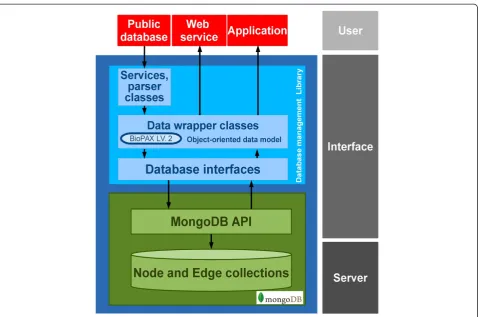
The overview of the system architecture is shown in Figure 2. As the base of the system, the physical layer is managed by a document-based management system, the MongoDB, which contains the necessary interfaces; such as an interactive shell and web services. However, the MongoDB is not designed to manage a specific data struc-ture, especially with complex relationships, and does not have features to control relationships among data objects and this may cause problems in data integrity, consistency and reliability. The database system library was there-fore implemented as a core of the system, providing vital functions to manage transactions between developers and the system, and this makes it easy to populate and trans-form data.
Results and discussion
Applications on a yeast data repository
Given that yeastS. cerevisiaeis a widely used model organ-ism with abundance of genome-scale information and data-sets e.g. protein-protein interactions (PPI), transcriptional
regulation interactions (TRI), protein kinase interactions (KI), genome-scale metabolic model and gene annota-tions, integration of data from these different data sources and levels can help to gain new understanding of complex cellular systems.
We therefore developed a yeast data repository as an in-tegrated database that contains various data of yeast. Two types of applications were built on top of the repository. One is a simple web search to query about specific bio-logical objects. The other is additional javascripts for con-ducting two different research cases which utilize various data in the database to achieve the goals. Those applica-tions are available online at http://atlas.sysbio.chalmers. se:8082. Our intention is to demonstrate efficiency of inte-grating data under a solitary database environment to help systems biology research rather than to present novel discoveries. As we focus on how the database system is applied, not all features of the database system are illus-trated. Specific scripts were implemented to query the data stored in the database.
Data population and implementation
The yeast data repository comprises of different kinds of biological data such as genome, reactome, interactome and annotations. These data were downloaded in tab
delimited or XML format from different repositories (see Table 1). The data were parsed and populated into the database using the parser library in the database system. Each biological molecule (e.g. DNA strand, gene, tran-script and protein) corresponds to a specific object in the database. A unique id was assigned to each object
Figure 2Database management system architecture.
Table 1 Data in Yeast data repository and sources
Biological entity Physical entity Data source Amount
Chromosome DNA NCBI GenBank [2] 17
Gene DNA region Ensembl [30] 7126
RNA transcript RNA Ensembl [30] 7126
Protein Protein UniProt [3] 6617
Compound Small molecule iTO977 [31] 484
Biochemical reaction Biochemical reaction
iTO977 [31] 717
Protein-protein interaction
Molecular interaction
BioGRID [6] 72453
Transcriptional regulation interaction
Control YEASTRACT [32] and [33]
48548
Kinase interaction Control [34] 1333
Phosphorylase interaction
and properties associated with it were also stored such as name, primary data source and external references.
In general, biological molecules are related to the mol-ecule in different type (e.g. reaction performed by pro-teins, proteins translated from transcript, transcripts transcribed from genes and genes are on chromosome). Similar to a biological network, relationships in the data-base were designed in accordance with real biological phenomena. To insert an object into the database, it is required that such a relation is known. The relational reference is added together with the object and the data-base system will create a relation object corresponding to that relation pair. These relation objects were used in the cases below to search and explore relationship be-tween one biological object to another. The biological and relation objects were populated separately into two collections: biological collection and relation collection. There were 144,675 documents of biological objects and 268,630 documents of relation objects.
The database system provides a practical library where each object type in the final database corresponds to a C++ object. This allows the user to fully populate the object before inserting it into the database. The database system ensures that all required data is set and pre-forms the task of inserting the object in the database. The task for the user simply becomes the task of gathering the re-quired data, populating the object with the data and inserting the object. For each required data there exists a function such as addname and setlength to add the data to the object.
Web interface
An online web interface was developed containing links to each application: a simple query interface and a page for case demonstration. The current version allows searching for different object types such as genes, proteins, small molecules, biochemical reactions and interactions with search results that include essential objects related to the queried object. On Cases page, it comprises interactive commands used to compile the two research cases de-scribed below.
Case 1: Detecting the pheromone pathway in protein interaction networks
Signaling pathways transmit signals from one part of the cell to another part through a cascade of protein interac-tions and protein modificainterac-tions. Cells organize cellular changes such as transcriptional programs in response to different stimuli. The yeast mitogen-activated protein kinase (MAPK) pathways are signaling pathways that have been extensively studied including pheromone re-sponse, filamentous growth, high osmolarity response and maintenance of cell wall integrity [35]. These path-ways are activated by sensing stressors of protein sensors
or binding of receptors to the stimuli, which in turn trig-gers MAPKs via a series of phosphorylations. Active MAPKs phosphorylate different targets such as protein kinases, phosphatases and transcription factors (TFs), consequently controlling cell cycle, cellular metabolism and gene expression [36]. The pheromone response path-way is activated by binding of pheromonesα- and a-factor to the protein receptors Ste2 and Ste3, respectively. The signals from these membrane receptors are transmitted via sequential binding and phosphorylation reactions of MAPK cascades to TF Ste12 that subsequently activate downstream genes.
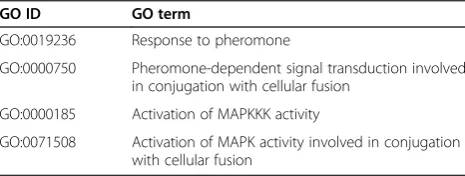
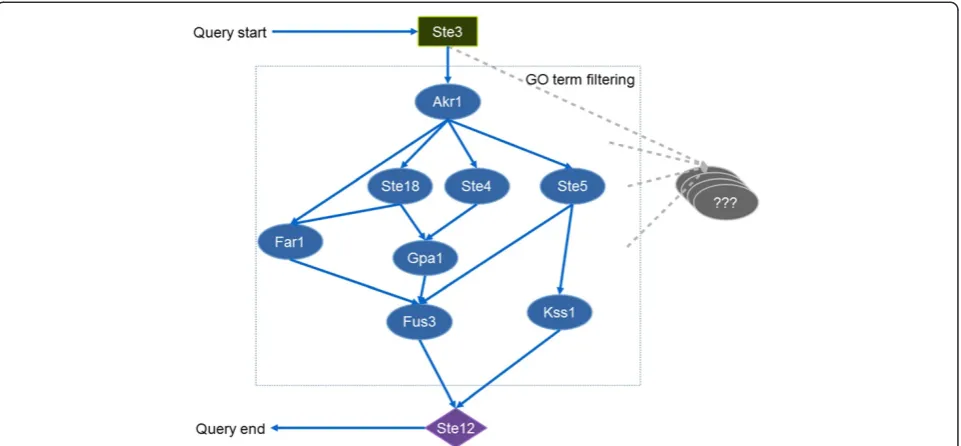
In this case, we mined the pheromone pathway seg-ment from PPI networks where both Ste2 and Ste3 were the starting proteins and Ste12 was the ending point. However, this could result in an excessive number of can-didate pathways. Several computational methods have been implemented for integrating PPIs and gene expres-sion data or GO annotations to constraint the search [37]. To simplify the case, we integrated only PPI and GO an-notation data for finding the pathways. Specific gene ontology terms (GO) in Table 2 were recursively used as constraints to eliminate proteins that are not relevant to the pheromone response pathway and consequently ex-clude the interactions among those proteins.
The resulting pathway contains Ste3 as a starting pro-tein and TF Ste12 as an ending node (Figure 3). Key proteins in the pheromone pathway (e.g. Ste4, Ste5 and Fus3) were partially found in comparison to the phero-mone pathway from literature [36]. This is because of: 1) the completeness of PPI data; 2) the method used for fil-tering unrelated proteins; and 3) the number of path lengths to search. As it is beyond our scope, we simpli-fied the pathway construction by using only GO terms as the filters and searching with short path length (3 path lengths). The paths from Ste2 could not be identified. This is because PPI data of Ste2 could not be populated to the database. BioGRID PPI data use gene identifiers (e.g. YNR074C) for protein participants. These gene identifiers have to be mapped to UniProt protein identi-fiers before populating to the database. However, Ste2 gene was mapped to two proteins which conflict with data propagation rules where PPIs are represented in binary relationship. Thus whole Ste2 interactions were
Table 2 GO terms used for filtering proteins
GO ID GO term
GO:0019236 Response to pheromone
GO:0000750 Pheromone-dependent signal transduction involved in conjugation with cellular fusion
GO:0000185 Activation of MAPKKK activity
automatically excluded. This case highlights strict restric-tions of the data population API in the database library which do not allow data population of conflict informa-tion to ensure data integrity.
Case 2: Finding metabolic reactions regulated by Snf1 kinase
Upon sensing availability of nutrients, cells undergo tran-scriptional, metabolic and developmental changes in order to survive under a particular nutritional state. In yeast, through complex signaling and regulatory networks, it can grow on a wide variety of nutrients e.g. glucose, galactose, glycerol and nitrogen sources. Key components in these networks include Ras/protein kinase, Snf1 and target of rapamycin complex I (TORC1) [38]. The protein kinase Snf1 is a member of the AMP-activated protein kinase (AMPK) family, which serves as a global energy regu-lator to ensure metabolic homeostasis of the cells. Under glucose limited condition, it allows the cells to use alternative carbon sources by regulating a set of TFs and genes in several metabolic processes includ-ing gluconeogenesis, glyoxylate cycle and β-oxidation of fatty acids [39]. In addition, Snf1 also participates in other processes such as ion homeostasis, general stress response, carnitine metabolism, pseudohyphal growth and ageing [39]. As Snf1 plays an important role in con-trolling many metabolic processes, we present how pro-cesses both directly and indirectly regulated by Snf1 can be retrieved from the database by integrating data from different levels.
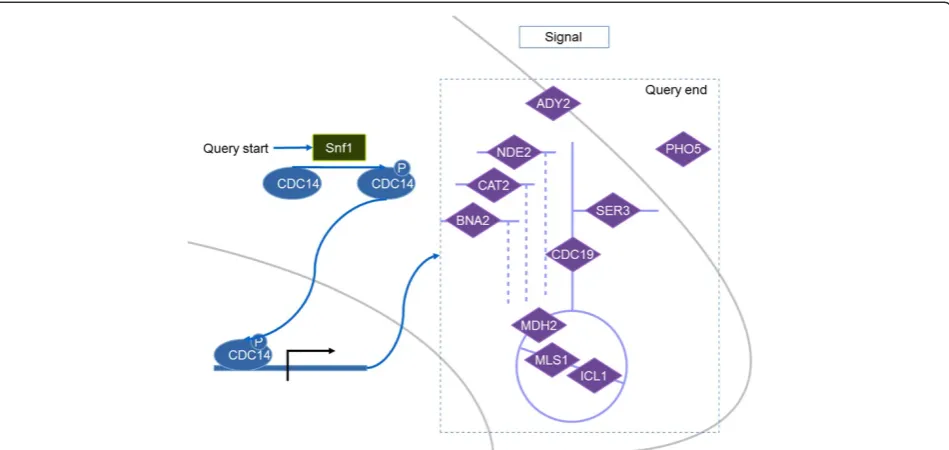
TheSNF1gene encodes the Snf1 catalytic subunit which regulates expression of several genes through a variety of TFs. To identify a list of metabolic reactions that are regu-lated by Snf1, the Snf1 protein is therefore used as a main molecule to construct the query. The first achievement is the identification of TFs, phosphorylated by the Snf1. This was done by querying for the protein targets of Snf1 from the KIs. Then with the TRIs we can retrieve the target genes of those substrates of Snf1 which are acting as TFs. From this list of the target genes we further retrieved bio-chemical reactions where they are involved in.
The queried result is illustrated in Figure 4. From 1333 KIs, we found Cdc14 as the substrate of Snf1 that transcriptionally regulates several metabolic genes in-volved in the glyoxylate cycle, amino acid biosynthesis, glycolysis/gluconeogenesis, acetate transport and oxida-tive phosphorylation.
Conclusions
Here we present a dedicated database model design for handling data in systems biology. It allows and supports crucial tasks in this area including integration and analysis of multi-level data, modeling of cellular pathways and col-lecting biological network data. In the database design, we have used a basic three layer approach to allow independ-ent and effective implemindepend-entation or changes at each data layer. The C++ library provides essential classes and ser-vices for communication among the layers. The basic properties of the database system, ACID, are responsible for providing specific functions and control processes
in the library such as ”insert”, ”remove”, ”update” and
”query” to ensure that database transactions and the data inside are consistent, reliable and not corrupted. An object-oriented concept was adopted for the design and implementation of the database schema because it repre-sents real world information as an object with related attributes and a variety of relationships. It can make the manipulation of this object and its related data easy, straightforward and relatively fast. In addition, the concept is applicable for capturing and reflecting biological infor-mation that is apparently heterogeneous and sophisticated [24]. The major design of the conceptual data structure that characterizes data in systems biology was adapted from the BioPAX ontology. Among standards, such as BioPAX, SBML and PSI-MI, for representation of bio-logical pathway data, the main structure of them is fairly similar but BioPAX is the most general [40]. It describes biological objects in a class hierarchy, has explicit use of relations among entities and covers most of the molecular entities in biological pathways. By realizing usages of dif-ferent standard formats, we included the parser classes in the library. These classes support standard formats that are generally used in most biological databases to accom-modate integration of data from different sources to the database and to enhance extensibility of the system.
The database system was applied for establishing the yeast data repository, which represents an integrated plat-form for perplat-forming efficient systems biology research. Two applications were developed showing that building additional applications on a single database environment administrated by the dedicated database system is feasible
and convenient. It should be noted that correctness and completeness of results from both research cases are not the main concern in this study, since they are depended on the quality and the availability of data sources. How-ever the restricted control processes and functions in the database API library were designed to ensure integrity and reliability of data in the database.
We believe that the proposed database system shows an extensive attempt to serve and solve complex data handling and integration in systems biology by follow-ing and usfollow-ing different standards and technologies. It gives users the ability to extend and personalize the views of data through additional applications and en-sures the integrity, consistency and reliability of data in the database.
Availability and requirements
Project name: A dedicated database system for handling multi-level data in systems biology.
Project home page:http://atlas.sysbio.chalmers. se:8082.
Operating system(s): Platform independent.
Programming language: C++, php.
Other requirements: Web Browser.
Any restrictions to use by non-academics: none.
Additional files
Additional file 1:Description of data wrapper classes.
Additional file 2:CRUD functions.Details of Create, read, update and delete (CRUD) function implemented in the system library.
Additional file 3:Flow of activities in each function: A) Create; B) Delete; C) Update; and D) Read.
Competing interests
The authors declare that they have no competing interests.
Authors’contributions
NP and KW designed the database system. NP designed and coded the main library. KW designed and coded the parser class. AN populated the data and implemented the web interface. JN and IN conceived the project. NP, KW and AN wrote the paper and all authors edited it. All authors read and approved the final manuscript.
Acknowledgements
This project was supported by The Knut and Alice Wallenberg Foundation and the Bioinformatics Infrastructure for Life Sciences (BILS). The open access charge is supported by Chalmers Library.
Received: 14 March 2014 Accepted: 1 July 2014 Published: 10 July 2014
References
1. Ideker T, Galitski T, Hood L:A new approach to decoding life: systems biology.Annu Rev Genomics Hum Genet2001,2:343–372.
2. Benson DA, Karsch-Mizrachi I, Clark K, Lipman DJ, Ostell J, Sayers EW: GenBank.Nucleic Acids Res2012,40(Database issue):D48–D53.
3. Magrane M, Consortium U:UniProt Knowledgebase: a hub of integrated protein data.Database (Oxford)2011,2011:bar009.
4. Cherry JM, Hong EL, Amundsen C, Balakrishnan R, Binkley G, Chan ET, Christie KR, Costanzo MC, Dwight SS, Engel SR, Fisk DG, Hirschman JE, Hitz BC, Karra K, Krieger CJ, Miyasato SR, Nash RS, Park J, Skrzypek MS, Simison M, Weng S, Wong ED:Saccharomyces Genome Database: the genomics resource of budding yeast.Nucleic Acids Res2012,40(Database issue): D700–D705.
5. Wishart DS, Knox C, Guo AC, Eisner R, Young N, Gautam B, Hau DD, Psychogios N, Dong E, Bouatra S, Mandal R, Sinelnikov I, Xia J, Jia L, Cruz JA, Lim E, Sobsey CA, Shrivastava S, Huang P, Liu P, Fang L, Peng J, Fradette R, Cheng D, Tzur D, Clements M, Lewis A, De Souza A, Zuniga A, Dawe M,
et al:HMDB: a knowledgebase for the human metabolome.Nucleic Acids Res2009,37(Database issue):D603–D610.
6. Stark C, Breitkreutz BJ, Chatr-Aryamontri A, Boucher L, Oughtred R, Livstone MS, Nixon J, Van Auken K, Wang X, Shi X, Reguly T, Rust JM, Winter A, Dolinski K, Tyers M:The BioGRID Interaction Database: 2011 update.
Nucleic Acids Res2011,39(Database issue):D698–D704.
7. Ogata H, Goto S, Sato K, Fujibuchi W, Bono H, Kanehisa M:KEGG: Kyoto Encyclopedia of Genes and Genomes.Nucleic Acids Res1999,27(1):29–34. 8. Parkinson H, Sarkans U, Kolesnikov N, Abeygunawardena N, Burdett T, Dylag
M, Emam I, Farne A, Hastings E, Holloway E, Holloway E, Kurbatova N, Lukk M, Malone J, Mani R, Pilicheva E, Rustici G, Sharma A, Williams E, Adamusiak T, Brandizi M, Sklyar N, Brazma A:ArrayExpress update–an archive of microarray and high-throughput sequencing-based functional genomics experiments.Nucleic Acids Res2011,39(Database issue):D1002–D1004. 9. Barrett T, Troup DB, Wilhite SE, Ledoux P, Evangelista C, Kim IF,
Tomashevsky M, Marshall KA, Phillippy KH, Sherman PM, Muertter RN, Holko M, Ayanbule O, Yefanov A, Soboleva A:NCBI GEO: archive for functional genomics data sets–10 years on.Nucleic Acids Res2011,39(Database issue):D1005–D1010.
10. Cary MP, Bader GD, Sander C:Pathway information for systems biology.
FEBS Lett2005,579(8):1815–1820.
11. Hucka M, Finney A, Sauro HM, Bolouri H, Doyle JC, Kitano H, Arkin AP, Bornstein BJ, Bray D, Cornish-Bowden A, Cuellar AA, Dronov S, Gilles ED, Ginkel M, Gor V, Goryanin II, Hedley WJ, Hodgman TC, Hofmeyr JH, Hunter PJ, Juty NS, Kasberger JL, Kremling A, Kummer U, Le Novère N, Loew LM, Lucio D, Mendes P, Minch E, Mjolsness ED,et al:The systems biology markup language (SBML): a medium for representation and exchange of biochemical network models.Bioinformatics2003,19(4):524–531. 12. Lloyd CM, Halstead MD, Nielsen PF:CellML: its future, present and past.
Prog Biophys Mol Biol2004,85(2–3):433–450.
13. Hermjakob H, Montecchi-Palazzi L, Bader G, Wojcik J, Salwinski L, Ceol A, Moore S, Orchard S, Sarkans U, von Mering C, Roechert B, Poux S, Jung E, Mersch H, Kersey P, Lappe M, Li Y, Zeng R, Rana D, Nikolski M, Husi H, Brun C, Shanker K, Grant SG, Sander C, Bork P, Zhu W, Pandey A, Brazma A, Jacq B,
et al:The HUPO PSI's molecular interaction format–a community standard for the representation of protein interaction data.Nat Biotechnol2004, 22(2):177–183.
14. Demir E, Cary MP, Paley S, Fukuda K, Lemer C, Vastrik I, Wu G, D'Eustachio P, Schaefer C, Luciano J, Schacherer F, Martinez-Flores I, Hu Z, Jimenez-Jacinto V, Joshi-Tope G, Kandasamy K, Lopez-Fuentes AC, Mi H, Pichler E, Rodchenkov I, Splendiani A, Tkachev S, Zucker J, Gopinath G, Rajasimha H, Ramakrishnan R, Shah I, Syed M, Anwar N, Babur O,et al:The BioPAX community standard for pathway data sharing.Nat Biotechnol2010,28(9):935–942.
15. Ashburner M, Ball CA, Blake JA, Botstein D, Butler H, Cherry JM, Davis AP, Dolinski K, Dwight SS, Eppig JT, Harris MA, Hill DP, Issel-Tarver L, Kasarskis A, Lewis S, Matese JC, Richardson JE, Ringwald M, Rubin GM, Sherlock G:Gene ontology: tool for the unification of biology. The Gene Ontology Consortium.
Nat Genet2000,25(1):25–29.
16. Courtot M, Juty N, Knüpfer C, Waltemath D, Zhukova A, Dräger A, Dumontier M, Finney A, Golebiewski M, Hastings J, Hoops S, Keating S, Kell DB, Kerrien S, Lawson J, Lister A, Lu J, Machne R, Mendes P, Pocock M, Rodriguez N, Villeger A, Wilkinson DJ, Wimalaratne S, Laibe C, Hucka M, Le Novère N:Controlled vocabularies and semantics in systems biology.Mol Syst Biol2011,7:543. 17. Cerami EG, Bader GD, Gross BE, Sander C:cPath: open source software for
collecting, storing, and querying biological pathways.BMC Bioinform
2006,7:497.
18. Cakmak A, Qi X, Coskun SA, Das M, Cheng E, Cicek AE, Lai N, Ozsoyoglu G, Ozsoyoglu ZM:PathCase-SB architecture and database design.BMC Syst Biol2011,5:188.
19. Cerami EG, Gross BE, Demir E, Rodchenkov I, Babur O, Anwar N, Schultz N, Bader GD, Sander C:Pathway Commons, a web resource for biological pathway data.Nucleic Acids Res2011,39(Database issue):D685–D690. 20. Boyle J, Cavnor C, Killcoyne S, Shmulevich I:Systems biology driven
software design for the research enterprise.BMC Bioinform2008,9:295. 21. Maier CW, Long JG, Hemminger BM, Giddings MC:Ultra-Structure
database design methodology for managing systems biology data and analyses.BMC Bioinform2009,10:254.
22. Sreenivasaiah PK, Kimdo H:Current trends and new challenges of databases and web applications for systems driven biological research.
Front Physiol2010,1:147.
23. Ozsoyoglu ZM, Ozsoyoglu G, Nadeau J:Genomic pathways database and biological data management.Anim Genet2006,37(Suppl 1):41–47. 24. Okayama T, Tamura T, Gojobori T, Tateno Y, Ikeo K, Miyazaki S, Fukami-Kobayashi
K, Sugawara H:Formal design and implementation of an improved DDBJ DNA database with a new schema and object-oriented library.Bioinformatics1998, 14(6):472–478.
25. Barry DK:The Object Database Handbook: How To Select, Implement, and Use Object Oriented Databases.New York: John Wiley & Sons, Inc.; 1996. 26. Steel BT:Interim Report ANSI/X3/SPARC Study Group on Data Base
Management Systems.ACM SIGMOD Record1975,7(2).
27. Hoffer JA, George J, Valacich J:Modern Systems Analysis and Design.6th edition. 2010: Prentice Hall; 2010.
28. Quintero C, Tran K, Szewczak AA:High-throughput quality control of DMSO acoustic dispensing using photometric dye methods.J Lab Autom
2013,18(4):296–305.
29. Chodorow K:MongoDB, the Definitive Guide.Sebastopol: O'Reilly Media; 2013. 30. Flicek P, Ahmed I, Amode MR, Barrell D, Beal K, Brent S, Carvalho-Silva D,
Clapham P, Coates G, Fairley S, Fitzgerald S, Gil L, García-Girón C, Gordon L, Hourlier T, Hunt S, Juettemann T, Kähäri AK, Keenan S, Komorowska M, Kulesha E, Longden I, Maurel T, McLaren WM, Muffato M, Nag R, Overduin B, Pignatelli M, Pritchard B, Pritchard E,et al:Ensembl 2013.Nucleic Acids Res
2013,41(Database issue):D48–D55.
31. Osterlund T, Nookaew I, Bordel S, Nielsen J:Mapping condition-dependent regulation of metabolism in yeast through genome-scale modeling.
BMC Syst Biol2013,7:36.
32. Teixeira MC, Monteiro P, Jain P, Tenreiro S, Fernandes AR, Mira NP, Alenquer M, Freitas AT, Oliveira AL, Sa-Correia I:The YEASTRACT database: a tool for the analysis of transcription regulatory associations in Saccharomyces cerevisiae.Nucleic Acids Res2006,34(Database issue):D446–D451. 33. Harbison CT, Gordon DB, Lee TI, Rinaldi NJ, Macisaac KD, Danford TW,
Pokholok DK, Kellis M, Rolfe PA, Takusagawa KT, Lander ES, Gifford DK, Fraenkel E, Young RA:Transcriptional regulatory code of a eukaryotic genome.Nature2004,431(7004):99–104.
34. Breitkreutz A, Choi H, Sharom JR, Boucher L, Neduva V, Larsen B, Lin ZY, Breitkreutz BJ, Stark C, Liu G, Liu G, Ahn J, Dewar-Darch D, Reguly T, Tang X, Almeida R, Qin ZS, Pawson T, Gingras AC, Nesvizhskii AI, Tyers M:A global protein kinase and phosphatase interaction network in yeast.Science2010, 328(5981):1043–1046.
35. Roberts CJ, Nelson B, Marton MJ, Stoughton R, Meyer MR, Bennett HA, He YD, Dai H, Walker WL, Hughes TR, Tyers M, Boone C, Friend SH:Signaling and circuitry of multiple MAPK pathways revealed by a matrix of global gene expression profiles.Science2000,287(5454):873–880.
36. Chen RE, Thorner J:Function and regulation in MAPK signaling pathways: lessons learned from the yeast Saccharomyces cerevisiae.Biochim Biophys Acta2007,1773(8):1311–1340.
37. Wang K, Hu F, Xu K, Cheng H, Jiang M, Feng R, Li J, Wen T:CASCADE_SCAN: mining signal transduction network from high-throughput data based on steepest descent method.BMC Bioinform2011,12:164.
38. Broach JR:Nutritional control of growth and development in yeast.
Genetics2012,192(1):73–105.
39. Zhang J, Vaga S, Chumnanpuen P, Kumar R, Vemuri GN, Aebersold R, Nielsen J:Mapping the interaction of Snf1 with TORC1 in Saccharomyces cerevisiae.Mol Syst Biol2011,7:545.
40. Stromback L, Lambrix P:Representations of molecular pathways: an evaluation of SBML, PSI MI and BioPAX.Bioinformatics2005, 21(24):4401–4407.
doi:10.1186/1751-0473-9-17
Cite this article as:Pornputtaponget al.:A dedicated database system for handling multi-level data in systems biology.Source Code for Biology and Medicine20149:17.
Submit your next manuscript to BioMed Central and take full advantage of:
• Convenient online submission
• Thorough peer review
• No space constraints or color figure charges
• Immediate publication on acceptance
• Inclusion in PubMed, CAS, Scopus and Google Scholar
• Research which is freely available for redistribution