G U I D E L I N E S
Open Access
Improving collaborative knowledge
production for climate change mitigation:
lessons from EU Horizon 2020 experiences
Daan Boezeman
1*and Heleen de Coninck
2Abstract
Scientific knowledge is key to climate mitigation governance. However, effective exchange between science and policy is challenging. Science-policy theory suggests collaboration, stakeholder participation and iterative communication as key principles for improving the science-policy interface. The Horizon 2020 project“Coordination and Assessment of Research and Innovation in Support of climate Mitigation Actions”(CARISMA) attempted to implement these principles. To help other projects learn from CARISMA’s experiences, this Guideline article critically discusses how the CARISMA project fared. CARISMA’s activities included stakeholder engagement through feedback loops, interviews with Advisory Board members, and an information platform. Experiences were discussed in a workshop with science-policy practitioners. Theory and workshop participants’insights led to the identification of seven practical directions towards a more effective exchange between science and policy, aimed at policymakers, funding agencies and researchers: 1) Know the researcher’s role; 2) Work with policy dynamics; 3) Use alternative communication means; 4) Allow for flexibility in projects’deliverables and milestones; 5) Be realistic about the possibility of stakeholder engagement; 6) Adjust funding criteria; 7) Invest in stable knowledge infrastructures.
Keywords:Science-policy interface, Knowledge use, Boundary organisations, Climate change, Mitigation, Co-production
Plain english summary
Addressing climate change requires scientific knowledge. The academic literature formulates various theories on how to improve the use of scientific knowledge in policy. However, effective exchange between science and policy is challenging in practice. Scientific knowledge often mismatches the needs of policy makers. Therefore, improving the effective exchange between science and policy is an important challenge for those working in ap-plied research projects and in research funding agencies. In this Guideline article we draw on the European Union Horizon 2020 project “Coordination and Assessment of Research and Innovation in Support of climate Mitiga-tion AcMitiga-tions” (CARISMA) to share practical experiences and formulate recommendations to improve the so called‘science-policy interface’.
CARISMA aimed not to develop new knowledge per se, but rather assess, synthesise and exchange existing know-ledge. The project design was based upon theory-informed principles. Those principles are genuine two-directional communication, translation of knowledge towards different audiences, and active mediation in conflicts about know-ledge. These principles informed the use of ‘stakeholder feedback loops’, two advisory bodies that contain a broad group of stakeholders and a climate mitigation knowledge platform. Realising a productive collaboration between sci-entists and policy makers and producing knowledge that was directly useful in policy was difficult. Firstly, we con-clude that supplying readily applicable knowledge for policy is often not realistic. Researchers have more useful roles in the science-policy interface than only a consultant like role of direct knowledge supply. Facilitating learning by present-ing alternatives, new uncertain knowledge or engagement in collaborative reflection was also highly valued. Secondly, we that incentives and requirements are not always aligned towards collaboration between science and policy. The temporary project funding makes it difficult to invest in
* Correspondence:[email protected]
1Institute for Management Research, Radboud University and PBL
Netherlands Environmental Assessment Agency, Postbus 9108 6500, Nijmegen, HK, The Netherlands
Full list of author information is available at the end of the article
permanent knowledge exchange infrastructure, such as online platforms. Creating practical mechanisms that stimulate collaboration are important. Based on CARISMA experiences, we formulate seven recommendations to im-prove the exchange between science and policy.
1. Know the researcher’s role 2. Work with policy dynamics
3. Use alternative communication means
4. Allow for flexibility in projects’deliverables and milestones
5. Be realistic about the possibility of stakeholder engagement
6. Adjust funding criteria
7. Invest in stable knowledge infrastructures
Climate action and the need for robust knowledge
Addressing climate change relies on scientific knowledge [1]. However, both producing policy-relevant knowledge and crafting evidence-based policy are challenging [2]. All too often, decision-makers find that research results are published too late to be of use, or are beside the point. In turn, researchers are confronted with policy questions that are hard to answer in a scientifically sound way. These observations influences a burgeoning literature with principles on organising more open and collaborative knowledge systems [3] and research pro-jects [4] that inform funding schemes for societal chal-lenges [5]. In response, the Horizon2020 project CARISMA (Coordination and Assessment of Research and Innovation in Support of climate Mitigation Ac-tions) has had the ambition to coordinate and support the maintenance, assessment and communication of cli-mate change mitigation knowledge for decision-makers in both the public and the private sector.
The organisation of CARISMA was built upon the general theoretical principles of collaborative knowledge production. From the start, the project plan acknowl-edged that climate mitigation is a‘wicked issue’[6]. Such stubborn issues are characterised by multiple perspec-tives on what ‘the problem’ actually is, and therefore what knowledge is needed to address it. In wicked prob-lems, yesterday’s solutions may become tomorrow’s problems. When preferences for what needs to be done vary and stakes are high, knowledge may become con-tested [2, 7, 8]. Stimulating participation and facilitating reciprocal communication between experts, policy-makers and societal stakeholders was central to CARIS-MA’s project design to improve mutual understanding and facilitate knowledge exchange. With this design, CARISMA aimed to circulate knowledge simultaneously perceived as salient (meaning politically useful, feasible and timely), credible (scientifically sound) and legitimate
(societally acceptable), following the criteria of Cash and colleagues [9].
This Guideline aims to offer both practical lessons for practitioners of the science-policy interface and propose suggestions to strengthen the interface. We reflect on the key choices CARISMA made in the project design, the practical forms it used to forge col-laboration and the problems it encountered doing so. We build on our observations of the project made during formal interviews, reflection workshops, infor-mal talks and documents analysis, and confront these observations with the scientific theory on these mat-ters. In line with the theory on which we draw, a first draft essay [10] functioned as a starting point of a workshop with practitioners of the science-policy interface, involving also other Horizon2020 projects focussing on decarbonisation pathways in combination with explicit collaborative and participatory objectives (TRANSrisk, REINVENT and DEEDS). During this workshop the reflections were refined, tested and jointly elaborated in a series of lessons for the design of projects that seek to bring science and policy to-gether. The last section of this Guideline summarises seven directions that we recommend for improving the navigations of the interface between science and policy. Those directions were validated in an extensive review by policymakers and researchers.
CARISMA’s design: Engagement on different levels
CARISMA was funded as a ‘Coordination and Support Act’ under the EU Horizon 2020 programme with a budget of approximately 1.5 million euros in 2014–2018. As such, the project was supposed not to develop new scientific knowledge per se, but rather provide synthesis, assessment and communication of existing climate knowledge. Nevertheless, identifying and addressing knowledge gaps was part of the project. Embedded in various work packages (i.e. innovation, mitigation op-tions, policy, governance, international cooperation), the project was to support and develop mitigation policies by first providing an overview of technical and social options, evaluate them in economic, environmental, so-cial and political terms, and communicate in terms to facilitate public and private governance processes with
‘useful’ knowledge. Given the diversity of the relevant that were to be integrated, the project involved natural scientists, economists, social scientists and legal scholars based t universities and think thanks.
involved. Third, conflicting interests about knowledge re-quire active mediation.
Two-directional engagement in CARISMA was orga-nised at different levels.‘Feedback loops’were a key elem-ent of the project. Actively targeting stakeholders, those loops were to harvest questions, provide answers via as-sessment and identify follow up questions, etc. In various rounds,‘generalist’stakeholders were queried about miti-gation knowledge needs, as well as for inputs in the pro-ject. The double advisory board, one representing the policy community and the other the business world, were regularly consulted and interviewed extensively once (in late Fall 2015) [12] for advice on the project. On a more concrete level, stakeholders were engaged on specific topics in work packages. In the work packages, stake-holder needs were assessed and workshops consistently included both practitioners and researchers. In CARIS-MA’s case, the (potential) stakeholder group was broad. Involved stakeholders varied from practitioners technical options to those working on governance arrangements for technology transfer or innovation. Also, stakeholders worked in both the private and public sector. This made it hard to serve all needs and choices were necessary. Yet it also provided the opportunity to be useful to different pol-icy communities.
Experiences with communication, translation and mediation
Several key issues regarding the three central activities stand out. Realising iterative and two-directional communication via feedback loops proved difficult in practice. With a flying start in the first year, knowledge needs expressed were quite broad. Questions included how to embed mitigation options in socio-economic planning, how to create market conditions for particular transitions, and under what conditions do options and policies ‘work’ [13]. In general, those questions are very hard to credibly answer via ‘normal’ scientific research [14] and readily available bodies of knowledge on those issues which could be assessed and synthesised were limited. While some questions were out of the project scope, addressing the questions required choices to be made on which issues the development of new expertise was to be based. This yielded a need to redirect the project and also deciding on what loops could not be followed up.
In addition, gradually, commitment to the feedback loops faded. Time investment for both researchers and practitioners was substantial, while other priorities loomed. During CARISMA’s kick-off meeting, many re-searchers implicitly resonated what is termed the‘linear model’ of science-policy relations: filling a reservoir of knowledge to be transferred to policy [7]. Complete the substantive tasks of the grant agreement and then move
to communication. Moreover, the linear model still in-forms ideas of policy officials and knowledge institutions developed at the European level, albeit sometimes in an
‘inverted’form. For example, when a new project or or-ganisational form is set up to facilitate‘knowledge trans-fer’. The fading enthusiasm risked the feedback loops to remain single shots.
In science-policy workshops, the importance of interaction in multiple cycles was stressed in order to gradually develop both more useful knowledge by re-searchers and better answerable questions by practi-tioners. Thus, iterative communication is much more than the active circulating of knowledge in attractive communicative formats such as policy briefs, one-pagers, infographics or tweets. Notwithstanding the importance of form, iterative and two-directional communication is about learning via dialogue. Learn-ing by both researchers and policymakers on their respective roles and expectations requires investments by both.
Active mediation in conflicting interests about know-ledge was therefore necessary. Informed by the advisory board’s feedback, the CARISMA coordinator, supported by the project officer with the European Commission (not a project member), continuously pushed outcome (salient products), rather than output (deliverables). An internal review system was set up involving both re-searchers and advisory board members. This measure aimed to institutionalise that publications were interro-gated on their epistemic credibility as well as on their policy salience. In project meetings, policy processes, such as those surrounding the Paris Agreement imple-mentation, were reviewed and discussed for links where the CARISMA work could add value, and follow-up ac-tion was agreed.
On a more systemic level, however, it seems the case that CARISMA aimed to commensurate two conflicting ideas. On the one hand, CARISMA was about assess-ment. This means compiling evidence, making it more readily accessible and presenting it in salient ways. On the other hand, CARISMA was about research. The pro-ject also aimed to fill knowledge gaps on mitigation options and policies, and “upstreaming stakeholders in the production of knowledge”. The conflict was not just about how to allocate resources among the two ideas, but also about how to advise policy: providing an over-view of (dis)agreements in different studies or providing novel research results?
Structural challenges of boundary organisations
Knowledge use and the role of researchers
The first issue concerns the question on how knowledge ends up in policy [1, 15]. And, more importantly, what does that mean for the possible roles of those working in the borderlands of science and policy [16, 17]? A dominant perspective held by many stakeholders, and what seems the holy grail for many CARISMA re-searchers as well, is the need to provide ‘actionable’ information. Actionable is then equal to those mitigation options, suggestions and data that can directly inform officials working on policies.
In this rationalist view, the policy process is por-trayed as a process dominated by ‘puzzling’: know-ledge is used to make policies more evidence-based. Researchers can have a ‘consultant’ role in which they develop and supply knowledge for clear and stable problems. Unfortunately, research has shown this type of ‘instrumental use’ (see Table 1 below) to be very rare, especially in dense and noisy policy arenas. Of course, practical problems are important, to which we return later. But the main argument here is that this type of use is usually restricted to those policy issues that are uncontested, depoliticised and scientifically relatively structured. None of these conditions apply to climate mitigation policy.
Political science conceives the role of knowledge much more strategic and underscores that policy-making is about ‘powering’. This more cynical take suggests concrete knowledge gets used predominantly to underline standpoints when real decisions already taken. This is termed ‘symbolic use’. Some of the stakeholders warned CARISMA to provide knowledge to be impartial. Still, a supposedly impartial know-ledge claim can always become ammunition in parti-san debates. Involving multiple normative viewpoints and disclosing the procedures in which knowledge is translated can strengthen the perceived legitimacy of the boundary organisation in question.
Interestingly, studies on policy change come up with even different types of knowledge use. Already in the 1970s, Carol Weiss [18] argued that knowledge finds its ways to policy in a more indirect and conceptual manner. Knowledge offers ongoing reflection, doubt and alternatives to policymakers. In her ‘ enlighten-ment’ type of knowledge use, the policy and research
communities gradually learn to see alternative prob-lems and solutions. This view links up with contem-porary ideas that a key role for researchers is to ‘open up’issues [3,19]. Researchers then either act as honest brokers of alternatives [16]. Their role is then raising new questions and bring in knowledge-based alterna-tives. They remain in an intermediate position between knowledge production and use. Alternatively they can take a role of participatory knowledge producers [17], in which they take a more active position in developing new knowledge and facilitating broader deliberation. These roles are often especially related to wicked prob-lems such as climate change, in which value disputes loom and science is inherently incomplete [20].
The final suggested variant is termed ‘political use’, building on the idea that knowledge is a strategic re-source in political power disputes. Some knowledge cannot get used until a paradigmatic shift in the way an issue is conceptualised happens, or when a political landslide brings a different group in power, and hence a
‘window of opportunity’opens up [21]. Researchers can act as entrepreneurs to push knowledge to negotiation tables. This requires the uneasy task of being at the table at the right moment and being keenly aware of political processes.
It is up to CARISMA and other projects to acknow-ledge that there are several types of knowacknow-ledge use [8,
15, 18] and that there are multiple valuable roles re-searchers can play [16, 17]. Sometimes researchers can play a consultant role, tailoring knowledge in such a form that it can directly be used in policy. However, one needs to acknowledge that silver bullet knowledge solu-tions are not always realistic. It may find its way into the policy realm, but only as other ideas, models, data and narratives have softened up the community for its ac-ceptance. During interviews with stakeholders and the advisory boards, the importance of other roles was also emphasised as valuable.
The appreciation of a ‘learning space’ to reflect on new, yet not directly implementable, ideas was also expressed by CARISMA’s advisory board members and stakeholders. CARISMA documents, but especially meetings were named by some interviewed stakeholders a‘learning space’: to keep up with new ideas and allow-ing for dialogues to explore also uncertainties and the limits of knowledge. Hence, to facilitate learning and reflection, researchers can play a role to open up ways of thinking with alternatives, criticise core policy assump-tions, or provide novel, yet not readily applicable, new insights. Also, sometimes researchers have to be messen-gers that knowledge is incomplete or uncertain. A medi-ating role may be in situations be useful, e.g. in illuminating conflicts in which knowledge is disputed with alternative claims.
Table 1Typology of knowledge use based on [8]
Policymaking as puzzling Policymaking as powering
Direct informing Instrumental use Symbolic use
Indirect informing Enlightenment use Political use
The different types of knowledge use can be organised according to whether they inform policies directly or more indirectly. Depending on whether the
policy process is about rational‘puzzling’for optimal solutions or about
The lesson for CARISMA is that it should be aware of the possibility of multiple useful roles, which empha-sise different tasks (e.g. supplying knowledge, bridging fields or facilitating stakeholders to learn) and require different skills (e.g. in communication and process sup-port). The project goal of synthesising and assessing knowledge of mitigation options in factsheets and data-bases, requires a supplying role in researchers focussing on the scientific credibility of knowledge. Engagement with stakeholders can then be less intensive and is about making information more accessible and under-standable. The goal to facilitate collaborative learning about policy-relevant issues stakeholder engagement must be more intensive. Negotiating roles and being transparent about what a researcher can and cannot do, within what timeframe and within what normative starting points, is important to maintain credibility and trust in case of disputes over knowledge.
Incentive structures for ongoing collaboration
The second issue is that researchers and policymakers respond to communities with different cultures. Col-laboration via several iterative cycles is not necessarily rewarded. A stream of literature suggests that the practical mismatches in timing, language and mes-sages are a result of differences in cultures, reward systems and codes of conduct [2, 20]. To counter these problems, formal incentives and requirements were created, such as reserving a substantial part of the project budget for outreach and follow up ques-tions in the final project year and an internal proced-ure for reviewing products on both scientific validity (credible) and policy relevance (salience).
An example of the importance of incentives and re-quirements are the well-known publication criteria at universities, which often push researchers to do novel research, rather than providing rigorous assessments of current knowledge. On the other hand, via funding criteria of modern demand-led research programmes, CARISMA researchers were pushed to develop activities to work with stakeholders and disseminate information in ways fitting knowledge needs of policy-makers such as the feedback loops in the project design. While the project design made a substantial time and budget reservation for a final outreach stage and follow up questions, there was a pressure on re-searchers to spend time on products pushed by their universities or research organisations rather than investing in better tailoring their outreach. In CAR-ISMA this issue was addressed by the project coordin-ator pushing project members for salience. In one of the reflection workshops it was also suggested that it would incentivise collaboration of researchers and pol-icy makers could write short proposals for funding
follow up questions (see also [20],). This would require not earmarking all project budget over the partners in advance incorporating more budgetary flexibility. Pol-icymakers usually have less of such formal incentive mechanisms to keep them committed in projects to take their part in a continued dialogue and help de-velop questions that are suitable for the realm of research. Just as researchers have to become aware of the “ridiculous deadlines” of politics, as one civil ser-vant expressed it in a meeting, policymakers have to learn to be patient with researchers, who need to do their assessment work in a credible way.
Another example are the requirements of detailed and delineated activities with deliverables to get boundary projects funded. Bi-directional engagement of the two communities takes place not only in formal CARISMA reports and workshops, but importantly also in the continuous informal contacts, exchanges, and meetings in very different venues and occasions. Such activities of large science-policy consortia are opaque, while reward structures favour producing visible (and promised) products: deliverables. Such structures, designed to guarantee legitimacy and trans-parency, risk overlooking the ongoing activities that are crucial to realise them. In CARISMA,
In addition, projects are funded on temporary bud-gets, and new consortia take over after projects have ended. In these circumstances it is less attractive to in-vest in more permanent exchange infrastructure, that is more resource intensive and takes time before re-searchers and policy makers start using it. By the time such infrastructure starts paying off for the project, the project may have already ended. This was espe-cially a challenge for CARISMA’s interactive platform, to which we return in the next section. Combined with the phenomenon of quick personnel turnover, both with researchers and rotating civil servants, the temporary character of funding makes it difficult to build lasting relations and trust, and render continued collaboration and dialogue challenging.
Balancing flexibility and stability
‘boundary infrastructure’ that enables the collabor-ation between scientists and policymakers. It offered the certainty to publics as a venue to find useful knowledge on mitigation options and lower transac-tion costs of searching. Credibility can be enhanced by reviewing content, salience by ongoing feedback on the content.
However, the platform can also be problematic as it is facing an institutional environment – of a time-bound research project – that threatens its con-tinuity, which is crucial for its effectiveness. This insti-tutional environment favours the set-up of new projects rather than continuing existing ones, and de-pends on ad-hoc funding. There is no embedding in a permanent organisation that safeguards its continu-ation. The challenge for the platform is not tomake it work, notwithstanding that daunting task, but to
maintain the platform to work. In CARISMA, the follow-up Coordination and Support Action, the DEEDS project, will adopt the platform so its contin-ued operation is safeguarded for the next three years. This was made possible by a push on the part of the Commission, by a constructive attitude of those man-aging stakeholder engagement in DEEDS and CAR-ISMA, and the practical coincidence that the project period of the two projects overlapped.
Seven directions to move forward
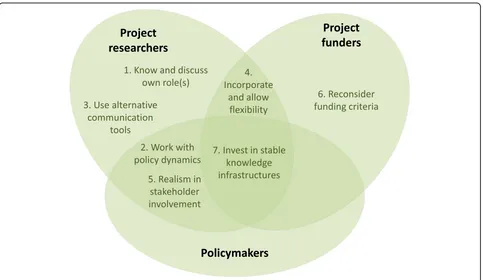
Effective work at the science-policy interface needs a significant effort of all actors involved as well as an in-stitutional environment that incentivises commitment of researchers and policymakers. This commitment should facilitate cross-boundary cooperation, rather than dissolving the productive differences between the two communities altogether. Answers are needed on the question how continued collaboration can be made more rewarding for all actors involved. Drawing upon the lessons of the CARISMA project and the reflection workshop in which the structural challenges of boundary organisations were discussed in relation to EU funded projects, we identify the following seven directions forward to make the science-policy ex-change more effective:
1) Reflect and act on the role of project researchers. Multiple roles in a project are useful. While hard to mix in a single person, a project team can contain multiple roles. Especially in domains characterised by scientific uncertainties, clear communication of the roles taken is important to maintain credibility and trust.
2) Work with the dynamics of the policy process. Topics in the agenda-setting phase require other types of knowledge than topics that facing
decisions. The former may allow novel ideas while the latter is about substantiating or amending a decision at hand. The criteria and timing to which knowledge should respond varies with the phase. 3) Explore and try alternatives in communication.
Involving science journalists and influential societal actors can help translating research findings in salient messages. They can also act as ambassadors. Using alternative communication means requires a clear understanding of the different audiences of the project and the routes via which knowledge reaches them.
4) Incorporate and appreciate flexibility in projects. The system of ex-ante promised deliverables favours unidirectional exchange and mismatches in pace of research and policy, if not be approached with some flexibility. Flexibility regarding deliverables requires cooperative attitudes of both funding officials, project coordinators and researchers. The project coordinator needs possibilities to reallocate budget to emerging issues, while staying within the general scope of project goals.
5) Be realistic about and prepared for stakeholder involvement. Involving stakeholders is vital for both relevance and robustness of research. Different rationales for involvement are legitimate, but manage expectations, including those of the funding agency or client. Involvement requires substantial investment of time and resources of all actors. This points at two conditions: researchers and policymakers need to be prepared to spend time (or they will not start), and the time spent on cooperation needs to be rewarding (or they will not continue).
6) Reconsider funding criteria. Demonstrating how collaboration is guaranteed should be an eligibility criterion for funding. Collaboration could be rewarded by funding small joint projects between researchers and policymakers that address follow-up questions from the project’s assessments. A small part of future project budgets can be reserved for the purpose. Small budget extensions are also an option, but risk high transaction costs if this would require new procedures with funders.
7) Invest in stable knowledge infrastructures. Ad hoc funding is problematic for knowledge
The seven directions address both the direct actors involved (see Fig. 1) as well as the institutional envir-onment in which they operate. They should not be understood in isolation but are highly interrelated. For example, investing in a skillset of participating researchers, stakeholders and project coordinators is of no avail if an enabling operating environment is absent. A favourable science-policy environment re-mains ineffective if it is not effectively navigated.
Abbreviations
CARISMA:Coordination and Assessment of Research and Innovation in Support of climate Mitigation Actions; DEEDS: DialoguE on European Decarbonisation Strategies; REINVENT: Realising Innovation in Transitions for Decarbonisation; TRANSrisk: Transitions Pathways and Risk Analysis for Climate Change Mitigation and Adaption Strategies
Acknowledgements
The authors wish to thank all interview respondents, workshop participants and two anonymous reviewers for their time and their valuable
contributions to the paper.
Funding
This project has received funding from theEuropean Union’s Horizon 2020 research and innovation programmeunder grant agreement No. 642242.
Availability of data and materials
The datasets used and/or analysed during the current study are available from the corresponding author on reasonable request.
Authors’contributions
DB designed the research, collected the data and wrote the first draft. DB and HC organised the reflection workshop and revised the draft based on the results. All authors read and approved the final manuscript.
Authors’information
During the research phase Daan Boezeman worked as a researcher and lecturer at the chair group Political Sciences of the Environment at the Radboud University. In 2017 he moved to PBL Netherlands Environmental Assessment Agency and is an affiliated researcher at his former institution. Heleen de Coninck is an associate professor at the Department of Environmental Sciences of the Radboud University, project coordinator of the CARISMA project, and coordinating lead author in the IPCC special report on 1.5 degrees.
Ethics approval and consent to participate
The research was based on interviews, observations and a reflection workshop with practitioners following Chatham House Rules. Statements are anonymised and cannot be traced to individual participants. Participants were aware of and approved the writing of this paper. All conclusions remain the sole responsibility of the authors.
Consent for publication
Not applicable.
Competing interests
The authors declare that they have no competing interests.
Publisher’s Note
Springer Nature remains neutral with regard to jurisdictional claims in published maps and institutional affiliations.
Author details
1Institute for Management Research, Radboud University and PBL
Netherlands Environmental Assessment Agency, Postbus 9108 6500, Nijmegen, HK, The Netherlands.2Department of Environmental Science, Radboud University, PO Box 9010 (Mailbox 89), Nijmegen, GL 6500, The Netherlands.
Received: 10 May 2018 Accepted: 20 November 2018
References
1. Turnhout E, Tuinstra W, Halffman W. Environmental expertise: connecting science, policy and society. Cambridge: Cambridge University Press; 2019. 2. Sarewitz D, Pielke RA. The neglected heart of science policy: reconciling
supply of and demand for science. Environ Sci Pol. 2007;10:5–16. 3. Cornell S, Berkhout F, Tuinstra W, Tàbara JD, Jäger J, Chabay I, et al.
Opening up knowledge systems for better responses to global environmental change. Environ Sci Pol. 2013;28:60–70.https://doi.org/10. 1016/j.envsci.2012.11.008.
4. Meadow AM, Ferguson DB, Guido Z, Horangic A, Owen G, Wall T. Moving
toward the deliberate coproduction of climate science knowledge. Weather Clim Soc. 2015;7:179–91.
5. Boon W, Edler J. Demand, challenges, and innovation. Making sense of new
trends in innovation policy. Sci Public Policy. 2018;45:435–47https://doi.org/ 10.1093/scipol/scy014.
6. Rittel HJ, Webber M. Dilemmas in a general theory of planning. Policy Sci. 1973;4:155–69.https://doi.org/10.1007/bf01405730.
7. Jasanoff S, Wynne B. Science and decision making. In: Rayner S, Malone E, editors. Human choice and climate change, vol. 1: the societal framework. Columbus: Battelle press; 1998. p. 1–87.
8. Daviter F. The political use of knowledge in the policy process. Policy Sci. 2015;48:491–505.https://doi.org/10.1007/s11077-015-9232-y.
9. Cash DW, Clark WC, Alcock F, Dickson NM, Eckley N, Guston DH, et al. Knowledge systems for sustainable development. PNAS. 2003;100:8086–91. 10. Boezeman D, De Coninck HC. Organising effective exchange in the
science-policy interface: Lessons from the Horizon 2020 CARISMA project. Deliverable 8.5. Nijmegen: Radboud University; 2018.http://carisma-project. eu/LinkClick.aspx?fileticket=KhqvIBnIvTM%3D&tabid=95&portalid=0&mid= 580.
11. Boezeman D. Transforming adaptation. Authoritative knowledge for climate change governance. Nijmegen: Radboud University; 2015.http://hdl.handle. net/2066/141636
12. Hagens J, Koretsky Z. CARISMA Advisory Boards consultations report. Nijmegen: Radboud University; 2016.
13. Van der Gaast W, Stavakras V. D2.4 report on implementation of stakeholder engagement plan and communication plan. Groningen: JIN; 2016. 14. Funtowicz SO, Ravetz JR. Science for the post-normal age. Futures. 1993;25:
739–55.https://doi.org/10.1016/0016-3287(93)90022-l.
15. Radaelli CM. The role of knowledge in the policy process. J Eur Public Policy. 1995;2:159–83.https://doi.org/10.1080/13501769508406981. 16. Pielke R. The honest broker: making sense of science in policy and politics.
Cambridge: Cambridge University Press; 2007.
17. Turnhout E, Stuiver M, Klostermann J, Harms B, Leeuwis C. New roles of science in society: different repertoires of knowledge brokering. Sci Public Policy. 2013;40:354–65.https://doi.org/10.1093/scipol/scs114.
18. Weiss CH. Have we learned anything new about the use of evaluation? Am
J Eval. 1998;19:21–33.https://doi.org/10.1177/109821409801900103. 19. Stirling A.“Opening up”and“closing down”: power, participation, and
pluralism in the social appraisal of technology. Sci Technol Human Values. 2008;33:262–94.https://doi.org/10.1177/0162243907311265.
20. Termeer C, van Buuren A, Knieling J, Gottschick M. Reconciling collaborative action research with existing institutions: insights from Dutch and German climate knowledge programmes. J water Clim Chang. 2015;6:89–103. 21. Kingdon JW. Agendas, alternatives, and public policies. 2nd ed. Boston:
![Table 1 Typology of knowledge use based on [8]](https://thumb-us.123doks.com/thumbv2/123dok_us/9137962.1907388/4.595.55.291.657.697/table-typology-knowledge-use-based.webp)