RESEARCH
Discrimination of boron tolerance
in
Pisum sativum
L. genotypes using a
rapid, high-throughput hydroponic screen
and precociously germinated seed grown
under far-red enriched light
Richard G. Bennett
1*, Federico M. Ribalta
1, Maria Pazos‑Navarro
1, Antonio Leonforte
2and Janine S. Croser
1Abstract
Background: Boron (B) tolerance has been identified as a key target for field pea improvement. Screening for B tolerance in the field is problematic due to variability in space and time, and robust B molecular markers are currently unavailable in field pea. There has been recent progress in developing protocols that can accelerate the life cycle of plants to enable rapid generation turnover in single seed descent breeding programs. A robust B screening protocol that can be fully integrated within an accelerated single seed descent system could lead to rapid identification and introgression of B tolerance into field pea genotypes. Integration with an accelerated single seed descent system requires: (1) screening under artificially lit, temperature‑controlled conditions; (2) capacity to use immature preco‑ ciously germinated seed (PGS); (3) recovery of lines without significant time penalty; and (4) good correlation with results from established screening protocols.
Results: We present herein a B toxicity screening system for field pea based on hydroponic growth of PGS in a light and temperature controlled environment that allows recovery of seedlings for rapid seed production. Screen‑ ing results were compared to traditional methods for B tolerance screening in B‑laced soil and with published field tolerance ratings. B tolerance was scored 17 days after sowing using leaf symptoms as a metric. Plants were then transferred to soil with maximum of six days delay in flowering compared to a typical accelerated single seed descent system generation. The use of PGS had minimal impact on B tolerance rankings compared to plants grown from mature seed. The leaf tolerance rankings from hydroponic‑grown plants correlated well with those from soil‑grown plants, and consistently identified the most tolerant genotypes.
Conclusions: Our 17 day screening protocol represents a major time‑saving over previously published B screening protocols for field pea, thereby extending the application of the protocol to traditional single seed descent systems or RIL screening. We anticipate that small modifications to the proposed technique will make it applicable to screen for other individual abiotic stresses, or allow studies of the interactions between B tolerance and stresses such as salinity. Keywords: LED, Boron tolerance, Immature seed, Leaf symptoms, Abiotic screening
© The Author(s) 2017. This article is distributed under the terms of the Creative Commons Attribution 4.0 International License (http://creativecommons.org/licenses/by/4.0/), which permits unrestricted use, distribution, and reproduction in any medium, provided you give appropriate credit to the original author(s) and the source, provide a link to the Creative Commons license, and indicate if changes were made. The Creative Commons Public Domain Dedication waiver (http://creativecommons.org/ publicdomain/zero/1.0/) applies to the data made available in this article, unless otherwise stated.
Open Access
*Correspondence: [email protected]
1 Centre for Plant Genetics and Breeding, The University of Western Australia, 35 Stirling Hwy, Perth, WA 6009, Australia
Background
Field pea (Pisum sativum L.) is an important grain and forage crop grown widely in temperate and Mediter-ranean climates for human and animal consumption [1]. Field pea provides benefits to cereal-based rota-tions as a break crop for pest and disease management and improves soil fertility from the rhizobial fixation of atmospheric nitrogen [2]. Along with improved yield, nutritional quality, adaptation and reliability, field pea breeders have identified boron (B) tolerance as an impor-tant target for improvement [3]. Boron toxicity is caused by high B concentration in soil or irrigation water, and is particularly problematic in medium or heavier textured soil types with moderate alkalinity and low annual rainfall (<500 mm p.a.) where leaching of B from the soil is slow [4–7]. Yield losses due to B toxicity are hard to quantify. While losses in field pea crops have not been measured directly, yield penalties of 10–20% have been estimated in wheat and barley field crops due to B rich soils [4, 8]. Remediation of boron-toxic soils is impractical in most cases so genetic solutions based on improved plant toler-ance to B have been investigated for several decades by plant breeders [6].
A system for rapid generation cycling in pulses has recently been developed that can speed up breeding and molecular mapping efforts. Accelerated single seed descent (aSSD) employs techniques to speed flowering and precociously germinate immature seed [9–11]. In field pea, the aSSD system enables the turnover of up to six generations per year across a diverse range of phenol-ogies [11]. The integration of a B tolerance screen within this aSSD system will facilitate the rapid development of novel genotypes with tolerance to B. However, to enable integration into the aSSD platform, a screen needs to ful-fil four key requirements: (1) Occur within a controlled environment growth facility to enable rapid, year-round screening; (2) Have the capacity to use immature preco-ciously germinated seed (PGS) as a starting material; (3) Enable recovery of lines without a significant penalty to generation turnover time; (4) Produce a result that cor-relates well with established screening protocol. To date, there is no reported B screening protocol that can satisfy these requirements.
A recurrent problem in field screening for abiotic stress tolerance is environmental heterogeneity. The severity of climatic, abiotic and biotic stresses such as drought, frost, subsoil constraints or disease can all vary in the field year to year and within a site, confounding screen-ing results [12]. Even under temperature controlled glass-house conditions, seasonal changes in photoperiod and light intensity lead to changes in photosynthetic load and transpiration, affecting the repeatability and accuracy of abiotic stress screening in traits that are linked to water
use, such as B tolerance [13]. Extended photoperiod, far red-enriched light and tailored temperature in a growth chamber are used to reduce generation time and mini-mise seasonal influences in the aSSD system [9, 11], but there are no reports of B tolerance screening in this type of environment. There is clear value in the development of a controlled environment-based screen to enable rapid, repeatable and uniform discrimination for B toler-ance in field pea.
The use of immature PGS is a key element of the aSSD system [9, 11]. However, to our knowledge, no screening method has used immature PGS as a starting material. With the appropriate treatment, immature seeds have the capacity to robustly germinate once the embryo reaches physiological maturity and, in field pea, this occurs at 18 days after anthesis under aSSD growth conditions [11]. Active exclusion mechanisms play a role in B tol-erance [14], so the energy available from the germinat-ing seed may affect the ability of seedlgerminat-ings to tolerate B stress during early plant growth. However, seed develop-ment after physiological maturity is reached is primarily related to desiccation [15], rather than energy accumula-tion, and Ribalta et al. [11] saw no developmental penalty in plants grown from immature PGS, once physiological maturity was achieved. Therefore, we expect to observe similar responses to B stress in seedlings grown from immature PGS, compared to mature seed.
suitable soil medium. We reason that the application of hydroponic growth systems under controlled conditions using leaf symptoms as the B tolerance discrimination metric, and recovery of hydroponically grown plants to pots for seed production should allow efficient integra-tion of a B tolerance screen within aSSD-based genetic improvement programs.
This paper presents a B toxicity screening system for field pea that is based on hydroponic growth of immature PGS in a light and temperature controlled environment and which allows recovery of seedlings for seed produc-tion. We compare the results from this novel screening system to the traditional methods of B tolerance screen-ing in B-laced soil and published tolerance ratscreen-ings for field pea genotypes. Specifically, our hypotheses were: (1) This screening methodology would provide good cor-relations with traditional metrics and established rank-ings; (2) Symptoms of B toxicity in plants grown from immature PGS will be similar to those from mature seed; (3) Screening in a controlled environment, followed by recovery of seedlings to soil would allow the screen to be carried out rapidly and without significant delay to the aSSD generation. Aside from providing a protocol for B tolerance screening that can be applied to tradi-tional breeding and selection systems, the integration of a repeatable and consistent screen into the aSSD system should lead to more rapid development of B tolerant field pea cultivars.
Methods
The research was undertaken within the controlled plant growth facilities at the University of Western Aus-tralia, Perth (lat: 31°58′49″; long: 115°49′7″). Field pea genotypes were selected in consultation with the Pulse Breeding Australia (PBA) field pea breeding team to represent a range of B tolerance based on published B tolerance rankings for commercial cultivars that were established using pot trials [22], hereafter ‘DEDJTR data’, and breeders’ advice for pre-release lines (Dr Antonio Leonforte, unpublished data). Through consultation with breeders and pre-breeders (pers. comm. Drs. Matthew Rodda, Timothy Sutton and David Peck) and a prelimi-nary experiment, we developed a hydroponic system for assessing B sensitivity in field pea when grown under controlled environment conditions. This paper reports on the development of the hydroponic system and valida-tion through comparison with convenvalida-tional B tolerance screening techniques, including biomass production, flowering behaviour and seed yield of plants grown in pots (Additional file 1: Table S1).
Since harvesting of immature seed is a key element of the aSSD system [9, 11], hydroponic experiments were designed to determine if seed maturity had an effect on
the response to B. Immature seeds (at the embryo physi-ological maturity stage, 18 DAA) were produced for all the genotypes (Additional file 1: Table S1) and subjected to treatment to enable precocious germination as per Munday et al. [10] and Ribalta et al. [11].
Hydroponic experiments
A preliminary hydroponic experiment was conducted to establish a B concentration and duration of expo-sure that provided optimal discrimination among seven field pea genotypes (Additional file 1: Table S1) grown from mature seed. Seeds were nicked with a scalpel and imbibed for 24 h on DI water-moistened filter paper in petri dishes. For each of four B treatments, 10 seeds of each genotype were sown into 20 mm diameter peat plugs in ‘Preforma’ trays (J50000227, Garden City Plas-tics, Perth, Australia) floated in 40 L plastic crates con-taining 20 L of tap water, aerated using porous aquarium tubing. The location of genotypes were randomised within trays. The solution volume was maintained by adding tap water to replace evapotranspiration every two to three days. Plants were grown in a controlled environ-ment room with 24/20 °C (day/night) temperature and a 20 h far-red enriched photoperiod supplied by LED lights (4:3 ratio of model 108D18-V12 tubes from S-Tech Lighting, Australia and AP67 L series tubes from Valoya, Helsinki, Finland; total intensity = 380 µmol m−2 s−1)
(Additional file 2: Figure S1).
Seven days after imbibition, boric acid (H3BO3)
dis-solved in water was added to three treatments to bring the hydroponic solution to 5, 15 or 25 mg L−1 B. The
final treatment was maintained as a nil B control. Leaf symptom ratings were recorded after 6 days of B expo-sure according to a 15-step scoring metric adapted from that used by Bagheri et al. [17] and Hobson et al. [23] (Additional file 3: Table S2). Symptom scores were ana-lysed using ‘LSD.test’ (agricolae package) in RStudio (Version 0.99.484, RStudio, Inc.) with individual plants treated as replicates. A concentration of 15 mg L−1 B
pro-vided greatest discrimination among genotypes and was adopted for further hydroponic experiments.
storage crates containing 15 L of tap water. Plants were grown in identical culture conditions to those described above with one exception: the 15 mg L−1 B treatment was
added 11 days after imbibition to provide seedlings more time to establish. Symptom scores were recorded and analysed as previously described. Due to insufficient ger-mination in three genotype * maturity combinations in hydroponic experiment 2 (immature PBA Oura, imma-ture Sturt and maimma-ture OZP1202) another small experi-ment was conducted with these combinations and their reciprocal maturity pairs. The results from missing com-binations in hydroponic experiment 2 were filled using the results from the third experiment after an ‘LSD.test’ in RStudio confirmed that all three reciprocal maturity pairs in the third experiment were not significantly differ-ent (P > 0.05) from hydroponic experimdiffer-ent 2. A duplicate set of replicates were grown with no B added in all hydro-ponic experiments to act as a nil B control (B0).
The effect of the hydroponic B tolerance screen on time to floral initiation was assessed by transplanting into pots a subset of plants (Additional file 1: Table S1) that had undergone screening in hydroponic experiment 1 and comparing flowering behaviour to results generated during the development of the aSSD platform. Plants were trans-planted the day after screening (18 days after imbibition) into 90 mm, free draining ‘Olive pots’ (P90OPX, Garden City Plastics, Australia) and grown as per Ribalta et al. [11] in the same environment used for the hydroponic experi-ments. Days to flowering (DTF) was recorded. For three genotypes (Additional file 1: Table S1), plants originating from both mature and immature seed were transplanted to soil and the effect of seed maturity on DTF was tested using one-way ANOVA in RStudio for each genotype. Other results for DTF of screened and transplanted plants were compared directly to DTF records obtained from plants grown as per Ribalta et al. [11] during the develop-ment and testing of the aSSD system.
Pot experiments
For soil based experiments, mature seeds were imbibed for 24 h on filter paper moistened with DI water and sown in a glasshouse in 2 L sealed plastic pots filled with pasteurised potting mix (Richgro Garden Products Aus-tralia Pty Ltd) with B added as H3BO3. Five individuals
were grown in separate pots for each treatment and gen-otype combination. The five replicates were blocked and each block completely randomised. The glasshouse was temperature controlled at 24/20 °C day/night with natu-ral light conditions (July/August 2015; 12 h photoperiod). Immediately after sowing, pots were watered to 100% field capacity (fc) and allowed to dry down to 80% fc, after which pots were watered to 80% fc by weight every
second or third day. Pots did not dry below 50% fc during the experiments.
A preliminary pot trial was conducted to identify a level of applied B that would enable clear discrimination between tolerant and susceptible genotypes. Two puta-tively tolerant (OZP1202 and PS3715) and one putaputa-tively susceptible (PBA Percy) field pea genotypes were sub-jected to four levels of applied B (20, 40, 60 or 80 mg B kg dry soil−1 applied as H
3BO3) and compared to a
con-trol treatment (no applied B). Shoot and root dry weights were used to assess B sensitivity after 37 days’ growth. Boron application at 80 mg kg dry soil−1 provided the
best discrimination among genotypes based on ‘LSD. test’ in RStudio and was selected for future pot based experiments.
A second pot-based experiment was conducted to examine the response of a larger selection of germplasm to B (Additional file 1: Table S1). Two treatments were used: addition of 80 mg B kg dry soil−1 (B80) and a
con-trol with no added B (B0). Six weeks after sowing, B tox-icity symptoms in leaves were scored using the method outlined above (Additional file 3: Table S2) and roots and shoots were harvested for biomass measures. Plants were cut at the hypocotyl and roots and shoots rinsed with DI water before drying at 70 °C for one week to deter-mine dry weight. The measures of biomass components of control (B0) plants were converted into a pooled mean for each genotype. A measure of the percentage depres-sion of shoot and root growth due to the B treatment was then calculated for each B80 individual as the dif-ference between the individual’s B80 biomass and the pooled mean of B0 plants, expressed as a percentage of B0 plants. Symptom scores and the depression of root and shoot growth of B treated plants were analysed using ‘LSD.test’ in RStudio to generate significance groupings (P = 0.05) among the genotypes.
of control (B0) plants in the relevant genotype and mul-tiplying by 100. These standardised data were then ana-lysed using the ‘LSD.test’ in RStudio to create significance groups (P = 0.05) among the genotypes.
Analysis of correlations among experiments
The strength and significance of correlations among the three B tolerance metrics measured in the pot ments, the leaf symptom scores in hydroponic experi-ments and DEDJTR B tolerance rankings (Additional file 4: Table S3) were calculated using Pearson correlation coefficients in RStudio (‘Rcorr’ method in the ‘Hmisc’ package). DEDJTR data were assigned numerical ranks for the analysis viz. tolerant (1), moderately tolerant (2), moderately susceptible (3) and susceptible (4).
Results
Hydroponic experiments
The 15 mg L−1 B treatment provided the best
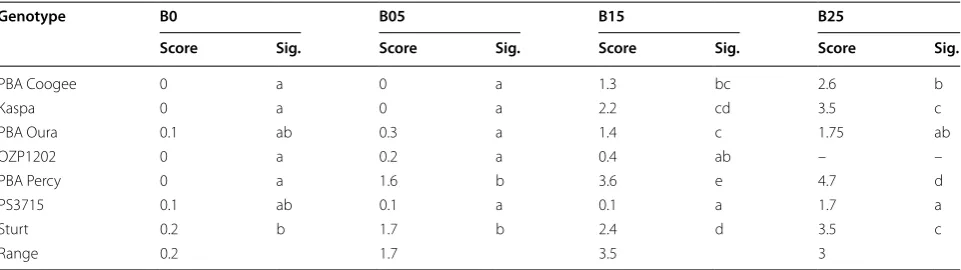
discrimi-nation among genotypes in the preliminary hydroponic experiment (5 significance levels and an overall range of 3.5 in scores, Table 1) and was selected for further hydro-ponic experiments. The most tolerant genotypes were PS3715 and OZP1202 and both were significantly more tolerant than Kaspa, PBA Oura, PBA Percy and Sturt, based on leaf symptoms.
Hydroponic experiment 1 provided three clear discrim-ination levels among genotypes based on leaf symptom scores (Fig. 1A; Additional file 5: Figure S2). PBA Percy, Kaspa and PBA Oura were the most susceptible geno-types, PBA Wharton and PBA Coogee were intermedi-ate, and PS3715, OZP1202 and OZP0804 were the most tolerant. There was no significant effect of seed maturity on the B leaf toxicity symptom scores in any genotype.
Leaf symptoms in hydroponic experiment 2 (Fig. 1B) also provided significant discrimination among
genotypes. Although the levels of discrimination were not as discrete as in hydroponic experiment 1, the main findings were consistent; PS3715, OZP1202 and OZP0804 were the most tolerant and Kaspa, PBA Oura and PBA Percy were among the least tolerant. Sturt, included in hydroponic experiment 2 but not hydro-ponic experiment 1, was also among the least tolerant genotypes. There were three cases where seed maturity had a significant effect on symptom scores in hydroponic experiment 2: PS3715, PBA Wharton and PBA Percy; although the magnitude of the differences was small rela-tive to the differences among genotypes.
Time to flowering in screened plants
The hydroponic B screening protocol reported here had no or minimal effect on time to floral initiation, compared to generations grown without a B stress in the aSSD sys-tem (Table 2). In all but one (PS3715) of the seven geno-types tested, DTF in screened plants was equivalent or lower than for aSSD generations without screening. Seed maturity had an effect on DTF in screened plants in PBA Percy (P < 0.002), with plants grown from immature PGS taking 5 days longer to flower (Table 2), while for PBA Coogee and PBA Oura, there was no effect of seed matu-rity on DTF (P ≥ 0.07).
Pot experiment
Figure 2 presents leaf symptom scores, shoot dry weight depression and root dry weight depression for the nine genotypes tested when grown in pots with 80 mg kg−1 B
amended soil. There were significant differences among genotypes in all three metrics and on the whole, there was good consensus among the metrics. OZP0804, Sturt and PS3715 were significantly lower (more tolerant) in all three metrics, compared to Kaspa and PBA Percy. In leaf symptom scores, PBA Oura, Kaspa and PBA
Table 1 Boron (B) toxicity symptom scores (including the range of scores) of seven field pea genotypes subject to four B concentrations in a preliminary hydroponic experiment
B0, B5, B15 and B25 refer to 0, 5, 15 and 25 mg L−1 B, respectively. Letters in ‘Sig.’ columns refer to significance groups among genotypes within each B treatment
Genotype B0 B05 B15 B25
Score Sig. Score Sig. Score Sig. Score Sig.
PBA Coogee 0 a 0 a 1.3 bc 2.6 b
Kaspa 0 a 0 a 2.2 cd 3.5 c
PBA Oura 0.1 ab 0.3 a 1.4 c 1.75 ab
OZP1202 0 a 0.2 a 0.4 ab – –
PBA Percy 0 a 1.6 b 3.6 e 4.7 d
PS3715 0.1 ab 0.1 a 0.1 a 1.7 a
Sturt 0.2 b 1.7 b 2.4 d 3.5 c
Percy displayed significantly more severe toxicity symp-toms than OZP0804, Sturt, PS3715, PBA Coogee and OZP1202.
Leaf symptom scores from the pot experiment differed in scale and magnitude to those obtained in hydroponic experiments, with the lowest scores around 3 in the former and 0 in the latter. However, the discrimination of four significance levels among genotypes in the pot experiment was similar to that in hydroponic experiment 1. There were two obvious and specific inconsistencies in comparisons among the metrics in the pot experiment and the two hydroponic experiments. First, although Sturt appeared consistently tolerant in the pot experiment based on leaf symptom scores, biomass metrics and seed production (Fig. 2), this genotype had poor leaf symptom scores in both the preliminary hydroponic experiment (Table 1) and in hydroponic experiment 2 (Fig. 1B). Second, OZP1202 ranked poorly in biomass metrics in the pot experiment, but was consistently among the most
tolerant genotypes based on leaf symptom scores in pots and all three experiments.
In plants grown to full maturity in pots, time to flo-ral initiation was delayed by the B80 treatment in two (PBA Percy and Sturt) of the four genotypes tested
(Table 3). Both seed count and seed weight were
impacted by the B80 treatment in all four genotypes, with reductions around 70% or more. Seed produc-tion of PBA Coogee, PBA Percy and PS3715 were most heavily impacted by B, with no difference among these three genotypes. However, Sturt was able to maintain higher yield in the B80 treatment, with higher seed count than PBA Coogee and PBA Percy, and higher seed weight than the other three genotypes, propor-tional to the B0 control.
Correlations between hydroponic scores and other results
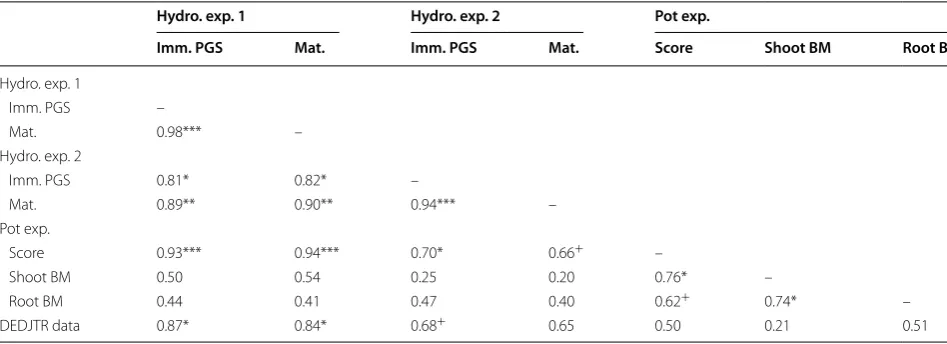
screening for leaf symptoms against a pot experiment and published rankings for the same genotypes, where available. All correlations among the tested B tolerance metrics were positive (Table 4). Leaf symptom scores from all three experiments and in both seed maturity levels were highly correlated (r > 0.7, P ≤ 0.05), except in one instance (Pot exp., Score vs. Hydro. exp. 2, Mat.) which was near significance (r = 0.66, P = 0.0514). Correlations among the metrics from the pot experiment were all near significance (root biomass vs. score: r = 0.62, P ≤ 0.1) or better (r ≥ 0.74, P ≤ 0.05). Biomass metrics from the pot experiment were not significantly correlated (P > 0.1) with metrics from hydroponic experiments or the DEDJTR data. All leaf symptom scores among the two hydroponic experiments were highly correlated (P < 0.05). DEDJTR data for B tolerance and symptom scores from both seed maturity levels in hydroponic experiment 1 were highly correlated (P ≤ 0.05), but DEDJTR data and hydroponic experiment 2 were less strongly correlated.
Table 2 Days to flowering (DTF) for plants subject
to hydroponic B screening then transplanted to pots (screened transplants), grown from immature preco-ciously germinated seed (PGS) or mature seed, compared to plants grown in pots in an accelerated single seed descent (aSSD) system
‘Sig.’ column shows P value of one-way ANOVA testing seed maturity effect on DTF
a ‘aSSD’ flowering data taken from plants grown in pots and soil under aSSD
conditions that minimise DTF as reported by Ribalta et al. [11], with no screening taking place
Genotype Screened transplants aSSDa
DTF Immature PGS
DTF (±SD) Mature seedDTF (±SD) Sig. (P value)
PBA Coogee 43 (3.6) 41 (1.8) 0.42 43
Kaspa – 37 (1.7) 41
PBA Oura 35 (3.8) 31 (0.8) 0.07 36
OZP0804 – 43 (2.6) 44
OZP1202 42 (2.2) – 43
PBA Percy 33 (1.5) 28 (1.3) 0.002 35
PS3715 44 (2.9) – 38
Fig. 2 Mean leaf symptom scores (left hand y‑axis), shoot (Shoot BM) and root (Root BM) dry weight depression (right hand y‑axis) for nine field pea genotypes grown in pots with 80 mg kg−1 B amended soil. Error bars represent ± 1 standard error. Letters below genotype names indicate
significance groupings among genotypes within each variable (labels on left of lines) based on ‘LSD.test’ in RStudio at P = 0.05
Table 3 Days to flower when grown in control (B0 DTF) and B amended (B80 DTF) potting mix, the significance of B effect on DTF (ANOVA P value), seed count and harvested seed weight for four field pea genotypes
Seed count and weight are B80 results as a percent of control. Letters in ‘Sig.’ columns indicate significance groups among means within preceding column based on ‘LSD.test’ in RStudio (P = 0.05)
Genotype B0 DTF B80 DTF ANOVA P-value Seed count (% control) Sig. Seed weight (% control) Sig.
PBA Coogee 81.4 81.4 1.00 9.3 a 7.4 a
PBA Percy 65.6 74.2 0.01 4.6 a 4.4 a
PS3715 77.4 78.4 0.74 12.8 ab 9.3 a
Discussion
We present a protocol designed to enable high-through-put, hydroponic based, controlled environment screening for B toxicity leaf symptoms in field pea. We demonstrate that the use of precociously germinated seed (PGS) har-vested 18 days after anthesis (DAA) yields results consist-ent with mature seed. The proposed screening protocol fulfils the requirements of integration within the accel-erated single seed descent (aSSD) system proposed by Ribalta et al. [11]. In addition, leaf toxicity ratings across genotypes correlated well with B tolerance ratings from pot trials and published rankings [22]. We, therefore, accept our original hypotheses.
This is the first report of abiotic screening in pulses undertaken in environmentally regulated conditions with all photoperiod requirements met using far-red enriched artificial light sources. Boron screening under our con-trolled conditions represents a major timesaving com-pared to previously reported soil systems in field pea that took 28 days [24]. Plants could be scored within 17 days of seed imbibition and then transplanted to soil without substantial delay in days to floral initiation, compared with unscreened plants in a typical aSSD generation. The aSSD system makes use of controlled environments to tailor photoperiod, temperature and light quality to greatly reduce generation time and enable consistent year-round growth [9]. The use of controlled conditions for B tolerance screening in field peas provides similar benefits, resulting in a rapid, repeatable and consistent year-round screening platform.
The second major point of difference between our protocol and previously published screens is the use of immature PGS as the starting material. We found minimal impact on B tolerance rankings (based on leaf symptoms) when using seed harvested at 18 DAA and subjected to precocious germination treatment, compared to mature seed. Over 80% of the direct comparisons between immature and mature seed showed no significant difference in response of leaf symptoms to B exposure. In the few cases where there was a difference, the magnitude was small, relative to differences among genotypes. Correlations between rankings of mature and immature seed within both hydroponic experiments were above 0.81 and significant at P ≤ 0.05. Importantly, there was minimal delay in time to floral initiation in screened then transplanted seedlings grown from immature seed, compared to those grown from mature seed. We have demonstrated that screening immature seed for leaf toxicity symptoms provides a reliable discrimination for B tolerance without the delays associated with waiting for full seed maturity or with a flowering time penalty in the screened generation. Naturally, mature seed can also be used in the screening system if preferred.
Leaf symptom scores are routinely used in B tolerance
screening in pulses [13, 16–18, 23–25]. We have
validated our hydroponic screening methodology by comparison with leaf symptoms and biomass results in soil-grown plants. We have confirmed that leaf symptom results from hydroponically grown plants align well with published categories for B tolerance from DEDJTR data Table 4 Pearson correlation coefficients among B tolerance metrics measured in a pot experiment (Pot exp.) and two hydroponic experiments (Hydro. exp. 1 & 2) and B tolerance rankings from DEDJTR data and breeders’ advice, as described in the methods
Pot exp. metrics include leaf symptom scores (Score) and shoot and root biomass (BM) reduction relative to a control treatment. Hydroponic metrics were leaf symptom scores on plants grown from immature precociously germinated seed (Imm. PGS) or mature (Mat.) seed. DEDJTR data were converted to numerical categories as described in the methods. Symbols after correlation coefficients indicate significance levels (+ P ≤ 0.1; * P ≤ 0.05; ** P ≤ 0.01; *** P ≤ 0.001)
Hydro. exp. 1 Hydro. exp. 2 Pot exp.
Imm. PGS Mat. Imm. PGS Mat. Score Shoot BM Root BM
Hydro. exp. 1
Imm. PGS –
Mat. 0.98*** –
Hydro. exp. 2
Imm. PGS 0.81* 0.82* –
Mat. 0.89** 0.90** 0.94*** –
Pot exp.
Score 0.93*** 0.94*** 0.70* 0.66+ –
Shoot BM 0.50 0.54 0.25 0.20 0.76* –
Root BM 0.44 0.41 0.47 0.40 0.62+ 0.74* –
and our results from pot experiments. The leaf symptom scores from pot- and hydroponic-grown plants showed strong correlations for B tolerance and consistently identified the most tolerant genotypes. There were some specific inconsistencies in the performance of genotypes according to results from different metrics or experiments. For example, Sturt and OZP1202 showed differing responses depending on the metric and growth system used for screening (Table 1; Figs. 1, 2). It is possible that the tolerance expressed by Sturt in pot-grown plants is related to plant developmental stage, since seedlings of Sturt demonstrated poor tolerance in the hydroponic protocol. In the case of OZP1202, the reduced expression of B toxicity symptoms in leaves is apparently not linked with an ability to maintain growth under B stress, since biomass results in the pot experiment indicated that this genotype was among the most severely affected. These inconsistencies reinforce that B tolerance in field peas is not a simple mechanism and not fully understood [13]. Different mechanisms are likely to play a larger role under different conditions (soil vs. solution culture) and at different stages of plant development. Perhaps most importantly, leaf symptom scores from the pot experiment and the two hydroponic experiments consistently identified OZP0804, OZP1202 and PS3715 as being among the most tolerant genotypes tested. We have developed this screen to complement the aSSD process and anticipate its primary use will be as a rapid screening method to identify the extreme levels of tolerance within a population. The various limitations of screening seedlings for abiotic stresses, along with the advantages of high speed and throughput, must be fully considered when using a rapid, compact protocol such as that reported here.
Advances have been made to identify molecular mark-ers for selection of B tolerance in a number of species [21, 26–30]. Tolerance to B is controlled by single genes in the model legume Medicago truncatula [21] and Lens culi-naris [31], however, the molecular basis of B tolerance in field peas has not been firmly established. Bagheri et al. [24] hypothesised that two additive loci with incomplete dominance may be responsible for the B tolerance seg-regation ratios they observed. More recently, Sudheesh et al. [16] identified a major QTL for B tolerance in field pea and developed a putative marker for the region that was associated with both powdery mildew (PM) resist-ance and B tolerresist-ance. While validating this marker across a selection of germplasm and breeding lines, Javid et al.
[3] confirmed a strong link between B tolerance and PM resistance (r = 0.959) but the marker incorrectly predicted B tolerance in 21% of cases. Concordant with screening results reported by Javid et al. [3], we found Kaspa and Sturt to be sensitive to B. However in that study, Sturt presented the B tolerant marker. This under-lines the importance of combining a rapid phenotypic assay for B with molecular data to help breeders form a complete picture of the likely performance of genotypes in the field.
We believe that small modifications to the proposed technique will enable wider application to other pulse species for which an aSSD system is available (9, 10) and potentially make it applicable to screen for the individual effects of abiotic stresses other than B, or allow studies of the interactions between B tolerance and stresses such as salinity [32]. The vast majority of research on salinity and B tolerance has been undertaken independent of one another [33]. However, high salinity and high levels of B often co-occur in agricultural environments [34]. When both stresses occur together, studies have shown that increased salinity may reduce or increase boron’s toxicity effect [32].
Conclusions
Authors’ contributions
RGB, JSC, MPN, FMR conducted experimental design, data analysis and manu‑ script writing. AL assisted with manuscript preparation. All authors read and approved the final manuscript.
Author details
1 Centre for Plant Genetics and Breeding, The University of Western Australia, 35 Stirling Hwy, Perth, WA 6009, Australia. 2 Nuseed, 5 Ballinger St, Horsham, VIC 3400, Australia.
Acknowledgements
We thank Mr Robert Creasy, Mr William Piasini and Mr Leon Hodgson for glasshouse expertise and Ms Sabrina Tschirren, Ms Kylie Edwards, Ms Christine Munday and Ms Simone Wells for technical support. We appreciate advice from Drs Matthew Rodda, Timothy Sutton and David Peck in early trials of the hydroponic system.
Competing interests
The authors declare that they have no competing interests.
Availability of data and materials
The datasets used and/or analysed during the current study are available from the corresponding author on reasonable request.
Consent for publication Not applicable.
Ethics approval and consent to participate Not applicable.
Funding
This work was supported by the Grains Research and Development Corpora‑ tion [UWA00159].
Publisher’s Note
Springer Nature remains neutral with regard to jurisdictional claims in pub‑ lished maps and institutional affiliations.
Additional files
Additional file 1: Table S1. List of genotypes used in a preliminary and two subsequent hydroponic experiments (‘Prelim. hydro.’, ‘Exp. 1’ and ‘Exp. 2’), a measurement of days to flower in transplanted seedlings (DTF) and each of three pot based experiments (‘Prelim. soil’, ‘Full trial’ and ‘DTF & yield’). ‘M’ and ‘I’ indicate that the experiment used plants grown from mature or immature seed, respectively.
Additional file 2: Figure S1. Spectrum of light used in controlled environments. Light spectrum in controlled growth environment used for hydroponic experiments modified from Croser et al. [9].
Additional file 3: Table S2. B toxicity scoring system. Leaf B toxicity scoring system used in hydroponic and pot experiments adapted from Hobson et al. [23] and Bagheri et al. [24].
Additional file 4: Table S3. DEDJTR boron tolerance rankings. DEDJTR boron tolerance rankings used as a benchmark for validation of B toler‑ ance results obtained through hydroponic experiments. ‘DEDJTR data’ are published B tolerance ratings from Department of Economic Develop‑ ment Jobs Transport and Resources [22] : T = tolerant; MT = moderately tolerant; MS = moderately susceptible; S = susceptible.
Additional file 5: Figure S2. Example of B toxicity symptom expression in field peas. Field pea varieties subject to hydroponic boron (B) tolerance screening protocol. a PBA Oura, mature seed, grown in hydroponics with nil B. b PBA Oura, mature seed, with 6 days exposure to 15 mg L−1 B showing foliar toxicity symptoms on lower leaf margins (indicated by arrows). c OZP1202, mature seed, with 6 days exposure to 15 mg L−1 B showing only minor chlorosis symptoms.
Received: 18 May 2017 Accepted: 20 August 2017
References
1. Khan TN, Meldrum A, Croser JS. Pea: overview. In: Wrigley C, Corke H, Seetharaman K, Faubion J, editors. Encyclopedia of food grains. 2nd ed. Oxford: Elsevier Ltd; 2016. p. 324–33.
2. Seymour M, Kirkegaard JA, Peoples MB, White PF, French RJ. Break‑crop benefits to wheat in Western Australia insights from over three decades of research. Crop Pasture Sci. 2012;63:1–16. doi:10.1071/CP11320. 3. Javid M, Rosewarne GM, Sudheesh S, Kant P, Leonforte A, Lombardi M,
et al. Validation of molecular markers associated with boron tolerance, powdery mildew resistance and salinity tolerance in field peas. Front Plant Sci. 2015;6:1–9. doi:10.3389/fpls.2015.00917.
4. Cartwright B, Zarcinas BA, Mayfield AH. Toxic concentrations of boron in a red‑brown earth at Gladstone, South Australia. Soil Res. 1984;22:261–72. doi:10.1071/SR9840261.
5. Nable RO, Bañuelos GS, Paull JG. Boron toxicity. Plant Soil. 1997;193:181– 98. doi:10.1104/pp.110.158832.
6. Yau SK, Ryan J. Boron toxicity tolerance in crops: a viable alternative to soil amelioration. Crop Sci. 2008;48:854. doi:10.2135/cropsci2007.10.0539. 7. Hall D. Boron—Western Australia. 2016. http://soilquality.org.au/
factsheets/boron. Accessed 22 April 2017.
8. Moody DB, Rathjen AJ, Cartwright B. Yield evaluation of a gene for boron tolerance using backcross‑derived lines. In: Randall PJ, Delhaize E, Richards RA, Munns R, editors. Genetic aspects of plant mineral nutrition. Netherlands: Springer; 1993. p. 363–6. doi:10.1007/978‑94‑011‑1650‑3_45.
9. Croser JS, Pazos‑Navarro M, Bennett RG, Tschirren S, Edwards K, Erskine W, et al. Time to flowering of temperate pulses in vivo and generation turno‑ ver in vivo–in vitro of narrow‑leaf lupin accelerated by low red to far‑red ratio and high intensity in the far‑red region. Plant Cell Tissue Organ Cult. 2016;127:591–9. doi:10.1007/s11240‑016‑1092‑4.
10. Munday C, Ribalta F, Bennett R, Edwards K, Tschirren S, Wells S, et al. Speed breed to meet industry needs. In: Australian pulse conference— feed the farm: optimising pulse performance in diverse agro‑ecological environments (Tamworth). 2016. p. 86. http://www.destinationtamworth. com.au/ArticleDocuments/196/2016%20Australian%20Pulse%20Confer‑ ence%20Book_FINAL.pdf.aspx. Accessed 19 Apr 2017.
11. Ribalta FM, Pazos‑Navarro M, Nelson K, Edwards K, Ross JJ, Bennett RG, et al. Precocious floral initiation and identification of exact timing of embryo physiological maturity facilitate germination of immature seeds to truncate the lifecycle of pea. Plant Growth Regul. 2017;81:345–53. doi:10.1007/s10725‑016‑0211‑x.
12. Stoddard FL, Balko C, Erskine W, Khan HR, Link W, Sarker A. Screen‑ ing techniques and sources of resistance to abiotic stresses in cool‑ season food legumes. Euphytica. 2006;147:167–86. doi:10.1007/ s10681‑006‑4723‑8.
13. Paull JG, Nable RO, Lake AWH, Materne MA, Rathjen AJ. Response of annual medics (Medicago spp.) and field peas (Pisum sativum) to high concentration of boron: genetic variation and the mechanism of toler‑ ance. Aust J Agric Res. 1992;43:203–13. doi:10.1071/AR9920203. 14. Reid R. Understanding the boron transport network in plants. Plant Soil.
2014;385:1–13. doi:10.1007/s11104‑014‑2149‑y.
15. Le Deunff Y, Rachidian Z. Interruption of water delivery at physiological maturity is essential for seed development, germination and seedling growth in pea (Pisum sativum L.). J Exp Bot. 1988;39:1221–30. doi:10.1093/ jxb/39.9.1221.
16. Sudheesh S, Lombardi M, Leonforte A, Cogan NOI, Materne M, Forster JW, et al. Consensus genetic map construction for field pea (Pisum sativum L.), trait dissection of biotic and abiotic stress tolerance and development of a diagnostic marker for the er1 powdery mildew resistance gene. Plant Mol Biol Rep. 2015;33:1391–403. doi:10.1007/s11105‑014‑0837‑7. 17. Bagheri A, Paull JG, Rathjen AJ, Ali SM, Moody DB. Genetic variation in the
• We accept pre-submission inquiries
• Our selector tool helps you to find the most relevant journal • We provide round the clock customer support
• Convenient online submission • Thorough peer review
• Inclusion in PubMed and all major indexing services • Maximum visibility for your research
Submit your manuscript at www.biomedcentral.com/submit
Submit your next manuscript to BioMed Central
and we will help you at every step:
18. Bagheri A, Paull JG, Rathjen AJ. The response of Pisum sativum L. germ‑ plasm to high concentrations of soil boron. Euphytica. 1994;75:9–17. doi:10.1007/BF00024526.
19. Kaur S, Nicolas ME, Ford R, Norton RM, Taylor PWJ. Selection of Brassica rapa genotypes for tolerance to boron toxicity. Plant Soil. 2006;285:115– 23. doi:10.1007/s11104‑006‑0063‑7.
20. Schnurbusch T, Hayes J, Sutton T. Boron toxicity tolerance in wheat and barley: Australian perspectives. Breed Sci. 2010;60:297–304. doi:10.1270/ jsbbs.60.297.
21. Bogacki P, Peck DM, Nair RM, Howie J, Oldach KH. Genetic analysis of tolerance to boron toxicity in the legume Medicago truncatula. BMC Plant Biol. 2013;13:54. doi:10.1186/1471‑2229‑13‑54.
22. Department of Economic Development Jobs Transport and Resources. Field pea. In: Couchman J, Hollaway K, editors. Victorian winter crop summary 2016. Horsham: Department of Economic Development, Jobs, Transport and Resources; 2016. p. 56–61. https://grdc.com.au/Resources/ Publications/2016/03/NVT‑Victorian‑Winter‑Crop‑Summary‑2016. Accessed 19 Apr 2017.
23. Hobson K, Armstrong R, Nicolas M, Connor D, Materne M. Response of lentil (Lens culinaris) germplasm to high concentrations of soil boron. Euphytica. 2006;151:371–82. doi:10.1007/s10681‑006‑9159‑7.
24. Bagheri A, Paull J, Rathjen A. Genetics of tolerance to high concentrations of soil boron in peas (Pisum sativum L.). Euphytica. 1996;87:69–75. 25. Yau SK, Erskine W. Diversity of boron‑toxicity tolerance in lentil
growth and yield. Genet Resour Crop Evol. 2000;47:55–62. doi:10.102 3/A:1008733106108.
26. Jefferies SP, Barr AR, Karakousis A, Kretschmer JM, Manning S, Chalmers KJ, et al. Mapping of chromosome regions conferring boron toxicity toler‑ ance in barley (Hordeum vulgare L.). Theor Appl Genet. 1999;98:1293–303. doi:10.1007/s001220051195.
27. Jefferies SP, Pallotta MA, Paull JG, Karakousis A, Kretschmer JM, Manning S, et al. Mapping and validation of chromosome regions conferring boron toxicity tolerance in wheat (Triticum aestivum). Theor Appl Genet. 2000;101:767–77. doi:10.1007/s001220051542.
28. Sutton T, Baumann U, Hayes J, Collins NC, Shi B, Schnurbusch T, et al. Boron‑toxicity tolerance in barley arising from efflux transporter amplifi‑ cation. Science. 2007;318:1446–9. doi:10.1126/science.1146853. 29. Schnurbusch T, Langridge P, Sutton T. The Bo1‑specific PCR marker
AWW5L7 is predictive of boron tolerance status in a range of exotic durum and bread wheats. Genome. 2008;51:963–71. doi:10.1139/ G08‑084.
30. Pallotta M, Schnurbusch T, Hayes J, Hay A, Baumann U, Paull J, et al. Molecular basis of adaptation to high soil boron in wheat landraces and elite cultivars. Nature. 2014;514:88–91. doi:10.1038/nature13538. 31. Kaur S, Cogan NOI, Stephens A, Noy D, Butsch M, Forster JW. EST‑SNP
discovery and dense genetic mapping in lentil (Lens culinaris Medik.) enable candidate gene selection for boron tolerance. Theor Appl Genet. 2014;127:703–13. doi:10.1007/s00122‑013‑2252‑0.
32. Smith TE, Grattan SR, Grieve CM, Poss JA, Suarez DL. Salinity’s influ‑ ence on boron toxicity in broccoli: II. Impacts on boron uptake, uptake mechanisms and tissue ion relations. Agric Water Manag. 2010;97:783–91. doi:10.1016/j.agwat.2010.01.015.
33. Maas EV, Grattan SR. Crop yields as affected by salinity. In: Skaggs RW, van Schilfgaarde J, editors. Agricultural drainage, agronomy monograph 38. Madison: American Society of Agronomy; 1999.