1799
Volume LXI 200 Number 6, 2013
http://dx.doi.org/10.11118/actaun201361061799
THE EFFICIENCY OF NUTRIENT
UTILIZATION BY PERMANENT GRASSLAND
IN THE KAMENIČKY LOCALITY
Adam Nawrath, Jakub Elbl, Antonín Kintl, Jaroslav Záhora, Jiří Skládanka
Received: September 12, 2013
Abstract
NAWRATH ADAM, ELBL JAKUB, KINTL ANTONÍN, ZÁHORA JAROSLAV, SKLÁDANKA JIŘÍ: The effi ciency of nutrient utilization by permanent grassland in the Kameničky locality. Acta Universitatis Agriculturae et Silviculturae Mendelianae Brunensis, 2013, LXI, No. 6, pp. 1799–1806
This work presents the analysis of the eff ect of grassland management on leaching of mineral nitrogen from rhizosphere and plant biomass production in area of our interest. The determined values show the infl uence of fertilization and species composition of permanent grassland on leaching of mineral nitrogen and biomass production. The values were determined during fi eld and laboratory experiments. The highest availability of Nmin in the fi eld experiment was detected in the variant N90+PK; the lowest availability of Nmin was recorded in the PK variant. The diff erence was statistically signifi cant (P < 0.05). In the pot experiment, the highest loss of Nmin was recorded in the variant with N180+PK (16.88 mg.dm−3) with the diff erence being statistically signifi cant as compared with the other variants (P < 0.05). Measured values of the availability of mineral nitrogen and plant biomass production indicate the importance of species composition at the establishment of new grassland. For example, species composition of permanent grassland has a great importance at the establishment of new grassland on erosion-aff ected soils in protection areas of drinking water. Because selected species of grasses can immobilize nitrogen in their bodies, thus preventing it’s leaching from the soil. mineral nitrogen, permanent grassland, primary production, fertilization
Meadows and pastures are constituents of harmonic cultural landscape from times immemorial. Grasslands represent an important landscape element, which can signifi cantly facilitate stabilization of broader ecological linkages in the landscape if their biological and ecological regularities are identifi ed and respected (Heger et al., 2007). Permanent grasslands occupy over 23% of farmland in the Czech Republic and their area has been ever increasing. According to the Czech Offi ce for Surveying, Mapping and Cadastre (COSMC), the area of permanent grasslands increased in 2010 by more than 3,000 ha. From the non-market perspective, grassland farming represents a great potential for ecological functions, which include species biodiversity, erosion control, infi ltration and retention of water in the landscape and the function of biological fi lter (Hrevušová, 2011).
1800 Adam Nawrath, Jakub Elbl, Antonín Kintl, Jaroslav Záhora, Jiří Skládanka
factors. Then the fertilization would become ineff ective and would conversely load the ecosystem with excessive doping of nutrients. Intensive fertilization may also lead to negative succession and hence to the reduced production of above-ground biomass (Hanzes et al., 2005). A no less serious consequent of excessive fertilization is also suppressed species diversity, which puts limitations on the capacity of grasslands to fulfi l a range of non-productive functions.
The paper aims to assess the eff ect of fertilization on the availability and loss of nutrients and on the yields of grass stands. Its objective is to establish an optimum fertilizer dose, which would ensure suffi ciently high yields at a simultaneous minimization of nutrient losses by leaching into ground water.
MATERIAL AND METHODS
Effi ciency of nutrient utilization by permanent grassland was ascertained in the fi eld and laboratory experiments at the Faculty of Agronomy, Mendel University in Brno. The fi eld experiment was conducted in the research locality of Kameničky and the laboratory experiment was established at the workplace of Microbiology.
Field experiment
The experiment was established on research plots in the cadastre of the village Kameničky with the permanent stand of Sanguisorba-Festucetum comutatae association. The village of Kameničky is situated in the Protected Landscape Area of Žďárské vrchy Hills. The site has a SW aspect and is situated on a slope with the gradient of 3°. Mean annual temperature (1951–2000) is 5.8 °C and mean annual precipitation amount is 758.4mm. Soil type is acidic Luvic Stagnosol on the gneiss diluvium. The experiment was designed by using the method of split compartments in four repetitions. The evaluated factor was fertilization (no fertilization – control, PK fertilization, N90+PK fertilization and N180+PK fertilization. The stands were exploited in the system of three cuts. The contents of available nutrients established by the Mehlich III method are presented in Tab. I.
Nitrogen was supplied in the form of ammonium nitrate with limestone (LAV 27%) at a total dose of 90kg.ha−1N resp. 180kg.ha−1N. In the mode of three cuts, the nitrogen dose was applied in three terms (1/3 in spring, 1/3 a er 1st cut and 1/3 a er 2nd cut). Potassic and phosphoric fertilizers were applied in spring. Phosphorus was applied in the form of Hyperkorn (26%) at 30 kg.ha−1 P and potassium was applied in the form of potassium salt (60%) at 60 kg.ha−1 K. The stands were harvested in three terms (early June, early August and early October). The grass was harvested by the mower Model MF-70 equipped with a cutting bar (engagement 1.2 m).
Characteristics assessed in our experiment included dry matter yields for the entire
growing season and availability of nutrients in the rhizosphere. In order to establish the share of individual species in the harvested forage, samples were taken of above-ground biomass from permanently staked plots (0.5 m2). The samples of the above-ground forage biomass were sorted out into individual species and dried at 60 °C. Subsequently, their dry weight was established and the proportions of individual species were expressed as percentages from the total weight of dry forage.
Availability and movement of Nmin was tracked by means of the in situ application of mixed ionex (IER) beads composed of cation exchange resin (CER) and anion exchange resin (AER) beads in the ratio of 1:1 (preserving the 1:1 anex and catex ratio) in probes made of Uhelon fi ne nylon mesh (Silk & Progres, type 130 T, mesh size 42 μm). The probes were sewn together to form a roller of 18cm in length and one cm in diameter. Each probe was worked into the soil by means of a steel spike at an angle of 45° (Novosadová, 2011). Exposure time during the growing season was from 26 April 2012 to 11 November 2012. A er 199 days of exposition, eight probes were removed from the soil profi le and the absorbed ions were resorbed by applying 10% NaCl solution. Released ions were ascertained by distillation and titration method according to Peoples et al. (1989). The ammonium and nitrate forms were established separately with their sum in the respective variants representing the Nmin capture (Elbl et al., 2012).
Laboratory experiment
The laboratory experiment was implemented with using the soils sampled from the site in Kameničky. Main indicators of the capacity of the respective variants to utilize effi ciently the applied nutrients were chosen to be the Nmin loss and the biomass production.
Laboratory experiment scheme
The pot experiment was established to measure the Nmin loss from the soil with the permanent grass stand. A model of the used pot is presented in Fig. 1. The individual pots were fi lled with soil (m = 250 g) collected from the Kameničky site. Indicator crop was Lactuca sativa L. Disturbed soil samples were taken on 26 April 2012 in accordance with CSN ISO 10 381-6. Prior to their application into the experimental containers, the collected samples were homogenized, si ed through a sieve with a mesh size of 2 mm, and pre-incubated for 30 days at a laboratory temperature (t ~ 20 °C).
I: Soil contents of available nutrients [mg.kg−1] in 2012
Fertilizer intensity P K Ca Mg pH
No fertilizer 34,62 75,9 2064 177 4,6
PK 100,13 88,9 2597 197,7 4,7
N 90 + PK 89,84 89,8 2167 167,2 4,5
The experiment consisted of four fertilization variants, each with three repetitions (V1 – no fertilizer, V2 – P and K fertilization, V3 – N90 and PK fertilization and V4 – N180 and PK fertilization).
Course of experiment exposition in the growth box
The loss of Nmin was monitored in each experimental container under controlled conditions (t = 22 °C, light intensity 300μmol/m−1s−1, light period 16/8) in the growth box for 36 days. Indicator crop seeds (8 pcs) were sown into each previously prepared container and all containers were irrigated with 15 ml of distilled water per day for a period of ten days. A er that time, the sown seeds germinated and only one plant was le in each container. In the remaining time of the experiment, the plants were irrigated with 30 ml of distilled water for three week-days (Mo, Tue, Fri).
Determination of Nmin loss
The Nmin capture was measured with using the mixed ionex beads (IER, Ion Exchange Resin) composed of cation (CER, Cation Exchange Resin) and anion (AER, Anion Exchange Resin) beads. Individual IER sheaths consisted of Novodur tubing rings, each of 75 mm in diameter and 5mm wall thickness. The UHELON mesh (fi ne nylon) was attached on both sides of the discs so that the discs could be fi lled with the above-mentioned CER and AER mixture (1:1). The resorption of captured Nmin and its subsequent determination were made similarly as in the fi eld experiment. The conversion of the Nmin of ionex to the mg in dm
3 of soil was conducted according to the algorithm of Novosadová et al. (2011).
Determination of above-ground and under-ground plant biomass production
The above-ground and under-ground biomass of the indicator crop was sampled separately from all
repetitions of individual experimental variants. Dry weight was established according to Elbl et al. (2013), which for the paper purposes represented the value of above-ground and under-ground biomass production.
Statistical evaluation
The obtained measurements were statistically evaluated with using the single-factor analysis of variance (ANOVA). In addition, we calculated the least signifi cant diff erences (LSD) at a signifi cance level of 5% (p < 0.05) with Post-Hoc Tuckey’s HSD test. The statistical analysis was performed with using the STATISTICA 10 programme and the data were graphically processed in Excel 2010 (MS OFFICE).
RESULTS AND DISCUSSION
Field experiment
Availability of mineral nitrogen in the rhizosphere of grassland belonging in the association of Sanguisorba-Festucetum comutatae
Availability of Nmin in the rhizosphere, i.e. at a depth of up to 18cm was monitored in the period from 26 April 2012 – 11 November 2012 (spring-autumn). Nmincapture values found on ionex beads are graphically illustrated in Fig. 2.
The highest and lowest Nmin availability was recorded in the N90+PK variant and in the PK variant, respectively. The diff erence between these variants was statistically signifi cant (P < 0.05). Compared with the N90+PK variant, the N180+PK variant showed impaired availability of Nmin in spite of the fact that it was doped with a double amount of nitrogen. Since the N180+PK variant did not exhibit any distinctive increase of yields, the answer should be sought in the species composition (Tab. II).
1802 Adam Nawrath, Jakub Elbl, Antonín Kintl, Jaroslav Záhora, Jiří Skládanka
species were Alopecurus pratensis and Poa pratensis. High-production grasses can fi x in their biomass a considerable amount of nitrogen, which might explain the decreased availability of Nmin in this variant. It is a well-known fact that the species of Alopecurus pratensis is capable of utilizing eff ectively nitrogen doses up to 300 kg.ha−1. The capacity of Poa pratensis to reduce the amount of leached NO3
− is known as well (Bouman et al., 2010). High nitrogen doses o en result in the occurrence of a so-called undesirable fl ora of nitrophilous species. The N-doped variants were demonstrated to exhibit a higher incidence of Rumex acetosa and Polygonum bistorta than the variants without the nitrogen fertilization. The lowest availability of mineral nitrogen was recorded in the PK variant. An explanation for this fact appears to be the high yield of primary production and the representation of individual agro-botanical groups (Fig. 3, Tab. II).
Above-ground biomass production on the research locality
Comparing the primary production of above-ground biomass (Fig. 3) and the availability of Nmin in the rhizosphere (Fig. 2), we can see that the PK variant of fertilization exhibited the lowest Nmin availability (0.46 mg/10 ml of ionex) while the production of above-ground biomass was comparable with the N90+PK and N180+PK variants. This indicates that the variant showed the same production capacity with a simultaneous maximum utilization of Nmin available in the rhizosphere. The high share of clover crops in the stand (22.6%) presumably contributed to the high yields. The capacity of clover crops to fi x atmospheric nitrogen into the form utilizable not only for their own need but also for other plants in the community is well known. Although there are studies (Bouman et al., 2010) claiming that a high share of legumes can increase the amount of available nitrogen, it was not the 2: The amount of IER-trapped soil Nmin; different letters indicate significant
differences between the respective variants
II: Representation (%) of dominant species and agro-botanical groups in the stand in 2012 in the respective variants Representation (%) of dominant species and agro-botanical groups in the stand
Species, groups/Variant No fertilizer PK N90+PK N180+PK
Festuca rubra 6,4 2,3 4,4 1,5
Poa pratensis 2,0 4,8 3,9 10,3
Alopecurus pratensis 0,7 12,4 21,0 24,8
Sanquisorba offi cinalis 1,6 13,8 8,3 4,4
Carex ssp. 32,2 2,5 0,2 0,2
Ranunculus acris 3,2 15,5 1,9 0,7
Ranunculus auricomus 15,1 8,2 8,7 13,7
Bistorta major 9,9 8,1 23,4 16,5
Juncus conglomeratus 4,3 4,2 7,5 8,5
Rumex acetosella 0,3 0,5 1,7 3,2
Trifolium repens 2,9 16,8 5,3 1,8
Grasses 40,8 27,0 49,7 53,4
Clovers 6,9 22,6 9,1 2,4
case of our experiment. We found out that nitrogen produced by clover crops was readily utilized by other plants in the association due to the absence of nitrogen fertilization, which resulted in high yields. This correlation between the share of clover crops and yields was demonstrated also by Skládanka et al. (2008).
As to the production of plant biomass, a statistically signifi cant diff erence (P < 0.05) was found between the unfertilized variant (control) with the lowest yields and the variants doped with fertilizers (PK, N90+PK and N180+PK). The individual fertilized variants showed yields comparable with the negligible increase in the N180+PK variant
Laboratory experiment
We measured the loss of Nmin during the pot experiment and ascertained the production of above-ground and under-ground biomass upon its end.
Loss of mineral nitrogen from experimental containers
The highest loss of mineral nitrogen recorded during the pot experiment was found in the N180+PK variant (16.88 mg.dm−3) with the diff erence being statistically signifi cant (P < 0.05) as compared with the other variants. It was obvious in the variants with the highest Nmin loss that the soil was saturated with mineral nitrogen, which could not be utilized by the indicator crop. The lowest Nmin loss was recorded in the PK variant (5.17 mg.dm−3).
The reason was the presence of phosphorus as limiting element for the utilization of Nmin by soil organisms in the rhizosphere. Its increased availability results in the immobilization of free Nmin in the bodies of microorganisms, and at the same time in its decomposition by metabolic processes of microorganisms into a more readily utilizable ammonium form (Šimek, 2007; Novosadová et al., 2011; Záhora et al., 2011).
The Nmin loss is expressed as a sum of the weighted means of ammonium nitrogen and nitrate nitrogen 3: Primary production of biomass in the study area in 2012
1804 Adam Nawrath, Jakub Elbl, Antonín Kintl, Jaroslav Záhora, Jiří Skládanka
trapped in the respective variants. The values of captured N in mg were converted to dm3 of soil.
Production of above-ground and under-ground biomass
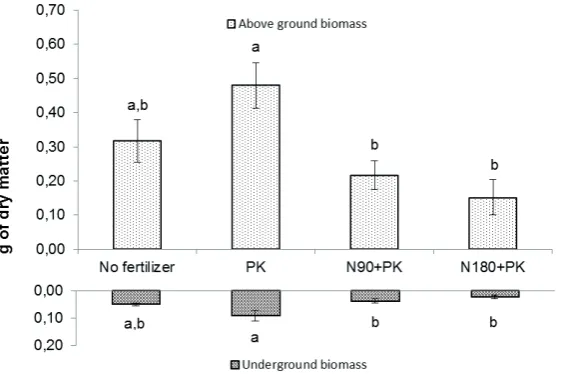
The amount of leached nitrogen was closely connected also with the increased biomass of Lactuca sativa. The greatest increase of both above-ground (0.48 g) and under-ground (0.09 g – see Fig. 5) biomass was recorded in the PK variant. The lowest increase was found in the N180+PK variant (0.15 g and 0.02 g, resp.). Diff erences between the variants were signifi cant (P < 0.05). A signifi cant diff erence was also observed between the PK and N90+PK variants. Compared with the N180+PK, a high amount of biomass was recorded in the unfertilized variant. The results suggest that Lactuca sativa is a species distinctly sensitive to the soil supply of available nutrients, the growth of which is suppressed by the excessive doses of nutrients. D’Antuono et al. (2001) demonstrated the same fact and observed positive infl uence of fertilization on Lactuca sativa only to a maximum N dose 80 kg.ha−1. The fi nding is further corroborated by comparing biomass increase in the pot experiment with meadow stand yields where the higher supply of nitrogen supported the growth in the meadow stand while the biomass increase in Lactuca sativa was decreasing. The reason was primarily the high representation of grasses capable of utilizing the high nitrogen doses for their growth, contrary to Lactuca sativa. In both cases, however, the growth was decidedly boosted by PK fertilization, probably due
to the low content of available phosphorus in local acidic soils in which a so-called degeneration of phosphorus occurs, which is then fi xed into forms not available to plants.
CONCLUSION
Based on the conducted fi eld and laboratory inquiries, the authors can state that the loss of mineral nitrogen from the soil environment of permanent grassland is most aff ected by fertilization and species composition of the stand in question. The facts appear quite clear but they become very important in situations when the strategies of soil protection against the loss of nutrients and erosion have to be revaluated. The reason is that arable land is increasingly being converted into permanent grasslands. The eff ort is particularly obvious in the protection zones of water sources or in areas threatened by erosion. This is why the results of our study represent a possible theoretical basis e.g. for the planning of permanent grasslands in exposed areas. The most appropriate measure appears to be the PK fertilization when high yields are achieved even with the absence of N fertilizer and at the same time, the nutrients are not leached into sub-surface waters. In localities extremely endangered by the leakage of nitrates or in the protection zones of water sources, grass mixtures should include species such as Alopecurus pratensis, Phleum pratense or Lolium perenne, capable of immobilizing large amounts of nitrogen and thus preventing its loss.
5: Production of above-ground and under-ground biomass in g of DM of Lactuca sativa
SUMMARY
in the Kameničky research locality. The assessed factor was fertilization in the following variants: no fertilization (control), PK fertilization, N90+PK fertilization and N180+PK fertilization. The stands were exploited in the system of three cuts. Evaluated characteristics included dry matter yields for the entire growing season and availability of nutrients in the rhizosphere determined by means of using a fi ne nylon mesh probe with mixed ionex beads. The laboratory experiment was established at the workplace of Microbiology and was conducted with using soils sampled from the Kameničky locality. Indicators of the capability of individual variants to utilize nutrients eff ectively were chosen to be the loss of Nmin and the production of Lactuca sativa biomass.
The highest availability of Nmin was detected in the variant N90+PK; the lowest availability of Nmin was recorded in the PK variant. The diff erence was statistically signifi cant (P < 0.05). The PK variant of fertilization showed forage production comparable with the nitrogen-doped variants the reason being a high representation of clover crops in the stand (22.6%), capable of binding nitrogen not only for their own need but also for the needs of other plants in the community.
In the pot experiment, the highest loss of Nmin was recorded in the variant with N180+PK (16.88 mg.dm−3) with the diff erence being statistically signifi cant as compared with the other variants (P < 0.05). The highest increase of Lactuca sativa biomass was observed in the PK variant, which exhibited also the lowest Nmin loss. Nitrogen in this variant was fully used for the growth with a minimum risk of losses due to leaching.
Acknowledgement
The paper was prepared under the support from grant IGA No. TP3/2013, NAZV No. QJ1220007 and grant CZ.1.07/2.3.00/20.005.
REFERENCES
BOUMAN, O. T., MAZZOCCA, M. A. and CONRAD, C., 2010: Soil NO3− leaching during growth of three grass–white-clover mixtures with mineral N applications. Agriculture, Ecosystems, 36, 1–2: 111– 115. ISSN 0167-8809.
D‘ ANTUONO, L. F. and NERI, R., 2001: The evaluation of nitrogen eff ect on lettuce quality by means of descriptive sensory profi ling. Acta Horticultural, 563: 217–223. ISSN 0567-7572. ELBL, J., KINTL, A. and ZÁHORA, J., 2012: Leaching
of mineral nitrogen from arable land in relation to the previous type of soil fertilization. In: MendelNet 2012 – Proceedings of International Ph.D. Students Conference. Brno: MENDELU, p. 392–400. ISBN 978-80-7375-656-7.
ELBL, J., PLOŠEK, L., KINTL, A., ZÁHORA, J., PŘICHYSTALOVÁ, J. and J. HYNŠT, J., 2013: Eff ect of organic-waste compost addition on leaching of mineral nitrogen from arable land and plant production. World Academy of Science, Engineering and Technology. 78, 22: 2858–2863. ISSN 2010-376X. HANZES, L., ILAVSKA, I. and BRITANAK, N., 2005: Eff ect of mineral fertilization on the above-ground biomass and root systém production of permanent grassland. Acta Fytotechnica et Zootechnica, 7, 3: 78– 83. ISSN 1335-258X.
HEGER, P., J. SKLÁDANKA, J. and F. HRABĚ, F., 2007: Změny druhové skladby travního porostu asociace Sanguisorba-Festucetum comutatae. In: MendelNet 2007 – Proceedings of International Ph.D. Students Conference. Brno: MZLU, 26. ISBN 978-8097375-119-7.
HŘEVUŠOVÁ, Z., 2011: Vliv různé intenzity obhospodařování na vybrané ekologické a produkční funkce lučního porostu. Praha, 2011. 186 s. Disertační
práce. Česká zemědělská univerzita v Praze. Vedoucí práce: doc. Ing. Jiří Mrkvička, CSc.
KINTL, A., PLOŠEK, L., HYNŠT, J., TŮMA, I. and ZÁHORA, J., 2012: Eff ect of carbon stimulated microbial activity on plant growth and loss of nitrogen from the soil. In: MendelNet 2012 – Proceedings of International Ph.D. Students Conference. Brno: MENDELU, p. 422–430. ISBN 978-80-7375-656-7.
LAEGREID, M., BOCKMAN, O. C. and KAARSTAD, O., 1999: Agriculture, fertilizers, and the environment. 3. ed. New York: Cabi, 1999, 294 s. ISBN 08-519-9358-3.
NOHEL, P., ZÁHORA, J. and MEJZLÍK, L., 2008: Sledování úniku minerálního dusíku z půd různých ekosystémů v OPVZ II. stupně Březová nad Svitavou. SOVAK, 17, 7–8: 48–51. ISSN 1210-3039.
NOVOSADOVÁ, I., ZÁHORA, J. and RUIZ-SINOGA, J. D., 2011:. Vliv trsanaté trávy Stipa tenacissima L. na mikrobiální transformaci půdního uhlíku a dusíku v aridních podmínkách středozemního klimatu. Úroda, časopis pro rostlinnou výrobu,. Vědecká příloha, 61, 10: 412—423. ISSN 0139-6013.
PEOPLES, M. B., FAIZAH, A. V., RERKASEM, B. and HERRIDGE, D. F., 1989: Methods for evaluating nitrogen fi xation by nodulated legumes in the fi eld. Canberra: Australian centre for international agriculture research, 76 p. ISBN 978921531569. PLOŠEK, L., ELBL, J., KINTL, A., ZÁHORA, J.
a HYNŠT, J., 2013: Vliv přídavku kompostu na únik minerálního dusíku a produkci biomasy. Waste forum, 8, 1: 20–28. ISSN 1804-0195.
1806 Adam Nawrath, Jakub Elbl, Antonín Kintl, Jaroslav Záhora, Jiří Skládanka
SKOŘEPOVÁ, I., PAŘÍZEK, I. a ROUŠAROVÁ, R., 1999: Studie a souborné informace: Omezování plošného znečištění povrchových a podzemních vod v ČR, dílčí zpráva subprojektu “půda“ za rok 1999. EKO VIS MŽP: Informační zpravodaj, 10, 3: 17. ISSN N.
ŠIMEK, M., 2007: Základy nauky o půdě. 2., upravené a rozšířené vydání. České Budějovice: Jihočeská univerzita v Českých Budějovicích, 158 s. ISBN 80-704-0747-6.
ÚLEHLOVÁ, B., 1989: Koloběh dusíku v travních ekosystémech. Praha: Academia, 110 s. Studie ČSAV, č. 20. ISBN 80-200-0192-1.
ZÁHORA, J., NOHEL, P. a KINTL, A., 2011: Vyplavování minerálního dusíku z orných, lučních a lesních půd v OPVZ II. st. Březová nad Svitavou. In: Sborník příspěvků XV. mezinárodní vodohospodářské konference VODA ZLÍN 2011. Zlín: Voding Hranice a Moravská vodárenská, s. 49–54. ISBN 978-80-254-9113-3.
Address