©
Prentice-Hall, Inc.
Stomata Functions
◆
Pre-Lab Discussion
During photosynthesis, plants capture light energy and convert it into chemical energy that is stored in sugar molecules. The two raw materials needed for this process are water and carbon dioxide. Plants obtain water through their roots. They obtain carbon dioxide, a gas, through tiny openings, or pores, called stomata (singular stoma). Most of the stomata are located in the plant’s leaves. The stom-ata must be open to allow carbon dioxide to pass into the leaf. The open stomstom-ata also allow water and oxygen to pass out of the leaf.
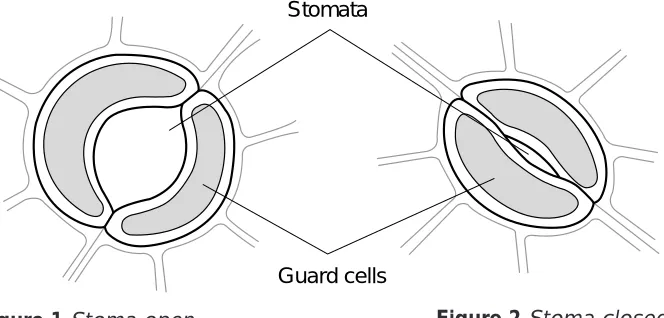
The opening and closing of the stomata is carried out by guard cells. When guard cells absorb water, they swell, and the stomata open, as shown in Figure 1. When guard cells lose water, the swelling is reduced, and the stomata close, as shown in Figure 2. Stomata are adaptations that help plants survive. When they are open, they allow carbon dioxide to enter. When they are closed, they help prevent the loss of water from the plant.
In this investigation, you will determine the number of stomata on different types of leaves.
1. Are the stomata usually open or closed during photosynthesis? Explain.
The stomata are open during photosynthesis. The open stomata enable plants to obtain a supply
of carbon dioxide, which they need for photosynthesis
2. Are stomata usually open or closed during dry periods? Explain.
The stomata are usually closed when it’s dry. The closed stomata help the plant reduce the loss
of water.
L A B 2
L A B O R A T O R Y I N V E S T I G A T I O N
Key Concept: Pairs of guard cells open and close tiny holes called stomata, which allow certain materials to pass into and out of the plant.
Skills Focus: Observing, inferring, measuring, calculating
Time Required: 60 minutes
Stomata
Guard cells
◆
Problem
Approximately how many
stomata are present on a typical leaf?
◆
Materials
(per group)microscope slide coverslip
water
plastic dropper lettuce leaf, fresh forceps
iodine solution
compound microscope paper towel
leaves from two different plants metric ruler
◆
Safety
Review the safety guidelines in the front ofyour lab book.
Wipe up spills immediately. Coverslips and slides break easily, so handle them care-fully. Tell the teacher if a slide breaks. If your microscope has a mirror, do not use it to reflect direct sunlight. Eye damage can occur if direct sunlight is used as a light source. Iodine solution can stain skin and clothing. If you spill any solution on your skin, rinse it off immediately with cold running water, and tell the teacher.
◆
Procedure
Part A: Identifying Guard Cells
1. Prepare to make a wet mount by placing a drop of water in the center of a microscope slide.
2. Obtain a fresh lettuce leaf, and turn it over so that it curves downward. You are now looking at the lower epidermis, or bottom, of the lettuce leaf. Locate the large central rib in the leaf.
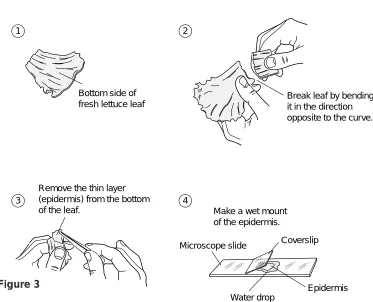
3. Bend the leaf backward against the curve until it breaks, as shown in Figure 3. Use forceps to carefully remove a small piece of the thin epidermal layer.
4. Spread out the epidermis specimen in the water drop on the slide. Be sure that no part of the epidermis is folded over.
©
Prentice-Hall, Inc.
usually sold over the counter in pharmacies.
Advance Preparation: For Part B, determine whether the types of leaves you are providing need to be blanched. The lower epidermis of some types of leaves—such as
fresh lettuce and spinach, Coleus, Tradescantia,and
Peperomia—usually peels off easily. Other leaves may need to be placed in boiling water for a few minutes before their epidermises become loose. Students can compare leaves from houseplants, garden plants, or wild-growing plants.
Alternate Materials: Ask students to bring in any plants they have.
Teaching Tips: You may wish to review how to focus the microscope. Discuss other precautions students should take to avoid damaging the microscopes or their slides.
IMPORTANT: The area of a leaf must be determined before it is blanched.
5. Add a drop of iodine to the water.CAUTION:Iodine is poisonous, and it can cause stains. Handle it carefully. Then hold a coverslip at the angle shown in
Figure 3, and gently lower it over the specimen. Touch the edge of a paper towel to one side of the coverslip to remove excess water.
6. Observe the slide with a microscope under low power.CAUTION:When using the microscope, follow safe procedures described on pages 1–5. Look for different
types of cells. Most of the cells you see will have an irregular shape. The rest of the cells, which are shaped like sausages, appear in pairs. The paired cells are the guard cells. Notice whether they are open or closed.
7. On the next page, make a labeled drawing of the epidermis under low power.
8. Examine a pair of guard cells under high power, and make a labeled drawing beside the one you drew in Step 7.
Part B: Comparing the Number of Stomata in Different Leaves
1.Obtain freshly cut leaves from two different kinds of plants. Record the types of plants you are using in the Data Table.
2.Use a metric ruler to determine the approximate length and width of the first leaf in millimeters. If the leaf has an irregular shape, estimate the length and width as closely as you can. Multiply the length times the width to find the area in square millimeters (mm2). Record the area in the Data Table.
©
Prentice-Hall, Inc.
S TO M ATA F U N C T I O N S
(continued)Bottom side of fresh lettuce leaf
Break leaf by bending it in the direction opposite to the curve.
1 2
3 4
Remove the thin layer (epidermis) from the bottom
of the leaf. Make a wet mount of the epidermis.
Microscope slide Coverslip
Epidermis Water drop
3. Use the procedures from Part A to examine a section of the lower epidermis of the leaf.
4. Observe the slide under low power. Count the number of stomata in your field of view. Record this number in the appropriate column in the Data Table.
5. The field of view under low power is usually about 1.33 mm2. To determine the total number of stomata in the leaf, use the equation below. Record the results in the Data Table.
total area of the leaf in mm2
3 number of stomata in field of view = ___ stomata 1.33 mm2in field of view
6. Repeat Steps 2 through 5 for the second leaf. Wash your hands thoroughly when you are finished handling the materials.
◆
Observations
©
Prentice-Hall, Inc.
Teaching Tip: Another method for finding the area of the leaf involves tracing the leaf on graph paper,
counting the number of squares in the leaf’s area, then calculating the area of each square and multiplying by the number of squares.
Data Table
◆
Analyze and Conclude
1. How do the number and shape of the guard cells compare with the number and shape of the cells around them?
The guard cells appear in pairs, and they have a sausagelike shape. The other cells, which have
irregular shapes, appear in much larger numbers.
2. How do guard cells control the stomata?
The guard cells open and close the stomata. When the guard cells are swollen because
addi-tional water has diffused into them, they are forced apart, and the stomata open. When the
excess water leaves the guard cells, they relax, and the stomata close.
3. How do the number of stomata compare for the two leaves you examined at low power?
Answers will vary. See the Data Table for samples. The field of view at low power is a little larger
than 1 square millimeter. Some leaves have as few as 40 stomata per square millimeter. Many
have more than 100 per square millimeter; some have more than 400 per square millimeter.
4. How did the number of stomata per leaf compare?
Answers will vary. See the sample answers in the Data Table.
◆
Critical Thinking and Applications
1. Can photosynthesis occur if the stomata are closed? Explain.
Little or no photosynthesis can take place when the stomata are closed because most of the
carbon dioxide needed as a raw material comes from the air. Carbon dioxide from the air cannot
enter the leaf when the stomata are closed.
2. The stomata tend to be closed during dry periods. How does that pattern aid the survival of the plant?
Plants give off water through open stomata, but they can conserve water when the stomata are
closed. Keeping the stomata closed may save the plant from drying out.
©
Prentice-Hall, Inc.
S TO M ATA F U N C T I O N S
(continued)Type of Leaf Area of Leaf Stomata in Lower Epidermis (mm2)
In Field of View In Total Leaf
Coleus 2,500 180 338,345
◆
More to Explore
Find a way to estimate the number of stomata on a specific plant. You could start with the number of stomata on a single leaf. You may be able to count or estimate the number of leaves on a plant directly.
However, if the plant is large and has a huge number of leaves, develop a method for estimating the number of leaves. For example, estimate the number of main branches of a tree; then estimate the number of smaller branches on the main branch; then estimate the number of leaves on a smaller branch; then multiply to find the total. (Hint: Use round numbers and any other math strategies you know to simplify your work.)
Be sure students understand that there are many acceptable ways to carry out these estimates. Urge them to explain why their chosen method is reasonable.
Sample for a coleus plant: About 300,000 stomata per leaf 315 leaves = 4,500,000
stomata on the whole plant
Sample for a tree with 1 million stomata per leaf: About 10 main branches per tree 310
smaller branches per main branch 3100 leaves per smaller branch = 10,000 leaves per
tree; then 10,000 leaves per tree31 million stomata per leaf = 10 billion stomata per tree
If students have learned to use scientific notation, they can use that method of work-ing with large numbers to carry out these calculations.
©