Biogeosciences, 8, 1477–1486, 2011 www.biogeosciences.net/8/1477/2011/ doi:10.5194/bg-8-1477-2011
© Author(s) 2011. CC Attribution 3.0 License.
Biogeosciences
The effect of resource history on the functioning of soil microbial
communities is maintained across time
A. D. Keiser1, M. S. Strickland1, N. Fierer2,3, and M. A. Bradford1
1School of Forestry and Environmental Studies, Yale University, New Haven, CT, 06511, USA 2Department of Ecology and Evolutionary Biology, University of Colorado, Boulder, CO, 80309, USA
3Cooperative Institute for Research in Environmental Sciences, University of Colorado, Boulder, CO, 80309, USA Received: 28 January 2011 – Published in Biogeosciences Discuss.: 23 February 2011
Revised: 18 May 2011 – Accepted: 25 May 2011 – Published: 9 June 2011
Abstract. Historical resource conditions appear to influ-ence microbial community function. With time, histori-cal influences might diminish as populations respond to the contemporary environment. Alternatively, they may persist given factors such as contrasting genetic potentials for adap-tation to a new environment. Using experimental micro-cosms, we test competing hypotheses that function of dis-tinct soil microbial communities in common environments (H1a) converge or (H1b) remain dissimilar over time. Us-ing a 6×2 (soil community inoculum×litter environment) full-factorial design, we compare decomposition rates in ex-perimental microcosms containing grass or hardwood litter environments. After 100 days, communities that develop are inoculated into fresh litters and decomposition followed for another 100 days. We repeat this for a third, 100-day pe-riod. In each successive, 100-day period, we find higher de-composition rates (i.e. functioning) suggesting communities function better when they have an experimental history of the contemporary environment. Despite these functional gains, differences in decomposition rates among initially distinct communities persist, supporting the hypothesis that dissimi-larity is maintained across time. In contrast to function, com-munity composition is more similar following a common, ex-perimental history. We also find that “specialization” on one experimental environment incurs a cost, with loss of func-tion in the alternate environment. For example, experimen-tal history of a grass-litter environment reduced decompo-sition when communities were inoculated into a hardwood-litter environment. Our work demonstrates experimentally that despite expectations of fast growth rates, physiological
Correspondence to: A. D. Keiser
flexibility and rapid evolution, initial functional differences between microbial communities are maintained across time. These findings question whether microbial dynamics can be omitted from models of ecosystem processes if we are to pre-dict reliably global change effects on biogeochemical cycles.
1 Introduction
Soil microbial communities play a pivotal role in ecosystems as drivers of biogeochemical processes, including carbon and nitrogen cycling (Allison and Martiny, 2008; Lauber et al., 2009; Bell et al., 2005; Fierer et al., 2007; Manzoni and Porporato, 2009; McGuire and Treseder, 2010; Wallenstein et al., 2010). How the activities of these communities will respond to environmental change, and hence influence car-bon storage and nutrient availability, is an important research question for predicting future ecosystem function (Wallen-stein et al., 2010). Given high species richness, fast growth rates, physiological flexibility and rapid evolution, soil mi-crobial communities are traditionally assumed to be func-tionally similar with regard to broad-physiological processes such as the decomposition of organic carbon (Allison and Martiny, 2008; Schimel, 1995; Green et al., 2008; McGuire and Treseder, 2010). This assumption of similarity underlies the majority of terrestrial ecosystem models and is broadly defined as the ability of different microbial communities to carry out a functional process at a similar rate regardless of differences in composition (Allison and Martiny, 2008; Reed and Martiny, 2007).
also historical factors, such as limited dispersal (Martiny et al., 2006; Ramette and Tiedje, 2007). Biogeographic het-erogeneity provides conditions suitable for individuals and communities to adapt to their environment (Holt and Go-mulkiewicz, 1997; Gholz et al., 2000; Strickland et al., 2009b). This indicates that the history of any one habi-tat might shape microbial community function under a new resource environment. To test for such historical effects one can compare ecosystem process rates in a common en-vironment, inoculated with microbial communities sourced from different environments (Ayres et al., 2009; Langen-heder and Prosser, 2008; Reed and Martiny, 2007; Strickland et al., 2009a). Using this approach, Strickland et al. (2009a) demonstrated that resource history generated functionally dissimilar communities, with history explaining between 22 and 86 % of variance in the ecosystem process measured. What has not been resolved is whether these historical ef-fects diminish as microbial communities respond to contem-porary resource conditions. In other words, it is not apparent whether the communities become functionally more similar across time if exposed to a common environment. Such con-vergence in function might be expected if communities ac-climate or adapt given physiological flexibility and natural selection, respectively. If initially distinct communities do become more functionally similar across time in a common environment then this might minimize the need to include microbial dynamics in predictive ecosystem models (see Al-lison and Martiny, 2008).
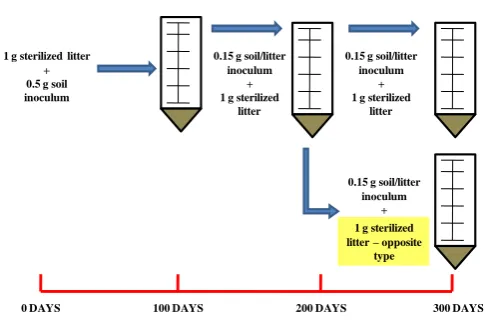
We used experimental microcosms, in a common garden design, to test whether initially distinct microbial communi-ties exposed to common environments became more func-tionally similar (i.e. converge) across time (H1a)or whether they remained functionally dissimilar (H1b). Microbial in-ocula were collected from three, paired hardwood-grassland locations in the southeastern United States and introduced to common litter environments. After 100 days, the communi-ties that developed were used to inoculate fresh litter envi-ronments and decomposition followed for another 100 days. We repeated this re-inoculation for a third, 100-day period (Appendix A). In addition to assessing function by measur-ing litter decomposition (as carbon mineralization rates), we also measured microbial community composition using ge-nomic techniques at the end of the first and third 100-day period. Lastly, reciprocal inoculations were introduced in the third 100-day period. We placed microbial communities exposed to each of the common environments (either grass or hardwood litter) across the first two 100-day periods into the alternate litter environment for the third 100-day period (Appendix A). For example, communities experiencing the grass environment for two 100-day periods were inoculated into the hardwood environment, and vice-versa. This per-mitted us to test whether a change in function with expo-sure to one environment had consequences for function in an alternate environment. Specifically, we hypothesized that function is impaired when communities are moved to a less
favorable (i.e. more chemically recalcitrant) resource envi-ronment, and maintained when communities are moved to more favorable resource environments (H2a). The hardwood litter being the poor resource environment and the grass lit-ter the rich. That is, “trade-offs” in function are asymmet-ric, which would be expected under the “functional breadth” hypothesis proposed by van der Heijden et al. (2008). This hypothesis states that microbial communities from poor re-source environments maintain function across different envi-ronments because they’re adapted to use a broad range of or-ganic compounds, whereas communities from rich resource environments specialize on a narrower range of compounds and so have reduced function in poorer environments. Al-ternatively, function is simply a relative product of the con-temporary environment (H2b), which is consistent with the expectation that litter quality (e.g. initial C:N), for example, determines decomposition rates independent of the microbial community. Such assumptions are implicit in most predictive ecosystem models (see Allison and Martiny, 2008).
2 Methods
2.1 Soil inocula and litter environments
Soil microbial community inocula were collected from paired hardwood forest and grassland habitats at three lo-cations: Coweeta Hydrologic Laboratory, North Carolina (35◦000N, 83◦300W), Whitehall Forest, Georgia (33◦880N, 83◦360W), and Calhoun Experimental Forest, South Car-olina (34◦630N, 81◦730W). The locations span a regional physiographic gradient, ranging from mountains to mid- and low-piedmont, respectively. Soils at each location are Ul-tisols and have an acid pH (ranging from 4.35 in water at the Coweeta hardwood site to 5.75 at the Whitehall grass-land site). The pairings and locations were chosen given the expectation that they would initially demonstrate differences in function in a common environment resulting from dif-ferences in historical environment (grass or forest) and ge-ographic distance (locations are 145–225 km apart). Soils were collected from the surface 7.5 cm of the A horizon at each site from three, 25×25 cm quadrats along a 10 m tran-sect. Prior to collection, the litter layer was brushed aside. A pronounced Oe or Oa horizon does not develop at the sites, and thus the litter is in direct contact with the surface mineral horizon. Soils were passed through a 2 mm sieve and homog-enized prior to microcosm set-up (below). Hereon we refer to them as: Coweeta grassland=A, Coweeta hardwood=B, Calhoun grassland=C, Calhoun hardwood=D, Whitehall grassland=E, and Whitehall hardwood=F.
Litters for the common environments were collected at Coweeta Hydrologic Laboratory as either standing-dead ma-terial (grass) or recent litterfall (hardwood). Schizachyrium
A. D. Keiser et al.: History structures microbial communities 1479 as the hardwood. The grass litter was chemically less
recalci-trant, with 44.9 % C, 0.51 % N and 6.63 % lignin, compared to for the hardwood 48.9 % C, 0.55 % N and 12.54 % lignin. Litter was air-dried and homogenized by passing through a Wiley mill (2 mm mesh). It was sterilized by autoclaving twice in succession at 120◦C for 20 min, and then again 24 h later, before drying to 65◦C (Strickland et al., 2009a, b). 2.2 Experimental design
We used a 6×2 (soil inoculum×litter environment), full-factorial design. Litter microcosms were constructed and maintained following Strickland et al. (2009a, b). Briefly, microcosms were 50 ml plastic, centrifuge tubes containing 1 g litter and 0.5 g soil inoculum, homogeneously mixed. The soil inoculum represented approximately 20 % of the over-all volume, but the microcosm was a sufficient litter:soil mass ratio to sustain consistent microbial respiration through 100 days (see Strickland et al., 2009a). Six replicates were established for each litter (2) by inoculum (6) combination, giving 72 units per 100 day run. Water-holding capacities of the litter-soil mixes were adjusted by weight and maintained at 65 % (Langenheder and Prosser, 2008), which is within the favorable range for microbial activity. The litter microcosms were kept at 20◦C under 100 % humidity (to prevent drying), and carbon mineralization was measured periodically over each 100-day run (see below). For the second 100-day run, microcosms were established with 1 g fresh litter and 0.15 g of the previous round’s litter-soil mixture as the inoculum. This was repeated for a third, 100-day run (Appendix A). This design of inoculation of fresh litters across successive 100-day runs was designed to test whether functioning of mi-crobial communities converges (i.e. becomes more similar) if they are exposed to a common resource environment. To explore whether recent history of one litter type led to loss of function on an alternate litter type, in the third 100-day run we also crossed inocula into the alternate environment resulting in 72 additional units. Specifically, if a community experienced grass litter in the first two rounds, it was then inoculated in the third round into a hardwood litter environ-ment, and vice-versa (Appendix A).
2.3 Carbon mineralization rates
Carbon mineralization rates were measured twelve times across each 100-day run (days 2, 5, 8, 12, 17, 23, 30, 37, 45, 54, 75 and 100), following Strickland et al. (2009a, b). Briefly, for each measurement, centrifuge tubes were fit-ted with gas-tight lids modified with septa for gas analy-sis. They were flushed with CO2-free air and incubated for 24 h. Headspace CO2 concentrations were measured using infra-red gas analysis (Li-COR model LI-7000, Lincoln, NE, USA). In each round, tubes with inocula only were estab-lished to determine inocula-derived CO2efflux. These values were subtracted from the litter microcosm fluxes to estimate
litter mineralization rates. Cumulative carbon mineralized for each replicate was determined by integrating rate values across each 100-day run.
2.4 Microbial community composition
We used a barcoded pyrosequencing procedure targeting the small-subunit rRNA gene in order to determine the structure of the bacterial and fungal communities at the end of the 100 d incubations for both rounds 1 and 3. As we would not necessarily expect the bacterial and fungal communities to respond in a similar manner to the litters, these two de-composer taxa were analyzed independently. We conducted the molecular analyses to test whether the composition of the communities in the microcosms converged between rounds 1 and 3 on their respective litters. In other words, we were testing whether communities became more compositionally similar on a given litter type regardless of the microbial in-oculum. To keep sample numbers manageable, we only ex-amined community differences for four, randomly-selected, inoculum-types per litter. This gave eight samples per round, with replicate microcosms of a given inoculum pooled to-gether to produce a single composited sample, following Strickland et al. (2009a). The inocula selected for analysis in round 1 were also selected for round 3 to allow for com-parison across time. DNA extractions, PCR amplifications, amplicon pooling, and sequence analyses were conducted as described previously (Rousk et al., 2010; Lauber et al., 2009). Sequencing was done at Engencore at the University of South Carolina on a Roche 454 GS-FLX automated se-quencer. Only those samples which yielded>1000 quality bacterial and>1000 quality fungal sequences were included in the subsequent analyses. On average, the pyrosequencing yielded 2430 bacterial and 1550 fungal sequences per sam-ple, and, for both groups, the reads were sufficiently long to obtain sequence data for the full length of the amplicons. 2.5 Statistical analysis
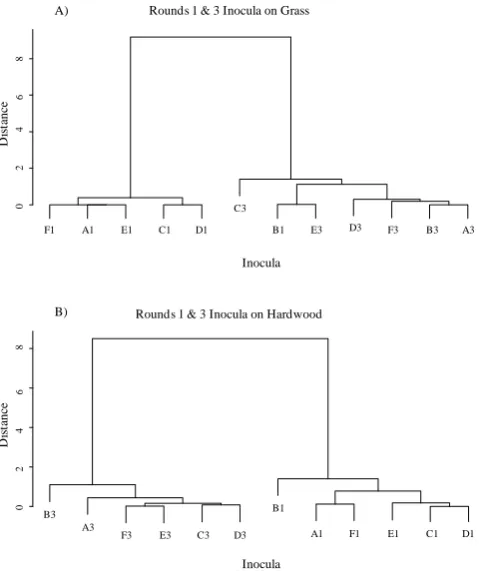
ANOVA was used to test between H1a and H1b (i.e. loss vs. maintenance of functional dissimilarity), by testing for effects on cumulative carbon mineralization of the litter en-vironment (hardwood or grass), inoculum (A through F), and sampling round (one through three). All factors were per-mitted to interact and treated as discrete. We also generated cluster diagrams in R (Team, 2009) – based on Euclidean dis-tance and Ward’s method – to more easily visualize whether function converged across time. Specifically, this approach permitted us to examine with more certainty whether signifi-cant interactions between sampling round and litter environ-ment and/or inoculum were associated with functional con-vergence (see Results).
hardwood in round 3) and experimental resource history (grass or hardwood in rounds 1 and 2) as fixed effects. In-oculum (A through F) was not a factor of interest in this analysis but was included as a random effect to account for the spatial association between inocula from the same site (e.g. A and B) but with a different contemporary litter envi-ronment and/or experimental resource history. For statistical significance, we used an alpha of <0.05. Data were loge
-transformed when necessary to conform to assumptions of homoscedasticity. ANOVAs and mixed-effect models were performed in the statistical freeware R (Team, 2009).
Sequence data were processed using the QIIME software package (Caporaso et al., 2010) using techniques employed previously with similar datasets (Rousk et al., 2010; Fierer et al., 2008; Lauber et al., 2009). Briefly, sequences were assigned to phylotypes at the 97 % sequence similarity level and the phylotypes were classified by comparing represen-tative sequences to those in curated databases. For both the bacterial and fungal data, matrices of proportional phylotype abundances per sample were square-root transformed with the pair-wise distance between each sample calculated using a Euclidean distance metric as implemented in PRIMERv6 (PRIMER-E Ltd, Ivybridge, UK). The resulting distance ma-trices were visualized using principal coordinates plots with the statistical significance of the community differences be-tween litter types and rounds determined using ANOSIM (PRIMER-E Ltd, Ivybridge, UK).
3 Results
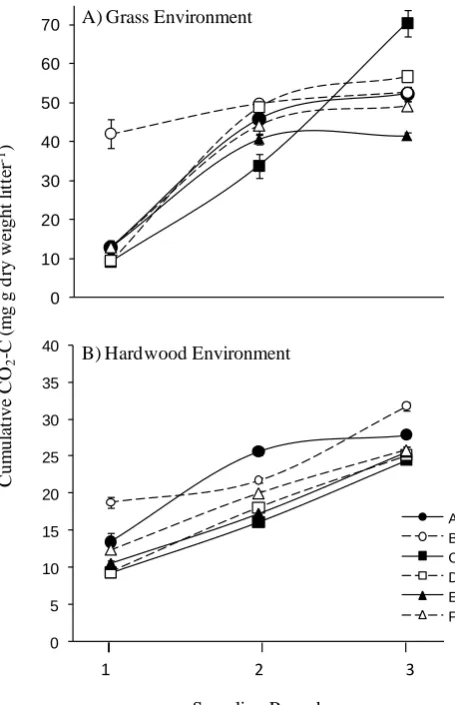
To test our competing hypotheses 1a and 1b (i.e. loss vs. maintenance of functional dissimilarity), we assessed whether initial functional differences (i.e. cumulative litter mineralization across 100 days in round 1) between inoc-ula changed across successive rounds in a common environ-ment. That there were initial functional differences between at least some of the inocula in round 1, for each litter en-vironment, was confirmed by a significant inoculum effect (grass,F5,30=29.65,P <0.001; hardwood,F5,30=27.175,
P <0.001, with inocula B and D differing to the greatest extent (Fig. 1). Also apparent were marked increases in function (i.e. cumulative mineralization) for all inocula in each successive sampling round (Fig. 1). Significant inter-actions between inoculum and round, for both environments (grass,F10,90=28.2,P <0.001; hardwood,F10,90=11.37,
P <0.001), indicated that as function increased, the rela-tive differences among inocula over the rounds also changed. For example, inoculum C moved from the lowest cumulative mineralization on grass in round 1 to the highest in round 3 (Fig. 1). Yet, shifts in relative function among inocula were not associated with increasing similarity in function across rounds (Hyp. 1a); rather, functional differences were main-tained overall (Hyp. 1b). To more clearly observe these pat-terns, we constructed cluster diagrams for the rounds 1 and 3
0 10 20 30 40 50 60 70
0 5 10 15 20 25 30 35 40
A B C D E F
1 2 3
C
um
ul
at
ive
C
O2
-C
(
m
g
g
d
ry
w
ei
gh
t
li
tt
er
-1)
Sampling Round A) Grass Environment
[image:4.595.314.542.63.416.2]B) Hardwood Environment
Fig. 1. Cumulative litter decomposition across each 100-day
sampling round for six different microbial community inocula in grass (A) and hardwood (B) environments. Closed symbols and solid lines represent inocula from grassland sites and open symbols
and dashed lines from hardwood sites. Values are means±1 SE
(n=6). For clarity, pair-wise comparisons are not shown.
How-ever, in each round at least three inocula are significantly different
(P≤0.05).
A. D. Keiser et al.: History structures microbial communities 1481
Figure 2.
B3
A3
F3 E3 C3 D3
B1
A1 F1 E1
C1 D1 0 2 4 6 8
Rounds 1 & 3 Inocula on Hardwood
hclust (*, "ward") Inocula D ist a n ce
F1 A1 E1 C1 D1
C3 B1 E3 D3 F3 B3 A3 0 2 4 6 8
Rounds 1 & 3 Inocula on Grass
hclust (*, "ward") Inocula D ist a n ce A) B) D is ta nc e 0 2 4 6 8 0 2 4 6 8 D is ta nc e Inocula Inocula
F1 A1 E1 C1 D1
C3
B1 E3 D3 F3 B3 A3
B3 A3
F3 E3 C3 D3
B1
A1 F1 E1 C1 D1
Rounds 1 & 3 Inocula on Grass
Rounds 1 & 3 Inocula on Hardwood
Fig. 2. Cluster diagrams, using Euclidean distance and Ward’s
method, for cumulative litter decomposition rates for inocula with a history of grass (A) or hardwood litter environments (B) in rounds 1 and 3. For both the grass and hardwood litter environments, func-tioning across inocula is approximately equal within rounds, indi-cating that functional dissimilarity is maintained across time.
after 100 days and 0.178 and 0.101 after 300 days on grass and hardwood, respectively. However, a paired t-test of the variances between rounds 1 and 3 by litter type, ranked from smallest to largest variance, showed this decline was not sig-nificant: grass,t5=0.846,P =0.436; hardwood,t5=1.716,
P=0.147. Overall, our data support hypothesis 1bfor func-tional dissimilarity.
The maintenance of functional dissimilarity across rounds contrasted with the phylogenetic composition of the bacterial communities, where the communities clustered by litter type in round 3 but not in round 1 (Fig. 3a). This suggested that there was convergence of community composition over time in the same litter environment. A similar, though less dra-matic, convergence was also observed in the fungal commu-nities, with the composition clustering by litter type in round 3 (Fig. 3b).
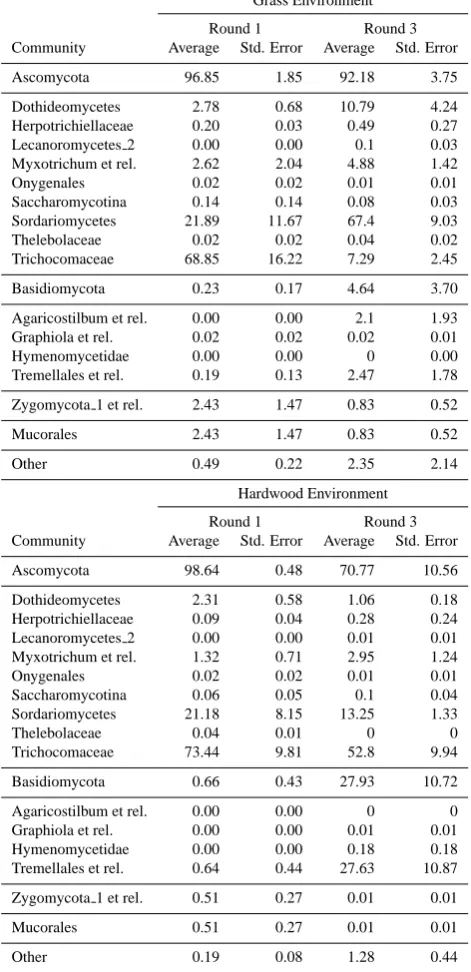
The clustering of bacterial and fungal communities across time reflected shifts in the dominant taxa. At the end of round 1, there was not a clear distinction between dominant taxa in the grass or hardwood environments (Tables 1, 2), as visu-alized in the PCA plots of Fig. 3. For example, Alphapro-teobacteria composed 29.43 %±8.64 and 21.83 %±6.06 of
Figure 3.
-5 0 5 10
-5 0 5 10
C om p. 2 ( 16.4 % of t ot al va ri at ion)
Comp. 1 (33.5% of total variation)
1 gra ss
1 ha rdwood
3 gra ss
3 ha rdwood
A) Bacteria
-5 0 5 10
-5 0 5 10
C om p 2. ( 22.4 % of t ot al va ri at ion)
Comp. 1 (46.1% of total variation) B) Fungi
Fig. 3. Principle components plots of bacterial (A) and fungal (B)
communities, using Euclidean distance (calculated from phylotype abundances), for inocula in round 1 (circles) or round 3 (squares). The phylogenetic composition of these inocula cluster by litter en-vironment (grass or hardwood) in round 3 only, following exposure to these litter environments in previous rounds (1 and 2).
[image:5.595.309.545.66.433.2]Table 1. Percent distribution of bacterial taxa averaged across
in-ocula within a litter environment and sampling round. Each num-ber represents the percent occurrence of a specific phylum or sub-phylum within the total number of bacterial sequences.
Grass Environment Round 1 Round 3 Community Average Std. Error Average Std. Error
Acidobacteria 8.18 3.42 7.51 1.80
Actinobacteria 17.85 2.66 13.07 4.88 Bacteroidetes 3.66 2.61 19.28 6.81
Firmicutes 6.82 5.62 0.10 0.04
Planctomycetes 0.45 0.15 0.70 0.32 Alphaproteobacteria 21.83 6.06 25.79 3.94 Betaproteobacteria 18.99 3.92 11.01 2.03 Deltaproteobacteria 0.21 0.11 0.09 0.04 Gammaproteobacteria 4.43 1.64 19.26 7.18 Verrucomicrobia 0.96 0.30 0.10 0.05
Other 16.62 7.15 3.09 0.34
Hardwood Environment Round 1 Round 3 Community Average Std. Error Average Std. Error Acidobacteria 7.66 3.23 15.40 3.65 Actinobacteria 24.57 7.36 4.23 3.12
Bacteroidetes 0.95 0.46 3.05 2.97
Firmicutes 1.98 1.18 0.08 0.04
Planctomycetes 1.46 0.94 0.08 0.08 Alphaproteobacteria 29.43 8.64 59.26 8.64 Betaproteobacteria 13.64 5.73 7.42 2.90 Deltaproteobacteria 0.36 0.18 0.10 0.10 Gammaproteobacteria 3.43 1.34 3.43 2.96 Verrucomicrobia 1.02 0.71 0.01 0.01
Other 15.49 3.82 6.94 1.60
To test our second pair of hypotheses (functional breadth vs. contemporary environment), we crossed inocula that had experienced one litter environment for rounds 1 and 2 into the alternate environment during round 3. We assessed these hypotheses using two levels of inquiry. For the first, we asked the question using all six inocula and found marked effects of rounds 1–2 history on function in round 3. A sig-nificant interaction (F1,120=1075,P <0.001) between his-torical and contemporary environment indicated the effects were environment dependent. Specifically, inocula with an experimental history of grass litter in rounds 1 and 2 had cu-mulative mineralization rates ∼4 fold higher (F1,70=700,
P <0.001) in the round 3 grass than hardwood environment (Fig. 4a). In contrast, inocula with a history of hardwood lit-ter in rounds 1 and 2 had more similar rates (F1,70=14.24,
P <0.001) in both grass and hardwood litter environments in round 3. These results support the functional breadth hypoth-esis. For the second level of inquiry we used only inocula A and B given that these inocula were sourced from the same location (Coweeta) as the litters used to construct the micro-cosms, meaning the inocula had a pre-experimental history of the grass (inoculum A) and hardwood (inoculum B) litters.
Table 2. Percent distribution of fungal taxa averaged across inocula
within a litter environment and sampling round. Each number rep-resents the percent occurrence of a specific phylum or sub-phylum within the total number of fungal sequences.
Grass Environment Round 1 Round 3 Community Average Std. Error Average Std. Error
Ascomycota 96.85 1.85 92.18 3.75
Dothideomycetes 2.78 0.68 10.79 4.24 Herpotrichiellaceae 0.20 0.03 0.49 0.27 Lecanoromycetes 2 0.00 0.00 0.1 0.03 Myxotrichum et rel. 2.62 2.04 4.88 1.42
Onygenales 0.02 0.02 0.01 0.01
Saccharomycotina 0.14 0.14 0.08 0.03 Sordariomycetes 21.89 11.67 67.4 9.03
Thelebolaceae 0.02 0.02 0.04 0.02
Trichocomaceae 68.85 16.22 7.29 2.45
Basidiomycota 0.23 0.17 4.64 3.70
Agaricostilbum et rel. 0.00 0.00 2.1 1.93 Graphiola et rel. 0.02 0.02 0.02 0.01
Hymenomycetidae 0.00 0.00 0 0.00
Tremellales et rel. 0.19 0.13 2.47 1.78 Zygomycota 1 et rel. 2.43 1.47 0.83 0.52
Mucorales 2.43 1.47 0.83 0.52
Other 0.49 0.22 2.35 2.14
Hardwood Environment Round 1 Round 3 Community Average Std. Error Average Std. Error
Ascomycota 98.64 0.48 70.77 10.56
Dothideomycetes 2.31 0.58 1.06 0.18 Herpotrichiellaceae 0.09 0.04 0.28 0.24 Lecanoromycetes 2 0.00 0.00 0.01 0.01 Myxotrichum et rel. 1.32 0.71 2.95 1.24
Onygenales 0.02 0.02 0.01 0.01
Saccharomycotina 0.06 0.05 0.1 0.04 Sordariomycetes 21.18 8.15 13.25 1.33
Thelebolaceae 0.04 0.01 0 0
Trichocomaceae 73.44 9.81 52.8 9.94 Basidiomycota 0.66 0.43 27.93 10.72 Agaricostilbum et rel. 0.00 0.00 0 0 Graphiola et rel. 0.00 0.00 0.01 0.01 Hymenomycetidae 0.00 0.00 0.18 0.18 Tremellales et rel. 0.64 0.44 27.63 10.87 Zygomycota 1 et rel. 0.51 0.27 0.01 0.01
Mucorales 0.51 0.27 0.01 0.01
Other 0.19 0.08 1.28 0.44
[image:6.595.310.546.128.615.2]A. D. Keiser et al.: History structures microbial communities 1483
Figure 4.
0 5 10 15 20 25 30 35
Gra ss Ha rdwood
Contemporary Environment
Round 1
Round 3 0
10 20 30 40 50 60 70
Gra ss Ha rdwood
Resource History
Grass
Hardwood
A
ve
ra
ge
C
um
ul
at
ive
C
O2
-C
(
m
g g
d
ry w
ei
ght
li
tt
er
-1)
A)
B)
Contemporary environment
Inoculum A Inoculum B
Fig. 4. Cumulative litter decomposition for inocula exposed to grass
or hardwood litter environments and then placed in the same envi-ronment or switched into the alternate envienvi-ronment. In (A), expo-sure to the grass litter environment in rounds 1 and 2 (resource his-tory) leads to reduced decomposition in the hardwood compared to the grass litter environment in round 3 (contemporary environment), but no such loss of function is associated with history of exposure to the hardwood environment when inocula are placed into the two
environments in round 3. Values are means±1 SE (n=36). In (B),
the function of a single inoculum, (A or B) on a single litter type (grass or hardwood, respectfully), is compared between rounds 1 (white bars) and 3 (grey bars). The round 1 inocula are sourced from the same field location used to construct the microcosms (pre-experimental). After two rounds in hardwood litter, inoculum A increases function in a grass environment as compared to round 1 (a pre-experimental history of grass). In contrast, after two rounds in grass litter, inoculum B decreases function in a hardwood en-vironment as compared to round 1 (a pre-experimental history of
hardwood). Values are means±1 SE (n=6).
3 as compared to round 1 (Fig. 4b). In contrast, the hard-wood inoculum (B), after experiencing the grass environment for rounds 1 and 2, had reduced function on hardwood litter (t5=3.798, P <0.05) in round 3 as compared to round 1 (Fig. 4b). Again, these findings support the functional breath hypothesis.
4 Discussion
We established an experimental design to test two sets of competing hypotheses. In the first set, we tested whether
distinct microbial communities exposed to common environ-ments became more functionally similar across time (H1a) or whether they remained dissimilar (H1b). In contrast to the assumption of functional similarity that underlies the ma-jority of terrestrial ecosystem models (Allison and Martiny, 2008; Reed and Martiny, 2007), which posits that only the contemporary environment affects process rates, litter min-eralization remained dissimilar across inocula that had the same experimental resource histories (Figs. 1 and 2). Nev-ertheless, litter mineralization rates increased with exposure to a common environment (Fig. 1). This increase in func-tion across rounds 1 to 3 is commensurate with observafunc-tions that exposure of the microbial community to a specific lit-ter accelerates the litlit-ter’s decomposition in the contempo-rary environment (Ayres et al., 2009; Strickland et al., 2009a, b; Wallenstein et al., 2010). Interestingly, the soil inocu-lum sourced from the hardwood environment (inocuinocu-lum B) had the greatest initial litter mineralization (Fig. 1), suggest-ing “home-field advantage” (Gholz et al., 2000; Hunt et al., 1988). Our study design further demonstrates this “home-field advantage” phenomenon (Gholz et al., 2000; Hunt et al., 1988) for the first time through the generation of experimen-tal resource histories. These gains in function are consistent with the expected properties of microbial communities – fast growth rates, physiological flexibility and rapid evolution – that enable them to respond rapidly to new conditions (Al-lison and Martiny, 2008). However, it is an open question as to whether these same properties of microbial communi-ties negate initial functional dissimilarity (Strickland et al., 2009b). Our findings suggest that despite marked gains in function (Fig. 1), dissimilarity is maintained. This indicates that ecosystem process rates in contemporary environments, even long after a disturbance, are likely dependent, in part, on historical factors. It is possible that microfauna could be contributing equally to the observed patterns; however, we do not believe their presence or absence caused observed differ-ences between treatments (dissimilarity). Future work is re-quired to determine the mechanisms maintaining dissimilar-ity, which may include contrasting genetic potentials and/or biotic interactions.
[image:7.595.55.285.65.349.2]composition. Yet the disconnect between the functional and phylogenetic clustering suggests that the >97 % sequence similarity that we used to distinguish phylotypes was not an effective resolution for linking microbial phylogeny to func-tion. To enable prediction of the functional consequences of changes in the phylogenetic composition of microbial com-munities requires further work to resolve the genetic scale at which functional traits are clustered. The bacterial data (Table 1) do indicate dominance by copiotrophic taxa, or
r-strategists, which have fast growth rates and are gener-ally found utilizing labile organic carbon pools (Fierer et al., 2007). Copiotrophs include Betaproteobacteria, and, often-times, Alphaprotebacteria while Actinobacteria are not con-sistently copiotrophic or oligotrophic (K-strategist) (Fierer et al., 2007). These copiotrophic phyla would be expected in a more organic, nutrient rich, litter environment.
Our second set of competing hypotheses (H2a,b) con-cerned whether a change in function with exposure to one environment has consequences for function in an alternate environment. Strickland et al. (2009a) showed that the per-ception of litter quality by a microbial community appeared dependent on the litter resources to which it has been ex-posed. Specifically, their observations fit with the “functional breadth hypothesis” (van der Heijden et al., 2008), which posits that microbial communities from nutrient poor (as op-posed to nutrient rich) environments likely have higher func-tional diversity because they are adapted to utilize a greater range of complex/ recalcitrant compounds. Our study design permitted us to test this hypothesis using known experimen-tal histories and contemporary environments under tightly-controlled conditions. We found that exposure to the more chemically-recalcitrant resource environment (hardwood) in rounds 1 and 2 meant that litter decomposition rates were similar in round 3 whether the communities were inocu-lated into grass or hardwood environments (Fig. 4a). In con-trast, exposure to the less chemically-recalcitrant resource environment (grass) was associated with loss of function (i.e. lower mineralization rates) on hardwood litter in round 3 (Fig. 4a). So, the perception of “litter quality” was de-pendent on the experimental resource history, providing sup-port for the functional breadth hypothesis. Also consistent with functional breadth, the two inocula (A and B) collected from the same location (i.e. Coweeta) as the litters displayed changes in function across the experiment that were depen-dent on the experimental litter to which they were exposed. Specifically, the grassland inoculum (A) had higher function on its “home” grass litter in round 3 (than 1) after exposure to hardwood in rounds 1 and 2 (Fig. 4b). The hardwood in-oculum (B) had lower function on its “home” hardwood lit-ter in round 3 (than 1) aflit-ter exposure to grass in rounds 1 and 2 (Fig. 4b). These data are consistent with the expecta-tion that microbial communities respond rapidly to environ-mental change, and demonstrate this rapid response for func-tion. It should be noted that autoclaving, the method chosen to sterilize the litter, may have differentially altered the two
litter types. This may have caused, if anything, an under-estimation of differences in mineralization rates. Steriliza-tion also removed any epiphytic microbes which may have initially colonized the litter. There is no evidence that epi-phytic microbes affect functional similarity or dissimilarity of soil microbial communities (Osono, 2007; Osono and Hi-rose, 2011); however, there is a need for further research ex-ploring the interaction between epiphytic and soil microbial communities.
A. D. Keiser et al.: History structures microbial communities 1485
Appendix A
Appendix A. Illustration of the experimental design.
1 g sterilized litter + 0.5 g soil inoculum
0 DAYS 100 DAYS 200 DAYS 300 DAYS
0.15 g soil/litter inoculum
+ 1 g sterilized
litter
0.15 g soil/litter inoculum
+ 1 g sterilized
litter
1 g sterilized litter – opposite
type 0.15 g soil/litter
[image:9.595.45.288.73.233.2]inoculum +
Fig. A1. Illustration of the experimental design.
Acknowledgements. This research was funded by the Andrew
W. Mellon Foundation to MAB and NF, and the US National Science Foundation for the Coweeta LTER Program to MAB, and the Doctoral Dissertation Improvement Grant program to MAB and MSS. We would also like to thank Chris Lauber and Donna Berg-Lyons for their help with the molecular analyses.
Edited by: M. Bahn
References
Allison, S. D. and Martiny, J. B. H.: Resistance, resilience, and redundancy in microbial communities, P. Natl. Acad. Sci. USA, 105, 11512–11519, 2008.
Allison, S. D., Wallenstein, M. D., and Bradford, M. A.: Soil-carbon response to warming dependent on microbial physiology, Nat. Geosci., 3, 336–340, 2010.
Ayres, E., Steltzer, H., Berg, S., and Wall, D. H.: Soil biota acceler-ate decomposition in high-elevation forests by specializing in the breakdown of litter produced by the plant species above them, J. Ecol., 97, 901–912, 2009.
Balser, T. C. and Firestone, M. K.: Linking microbial community composition and soil processes in a California annual grassland and mixed-conifer forest, Biogeochemistry, 73, 395–415, 2005. Bell, T., Newman, J. A., Silverman, B. W., Turner, S. L., and Lilley,
A. K.: The contribution of species richness and composition to bacterial services, Nature, 436, 1157–1160, 2005.
Bossdorf, O., Richards, C. L., and Pigliucci, M.: Epigenetics for ecologists, Ecol. Lett., 11, 106–115, 2008.
Bradford, M. A., Davies, C. A., Frey, S. D., Maddox, T. R., Melillo, J. M., Mohan, J. E., Reynolds, J. F., Treseder, K. K., and Wallen-stein, M. D.: Thermal adaptation of soil microbial respiration to elevated temperature, Ecol. Lett., 11, 1316–1327, 2008. Caporaso, J. G., Kuczynski, J., Stombaugh, J., Bittinger, K.,
Bush-man, F. D., Costello, E. K., Fierer, N., Gonzalez Pena, A., Goodrich, J. K., Gordon, J. I., Huttley, G. A., Kelley, S. T., Knights, D., Koenig, J. E., Ley, R. E., Lozupone, C. A., Mc-Donald, D., Muegge, B. D., Pirrung, M., Reeder, J., Sevinsky, J. R., Turnbaugh, P. J., Walters, W. A., Widmann, J., Yatsunenko,
T., Zaneveld, J., and Knight, R.: QIIME allows analysis of high-throughput community sequencing data, Nat. Methods, 7, 335– 336, 2010.
Fierer, N., Bradford, M. A., and Jackson, R. B.: Toward an eco-logical classification of soil bacteria, Ecology, 88, 1354–1364, 2007.
Fierer, N., Hamady, M., Lauber, C. L., and Knight, R.: The influ-ence of sex, handedness, and washing on the diversity of hand surface bacteria, P. Natl. Acad. Sci. USA, 105, 17994–17999, 2008.
Fukami, T., Dickie, I. A., Wilkie, J. P., Paulus, B. C., Park, D., Roberts, A., Buchanan, P. K., and Allen, R. B.: Assembly his-tory dictates ecosystem functioning: evidence from wood de-composer communities, Ecol. Lett., 13, 675–684, 2010. Gholz, H. L., Wedin, D. A., Smitherman, S. M., Harmon, M. E.,
and Parton, W. J.: Long-term dynamics of pine and hardwood litter in contrasting environments: toward a global model of de-composition, Glob. Change Biol., 6, 751–765, 2000.
Goddard, M. R. and Bradford, M. A.: The adaptive response of a natural microbial population to carbon- and nitrogen-limitation, Ecol. Lett., 6, 594–598, 2003.
Goldfarb, K. C., Karaoz, U., Hanson, C. A., Santee, C. A., Brad-ford, M. A., Treseder, K. K., Wallenstein, M. D., and Brodie, E. L.: Differential growth responses of soil bacterial taxa to carbon substrates of varying chemical recalcitrance, Front. Microbio., 2, 94, doi:10.3389/fmicb.2011.00094, 2011.
Green, J. L., Bohannan, B. J. M., and Whitaker, R. J.: Microbial biogeography: From taxonomy to traits, Science, 320, 1039– 1043, 2008.
Holt, R. D. and Gomulkiewicz, R.: How does immigration influence local adaptation? A reexamination of a familiar paradigm, Am. Nat., 149, 563–572, 1997.
Hunt, H. W., Ingham, E. R., Coleman, D. C., Elliott, E. T., and Reid, C. P. P.: Nitrogen limitation of production and decomposition in prarie, mountain meadow, and pine forest, Ecology, 69, 1009– 1016, 1988.
Langenheder, S. and Prosser, J. I.: Resource availability influences the diversity of a functional group of heterotrophic soil bacteria, Environ. Microbiol., 10, 2245–2256, 2008.
Lauber, C. L., Hamady, M., Knight, R., and Fierer, N.: Pyrosequencing-based assessment of soil pH as a predictor of soil bacterial community structure at the continental scale, Appl. Environ. Microb., 75, 5111–5120, 2009.
Manzoni, S. and Porporato, A.: Soil carbon and nitrogen mineral-ization: Theory and models across scales, Soil Biol. Biochem., 41, 1355–1379, 2009.
Martiny, J. B. H., Bohannan, B. J. M., Brown, J. H., Colwell, R. K., Fuhrman, J. A., Green, J. L., Horner-Devine, M. C., Kane, M., Krumins, J. A., Kuske, C. R., Morin, P. J., Naeem, S., Ovreas, L., Reysenbach, A. L., Smith, V. H., and Staley, J. T.: Microbial bio-geography: putting microorganisms on the map, Nat. Rev. Mi-crobiol., 4, 102–112, 2006.
McGuire, K. L. and Treseder, K. K.: Microbial communities and their relevance for ecosystem models: Decomposition as a case study, Soil Biol. Biochem., 42, 529–535, 2010.
Osono, T.: Ecology of ligninolytic fungi associated with leaf litter decomposition, Ecol. Res., 22, 955–974, 2007.
41, 156–162, 2011.
Ramette, A. and Tiedje, J. M.: Multiscale responses of micro-bial life to spatial distance and environmental heterogeneity in a patchy ecosystem, P. Natl. Acad. Sci. USA., 104, 2761–2766, 2007.
Reed, H. E. and Martiny, J. B. H.: Testing the functional signifi-cance of microbial composition in natural communities, FEMS Microbiol. Ecol., 62, 161–170, 2007.
Rousk, J., Baath, E., Brookes, P. C., Lauber, C. L., Lozupone, C., Caporaso, J. G., Knight, R., and Fierer, N.: Soil bacterial and fungal communities across a pH gradient in an arable soil, Inter-national Society for Microbial Ecology, 4, 1–12, 2010.
Schimel, J. P.: Ecosystem consequences of microbial diversity and community structure, in: Arctic and Alpine Biodiversity, Eco-logical Studies vol. 113, edited by: Chapin, F. S. and Korner, C., Springer-Verlag, New York, 239–254, 1995.
Strickland, M. S., Lauber, C., Fierer, N., and Bradford, M. A.: Test-ing the functional significance of microbial community compo-sition, Ecology, 90, 441–451, 2009a.
Strickland, M. S., Osburn, E., Lauber, C., Fierer, N., and Bradford, M. A.: Litter quality is in the eye of the beholder: initial decom-position rates as a function of inoculum characteristics, Funct. Ecol., 23, 627–636, 2009b.
van der Heijden, M. G. A., Bardgett, R. D., and van Straalen, N. M.: The unseen majority: soil microbes as drivers of plant diversity and productivity in terrestrial ecosystems, Ecol. Lett., 11, 296– 310, 2008.