What You’ll Learn
• You will learn the nature ofgravitational force. • You will relate Kepler’s laws
of planetary motion to Newton’s laws of motion. • You will describe the orbits
of planets and satellites using the law of universal gravitation.
Why It’s Important
Kepler’s laws and the law of universal gravitation will help you understand the motion of planets and satellites.Comets Comet Hale-Bopp was discovered by Alan Hale and Thomas Bopp in 1995. The comet entered the inner solar system in 1997 and was visible from Joshua Tree National Park in California, providing spectacular views of its white dust tail and blue ion tail.
Think About This
Comets orbit the Sun just as planets and stars do. How can you describe the orbit of a comet such as Hale-Bopp?
170
physicspp.com
Wally Pacholka/Astropics.com
Can you model Mercury’s motion?
QuestionDo planets in our solar system have circular orbits or do they travel in some other path?
Section 7.1 Planetary Motion and Gravitation 171
S
ince ancient times, the Sun, Moon, planets, and stars had been assumed to revolve around Earth. Nicholas Copernicus, a Polish astronomer, noticed that the best available observations of the movements of planets and stars did not fully agree with the Earth-centered model. The results of his many years of work were published in 1543, when Copernicus was on his deathbed. His book showed that the motion of planets is much more easily understood by assuming that Earth and other planets revolve around the Sun.Tycho Brahe was born a few years after the death of Copernicus. As a boy of 14 in Denmark, Brahe observed an eclipse of the Sun on August 21, 1560, and vowed to become an astronomer.
Brahe studied astronomy as he traveled throughout Europe for five years. He did not use telescopes. Instead, he used huge instruments that he designed and built in his own shop on the Danish island of Hven. He spent the next 20 years carefully recording the exact positions of the planets and stars. Brahe concluded that the Sun and the Moon orbit Earth and that all other planets orbit the Sun.
7.1
Planetary Motion and Gravitation
Objectives
•RelateKepler’s laws to the law of universal gravitation. •Calculateorbital speeds
and periods.
•Describethe importance of Cavendish’s experiment.
Vocabulary Kepler’s first law Kepler’s second law Kepler’s third law gravitational force law of universal gravitation Procedure
1.Use the data table to plot the orbit of Mercury using the scale 10 cm1 AU. Note that one astronomical unit, AU, is Earth’s distance from the Sun. 1 AU is equal to 1.5108km.
2.Calculate the distance in cm for each distance measured in AU.
3.Mark the center of your paper and draw a horizontal zero line and a vertical zero line going through it.
4.Place your protractor on the horizontal line and center it on the center point. Measure the degrees and place a mark.
5.Place a ruler connecting the center and the angle measurement. Mark the distance in centimeters for the corresponding angle. You will need to place the protractor on the vertical zero line for certain angle measurements.
6.Once you have marked all the data points, draw a line connecting them.
Analysis
Describe the shape of Mercury’s orbit. Draw a line going through the Sun that represents the longest axis of the orbit, called the major axis.
Critical Thinking
How does the orbit of Mercury compare to the orbit of comet Hale-Bopp, shown on page 170?
Mercury’s Orbit (°) d(AU)
4 61 122 172 209 239 266 295 330 350
■ Figure 7-1 Among the huge astronomical instruments that Tycho Brahe constructed to use on Hven (a)were an astrolabe (b) and a sextant (c).
172 Chapter 7 Gravitation
Sun Planet
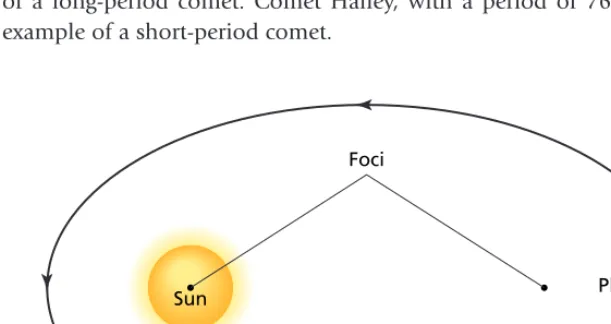
Ellipse Foci
■ Figure 7-2 Planets orbit the Sun in elliptical orbits with the Sun at one focus. (Illustration not to scale)
Kepler’s Laws
Johannes Kepler, a 29-year-old German, became one of Brahe’s assistants when he moved to Prague. Brahe trained his assistants to use instruments, such as those shown in Figure 7-1.Upon his death in 1601, Kepler inher-ited 30 years’ worth of Brahe’s observations. He studied Brahe’s data and was convinced that geometry and mathematics could be used to explain the number, distance, and motion of the planets. Kepler believed that the Sun exerted a force on the planets and placed the Sun at the center of the system. After several years of careful analysis of Brahe’s data on Mars, Kepler discov-ered the laws that describe the motion of every planet and satellite.
Kepler’s first lawstates that the paths of the planets are ellipses, with the Sun at one focus. An ellipse has two foci, as shown in Figure 7-2.Like planets and stars, comets also orbit the Sun in elliptical orbits. Comets are divided into two groups—long-period comets and short-period comets— based on orbital periods, each of which is the time it takes the comet to complete one revolution. Long-period comets have orbital periods longer than 200 years, and short-period comets have orbital periods shorter than 200 years. Comet Hale-Bopp, with a period of 2400 years, is an example of a long-period comet. Comet Halley, with a period of 76 years, is an example of a short-period comet.
a b c
Newberry Library/Stock Montage
[image:3.660.237.530.37.236.2] [image:3.660.45.172.40.237.2] [image:3.660.218.524.559.721.2]Kepler found that the planets move faster when they are closer to the Sun and slower when they are farther away from the Sun. Thus, Kepler’s second lawstates that an imaginary line from the Sun to a planet sweeps out equal areas in equal time intervals, as illustrated in Figure 7-3.
Kepler also found that there is a mathematical relationship between periods of planets and their mean distances away from the Sun. Kepler’s third law states that the square of the ratio of the periods of
any two planets revolving about the Sun is equal to the cube of the ratio of their average distances from the Sun. Thus, if the periods of the planets are TA and TB, and their average distances from the Sun are rAand rB, Kepler’s third law can be expressed as follows.
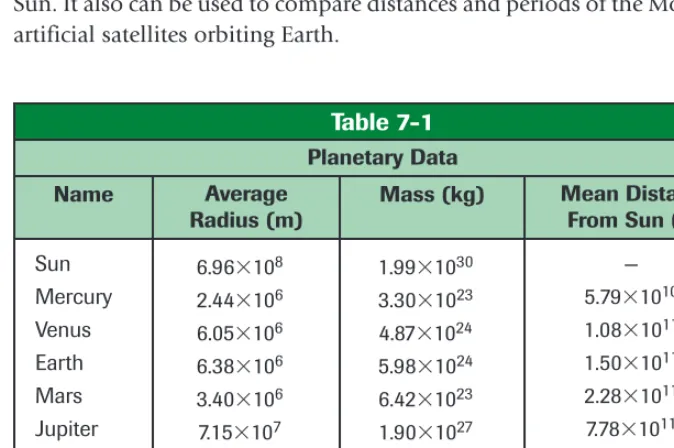
Note that the first two laws apply to each planet, moon, and satellite individually. The third law, however, relates the motion of several objects about a single body. For example, it can be used to compare the planets’ distances from the Sun, shown in Table 7-1, to their periods about the Sun. It also can be used to compare distances and periods of the Moon and artificial satellites orbiting Earth.
Kepler’s Third Law
TTAB
2rr
A B
3The squared quantity of the period of object A divided by the period of object B, is equal to the cubed quantity of object A’s average distance from the Sun, divided by object B’s average distance from the Sun.
Planet
1
2
3 4
5
6 7 8 9 10
11 12
Sun
Table 7-1 Planetary Data
Name Average
Radius (m)
Mass (kg) Mean Distance
From Sun (m)
Sun Mercury Venus Earth Mars Jupiter Saturn Uranus Neptune Pluto
6.96108 2.44106 6.05106 6.38106 3.40106 7.15107 6.03107 2.56107 2.48107 1.20106
1.991030 3.301023 4.871024 5.981024 6.421023 1.901027 5.691026 8.681025 1.021026 1.251022
— 5.791010 1.081011 1.501011 2.281011 7.781011 1.431012 2.871012 4.501012 5.871012
■ Figure 7-3 A planet moves fastest when it is close to the Sun and slowest when it is farther from the Sun. Equal areas are swept out in equal amounts of time. (Illustration not to scale)
[image:4.666.70.404.508.729.2]1. If Ganymede, one of Jupiter’s moons, has a period of 32 days, how many units are there in its orbital radius? Use the information given in Example Problem 1.
2. An asteroid revolves around the Sun with a mean orbital radius twice that of Earth’s. Predict the period of the asteroid in Earth years.
3. From Table 7-1, on page 173, you can find that, on average, Mars is 1.52 times as far from the Sun as Earth is. Predict the time required for Mars to orbit the Sun in Earth days. 4. The Moon has a period of 27.3 days and a mean distance of 3.90105km from the center
of Earth.
a. Use Kepler’s laws to find the period of a satellite in orbit 6.70103km from the center of Earth.
b. How far above Earth’s surface is this satellite?
5. Using the data in the previous problem for the period and radius of revolution of the Moon, predict what the mean distance from Earth's center would be for an artificial satellite that has a period of exactly 1.00 day.
174 Chapter 7 Gravitation
Callisto’s Distance from Jupiter Galileo measured the orbital sizes of Jupiter’s moons using the diameter of Jupiter as a unit of measure. He found that Io, the closest moon to Jupiter, had a period of 1.8 days and was 4.2 units from the center of Jupiter. Callisto, the fourth moon from Jupiter, had a period of 16.7 days. Using the same units that Galileo used, predict Callisto’s distance from Jupiter.
Analyze and Sketch the Problem
• Sketch the orbits of Io and Callisto.
• Label the radii.
Known: Unknown:
TC16.7 days rC= ? TI 1.8 days
rI 4.2 units
Solve for the Unknown
Solve Kepler’s third law for rC.
(
TTCI
)
2(
rrC I)
3rC3r I3
(
T T C
I
)
2rC
3r I3(
T T C
I
)
2 3(4.2 units)3(
1 16 .8
.7 d
d a
a
yy s s
)
2 Substitute rI4.2 units, TC16.7 days, TI1.8 days 36.41
03units319 units
Evaluate the Answer
• Are the units correct? rC should be in Galileo’s units, like rI.
• Is the magnitude realistic? The period is large, so the radius should be large. 3
2 1
Math Handbook
Isolating a Variable page 845
Jupiter
Callisto
rI
rC
Io
Direct and Inverse Relationships Newton’s law of universal gravitation has both direct and inverse relationships.
Fm1m2 F
r
1 2
Change Result Change Result
2m1m2 2F 2r 14F
3m1m2 3F 3r 1
9F
2m13m2 6F 1
2r 4F
12m1m2 1
2F
1
3r 9F
Force v. Distance Inverse Square Law
20 40 60 80
0
0.5 Distance (m)
Force (N)
■ Figure 7-4 The change in gravitational force with distance follows the inverse square law.
Section 7.1 Planetary Motion and Gravitation 175
Newton’s Law of Universal Gravitation
In 1666, 45 years after Kepler published his work, Newton began his studies of planetary motion. He found that the magnitude of the force, F, on a planet due to the Sun varies inversely with the square of the distance, r, between the centers of the planet and the Sun. That is, F is proportional to 1/r2. The force, F,acts in the direction of the line connecting the centers of the two objects.
It is quoted that the sight of a falling apple made Newton wonder if the force that caused the apple to fall might extend to the Moon, or even beyond. He found that both the apple's and Moon’s accelerations agreed with the 1/r2relationship. According to his own third law, the force Earth exerts on the apple is exactly the same as the force the apple exerts on Earth. The force of attraction between two objects must be proportional to the objects’ masses, and is known as the gravitational force.
Newton was confident that the same force of attraction would act between any two objects, anywhere in the universe. He proposed his law of universal gravitation, which states that objects attract other objects with a force that is proportional to the product of their masses and inversely proportional to the square of the distance between them. This can be represented by the following equation.
According to Newton’s equation, F is directly proportional to m1 and m2. Thus, if the mass of a planet near the Sun were doubled, the force of attraction would be doubled. Use the Connecting Math to Physics feature below to examine how changing one variable affects another. Figure 7-4 illustrates the inverse square law graphically.
Law of Universal Gravitation FGm1 r2
m2
The gravitational force is equal to the universal gravitational constant, times the mass of object 1, times the mass of object 2, divided by the distance between the centers of the objects, squared.
[image:6.666.427.550.249.431.2] [image:6.666.67.406.518.730.2]Sun
Planet
mp r
■ Figure 7-5 A planet with mass
mp and orbital radius rorbits the Sun with mass mS. (Illustration not to scale)
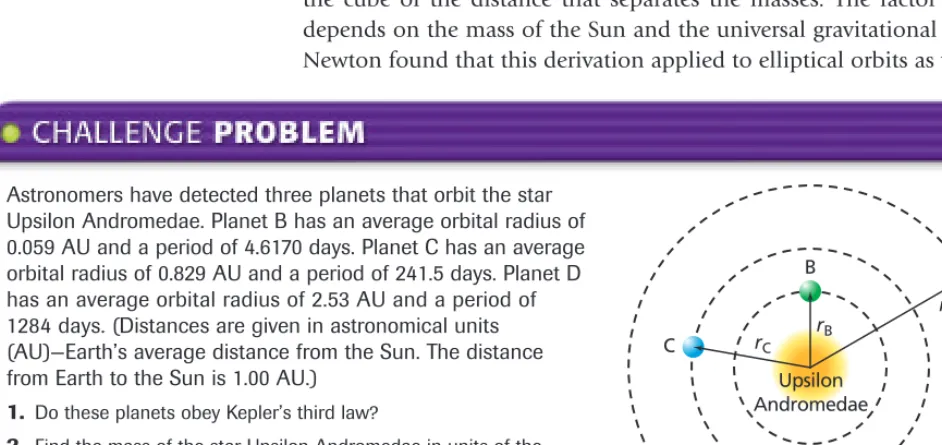
Astronomers have detected three planets that orbit the star Upsilon Andromedae. Planet B has an average orbital radius of 0.059 AU and a period of 4.6170 days. Planet C has an average orbital radius of 0.829 AU and a period of 241.5 days. Planet D has an average orbital radius of 2.53 AU and a period of 1284 days. (Distances are given in astronomical units (AU)—Earth’s average distance from the Sun. The distance from Earth to the Sun is 1.00 AU.)
1. Do these planets obey Kepler’s third law?
2. Find the mass of the star Upsilon Andromedae in units of the Sun’s mass.
Universal Gravitation and Kepler’s Third Law
Newton stated his law of universal gravitation in terms that applied to the motion of planets about the Sun. This agreed with Kepler’s third law and confirmed that Newton’s law fit the best observations of the day.
Consider a planet orbiting the Sun, as shown in Figure 7-5.Newton’s second law of motion, Fnet ma, can be written as Fnet mpac, where Fis the gravitational force, mpis the mass of the planet, and acis the centripetal acceleration of the planet. For simplicity, assume circular orbits. Recall from your study of uniform circular motion in Chapter 6 that, for a circular orbit, ac 42r/T2. This means that F
net mpac may now be written as Fnet mp42r/T2. In this equation, Tis the time required for the planet to make one complete revolution about the Sun. If you set the right side of this equation equal to the right side of the law of universal gravitation, you arrive at the following result:
GmS r2
mp
mp
T 4 2
2r
T2
G 4
m
2
S
r3Thus, T
G 4
m
2
S
r3The period of a planet orbiting the Sun can be expressed as follows.
Squaring both sides makes it apparent that this equation is Kepler’s third law of planetary motion: the square of the period is proportional to the cube of the distance that separates the masses. The factor 42/Gm
S depends on the mass of the Sun and the universal gravitational constant. Newton found that this derivation applied to elliptical orbits as well.
Period of a Planet Orbiting the Sun T2
Gr m
3
S
The period of a planet orbiting the Sun is equal to 2times the square root of the orbital radius cubed, divided by the product of the universal
gravitational constant and the mass of the Sun.
C
B D
Upsilon Andromedae
rC
rB
rD
176 Chapter 7 Gravitation
[image:7.660.68.539.504.726.2]Mirror
Small lead sphere Large lead sphere
Direction of rotation
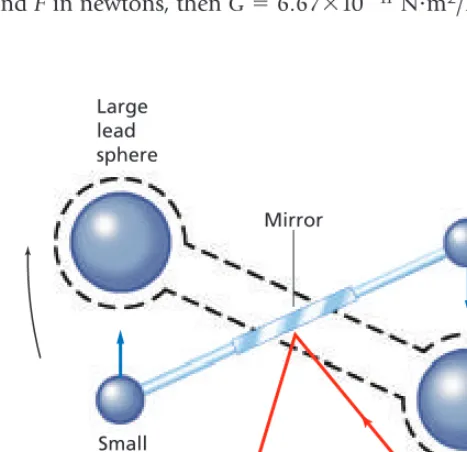
■ Figure 7-7 When the large lead spheres are placed near the small lead spheres, the gravitational attraction between the spheres causes the rod to rotate. The rotation is measured with the help of the reflected light ray.
Measuring the Universal Gravitational Constant
How large is the constant, G? As you know, the force of gravitational attraction between two objects on Earth is relatively small. The slightest attraction, even between two massive bowling balls, is difficult to detect. In fact, it took 100 years from the time of Newton’s work for scientists to develop an apparatus that was sensitive enough to measure the force of gravitational attraction.
Cavendish’s experiment In 1798, Englishman Henry Cavendish used equipment similar to the apparatus shown in Figure 7-6 to measure the gravitational force between two objects. The apparatus had a horizontal rod with two small lead spheres attached to each end. The rod was suspended at its midpoint by a thin wire so that it could rotate. Because the rod was suspended by a thin wire, the rod and spheres were very sensitive to horizontal forces. To measure G, Cavendish placed two large lead spheres in a fixed position, close to each of the two small spheres, as shown in Figure 7-7. The force of attraction between the large and the small spheres caused the rod to rotate. When the force required to twist the wire equaled the gravitational force between the spheres, the rod stopped rotating. By measuring the angle through which the rod turned, Cavendish was able to calculate the attractive force between the objects. The angle through which the rod turned is measured using the beam of light that is reflected from the mirror. He measured the masses of the spheres and the distance between their centers. Substituting these values for force, mass, and distance into Newton’s law of universal gravitation, he found an experimental value for G: when m1and m2are measured in kilograms, rin meters, and Fin newtons, then G 6.671011Nm2/kg2.
Section 7.1 Planetary Motion and Gravitation 177
■ Figure 7-6 Modern Cavendish balances are used to measure the gravitational forces between two objects.
courtesy of PASCO Scientific
[image:8.666.435.552.53.346.2] [image:8.666.120.354.442.668.2]The importance of G Cavendish’s experiment often is called “weighing Earth,” because his experiment helped determine Earth’s mass. Once the value of Gis known, not only the mass of Earth, but also the mass of the Sun can be determined. In addition, the gravitational force between any two objects can be calculated using Newton’s law of universal gravitation. For example, the attractive gravitational force, Fg, between two bowling balls of mass 7.26 kg, with their centers separated by 0.30 m, can be calculated as follows:
Fg 3.9108N
You know that on Earth’s surface, the weight of an object of mass mis a measure of Earth’s gravitational attraction: Fgmg. If Earth’s mass is rep-resented by mEand Earth’s radius is represented by rE, the following is true:
FgGm
rE
E 2
m
mg, and so gGm
rE2E
This equation can be rearranged to solve for mE. mEgr
G
E2
Using rE 6.38106 m, g9.80 m/s2, and G6.671011 Nm2/kg2, the following result is obtained for Earth’s mass:
mE 5.981024 kg
When you compare the mass of Earth to that of a bowling ball, you can see why the gravitational attraction between everyday objects is not easily observed. Cavendish’s experiment determined the value of G, confirmed Newton’s prediction that a gravitational force exists between two objects, and helped calculate the mass of Earth.
(9.80 m/s2)(6.38106m)2
6.671011Nm/kg2
(6.671011Nm2/kg2)(7.26 kg)(7.26 kg)
(0.30 m)2
178 Chapter 7 Gravitation
7.1
Section Review
6.Neptune’s Orbital Period Neptune orbits the Sun with an orbital radius of 4.4951012 m, which allows gases, such as methane, to condense and form an atmosphere, as shown in Figure 7-8. If the mass of the Sun is 1.991030kg, calculate the period of Neptune’s orbit.
7. Gravity If Earth began to shrink, but its mass remained the same, what would happen to the value of gon Earth’s surface?
8.Gravitational Force What is the gravitational force between two 15-kg packages that are 35 cm apart? What fraction is this of the weight of one package?
9. Universal Gravitational Constant Cavendish did his experiment using lead spheres. Suppose he had replaced the lead spheres with copper spheres of equal mass. Would his value of Gbe the same or different? Explain.
10. Laws or Theories? Kepler’s three statements and Newton’s equation for gravitational attraction are called “laws.” Were they ever theories? Will they ever become theories?
11. Critical Thinking Picking up a rock requires less effort on the Moon than on Earth.
a.How will the weaker gravitational force on the Moon’s surface affect the path of the rock if it is thrown horizontally?
b.If the thrower accidentally drops the rock on her toe, will it hurt more or less than it would on Earth? Explain.
physicspp.com/self_check_quiz ■Figure 7-8
Photodisc/Artbase
7.2
Using the Law of Universal Gravitation
Objectives
•Solveorbital motion problems.
•Relateweightlessness to objects in free fall.
•Describegravitational fields. •Compareviews on
gravitation. Vocabulary
gravitational field inertial mass gravitational mass
v3 v2
v1 ■Figure 7-9 The horizontal speed
v1is not high enough and the cannonball falls to the ground. With a higher speed, v2, the cannonball travels farther. The cannonball travels all the way around Earth when the horizontal speed, v3, is high enough.
Section 7.2 Using the Law of Universal Gravitation 179
T
he planet Uranus was discovered in 1781. By 1830, it was clear that the law of gravitation didn’t correctly predict its orbit. Two astronomers proposed that Uranus was being attracted by the Sun and by an undiscovered planet. They calculated the orbit of such a planet in 1845, and, one year later, astronomers at the Berlin Observatory found the planet now called Neptune. How do planets, such as Neptune, orbit the Sun?Orbits of Planets and Satellites
Newton used a drawing similar to the one shown in Figure 7-9to illus-trate a thought experiment on the motion of satellites. Imagine a cannon, perched high atop a mountain, firing a cannonball horizontally with a given horizontal speed. The cannonball is a projectile, and its motion has both vertical and horizontal components. Like all projectiles on Earth, it would follow a parabolic trajectory and fall back to the ground.
If the cannonball’s horizontal speed were increased, it would travel farther across the surface of Earth, and still fall back to the ground. If an extremely powerful cannon were used, however, the cannonball would travel all the way around Earth, and keep going. It would fall toward Earth at the same rate that Earth’s surface curves away. In other words, the cur-vature of the projectile would continue to just match the curcur-vature of Earth, so that the cannonball would never get any closer or farther away from Earth’s curved surface. The cannonball would, therefore, be in orbit. Newton’s thought experiment ignored air resistance. For the cannonball to be free of air resistance, the mountain on which the cannon is perched would have to be more than 150 km above Earth’s surface. By way of com-parison, the mountain would have to be much taller than the peak of Mount Everest, the world’s tallest mountain, which is only 8.85 km in height. A cannonball launched from a mountain that is 150 km above Earth’s surface would encounter little or no air resistance at an altitude of 150 km, because the mountain would be above most of the atmosphere. Thus, a cannonball or any object or satellite at or above this altitude could orbit Earth for a long time.
A satellite in an orbit that is always the same height above Earth moves in uniform circular motion. Recall that its centripetal acceleration is given by ac v2/r. Newton’s second law, F
net mac, can thus be rewritten as Fnet mv2/r. If Earth’s mass is m
E, then this expression combined with Newton’s law of universal gravitation produces the following equation:
Gm r
E 2
m
m
r v2
Solving for the speed of a satellite in circular orbit about Earth, v,yields the following.
A satellite’s orbital period A satellite’s orbit around Earth is similar to a planet’s orbit about the Sun. Recall that the period of a planet orbiting the Sun is expressed by the following equation:
T2
G r m
3
S
Thus, the period for a satellite orbiting Earth is given by the following equation.
The equations for the speed and period of a satellite can be used for any object in orbit about another. The mass of the central body will replace mE in the equations, and r will be the distance between the centers of the orbiting body and the central body. If the mass of the central body is much greater than the mass of the orbiting body, then ris equal to the distance between the centers of the orbiting body and the central body. Orbital speed, v, and period, T, are independent of the mass of the satellite. Are there any factors that limit the mass of a satellite?
A satellite’s mass Landsat 7,shown in Figure 7-10,is an artificial satel-lite that provides images of Earth’s continental surfaces. Landsat images have been used to create maps, study land use, and monitor resources and global changes. The Landsat 7system enables researchers to monitor small-scale processes, such as deforestation, on a global scale. Satellites, such as Landsat 7, are accelerated to the speeds necessary for them to achieve orbit by large rockets, such as shuttle-booster rockets. Because the acceleration of any mass must follow Newton’s second law of motion, Fnetma, more force is required to launch a more massive satellite into orbit. Thus, the mass of a satellite is limited by the capability of the rocket used to launch it.
Period of a Satellite Orbiting Earth T2
Gr m
3
E
The period for a satellite orbiting Earth is equal to 2times the square root of the radius of the orbit cubed, divided by the product of the universal gravitational constant and the mass of Earth.
Speed of a Satellite Orbiting Earth v
Gmr
E
The speed of a satellite orbiting Earth is equal to the square root of the universal gravitational constant times the mass of Earth, divided by the radius of the orbit.
180 Chapter 7 Gravitation
Geosynchronous Orbit The
GOES-12weather satellite orbits Earth once a day at an altitude of 35,785 km. The orbital speed of the satellite matches Earth’s rate of rotation. Thus, to an observer on Earth, the satellite appears to remain above one spot on the equator. Satellite dishes on Earth can be directed to one point in the sky and not have to change position as the satellite orbits.
■Figure 7-10 Landsat 7, a remote sensing satellite, has a mass of about 2200 kg and orbits Earth at an altitude of about 705 km.
Geology Connection
Geology Connection
Russ Underwood, Lockheed Martin Space Systems/NASA
For the following problems, assume a circular orbit for all calculations.
12. Suppose that the satellite in Example Problem 2 is moved to an orbit that is 24 km larger in radius than its previous orbit. What would its speed be? Is this faster or slower than its previous speed?
13. Use Newton’s thought experiment on the motion of satellites to solve the following.
a. Calculate the speed that a satellite shot from a cannon must have to orbit Earth 150 km above its surface.
b. How long, in seconds and minutes, would it take for the satellite to complete one orbit and return to the cannon?
14. Use the data for Mercury in Table 7-1 on page 173 to find the following.
a. the speed of a satellite that is in orbit 260 km above Mercury's surface
b. the period of the satellite
Orbital Speed and Period Assume that a satellite orbits Earth 225 km above its surface. Given that the mass of Earth is 5.971024kg and the radius of Earth is 6.38106m, what are the satellite’s orbital speed and period?
Analyze and Sketch the Problem
• Sketch the situation showing the height of the satellite’s orbit.
Known: Unknown:
h 2.25105m v?
rE 6.38106m T? mE5.971024kg
G 6.671011Nm2/kg2
Solve for the Unknown
Determine the orbital radius by adding the height of the satellite’s orbit to Earth’s radius. rh rE
2.25105m + 6.38106m 6.61106m Substitute h2.25105m, r
E6.38106m
Solve for the speed.
v
GmrE7.76103m/s Solve for the period.
T2
Grm3 E2
5.35103s
This is approximately 89 min, or 1.5 h.
Evaluate the Answer
• Are the units correct? The unit for speed is m/s and the unit for period is s. 3
Substitute r6.61106m,
G 6.671011Nm2/kg2,
mE5.971024kg
(6.61106m)3
(6.671011Nm2/kg2)(5.971024kg)
Substitute G6.671011Nm2/kg2,
mE5.971024kg, r6.61106m
(6.671011Nm2/kg2)(5.971024kg)
6.61106m
2 1
rE
Satellite
Earth r
h
Section 7.2 Using the Law of Universal Gravitation 181 Math Handbook
Square and Cube Roots pages 839–840
Acceleration Due To Gravity
The acceleration of objects due to Earth’s gravity can be found by using Newton’s law of universal gravitation and his second law of motion. For a free-falling object, m,the following is true:
F Gm
r
E 2
m
ma, so aGm
r2E
Because a gand r rEon Earth’s surface, the following equation can be written:
g Gm
rE2E, thus, mE gr G
E2
You found above that a Gm
r2E for a free-falling object. Substituting the
above expression for mEyields the following:
aG
a g
rr
E
2This shows that as you move farther from Earth’s center, that is, as r becomes larger, the acceleration due to gravity is reduced according to this inverse square relationship. What happens to your weight, mg, as you move farther and farther from Earth’s center?
Weight and weightlessness You probably have seen photos similar to the one in Figure 7-11 in which astronauts are on the space shuttle in an environment often called “zero-g” or “weightlessness.” The shuttle orbits about 400 km above Earth’s surface. At that distance, g8.7 m/s2, only slightly less than on Earth’s surface. Thus, Earth’s gravitational force is certainly not zero in the shuttle. In fact, gravity causes the shuttle to orbit Earth. Why, then, do the astronauts appear to have no weight?
Remember that you sense weight when something, such as the floor or your chair, exerts a contact force on you. But if you, your chair, and the floor all are accelerating toward Earth together, then no contact forces are exerted on you. Thus, your apparent weight is zero and you experience weightlessness. Similarly, the astronauts experience weight-lessness as the shuttle and everything in it falls freely toward Earth.
The Gravitational Field
Recall from Chapter 6 that many common forces are contact forces. Friction is exerted where two objects touch, for example, when the floor and your chair or desk push on you. Gravity, how-ever, is different. It acts on an apple falling from a tree and on the Moon in orbit. It even acts on you in midair as you jump up or skydive. In other words, gravity acts over a distance. It acts between objects that are not touching or that are not close together. Newton was puzzled by this concept. He wondered how the Sun could exert a force on planet Earth, which is hundreds of millions of kilometers away.
grGE2r2
■Figure 7-11 Astronaut Chiaki Mukai experiences weightlessness on board the space shuttle
Columbia,as the shuttle and everything in it falls freely toward Earth.
182 Chapter 7 Gravitation
Weightless
Water
This activity is best done outdoors. Use a pencil to poke two holes through a foam or paper cup: one on the bottom and the other on the side. Hold your fingers over the two holes to block them as your lab partner pours colored water into the cup until it is two-thirds full.
1. Predictwhat will happen as the cup is allowed to fall. 2. Testyour prediction: drop the cup and watch closely.
Analyze and Conclude
3. Describeyour observations. 4. Explainyour results.
NASA
■Figure 7-13 An inertial balance allows you to calculate the inertial mass of an object from the period (T) of the back-and-forth motion of the object. Calibration masses, such as the cylindrical ones shown here, are used to create a graph of T2versus the mass. The period of the unknown mass is then measured, and the inertial mass is determined from the calibration graph.
The answer to the puzzle arose from a study of magnetism. In the 19th century, Michael Faraday developed the concept of a field to explain how a magnet attracts objects. Later, the field concept was applied to gravity. Any object with mass is surrounded by a gravitational field in which another object experiences a force due to the interaction between its mass and the gravitational field, g, at its location. This is expressed by the fol-lowing equation.
Suppose the gravitational field is created by the Sun. Then a planet of mass mhas a force exerted on it that depends on its mass and the magni-tude of the gravitational field at its location. That is, Fmg, toward the Sun. The force is caused by the interaction of the planet’s mass with the gravitational field at its location, not with the Sun millions of kilometers away. To find the gravitational field caused by more than one object you would calculate both gravitational fields and add them as vectors.
The gravitational field can be measured by placing an object with a small mass, m, in the gravitational field and measuring the force, F, on it. The gravitational field can be calculated using gF/m. The gravitational field is measured in N/kg, which is also equal to m/s2.
On Earth’s surface, the strength of the gravitational field is 9.80 N/kg, and its direction is toward Earth’s center. The field can be represented by a vector of length gpointing toward the center of the object producing the field. You can picture the gravitational field of Earth as a collection of vec-tors surrounding Earth and pointing toward it, as shown in Figure 7-12. The strength of the field varies inversely with the square of the distance from the center of Earth. The gravitational field depends on Earth’s mass, but not on the mass of the object experiencing it.
Two Kinds of Mass
Recall that when the concept of mass was discussed in Chapter 4, it was defined as the slope of a graph of force versus acceleration. That is, mass is equal to the ratio of the net force exerted on an object to its acceleration. This kind of mass, related to the inertia of an object, is called inertial mass and is represented by the following equation.
The inertial mass of an object is measured by exerting a force on the object and measuring the object’s acceleration using an inertial balance, such as the one shown in Figure 7-13. The more inertial mass an object has, the less it is affected by any force—the less acceleration it undergoes. Thus, the inertial mass of an object is a measure of the object’s resistance to any type of force.
Inertial Mass minertialFn
a
et
Inertial mass is equal to the net force exerted on the object divided by the acceleration of the object.
Gravitational Field gG
r M
2
The gravitational field is equal to the universal gravitational constant times the object’s mass, divided by the square of the distance from the object’s center. The direction is toward the mass’s center.
Section 7.2 Using the Law of Universal Gravitation 183
■Figure 7-12 Vectors
representing Earth’s gravitational field all point toward Earth’s center. The field is weaker farther from Earth.
courtesy of PASCO Scientific
■Figure 7-14 The platform balance shown here allows you to measure the force on a mass due to Earth’s gravity.
■Figure 7-15 Matter causes space to curve just as an object on a rubber sheet curves the sheet around it. Moving objects near the mass follow the curvature of space. The red ball is moving clockwise around the center mass.
Newton’s law of universal gravitation, F = Gm1m2/r2, also involves mass, but a different kind of mass. Mass as used in the law of universal gravita-tion determines the size of the gravitagravita-tional force between two objects and is called gravitational mass.It can be measured using a simple balance, such as the one shown in Figure 7-14.If you measure the attractive force exerted on an object by another object of mass, m,at a distance, r,then you can define the gravitational mass in the following way.
How different are these two kinds of mass? Suppose you have a water-melon in the trunk of your car. If you accelerate the car forward, the watermelon will roll backwards, relative to the trunk. This is a result of its inertial mass—its resistance to acceleration. Now, suppose your car climbs a steep hill at a constant speed. The watermelon will again roll backwards. But this time, it moves as a result of its gravitational mass. The watermelon is being attracted downward toward Earth. Newton made the claim that inertial mass and gravitational mass are equal in magnitude. This hypoth-esis is called the principle of equivalence. All experiments conducted so far have yielded data that support this principle. Albert Einstein also was intrigued by the principle of equivalence and made it a central point in his theory of gravity.
Einstein’s Theory of Gravity
Newton’s law of universal gravitation allows us to calculate the gravita-tional force that exists between two objects because of their masses. The concept of a gravitational field allows us to picture the way gravity acts on objects that are far away. Einstein proposed that gravity is not a force, but rather, an effect of space itself. According to Einstein, mass changes the space around it. Mass causes space to be curved, and other bodies are accel-erated because of the way they follow this curved space.
Gravitational Mass mgrav r2
G F m
grav
The gravitational mass of an object is equal to the distance between the objects squared, times the gravitational force, divided by the product of the universal gravitational constant, times the mass of the other object.
184 Chapter 7 Gravitation
(t)Horizons Companies, (b)Ted Kinsman/Photo Researchers
One way to picture how space is affected by mass is to compare space to a large, two-dimensional rubber sheet, as shown in Figure 7-15.The yellow ball on the sheet represents a massive object. It forms an indentation. A red ball rolling across the sheet simulates the motion of an object in space. If the red ball moves near the sagging region of the sheet, it will be acceler-ated. In the same way, Earth and the Sun are attracted to one another because of the way space is distorted by the two objects.
Einstein’s theory, called the general theory of relativity, makes many predictions about how massive objects affect one another. In every test con-ducted to date, Einstein’s theory has been shown to give the correct results.
Deflection of light Einstein’s theory predicts the deflection or bending of light by massive objects. Light follows the curvature of space around the massive object and is deflected, as shown in Figure 7-16.In 1919, during an eclipse of the Sun, astronomers found that light from distant stars that passed near the Sun was deflected in agreement with Einstein’s predictions.
Another result of general relativity is the effect on light from very mas-sive objects. If an object is masmas-sive and dense enough, the light leaving it will be totally bent back to the object. No light ever escapes the object. Objects such as these, called black holes, have been identified as a result of their effects on nearby stars. The radiation produced when matter is pulled into black holes has also been helpful in their detection.
While Einstein’s theory provides very accurate predictions of gravity’s effects, it is still incomplete. It does not explain the origin of mass or how mass curves space. Physicists are working to understand the deeper mean-ing of gravity and the origin of mass itself.
7.2
Section Review
15. Gravitational Fields The Moon is 3.9105 km from Earth’s center and 1.5108km from the Sun’s center. The masses of Earth and the Sun are 6.01024kg and 2.01030kg, respectively. a.Find the ratio of the gravitational fields due to
Earth and the Sun at the center of the Moon. b.When the Moon is in its third quarter phase, as
shown in Figure 7-17,its direction from Earth is at right angles to the Sun’s direction. What is the net gravitational field due to the Sun and Earth at the center of the Moon?
16.Gravitational Field The mass of the Moon is 7.31022kg and its radius is 1785 km. What is the strength of the gravitational field on the surface of the Moon?
17. A Satellite’s Mass When the first artificial satellite was launched into orbit by the former Soviet Union in 1957, U.S. president Dwight D. Eisenhower asked his scientific advisors to calculate the mass of the satellite. Would they have been able to make this calculation? Explain.
18. Orbital Period and Speed Two satellites are in circular orbits about Earth. One is 150 km above the surface, the other 160 km.
a.Which satellite has the larger orbital period? b.Which one has the greater speed?
19. Theories and Laws Why is Einstein’s description of gravity called a “theory,” while Newton’s is a “law?”
20. Weightlessness Chairs in an orbiting spacecraft are weightless. If you were on board such a space-craft and you were barefoot, would you stub your toe if you kicked a chair? Explain.
21. Critical Thinking It is easier to launch a satellite from Earth into an orbit that circles eastward than it is to launch one that circles westward. Explain.
Sun
Earth Moon
■Figure 7-17 (Not to scale)
physicspp.com/self_check_quiz Section 7.2 Using the Law of Universal Gravitation 185
physicspp.com/self_check_quiz
Star
Earth Moon
Sun
Reference
star positionActual
Apparent position
186
QUESTION
What is the shape of the orbits of planets and satellites in the solar system?
■Formulate modelsto infer the shape of orbits of planets and satellites.
■Collect and organize datafor aphelion distances and perihelion distances of objects as they orbit the Sun.
■Draw conclusionsabout Kepler’s first and second laws of motion.
■Pins are sharp and can puncture the skin.
piece of cardboard metric ruler
sheet of blank, sharp pencil or pen white paper four small pieces of tape two push pins string (25 cm)
1. Place a piece of paper on a piece of cardboard using tape at the four corners.
2. Draw a line across the center of the paper, along the length of the paper. This line repre-sents the major axis.
3. Mark the center of the line and label it C.
4. Use the string to tie a loop, which, when stretched, has a length of 10 cm. For each object listed in the data table, calculate the distance between the foci, d, using the following equation:
d2e(e10.01cm)
5. For the circle, place a pin at C. Put the loop of string over the pin and pull it tight with your pencil. Move the pencil in a circular fashion around the center, letting the string guide it.
6. For the next object, place one pin a distance of d/2 from C along the major axis.
7. Place a second pin a distance of d/2 on the opposite side of C. The two pins represent the foci. One focus is the location of the Sun.
8. Put the loop of string over both pins and pull it tight with your pencil. Move the pencil in a circular fashion, letting the string guide it.
9. Using the same paper, repeat steps 6-8 for each of the listed objects.
10. After all of the orbits are plotted, label each orbit with the name and eccentricity of the object plotted.
Procedure
Materials
Safety Precautions Objectives
Modeling the Orbits
of Planets and Satellites
In this experiment, you will analyze a model that will show how Kepler’s first and second laws of motion apply to orbits of objects in space. Kepler’s first law states that orbits of planets are ellipses, with the Sun at one focus. Kepler’s second law states that an imaginary line from the Sun to a planet sweeps out equal areas in equal time intervals.
The shape of the elliptical orbit is defined by eccentricity, e, which is the ratio of the distance between the foci to the length of the major axis. When an object is at its farthest distance from the Sun along the major axis, it is at aphelion. When the object is at its closest distance from the Sun along the major axis, it is at perihelion.
Horizons Companies
187
1. Measure the aphelion distance, A, by measur-ing the distance between one focus and the farthest point in the orbit along the major axis. Record your data in the data table.
2. Measure the perihelion distance, P, by measur-ing the closest distance between one focus and the closest point in the orbit along the major axis. Record the data in the data table.
3. Calculate the experimental eccentricity for each of the objects and record your data in the data table. Use the following equation:
eA
A
P P
4. Error Analysis Calculate the percent error for each object using the experimental eccentrici-ties compared to the known eccentricieccentrici-ties. Record your values in the data table.
5. Analyze Why is the shape of the orbit with e0 a circle?
6. Compare How does Earth’s orbit compare to a circle?
7. Observe Which of the orbits truly looks elliptical?
1. Does the orbit model you constructed obey Kepler’s first law? Explain.
2. Kepler studied the orbit data of Mars (e0.093) and concluded that planets move about the Sun in elliptical orbits. What would Kepler have concluded if he had been on Mars and studied Earth’s orbit?
3. Where does a planet travel fastest: at aphelion or perihelion? Why?
4. Kepler’s second law helps to determine the ratio between Pluto’s velocity at aphelion and perihelion (vA/vP). To determine this ratio, first calculate the area swept out by Pluto’s orbit. This area is approximately equal to the area of a triangle: Area12(distance to the Sun) current velocitytime. If the area that the orbit sweeps out in a fixed amount of time, such as 30 days, is the same at aphelion and perihelion, this relationship can be written
12P vPt1 2AvAt What is the ratio vP/vAfor Pluto?
5. Pluto’s minimum orbital velocity is 3.7 km/s. What are the values for vPand vA?
1. You used rough approximations to look at Kepler’s second law. Suggest an experiment to obtain precise results to confirm the second law.
2. Design an experiment to verify Kepler’s third law.
Does a communications or weather satellite that is orbiting Earth follow Kepler’s laws? Collect data to verify your answer.
Real-World Physics Going Further
Conclude and Apply Analyze
To find out more about gravitation, visit the Web site: physicspp.com
Data Table
Object Eccentricity (e)
d (cm)
Measured A
Measured P
Experimental e
% Error
Circle 0
Earth 0.017
Pluto 0.25
Black Holes
What would happen
if you were to travel to a black hole? Your body would be stretched, flattened, and eventually pulled apart. What is a black hole? What is known about black holes?A black hole is one of the possible final stages in the evolution of a star. When fusion reactions stop in the core of a star that is at least 20 times more massive than the Sun, the core collapses forever, compacting matter into an increasingly smaller volume. The infinitely small, but infi-nitely dense, object that remains is called a sin-gularity. The force of gravity is so immense in the region around the singularity that nothing, not even light, can escape it. This region is called a black hole.
Nothing Can Escape
In1917, German mathematician Karl Schwarzschild verified, mathematically, that black holes could exist. Schwarzschild used solutions to Einstein’s theory of general relativity to describe the properties of black holes. He derived an expression for a radius, called the Schwarzschild radius, within which neither light nor matter escapes the force of gravity of the singular-ity. The Schwarzschild radius is represented by the following equation:
Rs2Gc2
M
In this equation, Gis Newton’s universal gravi-tational constant, Mis the mass of the black hole, and cis the speed of light. The edge of the sphere defined by the Schwarzschild radius is called the event horizon. At the event hori-zon, the escape velocity equals the speed of light. Because nothing travels faster than the speed of light, objects that cross the event horizon can never escape.
Indirect and Direct Evidence
Blackholes have three physical properties that can theoretically be measured—mass, angular momentum, and electric charge. A black hole’s
mass can be determined by the gravitational field it generates. Mass is calculated by using a modified form of Kepler’s third law of plane-tary motion. Studies using NASA’s Rossi X-ray Timing Explorerhave shown that black holes spin just as stars and planets do. A black hole spins because it retains the angular momentum of the star that formed it. Even though a black hole’s electric charge has not been measured, scientists hypothesize that a black hole may become charged when an excess of one type of electric charge falls into it. Super-heated gases in a black hole emit X rays, which can be detected by X-ray telescopes, such as the space-based Chandra X-ray Observatory.
Although not everything is known about black holes, there is direct and indirect evi-dence of their existence. Continued research and special missions will provide a better understanding of black holes.
Solve The escape velocity of an object leaving the event horizon can be repre-sented by the following equation:
v
2GRs M
In this equation, G is Newton’s universal gravitational constant, Mis the mass of the black hole, and Rsis the radius of the black hole. Show that the escape velocity equals the speed of light.
Going Further
188 Extreme Physics
Hubblevisible image of galaxy NGC 6240.
ChandraX-ray image of two black holes (blue) in NGC 6240.
NASA
7.1 Planetary Motion and Gravitation
Vocabulary
• Kepler’s first law (p. 172)
• Kepler’s second law (p. 173)
• Kepler’s third law (p. 173)
• gravitational force (p. 175)
• law of universal gravitation (p. 175)
7.2 Using the Law of Universal Gravitation
Vocabulary
• gravitational field (p. 183)
• inertial mass (p. 183)
• gravitational mass (p. 184)
Key Concepts
•
Kepler’s first law states that planets move in elliptical orbits, with the Sun at one focus.•
Kepler’s second law states that an imaginary line from the Sun to a planet sweeps out equal areas in equal times.•
Kepler’s third law states that the square of the ratio of the periods of any two planets is equal to the cube of the ratio of their distances from the Sun.•
Newton’s law of universal gravitation states that the gravitational force between any two objects is directly proportional to the product of their masses and inversely proportional to the square of the distance between their centers. The force is attractive and along a line connecting their centers.•
Newton’s law of universal gravitation can be used to rewrite Kepler’s third law to relate the radius and period of a planet to the mass of the Sun.T2
G
4
m
2
S
r3FGm1
r2
m2
T
T
A
B
2rr
A
B
3Key Concepts
•
The speed of an object in circular orbit is given by the following expression.•
The period of a satellite in a circular orbit is given by the following expression.•
All objects have gravitational fields surrounding them.•
Gravitational mass and inertial mass are two essentially different concepts. The gravitational and inertial masses of an object, however, are numerically equal.•
Einstein’s general theory of relativity describes gravitational attraction as a property of space itself.mgravr
2
G F m
grav
minertial Fn
a
et
gGrm2
T2
Grm3E
v
GmrE189
physicspp.com/vocabulary_puzzlemaker
22.Create a concept map using these terms: planets, stars, Newton’s law of universal gravitation, Kepler’s first law, Kepler’s second law, Kepler’s third law, Einstein’s general theory of relativity.
Mastering Concepts
23.In 1609, Galileo looked through his telescope at Jupiter and saw four moons. The name of one of the moons that he saw is Io. Restate Kepler’s first law for Io and Jupiter. (7.1)
24.Earth moves more slowly in its orbit during summer in the northern hemisphere than it does during winter. Is it closer to the Sun in summer or in winter? (7.1)
25.Is the area swept out per unit of time by Earth moving around the Sun equal to the area swept out per unit of time by Mars moving around the Sun? (7.1)
26.Why did Newton think that a force must act on the Moon? (7.1)
27.How did Cavendish demonstrate that a
gravitational force of attraction exists between two small objects? (7.1)
28.What happens to the gravitational force between two masses when the distance between the masses is doubled? (7.1)
29.According to Newton’s version of Kepler’s third law, how would the ratio T2/r3change if the mass of the Sun were doubled? (7.1)
30.How do you answer the question, “What keeps a satellite up?” (7.2)
31.A satellite is orbiting Earth. On which of the following does its speed depend? (7.2)
a. mass of the satellite
b.distance from Earth
c. mass of Earth
32.What provides the force that causes the centripetal acceleration of a satellite in orbit? (7.2)
33.During space flight, astronauts often refer to forces as multiples of the force of gravity on Earth’s surface. What does a force of 5gmean to an astronaut? (7.2)
34.Newton assumed that a gravitational force acts directly between Earth and the Moon. How does Einstein’s view of the attractive force between the two bodies differ from Newton’s view? (7.2)
35.Show that the dimensions of gin the equation gF/mare in m/s2. (7.2)
36.If Earth were twice as massive but remained the same size, what would happen to the value of g? (7.2)
Applying Concepts
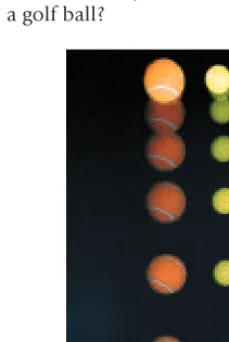
37.Golf Ball The force of gravity acting on an object near Earth’s surface is proportional to the mass of the object. Figure 7-18shows a tennis ball and golf ball in free fall. Why does a tennis ball not fall faster than a golf ball?
38.What information do you need to find the mass of Jupiter using Newton’s version of Kepler’s third law?
39.The mass of Pluto was not known until a satellite of the planet was discovered. Why?
[image:21.660.359.474.266.438.2]40.Decide whether each of the orbits shown in
Figure 7-19is a possible orbit for a planet.
Sun
Sun Sun
Sun c c
c
c
Concept Mapping
190 Chapter 7 Gravitation For more problems, go to Additional Problems, Appendix B.
■Figure 7-19
■Figure 7-18
Barry Runk/Grant Heilman
41.The Moon and Earth are attracted to each other by gravitational force. Does the more-massive Earth attract the Moon with a greater force than the Moon attracts Earth? Explain.
42.What would happen to the value of G if Earth were twice as massive, but remained the same size?
43.Figure 7-20shows a satellite orbiting Earth.
Examine the equation v
GmrE , relating the speed of an orbiting satellite and its distance from the center of Earth. Does a satellite with a large or small orbital radius have the greater velocity?44.Space Shuttle If a space shuttle goes into a higher orbit, what happens to the shuttle’s period?
[image:22.666.364.525.503.619.2]45.Mars has about one-ninth the mass of Earth.
Figure 7-21shows satellite M, which orbits Mars with the same orbital radius as satellite E, which orbits Earth. Which satellite has a smaller period?
46.Jupiter has about 300 times the mass of Earth and about ten times Earth’s radius. Estimate the size of g on the surface of Jupiter.
47.A satellite is one Earth radius above the surface of Earth. How does the acceleration due to gravity at that location compare to acceleration at the surface of Earth?
48.If a mass in Earth’s gravitational field is doubled, what will happen to the force exerted by the field upon the mass?
49.Weight Suppose that yesterday your body had a mass of 50.0 kg. This morning you stepped on a scale and found that you had gained weight.
a. What happened, if anything, to your mass?
b.What happened, if anything, to the ratio of your weight to your mass?
50.As an astronaut in an orbiting space shuttle, how would you go about “dropping” an object down to Earth?
51.Weather Satellites The weather pictures that you see every day on TV come from a spacecraft in a stationary position relative to the surface of Earth, 35,700 km above Earth’s equator. Explain how it can stay in exactly the same position day after day. What would happen if it were closer? Farther out? Hint: Draw a pictorial model.
Mastering Problems
7.1 Planetary Motion and Gravitation
52.Jupiter is 5.2 times farther from the Sun than Earth is. Find Jupiter’s orbital period in Earth years.
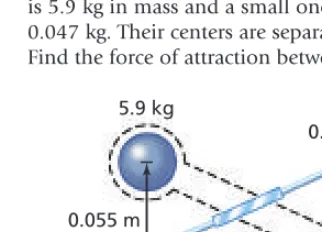
53.Figure 7-22shows a Cavendish apparatus like the one used to find G. It has a large lead sphere that is 5.9 kg in mass and a small one with a mass of 0.047 kg. Their centers are separated by 0.055 m. Find the force of attraction between them.
54.Use Table 7-1 on p. 173 to compute the gravitational force that the Sun exerts on Jupiter.
55.Tom has a mass of 70.0 kg and Sally has a mass of 50.0 kg. Tom and Sally are standing 20.0 m apart on the dance floor. Sally looks up and sees Tom. She feels an attraction. If the attraction is gravitational, find its size. Assume that both Tom and Sally can be replaced by spherical masses.
0.055 m 5.9 kg
5.9 kg 0.047 kg
0.047 kg
0.055 m
Earth
M E
Mars
rM rE
Satellite
Earth
r
Chapter 7 Assessment 191
physicspp.com/chapter_test ■Figure 7-20 (Not to scale)
■Figure 7-21 (Not to scale)
56.Two balls have their centers 2.0 m apart, as shown in Figure 7-23.One ball has a mass of 8.0 kg. The other has a mass of 6.0 kg. What is the gravitational force between them?
57.Two bowling balls each have a mass of 6.8 kg. They are located next to each other with their centers 21.8 cm apart. What gravitational force do they exert on each other?
58.Assume that you have a mass of 50.0 kg. Earth has a mass of 5.971024kg and a radius of 6.38106m.
a. What is the force of gravitational attraction between you and Earth?
b.What is your weight?
59.The gravitational force between two electrons that are 1.00 m apart is 5.541071N. Find the mass of an electron.
60.A 1.0-kg mass weighs 9.8 N on Earth’s surface, and the radius of Earth is roughly 6.4106m.
a. Calculate the mass of Earth.
b.Calculate the average density of Earth.
61.Uranus Uranus requires 84 years to circle the Sun. Find Uranus’s orbital radius as a multiple of Earth’s orbital radius.
62.Venus Venus has a period of revolution of 225 Earth days. Find the distance between the Sun and Venus as a multiple of Earth’s orbital radius.
63.If a small planet, D, were located 8.0 times as far from the Sun as Earth is, how many years would it take the planet to orbit the Sun?
64.Two spheres are placed so that their centers are 2.6 m apart. The force between the two spheres is 2.751012N. What is the mass of each sphere if one sphere is twice the mass of the other sphere?
65.The Moon is 3.9105km from Earth’s center and 1.5108km from the Sun’s center. If the masses of the Moon, Earth, and the Sun are 7.31022kg, 6.01024kg, and 2.01030kg, respectively, find the ratio of the gravitational forces exerted by Earth and the Sun on the Moon.
66.Toy Boat A force of 40.0 N is required to pull a 10.0-kg wooden toy boat at a constant velocity across a smooth glass surface on Earth. What force would be required to pull the same wooden toy boat across the same glass surface on the planet Jupiter?
67.Mimas, one of Saturn’s moons, has an orbital radius of 1.87108m and an orbital period of about 23.0 h. Use Newton’s version of Kepler’s third law to find Saturn’s mass.
68.The Moon is 3.9108m away from Earth and has a period of 27.33 days. Use Newton’s version of Kepler’s third law to find the mass of Earth. Compare this mass to the mass found in problem 60.
69.Halley’s Comet Every 74 years, comet Halley is visible from Earth. Find the average distance of the comet from the Sun in astronomical units (AU).
70.Area is measured in m2, so the rate at which area is swept out by a planet or satellite is measured in m2/s.
a. How quickly is an area swept out by Earth in its orbit about the Sun?
b.How quickly is an area swept out by the Moon in its orbit about Earth? Use 3.9108m as the average distance between Earth and the Moon, and 27.33 days as the period of the Moon.
7.2 Using the Law of Universal Gravitation 71. Satellite A geosynchronous satellite is one that
appears to remain over one spot on Earth, as shown in Figure 7-24.Assume that a geosynchronous satellite has an orbital radius of 4.23107m.
a. Calculate its speed in orbit.
b.Calculate its period.
72.Asteroid The asteroid Ceres has a mass of 71020 kg and a radius of 500 km.
a. What is gon the surface of Ceres?
b.How much would a 90-kg astronaut weigh on Ceres?
73.Book A 1.25-kg book in space has a weight of 8.35 N. What is the value of the gravitational field at that location?
74. The Moon’s mass is 7.341022kg, and it is 3.8108m away from Earth. Earth’s mass is 5.971024kg.
a. Calculate the gravitational force of attraction between Earth and the Moon.
b.Find Earth’s gravitational field at the Moon. Satellite
Earth
r
6.0 kg 8.0 kg
2.0 m
192 Chapter 7 Gravitation For more problems, go to Additional Problems, Appendix B. ■Figure 7-23