in the population sciences published by the Max Planck Institute for Demographic Research Konrad-Zuse Str. 1, D-18057 Rostock · GERMANY www.demographic-research.org
DEMOGRAPHIC RESEARCH
VOLUME 17, ARTICLE 23, PAGES 679-704
PUBLISHED 20 DECEMBER 2007
http://www.demographic-research.org/Volumes/Vol17/23/ DOI: 10.4054/DemRes.2007.17.23
Research Article
Distance to elderly parents:
Analyses of Swedish register data
Gunnar Malmberg
Anna Pettersson
Special Collection 6: Interdependencies in the Life Course, edited by Hill Kulu and Nadja Milewski.
© 2007 Malmberg & Pettersson
This open-access work is published under the terms of the Creative Commons Attribution NonCommercial License 2.0 Germany, which permits use, reproduction & distribution in any medium for non-commercial purposes, provided the original author(s) and source are given credit.
1 Introduction 680
2 Theoretical framework 681
2.1 Intergenerational distances 681
2.2 Family ties 682
2.3 Regional differences 683
2.4 Socio-economic differences 684
3 Data and method 684
4 Results 687
4.1 Intergenerational distances 687
4.2 Family ties 694
4.3 Gender differences 695
4.4 Regional differences 695
4.5 Socio-economic differences 697
5 Discussion 698
6 Acknowledgements 700
Distance to elderly parents:
Analyses of Swedish register data
Gunnar Malmberg1 Anna Pettersson2
Abstract
In the present study, features of and trends in child–parent proximity in Sweden are analyzed using comprehensive register data. The results show that 85% of older parents have adult children within a radius of 50 km, of which 10% live ‘just around the corner’; corresponding figures for adult children are 72% and 5%, respectively. The study gives no indication of increasing intergenerational distances. Results from logistic regressions show that adult children who are well educated, female, older, born in Sweden, who are not parents, who live in densely populated areas, and have siblings are less likely to stay in the same region as their parents.
1 Department of Social and Economic Geography, Centre for Population Studies: Ageing and Living
Conditions Programme Umeå University, Sweden. E-mail: [email protected]
2 Department of Social and Economic Geography, Centre for Population Studies: Ageing and Living
1. Introduction
Spatial proximity between older parents and adult children is a topic of great concern in contemporary society, as it affects crucial issues such as mutual assistance between family members, the strength of kinship ties, migration patterns, and everyday mobility. One vital issue of the social agenda concerns the impact of child-parent proximity on the care and support of the elderly. If the state fails to care for the growing number of elderly people, assistance from relatives may well be the only solution, and the proximity between adult children and their parents will become increasingly important in the care for the elderly. However, because many older people have no children and since many adult children live too far away to provide daily assistance to parents, it may be difficult to reintroduce a more family-based system of care.
Naturally, adult children may also benefit from the care and support provided by parents, and the proximity to mothers and fathers can be a crucial resource for young families. Moreover, social contacts between the generations may be essential to the well-being of both parents and children, even if family support and care are provided by the state. Locational nearness to relatives can be an important asset for those who lack, for instance, economic or educational assets; it may constitute social capital that may compensate for a scarcity of other resources.
However, close family ties can also be a burden that restrains individual careers and plans for both generations (Umberson 1992), and nearness is not always preferred. Women are often engaged in caring for their partner and parents, more so than their male counterparts (Joseph and Hallman 1998). Thus, if the burden of caring for elderly relatives is shifted from the state to adult children, women will be forced to make an even greater sacrifice (Szebehely 2005). Whether nearness is a burden or an asset, large variations in child-parent proximity between different groups may affect socio-economic gaps in society between the poor and the rich, between people living in urban and rural areas, men and women, immigrants and non-immigrants, as well as between people who live alone and people who have a rich social network.
The literature on residential proximity between adult children and ageing parents
includes topics such as the effects of divorce in the younger generation (Spitze et al.
1994) and in the older generation (Aquilino 1994), normative obligations and emotional
intimacy (Rossi and Rossi 1990), economic transfer between generations (Tomassini et
al. 2003), and the availability of kin (Wolf 1994) etc. Furthermore, the effects of
distances between parents and children, fewer intergenerational contacts (Hank 2005), and dependence on institutionalized care and welfare systems (Svallfors 2004). While previous studies on child-parent proximity have mainly been based on surveys (e.g.,
Rogerson et al. 1997, Hank 2005), the present study uses the rich register data available
in Sweden, which enable us, for instance, to analyse child–parent proximity in different
subgroups and to follow pattern changes occurring over time3.
The aim of the present study is to analyze the patterns and trends in distances between older parents and adult children, the relations between locational nearness and the individual characteristics of parents and adult children and, furthermore, the extent to which the family structure affects intergenerational nearness.
In the empirical analyses, the focus is on both the distance that adult children have to their older parents and, conversely, the distance older parents have to their adult children. Included are people aged over 65, with adult children living in Sweden (excluding the 20% of people over 65 years of age who do not have adult children living in the country) and the adult children (over 20) of these older parents.
Drawing on Swedish register data, we address the following questions:
• To what extent do adult children and older parents in Sweden live close to each
other?
• Is there a continuous process of child–parent separation?
• Does the family structure – such as the parity order and the presence of siblings –
still affect the geographical nearness between parents and children?
• How are intergenerational distances related to individual characteristics of parents
and adult children?
2. Theoretical framework
2.1 Intergenerational distances
The relational family landscape is formed by the continuous mobility of people over their life course, by the moves of adult children in relation to other family members and by the mobility of parents in relation to their children. Thus, intergenerational distances are shaped by a variety of conditions, such as job opportunities, education, place amenities or partners, and they result from a series of actions that are varyingly independent of the geographical location of relatives. Whether or not intergenerational ties are crucial to residential choice is a controversial issue. According to modernization
3 In a previous study on Swedish register data, Fransson (2004) analyzed the distance between mothers and
theory, there has been a continuous process in society towards decreasing family support owing to individualization, the development of the welfare state, parent–child separation and urbanization (Cowgill 1974, Aboderin 2004). Weaker family ties have been interpreted as a prerequisite for, but also as a consequence of, urbanization and intergenerational separation. However, alternative views question the linearity of this process and maintain that kin structures are still important for care and support in contemporary post-industrial society and that intergenerational relations are becoming more intense. For instance, Bengtson (2001) claimed that intergenerational contacts are becoming more important in U.S. society, and cross-national studies from several European countries show that many older parents still live locationally close to their adult children (Hank 2005).
Given that child–parent separation, the abandonment of family support, and dependence on formal welfare models seem to be more typical in Sweden and other Scandinavian countries than in the rest of Europe (Esping-Andersen 1999, Hank 2005), Swedish trends in child–parent distances could be of special interest. One hypothesis is that intergenerational distances are continuously increasing in the modern welfare society, because the family is no longer as important for care and support. An alternative hypothesis is that increasing migration rates in times of economic restructuring create cohorts with larger distances to parents and that the previously observed increase in intergenerational distances was the product of intense migration during the urbanization era. The latter outcome would then show a pattern of fluctuations in child–parent distances rather than a continuous increase. In that case, weaker ties may be the outcome of separation rather than the determinant of increasing distances.
2.2 Family ties
Several studies have shown that social ties and family conditions are significant in
migration decisions (Green 2004, Lundholm et al. 2004, Jans 2005), indicating that
proximity to children and parents could have a substantial effect on residential choice. In cases of strong family ties or when family-based support is needed, the distance to relatives may be vital in residential choices (Joseph and Hallman 1998). It is possible that even in a well-developed, modern welfare state, the location of other family members – adult children, parents or siblings – still influences residential choice.
Lawton et al. (1994) defined an interrelating system of solidarity between generations
and contact influences residential choice. Based on this result, one might hypothesize that single and very old parents have a higher propensity to live closer to their adult children. Choi (2003) claimed that co-residing is not only related to the needs of the elderly, but is often the consequence of adult children’s need for support. A further hypothesis is, then, that adult children with children of their own may have a greater need for assistance, resulting in a higher propensity to live close to their parents than is the case for adult children with no children of their own.
If older parents’ needs for care and support influences child–parent proximity, the presence and location of siblings may be crucial to residential choice, as the nearness of a brother or a sister to one’s parents may enable one to move farther away. For instance, Michielin and Mulder (2006) found that having a younger sister had a positive effect on the propensity to live far away from parents. The propensity to move farther away could also be related to parity (Warnes 1986), because older siblings may have greater freedom to move away if younger siblings stay geographically close to the parents. The hypotheses are, thus, that adult children with siblings are more likely to live far away from their parents than the only child, that parents with many children are more likely to have a child close by and, moreover, that the youngest siblings are the least likely to have large distances to their parents. The alternative hypothesis would be that older siblings have a greater responsibility to take care of their parents and, therefore, tend to live closest.
Lawton et al. (1994) also found that the contact–affection effect is seen only in the
mother–child relationship and not in the father–child relationship, suggesting that the motivation for contact differs between the two relationships. Because women are also more engaged in caring for their partner and parents (Joseph and Hallman 1998), we could hypothesize that the intergenerational distances between daughters and mothers is closer than it is between fathers and sons. However, the higher migration propensities among young women give us reason to formulate the alternative hypothesis, i.e., that sons live closer to parents than daughters do.
2.3 Regional differences
to their children than do older parents in more sparsely populated regions with high outmigration rates and, similarly, that the higher portion of inmigrated young people in larger cities would result in larger average distances to older parents among the adult children living there.
2.4 Socio-economic differences
It has been established in the migration literature that the well educated move more often and farther away than do the less educated, which also affects intergenerational distances (Silverstein 1995). A variety of explanations for the higher migration propensity can be found, including more transferable human capital, more specialized competence, a greater tendency to move to and from a place for reasons of education and to have a more dispersed social network. Previous studies have also shown larger child–parent distances among well-educated parents and children (Clark and Wolf
1992, Lawton et al. 1994, Michielin and Mulder 2007). This may be the result of higher
migration propensities among both parents and children and the combined effect, as well-educated parents tend to have well-educated children. However, for other groups, for example those without a permanent job, proximity to and assistance from relatives and friends can constitute valuable social capital that may compensate for a scarcity of other assets, such as economic prosperity, income or education (Silverstein 1995,
Rogerson et al. 1997). Hence, proximity to relatives may be essential to the well-being
of both older parents and adult children, but it may also serve as a mobility constraint, preventing children from moving away from their parents. This may result in a cumulative process of low mobility, low income, and mutual family support. However, because care in Sweden is largely the responsibility of the state, the social differentiation in child–parent proximity may not be as prominent as in other countries. Nevertheless, the hypothesis is that older parents with a high education level and income live farther away from their adult children than do older parents with a low education level and income and, furthermore, that well-educated adult children live farther from their parents than do adult children with a lower education level.
3. Data and method
demographic and socio-economic characteristics, links to family members (parents, children, siblings), and information about the place of residence within one hundred meter square (100x100 meters). These data enable us to present very detailed information about the distances between the places of residence of the parents and of their adult children. In the calculation of distances, we do not consider road or time distance, but rather the physical distance ‘as the crow flies’.
Included in the analyses is information about the distances older parents (over the age of 65) have to their adult children (over the age of 20) and, similarly, the distances
the latter group has to their parents for 19924 and 2002. The population of adult children
consists mainly of people in their 40s and 50s, as younger adults are unlikely to have parents over the age of 65, and the parents of older adult children in their 60s and 70s are often deceased. Excluded from the study are the 20% of the population over 65 of age who have no adult children living in Sweden.
The data enable us to map the place of residence of all people living in Sweden who are above the age of 65 and who have children over the age of 20 living in
Sweden5. We also had the opportunity to map the place of residence of these adult
children. Using these data, we have created two datasets. The first includes all parents aged over 65, the distances to their children (up to seven children) and information about the age, education, gender, the immigration experience, the marital status, and the residential region of the older parent. The other dataset includes all children over the age of 20 who have at least one parent over the age of 65, information about the distance to the place of residence of their mother and/or father, their own age, their education, gender, immigration experience, family situation, residential region, parity
order, and their employment status6.
Because our analyses are based on a large sample of individual records, we can expect to find highly significant results. However, the individual distances between parents and their adult children are influenced by a variety of unobserved individual conditions not included in the empirical analysis. Hence, we do not expect to find a high explanatory power. Only careful interpretations rather than far-reaching conclusions can be made based on the estimations.
Using logistic regressions, we have analyzed the relationship between child–parent proximity and the indicators of the social situation of the parents, including gender, age, family situation, education, characteristics of the residential region, and the migration
4 For 1992, we only have information for adult children under the age of 60 and their parents. In comparisons
between the two years, the same age groups are used for 2002.
5
Not included in the ‘parent population’ are parents under the age of 65, parents who only have children under the age of 20 or over the age of 60, and parents whose children are deceased or live outside Sweden. 6
experience. Similar analyses have been conducted on the relationship between the adult children’s locational distance to their nearest parent and their social situation. The distances are classified into two categories: (a) living in the same one hundred meter square (100x100 meters), i.e., living ‘around the corner’ and (b) living within a distance away of 50 km. These distances were chosen based on the assumption that a distance of 50 km would allow most adult children and elderly parents with access to a car or good public transportation to visit during the day to assist their parents or socialize with them, while for more continuous assistance in daily life, the generations would have to live very close to each other.
In the logistic regression analyses, we have estimated the effects of various independent variables on older parents living (a) in the same hundred meter square as an adult child and (b) within 50 km of distance to at least one adult child, as well as the effects on adult children living (c) within the same one hundred meter square as an older parent and (d) not more than 50 km away from an older parent. The dependent dummy variables have the value 1 for living within the same one hundred meter square and living within 50 km of distance, and the value 0 for living farther away.
4. Results
4.1 Intergenerational distances
According to our data, approximately 10% of older parents in Sweden live within the same one hundred meter square (‘around the corner’) to at least one of their adult
children (see Figure 1). This should not be seen as a direct indicator of co-residence7,
however, as previous surveys have revealed much lower levels of co-residing8 and as
many people tend to live close to their relatives without sharing households. In the countryside, it is common to live in another house on the same property as the adult children; in the city, it is not unusual to have a two-storey house, for instance, with one generation living on one floor and the other generation on another. A further explanation is that, in some urban residential areas, several buildings may be part of the same property and they are thus registered as being located within the same one hundred meter square, which means that residents may actually live more than hundred meters from each other. Living within the same one hundred meter square is rather an indicator of living ‘around the corner’, and the conclusion is that a considerable proportion (10%) of people aged over 65 in Sweden live very close to their adult children. However, a previous survey study revealed that parents in Sweden live farther away from their adult children than is the case in other European countries investigated, and that co-residing is less common (Hank 2005).
Our empirical investigation reveals that 85% of the older parents in Sweden live within a distance of 50 km to the adult child who lives closest (see Figure 1). So, although a relatively small share of the parents have a child living very close by, a large percentage have at least one child living close enough to have regular face-to-face contact. This leaves only 15% of older parents with no children within commuting distance. On the other hand, however, as many as 20% of all those over 65 of age have no children (at least, not living in Sweden). Moreover, we found that as many as 55% live within the more convenient travel distance of five km away from at least one child and that 30% live within walking distance, less than 1 km away (see Figure 1).
7 Our data contain no records on co-residence of children and parents, as people over 18 are automatically
defined as an independent household. 8
Figure 1: Percentage of parents aged over 65, living within a distance to an adult child of 100 meters, 1 km, 5 km, 50 km
0 10 20 30 40 50 60 70 80 90
<100 m <1 km < 5 km <50 km
Distance S h a re o f p a re n ts a g e d o v e r 6 5 y e a rs , in %
Source: Calculations based on ASTRID.
The figures for adult children reveal that 72% have at least one of their parents living within a 50 km radius. Approximately 38% have less than 5 km distance to at least one of their parents and 18% have a distance of less than 1 km. Moreover, we found that about 5% of adult children have a parent living within the same one hundred meter square.
to their parents in 1992. This may be understood as an effect of period-specific variations in early adulthood migration rates: The cohort born in the 1940s and that born in the early 1950s were young and mobile in the 1960s and early 1970s, when migration rates were high due to economic restructuring and rapid urbanization.
Figure 2: Percentage of age group with at least one parent living within a distance of 50 km in 1992 and 2002
50 55 60 65 70 75 80 85 90 95
20 25 30 35 40 45 50 55 60
Age in years
P
e
rc
e
n
t
1992 2002
Source: Calculations based on ASTRID.
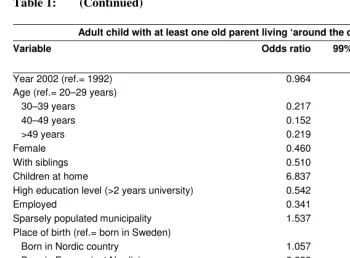
Table 1: Odds ratio (99% confidence interval) for an adult child living within a radius of 50 km and ‘around the corner’ of an old parent for 1992 and 2002, including effects of year and age
Adult child with at least one old parent within a distance of 50 km
Variable Odds ratio 99% confidence interval
Lower–upper
Year 2002 (ref.= 1992) 1.180 1.172–1.187
Age (ref.= 20–29 years)
30–39 years 0.829 0.813–0.846
40–49 years 0.711 0.697–0.725
>49 years 0.610 0.598–0.623
Female 0.896 0.890–0.901
With siblings 0.773 0.776–0.781
Children at home 1.311 1.302–1.320
High education level (>2 years university)
0.346 0.344–0.349
Employed 1.093 1.083–1.102
Sparsely populated municipality 1.102 1.094–1.111
Place of birth (ref.= born in Sweden)
Born in Nordic country 0.884 0.860–0.907
Born in Europe (not Nordic) 1.273 1.224–1.324
Born outside Europe 1.296 1.231–1.364
Oldest with sibling(s) 1.015 1.007–1.023
Youngest with sibling(s) 1.131 1.122–1.140
Constant 4.546
Table 1: (Continued)
Adult child with at least one old parent living ‘around the corner’
Variable Odds ratio 99% confidence interval
Lower–upper
Year 2002 (ref.= 1992) 0.964 0.952–0.976
Age (ref.= 20–29 years)
30–39 years 0.217 0.212–0.222
40–49 years 0.152 0.149–0.156
>49 years 0.219 0.213–0.224
Female 0.460 0.454–0.466
With siblings 0.510 0.502–0.519
Children at home 6.837 6.719–6.958
High education level (>2 years university) 0.542 0.534–0.551
Employed 0.341 0.337–0.346
Sparsely populated municipality 1.537 1.517–1.558
Place of birth (ref.= born in Sweden)
Born in Nordic country 1.057 1.003–1.114
Born in Europe (not Nordic) 2.222 2.107–2.344
Born outside Europe 2.675 2.530–2.828
Oldest with sibling(s) 1.113 1.094–1.132
Youngest with sibling(s) 1.232 1.214–1.250
Constant 0.385
Pseudo R² 0.167
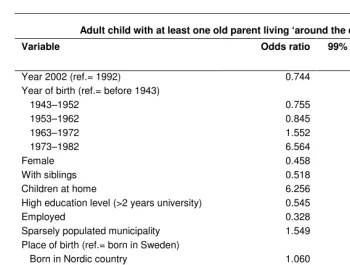
Table 2: Odds ratio (99% confidence interval) for an adult child living within a radius of 50 km and ‘around the corner’ of an old
parent for 1992 and 2002, including effects of year and year of birth
Adult child with at least one old parent within a distance of 50 km
Variable Odds ratio 99% confidence interval
Lower–upper
Year 2002 (ref.= 1992) 1.025 1.018–1.032
Year of birth (ref.= before 1943)
1943–1952 1.184 1.173–1.195
1953–1962 1.446 1.431–1.462
1963–1972 1.503 1.483–1.523
1973–1982 1.540 1.492–1.590
Female 0.896 0.891–0.902
With siblings 0.770 0.762–0.777
Children at home 1.285 1.276–1.293
High education level (>2 years university) 0.346 0.344–0.348
Employed 1.069 1.060–1.079
Sparsely populated municipality 1.101 1.093–1.110
Place of birth (ref.= born in Sweden)
Born in Nordic country 0.872 0.849–0.896
Born in Europe (not Nordic) 1.273 1.224–1.323
Born outside Europe 1.345 1.277–1.416
Oldest with sibling(s) 1.021 1.013–1.030
Youngest with sibling(s) 1.137 1.128–1.146
Constant 2.808
Table 2: (Continued)
Adult child with at least one old parent living ‘around the corner’
Variable Odds ratio 99% confidence interval
Lower–upper
Year 2002 (ref.= 1992) 0.744 0.734–0.755
Year of birth (ref.= before 1943)
1943–1952 0.755 0.740–0.770
1953–1962 0.845 0.827–0.863
1963–1972 1.552 1.514–1.591
1973–1982 6.564 6.304–6.836
Female 0.458 0.452–0.464
With siblings 0.518 0.510–0.527
Children at home 6.256 6.148–6.366
High education level (>2 years university) 0.545 0.536–0.553
Employed 0.328 0.324–0.333
Sparsely populated municipality 1.549 1.529–1.570
Place of birth (ref.= born in Sweden)
Born in Nordic country 1.060 1.006–1.117
Born in Europe (not Nordic) 2.167 2.055–2.286
Born outside Europe 2.523 2.387–2.666
Oldest with sibling(s) 1.098 1.079–1.117
Youngest with sibling(s) 1.223 1.206–1.241
Constant 0.103
Pseudo R² 0.158
4.2 Family ties
The analyses reveal some relationships between family structure and intergenerational distances. For the older parents, we found that being married had a negative effect on the probability of having at least one child living within the same one hundred meter
square when controlling for the impact of other variables (see Table 3)9. Although this
relationship may have many explanations, the result may be interpreted as empirical support for the hypothesis that lone parents, who are usually also older, need more assistance and company from their adult children, and consequently that parents or children move closer to each other when one of the older parents has died. However, the relationship between the distance to adult children and being married is not clear, as we found a positive effect of being married and having an adult child within a distance of 50 km.
From the adult child’s perspective, having a child of one’s own was found to substantially increase the probability of living close to an older parent. This result could be interpreted as support for the hypothesis that the care of and contact with grandchildren may be an important reason for moves that increase parent–child proximity. However, there may be many other explanations for the higher propensity of adult children with children to live close to older parents, for instance families with children are less mobile.
Furthermore, we found that having siblings had a negative effect on living close to an older parent. One interpretation of this is that adult children with siblings have greater freedom to move far away from their parents, as someone else can stay close by and take care of them, while the only child is less free to move away. As expected, we also found that having many adult children had a positive effect on parents living close by to at least one adult child.
When estimating the impact of parity order on proximity, we found that being the youngest or the oldest in a group of siblings increases the probability of staying close by, within both the commuting distance and ‘around the corner’ (see Table 1). Although there may be several possible explanations for this finding, it provides some support for two hypotheses, namely that the oldest siblings have the responsibility to care for the parents and that the youngest are trapped with the parents when the other siblings have left. An alternative interpretation may be that the young have not yet moved away.
9 Because results from the regression analyses were in most cases highly significant and also showed similar
4.3 Gender differences
In the relationship between geographical nearness to parents and gender, we found support for one of our hypotheses: Being a man had a positive effect on the probability of living close to an older parent. This is not surprising, because we know that women have moved further and did so more frequently than men have. Consequently, the results do not support the hypothesis that women’s greater involvement in care results in shorter distances between parents and daughters. We also found that the gender difference in the proximity to parents is reduced over time and that women move out of their parents’ home and away from the place where they grew up earlier in life, but that daughters in their late 50s live almost as close to their parents as sons do. This may constitute a generational difference, but it may also be the effect of women moving closer to their parents (or parents moving closer to their daughters) when they get older, possibly for care purposes.
Furthermore, we found that being a woman (a mother) had a negative effect on the probability of living ‘around the corner’ from an adult child (significant only for 1992). This result may be an indication of the pattern shown in previous studies, that older
men receive more informal help and less formal help than do older women (Katz et al.
2000, Szebehely 2005). However, being a woman had a positive effect on the probability of living within commuting distance of an adult child.
4.4 Regional differences
municipality had a positive effect on having at least one parent ‘around the corner’ as well as on having one parent within a distance of 50 km (see Tables 1 and 2).
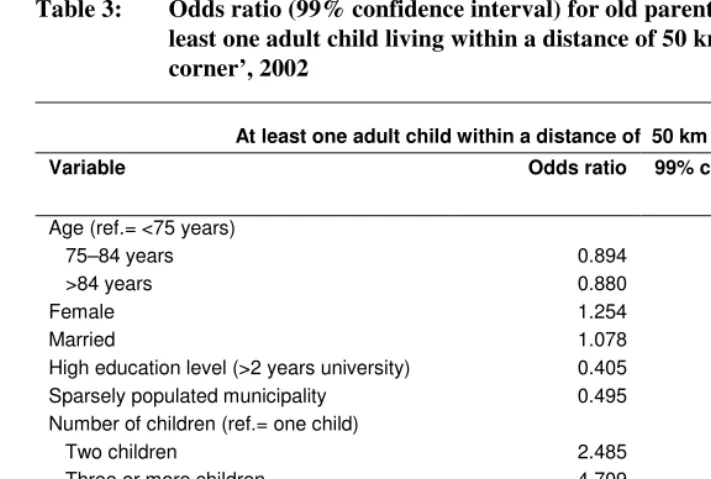
Table 3: Odds ratio (99% confidence interval) for old parents who have at least one adult child living within a distance of 50 km and ‘around the corner’, 2002
At least one adult child within a distance of 50 km
Variable Odds ratio 99% confidence interval
Lower–upper Age (ref.= <75 years)
75–84 years 0.894 0.880–0.909
>84 years 0.880 0.861–0.901
Female 1.254 1.236–1.273
Married 1.078 1.062–1.094
High education level (>2 years university) 0.405 0.395–0.416
Sparsely populated municipality 0.495 0.488–0.502
Number of children (ref.= one child)
Two children 2.485 2.447–2.524
Three or more children 4.709 4.618–4.801
Place of birth (ref.= born in Sweden)
Born in Nordic country 0.962 0.930–0.996
Born in Europe (not Nordic) 1.139 1.091–1.189
Born outside Europe 1.216 1.121–1.320
Constant 3.238
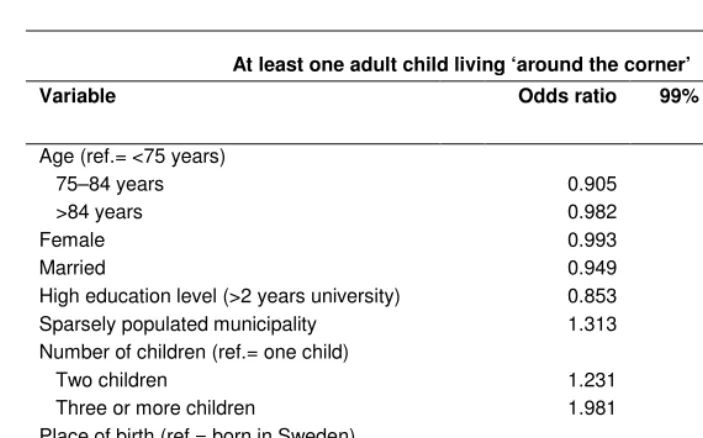
Table 3: (Continued)
At least one adult child living ‘around the corner’
Variable Odds ratio 99% confidence interval
Lower–upper Age (ref.= <75 years)
75–84 years 0.905 0.889–0.922
>84 years 0.982 0.957–1.008
Female 0.993 0.976–1.010
Married 0.949 0.933–0.966
High education level (>2 years university) 0.853 0.824–0.883
Sparsely populated municipality 1.313 1.290–1.337
Number of children (ref.= one child)
Two children 1.231 1.204–1.258
Three or more children 1.981 1.939–2.024
Place of birth (ref.= born in Sweden)
Born in Nordic country 1.160 1.118–1.203
Born in Europe (not Nordic) 1.932 1.856–2.011
Born outside Europe 3.973 3.751–4.208
Constant 0.076
Pseudo R² 0.026
Source: Calculations based on ASTRID; N=1,170,125.
4.5 Socio-economic differences
were found for high-income earners10. This means that the less wealthy and the less educated live closer by and have more access to the social capital of nearby relatives, but also that they are more tied to these relatives and to the place where they live. Similarly, we found that immigrants, especially those who had recently immigrated and those coming from low-income countries, had shorter intergenerational distances.
Previous research on Swedish migration has revealed that employment constrains mobility and that those who are unemployed or do not form part of the workforce can be more mobile than can others (Fischer and Malmberg 2001). Our results are in line with this, as we found a positive effect of being employed on the probability of living within a radius of 50 km to at least one parent. Those who found a job were more likely to stay in the area and remain close to their parents. However, our estimations show a negative effect of being employed on living in the same one hundred meter square as an older parent. It seems that the unemployed and who are not employed are more likely to
stay within one hundred metersquare to their parents. One interpretation is that parental
support – the social capital of having relatives close by – constitutes a kind of unemployment insurance.
5. Discussion
Trends in and patterns of child–parent proximity are vitally important for many reasons and they influence diverse phenomena, such as intergenerational contacts, kinship ties, everyday mobility, and migration. In the present study, we have used Swedish register data to scrutinize distances between adult children and older parents. We have searched for trends over time and investigated the extent to which the place of residence is affected by the geographical proximity to other members of one’s extended family. We have also investigated the child–parent proximity in different groups, by region, social position, gender, and migration background.
Although previous studies have shown relatively large child-parent distances in Sweden, our analyses reveal that as many as 85% of parents above retirement age do have at least one adult child within a commuting distance of 50 km, and that as many as 10% have an adult child living within 100 meters to the parent. However, the results do not refute previous conclusions that intergenerational distances are larger and that contacts are less frequent in Sweden than they are in most other European countries.
Large distances between older parents and adult children are considered to be signs of weak family ties and they are more common in countries that have strong welfare institutions, such as Sweden. Interestingly, the comparison of the two cross-sections,
10 Due to multicolinearity, the income variable was excluded in the final model and education is used as a
1992 and 2002, revealed no increasing distance over time in the Swedish case. In fact, our data show a minor decrease in the average child–parent distances. These results are in line with, for instance, U.S. studies showing no increasing child-parent distances
(Rogerson et al. 1993) and indicate a tendency towards increasing intergenerational
contacts (Bengtson 2001). However, our findings also indicate that the decreasing distances are rather the temporary effect of the high cohort-specific migration propensities of the ‘urbanization generation’ than an effect of long-term trends. However, more analyses are necessary to elucidate the impact of children’s and parents’ migration on changing intergenerational distances.
Furthermore, our investigations of regional variations in the parent–child proximity show some differences between densely and sparsely populated regions. Migration patterns from the urbanization era of the 1960s and 1970s have left traces not only in the age distribution, but also in the place-specific distances between parents and children. In the sparsely populated areas, we found more parents with no children living within the proximity of 50 km, although living ‘around the corner’ from an adult child is more common in remote areas. The difficulties for older people to live alone in the more sparsely populated regions may be one explanation for the higher probability of adult children to live very close by their older parents.
Although locational nearness to relatives seems to be less important in Sweden than in many other European countries, our analyses indicate that the place of residence of parents, siblings, and adult children to some extent affects where people live. It seems as though the choice of residence is still influenced by the responsibility of staying close to older parents and by the location of siblings in relation to the parents. Furthermore, our analyses indicate that contacts over several generations influences residential choices, as living close to adult children is more common among older parents with grandchildren. However, it is important to stress that these patterns of interfamily distances are not necessarily the product of intergenerational attraction. It should also be stressed that nearness to and the responsibility of caring for the old (or the young) may also constrain the individual freedom of children and parents. It can be a burden or a resource that may be distributed unequally in different groups.
Furthermore, the empirical analyses showed that people with a university education live farther away from their parents. This is expected, as almost all migration studies show a strong relationship between a high education level and a high migration propensity. Similarly, we found a longer intergenerational distance among those born in Sweden compared to those born abroad. This means that immigrants and the less educated segment of the population, both parents and adult children, live closer to their immediate relatives than do others. For less educated people and for weakly integrated immigrants, the lack of economic resources and more limited access to public welfare institutions may result in greater dependence on family support. Immigrants coming from countries where the family support model is still strong may also have higher preferences than non-immigrants do for having shorter intergenerational distances. We found that the distances between the generations are shorter for recent immigrants, but that the relationship between immigrant integration and intergenerational distances is an issue that requires further investigation.
In the present study, we scrutinized how older parents in different situations live in relation to their adult children. Using detailed information about parent–child proximity and additional data on the life situation of parents and children, we have been able to empirically illuminate some crucial research questions. However, the study also brings up new research questions, for instance how internal and international migration shape child–parent distances. Fortunately, available micro data make further analyses of such questions possible.
6. Acknowledgements
This research was partly funded by the Swedish Research Council; the grant to Strong
References
Aboderin, I. 2004. Modernisation and ageing theory revisited: current explanations of recent developing world and historical Western shifts in material family support
for older people, Ageing & Society 24: 29–50.
Aquilino, W. S. 1994. Later life parental divorce and widowhood: impact on young
adults’ assessment of parent-child relations, Journal of Marriage and the Family
56(4): 908–922.
Bengtson, V. L. 2001. Beyond the nuclear family: the increasing importance of
multigenerational bonds, Journal of Marriage and the Family 63(1): 1–16.
Choi, N. G. 2003. Coresidence between unmarried aging parents and their adult
children, Research on Aging 25(4): 384–404.
Clark, R. L., and D. A. Wolf. 1992. Proximity of children and elderly migration, in A.
Rogers (Ed.), Elderly Migration and Population Redistribution: A Comparative
Study. London: Belhaven Press, pp. 77–96.
Cowgill, D. O. 1974. The aging of populations and societies, Annals of the American
Academy of Political and Social Science 415: 1–18.
Esping-Andersen, G. 1999. Social Foundations of Postindustrial Economies. Oxford:
Oxford University Press.
Fischer, P., and G. Malmberg. 2001. Settled people don’t move. On life course and
(im-) mobility in Sweden, International Journal of Population Geography 7(5):
357–371.
Fransson, U. 2004. Åldrande föräldrars närhet till sina vuxna barn, in U. Fransson (Ed.),
Äldrelandskapet–Äldres boende och flyttningar. Uppsala: Forskningsinstitutet för bostads och urbanforskning Forskningsrapport 2004: 1.
Green, A. E. 2004. Is relocation redundant? Observations on the changing nature and
impacts of employment-related geographical mobility in the UK, Regional
Studies 38(6): 629–641.
Hank, K. 2005. Spatial Proximity and Contacts between Elderly Parents and Their
Adult Children: A European Comparison. Mannheim: Mannheim Research Institute for the Economics of Aging.
Jans, A.-C. 2005. Family Relations, Children and Interregional Mobility, 1970 to 2000,
Jiang, L. 1995. Changing kinship structure and its implications for old-age support in
urban and rural China, Population Studies 49(1): 127–145.
Joseph, A. E., and B. C. Hallman. 1998. Over the hill and far away: distance as a barrier
to the provision of assistance to elderly relatives, Social Science and Medicine
46(6): 631–639.
Katz, S. J., M. Kabeto, and K. M. Langa. 2000. Gender disparities in the receipt of
home care for elderly people with disability in the United States, JAMA 284(23):
3022–3027.
Lawton, L., M. Silverstein, and V. Bengtson. 1994. Affection, social contact, and
geographic distance between adult children and their parents, Journal of
Marriage and the Family 56: 57–68.
Lundholm, E., J. Garvil, G. Malmberg, and K. Westin. 2004. Forced or free movers? The motives, voluntariness and selectivity of interregional migration in the
Nordic countries. Population,Space and Place 10(1): 59–72.
Michielin, F., and C.H. Mulder. 2007. Geographical distances between adult children
and their parents in the Netherlands, Demographic Research 17(22): 655–678.
www.demographic-research.org/Volumes/Vol17/22/default.htm.
Rogerson, P. A., J. A. Burr, and G. Lin. 1997. Changes in geographic proximity
between parents and their adult children, International Journal of Population
Geography 3(2): 121–136.
Rogerson, P. A., R. H. Weng, and G. Lin. 1993. The spatial separation of parents and
their adult children, Annals of the Association of American Geographers 83(4):
656–671.
Rossi, A. S., and P. H. Rossi. 1990. Of Human Bonding: Parent-Child Relations across
the Life Course. New York: Aldine de Gruyter.
Schoeni, R. F. 1998. Reassessing the decline in parent-child old-age coresidence during
the twentieth century, Demography 35(3): 307–313.
Shanas, E. 1980. Older people and their families: the new pioneers, Journal of
Marriage and the Family 42(1): 9–15.
SHARE Database, 2006. Survey of Health, Ageing and Retirement in Europe Database.
Mannheim: Mannheim Research Institute for the Economics of Aging.
Silverstein, M. 1995. Stability and change in temporal distance between the elderly and
Silverstein, M., T. M. Parrott, and V. L. Bengtson. 1995. Factors that predispose middle-aged sons and daughters to provide social support to older parents,
Journal of Marriage and the Family 57(2): 465–475.
Spitze, G., J. R. Logan, G. Dean, and S. Zerger. 1994. Adult children’s divorce and
intergenerational relationships, Journal of Marriage and the Family 56(2):
279–293.
Statistics Sweden. 2006. Living Conditions Survey (ULF) 2006, Stockholm: Statistics
Sweden.
Svallfors, S. 2004. Class, attitudes and the welfare state: Sweden in comparative
perspective, Social Policy & Administration 38: 119.
Szebehely, M. 2005. Anhörigas betalda och obetalda äldreomsorgsinsatser in
Forskarrapporter till Jämställdhetspolitiska utredningen, SOU 2005: 66.
Tomassini, C., D. A. Wolf, and A. Rosina. 2003. Parental housing assistance and
parent-child proximity in Italy, Journal of Marriage and the Family 65(3):
700–715.
Umberson, D. 1992. Relationships between adult children and their parents:
psychological consequences for both generations, Journal of Marriage and the
Family 54: 664–674.
Warnes, A. M. 1986. The residential mobility histories of parents and children, and
relationships to present proximity and social integration, Environment and
Planning A 18: 1581–1594.
Wolf D. A. 1994. The elderly and their kin: patterns of availability and access, in
Martin and S. H. Preston (Eds.), Demography of Aging. Washington D.C.: