Adv. Fixed Point Theory, 4 (2014), No. 4, 571-585 ISSN: 1927-6303
FIXED POINT THEOREMS OF MULTI-VALUED AND SINGLE-VALUED MAPPINGS IN PARTIAL METRIC SPACES
ROMMEL O. GREGORIO1,2
1Philippine Science High School-Cordillera Administrative Region Campus 2University of the Philippines Baguio, Department of Mathematics and Computer Science
Baguio City 2600, Philippines
Copyright c2014 Rommel O. Gregorio. This is an open access article distributed under the Creative Commons Attribution License, which permits unrestricted use, distribution, and reproduction in any medium, provided the original work is properly cited.
Abstract. Matthews (1994) introduced the concept of nonzero self-distance called a partial metric and extended the Banach contraction principle in the context of partial metric spaces. This was followed by Aydiet al. (2012) by extending Nadler’s fixed point theorem to partial metric spaces and introducing the concept of partial Hausdorff metric. In this paper, we prove some fixed point theorems in the context of partial metric spaces endowed with partial ordering using partial Hausdorff metric and a notion of monotone multivalued mappings. Moreover, an example is provided to illustrate the usability of our results.
Keywords:fixed point; multivalued mapping; partially ordered set; partial metric space.
2010 AMS Subject Classification:47H10; 54H25.
1. Introduction
Fixed point theorems of multivalued mappings play fundamental roles in economics and en-gineering, control theory, convex optimization, and game theory. The first well known theorem
E-mail address: rommel [email protected] Received January 22, 2014
for multivalued contraction mapping was given by Nadler [1] in 1967, which is a generalization of Banach’s contraction principle [2].
Theorem 1.1[1]Let(X,d)be a complete metric space, and F :X →CB(X)is a multivalued mapping, where CB(X) is the set of all nonempty closed bounded subsets of X . Assume that
there existsα ∈[0,1)such that H(Fx,Fy)≤αd(x,y)for all x,y∈X . Then F has a fixed point.
The Nadler’s fixed point theorem has been generalized in many ways. One generalization of Nadler’s fixed point theorem was given by Reich in 1972 [3], which was followed with a relaxed condition by Mizoguchi and Takahashi in 1989 [4] where they used the concept of M T−function (R−function).
Definition 1.1A functionϕ:[0,∞)→[0,1)is said to be anM T−function if lim sup
r→t+
ϕ(r)<1
for allt ∈[0,∞).
Theorem 1.2[3]Let(X,d) be a complete metric space, and F :X →Comp(X)is a multival-ued mapping, where Comp(X) is the set of all nonempty compact subsets of X . Assume that
H(Fx,Fy)≤ϕ(d(x,y))d(x,y) for all x,y∈X , where ϕ is an M T−function. Then F has a
fixed point.
Theorem 1.3 [4] Let (X,d) be a complete metric space, and F :X →CB(X) is a multi-valued mapping. Assume that H(Fx,Fy)≤ϕ(d(x,y))d(x,y) for all x,y∈X , where ϕ is an
M T−function. Then F has a fixed point.
Recently, many fixed point theorems have been extended to partially ordered spaces. Some single valued fixed point theorems for partially ordered metric spaces were proved by Ran and Reurings [5], and Nieto and Lopez and applied their results to study a problem of ordinary differential equation. Moreover, fixed point theorems of multivalued mappings in partially or-dered metric spaces were established by Beg and Butt [7], and Gregorio and Macansantos [8], and references therein.
has a lower bound and an upper bound. If f is a continuous monotone (either order-preserving
or order-reversing) map from X into X such that
(i). there existsα ∈(0,1)such that d(f x,f y)≤αd(x,y)for all xy (ii). there exists x0∈X such that x0 f x0or f x0x0
Then f has a unique fixed point.
On the other hand, Matthews in 1994 [9] introduced the concept of partial metric, where self-distance need not be equal to zero, as part of the study of denotational semantics of dataflow networks. He gave a modified version of Banach’s contraction principle in partial metric spaces. For multivalued mappings, Aydiet al. [10] and Macansantos [11] established an analogue of Nadler’s fixed point theorem in the context of partial metric spaces.
Theorem 1.5 [9] Let (X,p) be a complete partial metric space. If f is a mapping from X into itself such that there exists a real numberα ∈[0,1)satisfying p(f x,f y)≤αp(x,y)for all x,y∈X . Then f has a unique fixed point.
Theorem 1.6 [10] Let (X,p) be a complete partial metric space. If F :X →CBp(X) is a multivalued mapping, where CBp(X)is the set of all nonempty closed and bounded subsets of
X, assume that for all x,y∈X , we have Hp(Fx,Fy)≤αp(x,y)whereα ∈(0,1). Then F has a fixed point.
Motivated by these works, we are going to combine the techniques employed by Mizoguchi and Takahashi [4] and Ran and Reurings [5] in generalizing and extending Nadler’s fixed point theorem and the fixed point theorem established by Aydiet al. [10] in the context of ordered partial metric spaces.
2. Preliminaries
Definition 2.1LetXbe a nonempty set. A function p:X×X→R+is said to be a partial metric
onX if for anyx,y,z∈X, the following conditions hold: (P1). p(x,x) =p(y,y) =p(x,y)if and only ifx=y; (P2). p(x,x)≤ p(x,y);
(P3). p(x,y) = p(y,x);
(P4). p(x,z)≤ p(x,y) +p(y,z)−p(y,y).
The pair(X,p)is then called a partial metric space.
Remark 2.1If p(x,y) =0, then P1 and P2 imply thatx=y. But the converse does not always hold.
Example 2.1 A trivial example of a partial metric space is the pair (R+,p), where p:R+× R+→R+ is defined asp(x,y) =max{x,y}.
Example 2.2 If X = {[a,b] :a,b ∈R,a≤ b}, then p([a,b],[c,d]) = max{b,d} −min{a,c} defines a partial metric ponX.
Definition 2.2A sequence{xn}in a partial metric space(X,p)converges to a pointx∈X, with
respect toτp, if and only if p(x,x) = lim n→∞
p(x,xn).
Definition 2.3 If p is a partial metric on X, then the mapping ps :X ×X → R+ given by
ps(x,y) = 2p(x,y)−p(x,x)−p(y,y), defines a metric on X. Furthermore, a sequence {xn}
converges in(X,ps)to a pointx∈X if and only if lim
n,m→∞
p(xn,xm) = lim
n→∞
p(xn,x) =p(x,x). Definition 2.4Let(X,p)be a partial metric space.
(i). A sequence{xn} inX is said to be a Cauchy sequence if lim
n,m→∞
p(xn,xm)exists and is finite.
(ii). (X,p)is said to be complete if every Cauchy sequence{xn}inXconverges with respect
toτpto a pointx∈X such that lim n→∞
p(xn,x) =p(x,x).
Lemma 2.1Let(X,p)be a partial metric space, then
(i). A sequence {xn} in X is a Cauchy sequence in (X,p) if and only if it is a Cauchy
(ii). A partial metric space(X,p)is complete if and only if the metric space(X,ps)is
com-plete.
Let CBp(X) be the set of all nonempty, closed and bounded subsets of the partial metric space (X,p). Closedness is in the context of (X,τp), where τp is the topology induced by p,
and boundedness is defined as follows: Ais a bounded set in(X,p)if there existsx0∈X and
M≥0 such that for alla∈A, we havea∈Bp(x0,M), that is,p(x0,a)<p(a,a) +M. ForA,B∈CBp(X)andx∈X, define
(i). p(x,A) =inf{p(x,a),a∈A} (ii). δp(A,B) =sup{p(a,B):a∈A}
(iii). δp(B,A) =sup{p(b,A):b∈B}
Note that ifp(x,A) =0 then ps(x,A) =0 where ps(x,A) ={infps(x,a):a∈A}.
From these natural extensions of partial metric ponX, if(X,p)is a partial metric space and
A,B∈CBp(X), define Hp:CBp(X)×CBp(X)→R+ asHp(A,B) =max{δp(A,B),δp(B,A)}.
We callHpas the partial Hausdorff metric induced by p.
Remark 2.2. Let (X,p) be a partial metric space and A be any nonempty set in (X,p), then
a∈A if and only if p(a,A) = p(a,a), where A denotes the closure of A with respect to the partial metric p. Thus,Ais closed in(X,p)if and only ifA=A.
Theorem 2.1Let(X,p)be a partial metric space. For all A,B,C∈CBp(X), we have (i). Hp(A,A)≤Hp(A,B)
(ii). Hp(A,B) =Hp(B,A)
(iii). Hp(A,B)≤Hp(A,C) +Hp(C,B)−infc∈Cp(c,c).
Corollary 2.1 Let (X,p) be a partial metric space. For A,B∈CBp(X) then, Hp(A,B) =0
implies that A=B.
Remark 2.3The converse of Corollary 2.1 is not true in general. Also, note that any Hausdorff metric is a partial Hausdorff metric, but the converse is not true.
For our results, we use the following relations between nonempty subsets of a partially or-dered partial metric space which give us a notion of monotone multivalued mappings. The first relation appeared in [13].
Definition 2.5Let(X,)be a partially ordered set, and suppose that there exists a partial metric
ponXsuch that(X,p)is a complete partial metric space. LetF:X→CBp(X)be a multivalued mapping. Define the following relations:
(i). A<(I)Bif for eacha∈A, there existsb∈Bsuch thatab.
(ii). A<(II)Bif for eacha∈A, there existsb∈Bsuch thataband p(a,b)≤Hp(A,B).
Moreover, letx,y∈X such thatxy, thenF is said to be: (i). monotone nondecreasing of type (I) ifFx<(I)Fy.
(ii). monotone nondecreasing of type (II) ifFx<(II)Fy.
3. Main results
Theorem 3.1Let(X,)be a partially ordered set. Suppose that there exists a partial metric p on X such that(X,p)is a complete partial metric space. Let F:X →CBp(X)be a multivalued mapping such that the following conditions are satisfied:
(i). There exists x0∈X such that{x0}<(I)Fx0.
(ii). F is monotone nondecreasing of type (II).
(iii). If xn→x is a nondecreasing sequence in X then xnx for all n.
(iv). For all x,y∈X with xy,
(1) Hp(Fx,Fy)≤ϕ(p(x,y))p(x,y),
whereϕ is anM T−function.
Then F has a fixed point.
Proof. By assumption (i), there existsx0∈X andx1∈Fx0 such thatx0x1. Ifx0=x1, then
Suppose thatx06=x1, then by assumptions (ii) and (iv), there existsx2∈Fx1such thatx1x2
and
p(x1,x2) ≤ Hp(Fx0,Fx1)
≤ ϕ(p(x0,x1))p(x0,x1)
< p(x0,x1),
whereϕ is anM T−function. By induction, we obtain a sequence{xn} ∈X with the property
thatxn+1∈Fxnandxnxn+1such that
p(xn,xn+1) ≤ Hp(Fxn−1,Fxn)
≤ ϕ(p(xn−1,xn))p(xn−1,xn)
< p(xn−1,xn) ∀n∈N.
Note that{p(xn,xn+1)}is strictly decreasing and bounded below. It follows that
lim
n→∞
p(xn,xn+1) =r≥0.
Suppose thatr>0. By assumptions (ii) and (iv), we find that
p(xn,xn+1) ≤ Hp(Fxn−1,Fxn)
≤ ϕ(p(xn−1,xn))p(xn−1,xn).
Therefore, we have
r = lim sup
n
p(xn,xn+1)
≤ lim sup
n
ϕ(p(xn−1,xn))lim sup n
p(xn−1,xn)
< lim sup
n
p(xn−1,xn) =r,
which is a contradiction. Thus,r=0, that is, lim
n→∞
p(xn,xn+1) =0 and it follows from (P2) that
(2) lim
n→∞
By definition, we also have
(3) lim
n→∞
ps(xn,xn+1) =0.
Next, we show that{xn}is a Cauchy sequence in(X,ps). By sense of contradiction, suppose
that{xn}is not a Cauchy sequence in(X,ps). Then there existsε >0 andm(k),n(k)∈Nsuch
that for allk≥0
n(k)>m(k)>k,
ps(xm(k),xn(k))≥ε
and
ps(xm(k),xn(k)−1)<ε.
Hence, fork∈N, we have
ε ≤ ps(xm(k),xn(k))
≤ ps(xm(k),xn(k)−1) +ps(xn(k)−1,xn(k))
< ps(xn(k)−1,xn(k)) +ε.
Takingk→∞in the above inequality and using (3), we obtain
(4) lim
k→∞
ps(xm(k),xn(k)) =ε.
By definition, we have
ps(xm(k),xn(k)) =2p(xm(k),xn(k))−p(xm(k),xm(k))−p(xn(k),xn(k)).
Takingk→∞and using (2) and (4), we obtain
(5) lim
k→∞
p(xm(k),xn(k)) = ε
2.
Since m(k)<n(k) and {xn} is a nondecreasing sequence, we find that xm(k) xn(k), and by condition ii, forxm(k)+1∈Fxm(k), there existsxn(k)+1∈Fxn(k) such thatxm(k)+1xn(k)+1and
p(xm(k)+1,xn(k)+1) ≤ Hp(Fxm(k),Fxn(k))
≤ ϕ(p(xm(k),xn(k)))p(xm(k),xn(k))
With this, we have
ps(xm(k)+1,xn(k)+1) = 2p(xm(k)+1,xn(k)+1)−p(xm(k)+1,xm(k)+1)−p(xn(k)+1,xn(k)+1)
< 2p(xm(k),xn(k))−p(xm(k)+1,xm(k)+1)−p(xn(k)+1,xn(k)+1).
Takingk→∞and using (2) and (5), we have
(6) lim
n→∞
ps(xm(k)+1,xn(k)+1)<ε.
By using triangle inequality, we have
ps(xm(k),xn(k))≤ps(xm(k),xm(k)+1) +ps(xm(k)+1,xm(k)+1) +ps(xn(k)+1,xn(k)).
Takingk→∞and using (3), (4), and (6), we obtain
ε ≤ 0+lim
k→∞
ps(xm(k)+1,xn(k)+1) +0
< ε,
which is a contradiction. Therefore, {xn} is a Cauchy sequence in (X,ps). Since (X,p) is complete. Then (X,ps) is a complete metric space, and {xn} converges to some x∈X with respect to the metric ps, that is, lim
n→∞
ps(xn,x) =0.
Now, we need to show that x∈X is a fixed point ofF. By definition, {xn} →x in (X,ps)
implies that
(7) p(x,x) = lim
n→∞
p(xn,x) = lim
n→∞
p(xn,xn) =0.
By conditions iii and iv, since {xn}is a nondecreasing sequence that converges tox∈X, then
xnxandHp(Fxn,Fx)≤ϕ(p(xn,x))p(xn,x)for alln. Taking (7) into consideration, we obtain
lim
n→∞
Hp(Fxn,Fx) =0.Sincexn+1∈Fxn, we see that
p(xn+1,Fx)≤δp(Fxn,Fx)≤Hp(Fxn,Fx)
and hence
(8) lim
n→∞
By Property 4 (P4) of a partial metric, we have
p(x,Fx) ≤ p(x,xn+1) +p(xn+1,Fx)−p(xn+1,xn+1)
≤ p(x,xn+1) +p(xn+1,Fx).
Takingn→∞and using (7) and (8), we obtain p(x,Fx) =0 Therefore, p(x,x) =p(x,Fx), and this implies thatx∈Fx=Fx, becauseFx∈CBp(X). Thusxis a fixed point ofF.
The following corollary considers the case when theM T−function is constant.
Corollary 3.1 Let (X,) be a partially ordered set, and suppose that there exists a partial metric p on X such that(X,p) is a complete partial metric space. Let F :X →CBp(X) be a multivalued mapping such that the following conditions are satisfied:
(i). There exists x0∈X such that{x0}<(I)Fx0.
(ii). F is monotone nondecreasing of type (II).
(iii). If xn→x is a nondecreasing sequence in X then xnx for all n.
(iv). For all x,y∈X with xy, there existsα ∈(0,1)such that
(9) Hp(Fx,Fy)≤αp(x,y).
Then F has a fixed point.
Remark 3.1Single valued fixed point theorems in partial metric spaces analogous to our mul-tivalued results can also be established, and are stated as follows.
Corollary 3.2 Let (X,) be a partially ordered set, and suppose that there exists a partial metric p on X such that (X,p)is a complete partial metric space. Let f :X →X be a single valued nondecreasing mapping such that the following conditions are satisfied:
(i). There exists x0∈X such that x0 f x0.
(ii). If xn→x is a nondecreasing sequence in X then xnx for all n.
(iii). For all x,y∈X with xy,
(10) p(f x,f y)≤ϕ(p(x,y))p(x,y),
Then f has a fixed point.
Corollary 3.3 Let (X,) be a partially ordered set, and suppose that there exists a partial metric p on X such that (X,p)is a complete partial metric space. Let f :X →X be a single valued nondecreasing mapping such that the following conditions are satisfied:
(i). There exists x0∈X such that x0 f x0.
(ii). If xn→x is a nondecreasing sequence in X then xnx for all n.
(iii). For all x,y∈X with xy, there existsα ∈(0,1)such that
(11) p(f x,f y)≤αp(x,y), whereϕ is anM T−function.
Then f has a fixed point.
Next theorem gives additional condition to ensure uniqueness of fixed point of single valued mapping.
Theorem 3.2Suppose that all assumptions of Corollary 3.2 are satisfied, and in addition, for arbitrary elements x,y∈X , there exists z∈X which is comparable with both x and y. Then the
fixed point of f is unique.
Proof.Letu,v∈X be two fixed points of f,i.e., f u=uand f v=v. We note the following two cases:
Case 1. uandvare comparable. WLOG, letuv. By assumption (iv) of Corollary 3.2,
p(u,v) =p(f u,f v)≤ϕ(p(u,v))p(u,v)
and this implies that p(u,v) =0, thusu=v.
Case 2. u and v are not comparable. By the virtue of the additional assumption, there exists
w∈X that is comparable to both ofuandv. Note also thatu= fnuis comparable with
fnwfor eachnbecause of transitivity and nondecreasing property of f. Letn∈N, then by assumption (iv) of Corollary 3.2,
p(u,fnw) = p(f fn−1u,f fn−1w)≤ϕ(p(fn−1u,fn−1w))p(fn−1u,fn−1w)
Hence,{p(u,fn−1w)}is strictly decreasing and bounded, thus
lim
n→∞
p(u,fnw) =l≥0.
Suppose that l >0. Getting the limit of p(u,fnw)≤ϕ(p(u,fn−1w))p(u,fn−1w) as n→∞, one arrives at a contradiction, and thus lim
n→∞
p(u,fnw) =0. Similarly, it can be shown that lim
n→∞
p(v,fnw) =0. Consider,
(12) p(u,v)≤p(u,fnw) +p(fnw,v).
Takingn→∞in (12), we have p(u,v) =0, and so,u=v. Therefore, in any case, the fixed point of f is unique.
To illustrate the usability of our results, we provide the following example where the result in [10] is not applicable.
Example 3.1.LetX=
(0,0),
0,1
5 , 1 8, 1 6 , 1 7, 1 7
, whereis defined as: forx,y∈X
such that x= (x1,y1), andy= (x2,y2), xyif and only if x1≤x2 andy1≤y2, and letX be
endowed with the partial metricp:X×X →R+ defined as
(13) p(x,y) =1
4|x1−x2|+ 1
2max{x1,x2}+ 1
4|y1−y2|+ 1
2max{y1,y2}.
Note that p
0,1
5
,
0,1
5
= 1
10 6=0, p
1 6, 1 8 , 1 8, 1 6 = 7
486=0, and
p 1 7, 1 7 , 1 7, 1 7 =1
76=0, sopis not a metric onX. Moreoverp
s=|x
1−x2|+|y1−y2|is
a complete metric space, and so(X,p)is a complete partial metric space. LetF:X →CBp(X)
be defined as
Fx=
{(0,0)} if x= (0,0),
{(0,0)} if x= (0,15),
{(0,0),(17,71)} if x= (18,16),
Note that{(0,0)},{(0,0),(17,17)}, and{(0,0),(0,15)}are bounded sets in(X,p). If(x,y)∈X, then
(x,y)∈ {(0,0)} ⇐⇒ p((x,y),{(0,0)}) =p((x,y),(x,y)
⇐⇒ 3 4x+
3 4y=
1 2x+
1 2y ⇐⇒ x=0,y=0
⇐⇒ (x,y)∈ {(0,0)}.
Hence,{(0,0)}is closed with respect to the partial metric p. Moreover,
(x,y)∈ {(0,0),(1
7, 1
7)} ⇐⇒ p((x,y),{(0,0),( 1 7,
1
7)}) =p((x,y),(x,y) ⇐⇒ min{3
4x+ 3 4y,
1 4|x−
1 7|+
1
2max{x, 1 7}+
1 4|y−
1 7|+ 1
2max{y, 1 7}=
1 2x+
1 2y ⇐⇒ (x,y)∈ {(0,0),(1
7, 1 7)}.
Hence,{(0,0),(17,17)}is closed with respect to the partial metric p. Also,
(x,y)∈ {(0,0),(0,1
5)} ⇐⇒ p((x,y),{(0,0),(0, 1
5)}) =p((x,y),(x,y) ⇐⇒ min{3
4x+ 3 4y,
1 4x+
1
2max{x,0}+ 1 4|y−
1 5|+ 1
2max{y, 1 5}=
1 2x+
1 2y ⇐⇒ (x,y)∈ {(0,0),(0,1
5)}. Hence,{(0,0),(0,15)}is closed with respect to the partial metric p.
Let us consider(0,15),(81,16)∈X. For these elements ofX,F(0,15) ={(0,0)}andF(18,16) =
{(0,0),(17,17)}, andp (0,15),(18,16)
=48097 whileHp(F(0,15),F(18,16)) =max{0,143}=143. Note that these two specific elements ofXdo not satisfy the contraction condition established by Ay-di et al. [10], that is, there is no α ∈(0,1) such that Hp(Fx,Fy)≤αp(x,y). Therefore, we
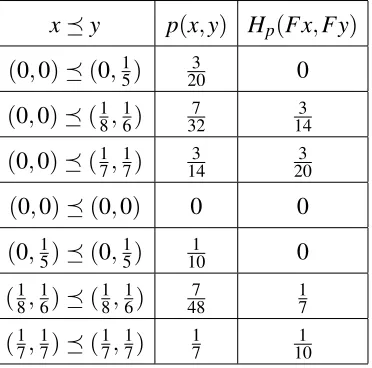
Now, we use our result to show that F has fixed point. Let us first demonstrate that the contraction condition is satisfied for comparable elements of X. For this, we consider cases summarized in Table 1.
Table 1. p(x,y)andHp(Fx,Fy)of comparable elementsx,y∈X
xy p(x,y) Hp(Fx,Fy)
(0,0)(0,15) 203 0
(0,0)(81,16) 327 143 (0,0)(71,17) 143 203 (0,0)(0,0) 0 0
(0,15)(0,15) 101 0
(18,16)(18,16) 487 17
(17,17)(17,17) 17 101
Thus we can chooseα = 859875 ∈(0,1)such that Hp(Fx,Fy)≤αp(x,y)whenever xy. It
can also be shown that the remaining assumptions of our result (specifically Theorem 3.1 and Corollary 3.1) are satisfied. Therefore, it can be invokedF has a fixed point.
Conflict of Interests
The author declares that there is no conflict of interests. REFERENCES
[1] S. B. Nadler, Multivalued contraction mappings, Pacific J. Math. 30 (1969), 475-488.
[2] S. Banach, Surles operations dans les ensembles abstraits et leus application aux quation integrales, Fund. Math. (1922), 1379-1393.
[3] S. Reich, Fixed points of contractive functions, Boll. Un. Mat. Ital. 5 (1972), 26-42.
[4] N. Mizoguchi, W. Takahashi, Fixed point theorems for multivalued mappings on complete metric spaces, J. Math. Anal. Appl. 141 (1989), 177-188.
[5] A. C. M. Ran, M. C. B. Reurings, A fixed point theorem in partially ordered sets and some applications to matrix equations, Proc. Amer. Math. Soc. 132 (2004), 1435-1443.
[7] I. Beg, A. R. Butt, Fixed point theorems for set valued mappings in partially ordered metric spaces, Int. J. Math. Sci. 7 (2013), 66-68.
[8] R. O. Gregorio, P. S. Macansantos, Fixed point theorems and stability of fixed point sets of multivalued mapping, Adv. Fixed Point Theory 3 (2013), 735-746.
[9] S. G. Matthews, Partial metric topology: proceedings of 8th summer conference on General Topology and Applications, Ann. N. Y. Acad. Sci. 728 (1994), 183-197.
[10] H. Aydi, M. Abbas, C. Vetro, Partial Hausdorff metric and Nadler’s fixed point theorem on complete partial metric spaces, Topology Appl. 159 (2012), 3234-3242.
[11] P. S. Macansantos, A generalized Nadler-type theorem in partial metric space, Int. J. Math. Anal. 7 (2013), 343-348.
[12] I. Altun, H. Simsek, Some fixed point theorems on dualistic partial metric spaces, J. Adv. Math. Stud. 1 (2008), 1-8.