in the population sciences published by the Max Planck Institute for Demographic Research Konrad-Zuse Str. 1, D-18057 Rostock · GERMANY www.demographic-research.org
DEMOGRAPHIC RESEARCH
VOLUME 23, ARTICLE 31, PAGES 879-904
PUBLISHED 05 NOVEMBER 2010
http://www.demographic-research.org/Volumes/Vol23/31/ DOI: 10.4054/DemRes.2010.23.31
Research Article
Premarital cohabitation and divorce:
Support for the “Trial Marriage” Theory?
Hill Kulu
Paul J. Boyle
©2010 Hill Kulu & Paul J. Boyle.
This open-access work is published under the terms of the Creative Commons Attribution NonCommercial License 2.0 Germany, which permits use, reproduction & distribution in any medium for non-commercial purposes, provided the original author(s) and source are given credit.
1 Introduction 880
2 Premarital cohabitation and divorce 881
3 Data 884
4 Methods 887
5 Results 890
6 Discussion 895
7 Acknowledgements 897
Premarital cohabitation and divorce:
Support for the “Trial Marriage” Theory?
Hill Kulu1
Paul J. Boyle2
Abstract
A number of studies show that premarital cohabitation is associated with an increased risk of subsequent marital dissolution. Some argue that this is a consequence of selection effects and that once these are controlled for premarital cohabitation has no effect on dissolution. We examine the effect of premarital cohabitation on subsequent marital dissolution by using rich retrospective life-history data from Austria. We model union formation and dissolution jointly to control for unobserved selectivity of cohabiters and non-cohabiters. Our results show that those who cohabit prior to marriage have a higher risk of marital dissolution. However, once observed and unobserved characteristics are controlled for, the risks of marital dissolution for those who cohabit prior to marriage are significantly lower than for those who marry directly. The finding that premarital cohabitation decreases the risk of marital separation provides support for the “trial marriage” theory.
1 School of Environmental Sciences, University of Liverpool, Roxby Building, Liverpool L69 7ZT, UK 2 Longitudinal Studies Centre – Scotland, School of Geography and Geosciences, University of St Andrews,
1. Introduction
The number of marriages ending in divorce rose rapidly in most developed nations during the 1970s and 1980s. Although divorce rates began to stabilise in the 1990s in some countries, they continued to rise in others. It has been shown that many factors are related to marriage dissolution, including women’s increasing financial independence as their role in the labour market grows (Becker 1981; Hoem and Hoem 1992) and gender inequalities in wages gradually diminish (Davis and Joshi 1998); changes in gender roles (Kalmijn, de Graaf, and Poortman 2004; Lye and Biblarz 1993); factors related to the parental home, including parental separation (Amato 1996; Kiernan 1986); personal characteristics, such as educational qualifications (Hoem 1997a; Morgan and Rindfuss 1985); religious attitudes (Balakrishnan et al. 1987; Kalmijn, de Graaf, and Janssen 2005); the presence of one’s own children (Erlangsen and Andersson 2001; Hoem 1997b; Morgan and Rindfuss 1985; Waite and Lillard 1991); the duration of the union (Chan and Halpin 2003); the partners’ age at union formation (Tzeng and Mare 1995); the age gap between partners (Chan and Halpin 2003); the number of previous unions (O’Connor et al. 1999); and the place of residence and migration histories (Boyle et al. 2008; Muszynska and Kulu 2007). Recent research has also compared the relative influence of some of these factors across countries (Härkönen and Dronkers 2006; Liefborer and Dourleijn 2006). A detailed review of the factors associated with separation and divorce is provided by Amato (2010) and Lyngstad and Jalovaara (2010).
An additional factor that has generated considerable debate in the literature, and is becoming an increasingly common phenomenon, is the role of premarital cohabitation (Bumpass, Sweet, and Cherlin 1991; Ermisch and Francesconi 2000; Gabrielli and Hoem 2010; Hoem et al. 2009; Thornton and Philipov 2009). While some might imagine that premarital cohabitation would stabilise subsequent married unions, most of the literature suggests that it is in fact related to higher risks of marital dissolution. Various reasons for this empirical finding have been suggested, but one important factor that has not usually been controlled for adequately is the role of unobserved selection. Those who cohabit prior to marriage may have different unmeasured characteristics compared to those who do not and, if true, selection effects may mask the positive role that premarital cohabitation plays in subsequent marital stability.
determine whether selection effects mask the “true” relationship between premarital cohabitation and divorce.
2. Premarital cohabitation and divorce
According to some theoretical arguments, we might expect premarital cohabitation to help stabilise subsequent married relationships, because those who cohabit will gain more information about their spouse than those who do not live together. Cohabiting partners who find they are well suited might consider marriage, while those who find they are incompatible will end the cohabitation (Teachman, Thomas, and Paasch 1991). Such “trial marriages” (Bennett, Blanc, and Bloom 1988) involve relatively low investment and are therefore easier to terminate; unsuccessful partnerships are effectively “weeded out” (Cherlin 1981; Klijzing 1992). Indeed, most young adults appear to believe that cohabitation improves the chances of a subsequent marriage (Kline et al. 2004), suggesting that lay people’s views about premarital cohabitation concur with this theoretical perspective.
Some have suggested that the duration of the union has an effect on this relationship. Bennett, Blanc, and Bloom (1988) and Thomson and Colella (1992) found that marriages were more susceptible to divorce for those who cohabited for longer periods of time. Teachman and Polonko (1990) found that while prior cohabitation raised the risk of dissolution of subsequent marriage, once the duration of the entire union was accounted for the effect disappeared. Similarly, Hall (1996) found that those who cohabited for at least one year prior to marriage did not have a higher risk of marriage dissolution. However, duration of prior cohabitation was not found to influence subsequent marital instability by Lillard, Brien, and Waite (1995) – short cohabitations appeared to offer no advantage compared to longer cohabitations. More recently, Kline et al. (2004) showed that those who are engaged at the point when the couple starts cohabiting are at much less risk of subsequent marital break-up. Hence, commitment to the relationship appears to be an important aspect influencing later partnership success (Stanley and Markman 1992).
Others have argued that premarital cohabitation raises the risk of marriage dissolution because of selection effects. Cohabiters may have unobserved characteristics that make them more prone to separation, such as less conventional attitudes about marriage and, perhaps, higher expectations about the quality of unions, or poorer relationship skills (Bennett, Blanc, and Bloom 1988; Hall 1996; Smock 2000; Thomson and Colella 1992). For example, we know that those who cohabit tend to be more liberal, less religious, and more supportive of egalitarian gender roles (Clarkberg, Stolzenberg, and Waite 1995; Lye and Waldron 1997). For cohabiters, relationships in general, be they marital or non-marital, may be characterised by a lack of commitment and stability and they may be more willing to contemplate divorce if a subsequent marriage proves unsatisfactory (Bennett, Blanc, and Bloom 1988). Early studies seemed to support this selection hypothesis: Carlson (1986) reported that cohabiters were much more likely to view marriage as a response to social pressure than married couples, while Axinn and Thornton (1992) showed that cohabitation was selective of those who were less committed to marriage and more approving of divorce.
A second hypothesis is that the experience of cohabiting may also change people’s views about marriage, making them less strongly committed to the institution (Axinn and Barber 1997; Axinn and Thornton 1992; DeMaris and Leslie 1984; Hall and Zhao 1995; Magdol et al. 1998; Thomson and Colella 1992). Through cohabitation, people may come to accept the temporary nature of relationships and to recognise that there are alternative arrangements to the more formal marriage. Of course, it is also possible that both selection and causation effects are operating concomitantly.
simultaneously considered time-invariant unmeasured characteristics of women that influenced the choice to cohabit and the characteristics that influenced marital dissolution. The strategy recognised that the decision to cohabit prior to the marriage may be endogenous to subsequent divorce and this was accounted for by allowing the unobserved heterogeneity to be correlated across the two decisions. The objective was to test if women with above-average risks of disruption had above-average propensities to cohabit prior to marriage instead of marrying directly. Their results provided convincing evidence of strong selection effects and showed that observed differences in union dissolution between married couples who had and had not cohabited previously disappeared once these were accounted for.
Lillard, Brien, and Waite’s (1995) approach has since been applied, with varying results. Woods and Emery (2002) have found that controlling for selection effects eliminates the significant relationship between premarital cohabitation and marital instability, as did Steele, Kallis, and Joshi (2006). And, controlling for selection effects in a German study, Brüderl, Diekmann, and Engelhardt (1997) found that premarital cohabitation actually decreases the risk of divorce, suggesting that gathering information about the spouse during this period does increase subsequent marital stability. A more recent study by Svarer (2004) in Denmark supported these results. At the very least, these findings suggest that accounting for potential selection effects is critical when examining the influence of premarital cohabitation on subsequent marital dissolution.
3. Data
The retrospective event-history data for this analysis were drawn from the Austrian Family and Fertility Survey (FFS) conducted in 1995–96. This was one of a sweep of surveys conducted in a number of European nations, Canada, New Zealand, and the US. The surveys included mainly consistent questions, but there were some variations, and an advantage of the Austrian survey is that it was one of the few to include detailed retrospective partnership and residential histories. This allowed us to identify where individuals were living at the time of a particular union and also to control for the effect of residential context when examining the relationship between premarital cohabitation and divorce (Boyle et al. 2008).
The response rate for the Austrian survey was 72% (Hoem, Prskawetz, and Neyer 2001), resulting in 4,581 female and 1,539 male respondents born between 1941 and 1976. As in many other studies (e.g., Berrington and Diamond 1999), the nature of the data meant that unions were defined based on the co-residence of two intimate (heterosexual) partners. We excluded those born outside Austria, those living abroad at age 15, and those for whom significant parts of the data were incomplete, leaving 3,804 women of whom 3,118 had been in a union (at least once) during their life and were therefore included in our analysis.
We constructed a multi-episode data set for union dissolutions where individuals are at risk from union formation and are followed until union dissolution, interview, or death (if not separated). Of the 3,118 women who had at least one partnership, 397 had a second, 62 had a third and 10 had a fourth union. The number of union dissolutions was 669 for first unions, 103 for second, 22 for third and 1 for fourth unions. Separations outside Austria and after return to Austria were excluded (a total of 22 events). We were particularly concerned with the dissolution rates for cohabiters, for those who married directly, and for those who married following an episode of cohabitation.
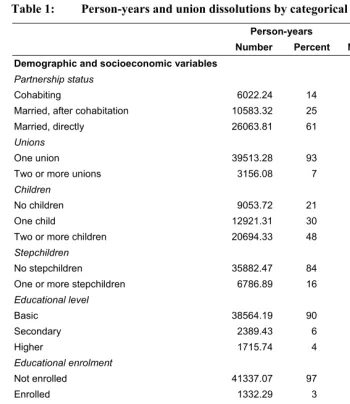
Table 1: Person-years and union dissolutions by categorical variables
Person-years Union dissolutions
Number Percent Number Percent
Demographic and socioeconomic variables
Partnership status
Cohabiting 6022.24 14 313 39
Married, after cohabitation 10583.32 25 193 24 Married, directly 26063.81 61 289 36
Unions
One union 39513.28 93 669 84
Two or more unions 3156.08 7 126 16
Children
No children 9053.72 21 329 41
One child 12921.31 30 268 34
Two or more children 20694.33 48 198 25
Stepchildren
No stepchildren 35882.47 84 638 80 One or more stepchildren 6786.89 16 157 20
Educational level
Basic 38564.19 90 690 87
Secondary 2389.43 6 81 10
Higher 1715.74 4 24 3
Educational enrolment
Not enrolled 41337.07 97 735 92
Enrolled 1332.29 3 60 8
Religiousness
No 11774.78 28 350 44
Yes 30894.58 72 445 56
Parental home
Parental divorce
No 39869.58 93 691 87
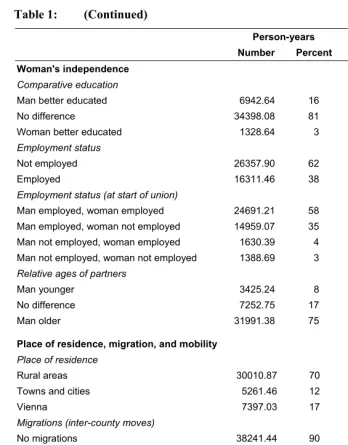
Table 1: (Continued)
Person-years Union dissolutions
Number Percent Number Percent
Woman's independence
Comparative education
Man better educated 6942.64 16 127 16
No difference 34398.08 81 612 77
Woman better educated 1328.64 3 56 7
Employment status
Not employed 26357.90 62 422 53
Employed 16311.46 38 373 47
Employment status (at start of union)
Man employed, woman employed 24691.21 58 432 54 Man employed, woman not employed 14959.07 35 266 33 Man not employed, woman employed 1630.39 4 38 5 Man not employed, woman not employed 1388.69 3 59 7
Relative ages of partners
Man younger 3425.24 8 87 11
No difference 7252.75 17 140 18
Man older 31991.38 75 568 71
Place of residence, migration, and mobility
Place of residence
Rural areas 30010.87 70 424 53
Towns and cities 5261.46 12 130 16
Vienna 7397.03 17 241 30
Migrations (inter-county moves)
No migrations 38241.44 90 704 89
One migration 3791.06 9 68 9
Two or more migrations 636.86 1 23 3
Residential moves (intra-county moves)
No moves 28407.94 67 565 71
One move 11517.74 27 162 20
Two or more moves 2743.68 6 68 9
Total 42669.36 100 795 100
4. Methods
We modelled the time from union formation to dissolution using a series of hazard regression models (Blossfeld and Rohwer 1995; Hoem 1987; 1993). We were particularly interested in whether marital dissolution was influenced by premarital cohabitation, controlling for a range of other factors, as represented by equation 1:
∑
+ +∑
+∑
+
= k k ijk l l ijl m ijm
ij(t) y(t) z (u t) x w (t)
lnµ α βm , (1)
where µij(t) denotes the hazard of dissolution for the jth union for individual i and y(t) denotes a piecewise linear spline that captures the impact of baseline (i.e., union) duration on the log-hazard. We used a piecewise linear spline specification, instead of the widely used piecewise constant approach, to pick up the baseline log-hazard. Parameter estimates are thus slopes for linear splines over user-defined time periods. With sufficient nodes (bend points), a piecewise linear specification can capture any log-hazard pattern in the data.3 Here
(
)
k ijk
z u +t denotes the spline representation of the effect of a time-varying variable that is a continuous function of t with origin uijk (e.g., a woman’s age), xijl represents the values of a time-constant variable (e.g., parental divorce), and wijm(t) represents a time-varying variable whose values can change only at discrete times (e.g., place of residence or partnership status).
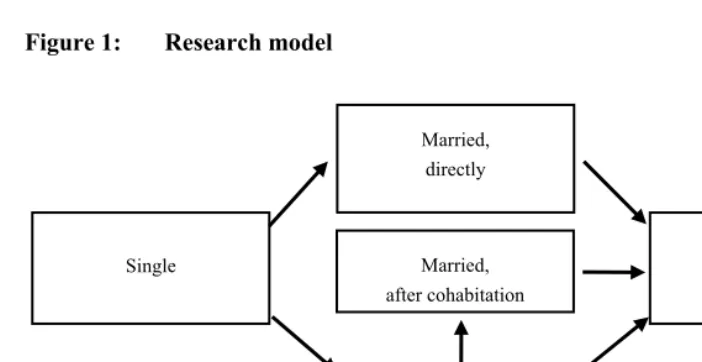
A crucial part of the modelling was to investigate the possible role of unobserved selectivity bias (see Figure 1). In particular, we were interested in whether the apparent relationship between marital dissolution and premarital cohabitation would persist once the time-invariant unmeasured characteristics of those who enter cohabitation or marry without prior cohabitation were accounted for. The aim was to test if women with above-average risks of disruption have above-average propensities to cohabit (prior to marriage) and whether women with below-average risks of disruption have above-average propensities to marry without prior cohabitation. Thus we built a simultaneous-equations model to estimate jointly an equation for union dissolution and three equations for partnership formation (distinguishing between direct marriage and cohabitation and marriage for cohabiters). Person-specific heterogeneity terms were included in all four equations, allowing us to test for a correlation between these
(
1 n n t t
s+ − 1 tn,tn+1
0
,... , 2 1s
s
3The value of the linear spline function between the points (t, y) and (t , y ) is computed as follows:
) for n = 0, 1, 2 ..., where is the slope of the linear spline over the interval [ ]. To
compute the linear spline function we thus need to define nodes and estimate from the data constant y and
slope parameters .
n n n+1 n+1
) (t
residual terms (cf. Lillard, Brien, and Waite 1995). The simultaneous equations model can be formalised as:
∑
∑
∑
∑
∑
∑
∑
∑
∑
∑
∑
∑
+ + + + + = + + + + + = + + + + + = + + + + + =k l ijl m ijm
CM l ijk CM k CM CM ij
k l ijl m ijm
M l ijk M k M M ij
k l ijl m ijm
C l ijk C k C C ij
k l ijl m ijm
D l ijk D k D D ij t w x t u z t y t t w x t u z t y t t w x t u z t y t t w x t u z t y t CM i CM m M i M m C i C m D i D m ε β α µ ε β α µ ε β α µ ε β α µ ) ( ) ( ) ( ) ( ln ) ( ) ( ) ( ) ( ln ) ( ) ( ) ( ) ( ln ) ( ) ( ) ( ) ( ln (2)
where µijD(t) denotes the hazard of dissolution for the jth union of individual i, µijC(t)
and µijM(t) represent the risk of transition to the jth cohabitation or direct marriage in the
competing risk framework, and µijCM(t) denotes the hazard of marriage for the jth
cohabitation. HereεiD, εiC, εiM and εiCM are person-specific heterogeneity terms for the
dissolution, cohabitation, direct marriage, and cohabitation to marriage equations respectively. We assumed that the residuals would follow a joint multivariate normal distribution: ⎟ ⎟ ⎟ ⎟ ⎟ ⎟ ⎠ ⎞ ⎜ ⎜ ⎜ ⎜ ⎜ ⎜ ⎝ ⎛ ⎟ ⎟ ⎟ ⎟ ⎟ ⎟ ⎠ ⎞ ⎜ ⎜ ⎜ ⎜ ⎜ ⎝ ⎛ ⎟⎟ ⎟ ⎟ ⎟ ⎠ ⎞ ⎜⎜ ⎜ ⎜ ⎜ ⎝ ⎛ ⎟ ⎟ ⎟ ⎟ ⎟ ⎠ ⎞ ⎜ ⎜ ⎜ ⎜ ⎜ ⎝ ⎛ 2 2 2 2 0 0 0 0 ~ CM CM M CM C CM D M CM M M C M D C CM C M C C D D CM D M D C D , N CM i M i C i D i ε ε ε ε ε ε ε ε ε ε ε ε ε ε ε ε ε ε ε ε ε ε ε ε ε ε ε ε σ ρ ρ ρ ρ σ ρ ρ ρ ρ σ ρ ρ ρ ρ σ ε ε ε ε (3)
where , , , and denote the variances of the person-specific residuals
and , , , , , and are the covariances between the residuals. 2 D ε σ 2 C ε σ 2 M ε σ Dε ε
ρ ρεCεM
2 CM ε σ C Dε ε
Figure 1: Research model
Married, after cohabitation
Note: The arrows indicate the processes that were explicitly modelled in the simultaneous equations framework.
The model thus controlled for unobserved selection into cohabitation and direct marriages and selection of cohabiters into marriage. While Lillard, Brien, and Waite (1995) controlled for unmeasured selection into premarital cohabitation among those who were married, we modelled all partnership transitions of women and corresponding selection effects. Choosing a more complex strategy allowed us to explore and explicitly control for selection effects for various partnership transitions (e.g., selection into cohabitation, selection from cohabitation into marriage). We used hazard regression to study partnership formation in order to exploit all the information that was available; this strategy allowed us to include time-varying covariates in the analysis. The aim was to identify unobservables, having controlled properly for all the observed variables. The identification of our model was attained through within-person replication (see Lillard, Brien, and Waite 1995; Kulu 2005; 2006; Steele, Kallis, and Joshi 2006). There were 397 women who experienced multiple partnerships and 103 women who experienced multiple separations during the observation period. The model was implemented in aML (Lillard and Panis 2003) and the parameters were obtained using maximum-likelihood estimation.
Single Separated
Married, directly
5. Results
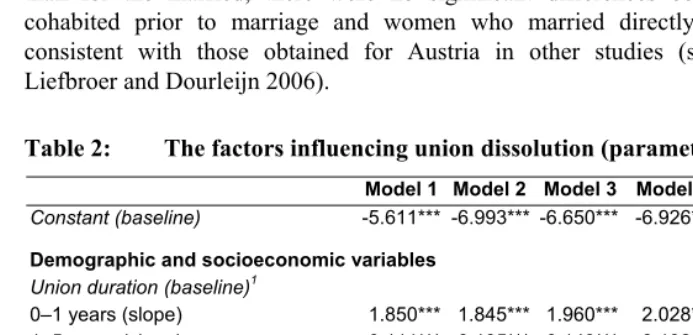
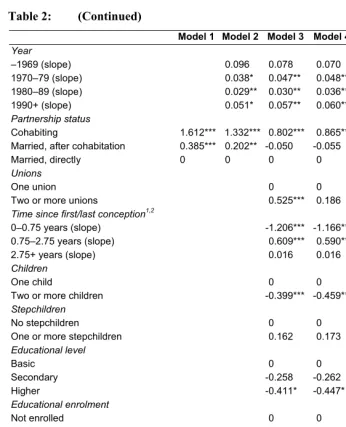
Table 2 provides the results for six models, which become increasingly complex. In Model 1 we considered the effect of partnership status on union dissolution, controlling only for the duration of the relationship and the age of the woman. Cohabiters were most likely to separate and those who cohabited prior to marriage were significantly more likely to separate than those who married directly. In Model 2 we also controlled for calendar time. The differences in the risk of union dissolution between various groups diminished, suggesting that cohabitants and those who cohabited prior to marriage are over-represented in more recent years, when the risk of union dissolution is higher than in earlier years (for various reasons). Still, the levels of divorce remained significantly higher for those who cohabited prior to marriage compared to those who married directly (the results of the likelihood ratio test to measure the improvement in the model fit are presented at the bottom of Table 2). Next we also included (other) demographic and socioeconomic characteristics in the model (Model 3). The differences in the dissolution levels decreased further between various groups of women. While the risk of union dissolution was still considerably higher for cohabiters than for the married, there were no significant differences between women who cohabited prior to marriage and women who married directly. The results were consistent with those obtained for Austria in other studies (see Kiernan 2002b; Liefbroer and Dourleijn 2006).
Table 2: The factors influencing union dissolution (parameter estimates)
Model 1 Model 2 Model 3 Model 4 Model 5 Model 6
Constant (baseline) -5.611*** -6.993*** -6.650*** -6.926*** -7.010*** -7.024***
Demographic and socioeconomic variables
Union duration (baseline)1
0–1 years (slope) 1.850*** 1.845*** 1.960*** 2.028*** 2.025*** 2.012*** 1–5 years (slope) 0.111*** 0.105*** 0.149*** 0.192*** 0.189*** 0.179*** 5–10 years (slope) 0.040 0.034 0.051 0.075** 0.070* 0.069* 10+ years (slope) -0.002 -0.010 0.000 0.014 0.012 0.013
Age
Table 2: (Continued)
Model 1 Model 2 Model 3 Model 4 Model 5 Model 6
Year
–1969 (slope) 0.096 0.078 0.070 0.075 0.081 1970–79 (slope) 0.038* 0.047** 0.048** 0.054** 0.057** 1980–89 (slope) 0.029** 0.030** 0.036** 0.044*** 0.046*** 1990+ (slope) 0.051* 0.057** 0.060** 0.066** 0.068**
Partnership status
Cohabiting 1.612*** 1.332*** 0.802*** 0.865*** 0.514*** 0.354* Married, after cohabitation 0.385*** 0.202** -0.050 -0.055 -0.419** -0.373*
Married, directly 0 0 0 0 0 0
Unions
One union 0 0 0 0
Two or more unions 0.525*** 0.186 0.092 0.009
Time since first/last conception1,2
0–0.75 years (slope) -1.206*** -1.166*** -1.150*** -1.195*** 0.75–2.75 years (slope) 0.609*** 0.590*** 0.583*** 0.589*** 2.75+ years (slope) 0.016 0.016 0.016 0.018
Children
One child 0 0 0 0
Two or more children -0.399*** -0.459*** -0.479*** -0.467***
Stepchildren
No stepchildren 0 0 0 0
One or more stepchildren 0.162 0.173 0.160 0.184
Educational level
Basic 0 0 0 0
Secondary -0.258 -0.262 -0.260 -0.245
Higher -0.411* -0.447* -0.440* -0.456*
Educational enrolment
Not enrolled 0 0 0 0
Enrolled 0.236 0.238 0.237 0.242
Religiousness3
No 0 0 0 0
Yes -0.333*** -0.392*** -0.444*** -0.474***
Parental home
Parental divorce
No 0 0 0 0
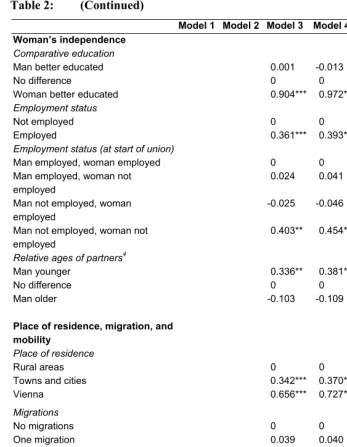
Table 2: (Continued)
Model 1 Model 2 Model 3 Model 4 Model 5 Model 6 Woman’s independence
Comparative education
Man better educated 0.001 -0.013 -0.014 -0.019
No difference 0 0 0 0
Woman better educated 0.904*** 0.972*** 0.983*** 0.989***
Employment status
Not employed 0 0 0 0
Employed 0.361*** 0.393*** 0.405*** 0.399***
Employment status (at start of union)
Man employed, woman employed 0 0 0 0 Man employed, woman not
employed
0.024 0.041 0.035 0.040
Man not employed, woman employed
-0.025 -0.046 -0.038 -0.019
Man not employed, woman not employed
0.403** 0.454** 0.451** 0.477***
Relative ages of partners4
Man younger 0.336** 0.381** 0.387** 0.388**
No difference 0 0 0 0
Man older -0.103 -0.109 -0.101 -0.108
Place of residence, migration, and mobility
Place of residence
Rural areas 0 0 0 0
Towns and cities 0.342*** 0.370*** 0.402*** 0.411*** Vienna 0.656*** 0.727*** 0.777*** 0.794***
Migrations
No migrations 0 0 0 0
One migration 0.039 0.040 0.067 0.049
Frequency of migrations
One migration 0 0 0 0
Two or more migrations 0.933*** 1.006*** 1.013*** 1.018***
Residential moves
No moves 0 0 0 0
One move -0.252*** -0.265*** -0.267*** -0.279***
Frequency of residential moves
One move 0 0 0 0
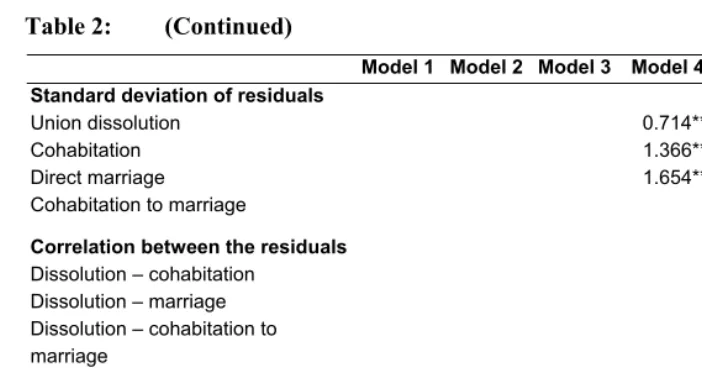
Table 2: (Continued)
Model 1 Model 2 Model 3 Model 4 Model 5 Model 6 Standard deviation of residuals
Union dissolution 0.714*** 0.790*** 0.856***
Cohabitation 1.366*** 1.553*** 1.551***
Direct marriage 1.654*** 1.776*** 1.782***
Cohabitation to marriage 0.696***
Correlation between the residuals
Dissolution – cohabitation 0.225* 0.229* Dissolution – marriage -0.132 -0.125 Dissolution – cohabitation to
marriage
-0.464**
Cohabitation – marriage 0.767*** 0.765*** Cohabitation – cohabitation to
marriage
-0.119
Marriage – cohabitation to marriage -0.270*
Significance: * = 10%; ** = 5%; *** = 1%.
1 For linear splines we present slope estimates that show how the hazard increases or decreases over a certain time period. For
example, during pregnancy (see time since conception) the log-risk of dissolution changes by -1.195 per year (Model 6), reaching a level of -0.896 (0.75×(-1.195)) by the time of birth. In relative terms, the risk is then 59% lower than prior to conception ((exp(-0.896)-1)×100%). The log-hazard of union dissolution increases 0.589 per year during the first two years of the child’s life, reaching a level of 0.282 (-0.896+(0.589×(2.75-0.75))) when the child is two, which is a 33% higher risk than prior to conception ((exp(0.282)-1)×100%).
2 The reference category for the first conception is parity zero.
3 Women were asked whether they were religious or not. Those women who answered “certainly yes” or “rather yes” were defined as
religious.
4 The age difference was defined to be present when one of the partners was older/younger than the other by more than one year.
Notes: Likelihood ratio test statistic (LR)
Model 2 versus Model 1: LR = 40.5, df = 4, p < 0.001; Model 3 versus Model 2: LR = 343.1, df = 25, p < 0.001; Model 4 versus Model 3: LR = 271.7, df = 3, p < 0.001; Model 5 versus Model 4: LR = 112.5, df = 3, p < 0.001; Model 6 versus Model 5: LR = 16.5, df = 4, p < 0.01; the likelihood of simultaneous-equations models was compared to a sum of the likelihoods of models for union dissolution and those for union formation. As our research focus is on union dissolution, we have not reported the parameter estimates for the union-formation equations (except for the standard deviation of the women-level residuals and the correlation between them).
In Model 4, we included a person-level heterogeneity term. The standard deviation of the person-level residuals was significantly different from zero (0.714), indicating that there were women-specific unmeasured characteristics that affected all unions. Controlling for woman-level unobserved heterogeneity removed initial differences in the dissolution risk between first and higher order unions, as expected, but had no significant effect on the coefficients for premarital cohabitation. We extended the analysis in Model 5 by fitting a simultaneous-equations model that included the equation for union dissolution, as fitted in Model 4, and equations of the risk of marriage and cohabitation for single and separated people (but excluded an equation for the hazard of marriage for cohabiters). This allowed us to test whether women with above-average risk of union dissolution were also more likely to cohabit before marriage and whether women who were less prone to union disruption tended to marry without prior cohabitation. Each equation included person-specific residuals and the correlations between them are reported at the end of Model 5. The significant positive correlation between the residuals from the cohabitation and dissolution equations (0.225) indicates that women who cohabited had unobserved characteristics that increased the risk of union dissolution, whereas the negative correlation (although not significant) between marriage and dissolution (-0.132) suggests that women who married directly had unobserved characteristics that decreased the risk of union dissolution. Once unobserved selection effects were accounted for women who cohabited prior to marriage had a significantly lower risk of union dissolution than women who married directly.
confidence interval around this estimate was between 5% and 50% lower risk of union dissolution.4
Lillard, Brien, and Waite (1995) showed how important it is to control for selection effects when considering premarital cohabitation effects on union dissolution. Our results confirm this, but are even more dramatic than those presented by Lillard, Brien, and Waite (1995). In their study a higher risk of premarital cohabitation ceased once selection effects were accounted for. In this study the higher risk of premarital cohabitation switched to a lower risk once observed and unobserved selection effects were accounted for – premarital cohabitation actually decreased the risk of marital separation.
Our analysis of selection effects revealed how unobserved selection into marriage operated through cohabitation. Women with above-average risk of separation selected themselves into cohabitation; among cohabiters, women with lower risks of separation were more likely to marry. However, the latter were still more prone to divorce than those women who married directly. Another interesting issue is the effect of cohabitation, which decreased significantly across the models, particularly after having controlled for unobserved selection effects. Although cohabiters had a higher risk of union dissolution than those who were married, observed characteristics and unobserved selection effects accounted for many of the initial differences in the risk of union disruption between women who cohabited and those who were married.
6. Discussion
The aim of our research was to examine whether premarital cohabitation influences subsequent marital dissolution, controlling for measured characteristics of women and their partners and unmeasured selection effects. We used data from Austria. Our initial analysis showed that those who cohabited prior to marriage had a higher risk of marital dissolution. However, once observed characteristics of women and unobserved selection effects were properly controlled for, the risks of marital dissolution for those who cohabited prior to marriage were significantly lower than for those who married directly. Premarital cohabitation – net of self-selection – actually decreased the risk of separation. Thus it would appear that the “trial marriage” theory may indeed be relevant, with premarital cohabitation providing information that allows for a more
4 In further analyses we excluded the variables on fertility and residential changes, which were potentially
precise estimate of the match quality with the prospective spouse. As a consequence, marriages that involve prior cohabitation are more stable than direct marriages.
The study thus supported the notion of “trial marriage”. The results are similar to those of Brüderl, Diekmann, and Engelhardt (1997) in West Germany and Svarer (2004) in Denmark; in both studies unobserved selection effects were explicitly addressed. In Lillard, Brien, and Waite’s (1995) study in the US a higher risk of premarital cohabitation disappeared once selection effects were accounted for. Furthermore, the risks of marital dissolution for those who cohabited prior to marriage were lower than for those who married directly. However, the differences between the two groups were not significant. One reason for some differences between the studies might be that the effect of premarital cohabitation – net of selection effects – varies across countries. Other explanations might be related to modelling strategies. While Lillard, Brien, and Waite (1995) controlled for unmeasured selection into premarital cohabitation among those who were married, we explicitly modelled all partnership transitions of women and corresponding selection effects. We used hazard regression in our study of partnership-formation processes in order to exploit all the information that was available, particularly the time-varying covariates. The aim was to identify unobservables, having controlled properly for the observed variables. Our strategy might provide a better measurement of selection effects. Nevertheless, the results from these four studies demonstrate the importance of explicitly addressing unobserved selectivity into cohabitation and marriage when considering the effect of premarital cohabitation on marital dissolution.
strong selection effects exist in a population where some cohabit prior to marriage and some marry directly.
Another interesting line of investigation is the effect of premarital cohabitation on subsequent marital separation by union order (cf. Kiernan 1999; Reinhold 2010). Our further analysis suggested that premarital cohabitation – net of self-selection –
decreased the risk of separation for both first and higher order unions. Again, the data set was too small for a detailed analysis. Finally, the essence of selection effects needs further clarification. Being “disruption-prone” may simply mean being more liberal than others, but it may also reflect some unmeasured personality traits. In further analysis we included a variable measuring how liberal or conservative a woman is. To construct the variable, we used several questions on opinions and values, and once included in the model with other observed characteristics women who cohabited prior to marriage had a lower risk of union dissolution than those who married directly (although the differences were not significant). However, as this “values” variable was measured at the time of the survey, it is endogenous in the union-dissolution equation; the experience of divorce by a woman might have shaped or even determined her values and opinions at the time of the survey or there might have been other unmeasured characteristics that shaped both her values and her risk of union dissolution.
Finally, our study shows that there are significant geographical variations in union dissolution within Austria. Separation rates were highest in the capital city, Vienna, and lowest in the rural areas. Given that we controlled for a range of observed and unobserved individual characteristics in our models, these results provide convincing support that residential context also influences the risk of union dissolution. Significant differences in union dissolution by place of residence would need more attention in the field of divorce studies (cf. Kulu and Boyle 2009).
7. Acknowledgements
References
Amato, P.R. (1996). Explaining the intergenerational transmission of divorce. Journal of Marriage and the Family 58(3): 628–640. doi:10.2307/353723.
Amato, P.R. (2010). Research on divorce: Continuing trends and new developments.
Journal of Marriage and the Family 72(3): 650–666. doi:10.1111/j.1741-3737.2010.00723.x.
Andersson, G. (2003). Dissolution of unions in Europe: A comparative overview. Rostock: Max Planck Institute for Demographic Research (MPIDR working paper; WP-2003-004).
Axinn, W.G. and Barber, J.S. (1997). Living arrangement and family formation attitudes in early adulthood. Journal of Marriage and the Family 59(3): 595– 611. doi:10.2307/353948.
Axinn, W.G. and Thornton, A. (1992). The relationship between cohabitation and divorce: Selectivity or causality? Demography 29(3): 357–374.
doi:10.2307/2061823.
Balakrishnan, T.R., Rao, K.V., LaPierre-Adamcyk, E., and Krotki, K.J. (1987). A hazard model analysis of the covariates of marriage dissolution in Canada.
Demography 24(3): 395–406. doi:10.2307/2061305.
Becker, G.S. (1981). A treatise on the family. Cambridge: Harvard University Press. Bennett, N., Blanc, A., and Bloom, D. (1988). Commitment and the modern union:
Assessing the link between premarital cohabitation and subsequent marital stability. American Sociological Review 53(1): 127–138. doi:10.2307/2095738.
Berrington, A. and Diamond, I. (1999). Marital dissolution among the 1958 British birth cohort: The role of cohabitation. Population Studies 53(1): 19–38.
doi:10.1080/00324720308066.
Blossfeld, H.-P. and Rohwer, G. (1995). Techniques of event history modeling: New approaches to causal analysis. Mahwah: Lawrence Erlbaum Associates.
Boyle, P.J., Kulu, H., Cooke, T., Gayle, V., and Mulder, C.H. (2008). The effect of moving on union dissolution. Demography 45(1): 209–222.
doi:10.1353/dem.2008.0000.
Bracher, M., Santow, G., Morgan, S.P., and Trussel, J. (1993). Marriage dissolution in Australia: Models and explanations. Population Studies 47(3): 403–425.
Brown, S.L. and Booth, A. (1996). Cohabitation versus marriage: A comparison of relationship quality. Journal of Marriage and the Family 58(3): 668–678.
doi:10.2307/353727.
Brown, S.L., Sanchez, L.A., Nock, S.L., and Wright, J.D. (2006). Links between premarital cohabitation and subsequent marital quality, stability, and divorce: A comparison of covenant versus standard marriage. Social Science Research
35(2): 454–470. doi:10.1016/j.ssresearch.2006.03.001.
Brüderl, J., Diekmann, A., and Engelhardt, H. (1997). Premarital cohabitation and marital stability in West Germany. Kölner Zeitschrift für Soziologie und Sozialpsychologie 49: 205–222.
Bumpass, L.L., Sweet, J.A., and Cherlin, A. (1991). The role of cohabitation in declining rates of marriage. Journal of Marriage and the Family 53(4): 913–927.
doi:10.2307/352997.
Carlson, E. (1986). Couples without children: Premarital cohabitation in France. In: Davis, K. and Grossbard-Schechtman, A. (eds.). Contemporary marriage: Comparative perspectives of a changing institution. New York: Russell Sage Foundation: 113–129.
Chan, T.W. and Halpin, B. (2003). Union dissolution in the United Kingdom.
International Journal of Sociology 32(4): 76–93.
Cherlin, A. (1981). Marriage, divorce, remarriage. Cambridge: Harvard University Press.
Clarkberg, M.E., Stolzenberg, R.M., and Waite, L.J. (1995). Attitudes, values, and entrance into cohabitational versus marital unions. Social Forces 74(2): 609– 632. doi:10.2307/2580494.
Davies, H. and Joshi, H. (1998). Gender and income inequality in the UK 1968–1990: The feminization of earnings or of poverty? Journal of the Royal Statistical Society A 161(1): 33–61. doi:10.1111/1467-985X.00089.
DeMaris, A. and Leslie, G.R. (1984). Cohabitation with future spouse: Its influence upon marital satisfaction and communication. Journal of Marriage and the Family 46(1): 77–84. doi:10.2307/351866.
Dush, C.M.K., Cohan, C.L., and Amato, P.R. (2003). The relationship between cohabitation and marital quality and stability: Change across cohorts? Journal of Marriage and the Family 65(3): 539–549. doi:10.1111/j.1741-3737.2003.00539.x.
Erlangsen, A. and Andersson, G. (2001). The impact of children on divorce risks in first and later marriages. Rostock: Max Planck Institute for Demographic Research (MPIDR working paper; WP-2001-033).
Ermisch, J. and Francesconi, M. (2000). Cohabitation in Great Britain: Not for long, but here to stay. Journal of the Royal Statistical Society A 163(2): 153–171.
doi:10.1111/1467-985X.00163.
Forste, R. and Tanfer, K. (1996). Sexual exclusivity among dating, cohabiting, and married women. Journal of Marriage and the Family 58(1): 33–47.
doi:10.2307/353375.
Gabrielli, G. and Hoem, J.M. (2010). Italy’s non-negligible cohabitational unions. European Journal of Population26(1): 33–46. doi:10.1007/s10680-009-9193-y.
Hall, D.R. (1996). Marriage as a pure relationship: Exploring the link between premarital cohabitation and divorce in Canada. Journal of Comparative Family Studies 27: 1–12.
Hall, D.R. and Zhao, J.Z. (1995). Cohabitation and divorce in Canada: Testing the selectivity hypothesis. Journal of Marriage and the Family 57(2): 421–427.
doi:10.2307/353695.
Härkönen, J. and Dronkers, J. (2006). Stability and change in the educational gradient of divorce: A comparison of seventeen countries. European Sociological Review
22(5): 501–517. doi:10.1093/esr/jcl011.
Haskey, J. (1992). Premarital cohabitation and the probability of subsequent divorce: Analyses using new data from the General Household Survey. Population Trends 68: 10–19.
Hoem, B. and Hoem, J.M. (1992). The disruption of marital and non-marital unions in contemporary Sweden. In: Trussel, J., Hankinson, R., and Tilton, J. (eds.).
Demographic applications of event history analysis. Oxford: Clarendon Press: 61–93.
Hoem, J.M. (1987). Statistical analysis of a multiplicative model and its application to the standardization of vital rates: A review. International Statistical Review
Hoem, J.M. (1993). Classical demographic models of analysis and modern event-history techniques. In: IUSSP: 22nd International Population Conference.
Montreal, Canada: 281–291. (Volume 3).
Hoem, J.M. (1997a). Educational gradients in divorce risks in Sweden in recent decades. Population Studies 51(1): 19–27. doi:10.1080/0032472031000149696.
Hoem, J.M. (1997b). The impact of the first child on family stability. Stockholm: Stockholm University, Demography Unit (Stockholm Research Reports in Demography 119).
Hoem, J.M., Kostova, D., Jasilioniene, A., and Muresan, C. (2009). Traces of the Second Demographic Transition in four selected countries in Central and Eastern
Europe: Union formation as a demographic manifestation. European Journal of
Population 25(3): 239–255. doi:10.1007/s10680-009-9177-y.
Hoem, J.M., Prskawetz, A., and Neyer, G. (2001). Autonomy or conservative adjustment? The effect of public policies and educational attainment on third births in Austria, 1975-96. Population Studies 55(3): 249–261.
doi:10.1080/00324720127700.
Kalmijn, M., de Graaf, P.M., and Janssen, J.P.G. (2005). Intermarriage and the risk of divorce in the Netherlands: The effects of differences in religion and in nationality, 1974–94. Population Studies 59(1): 71–85.
doi:10.1080/0032472052000332719.
Kalmijn, M., de Graaf, P.M., and Poortman, A.R. (2004). Interactions between cultural and economic determinants of divorce in the Netherlands. Journal of Marriage and the Family 66(1): 75–89. doi:10.1111/j.1741-3737.2004.00006.x.
Kiernan, K. (1986). Teenage marriage and marital breakdown: A longitudinal study.
Population Studies 40(1): 35–54. doi:10.1080/0032472031000141826.
Kiernan, K. (1999). Cohabitation in Western Europe. Population Trends 96: 25–32. Kiernan, K. (2002a). Cohabitation in Western Europe: Trends, issues, and implications.
In: Booth, A. and Crouter, A. (eds.). Just living together: Implications of cohabitation on families, children, and social policy. Mahwah: Erlbaum: 3–32. Kiernan, K. (2002b). The state of European Unions: An analysis of FFS data on
partnership formation and dissolution. In: Macura, M. and Beets, G. (eds.).
Klijzing, E. (1992). Weeding in the Netherlands: First-union disruption among men and women born between 1928 and 1965. European Sociological Review 8(1): 53– 70.
Kline, G.H., Stanley, S.M., Markman, H.J., Olmos-Gallo, P.A., St Peters, M., Whitton, S.W., and Prado, L.M. (2004). Timing is everything: Pre-engagement cohabitation and increased risk for poor marital outcomes. Journal of Family Psychology 18(2): 311–318. doi:10.1037/0893-3200.18.2.311.
Kulu, H. (2005). Migration and fertility: Competing hypotheses re-examined. European Journal of Population 21(1): 51–87. doi:10.1007/s10680-005-3581-8.
Kulu, H. (2006). Fertility of internal migrants: Comparison between Austria and Poland. Population, Space and Place 12(3): 147–170. doi:10.1002/psp.406.
Kulu, H. and Boyle, P.J. (2009). High fertility in city suburbs: Compositional or contextual effects? European Journal of Population 25(2): 157–174.
doi:10.1007/s10680-008-9163-9.
Liefbroer, A.C. and Dourleijn, E. (2006). Unmarried cohabitation and union stability: Testing the role of diffusion using data from 16 European countries.
Demography 43(2): 203–221. doi:10.1353/dem.2006.0018.
Lillard, L.A., Brien, M.J., and Waite, L.J. (1995). Premarital cohabitation and subsequent marital dissolution: A matter of self-selection? Demography 32(3): 437–457. doi:10.2307/2061690.
Lillard, L.A. and Panis, C.W.A. (2003). aML: Multilevel multiprocess statistical software, version 2.0. Los Angeles: EconWare.
Lye, D.N. and Biblarz, T.J. (1993). The effects of attitudes toward family life and gender roles on marital satisfaction. Journal of Family Issues 14(2): 157–188.
doi:10.1177/019251393014002002.
Lye, D.N. and Waldron, I. (1997). Attitudes toward cohabitation, family, and gender roles: Relationships to values and political ideology. Sociological Perspectives
40(2): 199–225.
Lyngstad, T. and Jalovaara, M. (2010). A review of the antecedents of union dissolution. Demographic Research 23(10): 257–292. doi:10.4054/ DemRes.2010.23.10.
and cohabitors. Journal of Marriage and the Family 60(1): 41–55.
doi:10.2307/353440.
Manting, D. (1992). The break-up of unions: The role of cohabitation. Amsterdam: University of Amsterdam (PDOD working paper no. 11).
Morgan, S.P. and Rindfuss, R.R. (1985). Marital disruption: Structural and temporal dimensions. American Journal of Sociology 90(5): 1055–1077.
doi:10.1086/228176.
Muszynska, M. and Kulu, H. (2007). Migration and union dissolution in a changing socio-economic context: The case of Russia. Demographic Research 17(27): 803–820. doi:10.4054/DemRes.2007.17.27.
Neyer, G.R. (2003). Family change and family policy in Europe after 1945: Austria. In: Flora, P. and Bahle, T. (eds.). Family change and family policies in Europe. Oxford: Oxford University Press.
O’Connor, T.G., Pickering, K., Dunn, J., and Golding, J. (1999). Frequency and predictors of relationship dissolution in a community sample in England.
Journal of Family Psychology 13(3): 436–449. doi:10.1037/0893-3200.13.3.436.
Reinhold, S. (2010). Reassessing the link between premarital cohabitation and marital instability. Demography 47(3): 719–733. doi:10.1353/dem.0.0122.
Schoen, R. (1992). First unions and the stability of first marriages. Journal of Marriage and the Family 54(2): 281–284. doi:10.2307/353059.
Smock, P.J. (2000). Cohabitation in the United States: An appraisal of research themes, findings, and implications. Annual Review of Sociology 26: 1–20.
doi:10.1146/annurev.soc.26.1.1.
Stanley, S.M. and Markman, H.J. (1992). Assessing commitment in personal relationships. Journal of Marriage and the Family 54(3): 595–608.
doi:10.2307/353245.
Stanley, S.M., Whitton, S.W., and Markman, H.J. (2004). Maybe I do: Interpersonal commitment and premarital or nonmarital cohabitation. Journal of Family Issues
25(4): 496–519. doi:10.1177/0192513X03257797.
Steele, F., Kallis, C., and Joshi, H. (2006). The formation and outcomes of cohabiting and marital partnerships in early adulthood: The role of previous partnership experience. Journal of the Royal Statistical Society A 169(4): 757–779.
Svarer, M. (2004). Is your love in vain? Another look at premarital cohabitation and divorce. Journal of Human Resources 39(2): 523–535. doi:10.2307/3559025.
Teachman, J.D. and Polonko, K.A. (1990). Cohabitation and marital stability in the United States. Social Forces 69(1): 207–220. doi:10.2307/2579614.
Teachman, J.D., Thomas, J., and Paasch, K. (1991). Legal status and the stability of coresidential unions. Demography 28(4): 571–586. doi:10.2307/2061423.
Thomson, E. and Colella, U. (1992). Cohabitation and marital stability: Quality or commitment? Journal of Marriage and the Family 54(2): 259–267.
doi:10.2307/353057.
Thornton, A. and Philipov, D. (2009). Sweeping changes in marriage, cohabitation and childbearing in Central and Eastern Europe: New insights from the developmental idealism framework. European Journal of Population 25(2):
123–156. doi:10.1007/s10680-009-9181-2.
Trussell, J., Rao, R.K., and White, J.M. (1989). Premarital cohabitation and marital stability: A reassessment of the Canadian evidence: Feedback. Journal of Marriage and the Family 51(2): 535–544. doi:10.2307/352514.
Trussell, J., Rodríguez, G., and Vaughan, B. (1992). Union dissolution in Sweden. In: Trussell, J., Hankinson, R., and Tilton, J. (eds.). Demographic applications of event history analysis. Oxford: Clarendon Press: 38–60.
Tzeng, J.M. and Mare, R.D. (1995). Labor market and socioeconomic effects on marital stability. Social Science Research 24(4): 329–351. doi:10.1006/ssre.1995.1013.
Wagner, M. and Weiss, B. (2004). On the variation of divorce risks in Europe: A meta-analysis. Paper presented at the Third Conference of the European Research Network on Divorce, Cologne: University of Cologne, December 2–4, 2004. Waite, L.J. and Lillard, L.A. (1991). Children and marital disruption. American Journal
of Sociology 96(4): 930–953. doi:10.1086/229613.
Woods, L.N. and Emery, R.E. (2002). The cohabitation effect on divorce: causation or selection? Journal of Divorce and Remarriage 37(3/4): 101-122.