Scuba divers’ household behavior to reduce plastic and
food waste
Mota, Luis
University of Santiago Compostela, Spain ([email protected])
Received: 6 January 2015 Revised: 18 January 2015 Accepted: 4 February 2015
Available Online: 25 February 2015 DOI: 10.5861/ijrsp.2015.1056
ISSN: 2243-7681 Online ISSN: 2243-769X
OPEN ACCESS
Abstract
The attempt to study if scuba produces positive pro-environmental behaviour, used the theory
of planned behaviour to build a new model to observe variables capable to explain possible
reduction of plastic and food waste in the household. Previous studies have recognised
subjective norms as giving little contribution to recycling process and waste prevention
control; as a consequence the proposed model excludes such variable, but introduces scuba
diving, awareness and demographic variables to register different behaviours adopted by
divers and non-divers. A questionnaire was developed to assess 181 US divers regarding their
household practices for plastic and food waste production, and two-step cluster analysis was
used to observe how variables can relate to each other. Although clusters containing values for
environmental awareness, attitude toward the behaviour and perceived behaviour control can
be used as important combination to predict for pro-environmental behaviour, the fact of
being a certified scuba diver is not significant for environmental behavioural. However, it
definitely plays an important role in raising awareness of and observing the impacts on the
reef. Thus, scuba diving is only characterized as a good vehicle for promoting good
environmental practices, motivating people to rethink their attitudes toward their behaviour in
the household.
Scuba divers’ household behavior to reduce plastic and food waste
1. Introduction
After the Second World War people started traveling more often and further afield, making a contribution to tourism growth and at the beginning of the 21st century tourists started seeking out low-impact sports tourism 'adventures' in water environments, with these adventures eventually becoming niche tourism. Engaging in such niche tourism activities sometimes requires expensive equipment for comfort, enjoyment and easy use. “Gender, ability, ethnicity, socio-economic, and cultural background were substantive limiting actors along with social, religious, and political influences” (Jennings, 2007, p. 1).
Scuba diving became more popular and more widely available at the destinations suitable for the activity. Tourism Queensland (2003) estimated there were 5 to 7 million active divers in the world, with 2.5 million in the U.S., approximately 100,000 in the UK contributes, and 34,600 in Australia. Depondt and Green (2006) conducted a study in South-East Asia and Francophone countries of the Indian and Pacific Oceans, calculating annual totals of 107,320 and 69,150 divers, respectively. Tourism Queensland (as cited in Jennings, 2007) stated that diving tourism takes place when individuals travel to a destination where at least one scuba dive is included.
Global tourism takes divers to coastal areas of the United States, Australia, Japan, the Red Sea, the Maldives, the Seychelles and the Philippines (Davis, Harriot, & MacNamara, 1995). The Caribbean Sea, Pacific coast of South Africa, Pacific Islands, Papua New Guinea, Palau (Vianna, Meekan, & Pannell, 2010), and other destinations in Asia are also areas of biodiversity and therefore diving grounds (Musa, 2003). According to Graham (2004), whale shark watching (Rinchodon typus) was estimated to have generated 47.5 million USD worldwide. In South Africa, Hara, Maharaj, and Pithers (2003) estimated the annual revenue from cage diving with great white sharks (Carcharodon carcharias) to be around 4.1 million USD and with tiger sharks (Galeocerdo cuvier) around 1.8 million USD in 2007 (Dicken & Hosking, 2009). According to studies carried out by DEMA (2012) for the Caribbean coral reefs including Florida, recreational scuba diving has generated around 2.1 billion USD, from of 4.56 million visitor-days per year. Diving is also responsible for 26,000 full-time jobs related to the activity, and in 2009 Florida took in around 20 million USD from locals taking diving courses, purchasing equipment and utilizing services related to scuba diving.
Divers were studied for their behaviors while attending a conservation education program to develop 'ownership and stewardship' towards the marine protected area held at the Flower Garden Banks National Marine Sanctuary in the USA. Divers were aged 18 to 65 years old, of which 70% were male and 30% female (Belknap, 2008), and as new tourism destinations opened up, offering more adventurous and exotic activities, greater numbers of women started to go scuba diving and according to Musa, Kadir, and Lee (2006) were 'balancing the scale' as already 53.1% of divers in Layang Layang, Malaysia were women.
Zhong, Deng, and Song (2011) described direct relations between tourism activity, local society and the use of natural resources, pointing out both positive and negative aspects of progress. Since 1978, when China opened its borders for tourism development, tourism has grown substantially but has caused considerable environmental problems. Considerable impacts occurred in the biophysical environment, affecting the water quality grade by increasing the volume of wastewater and garbage produced.
identity mediates relations between place dependence and general self-reported pro-environment behavior. Moreover, Fishbein and Ajzen (1975) and Kraus (1995) stated that behavioral intentions were proven to be indicators of future behavior. To target environmental behavior (Stern, Dietz, & Abel, 1999; Vaske & Donnelly, 1999; Vaske & Kobrin, 2001), there are programs for environmental education for adults, which are largely under-researched and under-theorized (Dillon, as cited in Walter, 2009). “Learning grounds such museums, science centers, zoos, botanical gardens, visitor centers and nature activities are the most usual sites outside school” (Falk, 2005, p. 2).
This paper aims to study behaviors noted for scuba divers in regards to environmental practices in the household by targeting plastic and food discards. The fact of spending time submersed in water exploring the beauty of the subaquatic world and observing how fragile the environment is, raises some questions about divers’ commitment to reducing their ecological impact. People go scuba diving to benefit from close encounters with marine life, but are there any differences between certified and non-certified divers regarding plastic and food waste disposal?
The approach used by Bortoleto, Kurisu, and Hanaki (2012) to study waste prevention behavior to understand and assist “more-effective policies for reducing the amount of waste that is generated” (p.2195) explains the second objective of this paper which is focused on the need to be aware of which of the variables used in the proposed model are important to predict pro-environmental behavior for reducing the use of plastic and food waste.
2. Modeling divers’ pro-environmental behavior based on Ajzen’s theory of planned behaviour (TPB) Schwab, Harton, and Cullum (2014) used the theory of reasoned action (TRA) from Ajzen and Fishbein (1980) to study attitudes and perceptions for recycling in four residence halls at the University of Northern Iowa during different periods of a semester. Attitudes and fellow group member behavior are best predictors for recycling, and subjective norms, predicted behavior, and contestant do not contribute for similar fellow friends' attitudes and behavior over time, moreover, subjective norms did not show to be relevant for his study. When compared average American and African households, Diamond (2005) pointed differences in Africa as 32 times smaller regarding consumption of goods and waste disposal. Patterns are directly related to long-term impacts on the environment and as per Mckinney, Schoch, and Yoanvjak (2007), recycling practices could reduce Americans' impact, having 'attitude' as good predictive variable when targeting recycling behavior (Schwab et al., 2014).
The use of technology for waste management benefits civilization and is aimed at providing healthier conditions in the local living geographic area; however, the capacity to respond to such impact sometimes is not achieved by the natural surroundings. Daily waste production demands a convenient mode of regulation and active participation from the population (Bortoleto, Kurisu, & Hanaki, 2012), and studying the reasons why citizens participate (or not) in such practices for waste management (for example, waste prevention, garbage separation, recycling, littering, etc.) has led scientists to use theoretical models for understanding such behavior. Waste management requires regular disposal practices which can be affected by external factors like outside temperature (Olsen, 1981) and residence characteristics (Oskamp, Harrington, & Edwards, 1991) besides can be also conditioned by environmental policies to facilitate reducing waste by imposing a fee for waste disposal (Kaiser, Wolfing, & Fuhrer, 1999).
Fishbein and Ajzen (1975) found a great number of definitions for attitude, for example, they mentioned Campbell (1963) and Greenwald (1968), who picked up the particular measurement of most interest for their research, having to try new definitions for attitude. Judgments for attitude were recorded and measured with scales; such an approach was included in statements asking people to measure attitude and behaviors. La Pierre (as cited in Fishbein & Ajzen, 1975) used letters when asking restaurant managers about their behavior regarding accepting Chinese customers in their restaurant. A different approach was taken by Ostrom (as cited in Fishbein & Ajzen, 1975) who used use a 9-point scale to measure three aspects of attitude on religious feelings and beliefs. Festinger and Carlsmith (as cited in Fishbein & Ajzen, 1975) used an 11-point scale, ranging from 'extremely interesting and enjoyable to extremely dull and boring', to rate boring tasks. Fishbein and Ajzen (1975) observed differing attitudes when different measures of 'attitude' were employed.
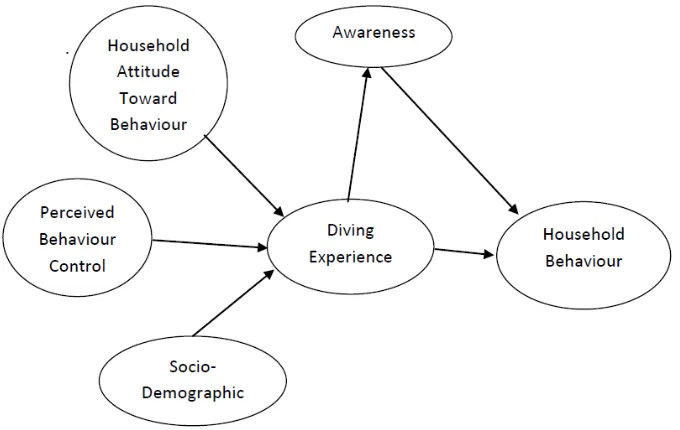
Not all predictors of the TPB are actually important to provide significant statistics (Carrus, Passafaro, & Bonnes, 2008), and the attempt to improve prediction makes researchers associate contextual variables to understand environmental behavior, recognizing for example that convenient location for recycling curbs is important for prediction of good environmental practices. Schwab, Harton, and Cullum (2014) has pointed social norms related with pro-environmental behavior, although more research should be conducted to support understanding the ability to influence on waste prevention behavior (Bortoleto et al., 2012). Hence, the Figure 1 gives the proposed model to study pro-environmental behavior in the divers' household, with 'subjective norms' excluded from the Fishbein's TPB original model, but with scuba diving as variable to distinguish from divers and non-divers, demographic inputs and environmental awareness associated to this form of tourism based activity.
Figure 1. Model to study environmental behavior change in the diver’s household
2.1 Diver’s awareness (AWARE)
2.2 Diver’s household attitude towards the behavior (HATB)
Attitude is commonly accepted as a variable to explain or influence behavior; however, it cannot be measured directly. For example, Sarnoff (1960) defined attitude as “a disposition to react favorably or unfavorably to a class of objects. In addition, Chave (1928) provided a detailed description of the factors that influence a person‘s predisposition: A attitude is a complex of feeling, desires, fears, convictions, prejudices, or other tendencies that have given a set or readiness to act to a person because of varied experiences” (Fishbein & Ajzen, 1975, p. 9).
Whereas attitude reflex divers opinion, either favorable or unfavorable about plastic and food discards, beliefs will represent specific information about the same plastic and food discards. Beliefs link objects to attributes (Kaiser et al., 1999), imagine, the belief of 'using a shopping list' (the object) to 'reduce food waste' (the attribute) or 'not consuming plastic' (the object) to reduce plastic in the household (the attribute). Beliefs about an object sustain specific attitudes toward the same object; adopting good practices for household waste management might be triggered by the belief that doing so makes a positive contribution to the environment. Such an attitude carries the intention to carry out good practices in the household in regard to the environment (Schwab et al., 2014); in this manner environment-related behavior is noted and also leads to new beliefs about the environment.
The variable HATB measures the degree of commitment to which performance of good practices (Mohammad Ali & Samane, 2014) for waste management in the household is positively or negatively valued (López-Mosquera & Sánchez, 2012). The attitude toward behavior is ruled by the person's evaluation of the consequence of his behavior and how using 'the object' influences his decision to behave.
2.3 Diver’s perceived behavior control (PBC)
People perceiving the ability to perform a given behavior and are in control and respond to the new variable perceived behavior control, individuals must be free to decide whether or when to perform a certain behavior. Ajzen's (1991) new theory adds the novelty of achieving behavior through motivation and ability to perform (intention + behavior control), PBC defines confidence and intention to perform a task, the aim of achieving success. A person can sense the difficulty level of the task and when they are committed to completing it, success is achieved through gaining control of the various factors.
Bortoleto et al. (2012) merged the Schwartz‘s altruistic behavior model and the theory of planned behavior for waste prevention, indicating that “personal norms and perceived behavior control are the main predictors and that, unlike the case of recycling, subjective norms have a weak influence on waste prevention behavior; waste prevention behavior is likely to be influenced by concern for the environment and the community, as well by perception of moral obligation and inconvenience” (Bortoleto et al., 2012, p. 2195). The results from Bortoleto‘s research demonstrated the effectiveness and good reliability of the TPB for modelling participation in waste prevention. Five questions were included in the model from Bortoleto‘s model, which describe attitude towards behavior, and one for perceived behavior control.
2.4 Diver’s socio-demographic (DEMO)
2.5 Diver’s household behaviour (BEH)
The behavior of using good practices is a function of suitable and consistent intentions, and also personal perception and ability to perform such practices (Ajzen, 1991). Strong and favorable intentions produce behavior only when perceived behavior control is also strong. Real behavior carries details obtained from variables such as verbal responses or questionnaires, providing observations of the subject. Positive responses will lead to positive behaviors in the household, variable to predict environmental behavior (Kaiser et al., 1999).
3. Materials and Methods
The representative study was based on the Organization for Economic Co-operation and Development's (OECD) last available report. In 2010 the US was cited as the country creating the most municipal solid waste with an annual average of 720 kg per capita (OECD, 2013), and in 2011 the most discarded materials after recycling were food waste and plastic (EPA, 2011). Therefore, the measurement was directed to the U.S. divers visiting a popular diving destination, and observations are related with the use of plastic and food discards in the household. The country was chosen to be Mexico which through the cross-border movement in Mexico, in 2012 could be counted 5,941,914 US citizens visited the country, representing the first nation to visit Mexico (SIOM, 2013), and fieldwork took place on Cozumel Island.
The study compared student divers who have not been exposed to scuba diving before, and also certified divers with particular attention to those taking a course of further education on diving. With student divers, there is the chance they will exhibit similar attributes to certified divers, but will always lack the diving experience and water as stimulus for behavioral change.
3.1 Instrument
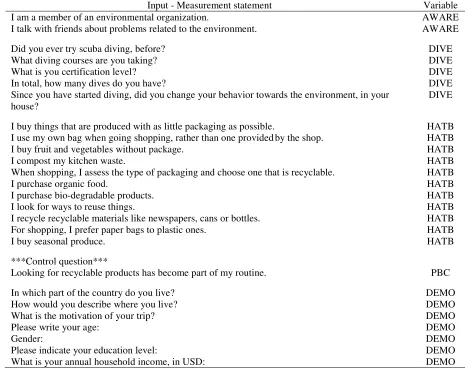
A questionnaire was developed to study behaviors regarding plastic and food discards in the divers’ household using a set of questions for providing input for each variable in the study taken from several scientific documents (see: Kaiser et al., 2003, pp. 15, 16; Bortoleto et al., 2012, pp. 2198, 2199; Rodríguez-Barreiro et al., 2012, p. 8; Gunders, 2012; Miao & Wei, 2013, p. 106), and which reported studies on ecological behaviours, waste prevention, environmental impacts and pro-environmental behavior (See Table 1). For food-discard-related questions, Gunders’s (2012) report proved to be a great reference for searching relevant items, and was used previously by scientists. Kaiser et al. (2003) referred to the vital need for studying pollution levels, and the need to save energy and resources, despite the fact that environmental psychologists had conducted little research on it. This paper contributed with important questions to add to the measurement tool, describing household attitude toward behavior and environmental awareness. Bortoleto et al. (2012) developed a model for household waste prevention, which is suitable for use as a tool for governance and assists in understanding how to reduce waste.
The statements measuring AWARE, HATB, and PBC, are directly related with plastic use and food waste production in the household, being DIVE and DEMO used for correlations with diving experience and potential influence for behavioral change, and socio-demographic aspects. Variables to measure AWARE, DIVE, PBC and DEMO used closed-end and dichotomous questions, but HATB statements use a Likert-type scale (0 – I don’t know; 1 – I never do it; 2 – I do it sometimes; 3- I do it often; 4 – I do it always), arranged from the less favorable to the more favorable answer within a certain rank, and unfavorable answers always tend to occupy the lower rank (Gliem & Gliem, 2003). The developed tool was designed for reaching distinct groups of divers:
Certified divers looking for a diving holiday;
Divers with previous certification, but engaging in further diving education;
Non-certified divers participating in a 'one-day experience' with a diving instructor, which could be a try dive, discover scuba dive or resort dive.
Table 1
List of statements used to predict divers’ household pro-environmental behaviour.
Input - Measurement statement Variable
I am a member of an environmental organization. AWARE
I talk with friends about problems related to the environment. AWARE
Did you ever try scuba diving, before? DIVE
What diving courses are you taking? DIVE
What is you certification level? DIVE
In total, how many dives do you have? DIVE
Since you have started diving, did you change your behavior towards the environment, in your house?
DIVE
I buy things that are produced with as little packaging as possible. HATB I use my own bag when going shopping, rather than one provided by the shop. HATB
I buy fruit and vegetables without package. HATB
I compost my kitchen waste. HATB
When shopping, I assess the type of packaging and choose one that is recyclable. HATB
I purchase organic food. HATB
I purchase bio-degradable products. HATB
I look for ways to reuse things. HATB
I recycle recyclable materials like newspapers, cans or bottles. HATB
For shopping, I prefer paper bags to plastic ones. HATB
I buy seasonal produce. HATB
***Control question***
Looking for recyclable products has become part of my routine. PBC
In which part of the country do you live? DEMO
How would you describe where you live? DEMO
What is the motivation of your trip? DEMO
Please write your age: DEMO
Gender: DEMO
Please indicate your education level: DEMO
What is your annual household income, in USD: DEMO
Source: Adapted from Kaiser et al., 2003; Bortoleto et al., 2012; Rodríguez-Barreiro et al., 2012; Miao & Wei, 2013
The type of variables selected for cluster analysis has a direct influence on the segment target when identified by means, and specific inferred variables tend to form a more homogeneous cluster (Wedel & Kamakura, 2000), although variables that are easy to measure need to be assisted with segments to make divers‘ behavior easy to measure. Having certain socio-demographic profile does not necessarily match with divers behaving more, or less, in favor of reducing debris. Combining different variables (demographic with attitude toward the behavior; diver certification with attitude toward the behavior; or number of dives with divers’ household attitude toward the behavior) gives strength to the model.
3.2 Procedure
From a list of 56 diving schools, data collection took place during 66 days with divers using the services of only 9 professional training schools on the island of Cozumel, Mexico. All schools were invited to participate in the study, but and in many cases, diving operators were not interested in participating in the study, or by company rules, private data such Email addresses, name, or postcode could not be recorded for the study. From the 5th of February until the 7th of April, 2013, the total of 181 surveys were administered to U.S. divers with the minimum of 18 years old as target group, the sample guarantees a statistic with 95% confidence, with 10% sampling error associated from an unknown population size (Bhattacherjee, 2012). Valledor and Carreira (2000) accept such error, fitting the distribution of the population sampled for certified divers and students (non-divers participating in try dives or taking most of the certification courses); both were assessed regarding the variables of the model illustrated in Figure 1.
The set of variables representing AWARE, DIVE, HATB, PBC, and DEMO were entered into IBM SPSS statistic 20 and performed the two-step cluster analysis using the variable statements listed in Table 1, for observing clusters and how they can be related to each other for better prediction of pro-environmental behavior in the divers’ household. To quantify the standardized distance between a participant‘s data points and the parameter 'mean' (Baraldi & Enders, 2010), the log-likelihood method was used as a distance measure, and the Schwarz’s Bayesian Criterion (BIC) was selected for forming clusters. Furthermore, setting the algorithm to handle 25% noise reduced possible outliers.
The number of clusters to be determined automatically was set at a maximum of 4, aside from the combination chosen for field evaluation using the variables ‘What diving courses are you taking’ and ‘What is your certification level’. These variables were not used to form clusters, but the software rated the clusters regarding the evaluation fields.
Being a combination of hierarchical and non-hierarchical methods, the two-step cluster method (Chiu, Fang, & Chen, 2001) allows the use of different types of variables introduced for clustering, as continuous and discrete variables do not require to be represented on a specific type of scale. Scales were analyzed with their original value without conversion for fitting in the model.
4. Results
The study of the variable HATB used a Likert-type scale, which was tested for Cronbach‘s alpha and its internal consistency. In the sample measured for all U.S. divers (n=181) the reliability for the 11 statements representing variable HATB listed in Table 1 was 0.783, suggesting that the statements and respective Likert-type scale are acceptable for measuring the divers’ household attitudes toward behavior.
Sampling U.S divers on Cozumel Island was done by the researcher and the use of 6 drop-boxes placed in the diving schools. From 236 questionnaires, 181 were selected based on the target nationality for the study registering 61.33% of male and 38.67% female divers, all aged 18 to more than 50 years old and with 47.51% motivated to scuba dive. 67.96% of divers have recorded their annual household income of more than 45.000 USD and more than 78% have university studies. Apart from the 5.52% of divers living in highly populated cities, the population in study was well almost evenly distributed among rural, urban and city, but 77.90% living on inland areas.
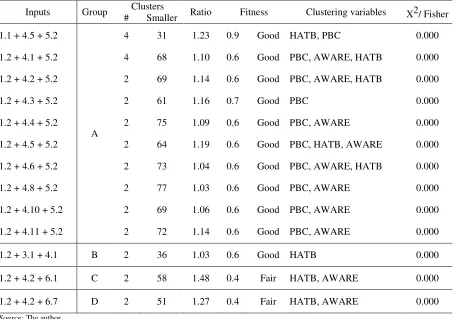
The set of variables representing AWARE, DIVE, HATB, PBC, and DEMO were modelled and created the group A; AWARE, DIVE, and HATB created group B; and AWARE, HATB, and DEMO created group C. Table 2 illustrates the model summary for suitable clusters formed by using the combination of 3 different variables, reaching goodness-of-fit of 0.60-0.90 for group A. The only suitable goodness-of-fit for group B was 0.60, and with 2 sets of variables group C reached 0.40 as fair value. Overall, the smallest cluster has 31 members and the largest 77, with ratio sizes varying between 1.03 and 1.48.
Sarstedt (2011), who recommended using correlations below 0.90 for predicting the importance of the cluster. Furthermore, the rule of thumb set the cluster size to at least 30 members, with a ratio between clusters smaller than 3.0. Thus, the set of variables used to define group A created 2 to 4 clusters, as it was pre-set the maximum number of clusters to be formed. Such arrangement required the minimum of 2 and the maximum of 3 clustering variables, with the exception for the set combining the variable AWARE (1.2 - I talk with friends about problems related to the environment) with HATB (4.3 - I buy fruit and vegetables without package), and PBC (5.2 - Looking for recyclable products has become part of my routine). PBC has high predictor importance and makes part of clusters created in the group, thus, also for predicting household behavior. The variable AWARE makes part of 80% of the clusters formed, and HATB 50%.
The study revealed divers as being associated with environmental organizations, identifying the divers’ beliefs, and also conferring some awareness. Such memberships are quite variable and not necessarily related to scuba diving organizations, but with activities or preferences relating to the diver‘s lifestyle. Supporting activities promoted by environmental organizations was expected to be a determinant for forming clusters, but results demonstrated the opposite (see arrangement 1.1+4.5+5.2 in Table 2), with divers clustered in the same group as participants who do not have memberships with environmental organizations.
Table 2
List of clusters formed to predict divers’ household pro-environmental behaviour.
Inputs Group Clusters Ratio Fitness Clustering variables Χ2/ Fisher # Smaller
1.1 + 4.5 + 5.2
A
4 31 1.23 0.9 Good HATB, PBC 0.000
1.2 + 4.1 + 5.2 4 68 1.10 0.6 Good PBC, AWARE, HATB 0.000
1.2 + 4.2 + 5.2 2 69 1.14 0.6 Good PBC, AWARE, HATB 0.000
1.2 + 4.3 + 5.2 2 61 1.16 0.7 Good PBC 0.000
1.2 + 4.4 + 5.2 2 75 1.09 0.6 Good PBC, AWARE 0.000
1.2 + 4.5 + 5.2 2 64 1.19 0.6 Good PBC, HATB, AWARE 0.000
1.2 + 4.6 + 5.2 2 73 1.04 0.6 Good PBC, AWARE, HATB 0.000
1.2 + 4.8 + 5.2 2 77 1.03 0.6 Good PBC, AWARE 0.000
1.2 + 4.10 + 5.2 2 69 1.06 0.6 Good PBC, AWARE 0.000
1.2 + 4.11 + 5.2 2 72 1.14 0.6 Good PBC, AWARE 0.000
1.2 + 3.1 + 4.1 B 2 36 1.03 0.6 Good HATB 0.000
1.2 + 4.2 + 6.1 C 2 58 1.48 0.4 Fair HATB, AWARE 0.000
1.2 + 4.2 + 6.7 D 2 51 1.27 0.4 Fair HATB, AWARE 0.000
Source: The author.
Based on cluster member size, a similar analysis was obtained for group C in which only 2 arrangements fit the requirements. AWARE, HATB, and DEMO are combined where divers were asked to describe where they live, and to rank their annual household income. For DEMO, the two-step cluster analysis has given low prediction importance, however to HATB and AWARE high importance for forming clusters which can be an indication to prediction for household behavior.
4.1 Validating and interpreting the clusters’ solution
Categorical variables required cross-tabulation for validating the solution. Designed for every set of variables, the cluster membership number was created to perform the testing; the Pearson’s Chi-square test verified the independence of the variables and dissimilarity of the clusters formed. For executing the test, there was the assumption that:
(H0) variables and the clusters formed are not related, where values of the dependent variable (cluster
membership number) are not affected at all by the independent variables (AWARE, DIVE, HATB, PBC, and DEMO).
When verifying the independence of the variables with expected frequencies less than 5, the Pearson’s Chi-square test (χ2) is no longer suitable, hence, used the Fisher’s Exact Test (F) with the Monte Carlo exact test selected for providing an estimate of the exact p value, and using the random sample of 181 participants with a confidence level of 95%. From the 181 US divers, participating in the study, and despite some variables not being important for forming clusters (see Table 2), both Chi-square and Fisher’s exact test reveals statistical significant evidence that the formed clusters are depend on the variables used in the model (p < 0.05). By rejecting the null hypothesis, the tests confirm the dependency of the formed clusters where values of the dependent variable (cluster membership number) are affected at all by the independent variables (AWARE, HATB, and PBC).
The stability of the formed clusters was tested by re-testing the same sample, using a different method for measuring the distances between the closest members to form clusters, based on Akaike‘s Information Criterion (AIC) estimating the optimal number of clusters (Schiopu, 2010; Mooi & Sarstedt, 2011). Equal values were displayed for the number of clusters formed and respective sizes; the ratio between the largest and the smallest cluster is also equal, and when changing the order of the clusters formed, no differences were displayed. The new cluster membership variable was used in the same process, verifying the same solutions for the test of independence of the clusters and variables used.
5. Discussion
Regarding the fact that questionnaires were delivered to divers with minimum of 18 years old, U.S. divers' profile on Cozumel Island match previous studies from Belknap (2008) and other authors, although scuba can be taken by people under 18 years of age and therefore age can be also represented with younger generations. Having a big percentage of divers motivated to scuba dive, associated with wealthy annual household income and university studies, it can be an indicator for expenditure on scuba diving or sustaining jobs related to dive tourism (DEMA, 2012). Divers are curious to visit different diving grounds (Davis et al., 1995; Musa, 2003) and are willing to experience encounters with other species of fish found in specific geographic locations (Vianna et al., 2010; Graham, 2004).
sustaining the theory that education can contribute to environmental awareness and reduction of plastic and food discards in the household. Talking to friends about problems related to the environment has revealed good value to be included in reliable clusters with good level off fitness, although the expected relevance given from a membership of an environmental organization has created only one reliable cluster. The association has good fit when clustered with HATB and PCB, but not with DIVE, an indication of similar behavior (BEH) between divers and non-divers. The variable AWARE was combined with all the different variables in the model, and formed clusters with good level of fitness, except when combined with variables for DIVE.
Scuba diving has taken a central position for mediating important variables such as HATB, DEMO and PBC for environmental awareness and possible behavioral change, although it led to small cluster sizes with fewer than 30 members, which is not suitable for forming solid clusters. The level of fitness was always good, but probably due to the type of inputs only one arrangement of variables was revealed. Moreover, dissimilarity between clusters is statistically significant, with clusters depending on the variable set, but not sufficiently to affirm that DIVE itself, represents a very important level for environmental behavior. The use of socio-demographic variables (López-Mosquera & Sánchez, 2012) listed in Table 1, such as country location where divers are living (DEMA, 2012), and annual household income were also revealed to be an important predictor to form clusters, in particular when combined with attitudes and awareness.
5.1 Implications
This research was an attempt to interpret a possible relationship between diving activity and the behavior performed in the household, has demonstrated as relevant for profiling the diving community. Furthermore, it can offer a different approach for understanding how divers tend to act when living in their comfort zone (Schwab et al., 2014), and if being exposed with certain frequency to the natural environment actually makes them reduce their waste production in regards plastic and food discards. Divers and non-divers were profiled to test differences between groups regarding environmental practices to minimize plastic and food discards in the household.
By introducing a new variable (Carrus et al., 2008) such DIVE where divers were registered sometimes with a large amount of dives and different levels in scuba, does not provide enough significance to create clusters capable to be used to sustain of good pro-environmental behavior. Thus, in responding to the first objective of this paper, there are no significant differences between both groups behavior, the deviation between divers and non-divers is minimal. However, DIVE has demonstrated its potential for being an important nature-based activity fostering environmental education and awareness which can lead to important clusters always related with perception of relevant behavior. Prolonged interaction with wildness tend to attach people to the environment (Borrie & Roggenbuck, 2001), in which divers increase their awareness by being exposed to the open water environment, thus, making them prone to develop positive behaviors towards good environmental practices.
Scuba diving activity is a constant learning process providing knowledge about underwater world and potential human impacts on the environment, but makes no difference in between the groups studied, although is a facilitator directly related with variables for good prediction for waste management practices in the household. Comparable impacts were already confirmed by Lee and Moscardo (2005), Ballantyne et al. (2007), Ballantyne and Packer (2009) when studying visitors' environmental learning process noticed on short- and long-term after nature based tourism activities.
clusters formed and formed arrangements with high importance for household waste reduction, in particular regarding the use of plastic and food waste production. The more an attitude toward behavior scores a higher rating on a positive scale, the more likely it can be used as predictor (Kaiser et al., 1999) for reducing plastic and food waste.
5.2 Limitations and further research
The tool was designed to be short and effective, but a longer set of questions could be used for giving more power to the instrument, registering behavior and attitudes in other situations related to plastic and food discards. Increasing the set of questions for each variable automatically increases the time needed for registering observations, thus it is recommended to review the sampling procedure for reducing the number of surveys with missing information. The use of the minimal number of participants can be associated with the size of the clusters, and as a consequence in some cases it was decisive for rejection; thus it is recommended to use a bigger sample with more than 600 participants, combining procedures for more effective data handling of smaller sample sizes, and playing different types of variables (Zhang, Ramakrishnon, & Livny, 1996). Also the use of different methods for cluster analysis can be used for comparison and commenting on possible differences between them.
5.3 Contributions
The present conclusion is a contribute to studies focus on social behavior (Ajzen & Fishbein, 1980; Kaiser et al., 2003; Bortoleto et al., 2012; Rodríguez-Barreiro et al., 2012; Miao & Wei, 2013) to understand what variables have greater importance for solid waste prevention (Bortoleto e al., 2012), in particular plastic and food discards (EPA, 2011; OECD, 2013). Environmental awareness has revealed to be strongly related to divers’ attitude when targeting environmental behavior for plastic consumption, which is also an evidence that divers’ psychological aspects and personal decisions (Mohammad Ali & Samane, 2014) characterize their perceive behaviour control and the ability to contribute to reduce plastic waste and food discards. The group-focus are scuba divers, avid nature-based tourism activities consumers, therefore the study gives additional indication of divers preferences regarding consumption of ‘plastic’. Even not being statistical significant, divers have shown higher positive behavior towards the environment in comparison to non-divers, thus tourism destination management can take in consideration the cluster variables presented for better decision- and policy-making process in regards environmental impacts from the activity.
Acknowledgments - This article is part of the PhD fellowship at the University of Quintana Roo (UQRoo) and research for responsible diving tourism on Cozumel Island. The collaboration of the UQRoo and participant diving schools was crucial for collecting data and new findings for future research.
6. References
Ajzen, I. (1991). The theory of planned behavior. Organizational behavior and human. Decision Processes, 50(2), 179–211. http://dx.doi.org/10.1016/0749-5978(91)90020-T
Ajzen, I., & Fishbein, M. (1980). Understanding attitudes and predicting social behavior. Englewood Cliffs, New Jersey: Prentice Hall.
Ballantyne, R., & Packer, J. (2009). Future directions for research in free-choice environmental learning. In J. Falk, J. Heimlich, & S., Foutz (Eds), Free-choice learning and the environment (pp. 157-170). Lanham, Maryland: AltaMira Press.
Ballantyne, R., Packer, J., Hughes, K., & Dierking, L. (2007). Conservation learning in wildlife tourism settings: lessons from research in zoos and aquariums. Environmental Education Research, 13(3), 367-383. http://dx.doi.org/10.1080/13504620701430604
Belknap, J. (2008). A Study of the relationship between conservation education, and scuba diver behaviour in the Flower Garden Banks National Marine Sanctuary. Unpublished doctoral dissertation, Texas A&M University, Texas.
Bhattacherjee, A. (2012). Social science research: Principles, methods, and practices. Textbooks Collection. Book 3.
Borrie, W., & Roggenbuck, J. (2001). The dynamic, emergent, and multi-phasic nature of on-site wilderness experiences. Journal of Leisure Research, 33(2), 202-228.
Bortoleto, A. P., Kurisu, K. H., & Hanaki, K. (2012). Model development for household waste prevention behaviour. Waste Management, 32(12), 2195–207. http://dx.doi.org/10.1016/j.wasman.2012.05.037 Campbell, T. (1963). Social attitudes and other acquired behavioral dispositions. In S. Koch (Ed.), Psychology: A
study of a science (pp. 94–172). New York: McGraw-Hill.
Carrus, G., Passafaro, P., & Bonnes, M. (2008). Emotions, habits and rational choices in ecological behaviours: The case of recycling and use of public transportation. Journal of Environmental Psychology, 28, 51-62. http://dx.doi.org/10.1016/j.jenvp.2007.09.003
Chave, I. (1928). A new type scale for measuring attitudes. Religious Education, 23, 364-369.
Chiu, T., Fang, D., Chen, J., Wang, Y, & Jeris, C. (2001). A robust and scalable clustering algorithm for mixed type attributes in large database environment. In KDD-2001 (Ed.), 7thACM SIGKDD International conference in knowledge discovery and data mining (pp. 263–268). New York, NY, USA: ACM. Davis, D., Harriot V., MacNamara, C., Roberts, L., & Austin, S. (1995). Conflicts in a marine protected area:
scuba divers, economics, ecology, and management in Julian Rocks Aquatic Reserve. Australian Parks & Recreation, 31(1), 29–35.
DEMA. (2012). Fast facts: Recreational scuba diving and snorkeling. Retrieved from http://www.dema.org/associations/1017/files/Diving%20Fast%20Facts-2013.pdf
Depondt, F., & Green, E. (2006). Diving user fees and the financial sustainability of marine protected areas: Opportunities and impediments. Ocean & Coastal Management, 49(3-4), 188–202.
http://dx.doi.org/10.1016/j.ocecoaman.2006.02.003
Dicken, M. L., & Hosking, S. G. (2009). Socio-economic aspects of the tiger shark-diving industry within the Aliwal Shoal Marine Protected Area, South Africa. African Journal of Marine Science, 31(2), 227-232. http://dx.doi.org/10.2989/AJMS.2009.31.2.10.882
Diamond, J. (2005). Collapse. How societies choose to fail or succeed. New York: Viking.
EPA. (2011). Municipal solid waste generation, recycling, and disposal in the United States: Facts and figures for 2011. (Report No.:EPA530-R-13-001). Retrieved from http://www.epa.gov
Falk, J. (2005). Free‐choice environmental learning: framing the discussion. Environmental Education Research, 11(3), 265-280. http://dx.doi.org/10.1080/13504620500081129
Fishbein, M., & Ajzen, I. (1975). Belief, attitude, intention, and behaviour: An introduction to theory and research. Reading, Massachusetts: Addison-Wesley.
Gliem, J. A., & Gliem, R. R. (2003). Calculating, interpreting, and reporting Cronbach‘s alpha reliability coefficient for Likert-type scales. In 2003 Midwest Research to Practice Conference in Adult, Continuing, and Community Education, Columbus, OH.
Graham, R. (2004). Global whale shark tourism: a ‘golden goose’ of sustainable and lucrative income. Shark News, 16, 8–9.
Greenwald, A. (1968). Cognitive learning, cognitive response to persuasion, and attitude change. Psychological foundations of attitudes, New York: Academic Press.
Gunders, D. (2012). Wasted: How America is losing up to 40 percent of its food from farm to fork to landfill, Natural Resources Defense Council. Retrieved from http://www.nrdc.org
Hara, M., Maharaj, I., & Pithers, L. (2003). Marine-based tourism in Gansbaai: A socio-economic study. Department of Environmental Affairs and Tourism, Pretoria, South Africa.
cycle assessment of a self-report measure. Journal of Environmental Psychology 23, 11–20. http://dx.doi.org/10.1016/S0272-4944(02)00075-0
Kaiser, F. G., Wolfing, S., & Fuhrer, U. (1999). Environmental attitude and ecological behaviour. Journal of Environmental Psychology, 19, 1-19. http://dx.doi.org/10.1006/jevp.1998.0107
Kraus, J. (1995). Attitudes and the prediction of behaviour: A meta-analysis of the empirical literature. Personality and Social Psychology, 21(1), 58–75. http://dx.doi.org/10.1177/0146167295211007 Lee, W., & Moscardo, G. (2005). Understanding the impact of ecotourism resort experiences on tourists'
environmental attitudes and behavioural intentions. Journal of Sustainable Tourism, 13(6), 546-565. http://dx.doi.org/10.1080/09669580508668581
López-Mosquera, N., & Sánchez, M. (2012). Theory of planned behavior and the value-belief-norm theory explaining willingness to pay for a suburban park. Journal of Environmental Management, 113, 251-262. http://dx.doi.org/10.1016/j.jenvman.2012.08.029
McKinney, M., Schoch, R., & Yonavjak, L. (2007). Environmental science: Systems and solutions. Sudbury, Massachusetts: Jones and Bartlett.
Miao, L., & Wei, W. (2013). Consumers‘ pro-environmental behavior and the underlying motivations: A
comparison between household and hotel settings. International Journal of Hospitality Management, 32, 102–112. http://dx.doi.org/10.1016/j.ijhm.2012.04.008
Mohammad Ali, B., & Samane, P. (2014). The moderating effects of inner-directed and other-directed behavior styles on the relationship between organizational commitment and organizational citizenship behavior. International Journal of Research Studies in Psychology, 3(1), 75-84.
Mooi, E., & Sarstedt, M. (2011). A concise guide to market research. Berlin: Springer. http://dx.doi.org/10.1007/978-3-642-12541-6
Musa, G. (2003). Sipadan: An over-exploited scuba-diving paradise? An analysis of tourism impact, diver satisfaction, and management priorities. In J. Garrod & J. C. Wilson (Eds), Marine ecotourism: issues and experiences (pp.122-137). Clevedon, UK: Channel View Publications.
Musa, G., Kadir, S., & Lee, L. (2006). Layang Layang: An empirical study on scuba divers‘ satisfaction. Tourism in Marine Environments, 2(2), 89–102. http://dx.doi.org/10.3727/154427306779436273
OECD (2013). Municipal waste, in OECD Fact book 2013: Economic, environmental and social statistics. OECD Publishing.
Olsen, M. (1981). Consumers’ attitudes toward energy conservation. Journal of Social Issues, 37(2), 108-131. http://dx.doi.org/10.1111/j.1540-4560.1981.tb02628.x
Ong, F., & Musa, G. (2011). An examination of recreational divers' underwater behaviour by attitude–behaviour theories. Current Issues in Tourism, 14(8), 779-795. http://dx.doi.org/10.1080/13683500.2010.545370 Oskamp, S., Harrington, M., Edwards, T., Sherwood, D., Okuda, S., & Swanson, D. (1991). Factors influencing
household recycling behavior. Environment and Behavior, 23(4), 494-519. http://dx.doi.org/10.1177/0013916591234005
Rodríguez-Barreiro, L. M., Fernández-Manzanal, R., Serra, L. M., Carrasquer, J., Murillo, M, Morales, M., Calvo, J., & Valle, J. (2013). Approach to a causal model between attitudes and environmental behaviour. A graduate case study. Journal of Cleaner Production, 48, 116–125.
http://dx.doi.org/10.1016/j.jclepro.2012.09.029
Sarnoff, I. (1960). Psychoanalytic theory and social attitudes. Public Opinion Quarterly, 24(2), 251-279. http://dx.doi.org/10.1086/266948
Sauer, U., & Fischer, A. (2010). Willingness to pay, attitudes and fundamental values - On the cognitive context of public preferences for diversity in agricultural landscapes. Ecological Economics, 70, 1-9.
http://dx.doi.org/10.1016/j.ecolecon.2010.03.026
Schiopu, D. (2010). Applying two-step cluster analysis for identifying bank customers‘ profile. Buletinul Universitătii Petrol – Gaze din Ploieşti, 62(3), 66–75.
SIOM. (2013). Sistema integral de información de mercados turísticos (SIIMT). Retrieved from http://www.siimt.com/zh/siimt/siim_siom
Environment and Behavior, 46(4), 403-422. http://dx.doi.org/10.1177/0013916512466093 Spash, C. (2006). Non-economic motivation for contingent values: rights and attitudinal beliefs in the
willingness to pay for environmental improvements. Land Economics, 82(4), 602-622.
Stern, P., Dietz, T., & Abel, T. (1999). A value-belief-norm theory of support for social movements: The case of environmentalism. Research in Human Ecology, 6(2), 81–97.
Tisdell, A., & Wilson, C. (2005). Perceived impacts of ecotourism on environmental learning and conservation: turtle watching as a case study. Environment, Development and Sustainability, 7(3), 291-302.
http://dx.doi.org/10.1007/s10668-004-7619-6 Tourism Queensland (2003). Dive Tourism. Retrieved from
http://www.tq.com.au/fms/tq_corporate/research/fact_sheets/dive_tourism.pdf
Valledor, M., & Carreira J.M.F. (2000). Unidad de calidad hospital San Agustín. Unidad de investigación hospital San Agustín. Retrieved from
http://scholar.google.es/scholar?start=20&q=direcciones+sobre+estadistica+inferencial+y+tecnicas+de +muestreo&hl=es&as_sdt=0
Vaske, J., & Donnelly, M. (1999). A value-attitude-behavior model predicting wildland preservation voting intentions. Society and Natural Resources, 12(6), 523-537. http://dx.doi.org/10.1080/089419299279425 Vaske, J., & Kobrin, K. (2001). Place attachment and environmentally responsible behavior. The Journal of
Environmental Education, 32(4), 16-21. http://dx.doi.org/10.1080/00958960109598658
Vianna, G.M.S., Meekan, M.G., Pannell, D., Marsh, S., & Meuuwig, G. (2010). Wanted dead or alive? The relative value of reef sharks as a fishery and an ecotourism asset in Palau. Australian Institute of Marine Science, Perth. Retrieved from
http://www.pewtrusts.org/~/media/Assets/2011/05/02/Palau_Shark_Tourism.pdf
Walter, P. (2009). Adult learning in ecotourism: The current state of research. In proceedings of the 50th Annual adult education research conference (390-395). Chicago, Illinois USA.
Wedel, M., & Kamakura, W. (2000). Market segmentation: conceptual and methodological foundations. Vol. 8 of International Series in Quantitative Marketing, Boston, New England: Springer.
http://dx.doi.org/10.1007/978-1-4615-4651-1
Zhang, T., Ramakrishnan, R., & Livny, M. (1996). BIRCH: An efficient data clustering method for very large databases. ACM SIGMOD Record, 25(2), 103-114. http://dx.doi.org/10.1145/235968.233324
Zhong, L., Deng, J., & Song, Z. (2011). Research on environmental impacts of tourism in China: progress and prospect. Journal of Environmental Management, 92(11), 2972-2983.