DEMOGRAPHIC RESEARCH
VOLUME 32, ARTICLE 30, PAGES 835
−
858
PUBLISHED 30 APRIL 2015
http://www.demographic-research.org/Volumes/Vol32/30/ DOI: 10.4054/DemRes.2015.32.30
Research Article
What is your couple type? Gender ideology,
housework-sharing, and babies
Arnstein Aassve
Giulia Fuochi
Letizia Mencarini
Daria Mendola
© 2015 Aassve,Fuochi, Mencarini &Mendola.
This open-access work is published under the terms of the Creative Commons Attribution NonCommercial License 2.0 Germany, which permits use, reproduction & distribution in any medium for non-commercial purposes, provided the original author(s) and source are given credit.
1 Introduction 836
2 Theoretical background and literature review 837
2.1 Gender equality and fertility 837
2.2 Gender ideology and fertility 839
2.3 Gender ideology – gender equality mismatch and fertility 840
3 Data and measurement 842
3.1 GGS data 842
3.2 Typology of couples 843
4 Results 847
4.1 Descriptive results 847
4.2 The effect of couple typology on childbearing 849
5 Conclusion 853
What is your couple type?
Gender ideology, housework-sharing, and babies
1Arnstein Aassve2
Giulia Fuochi3
Letizia Mencarini4
Daria Mendola5
Abstract
BACKGROUND
It is increasingly acknowledged that not only gender equality but also gender ideology plays a role in explaining fertility in advanced societies. In a micro perspective, the potential mismatch between gender equality (i.e., the actual sharing taking place in a couple) and gender ideology (i.e., attitudes and beliefs regarding gender roles) may drive childbearing decisions.
OBJECTIVE
This paper assesses the impact of consistency between gender equality in attitudes and equality in the division of household labour on the likelihood of having another child, for different parities.
METHODS
Relying on two-wave panel data of the Bulgarian, Czech, French, Hungarian, and Lithuanian Generations and Gender Surveys, we build a couple typology defined by gender attitudes and housework-sharing. The typology identifies four types of couple: 1) gender-unequal attitudes and gender-unequal housework-sharing; 2) gender-equal attitudes and gender-unequal housework-sharing; 3) gender-unequal attitudes and gender-equal housework-sharing; 4) gender-equal attitudes and gender-equal
1 The authors gratefully acknowledge financial support from the European Research Council under the
European ERC Grant Agreement no StG-313617 (SWELL-FER: Subjective Well-being and Fertility, P.I. Letizia Mencarini). Authors are listed in alphabetical order and contributed equally to this work.
2 Bocconi University, Dondena Centre for Research on Social Dynamics and Public Policy, Italy. 3 Collegio Carlo Alberto, Italy.
4 University of Torino, Collegio Carlo Alberto and Dondena Centre for Research on Social Dynamics and
Public Policy, Italy.
housework-sharing. The couple types enter into a logistic regression model on childbirth.
RESULTS
The impact of the typology varies with parity and gender: taking as reference category the case of gender-equal attitudes and gender-equal division of housework, the effect of all the other couple types on a new childbirth is strong and negative for the second child and female respondents.
CONCLUSIONS
The consistency between gender ideology and actual partners’ housework-sharing is only favourable for childbearing as long as there is gender equality in both the dimensions.
1. Introduction
that, indeed, inconsistency between attitudes toward couples’ sharing of tasks and actual division of housework reduces the likelihood of continued childbearing even in a high gender-equal society like Sweden (Goldscheider, Bernhardt, and Brandén 2013).
Our analysis follows up on these ideas and tackles the issue directly. Our hypothesis is that the mismatch between actual gender division of housework with respect to attitudes and beliefs regarding gender roles matters for explaining childbearing outcomes. We hypothesize that an inconsistency between gender ideology and partners’ actual gender division of household chores has a negative impact on childbearing behaviour. The analysis is made on a sub-set of European countries based on the Generations and Gender Surveys (GGS) in which information concerning gender ideology and sharing behaviour at the household level is available and with two waves of the panel survey. The countries with such information are Bulgaria, Czech Republic, France, Hungary, and Lithuania. Controlling for country differences and separating the model by gender and parity, we show how a couple's typology (defined by the consistency between gender attitudes and actual gender housework-sharing) differs in the rate of fertility progression from one survey wave to the other.
2. Theoretical background and literature review
2.1 Gender equality and fertility
It is now increasingly acknowledged that gender equality (i.e., equal outcomes for men and women in both the public and private spheres) plays a role in explaining the fertility differentials in advanced countries. For instance, Myrskylä, Kohler, and Billari (2011) argue that the recent upswing in fertility observed for highly developed countries can be explained by the way countries differ in gender equality. In other words, fertility appears lower in those countries where gender equality is low. The numerous studies considering the effect of gender equality on fertility tend to differ in that they use different measures of gender equality, the key disparities coming from some focusing on objective measures of country institutions, whereas others focus on actual sharing taking place within couples.
sharing of paid work, income resources, and decision-making power and time (including childcare and leisure time) in a country, was found to be correlated with lower fertility intentions. These opposing effects are not necessarily contradictory, because the GDI portrays gender equality from a macro perspective as it reflects gender equality in a society, whereas the EU-GEI is a summary measure representing gender equality as it is aggregated from the couples’ actual behaviour.
Those studies focusing on the micro-level of sharing of household tasks (i.e., actual division of household work) tend to find a positive association of gender equality with both fertility intentions and fertility behaviour (e.g., Cooke 2008; Mills et al. 2008; Oláh 2003; Tazi-Preve, Bichlbauer, and Goujon 2004; Torr and Short 2004). The burden of domestic care more frequently lies with the female partner even in the most advanced societies, but is nevertheless mitigated by several couple characteristics. For instance, being part of a dual-earner couple and the time spent by the woman in the labour market affect the extent to which women are able to undertake childcare tasks and household work (Gershuny, Bittman, and Brice 2005; Tanturri and Mencarini 2009). Tazi-Preve, Bichlbauer, and Goujon (2004) tested whether an unequal distribution of household chores and childcare duties had a negative effect on the desire to have children. Gender-equal men expressed stronger desires for children compared to men living in households where sharing took a more traditional pattern. This is in contrast to Torr and Short (2004), who found that both gender-equal couples and couples subscribing to a highly traditional division of household work had higher likelihood of progressing to a second child, thereby reflecting a U-shape relationship. Mills et al. (2008), while analysing Italy and the Netherlands, showed that an unequal division of household work had a negative impact on women’s fertility intentions only when they already bore a heavy load in terms of work hours and childcare, in particular if they were working women in Italy (as had previously been shown for the Italian context by Mencarini and Tanturri 2004).
access to private childcare significantly increased the chance of childbearing in Spain, whereas a larger amount of childcare carried out by the father produced the same effect in Italy, particularly among employed women. The characteristics of the fathers may also influence fertility through gender equality in the household. Sullivan, Billari, and Altintas (2014) showed that the larger contribution of younger, more highly educated fathers to childcare and domestic work in very low-fertility countries was likely to facilitate an upturn in fertility.
2.2 Gender ideology and fertility
Gender ideology, referring to “attitudes regarding the appropriate roles, rights, and responsibilities of women and men in society” (Kroska 2007), can range from traditional gender ideologies emphasizing the value of distinctive roles for women and men (with men fulfilling their family roles through breadwinning activities and women through nurturing, homemaking, and parenting activities) to egalitarian ideologies regarding the family, which, by contrast, endorse and value men's and women's equal and shared breadwinning and nurturing family roles (Kroska 2007). Gender ideology is therefore a set of attitudes and beliefs regarding gender roles and the nature of gender relations, which can be measured in family surveys by batteries of questions about gender role-sets.
Several studies look at the role of gender attitudes, the focus being especially on the extent to which gender ideology determines division of household work. The vast majority of studies support the idea that gender ideology to some extent affects actual division of household work, whereas the former, in turn, is driven by the influence of social networks and the cultural and institutional context where couples live (e.g., Blair and Johnson 1992; Greenstein 1996; Coltrane 2000).
findings was to a great extent driven by differences in the way gender ideology was measured: Puur et al. (2008) relied on opinions on the man’s and the father’s role in the family, whereas Westoff and Higgins (2009) used opinions on the role of the woman in society and her choice between work and children. As already highlighted in an extensive literature review by Coltrane (2000) on household labour, gender attitudes tend to better predict men’s participation in housework than women’s. Furthermore, gender ideology may matter differently for men and women: Kaufman (2000) showed that egalitarian women were less likely to intend to have a child and to actually have a child than traditional women, whereas egalitarian men were more likely to intend to have a child than traditional men. Miettinen, Basten, and Rotkirch (2011) found that men with either traditional or egalitarian attitudes had higher fertility intentions and desires compared to men with intermediate gender attitudes, independently of their family values.
2.3 Gender ideology – gender equality mismatch and fertility
An important point to be made is that gender equality has both macro and micro components. The macro perspective refers to the institutions that society provides in order to ensure equality across genders, and this means infrastructure such as childcare provision and national policies ensuring that men and women are treated on equal terms concerning education, work, and careers. The micro perspective refers to the family sphere, as there can be no gender equality when there is no equal sharing of household tasks. In the predominantly male breadwinner model of the 1960s and 1970s, fertility might have been high because there was no mismatch between gender ideology and equality – despite the low gender equality.
egalitarian societies may also consist of couples that subscribe to the male breadwinner idea.
Gender ideology and gender equality in the private sphere do not necessarily go hand in hand. According to Press and Townsley (1998), changing social perceptions of the appropriate domestic roles result in reporting biases that do not automatically correspond to actual changes in the division of housework. Furthermore, women are more likely to respect the declared appropriateness of gender sharing of home tasks than men (Baxter 1997). This suggests that couples will differ in the combination between gender equality in attitudes and the actual division of household work. This is an important element because even in highly egalitarian societies some will nevertheless have very conservative attitudes towards gender roles. The key question is whether this combination of ‘declared’ and ‘acted’ gender equality has an impact on childbearing decisions.
Esping-Andersen (2009), making a compelling case for why gender equality may matter for observed fertility levels across advanced societies, points out that consistency between gender ideology and actual equality may not be in place as societies transition from the male breadwinner model to an egalitarian model. As further explained by Aassve, Fuochi, and Mencarini (2014b), in the path of “women's revolution” for some countries there might be a transitional phase, when gender ideology is changing (in the sense that women's preferences are shifting, possibly as a result of educational expansion among women) and fertility will become lower as long as institutions do not adapt accordingly.
What is clear from the current literature is that very few consider both gender ideology and gender equality when trying to understand the effect on fertility. The study by Miettinen (2008) makes a step in this direction by focusing on women's satisfaction with housework-sharing (and its role in childbearing). Studies directly integrating both actual sharing behaviour and gender ideology as determinants of fertility are very few. To the best of our knowledge the only study so far is by Goldscheider, Bernhardt, and Brandén (2013). Relying on the Swedish Young Adult Panel Study (YAPS), the authors combine attitudes towards sharing of childcare and housework declared before parenthood. These measures are then compared with the actual sharing of domestic tasks reported four years later. Their findings support the idea that inconsistency between these two measures reduces the likelihood of childbearing.
3. Data and measurement
3.1 GGS data
The data used in our empirical analyses are from the Generations and Gender Programme (GGP), a data source of nationally comparative surveys whose core topics are fertility, partnerships, gender and intergenerational relations, and paid and unpaid work. Our sample is derived from the two waves of the Bulgarian, Czech, French, Lithuanian, and Hungarian surveys. The first wave of the data was collected in 2004 in Bulgaria, in 2005 in France and the Czech Republic, in 2006 in Lithuania, and between the end of 2004 and the beginning of 2005 in Hungary. The second wave was collected three years later for all the countries except Hungary (four years later). Whereas other national GGP surveys also offer two observational points in time, only these five surveys offer satisfactory variables regarding gender attitudes and the division of household work, on which our couple typology is built.6 Information concerning division of household tasks is only available for co-residing partners: thus couples in which the partners are not living together are excluded. Moreover, we include only individuals who live with the same partner in the two waves. Homosexual couples are excluded. The resulting sample is further restricted to include only women aged up to 45 years. The total number of observations in the cleaned sample is thus 9,326.
6 In particular, the German dataset had a different range of response values in the variables regarding
Whereas these surveys provide relatively rich information about household members, in particular about the respondent’s partner and children, it is important to keep in mind that partners are not interviewed. The respondent’s perspective is maintained throughout the questionnaire, so that the respondents report all information about the partners. This has important implications for our measure of gender ideology on the one hand and sharing of tasks on the other. For the latter, the respondents answer to what extent the partners share, whereas their replies regarding gender attitudes refer to the respondent only. In this sense there is a potential asymmetry when mapping information from the respondent’s to the couple’s perspective. This is an important caveat of our analysis: on the one hand, the respondent might be biased in the way he or she reports sharing of household tasks, and men are less likely to report that their partners contribute significantly more to housework than they do, compared to their partners’ self-declared amount of housework. Consequently, men may tend to overestimate their contribution to domestic labour (Kiger and Riley 1996). On the other hand we cannot establish the gender ideology of the partner, which may matter for the extent to which disagreement arises within the couple.
3.2 Typology of couples
have children in order to be fulfilled”). These last two questions do not refer to gender equality attitudes directly and do not compare men and women, if taken alone, but they compensate each other when considered together, as happens with our attitudes index. Furthermore, they do show strong association with the other items, suggesting that agreement with these statements reflects more traditional attitudes – also for what concerns genderroles.7
For the division of housework the question is framed as follows: “Please tell me who does the following tasks in your household” where the items on routine household work include: preparing daily meals, washing the dishes, shopping for food and doing the vacuum-cleaning. The possible answers are “always respondent”, “usually respondent”, “respondent and partner about equally”, “usually partner”, “always partner”, “always or usually other persons in the household” and “always or usually someone not living in the household”. We include these last two response values in the category “respondent and partner about equally”, assuming that the decision to outsource household labour represents ability and willingness to reduce the partner’s workload.8
The first step in creating the couple typology consists of summing up the scores from the items on attitudes. Scores range from 1 (strongly agree), meaning low attitude toward gender equality, to 5 (totally disagree), meaning high attitude toward gender equality. As there are eight items, the index spans in the interval [8, 40], where 8 reflects the lowest possible value of attitudes towards gender equality (i.e., highly conservative) and 40 refers to the maximum level of gender-equal attitudes. In the second stage we measure the extent to which the distribution of housework between the members of a couple is gendered. Initially the index is built by adding scores from -2 to +2, where -2 is assigned to the answer that a specific task is always performed by the woman inside the couple, -1 if the woman usually does that task, 0 if the partners equally share the task, +1 if the man usually does the task, and +2 if that task is always performed by the man. An important element of constructing the ‘sharing index’ in this way is that we allow for compensation between duties, meaning that tasks are given the same weights and are perfectly substitutable. In other words, cooking can be compensated by the activity of food shopping or cleaning. Given that we use four items, the sharing index is in the range [-8, +8], where -8 represents a situation where the woman does all of the housework, while at the other extreme an overall score of +8 suggests a couple in which the man does all of the housework.
7 The reliability of this set of items on gender attitudes is tested through Cronbach’s alpha for each country,
whose score is 0.59 for Bulgaria, 0.68 for Czech Republic, 0.65 for France, and 0.57 for Hungary and Lithuania.
8 Cronbach’s alpha for the items on the division of household tasks is 0.77 for Bulgaria, 0.75 for Czech
In order to dichotomize both indices, here “low attitude toward egalitarianism” refers to scores from 8 to 24 of the index on attitudes, 24 being the midpoint of the interval 8–40, and “gender-unequal sharing of household work” refers to scores from -8 to 0 of the index on housework. As already mentioned, the burden of unequal sharing lies predominantly on women, and as a result the very few cases of men experiencing unequal sharing against them were collapsed into gender-equal sharing.
Table 1 shows country differences in the mean of both the index portraying gender equality in the attitudes of the respondents, and the index of gender equality in the couple’s division of household work. Not unexpectedly, France is the country with the highest average gender equality both in the reported attitudes and in the actual division of household labour. Bulgaria and Hungary are far behind France on the path of gender equality. This is especially the case for the attitudes index, and we see that the Hungarian sample in particular scores low on attitudes. Three additional unsurprising findings can be seen in Table 1. First, women do far more housework than men (as testified by the negative signs in the scores). Second, on average female respondents declare a more gender unequal division of household labour than their partners (as it stands out comparing in magnitude the last two lines in Table 1). Third, there is a wider gap between the levels of housework division reported by female and male respondents than between their reported attitudes toward gender equality. This fact seems to anticipate the mismatch between gender ideology (measured by attitudes) and gender equality (measured by the actual sharing) that will be analysed in our regression analysis. It is possible that some men who declare gender equal attitudes, but do not comply with what is asserted, may prefer to report a higher contribution to the household work than is actually the case. Or, an alternative interpretation, it could be that women feel the need to emphasize their effort in domestic work, while their expressed opinions on gender equality do not follow through.
Table 1: Description of the indices of gender ideology and gender equality by country
Gender ideology and equality Bulgaria Czech R. France Hungary Lithuania N=3,386 N=656 N=1,797 N=2,881 N=606
Average Index for gender equality in the attitudes, female respondents (range: [8,40]) 20.9 (0.09) 21.9 (0.23) 26.4 (0.17) 19.4 (0.12) 23.1 (0.22)
Average Index for gender equality in the attitudes, male respondents
(range: [8,40]) 20.8 (0.11) 21.6 (0.28) 26.2 (0.18) 19.7 (0.14) 22.6 (0.21)
Average Index for gender equality in housework, female respondents (range: [-8,+8]) -3.9 (0.06) -4.1 (0.14) -3.2 (0.09) -4.2 (0.06) -3.7 (0.17)
Average Index for gender equality in housework, male respondents (range: [-8,+8]) -3.2 (0.07) -2.4 (0.17) -2.2 (0.1) -3.1 (0.07) -3.2 (0.16)
Note: Standard errors in parentheses.
Table 2: A typology of couples
Division of household chores
Level of gender equality in the attitudes as reported by the respondent
Below the midpoint Above or equal to the midpoint Gender-unequal Consistent Inequality Inconsistency 1
Gender-equal Inconsistency 2 Consistent Equality
Table 3: Percentage distribution of couple types
Bulgaria Czech R. France Hungary Lithuania N=3,386 N=656 N=1,797 N=2,881 N=606
Consistent inequality: gender-unequal division of housework, gender-unequal attitudes
67 58 25 71 48
Inconsistency 1: gender-unequal division of housework, gender-equal attitudes
22 26 53 17 34
Inconsistency 2: gender-equal division of housework, gender-unequal attitudes
8 9 4 9 9
Consistent equality: gender-equal division of housework, gender-equal attitudes
3 7 18 3 9
100 100 100 100 100
4. Results
4.1 Descriptive results
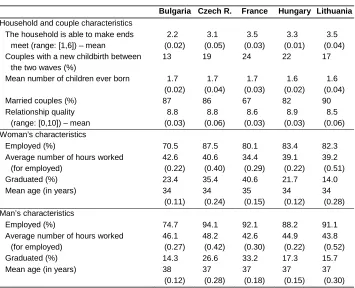
Looking at the descriptive statistics, the ability of the household to make ends meet seems more compelling in Bulgaria than in the other countries, especially compared to France and Lithuania. Marriage is far more widespread in Bulgaria and Lithuania, with the lowest rate of 67% for France, whereas the average number of children ever born in these country samples does not vary much. Interestingly, over the period covered by our panel, 24% of couples from the French sample reported new childbearing, against 22% in Hungary, 19% in the Czech Republic, 17% in Lithuania, and only 13% in Bulgaria.
Table 4: Descriptive statistics. Mean or frequency of model covariates by country
Bulgaria Czech R. France Hungary Lithuania
Household and couple characteristics The household is able to make ends
meet (range: [1,6]) – mean
2.2 (0.02) 3.1 (0.05) 3.5 (0.03) 3.3 (0.01) 3.5 (0.04) Couples with a new childbirth between
the two waves (%)
13 19 24 22 17
Mean number of children ever born 1.7 (0.02) 1.7 (0.04) 1.7 (0.03) 1.6 (0.02) 1.6 (0.04) Married couples (%) 87 86 67 82 90 Relationship quality
(range: [0,10]) – mean
8.8 (0.03) 8.8 (0.06) 8.6 (0.03) 8.9 (0.03) 8.5 (0.06) Woman’s characteristics
Employed (%) 70.5 87.5 80.1 83.4 82.3 Average number of hours worked
(for employed) 42.6 (0.22) 40.6 (0.40) 34.4 (0.29) 39.1 (0.22) 39.2 (0.51) Graduated (%) 23.4 35.4 40.6 21.7 14.0 Mean age (in years) 34
(0.11) 34 (0.24) 35 (0.15) 34 (0.12) 34 (0.28) Man’s characteristics
Employed (%) 74.7 94.1 92.1 88.2 91.1 Average number of hours worked
(for employed) 46.1 (0.27) 48.2 (0.42) 42.6 (0.30) 44.9 (0.22) 43.8 (0.52) Graduated (%) 14.3 26.6 33.2 17.3 15.7 Mean age (in years) 38
(0.12) 37 (0.28) 37 (0.18) 37 (0.15) 37 (0.30)
Note: Standard errors in parentheses.
while the highest level of female employment is found for the Czech Republic, together with the highest level of male employment. The average number of hours worked by women does not follow exactly the employment patterns when compared to men. Employed women work for more hours in the Czech Republic and Bulgaria, suggesting that in France part-time work is more common than in the other countries, as already found in the literature (Aassve, Fuochi, and Mencarini 2014a). In the end, education levels are the lowest in Lithuania for women and in Bulgaria for men. The highest diffusion of high education levels are, as expected, in France for both sexes.
4.2 The effect of couple typology on childbearing
As can be seen from Table 5, we made estimations separately by parity and respondents' sex. Parity zero refers to the transition to having a first child, whereas parity one refers to the progression to a second child, and parity greater than 1 refers to any higher order birth. As for the four couple types, the reference category is that referring to egalitarian attitudes and gender-equal sharing (i.e., “Consistent equality” type). Thus, the three couple types reported in Table 5 represent deviations from that category. Robust standard errors are estimated, thereby adjusting for the country clustering.
Three major results are immediately evident from Table 5. First, we find that the coefficients of the couple types differ in significance and magnitude for men and women. Secondly, the typology matters, mainly and more significantly, for parity one, whereas it has no impact for the onset of childbearing (i.e., parity zero), while, when considering birth orders over the second parity, it has an impact only for men, and with a reversed sign. These results are consistent with the literature that identifies specifically the (reorganisation of the) gender division of labour after the first child as salient for subsequent fertility (e.g., Oláh 2003; Torr and Short 2004).
Compared to the reference couple type “Consistent equality” (i.e., egalitarian ideology and gender-equal housework-sharing), the three other couple types are all significant and show a negative impact on the likelihood of having another child between the waves, for female respondents and the progression to the second birth. This implies that women with gender-unequal attitudes, or with gender-unequal housework-sharing, or with both characteristics together, are less prone to have a second child than women with gender-equal attitudes and gender-equal housework.
Focusing on the female sample first, where the effect on having a second child is clearly negative, one would argue that women here strongly disagree with the male partner. Women might be experiencing a feeling of disappointment due to unfulfilled expectations since they have a gender-equal ideology, but at the same time in actuality have to cope with a traditional sharing of housework. This kind of mismatch is likely to decrease the likelihood of further childbearing.
The third category, the “Inconsistency 2” type (i.e., gender-unequal ideology and gender-equal household work) is less intuitive, in the sense that it is harder to understand why the partners would organise themselves in this way. Women in this category report traditional attitudes, but nevertheless live in couples where the partners share the household work. Further investigation (not displayed here) shows that, compared to the other typology categories, “Inconsistency 2” is characterised by a smaller proportion of employed men and thus by a smaller average number of hours spent by men in the labour market. On the other hand, women belonging to this couple type are more likely to be employed and work for longer hours than women in the categories “Consistent Inequality” and “Inconsistency 1”. Moreover, in the couple type “Inconsistency 2” there is a greater proportion of employed women (83%) than employed men (79%). These facts suggest that the housework-sharing of “Inconsistency 2” might be gender-equal mainly due to external constraints; for instance, labour market conditions of the couple or time availability. Perhaps, if these external conditions were different, the housework-sharing would have been more gender unequal, as gender-unequal attitudes would make us predict. These arguments suggest that “Inconsistency 2” for women is likely to be another case of “unfulfilled expectations”. Female partners would have preferred a more traditional household organisation, but they are somehow pushed to delegate household tasks as their male partners have a considerable amount of spare time. The underlying dynamics of this kind of couple cannot be determined with certainty and it might be that lower fertility derives from unobserved couple characteristics (such as economic difficulties, etc.); nevertheless, it has to be kept in mind that the frequency of this category is relatively small (and concentrated in Bulgaria and Hungary), and so does not constitute a large contribution to the overall progression to second childbearing.
gender equality. The result is important, not least because the “Consistent inequality” arrangement represents by far the largest group in all the countries but France (see Table 1), and includes 58% of the overall sample. The impact of “Consistent inequality” is consequently driven by the Eastern European countries, which make up 92% of this group. There are several possible explanations for the pattern of “Consistent inequality” observed for Bulgaria, the Czech Republic, Hungary, and Lithuania. The Eastern European countries have experienced a remarkable fertility decline since the collapse of the Communist regime. The fall of the Iron Curtain also brought about dramatic societal upheavals. Prior to the 1990s the State provided support to families in the form of maternity leave, child allowances, and childcare facilities, and so outsourcing of traditional family activities was already in place. Consequently, one would expect gender ideology to lean towards the more egalitarian and liberal end of the scale. However, these socialist policies have undergone drastic revision in the transition period since the 1990s, reverting in the direction of the male breadwinner model (Robila 2004; Szelewa and Polakowski 2008). Moreover, the structural changes following the collapse of the socialist regimes were not accompanied by a shift to less traditional values in these societies, and this contributed to their fertility decline (Spéder and Kapitány 2014).
Table 5: Logit regressions: The impact of couple type on a new birth
Parity 0 Parity 1 Parity>1
Respondent Men Women Men Women Men Women
(Ref: Consistent equality)
Consistent Inequality 0.28 (0.43) 0.37+ (0.20) -0.43* (0.21) -0.84*** (0.15) 1.05* (0.47) -0.33 (0.68) Inconsistency 1 (gender-unequal housework, equal
attitudes) -0.37 (0.45) -0.22 (0.34) -0.40 (0.29) -0.68*** (0.13) 0.51+ (0.28) -0.08 (0.42) Inconsistency 2 (gender-equal housework, unequal
attitudes) 0.26 (0.40) 0.13 (0.33) -0.64+ (0.36) -1.22*** (0.37) 1.09* (0.51) -0.59 (0.54) The household is completely able to make ends meet 0.17
(0.50) 0.19 (0.23) 0.16 (0.44) -0.44** (0.16) 0.69 (0.48) -0.17 (0.27)
The couple is married 0.99***
(0.16) 0.67*** (0.15) -0.39 (0.29) -0.01 (0.43) -0.17 (0.57) -0.52 (0.41)
Relationship quality 0.05
(0.05) 0.14+ (0.08) 0.06 (0.06) 0.05* (0.02) -0.01 (0.14) -0.02 (0.09)
Age of the woman -0.02
(0.03) -0.07 (0.05) -0.05 (0.03) -0.11** (0.04) -0.08 (0.05) -0.02 (0.03)
The woman is a graduate 0.12
(0.13) 0.16 (0.15) 0.16 (0.36) 0.03 (0.22) -0.03 (0.34) 0.07 (0.29) (Ref. The woman is not employed)
The woman is employed and works up to 39 hours per week 0.37 (0.32) 0.62+ (0.34) -0.28 (0.30) 0.15 (0.18) -0.31* (0.13) -0.09 (0.34) The woman is employed and works at least 40 hours
per week -0.07 (0.26) 0.13 (0.36) -0.12 (0.09) -0.14 (0.29) -0.57 (0.40) -0.47* (0.22)
Age of the man -0.04*
(0.02) -0.06+ (0.03) -0.07* (0.03) -0.02 (0.02) -0.00 (0.02) -0.04+ (0.02)
The man is a graduate 0.23
(0.28) 0.02 (0.10) 0.15 (0.31) 0.62*** (0.18) 0.42*** (0.08) -0.10 (0.31) (Ref. The man is not employed)
The man is employed and works up to 39 hours per week 0.65* (0.32) 0.16 (0.31) 0.75** (0.25) -0.17 (0.21) -0.83* (0.34) -0.45 (0.29) The man is employed and works at least 40 hours per
week -0.14 (0.34) 0.75*** (0.23) 0.20 (0.17) -0.03 (0.18) -0.97** (0.37) -0.16 (0.13) (Ref. Bulgaria)
Czech Republic -0.99***
(0.13) 0.11 (0.09) 0.64*** (0.08) 1.35*** (0.18) -0.75*** (0.05) 0.15*** (0.04)
France -0.88**
(0.27) -0.07 (0.24) 1.61*** (0.29) 1.28*** (0.16) 0.95*** (0.25) 0.41 (0.31)
Hungary -0.61***
(0.09) -0.16* (0.07) 0.74*** (0.09) 0.63*** (0.11) 0.27*** (0.05) 0.30*** (0.08)
Lithuania -0.94***
(0.18) -0.43** (0.16) 0.60*** (0.11) 0.30** (0.10) 0.54*** (0.13) 0.28** (0.11)
Constant 0.94+
(0.53) 1.13 (1.00) 2.27** (0.69) 3.07** (1.05) 0.12 (0.82) 0.97 (0.63)
N 493 559 812 1151 1799 2354
5. Conclusion
In this analysis we have constructed a four-category couple typology based on gender ideology and equality in household sharing using individual-level data from five European countries. As outlined in our theoretical section, the underlying hypothesis is that consistency between gender attitudes and equality in the sharing of partners’ household tasks has a positive effect on childbearing outcomes, whereas inconsistency should lower fertility. As we have shown, our results only give partial support to this hypothesis. Indeed, couples who are gender-equal in attitudes and also have a higher level of sharing household chores are more likely to have a second child. In line with our hypothesis, we have found that the two types of couple that represent inconsistencies between attitudes and actual division of household labour are associated with lower fertility. However, contrary to our hypothesis, we also find consistent inequality to be associated with the lower likelihood of having a second child. This means that male breadwinner couples also, at least for the countries considered in our study, have lower parity progression.
In general, and importantly, the couple typology becomes salient only when considering the birth of the second child, whereas the couple type has no effect on the onset of parenthood. Lower progressions to second birth are prompted by inconsistency between attitudes and sharing, as hypothesised. This is a relevant result in terms of fertility behaviour, since it is well-known that one of the fundamental drivers of low fertility is the lack of progression from the first to the second child, and therefore family policies addressing the issue of gender equality may have an effect on fertility if this parity (i.e., couples with one child) is targeted.
Family arrangements corresponding to “Consistent inequality” (i.e., fully traditional families) and “Inconsistency 2” (traditional attitudes and equal sharing of housework) have a positive impact on the likelihood of a new birth only among men, and for higher fertility parity. In the case of “Inconsistency 2” this could suggest that when the family consists of a large number of children, fathers necessarily take on more of the housework. As for “Consistent inequality”, the positive impact for male respondents might be driven by the fact that men will be more willing to have three or more children if the woman is doing most of the housework, and especially if they belong to a gender-traditional family.
equality have come rather far. The comparison between our results and those previous results raises an interesting idea: the effect of the gender ideology–gender equality mismatch may impact differently on fertility depending on the stage to which the society has evolved on the gender ideology and gender equality path.
Our analysis is based on five countries, with at least two different cultural patterns (i.e., France and the others). We build here a couple typology using a unique threshold, equal for all the countries, to distinguish between gender equality and gender inequality either in housework-sharing or in attitudes. It is probable that the salience of a couple typology depends on the distribution (and hence diffusion) of the groups contained within the typology. That said, it is important to bear in mind that, despite the heterogeneity across European countries, our analysis brings further support to the argument that fertility increases when gender ideology is not traditional and the woman does not bear a disproportionate amount of the household work. Since low fertility in Europe is driven by relatively high rates of childlessness and a low rate of parity progression from one to two children, these results would strongly indicate that improving equal gender opportunities should be considered very seriously, in line with those policies introduced over the last couple of decades in the Nordic countries, where fertility rates are above the European average level.
Whereas our overall results appear robust,9 it is important to point out a few caveats. The most relevant one is that, since we do not have information about the partner’s specific attitudes, our estimation might be biased by the fact that partners differ in their reporting of gender attitudes. Another important issue arises from the fact that the male response quality is often poor and it is well known that men tend to over-report their own contribution to household-sharing (Baxter 1997). One should also emphasise that a full empirical test of the theoretical argument made would require long comparative panel data. With the two waves currently available from the GGS we are not able to address the inherent dynamic temporal argument, and we are not able to compare a larger number of countries.
9 We tried several specifications of the covariates, and the significance of the four types of couple was quite
References
Aassve, A., Fuochi, G., and Mencarini, L. (2014a). Desperate Housework: Relative Resources, Time Availability, Economic Dependency, and Gender Ideology Across Europe. Journal of Family Issues 35(8): 1000–1022. doi:10.1177/019251 3X14522248.
Aassve, A., Mencarini, L., and Sironi, M. (2014b). Institutional change, happiness and fertility. Milano: Dondena Centre for Research on Social Dynamics (Dondena working paper No. 64) and Torino: Collegio Carlo Alberto (Carlo Alberto Notebooks No. 362).
Baxter, J. (1997). Gender Equality and Participation in Housework: A Cross-National Perspective. Journal of Comparative Family Studies 28(3): 220–245. doi:10.230 7/41603517.
Blair, S.L. and Johnson, M.P. (1992). Wives’ Perceptions of the Fairness of the Division of Household Labor: The Intersection of Housework and Ideology.
Journal of Marriage and Family 54: 570–581. doi:10.2307/353243.
Coltrane, S. (2000). Research on Household Labor: Modeling and Measuring the Social Embeddedness of Routine Family Work. Journal of Marriage and the Family
62: 1208–1233. doi:10.1111/j.1741-3737.2000.01208.x.
Cooke, L.P. (2008). Gender Equity and Fertility in Italy and Spain. Journal of Social Policy 38(1): 123–140. doi:10.1017/S0047279408002584.
Duvander, A.-Z. and Andersson, G. (2006). Gender Equality and Fertility in Sweden. A Study on the Impact of the Father’s Uptake of Parental Leave on Continued Childbearing. Marriage and Family Review 39(1–2): 121–142. doi:10.1300/J002 v39n01_07.
Esping-Andersen, G. (2009). The Incomplete Revolution: Adapting to Women’s New Roles. Cambridge: Polity Press.
Gershuny, J., Bittman, M., and Brice, J. (2005). Exit, Voice, and Suffering: Do Couples Adapt to Changing Employment Patterns? Journal of Marriage and Family 67: 656–665. doi:10.1111/j.1741-3737.2005.00160.x.
Goldscheider, F., Oláh, L.S., and Puur, A. (2010). Reconciling studies of men’s gender attitudes and fertility: Response to Westoff and Higgins. Demographic Research
22(8): 189–198. doi:10.4054/DemRes.2010.22.8.
Greenstein, T.N. (1996). Gender Ideology and Perceptions of the Fairness of the Division of Household Labor: Effects on Marital Quality. Social Forces 74: 1029–1042. doi:10.1093/sf/74.3.1029.
Hochschild, A. and Machung A. (1990). The Second Shift. New York: Avon Books. Kaufman, G. (2000). Do Gender Role Attitudes Matter? Family Formation and
Dissolution Among Traditional and Egalitarian Men and Women. Journal of Family Issues 21(1): 128–144. doi:10.1177/019251300021001006.
Kiger, G. and Riley, P.J. (1996). Gender Differences in Perceptions of Household Labor. The Journal of Psychology: Interdisciplinary and Applied 130(4): 357– 370. doi:10.1080/00223980.1996.9915024.
Kroska, A. (2007). Gender ideology and gender role ideology. In: Ritzer, G. (ed.).
Blackwell Encyclopedia of Sociology. Malden MA: Blackwell: 1867–1869.
doi:10.1111/b.9781405124331.2007.x.
McDonald, P. (2000). Gender equity, social institutions and the future of fertility.
Journal of Population Research 17: 1–16. doi:10.1007/BF03029445.
McDonald, P. (2006). Low Fertility and the State: The Efficacy of Policy. Population
and Development Review 32(3): 485–510. doi:10.1111/j.1728-4457.2006.001
34.x.
McDonald, P. (2013). Societal foundations for explaining fertility: Gender equity.
Demographic Research 28: 981–994. doi:10.4054/DemRes.2013.28.34.
Mencarini, L. (2014a). Gender Equity. In: Michalos, A.C. (ed.). Encyclopedia of
Quality of Life and Well-Being Research. Dordrecht: Springer: 2437–2438.
doi:10.1007/978-94-007-0753-5_1131.
Mencarini, L. (2014b). Gender Role Beliefs. In: Michalos, A.C. (ed.). Encyclopedia of
Quality of Life and Well-Being Research. Dordrecht: Springer: 2476–2477.
doi:10.1007/978-94-007-0753-5_1140.
Mencarini, L. and Sironi M. (2012). Happiness, Housework and Gender Inequality in Europe. European Sociological Review 28(2): 203–219. doi:10.1093/esr/jcq059. Mencarini, L. and Tanturri M.L. (2004). Time use, family role-set and childbearing
Miettinen, A. (2008). Kotityöt, sukupuoli ja tasa-arvo. Palkattoman työn jakamiseen liittyvät käytännöt ja asenteet Suomessa [Housework, gender and equality. Division of unpaid labour and attitudes in Finland]. Helsinki: Population Research Institute, Family Federation of Finland. (E/32).
Miettinen, A., Basten, S., and Rotkirch, A. (2011). Gender equality and fertility intentions revisited. Evidence from Finland. Demographic Research 24(20): 469–496. doi:10.4054/DemRes.2011.24.20.
Mills, M. (2010). Gender Roles, Gender (In)equality and Fertility: An Empirical Test of Five Gender Equity Indices. Canadian Studies in Population 37(3–4): 445–474. Mills, M., Begall, K., Mencarini, L., and Tanturri, M.L. (2008). Gender equity and
fertility intentions in Italy and the Netherlands. Demographic Research 18(1): 1–26. doi:10.4054/DemRes.2008.18.1.
Mills, M., Rindfuss, R.R., McDonald, P., and te Velde, E. (2011). Why do people postpone parenthood? Reasons and social policy incentives. Human Reproduction Update 17(6): 848–860. doi:10.4054/DemRes.2008.18.1.
Myrskylä, M., Kohler, H.-P., and Billari, F.C. (2011). High development and fertility: Fertility at older reproductive ages and gender equality explain the positive link. Rostock: Max Planck Institute for Demographic Research (MPIDR working paper WP-2011-017) and Milano: Dondena Centre for Research on Social Dynamics (Dondena working paper No. 49).
Neyer, G., Lappegård, T., and Vignoli, D. (2013). Gender equality and fertility: Which equality matters? European Journal of Population 29(3): 245–272. doi:10.1007/ s10680-013-9292-7.
Nilsson, K. (2010). Housework and family formation: Exploring the relationship between gender division of housework and having children. The Open Demography Journal 3: 1–10. doi:10.2174/1874918601003010001.
Oláh, L.S. (2003). Gendering fertility: Second births in Sweden and Hungary.
Population Research and Policy Review 22: 171–200. doi:10.1023/A:102508903 1871.
Press, J. and Townsley, E. (1998). Wives’ and Husbands’ Housework Reporting: Gender, Class, and Social Desirability. Gender and Society 12(2): 188–218.
Puur, A., Oláh, L.S., Tazi-Preve, M.I., and Dorbritz, J. (2008). Men’s childbearing desires and views of the male role in Europe at the dawn of the 21st century.
Demographic Research 19(56): 1883–1912. doi:10.4054/DemRes.2008.19.56. Robila, M. (2004). Families in Eastern Europe. New York: Elsevier.
Spéder, Z. and Kapitány, B. (2014). Failure to Realize Fertility Intentions: A Key Aspect of the Post-communist Fertility Transition. Population Research and Policy Review 33(3): 393–418. doi:10.1007/s11113-013-9313-6.
Sullivan, O., Billari, F.C., and Altintas, E. (2014). Father’s changing contributions to child care and domestic work in very low fertility countries: The effect of education. Journal of Family Issues 35(8): 1048–1065. doi:10.1177/0192513X1 4522241.
Szelewa, D. and Polakowski, M.P. (2008). Who cares? Changing patterns of childcare in Central and Eastern Europe. Journal of European Social Policy 18(2): 115– 131. doi:10.1177/0958928707087589.
Tanturri, M.L. and Mencarini, L. (2009). Fathers’ involvement in daily childcare activities in Italy: does a work-family reconciliation issue exist? Torino: University of Torino (CHILD working paper n. 22/2009).
Tazi-Preve, I.M., Bichlbauer, D., and Goujon, A. (2004). Gender Trouble and Its Impact on Fertility Intentions. Yearbook of Population Research in Finland 40: 5–24.
Torr, B.M. and Short, S. (2004). Second births and the second shift: A research note on gender equity and fertility. Population and Development Review 30(1): 109–130.
doi:10.1111/j.1728-4457.2004.00005.x.
UNESCO (2000). Gender Equality and Equity. Paris: UNESCO.
Westoff, C.F. and Higgins, J. (2009). Relationships between men’s gender attitudes and fertility: Response to Puur et al.’s “Men’s childbearing desires and views of the male role in Europe at the dawn of the 21st century”. Demographic Research